
Skeletal Muscle Fibers Figure 9 6 a b

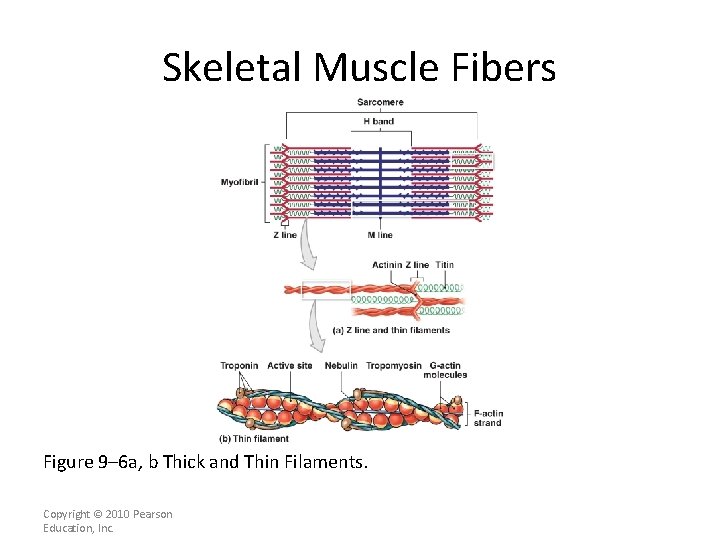
Skeletal Muscle Fibers Figure 9– 6 a, b Thick and Thin Filaments. Copyright © 2010 Pearson Education, Inc.
Skeletal Muscle Fibers • Initiating Contraction – Ca 2+ binds to receptor on troponin molecule – Troponin–tropomyosin complex changes – Exposes active site of F-actin Copyright © 2010 Pearson Education, Inc.
Skeletal Muscle Fibers • Thick Filaments – Contain twisted myosin subunits – Contain titin strands that recoil after stretching – The mysosin molecule • Tail: – binds to other myosin molecules • Head: – made of two globular protein subunits – reaches the nearest thin filament Copyright © 2010 Pearson Education, Inc.
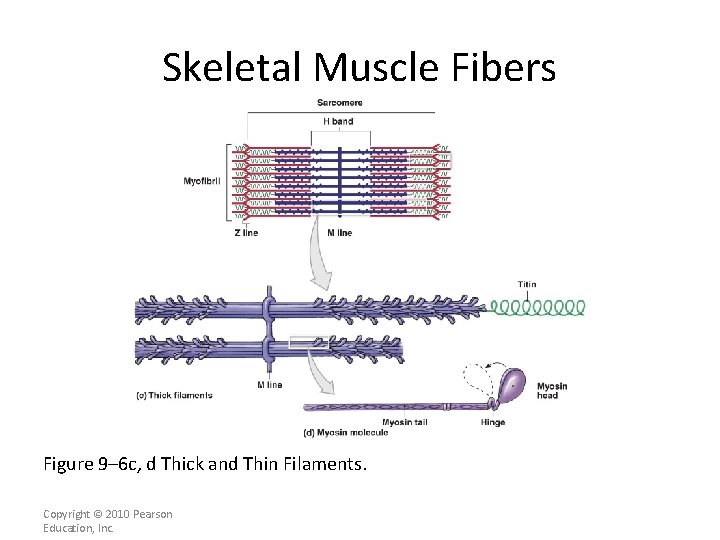
Skeletal Muscle Fibers Figure 9– 6 c, d Thick and Thin Filaments. Copyright © 2010 Pearson Education, Inc.

Skeletal Muscle Fibers • Myosin Action – During contraction, myosin heads • Interact with actin filaments, forming cross-bridges • Pivot, producing motion Copyright © 2010 Pearson Education, Inc.
Skeletal Muscle Fibers • Skeletal Muscle Contraction – Sliding filament theory • Thin filaments of sarcomere slide toward M line, alongside thick filaments • The width of A zone stays the same • Z lines move closer together Copyright © 2010 Pearson Education, Inc.
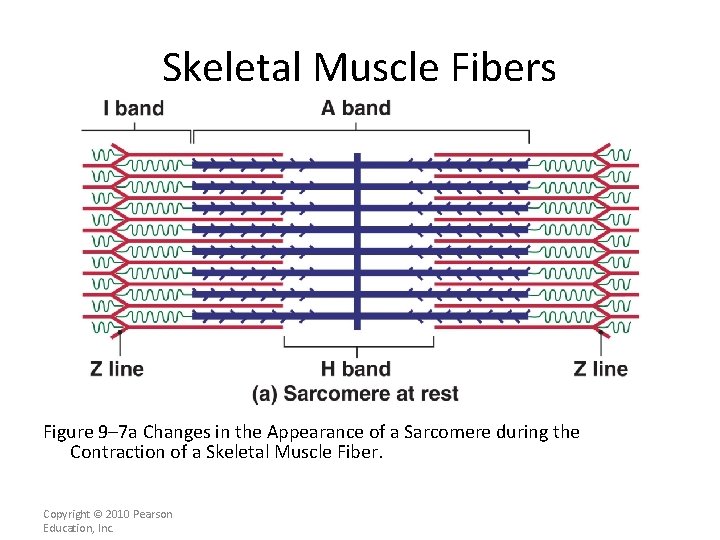
Skeletal Muscle Fibers Figure 9– 7 a Changes in the Appearance of a Sarcomere during the Contraction of a Skeletal Muscle Fiber. Copyright © 2010 Pearson Education, Inc.
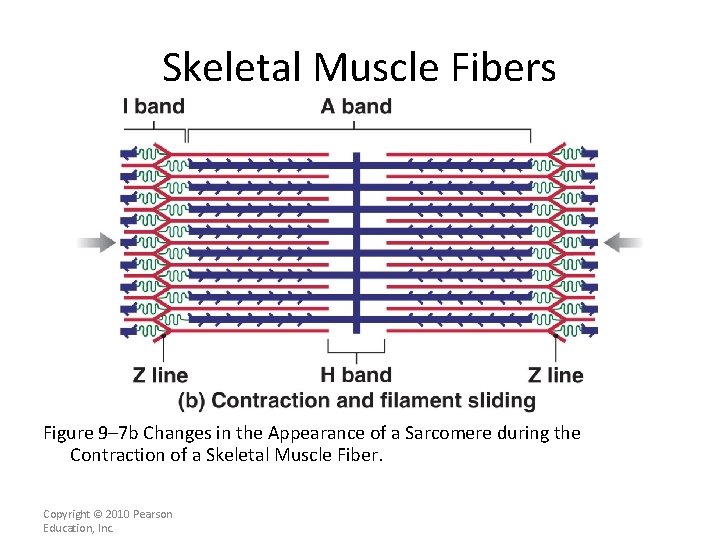
Skeletal Muscle Fibers Figure 9– 7 b Changes in the Appearance of a Sarcomere during the Contraction of a Skeletal Muscle Fiber. Copyright © 2010 Pearson Education, Inc.
Skeletal Muscle Fibers • Skeletal Muscle Contraction – The process of contraction • Neural stimulation of sarcolemma: – causes excitation–contraction coupling • Cisternae of SR release Ca 2+: – which triggers interaction of thick and thin filaments – consuming ATP and producing tension Copyright © 2010 Pearson Education, Inc.
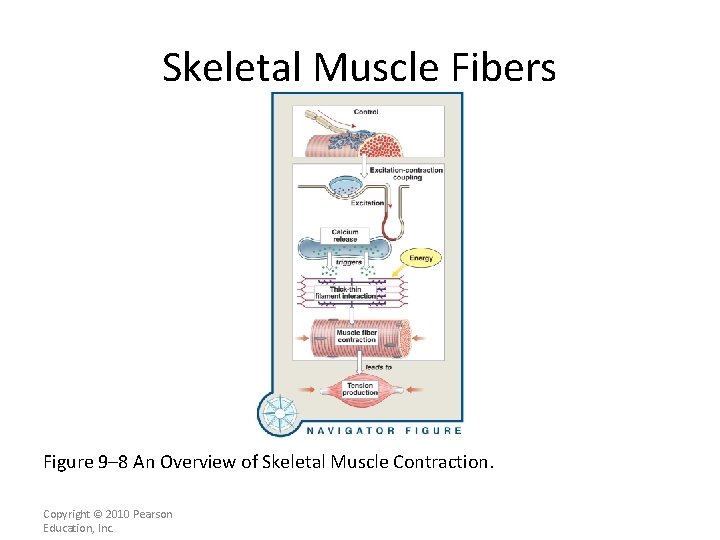
Skeletal Muscle Fibers Figure 9– 8 An Overview of Skeletal Muscle Contraction. Copyright © 2010 Pearson Education, Inc.
The Neuromuscular Junction • Is the location of neural stimulation • Action potential (electrical signal) – Travels along nerve axon – Ends at synaptic terminal • Synaptic terminal: – releases neurotransmitter (acetylcholine or ACh) – into the synaptic cleft (gap between synaptic terminal and motor end plate) Copyright © 2010 Pearson Education, Inc.

The Neuromuscular Junction Figure 9– 9 a, b Skeletal Muscle Innervation. Copyright © 2010 Pearson Education, Inc.
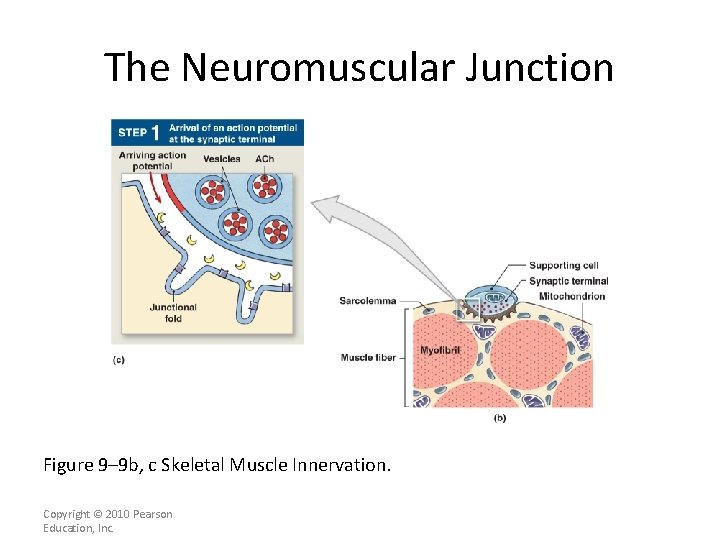
The Neuromuscular Junction Figure 9– 9 b, c Skeletal Muscle Innervation. Copyright © 2010 Pearson Education, Inc.

The Neuromuscular Junction Figure 9– 9 c Skeletal Muscle Innervation. Copyright © 2010 Pearson Education, Inc.
The Neuromuscular Junction • The Neurotransmitter – Acetylcholine or ACh • Travels across the synaptic cleft • Binds to membrane receptors on sarcolemma (motor end plate) • Causes sodium–ion rush into sarcoplasm • Is quickly broken down by enzyme (acetylcholinesterase or ACh. E) Copyright © 2010 Pearson Education, Inc.
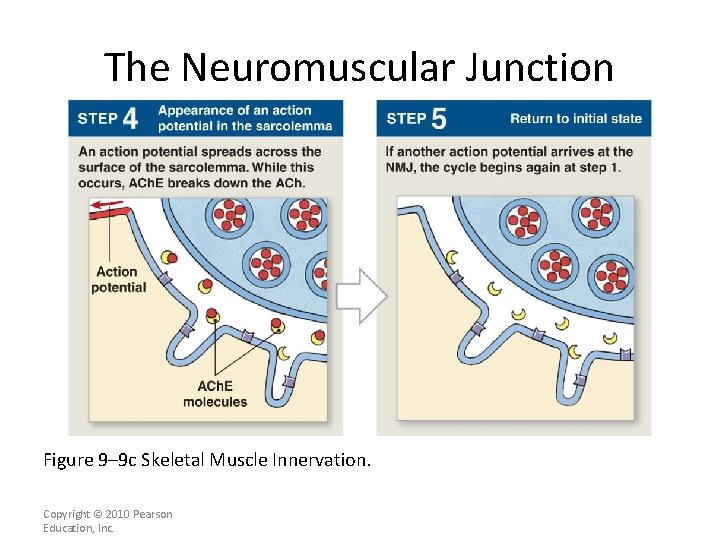
The Neuromuscular Junction Figure 9– 9 c Skeletal Muscle Innervation. Copyright © 2010 Pearson Education, Inc.
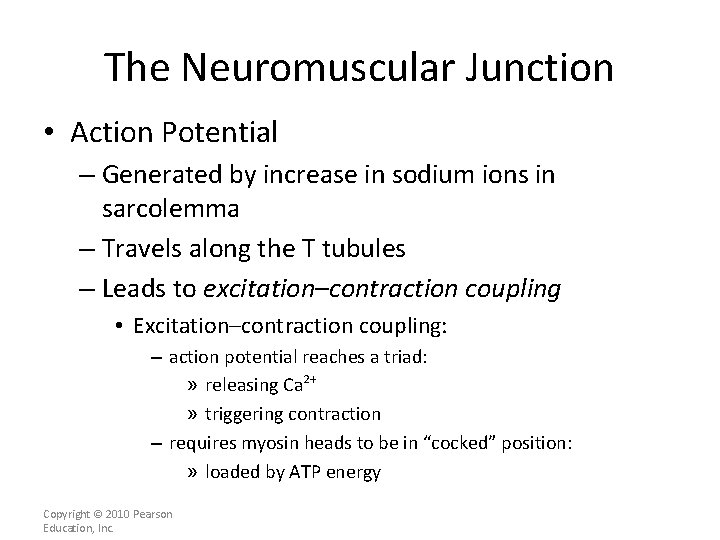
The Neuromuscular Junction • Action Potential – Generated by increase in sodium ions in sarcolemma – Travels along the T tubules – Leads to excitation–contraction coupling • Excitation–contraction coupling: – action potential reaches a triad: » releasing Ca 2+ » triggering contraction – requires myosin heads to be in “cocked” position: » loaded by ATP energy Copyright © 2010 Pearson Education, Inc.
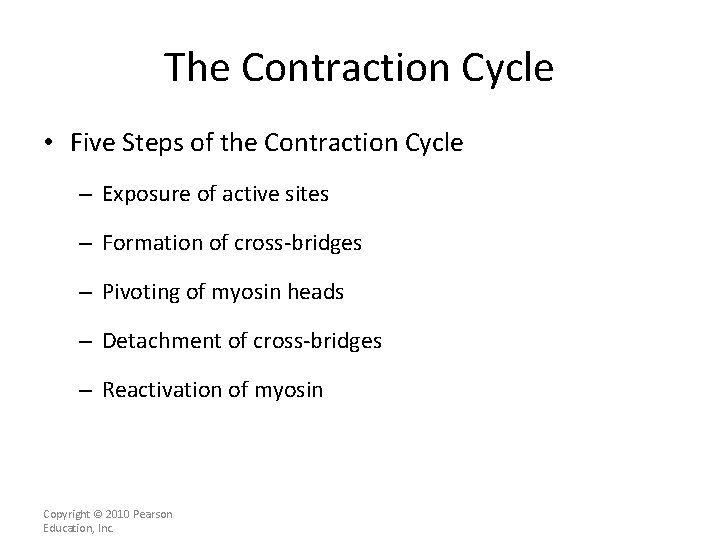
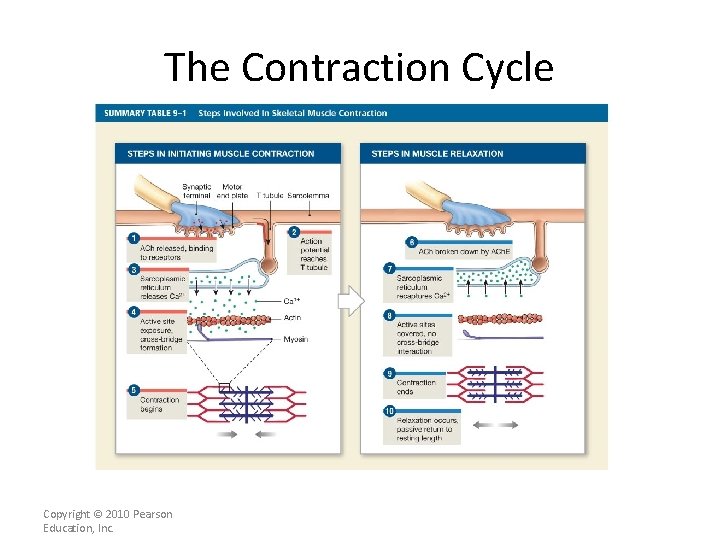
The Contraction Cycle • Five Steps of the Contraction Cycle – Exposure of active sites – Formation of cross-bridges – Pivoting of myosin heads – Detachment of cross-bridges – Reactivation of myosin Copyright © 2010 Pearson Education, Inc.
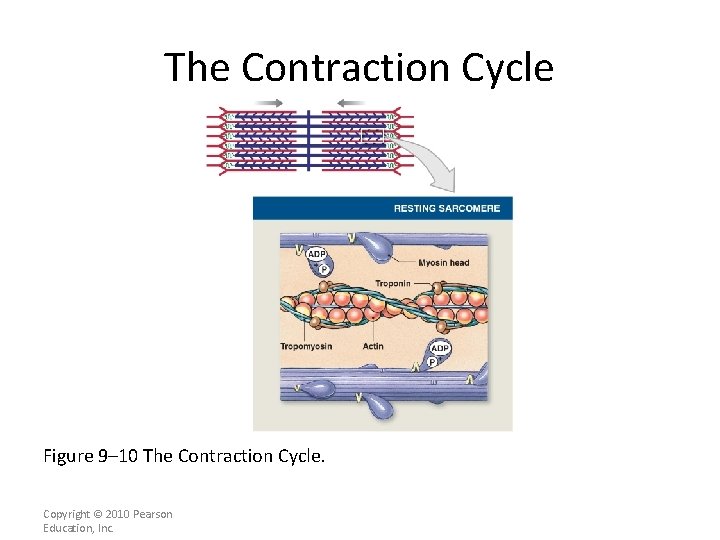
The Contraction Cycle Figure 9– 10 The Contraction Cycle. Copyright © 2010 Pearson Education, Inc.
![The Contraction Cycle [INSERT FIG. 10. 12, step 1] Figure 9– 10 The Contraction](http://slidetodoc.com/presentation_image_h2/bd3998012b407318a25ee08a602600a2/image-21.jpg "The Contraction Cycle [INSERT FIG. 10. 12, step 1] Figure 9– 10 The Contraction")
The Contraction Cycle [INSERT FIG. 10. 12, step 1] Figure 9– 10 The Contraction Cycle. Copyright © 2010 Pearson Education, Inc.
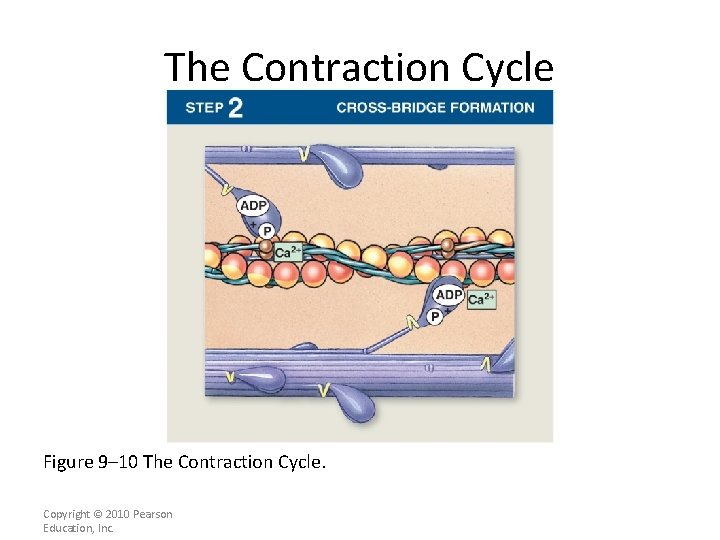
The Contraction Cycle Figure 9– 10 The Contraction Cycle. Copyright © 2010 Pearson Education, Inc.
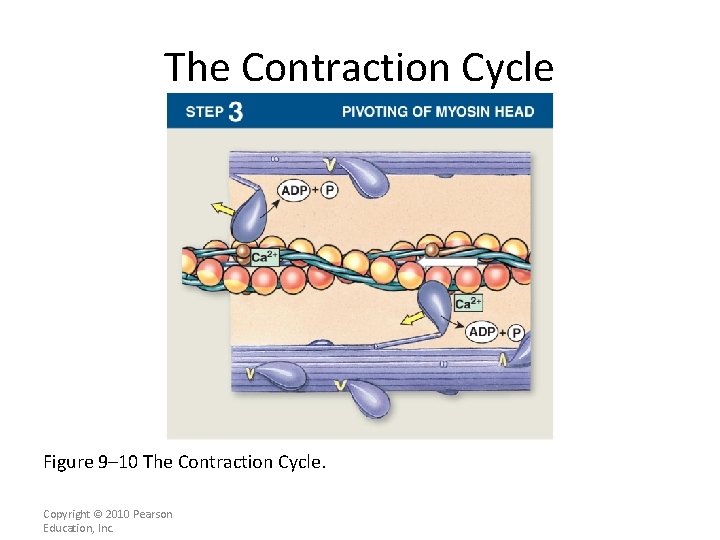
The Contraction Cycle Figure 9– 10 The Contraction Cycle. Copyright © 2010 Pearson Education, Inc.
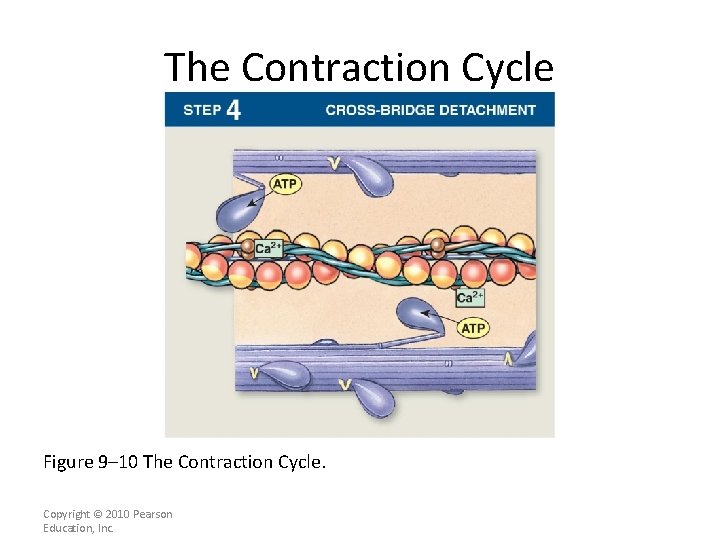
The Contraction Cycle Figure 9– 10 The Contraction Cycle. Copyright © 2010 Pearson Education, Inc.
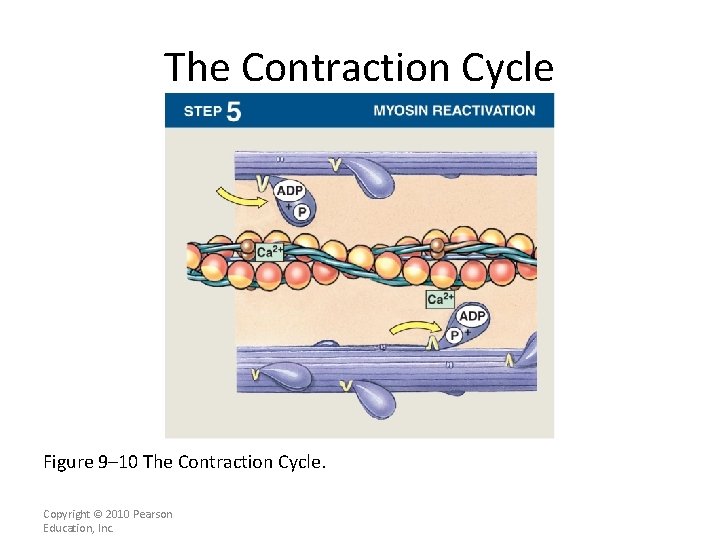
The Contraction Cycle Figure 9– 10 The Contraction Cycle. Copyright © 2010 Pearson Education, Inc.
The Contraction Cycle • Fiber Shortening – As sarcomeres shorten, muscle pulls together, producing tension • Contraction Duration – Depends on • Duration of neural stimulus • Number of free calcium ions in sarcoplasm • Availability of ATP Copyright © 2010 Pearson Education, Inc.
The Contraction Cycle • Relaxation – Ca 2+ concentrations fall – Ca 2+ detaches from troponin – Active sites are re-covered by tropomyosin – Sarcomeres remain contracted • Rigor Mortis – A fixed muscular contraction after death – Caused when • Ion pumps cease to function; ran out of ATP • Calcium builds up in the sarcoplasm Copyright © 2010 Pearson Education, Inc.
The Contraction Cycle • Skeletal muscle fibers shorten as thin filaments slide between thick filaments • Free Ca 2+ in the sarcoplasm triggers contraction • SR releases Ca 2+ when a motor neuron stimulates the muscle fiber • Contraction is an active process • Relaxation and return to resting length are passive Copyright © 2010 Pearson Education, Inc.
The Contraction Cycle Copyright © 2010 Pearson Education, Inc.
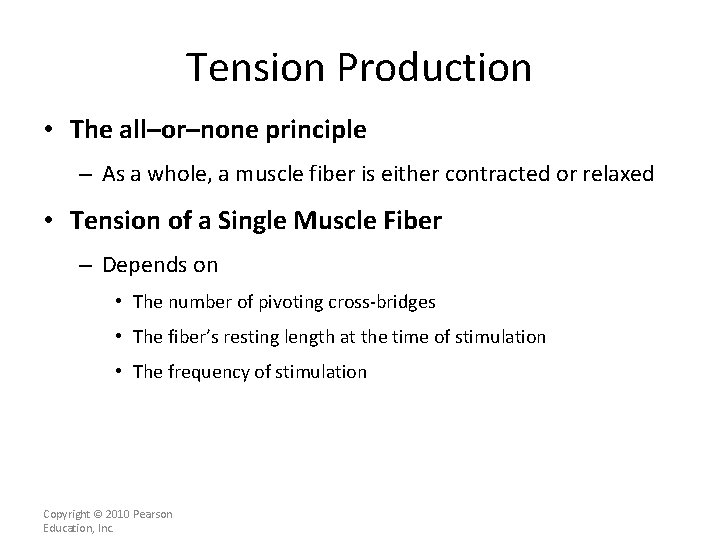
Tension Production • The all–or–none principle – As a whole, a muscle fiber is either contracted or relaxed • Tension of a Single Muscle Fiber – Depends on • The number of pivoting cross-bridges • The fiber’s resting length at the time of stimulation • The frequency of stimulation Copyright © 2010 Pearson Education, Inc.
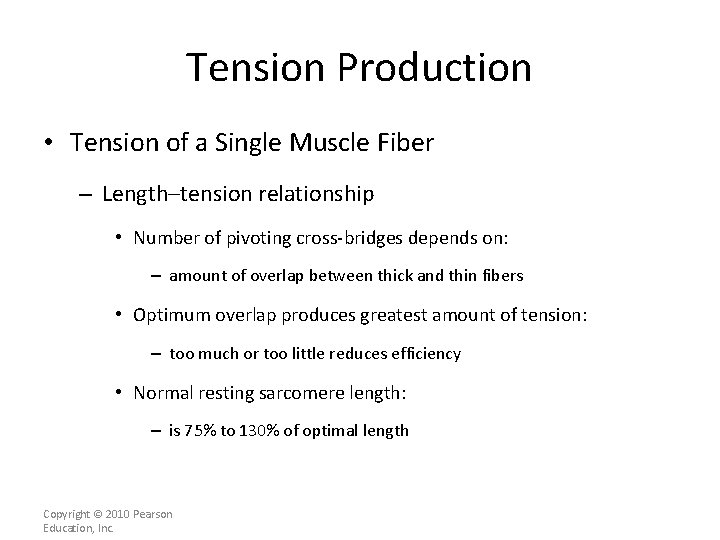
Tension Production • Tension of a Single Muscle Fiber – Length–tension relationship • Number of pivoting cross-bridges depends on: – amount of overlap between thick and thin fibers • Optimum overlap produces greatest amount of tension: – too much or too little reduces efficiency • Normal resting sarcomere length: – is 75% to 130% of optimal length Copyright © 2010 Pearson Education, Inc.
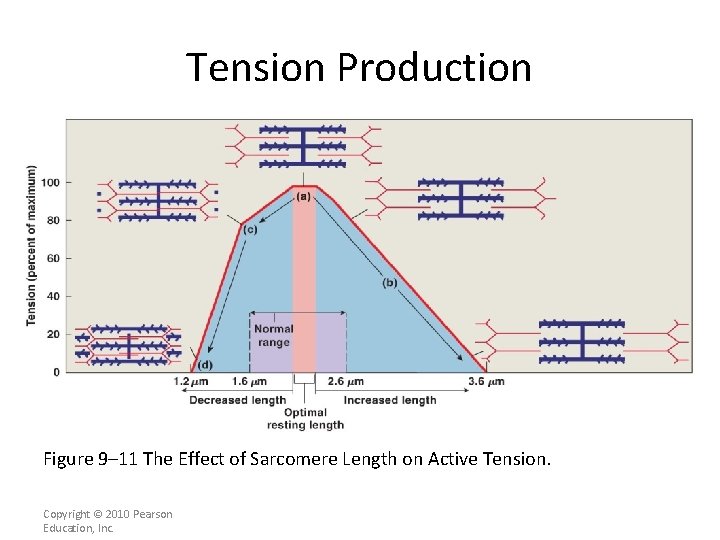
Tension Production Figure 9– 11 The Effect of Sarcomere Length on Active Tension. Copyright © 2010 Pearson Education, Inc.
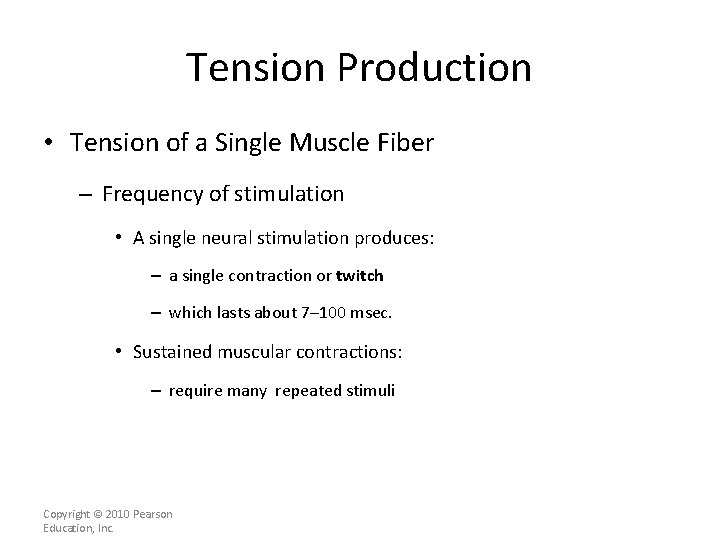
Tension Production • Tension of a Single Muscle Fiber – Frequency of stimulation • A single neural stimulation produces: – a single contraction or twitch – which lasts about 7– 100 msec. • Sustained muscular contractions: – require many repeated stimuli Copyright © 2010 Pearson Education, Inc.
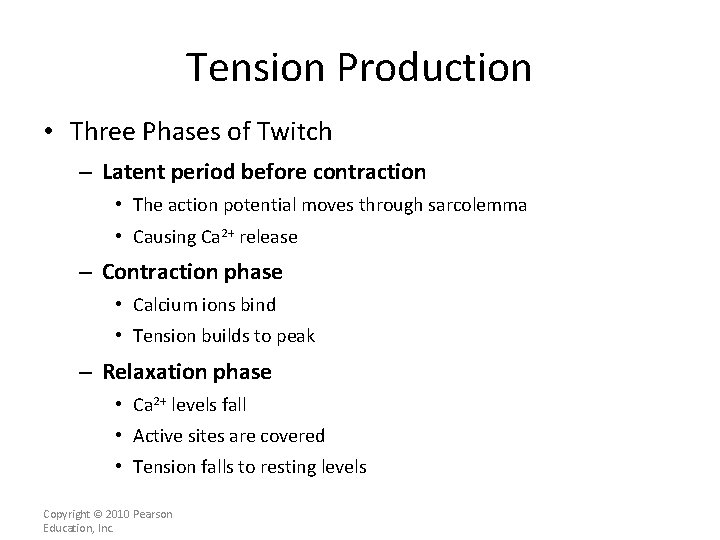
Tension Production • Three Phases of Twitch – Latent period before contraction • The action potential moves through sarcolemma • Causing Ca 2+ release – Contraction phase • Calcium ions bind • Tension builds to peak – Relaxation phase • Ca 2+ levels fall • Active sites are covered • Tension falls to resting levels Copyright © 2010 Pearson Education, Inc.
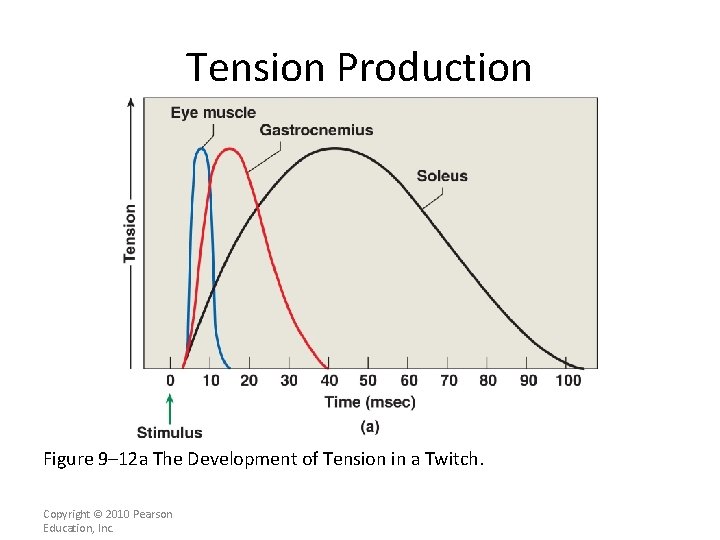
Tension Production Figure 9– 12 a The Development of Tension in a Twitch. Copyright © 2010 Pearson Education, Inc.
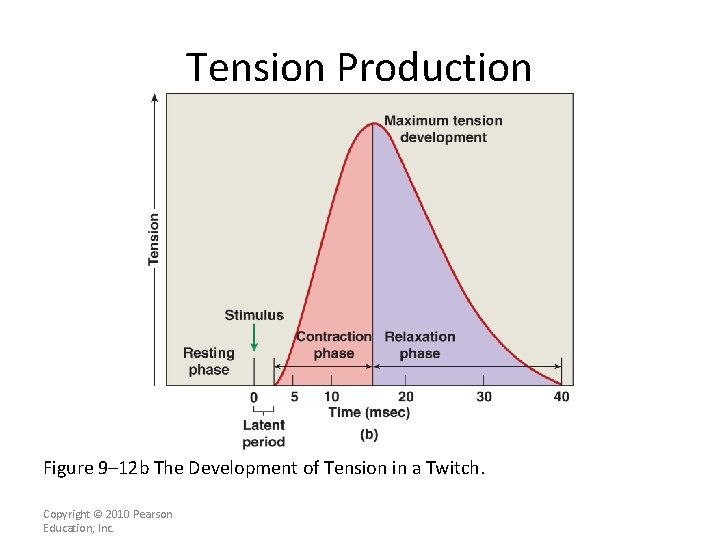
Tension Production Figure 9– 12 b The Development of Tension in a Twitch. Copyright © 2010 Pearson Education, Inc.
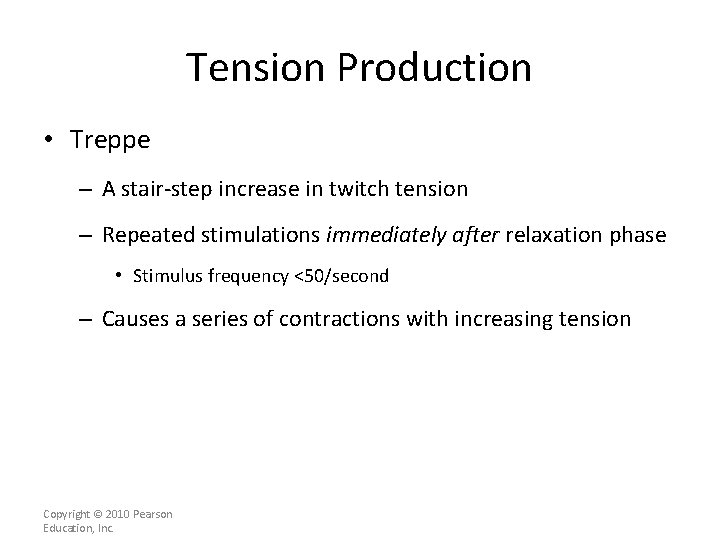
Tension Production • Treppe – A stair-step increase in twitch tension – Repeated stimulations immediately after relaxation phase • Stimulus frequency <50/second – Causes a series of contractions with increasing tension Copyright © 2010 Pearson Education, Inc.
Tension Production • Tension of a Single Muscle Fiber – Wave summation • Increasing tension or summation of twitches • Repeated stimulations before the end of relaxation phase: – stimulus frequency >50/second • Causes increasing tension or summation of twitches Copyright © 2010 Pearson Education, Inc.
Tension Production • Tension of a Single Muscle Fiber – Incomplete tetanus • Twitches reach maximum tension • If rapid stimulation continues and muscle is not allowed to relax, twitches reach maximum level of tension – Complete Tetanus • If stimulation frequency is high enough, muscle never begins to relax, and is in continuous contraction Copyright © 2010 Pearson Education, Inc.
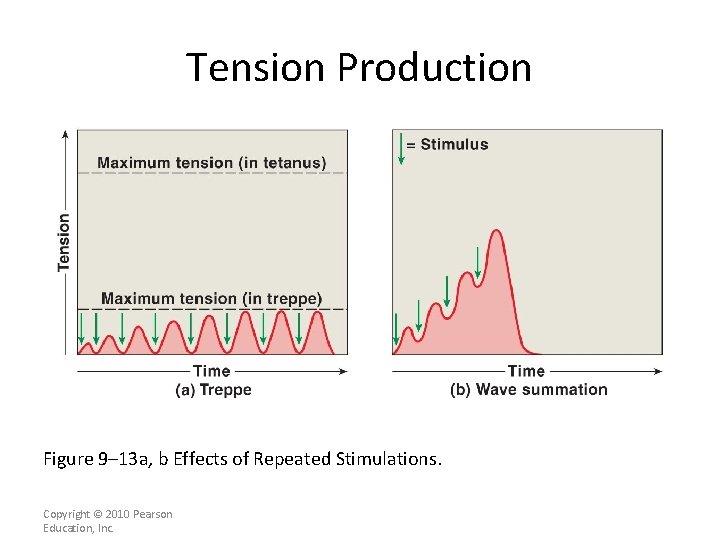
Tension Production Figure 9– 13 a, b Effects of Repeated Stimulations. Copyright © 2010 Pearson Education, Inc.
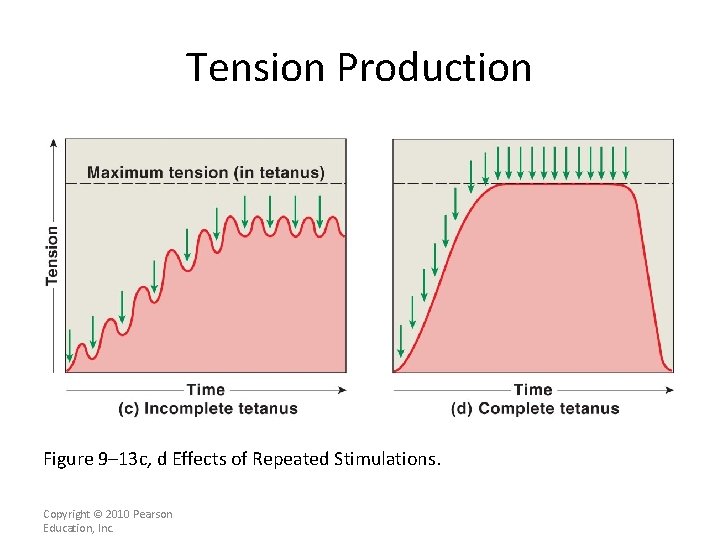
Tension Production Figure 9– 13 c, d Effects of Repeated Stimulations. Copyright © 2010 Pearson Education, Inc.
Tension Production • Tension Produced by Whole Skeletal Muscles – Depends on • Internal tension produced by muscle fibers • External tension exerted by muscle fibers on elastic extracellular fibers • Total number of muscle fibers stimulated Copyright © 2010 Pearson Education, Inc.
Tension Production • Tension Produced by Whole Skeletal Muscles – Motor units in a skeletal muscle • Contain hundreds of muscle fibers • That contract at the same time • Controlled by a single motor neuron Copyright © 2010 Pearson Education, Inc.
Tension Production • Tension Produced by Whole Skeletal Muscles – Recruitment (multiple motor unit summation) • In a whole muscle or group of muscles, smooth motion and increasing tension are produced by slowly increasing the size or number of motor units stimulated – Maximum tension • Achieved when all motor units reach tetanus • Can be sustained only a very short time Copyright © 2010 Pearson Education, Inc.
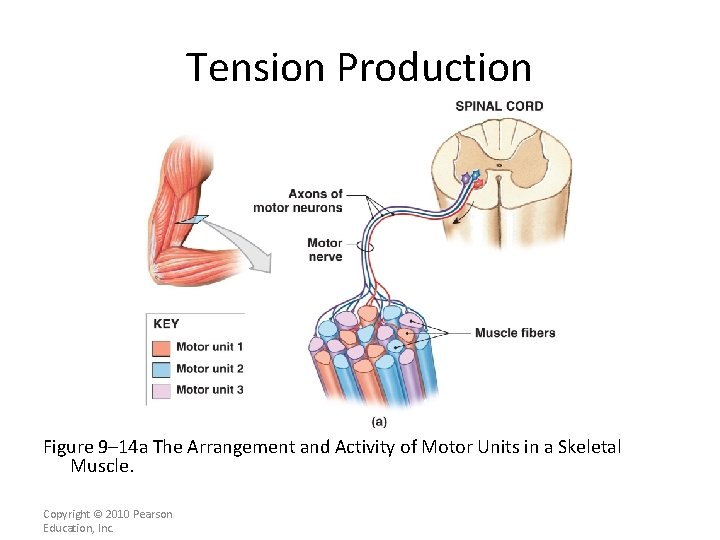
Tension Production Figure 9– 14 a The Arrangement and Activity of Motor Units in a Skeletal Muscle. Copyright © 2010 Pearson Education, Inc.
- Slides: 45