
Skeletal Injuries of the Elbow Forearm and Wrist
Skeletal Injuries of the Elbow, Forearm and Wrist Matthew Deibel October 30, 2008 Synergy EM
Objectives ØKnow the common injuries associated with the elbow, forearm and wrist ØBe able to determine adequacy of above films and identify abnormalities ØKnow how to read corresponding pediatric films ØAvoid common pitfalls with film interpretation
Lufkin 1998 • • Prospective, descriptive study of treating emergency physicians at a highvolume, urban teaching hospital and a moderate-volume nonteaching hospital Indicated their confidence on plain-film radiographic study interpretations All radiographs were then reviewed by radiologists 16, 410 emergency department radiographic studies were included – ED physicians were confident in 9, 599 sets of radiographs out of a total of 16, 410 (58%). – Discordant interpretation rates for the “confident” and “not confident” groups were 1. 2% and 3. 1%, respectively – Review of the 118 discordant interpretations in the confident group demonstrated that 11 were significant (0. 1%). – Total radiology review charges for the confident group were $215, 338
Elbow Mechanism -Fall on outstretched hand -Direct trauma to elbow Standard exam -Inability to extend elbow 91% sens and 69% spec for bony injury (Hanksworth 1991) -Vascular and neuro exam X-rays • Stardard – AP, Lat • Supplementary – Lat oblique, med oblique, capitellum, olecranon
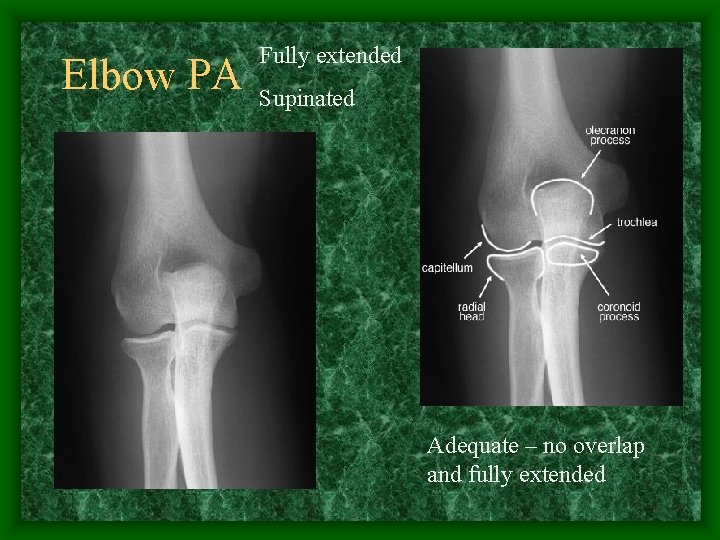
Elbow PA Fully extended Supinated Adequate – no overlap and fully extended

Radiocapitellar line, bone lines
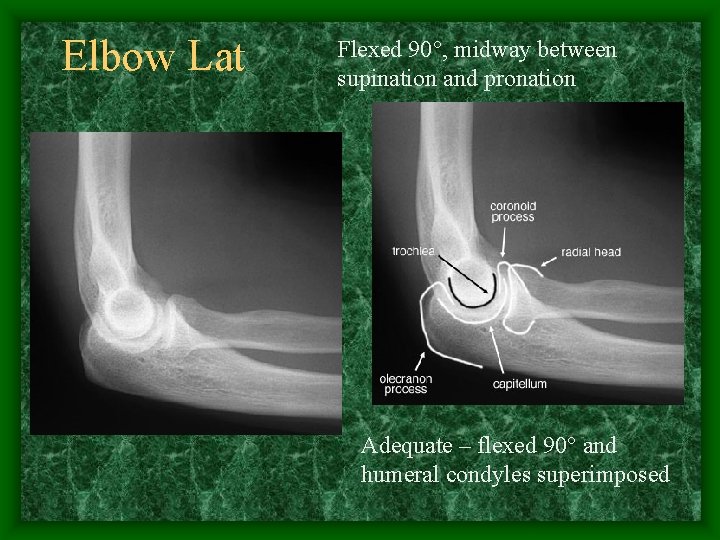
Elbow Lat Flexed 90°, midway between supination and pronation Adequate – flexed 90° and humeral condyles superimposed
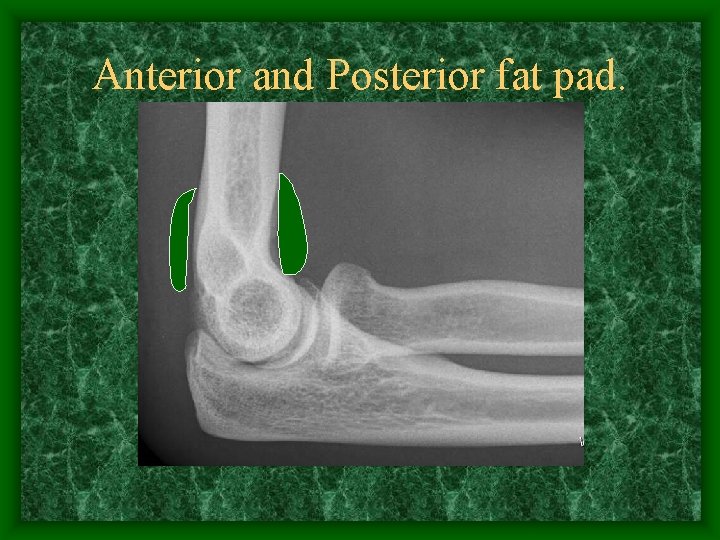
Anterior and Posterior fat pad.

Radiocapitellar line
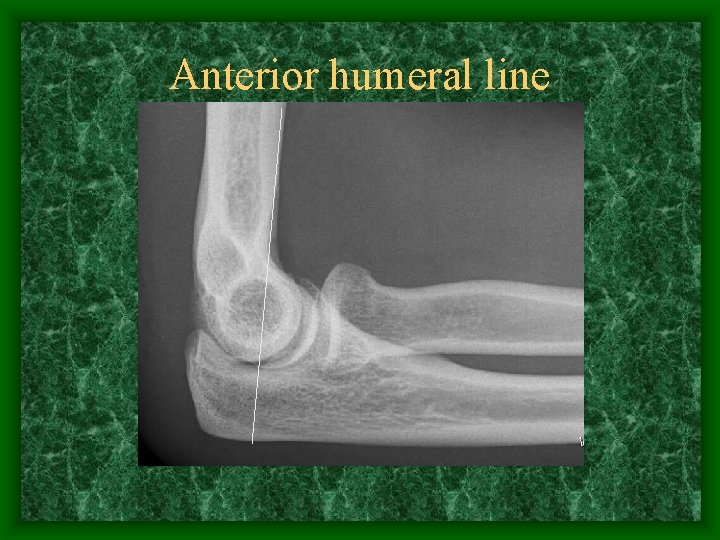
Anterior humeral line
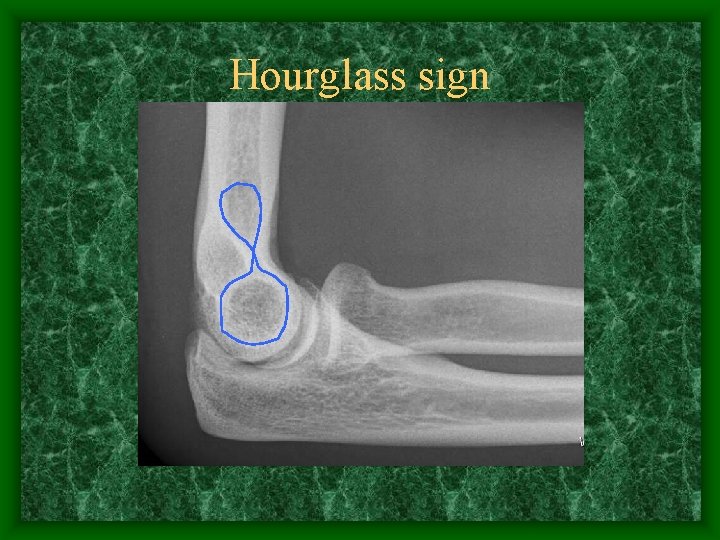
Hourglass sign
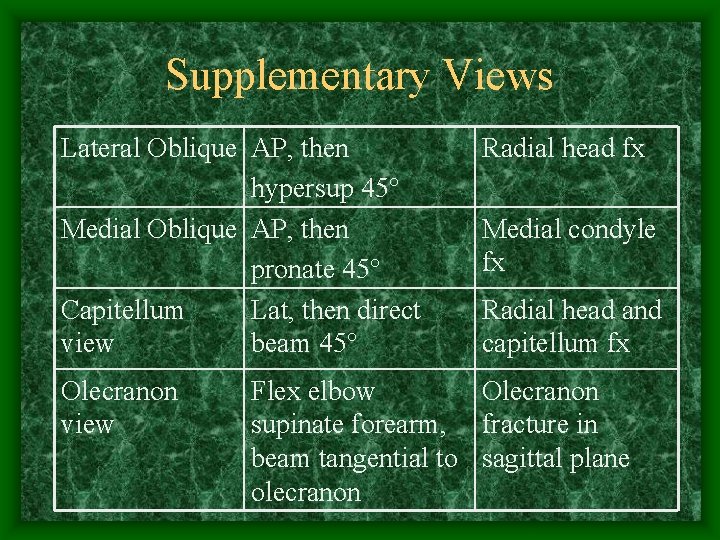
Supplementary Views Lateral Oblique AP, then hypersup 45° Medial Oblique AP, then pronate 45° Capitellum Lat, then direct view beam 45° Olecranon view Radial head fx Medial condyle fx Radial head and capitellum fx Flex elbow Olecranon supinate forearm, fracture in beam tangential to sagittal plane olecranon
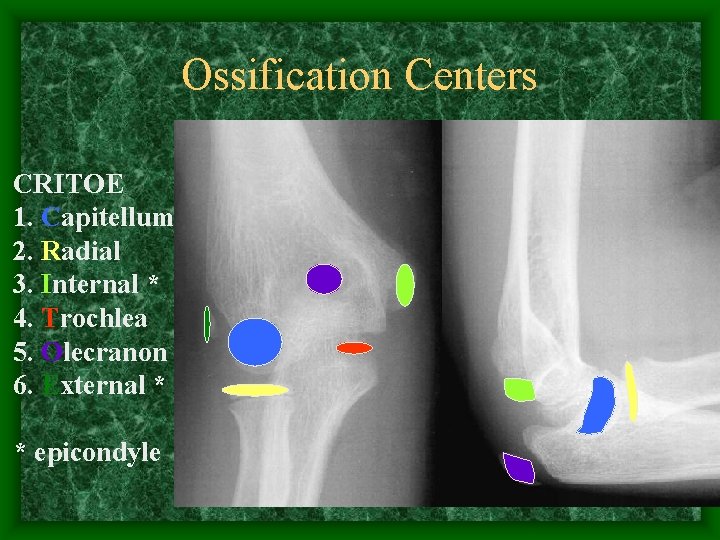
Ossification Centers CRITOE 1. Capitellum 2. Radial 3. Internal * 4. Trochlea 5. Olecranon 6. External * * epicondyle
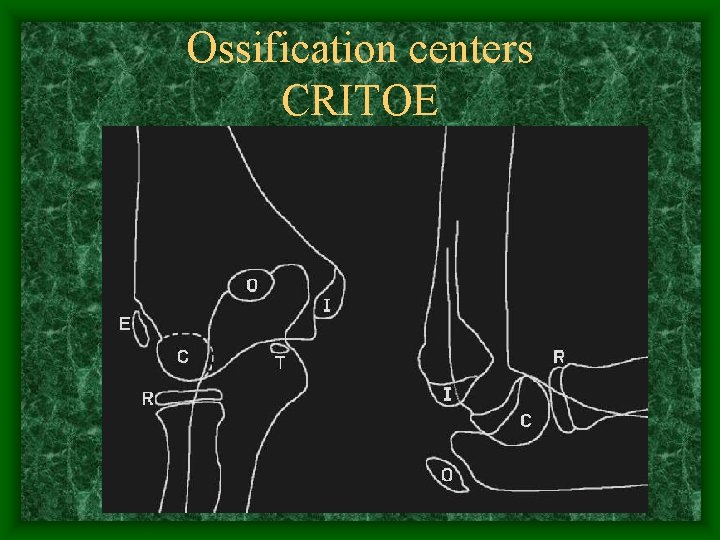
Ossification centers CRITOE
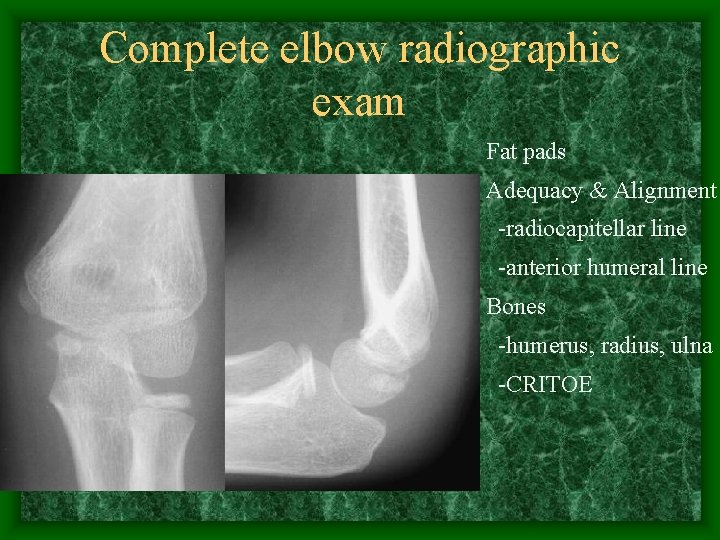
Complete elbow radiographic exam Fat pads Adequacy & Alignment -radiocapitellar line -anterior humeral line Bones -humerus, radius, ulna -CRITOE
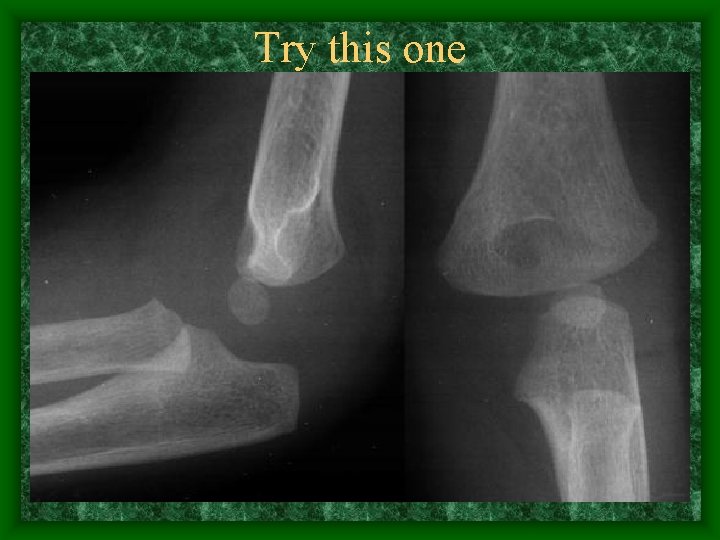
Try this one
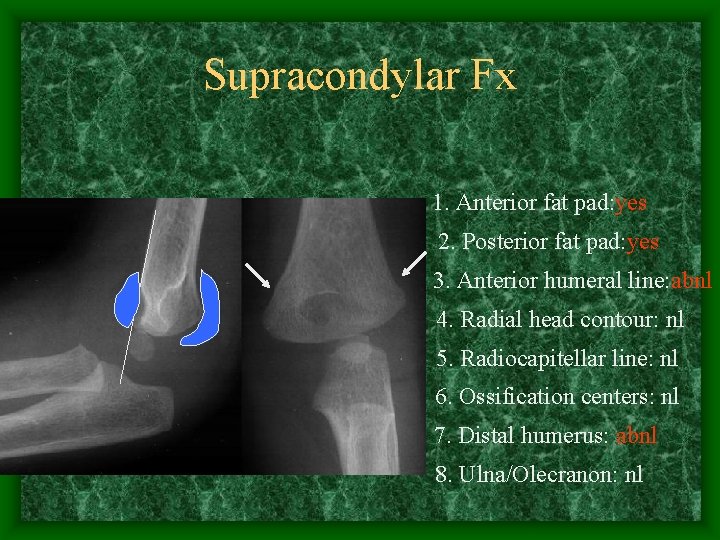
Supracondylar Fx 1. Anterior fat pad: yes 2. Posterior fat pad: yes 3. Anterior humeral line: abnl 4. Radial head contour: nl 5. Radiocapitellar line: nl 6. Ossification centers: nl 7. Distal humerus: abnl 8. Ulna/Olecranon: nl
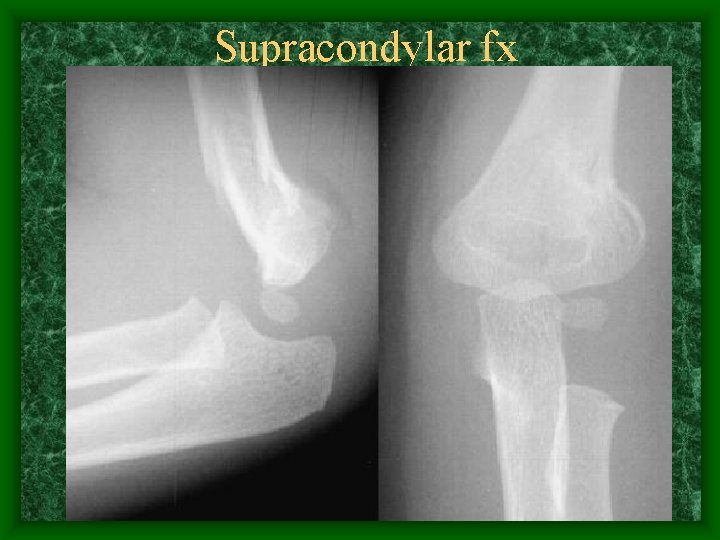
Supracondylar fx
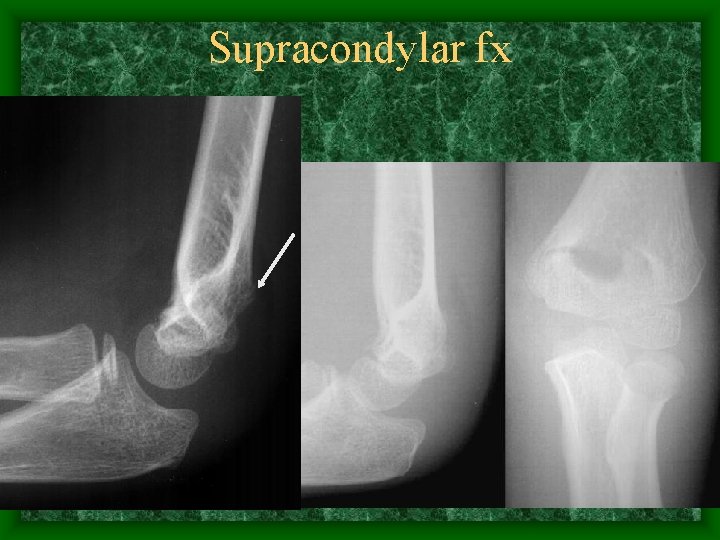
Supracondylar fx
Supracondylar Fx • 60% of all pediatric elbow fractures • Is intraarticular (transcondylar) runs across • • • condyles and coronoid and olecranon fossa Complete and incomplete, 99% are post Loss of normal valgus carrying angle Can injure brachial artery and median nerve Volkmann’s ischemic contractures possible if displaced fx not properly treated Posterior long arm splint
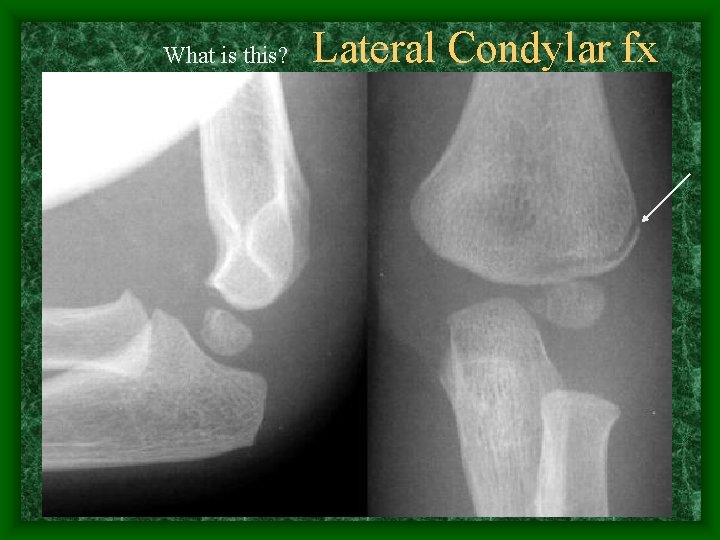
What is this? Lateral Condylar fx
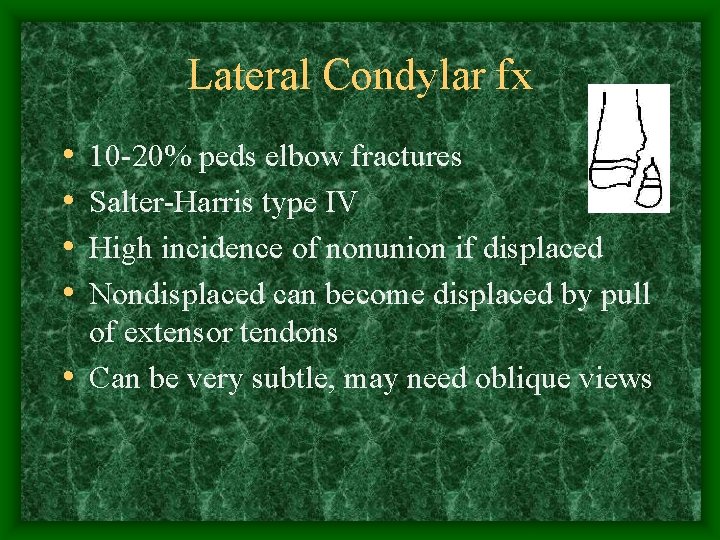
Lateral Condylar fx • • 10 -20% peds elbow fractures Salter-Harris type IV High incidence of nonunion if displaced Nondisplaced can become displaced by pull of extensor tendons • Can be very subtle, may need oblique views
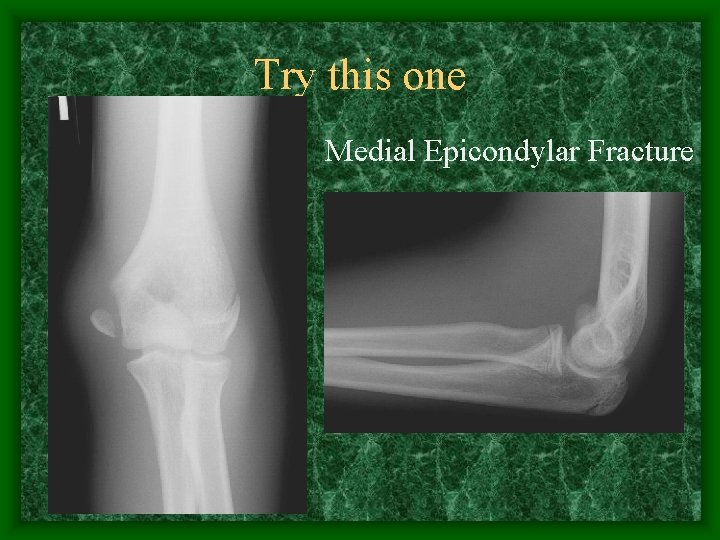
Try this one Medial Epicondylar Fracture
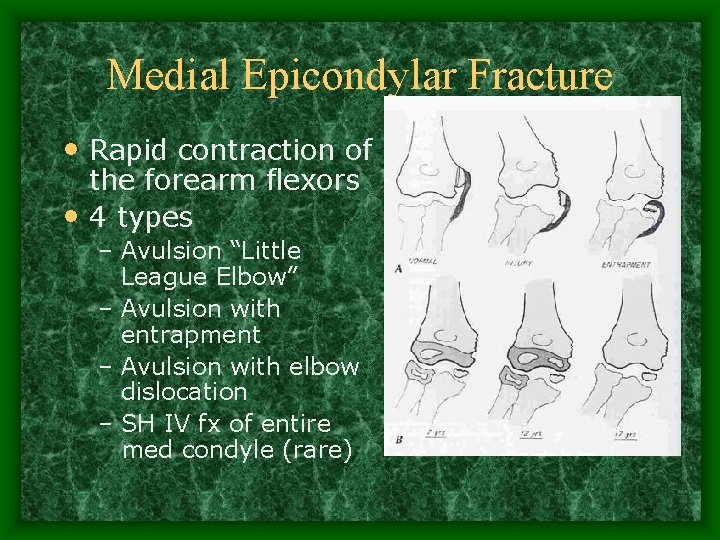
Medial Epicondylar Fracture • Rapid contraction of the forearm flexors • 4 types – Avulsion “Little League Elbow” – Avulsion with entrapment – Avulsion with elbow dislocation – SH IV fx of entire med condyle (rare)
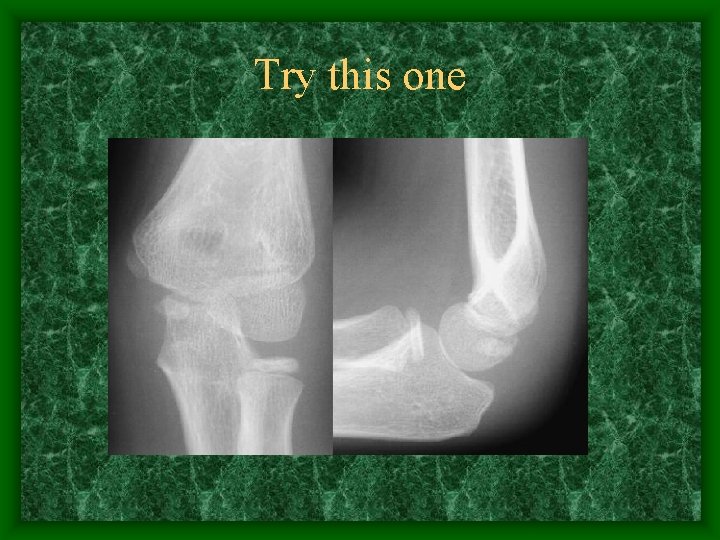
Try this one
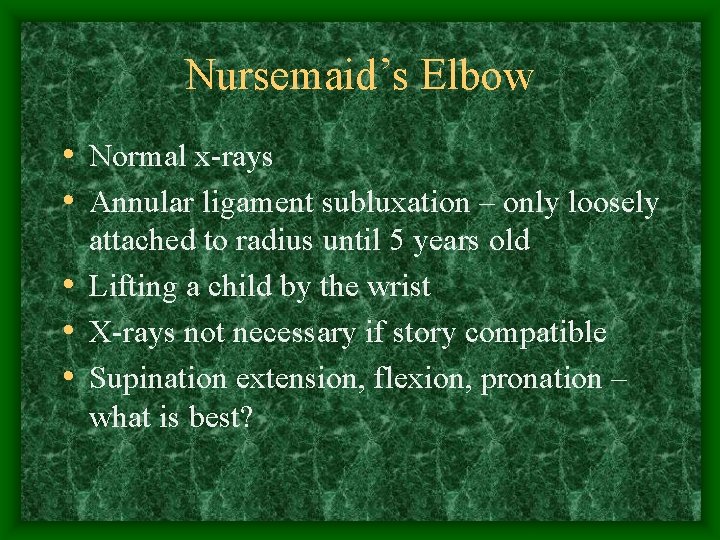
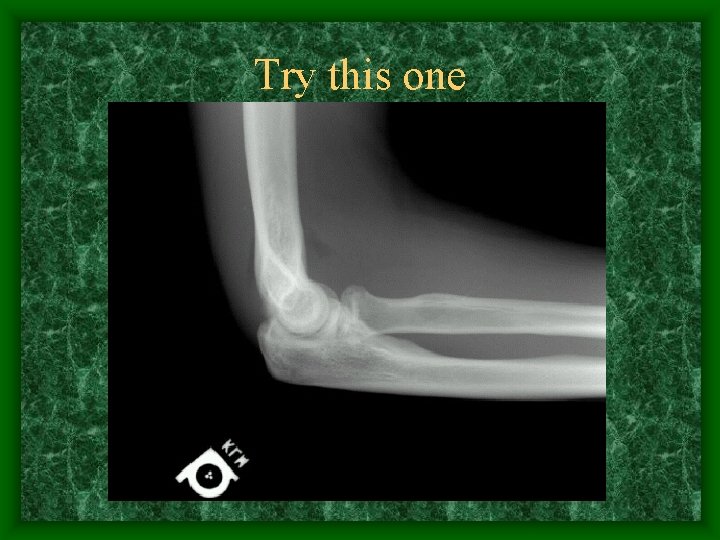
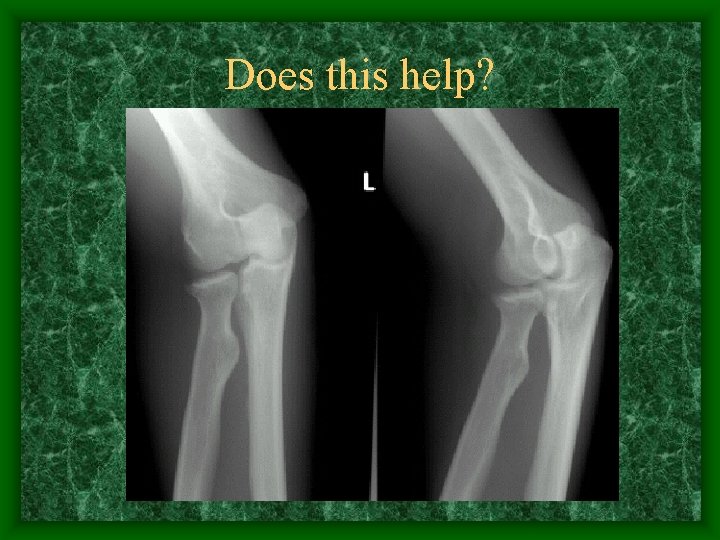
Nursemaid’s Elbow • Normal x-rays • Annular ligament subluxation – only loosely attached to radius until 5 years old • Lifting a child by the wrist • X-rays not necessary if story compatible • Supination extension, flexion, pronation – what is best?
Some studies • • Schunk 1990, prospective – 87 children < 6 years old with radial head subluxation – 49% did not have classic pull mechanism – L > R, girls > boys – No difference in method of reduction – Presence of click PPV of 92% and a NPV of 76% for reduction – Most children (76. 8%) had return of arm use in less than ten minutes Schutzman 1995, prospective – 178 children < 6 years old with injury or immobility of elbow – Radial head subluxation (RHS) was the most frequent diagnosis (63%; 99 definite and 13 probable), followed by fracture (22%) and soft-tissue injury (STI; 13%) – The mean age of children with RHS was significantly less than that of children with fractures (27± 12 months versus 39± 19 months) – Arm traction occurred in only 55% of the children with RHS – Arm held at side 95% for RHS, 18% Fx, 29% STI
Try this one
Does this help?
Radial Head Fx
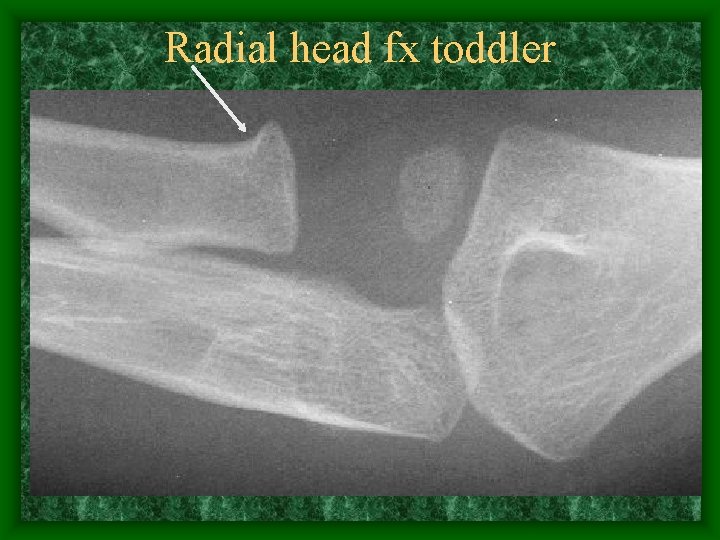
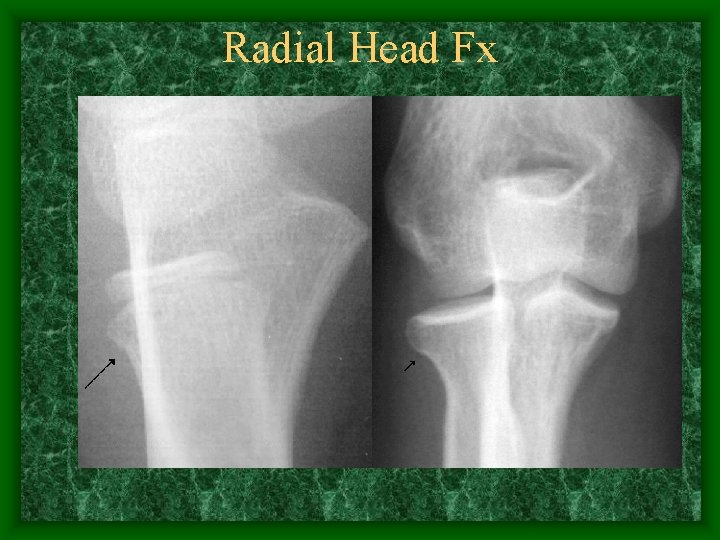
Radial head fx toddler
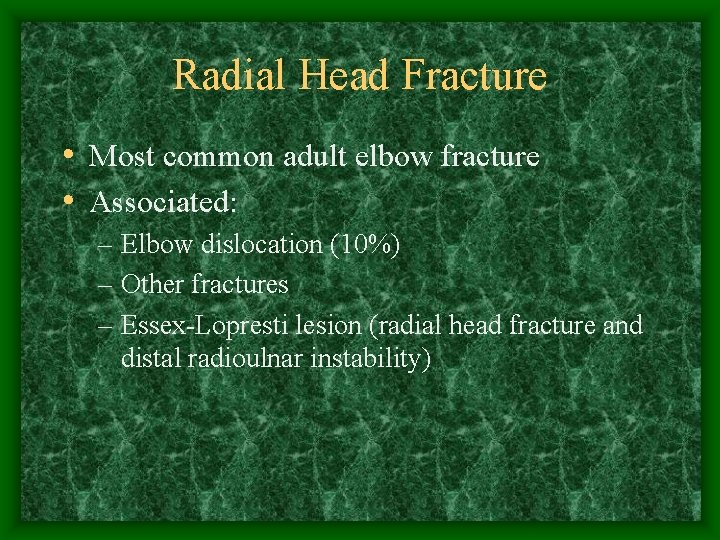
Radial Head Fracture • Most common adult elbow fracture • Associated: – Elbow dislocation (10%) – Other fractures – Essex-Lopresti lesion (radial head fracture and distal radioulnar instability)
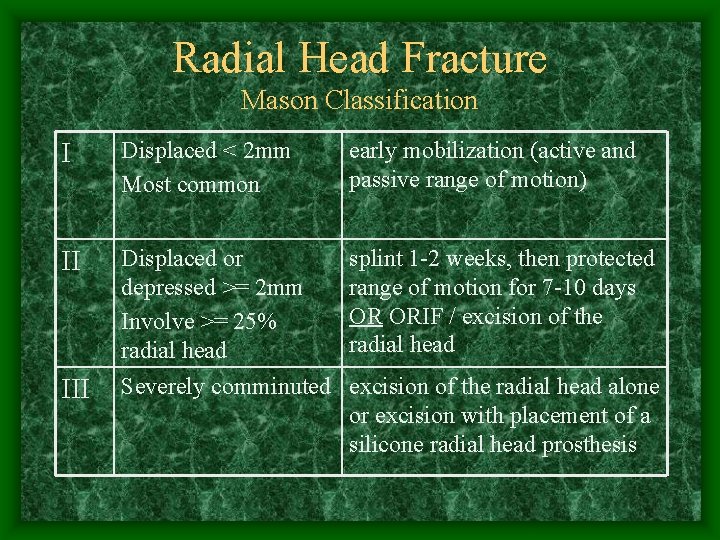
Radial Head Fracture Mason Classification I Displaced < 2 mm Most common early mobilization (active and passive range of motion) II Displaced or depressed >= 2 mm Involve >= 25% radial head Severely comminuted splint 1 -2 weeks, then protected range of motion for 7 -10 days OR ORIF / excision of the radial head III excision of the radial head alone or excision with placement of a silicone radial head prosthesis
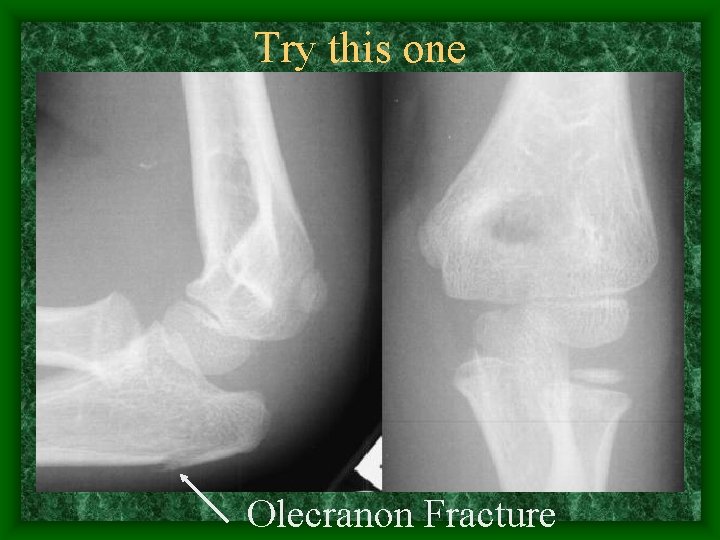
Try this one Olecranon Fracture
Olecranon Fracture • 20% of adult elbow fractures (5% kids) • Majority due to direct blow to elbow • Triceps may distract fracture fragments
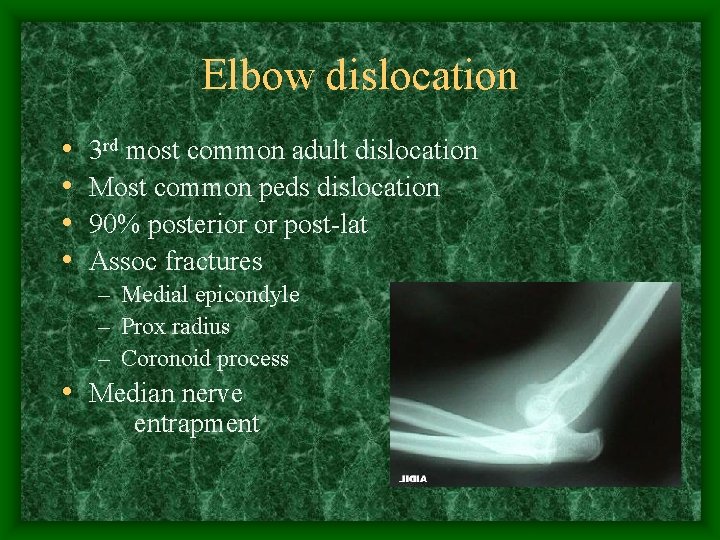
Elbow dislocation • • 3 rd most common adult dislocation Most common peds dislocation 90% posterior or post-lat Assoc fractures – Medial epicondyle – Prox radius – Coronoid process • Median nerve entrapment
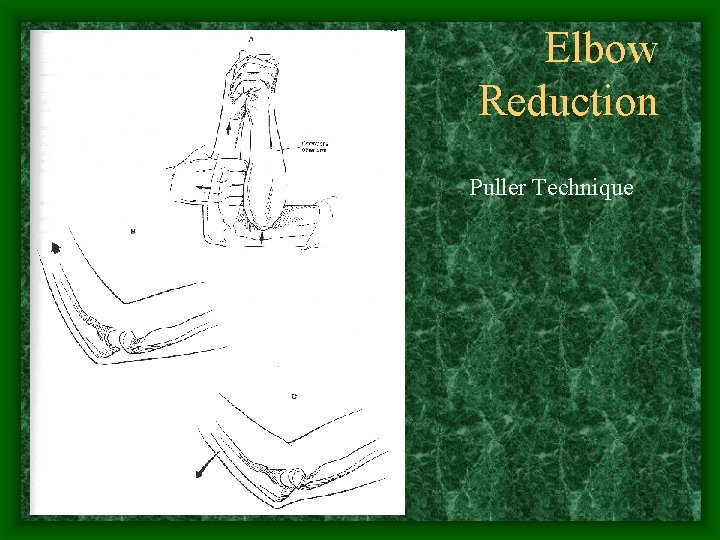
Elbow Reduction Puller Technique
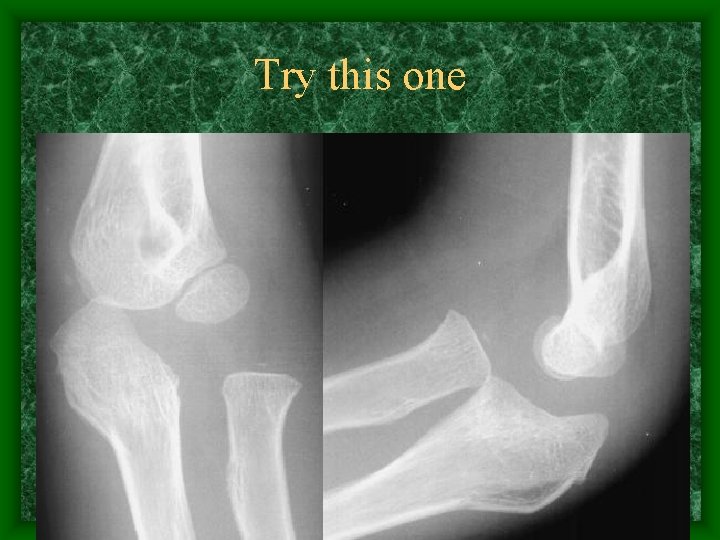
Try this one
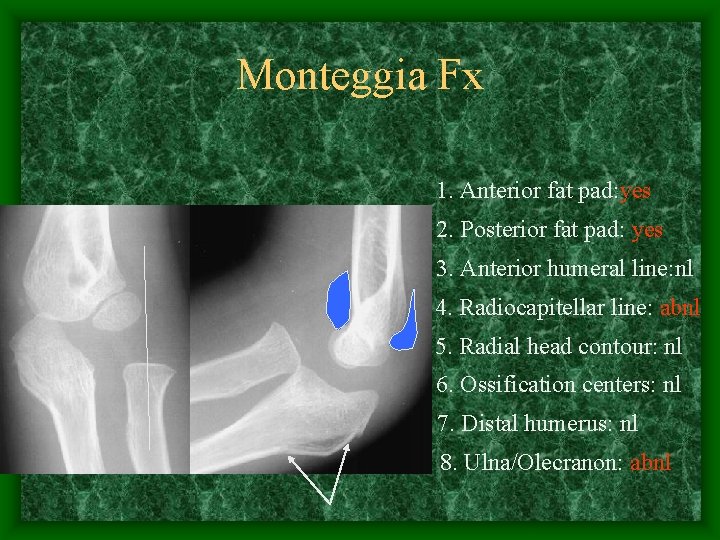
Monteggia Fx 1. Anterior fat pad: yes 2. Posterior fat pad: yes 3. Anterior humeral line: nl 4. Radiocapitellar line: abnl 5. Radial head contour: nl 6. Ossification centers: nl 7. Distal humerus: nl 8. Ulna/Olecranon: abnl
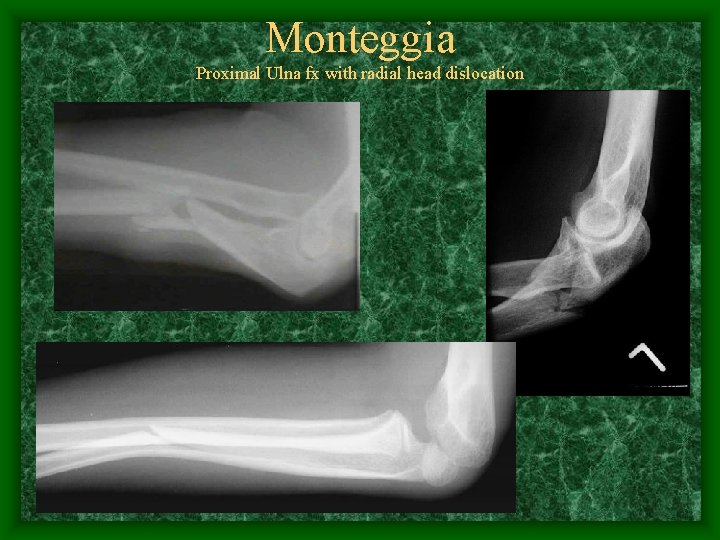
Monteggia Proximal Ulna fx with radial head dislocation
Monteggia Fx • Results from rotary forces • Disrupted radioulnar articulation makes more difficult to repair
Try this one
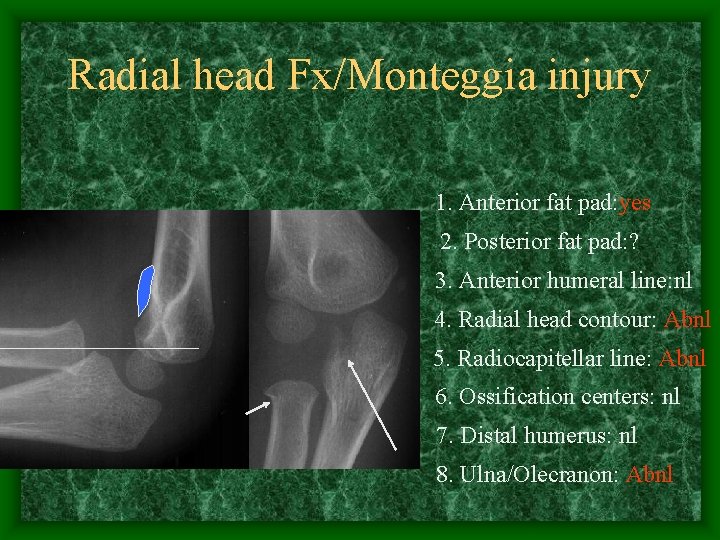
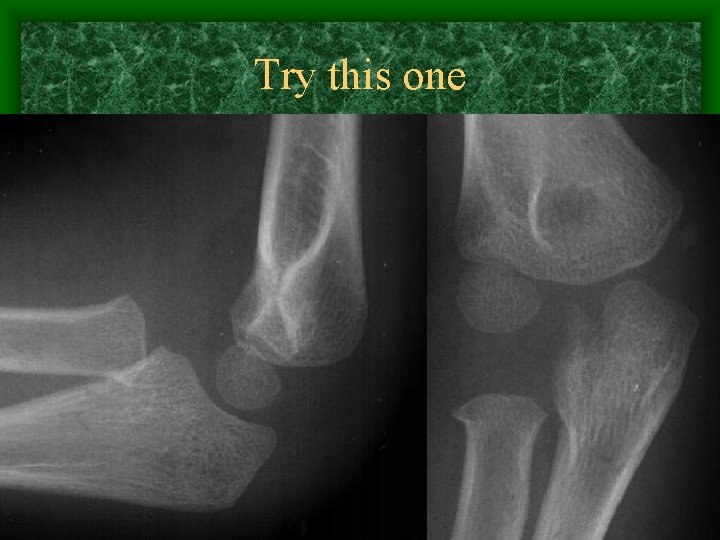
Radial head Fx/Monteggia injury 1. Anterior fat pad: yes 2. Posterior fat pad: ? 3. Anterior humeral line: nl 4. Radial head contour: Abnl 5. Radiocapitellar line: Abnl 6. Ossification centers: nl 7. Distal humerus: nl 8. Ulna/Olecranon: Abnl
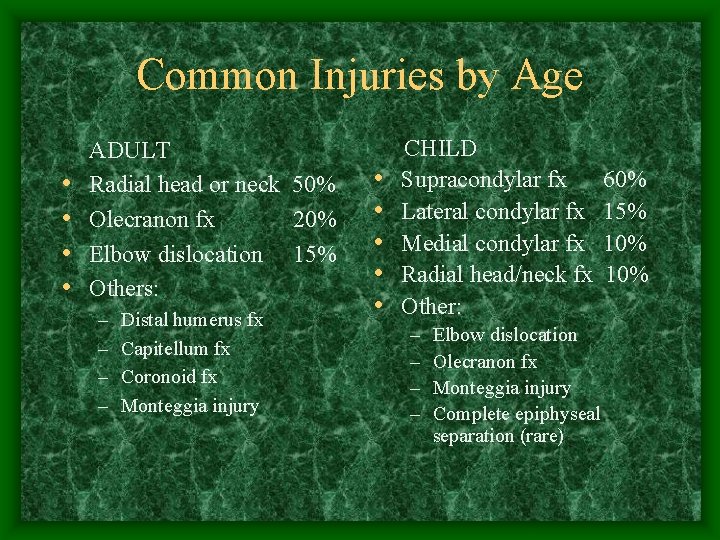
Common Injuries by Age • • ADULT Radial head or neck 50% Olecranon fx 20% Elbow dislocation 15% Others: – – Distal humerus fx Capitellum fx Coronoid fx Monteggia injury • • • CHILD Supracondylar fx Lateral condylar fx Medial condylar fx Radial head/neck fx Other: – – Elbow dislocation Olecranon fx Monteggia injury Complete epiphyseal separation (rare) 60% 15% 10%
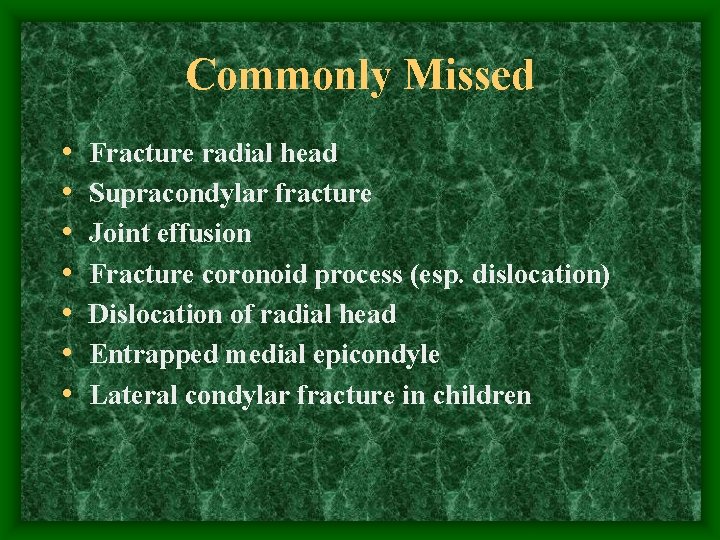
Commonly Missed • • Fracture radial head Supracondylar fracture Joint effusion Fracture coronoid process (esp. dislocation) Dislocation of radial head Entrapped medial epicondyle Lateral condylar fracture in children
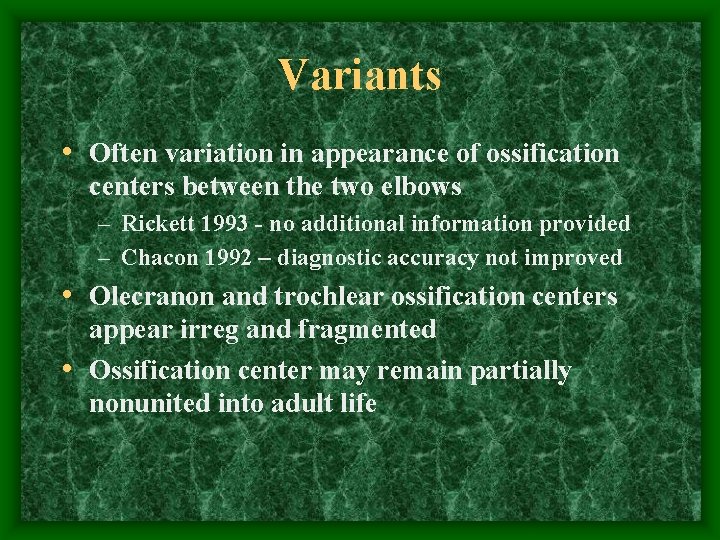
Variants • Often variation in appearance of ossification centers between the two elbows – Rickett 1993 - no additional information provided – Chacon 1992 – diagnostic accuracy not improved • Olecranon and trochlear ossification centers appear irreg and fragmented • Ossification center may remain partially nonunited into adult life
Wrist and forearm – Vascular and neuro anatomy – Standard exam – X-ray views • Standard - PA, Lat, Pronation oblique • Supplemental – scaphoid, supination oblique, carpal tunnel
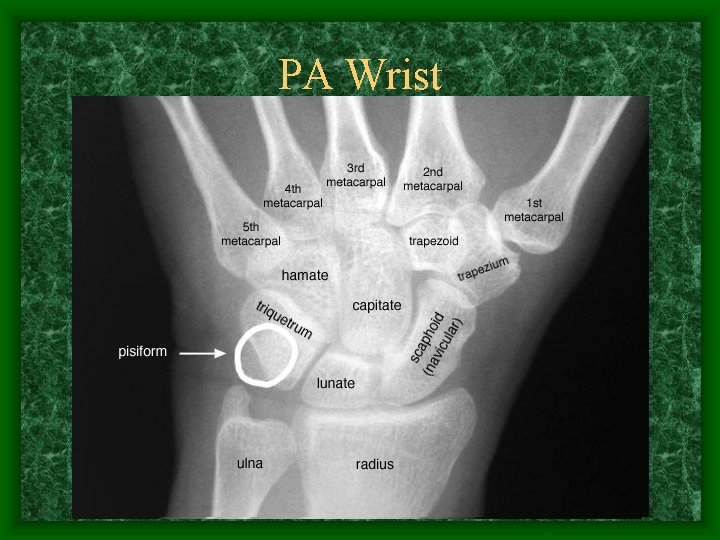
PA Wrist
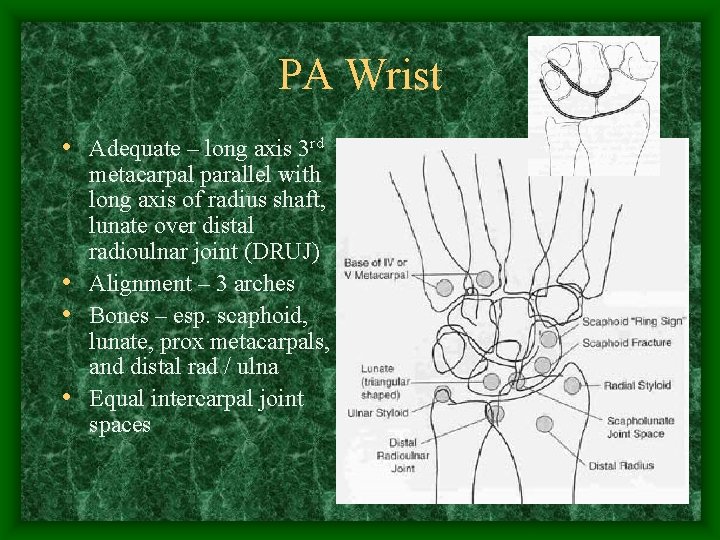
PA Wrist • Adequate – long axis 3 rd metacarpal parallel with long axis of radius shaft, lunate over distal radioulnar joint (DRUJ) • Alignment – 3 arches • Bones – esp. scaphoid, lunate, prox metacarpals, and distal rad / ulna • Equal intercarpal joint spaces
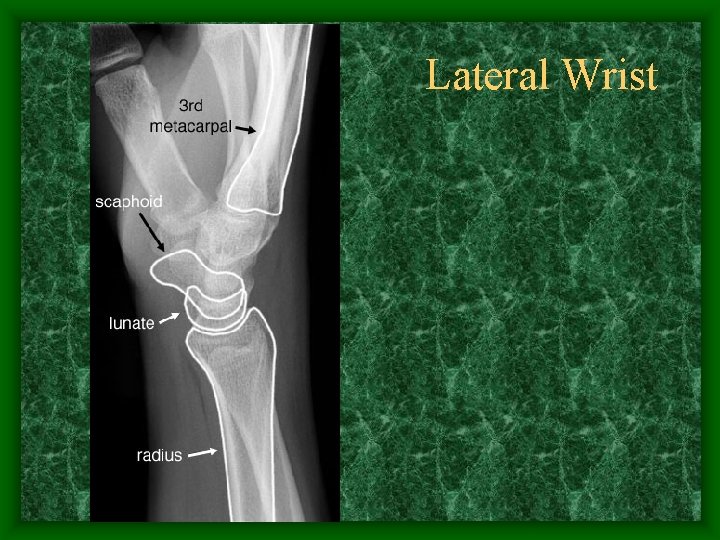
Lateral Wrist
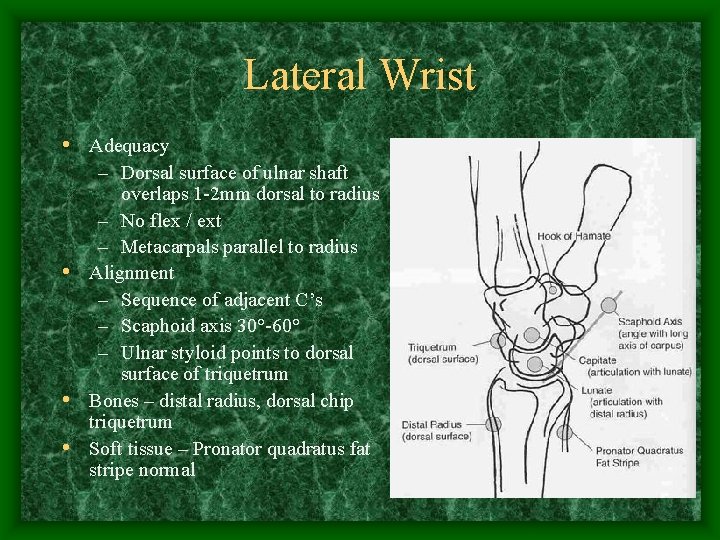
Lateral Wrist • Adequacy – Dorsal surface of ulnar shaft overlaps 1 -2 mm dorsal to radius – No flex / ext – Metacarpals parallel to radius • Alignment – Sequence of adjacent C’s – Scaphoid axis 30°-60° – Ulnar styloid points to dorsal surface of triquetrum • Bones – distal radius, dorsal chip triquetrum • Soft tissue – Pronator quadratus fat stripe normal
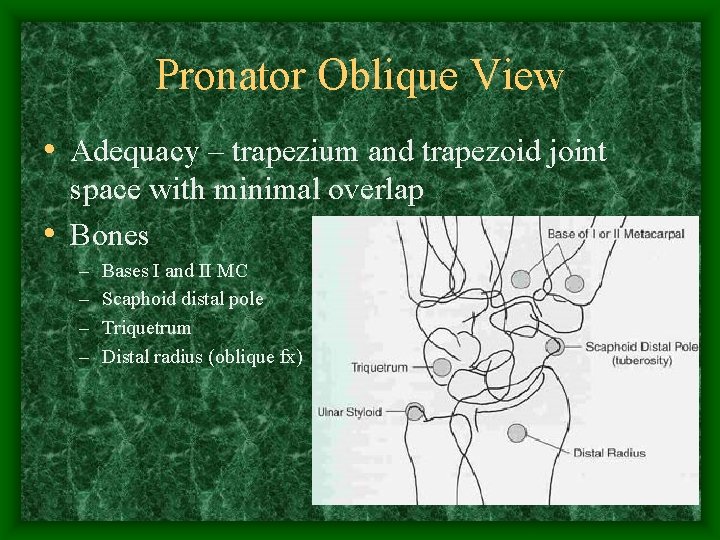
Pronator Oblique View • Adequacy – trapezium and trapezoid joint space with minimal overlap • Bones – – Bases I and II MC Scaphoid distal pole Triquetrum Distal radius (oblique fx)
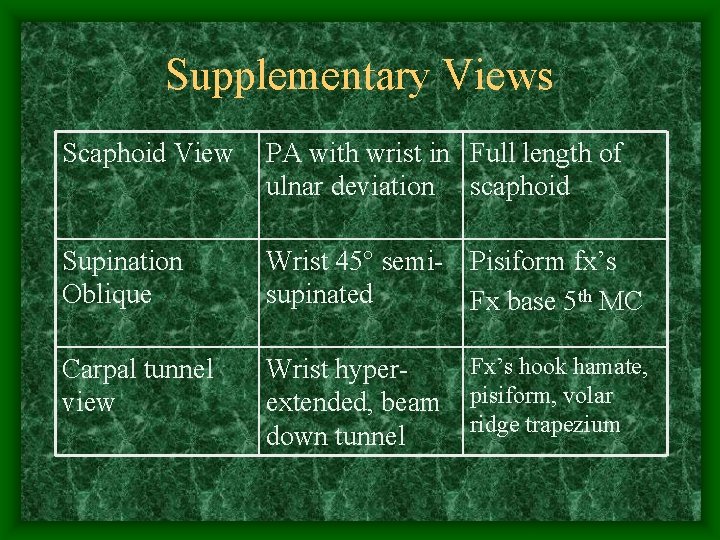
Supplementary Views Scaphoid View PA with wrist in Full length of ulnar deviation scaphoid Supination Oblique Wrist 45° semi- Pisiform fx’s supinated Fx base 5 th MC Carpal tunnel view Wrist hyperextended, beam down tunnel Fx’s hook hamate, pisiform, volar ridge trapezium
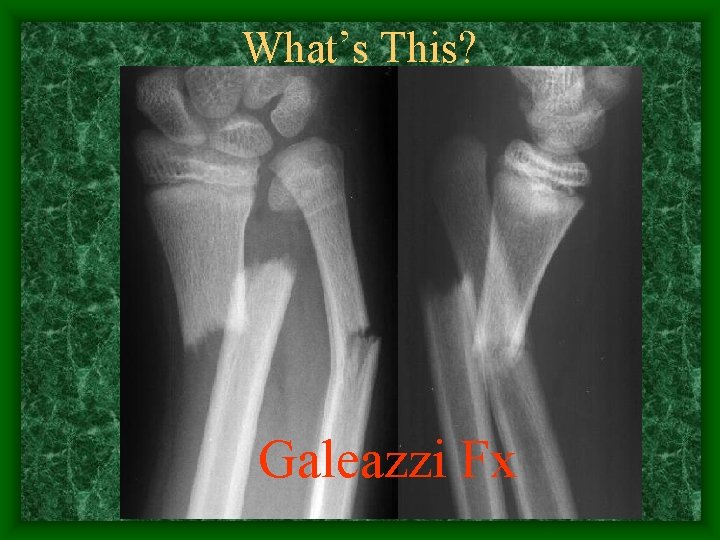
What’s This? Galeazzi Fx
Galeazzi Fracture • Fx distal 1/3 radius (GR) and ulnar dislocation • Fall on outstretched hand • ORIF
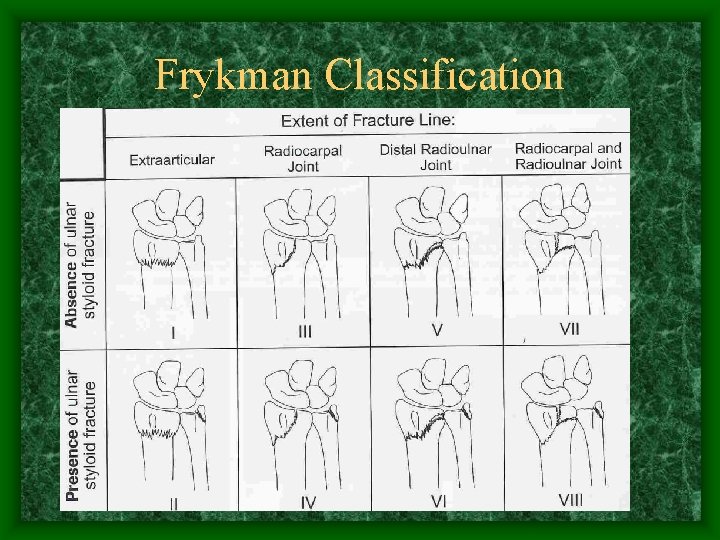
Frykman Classification
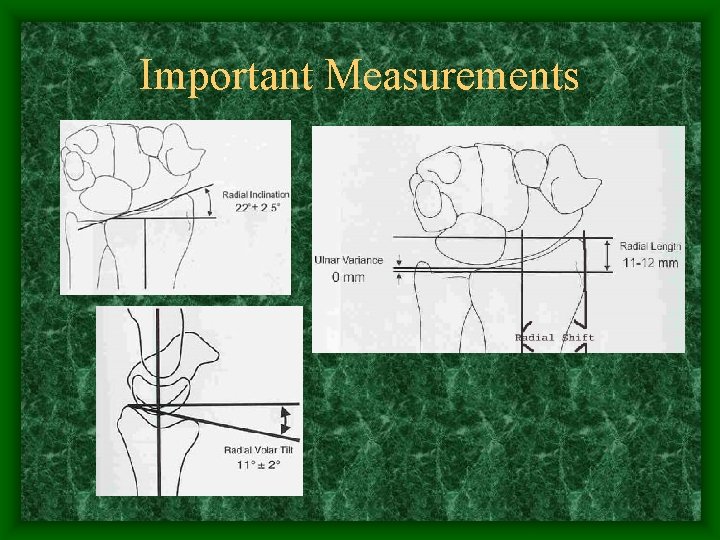
Important Measurements
Distal Radius Fractures • Colles Fx – dorsal displace and short • Smith Fx – volar displace • Barton Fx – volar or dorsal, involves distal radial articular surface • Chauffeur’s Fx (Hutchinson) – oblique through radial styloid, often with scapholunate dissociation • Distal Radioulnar Joint Dislocation – sig clinically because radiocarpal and triangular fibrocartilage usually disrupted
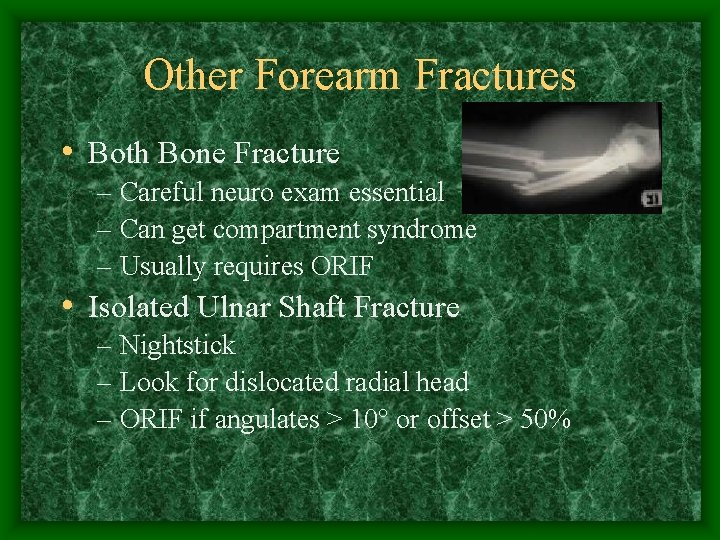
Other Forearm Fractures • Both Bone Fracture – Careful neuro exam essential – Can get compartment syndrome – Usually requires ORIF • Isolated Ulnar Shaft Fracture – Nightstick – Look for dislocated radial head – ORIF if angulates > 10° or offset > 50%
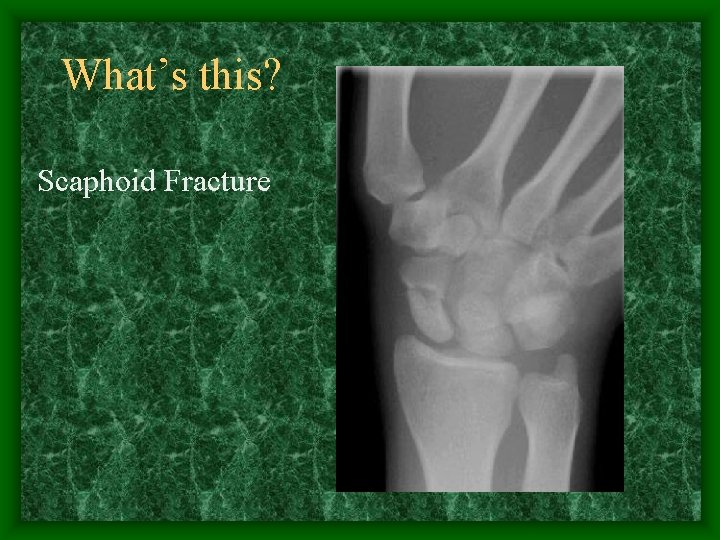
What’s this? Scaphoid Fracture
Scaphoid Fracture • Fall with outstretched palm – 60 -80% of carpal fractures • Tubercle, Distal pole, Waist (good prognosis) • Proximal pole (nonunion/osteonecrosis common) • • • – Osteonecrosis of proximal pole fragment – Posttraumatic arthritis X-ray up to 6 weeks Bone scans-80% by 24 hr; 95% in 3 days MRI immediate Immobilize 8 -12 weeks in long arm thumb spica Displaced – closed or open reduction
Other Carpal Fractures • Triquetrum dorsal chip fracture – 10 -20% of carpal fractures – Fall on outstreched hand • Lunate avascular necrosis (Kienböck disease) – Fracture, repetitive trauma, or ligamentous injury – Pain, swelling, decreased grip strength • Hook of Hamate – Dull pain in volar-ulnar region – Occurs with golf, tennis, racquetball, baseball
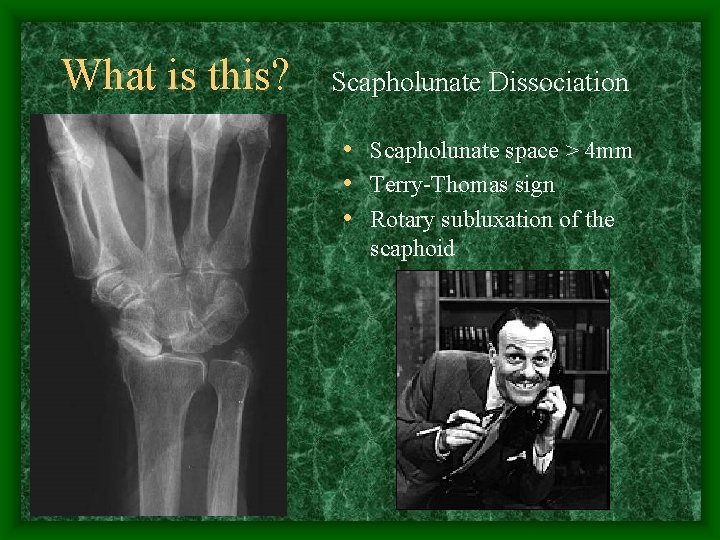
What is this? Scapholunate Dissociation • Scapholunate space > 4 mm • Terry-Thomas sign • Rotary subluxation of the scaphoid
Dislocations and Ligamentous Injuries • 10% of carpal injuries • Perilunate injuries – 4 stages – I – Tear scapholunate lig, scapholunate dissociation – II – Scaphoid and Capitate instability – III – Dorsal perilunate dislocation – IV – Lunate dislocation
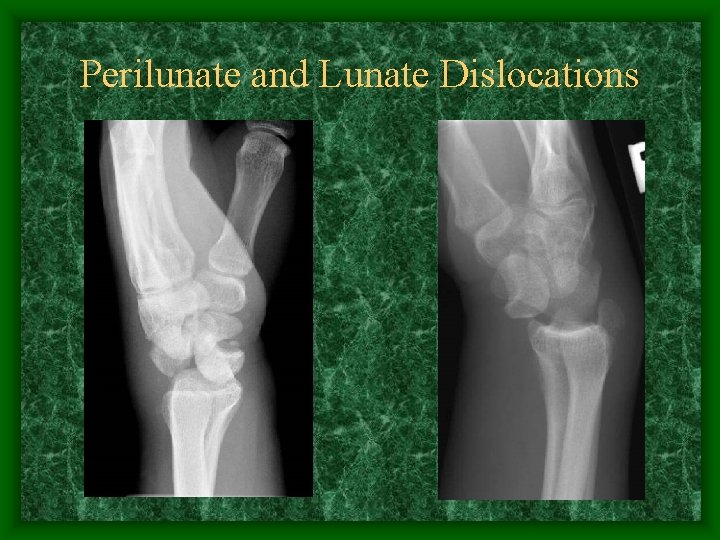
Perilunate and Lunate Dislocations
Common Errors • Failing to consider possibility of significant injury with normal x-rays • Reading negative scaphoid injuries as positive • Missing distal radius fracture
References • • • Chacon D, Kissoon N, Brown T, Galpin R. Use of comparison radiographs in the diagnosis of traumatic injuries of the elbow. Ann Emerg Med. 1992 Aug; 21(8): 895 -9. Hawksworth CR, Freeland P. Inability to fully extend the injured elbow: an indicator of significant injury. Arch Emerg Med. 1991 Dec; 8(4): 253 -6. Lufkin KC, Smith SW, Matticks CA, Brunette DD: Radiologists' review of radiographs interpreted confidently by emergency physicians infrequently leads to changes in patient management. Ann Emerg Med February 1998; 31: 202207. Medpix radiology. http: //rad. usuhs. mil/medpix April 2004. Rickett AB, Finlay DB: An audit of comparison views in elbow trauma in children. Br J Radiol 66: 123, 1993. Rosen, Peter. Atlas of Emergency Procedures. Mosby 2001. pp 262 -278. Schwartz, David T. Emergency Radiology. 2000. pp. 27 -100. Schunk JE. Radial head subluxation: epidemiology and treatment of 87 episodes. Ann Emerg Med. 1990 Sep; 19(9): 1019 -23. Schutzman SA, Teach S: Upper-extremity impairment in young children. Ann Emerg Med October 1995; 26: 474 -479. Simon RR, Koenigsknecht SJ. Emergency Orthopedics the extremities. Mc. Graw-Hill Fourth Ed. 2001. Vanderheide, Stuart. Elbow radiology lecture 2002.
- Slides: 67