
Skeletal Consideration for Movement Lecture 2 1 The
- Slides: 26
Skeletal Consideration for Movement Lecture 2 1
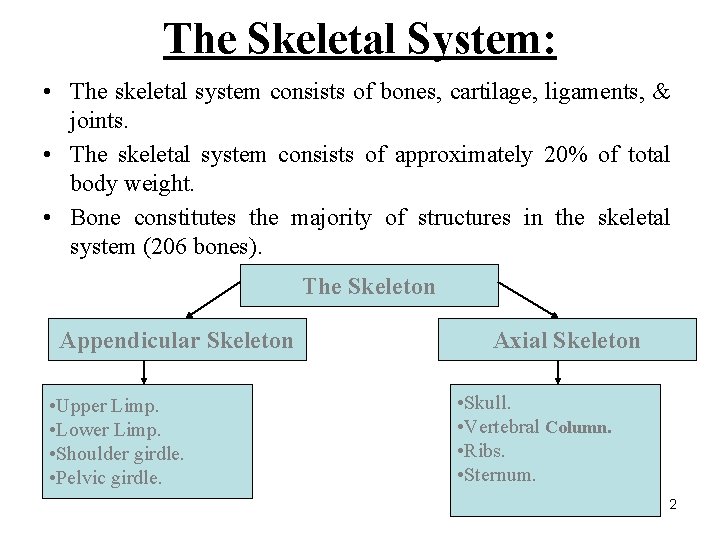
The Skeletal System: • The skeletal system consists of bones, cartilage, ligaments, & joints. • The skeletal system consists of approximately 20% of total body weight. • Bone constitutes the majority of structures in the skeletal system (206 bones). The Skeleton Appendicular Skeleton • Upper Limp. • Lower Limp. • Shoulder girdle. • Pelvic girdle. Axial Skeleton • Skull. • Vertebral Column. • Ribs. • Sternum. 2
Functions of the Skeletal System: • • • Leverage (attachment of muscles to produce movement). Support. Protection (brain, spinal cord, internal organs). Mineral storage. Blood cells formation in bone marrow. Lever = a simple machine that magnifies the force and/or speed of movement. The long bones act as the levers about which the muscular system generates the movements. • Morphology= the shape & structural arrangement of the bones & articulations determine movement. 3
Constituents of bone: Bone is a calcified osteoid formed of: 1. Bone matrix of calcified tissues, 2. Bone cells including; Osteoblasts (boneforming cells), Osteoccytes (mature bone cells), and Osteoclasts (bone-eating cells). 3. Periosteum (outer covering of the bone). 4. Endosteum (inner lining of the bone). 4
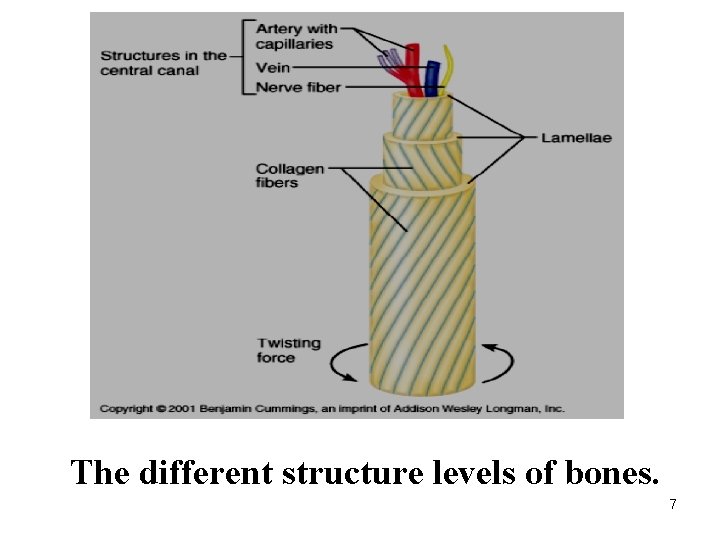
Architecture of bone (osseous tissue): 1. Cortical (compact) bone: –The exterior dense layer of the bone. –Consists of hollow tubes called lamellae (collagen fibers that are arranged in layers and run in different directions). –A series of lamellae form an osteon or haversian system (weight-bearing pillars). –Provides strength for weight bearing & stiffness in response to muscle tension. 5
2. Cancellous (spongy) bone : –Interior to cortical bone. –Consists of flat pieces of bone called trabeculae (collagen runs along the axis of the trabeculae). –Provides energy absorption & stress distribution in response to loads. –Not as strong as cortical bone (risk of fracture in the elderly). 6
The different structure levels of bones. 7
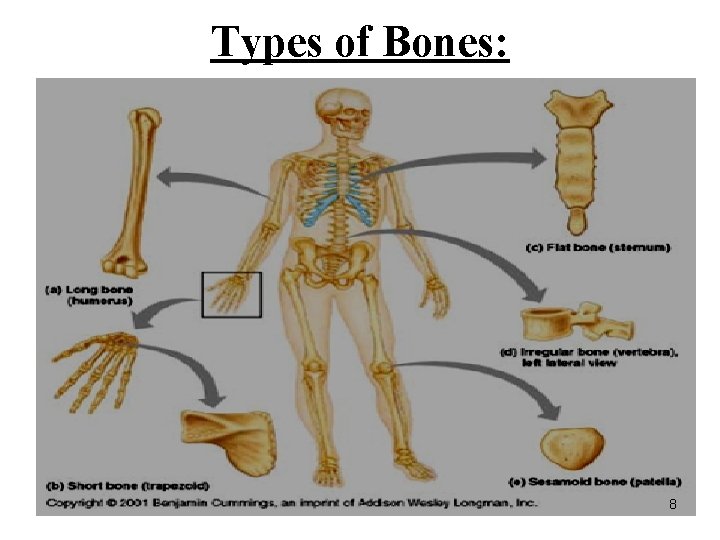
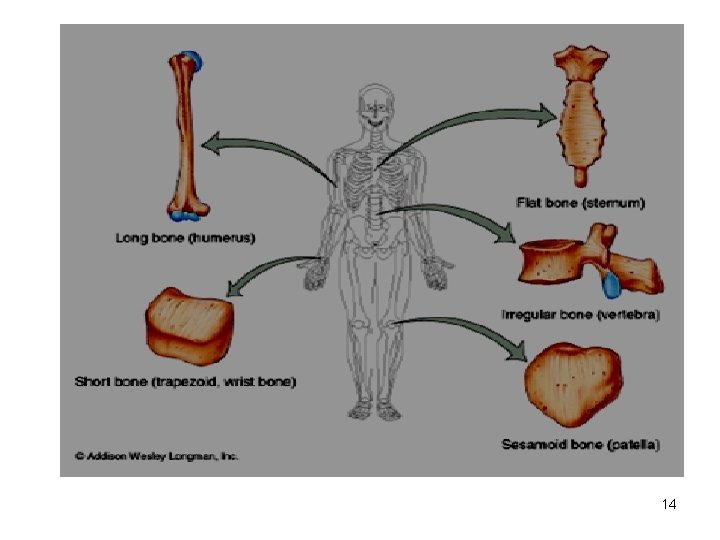
Types of Bones: 8
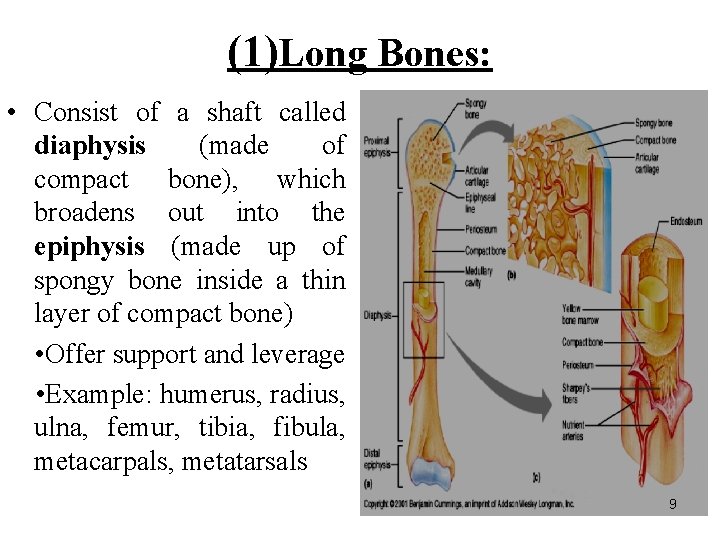
(1)Long Bones: • Consist of a shaft called diaphysis (made of compact bone), which broadens out into the epiphysis (made up of spongy bone inside a thin layer of compact bone) • Offer support and leverage • Example: humerus, radius, ulna, femur, tibia, fibula, metacarpals, metatarsals 9
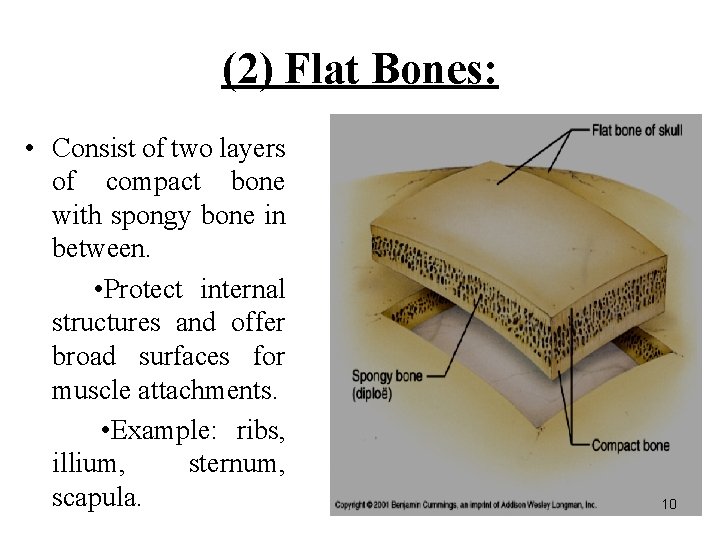
(2) Flat Bones: • Consist of two layers of compact bone with spongy bone in between. • Protect internal structures and offer broad surfaces for muscle attachments. • Example: ribs, illium, sternum, scapula. 10
(3) Short Bones: • Consist of spongy bone covered with a thin layer of compact bone. • Play an important role in shock absorption and transmission of forces. • Example: carpals of the hand the tarsals of the foot. 11
(4) Irregular Bones: • Consist of spongy bone and thin exterior layer of compact bone. • Specialized functions such as supporting the weight, protecting. the spinal cord, dissipating loads. • Example: vertebrae, ischium, pubis. 12
(5) Sesamoid Bones: • Short type of bone embedded in a tendon or joint capsule. • Alter the angle of muscle insertion to increase its mechanical advantage. • Example: the patella embedded in the quadriceps tendon, sesamoid bones within the flexor tendons of the great toe & thumb. 13
14
How does bone anatomy relate to stress? • Bones are subjected to bending stresses (the load placed on most bones is off center). • The strongest forces are at the periphery where they are resisted by the strongest compact bone. • Example: body weight is transmitted to the head of femur and threatens to bend the bone (compression on one side & tension on the other side). 15
Types of Joints: 1. Synovial diarthroidal (freely movable). 2. Cartilagenous amphiarthroidal (slightly movable) tibio-fibular joint. 3. Fibrous synarthroidal (immovable) skull. 16
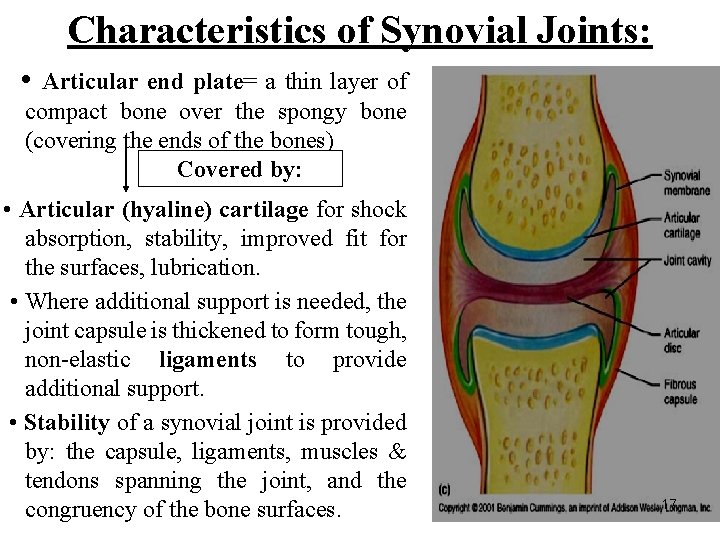
Characteristics of Synovial Joints: • Articular end plate= a thin layer of compact bone over the spongy bone (covering the ends of the bones) Covered by: • Articular (hyaline) cartilage for shock absorption, stability, improved fit for the surfaces, lubrication. • Where additional support is needed, the joint capsule is thickened to form tough, non-elastic ligaments to provide additional support. • Stability of a synovial joint is provided by: the capsule, ligaments, muscles & tendons spanning the joint, and the congruency of the bone surfaces. 17
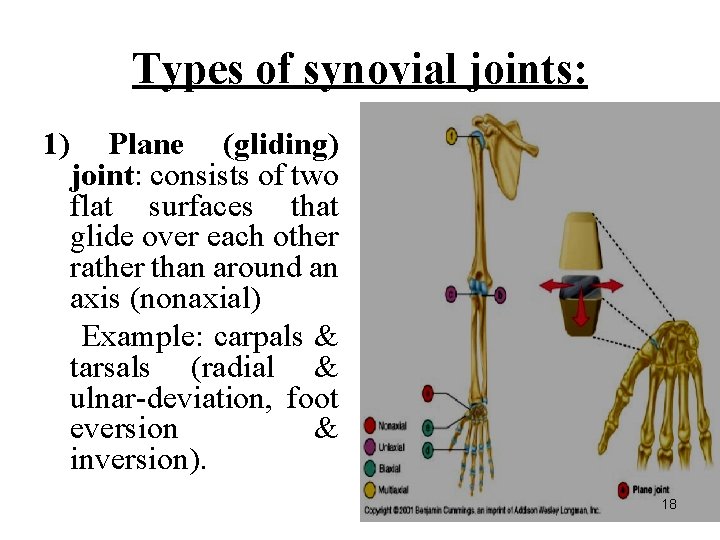
Types of synovial joints: 1) Plane (gliding) joint: consists of two flat surfaces that glide over each other rather than around an axis (nonaxial) Example: carpals & tarsals (radial & ulnar-deviation, foot eversion & inversion). 18
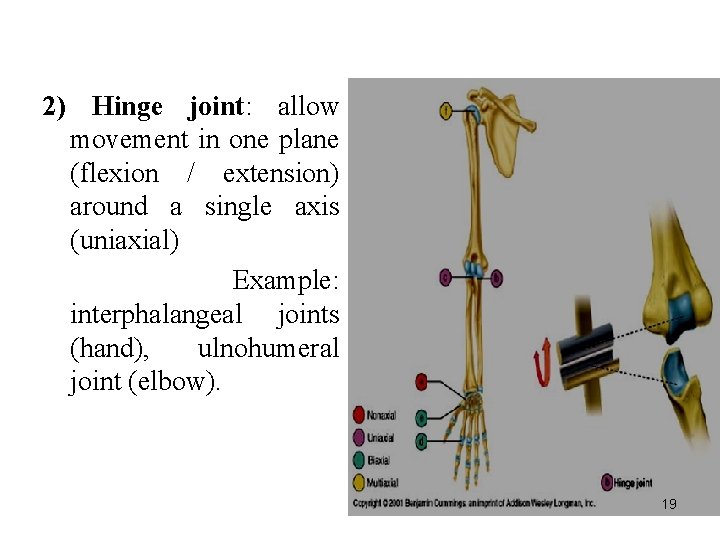
2) Hinge joint: allow movement in one plane (flexion / extension) around a single axis (uniaxial) Example: interphalangeal joints (hand), ulnohumeral joint (elbow). 19
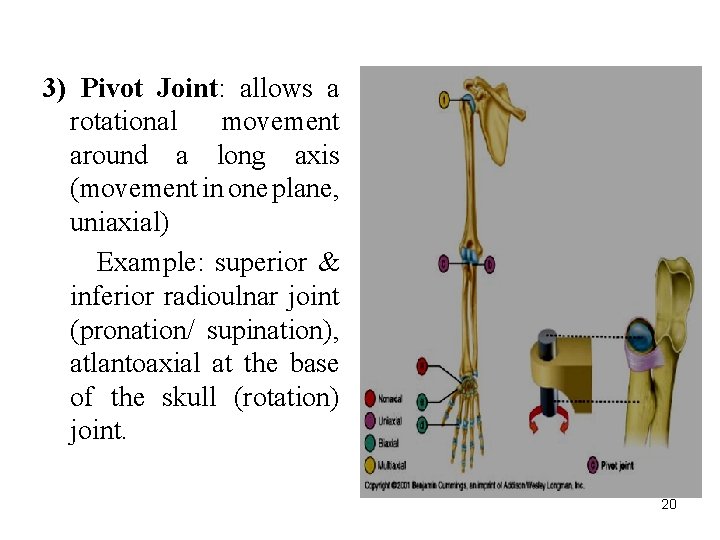
3) Pivot Joint: allows a rotational movement around a long axis (movement in one plane, uniaxial) Example: superior & inferior radioulnar joint (pronation/ supination), atlantoaxial at the base of the skull (rotation) joint. 20
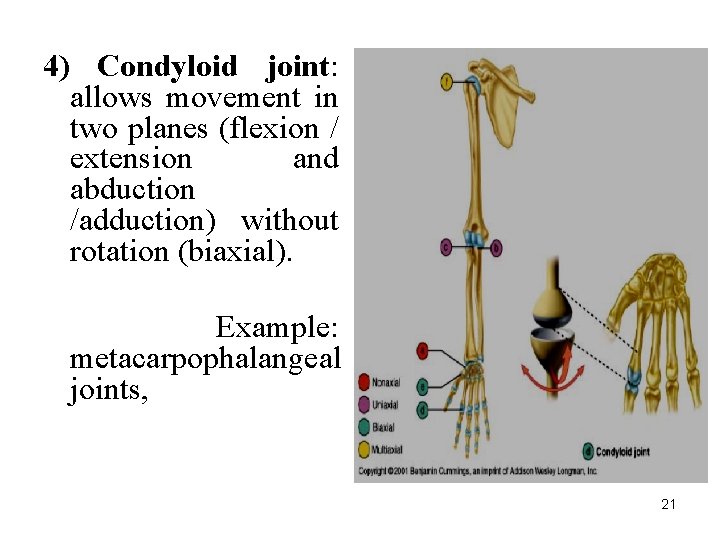
4) Condyloid joint: allows movement in two planes (flexion / extension and abduction /adduction) without rotation (biaxial). Example: metacarpophalangeal joints, 21
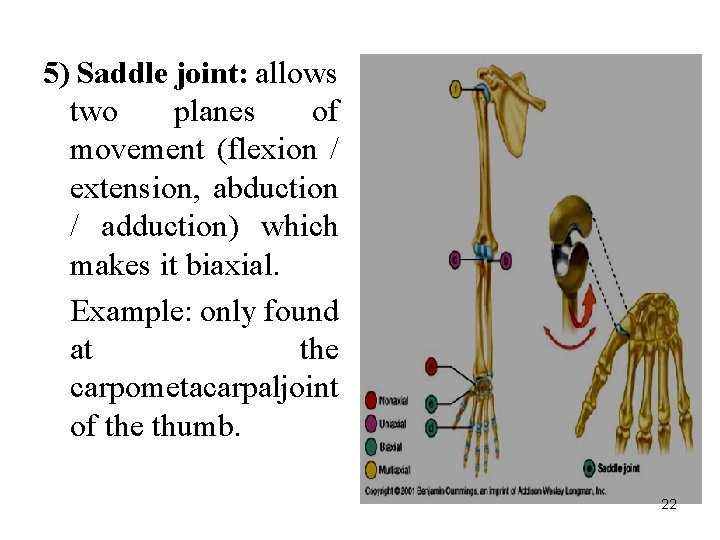
5) Saddle joint: allows two planes of movement (flexion / extension, abduction / adduction) which makes it biaxial. Example: only found at the carpometacarpaljoint of the thumb. 22
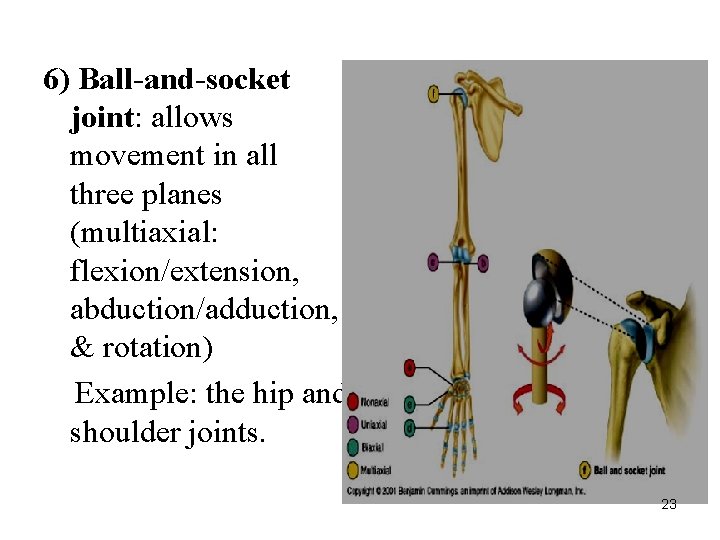
6) Ball-and-socket joint: allows movement in all three planes (multiaxial: flexion/extension, abduction/adduction, & rotation) Example: the hip and shoulder joints. 23
Degree of freedom: • Degrees of Freedom: the number of independent movements allowed at a joint; up to 3 degrees of angular freedom in the sagittal, frontal and horizontal planes. • Clinically, the greater the degree of freedom (greater mobility) of a joint system, the greater degree of instability of that joint system. • Outside movement in the three cardinal planes; translation can occur. This movement within a joint is considered “Accessory” motion occurring at a joint. – Clinical note: This accessory motion is often assessed when determining the amount of instability within a joint, and when determining the extent of ligamentous damage sustained by a joint. 24
The kinetic chain concept: Extremities consist of several bony segments linked by a series of joints: Chain. 1) Open-kinetic chain: • When the distal end of the extremity is not fixed to any surface. • Allows any joint in the extremity to move without causing movement in the other joints. • Example: shoulder shrug. 2) Closed-kinetic chain: • When the distal end of the extremity is fixed to a surface. • Movement of one joint can not occur without causing predictable movements of the other joint in the extremity. 25 • Example: push-up
Why learn kinetic chain? • For determining appropriate conditioning exercises to improve function. • Open-chain usually isolate one segment, while closed-chain exercises work all segments in the chain, resulting in conditioning of the muscles crossing each joint. • Most sports involve closed-kinetic chain activities in the lower limb, and open-kinetic chain in the upper limb. 26