
Skabelon 1 Effektopflgning Tool The project organization Tool
Skabelon 1: Effektopfølgning Tool: The project organization
Tool: The project organization Purpose and yield The project organization must ensure professional quality, decision-making competence and involvement of the "customers". Projects are temporary and many are not familiar with the different roles, therefore it is important that the organization is described in detail. The tool ensures that: • The project organization is described in detail • The organization has a relevant division of labor and roles • The three roles are kept separate: Project owner is decisive and granting, the project team is executing and the reference groups are advisory • An appropriate structure of the project in order to connect the assignment and the organization When is the project organized? • The overall structure must be established relatively quickly in a collaboration between project owner and project manager. • As a project manager you need to be quick off the mark in order to secure the right key resources. Once someone in the management has defined structure or people, it is very difficult to change. • The division into workstreams can wait until the hierarchy of objectives or impact case is in place. • The organization must be able to be adjusted along the way, as there is a need for different competencies and volume throughout the project. Pitfalls and restrictions • The steering group must be powerful and small. Avoid large steering groups, they are ineffective. • Leaders who cannot deliver resources or decisions should not be in the steering committee. They should be placed in a reference group. • Assess the composition of the reference group or groups. Should a group consist of people with homogeneous interests, or must different target groups be mixed? • Reference groups do not need to be a group, it may be individuals who advise the project manager. • Involve the reference groups as early as possible and create acceptance of objectives and plan. • Stakeholders decide undisputed whether the project is successful, so keep close contact with them so that they are well-informed. • Fight to get the best employees for the project, without them it is already uphill. • Find professionally competent participants with leadership skills for the role as team leaders in the working groups. • The structure of the project must be based on the main deliverables, so that professional and financial responsibility is clearly defined.
Approach for description of the project organization Hvem d. Who participates? • It is the project owner and steering group that designates the project manager. • The overall organization is carried out in collaboration between project manager and project owner. • As a project manager, you must seek influence on which key persons must be in the reference groups and the project team. • The project's internal organization is carried out by the project manager • The organization in workstreams and working groups is carried out by the project manager in collaboration with team leaders or sub-project managers. Project organization and roles On the next two slides, the principles of the overall project structure and the roles of the organization are described. Then 6 alternative templates are described for inspiration, all of which can document project organization. Template 1: A simple table to describe a project organization with project owner, steering committee, project manager and central project team, reference groups and workstreams. The template is prepared as a table and is available both in Power. Point and a Word edition. Template 2: Corresponds to template 1 but is expanded to describe up to 3 reference groups and 6 workstreams. The template is prepared as a table and is available both in Power. Point and a Word edition. Template 3: Describes a project organization with project owner, steering committee, project manager and central project team, up to 4 reference groups and 5 workstreams. The template is prepared as a table and is available both in Power. Point and a Word edition. Template 4: Used to describe a project organization with project owner, steering committee, project manager and central project team, up to 3 reference groups and 4 workstreams. The template is drawn in Power. Point and the individual groups can be deleted or copied as needed. Template 5: Describes a project organization with a project owner without a steering committee. In addition, the project consists of project manager, central project team, up to 4 reference groups and 4 workstreams. The template is made in Power. Point and groups can be deleted or copied as needed. Template 6: Used to describe a project organization with project owner, steering committee, project manager and central project team, up to 4 reference groups and 4 workstreams. The template is drawn in Power. Point and the individual groups can be deleted or copied as needed.
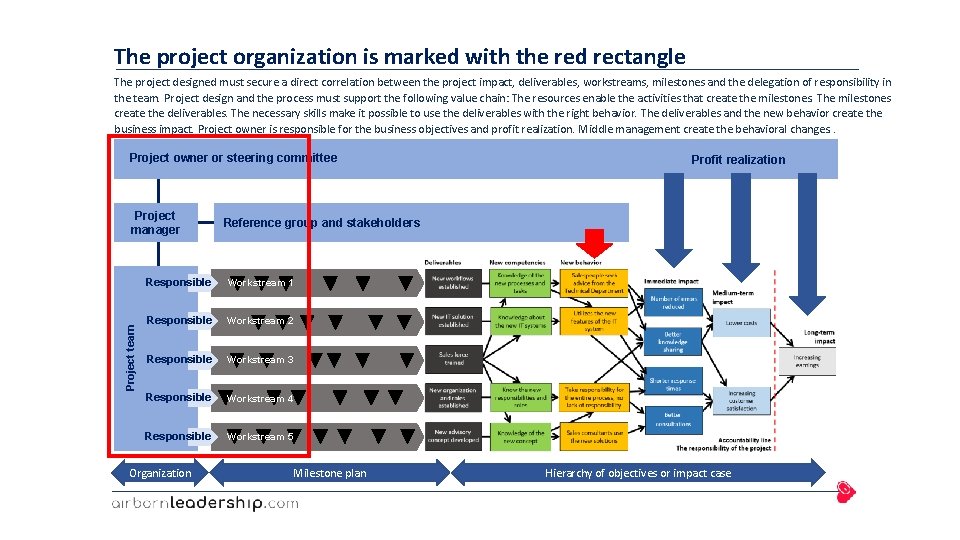
The project organization is marked with the red rectangle The project designed must secure a direct correlation between the project impact, deliverables, workstreams, milestones and the delegation of responsibility in the team. Project design and the process must support the following value chain: The resources enable the activities that create the milestones. The milestones create the deliverables. The necessary skills make it possible to use the deliverables with the right behavior. The deliverables and the new behavior create the business impact. Project owner is responsible for the business objectives and profit realization. Middle management create the behavioral changes. . Project owner or steering committee Project team Project manager Reference group and stakeholders Responsible Workstream 1 Responsible Workstream 2 Responsible Workstream 3 Responsible Workstream 4 Responsible Workstream 5 Organization Profit realization Milestone plan Hierarchy of objectives or impact case
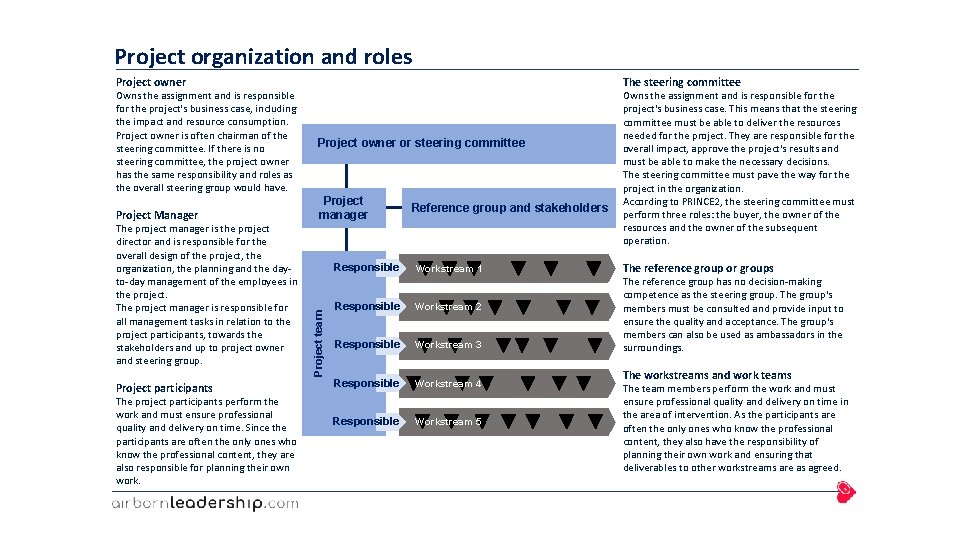
Project organization and roles Project owner Project Manager The project manager is the project director and is responsible for the overall design of the project, the organization, the planning and the dayto-day management of the employees in the project. The project manager is responsible for all management tasks in relation to the project participants, towards the stakeholders and up to project owner and steering group. Project participants The project participants perform the work and must ensure professional quality and delivery on time. Since the participants are often the only ones who know the professional content, they are also responsible for planning their own work. The steering committee Project owner or steering committee Project manager Responsible Project team Owns the assignment and is responsible for the project's business case, including the impact and resource consumption. Project owner is often chairman of the steering committee. If there is no steering committee, the project owner has the same responsibility and roles as the overall steering group would have. Reference group and stakeholders Workstream 1 Responsible Workstream 2 Responsible Workstream 3 Responsible Workstream 4 Responsible Workstream 5 Owns the assignment and is responsible for the project's business case. This means that the steering committee must be able to deliver the resources needed for the project. They are responsible for the overall impact, approve the project's results and must be able to make the necessary decisions. The steering committee must pave the way for the project in the organization. According to PRINCE 2, the steering committee must perform three roles: the buyer, the owner of the resources and the owner of the subsequent operation. The reference group or groups The reference group has no decision-making competence as the steering group. The group's members must be consulted and provide input to ensure the quality and acceptance. The group's members can also be used as ambassadors in the surroundings. The workstreams and work teams The team members perform the work and must ensure professional quality and delivery on time in the area of intervention. As the participants are often the only ones who know the professional content, they also have the responsibility of planning their own work and ensuring that deliverables to other workstreams are as agreed.
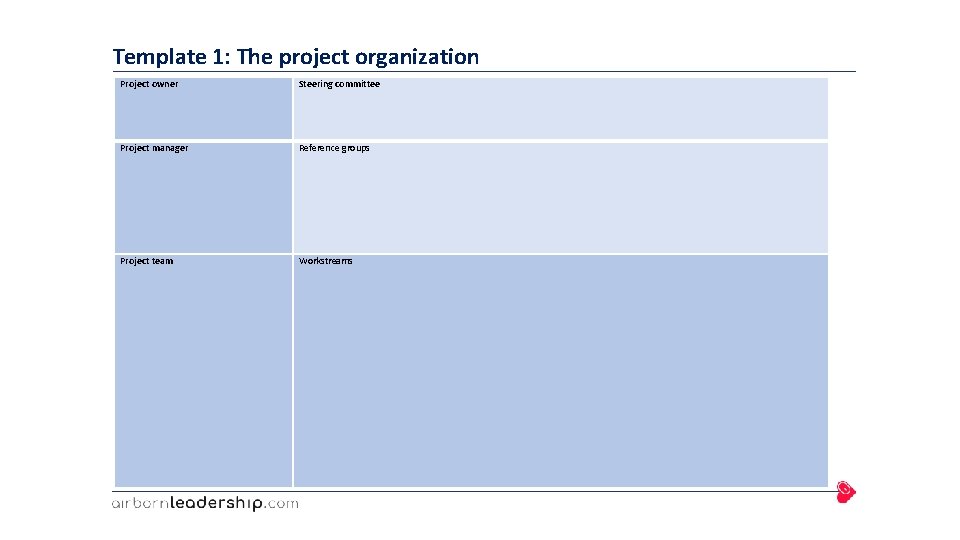
Template 1: The project organization Project owner Steering committee Project manager Reference groups Project team Workstreams
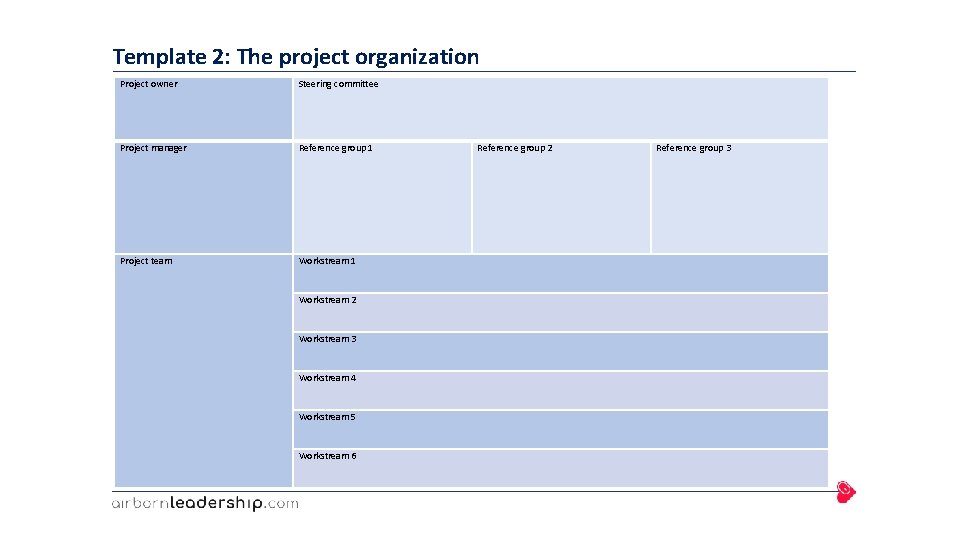
Template 2: The project organization Steering committee Project owner Project manager Reference group 1 Project team Workstream 1 Workstream 2 Workstream 3 Workstream 4 Workstream 5 Workstream 6 Reference group 2 Reference group 3
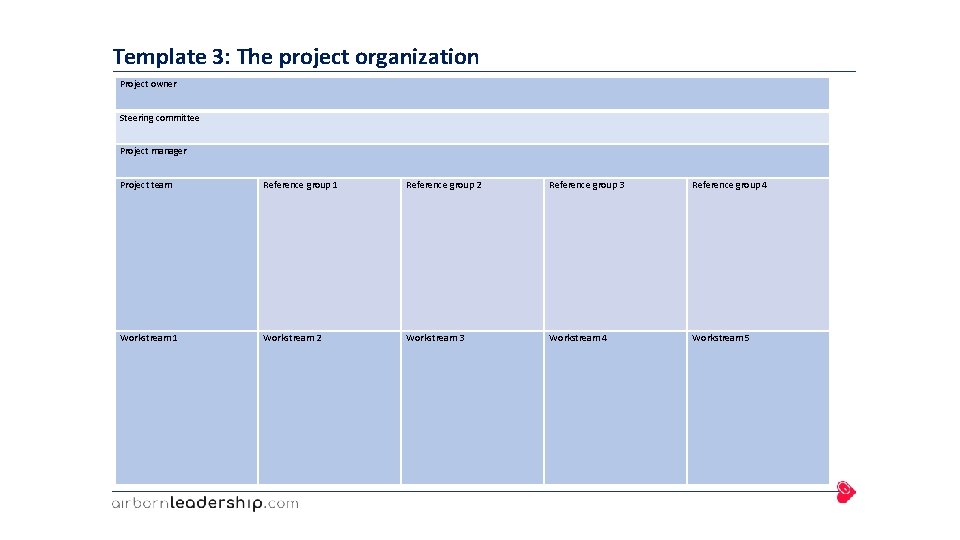
Template 3: The project organization Project owner Steering committee Project manager Project team Reference group 1 Reference group 2 Reference group 3 Reference group 4 Workstream 2 Workstream 3 Workstream 4 Workstream 5 Workstream 1
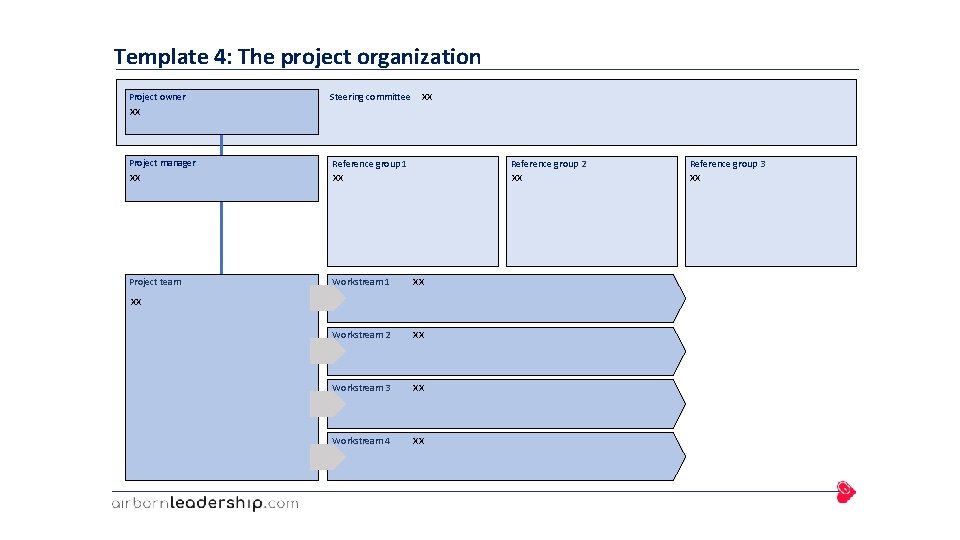
Template 4: The project organization xx Project owner xx Steering committee Project manager xx Reference group 1 Project team Workstream 1 xx Workstream 2 xx Workstream 3 xx Workstream 4 xx Reference group 2 xx xx xx Reference group 3 xx
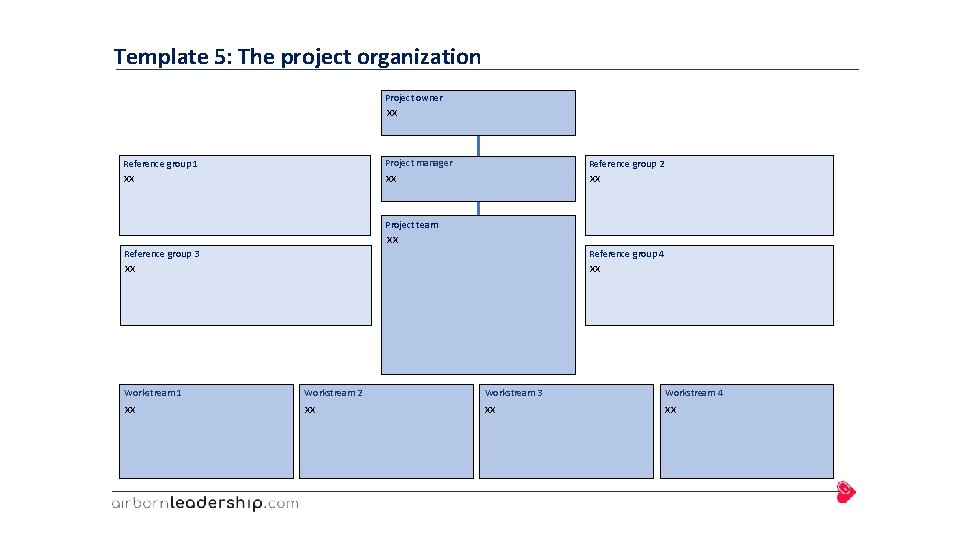
Template 5: The project organization Project owner xx Reference group 1 Project manager Reference group 2 xx xx xx Project team xx Reference group 3 Reference group 4 xx xx Workstream 1 Workstream 2 Workstream 3 Workstream 4 xx xx

Template 6: The project organization Project owner xx Steering committee xx Reference group 1 Project manager Reference group 2 xx xx xx Project team xx Reference group 3 Reference group 4 xx xx Workstream 1 Workstream 2 Workstream 3 Workstream 4 xx xx
References and links Connection to other tools Hierarchy of objectives and impact case: The hierarchy or impact case describes the project's impacts. The project's workstreams are often organized on the basis of these desired impacts. The milestone plan: You must always organize the project according to the assignment. The milestone plan describes the solution to the assignment and there must therefore be a connection between the milestone plan and the organization. The stakeholder analysis: The analysis describes which stakeholders are important to involve in the development of the project. It will often be some of these target groups that participate in work groups, project team, reference groups, etc. Links References • The book Power in projects, programs and portfolio, 1 st edition, Djoef Publishment 2015

Find other tools and other useful knowledge in theories, videos, books or through our e-learning modules Unleash your potential
- Slides: 13