
Sizing Your Development Effort Using Function Point Analysis
- Slides: 48
Sizing Your Development Effort Using Function Point Analysis Mike Pasley Logic Central http: //www. logicentral. com
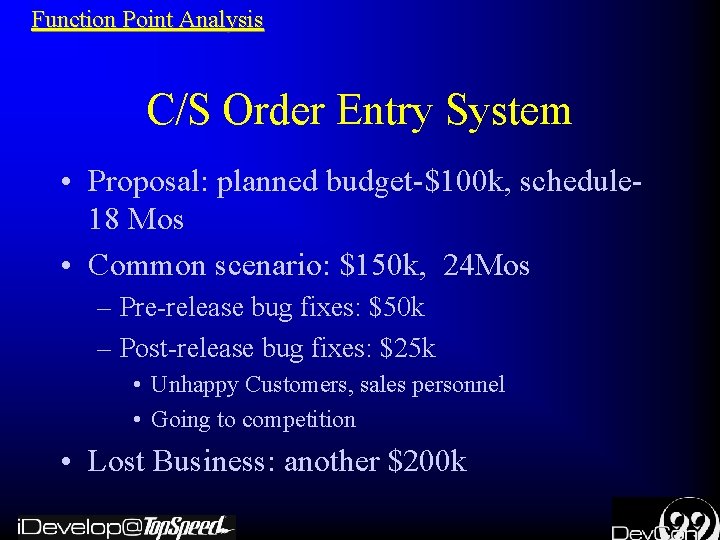
Function Point Analysis C/S Order Entry System • Proposal: planned budget-$100 k, schedule 18 Mos • Common scenario: $150 k, 24 Mos – Pre-release bug fixes: $50 k – Post-release bug fixes: $25 k • Unhappy Customers, sales personnel • Going to competition • Lost Business: another $200 k
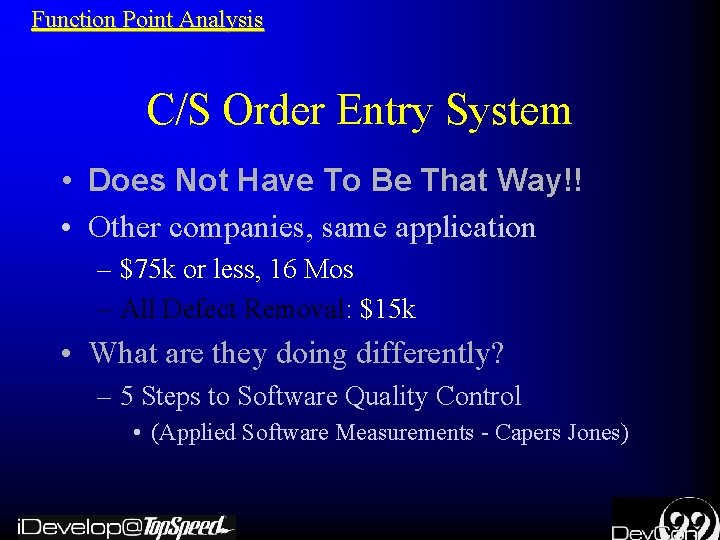
Function Point Analysis C/S Order Entry System • Does Not Have To Be That Way!! • Other companies, same application – $75 k or less, 16 Mos – All Defect Removal: $15 k • What are they doing differently? – 5 Steps to Software Quality Control • (Applied Software Measurements - Capers Jones)
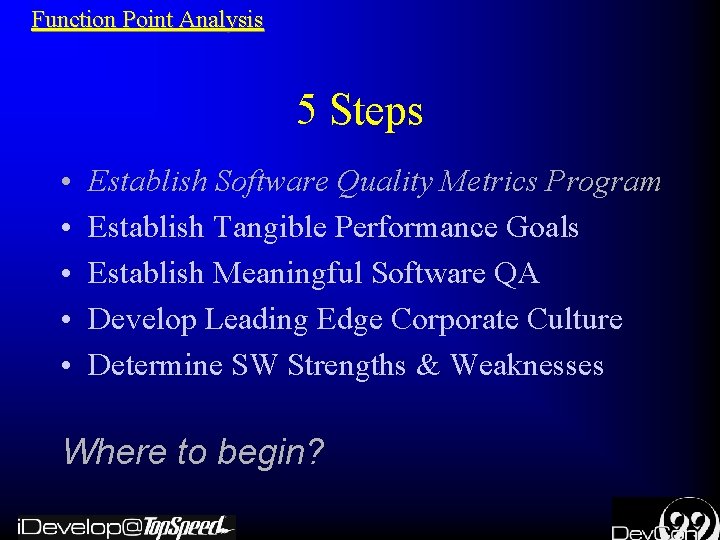
Function Point Analysis 5 Steps • • • Establish Software Quality Metrics Program Establish Tangible Performance Goals Establish Meaningful Software QA Develop Leading Edge Corporate Culture Determine SW Strengths & Weaknesses Where to begin?
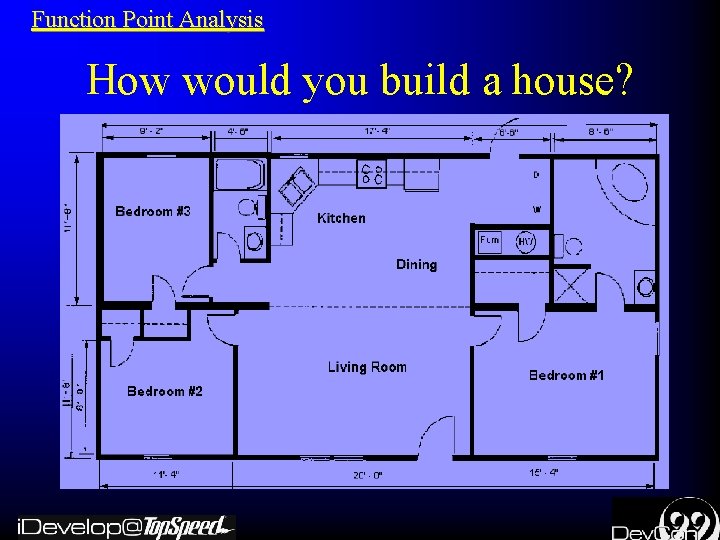
Function Point Analysis How would you build a house?
Function Point Analysis What Is Function Point Analysis? • Synthetic metrics derived from enumerating and weighing five external attributes of software applications: – Inputs – Outputs – Inquiries – Internal Logical Files – External Interface Files Plus Factor: index of system's overall complexity
Function Point Analysis What Is Function Point Analysis? • Function points are indicators of size based on the 'logical' view of a piece of software. • Make it possible to measure the size of information systems according to what the user sees and interacts with – Quantify functionality delivered to user based primarily on logical design
Function Point Analysis Summary of Benefits • Scheduling, effort, cost estimates – Easier – Greater Accuracy • Improves communications, sharpens management judgement, improves development process • GUI, Algorithms, Objects
Function Point Analysis Who Needs Function Points • Anyone who has responsibility for estimating and sizing software or measuring productivity • Anyone who is responsible for setting and meeting customer expectations for software projects
Function Point Analysis FPA fits Engineering Method • Use of heuristics (a decision-making aid) to cause the best change in a poorly understood system given available resources
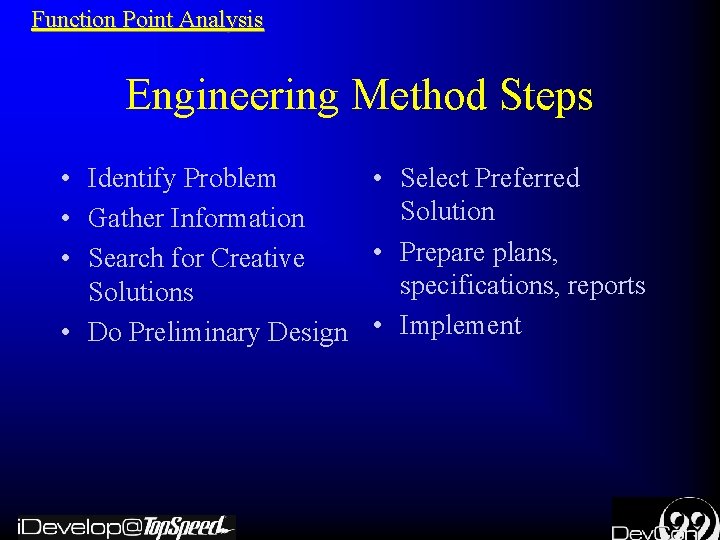
Function Point Analysis Engineering Method Steps • Identify Problem • Select Preferred Solution • Gather Information • Prepare plans, • Search for Creative specifications, reports Solutions • Do Preliminary Design • Implement
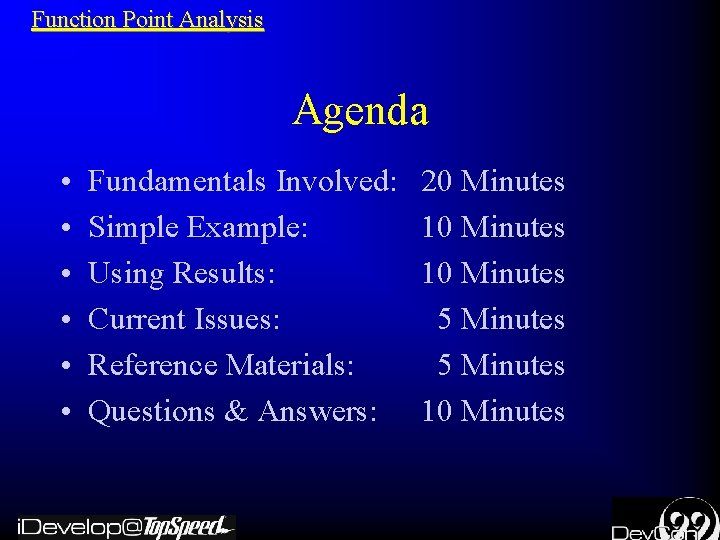
Function Point Analysis Agenda • • • Fundamentals Involved: Simple Example: Using Results: Current Issues: Reference Materials: Questions & Answers: 20 Minutes 10 Minutes 5 Minutes 10 Minutes
Function Point Analysis Development Goals • Software should be completed • Software should work
Function Point Analysis Relationship Goals • Clients should be satisfied • Developers should be satisfied • Clients/Developer relationship should be trusting, respectful
Function Point Analysis Connections • If everyone understands size of project , all parties will work better together • Three blind men/elephant effect: – – One near the tail described it as a snake One near the leg described it as a tree trunk One near the side described it as a wall Each description gives an accurate picture of some aspects of the elephant, but a false picture of the elephant as a whole.
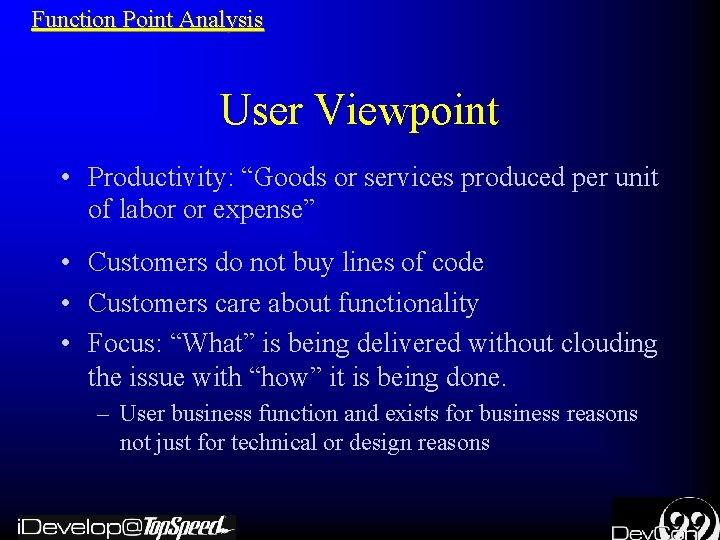
Function Point Analysis User Viewpoint • Productivity: “Goods or services produced per unit of labor or expense” • Customers do not buy lines of code • Customers care about functionality • Focus: “What” is being delivered without clouding the issue with “how” it is being done. – User business function and exists for business reasons not just for technical or design reasons
Function Point Analysis Terminology • • • Application Boundary Inputs Outputs Inquiries Internal Logical Files External Interface Files
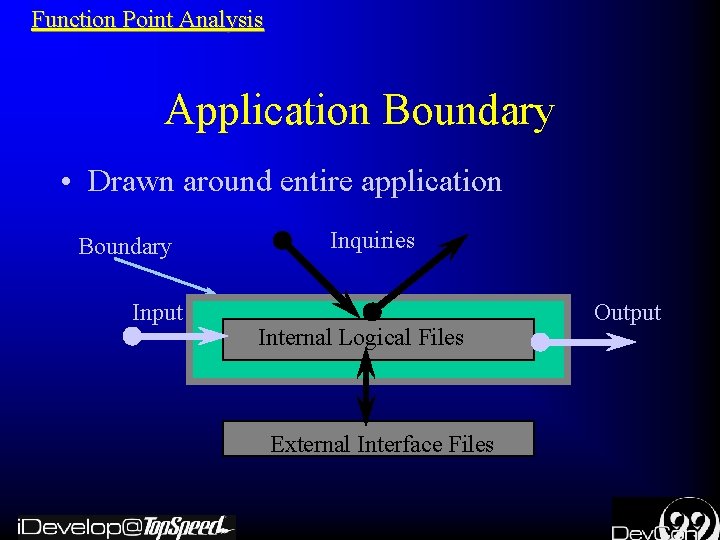
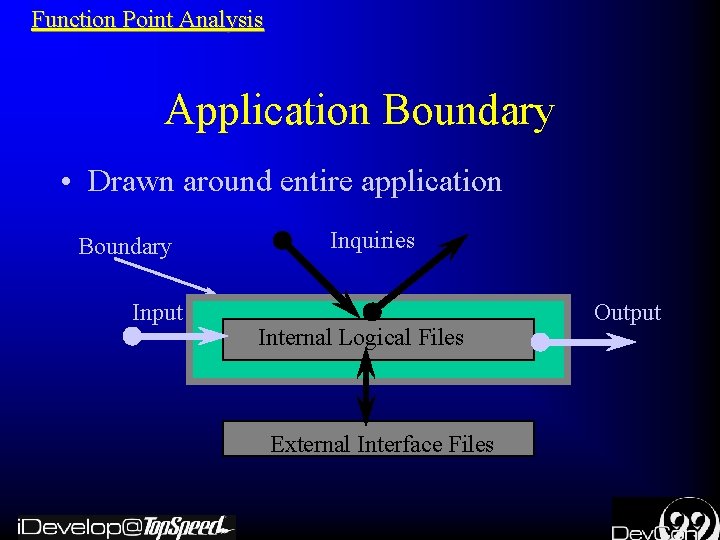
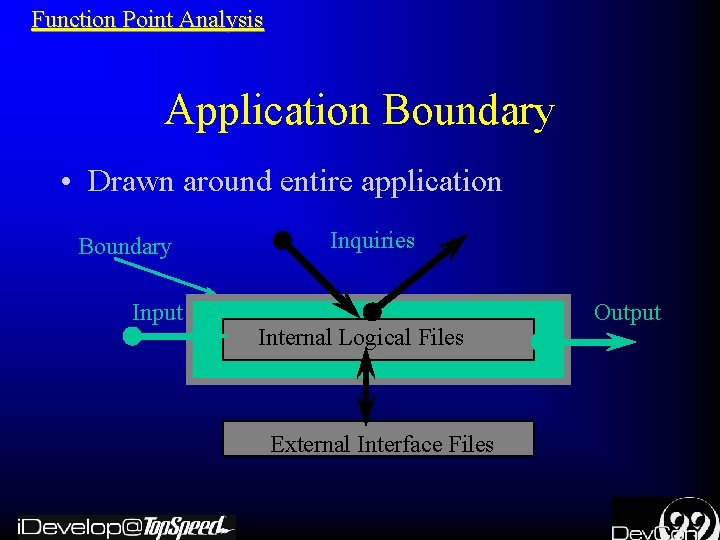
Function Point Analysis Application Boundary • Drawn around entire application Boundary Input Inquiries Internal Logical Files External Interface Files Output
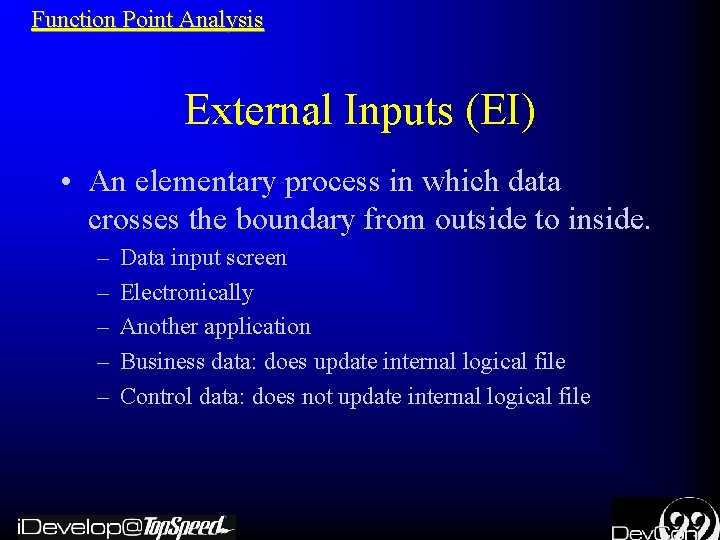
Function Point Analysis External Inputs (EI) • An elementary process in which data crosses the boundary from outside to inside. – – – Data input screen Electronically Another application Business data: does update internal logical file Control data: does not update internal logical file
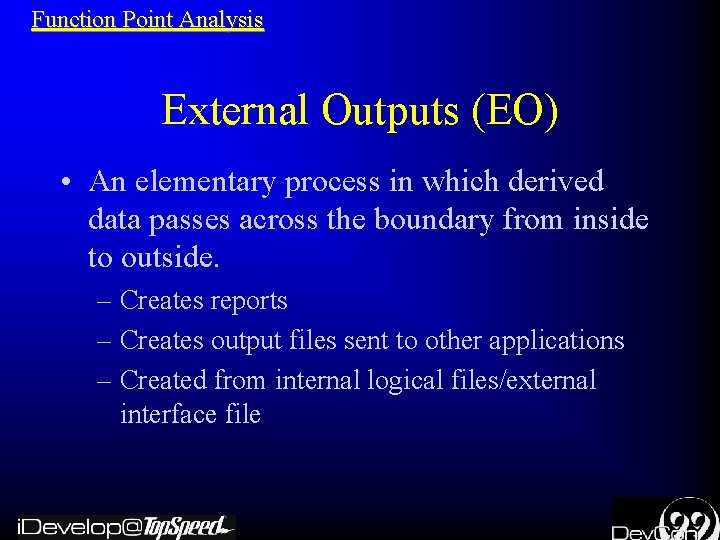
Function Point Analysis External Outputs (EO) • An elementary process in which derived data passes across the boundary from inside to outside. – Creates reports – Creates output files sent to other applications – Created from internal logical files/external interface file
Function Point Analysis External Inquiries (EQ) • An elementary process with both input and output components that result in data retrieval from one or more internal logical files and external interface files • Sent outside the application boundary – Input process does not update ILF – Output side does not contain derived data
Function Point Analysis Internal Logical Files • A User identifiable group of logically related data that entirely within the applications boundary and is maintained through External Inputs
Function Point Analysis External Interface Files (EIF) • A User identifiable group of logically related data that is used for reference purposes only. – Resides entirely outside application – Maintained by another application – It is an ILF for another application
Function Point Analysis Application Boundary • Drawn around entire application Boundary Input Inquiries Internal Logical Files External Interface Files Output
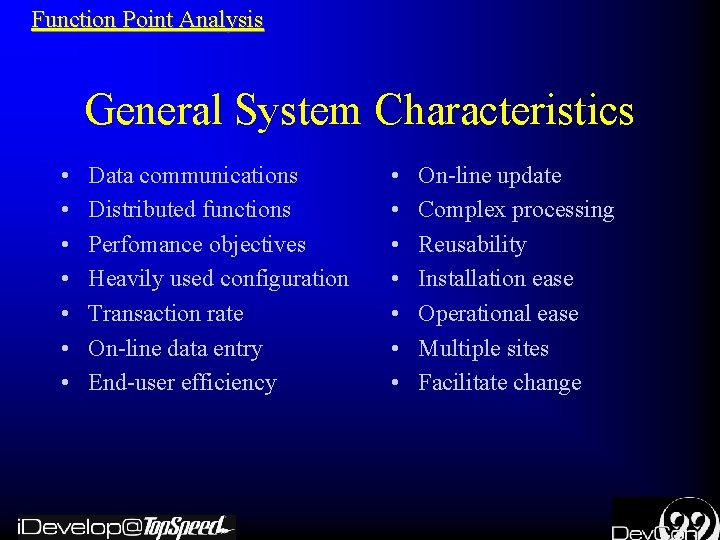
Function Point Analysis General System Characteristics • • Data communications Distributed functions Perfomance objectives Heavily used configuration Transaction rate On-line data entry End-user efficiency • • On-line update Complex processing Reusability Installation ease Operational ease Multiple sites Facilitate change
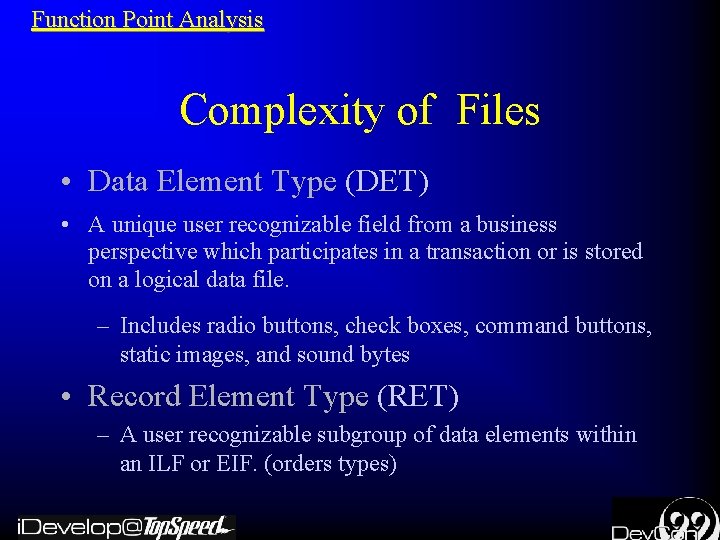
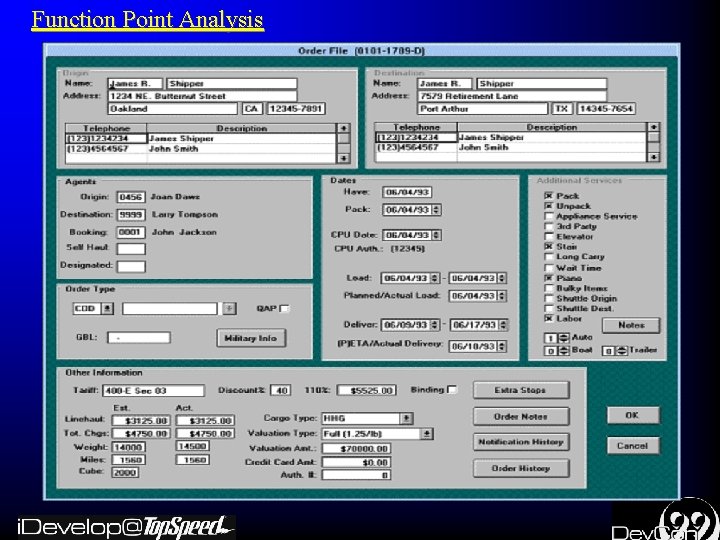
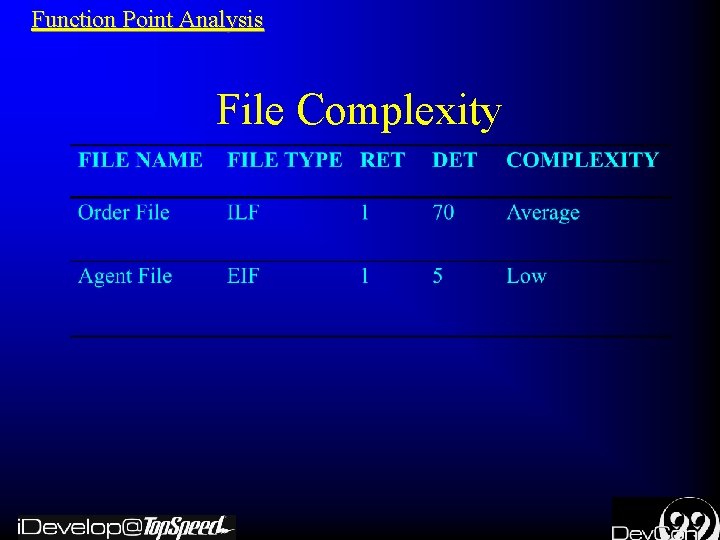
Function Point Analysis Complexity of Files • Data Element Type (DET) • A unique user recognizable field from a business perspective which participates in a transaction or is stored on a logical data file. – Includes radio buttons, check boxes, command buttons, static images, and sound bytes • Record Element Type (RET) – A user recognizable subgroup of data elements within an ILF or EIF. (orders types)
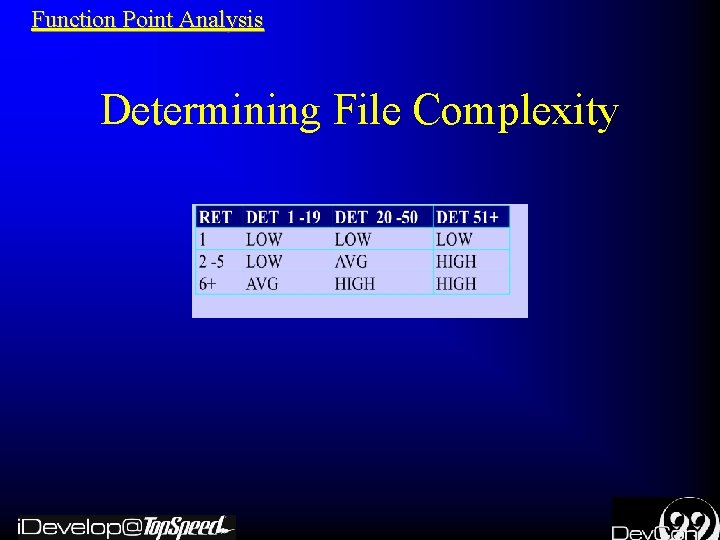
Function Point Analysis Determining File Complexity
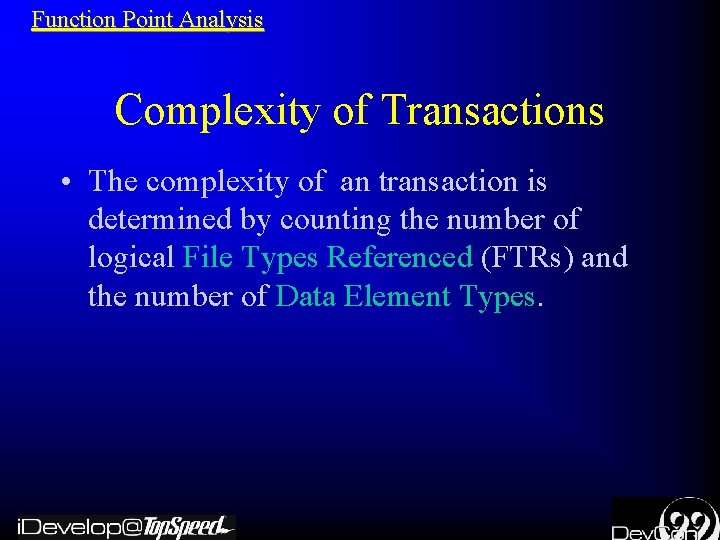
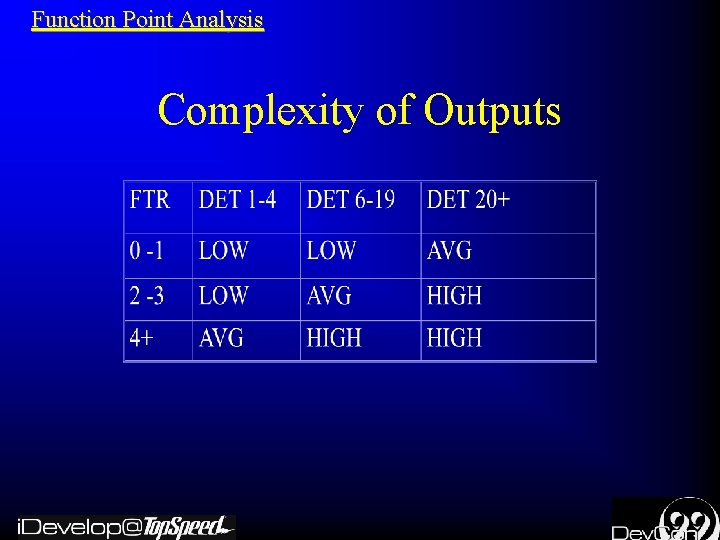
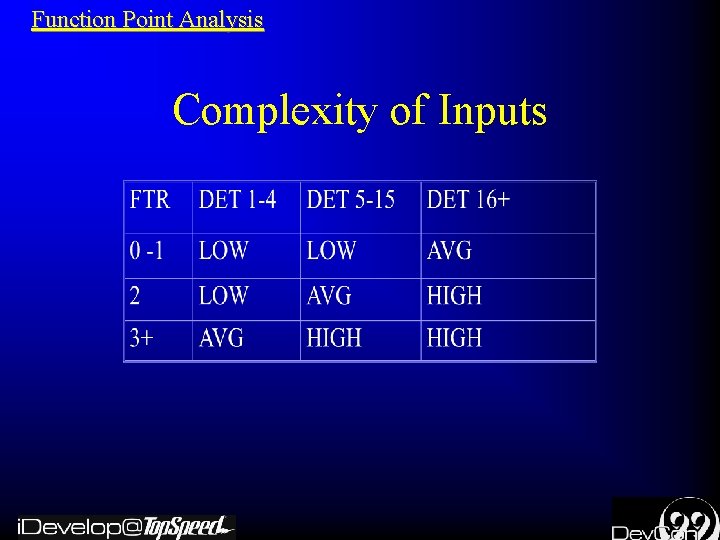
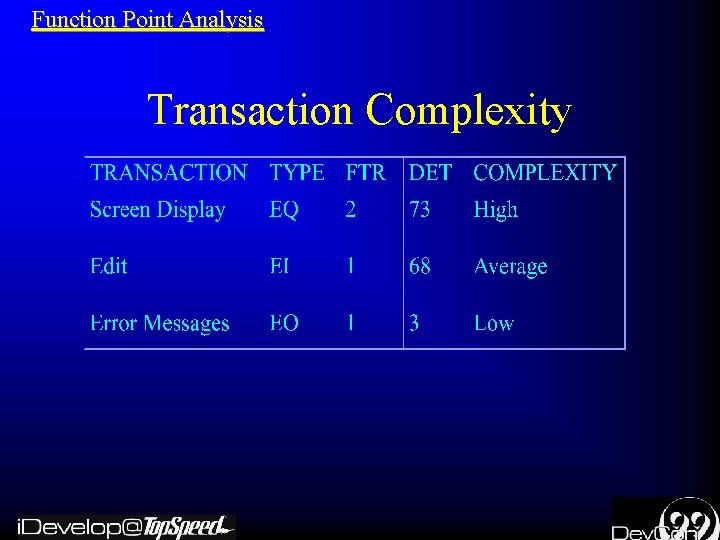
Function Point Analysis Complexity of Transactions • The complexity of an transaction is determined by counting the number of logical File Types Referenced (FTRs) and the number of Data Element Types.
Function Point Analysis Complexity of Outputs
Function Point Analysis Complexity of Inputs
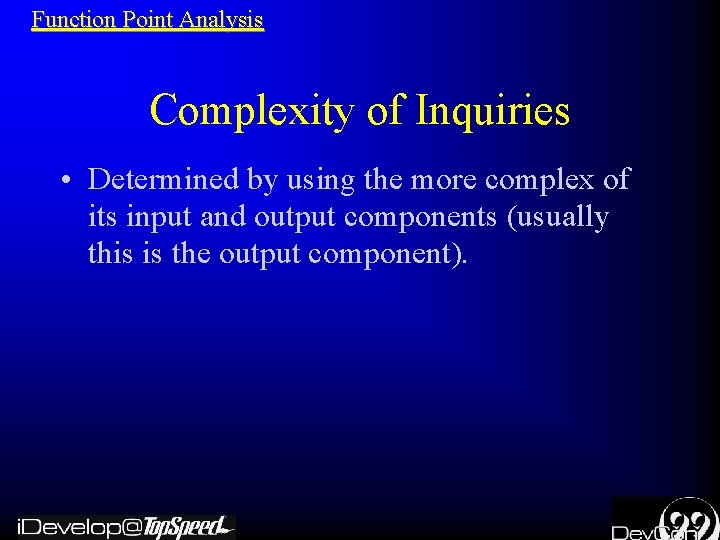
Function Point Analysis Complexity of Inquiries • Determined by using the more complex of its input and output components (usually this is the output component).
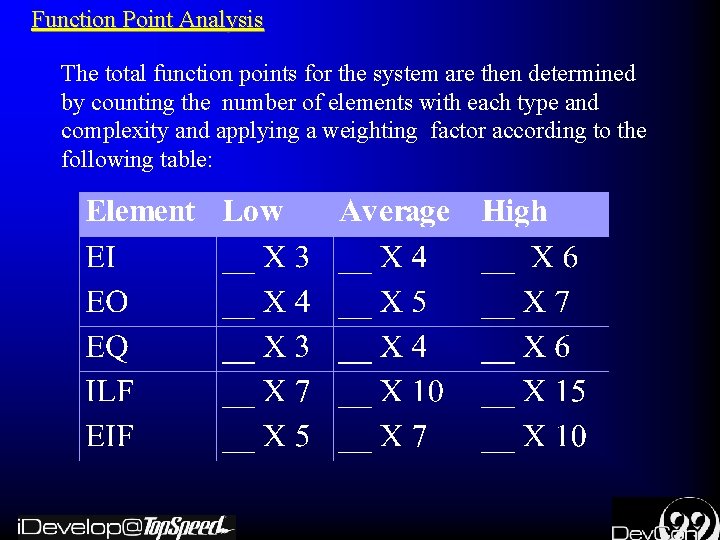
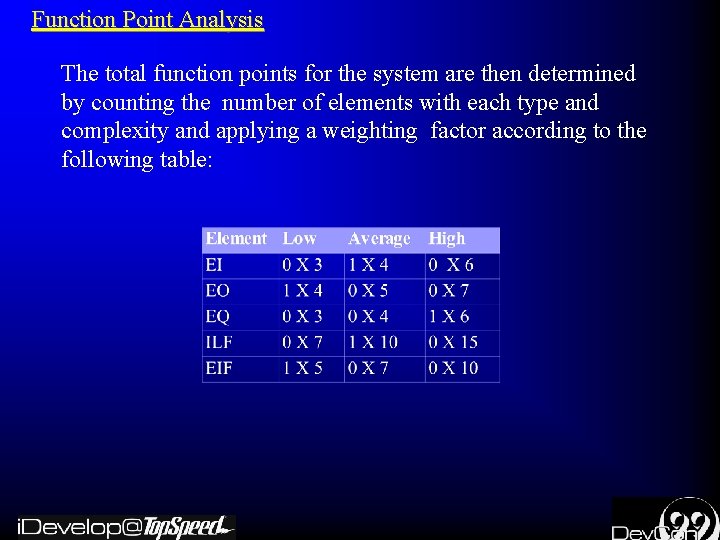
Function Point Analysis The total function points for the system are then determined by counting the number of elements with each type and complexity and applying a weighting factor according to the following table:
Function Point Analysis
Function Point Analysis File Complexity
Function Point Analysis Transaction Complexity
Function Point Analysis The total function points for the system are then determined by counting the number of elements with each type and complexity and applying a weighting factor according to the following table:
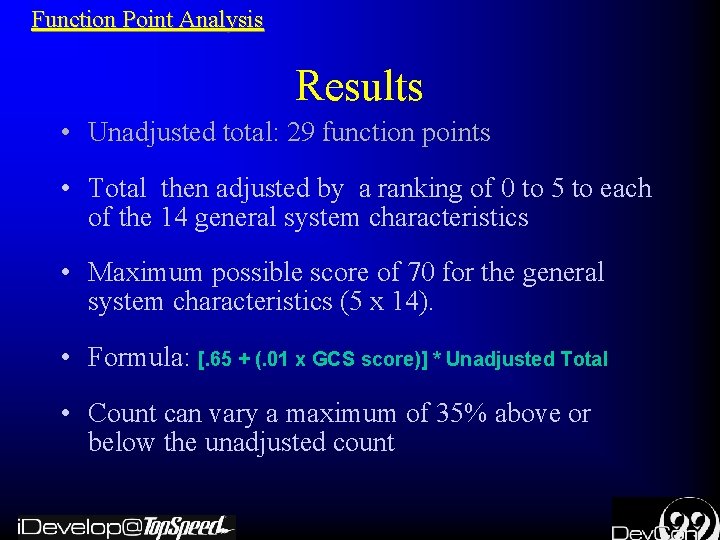
Function Point Analysis Results • Unadjusted total: 29 function points • Total then adjusted by a ranking of 0 to 5 to each of the 14 general system characteristics • Maximum possible score of 70 for the general system characteristics (5 x 14). • Formula: [. 65 + (. 01 x GCS score)] * Unadjusted Total • Count can vary a maximum of 35% above or below the unadjusted count
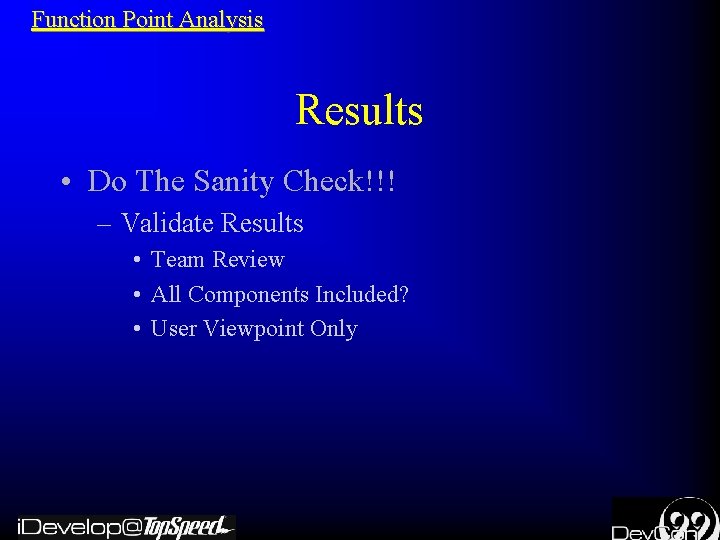
Function Point Analysis Results • Do The Sanity Check!!! – Validate Results • Team Review • All Components Included? • User Viewpoint Only
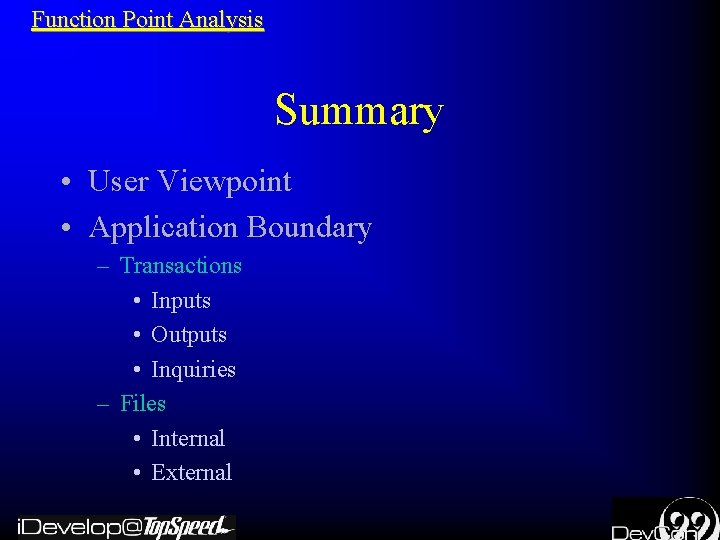
Function Point Analysis Summary • User Viewpoint • Application Boundary – Transactions • Inputs • Outputs • Inquiries – Files • Internal • External
Function Point Analysis User Viewpoint • Productivity: “Goods or services produced per unit of labor or expense” • Customers do not buy lines of code • Customers care about functionality • Focus: “What” is being delivered without clouding the issue with “how” it is being done. – User business function and exists for business reasons not just for technical or design reasons
Function Point Analysis Application Boundary • Drawn around entire application Boundary Input Inquiries Internal Logical Files External Interface Files Output
Function Point Analysis Benefits of Function Points • Scheduling, effort, cost estimates • Effects on communications, sharpens management judgement, improves development process • GUI, Algorithms, Objects
Function Point Analysis Gather Documentation • Users’ perceived objectives, problems and needs. • Documentation regarding the current system, • Refined objectives and constraints for the proposed system. • Requirements documentation • All Window and Report Layouts • Interfaces with other systems • Logical and/or preliminary physical data models
Function Point Analysis Economic Applications • Production – FP person -month – Work/hrs per FP – $Dev per FP – $Maint per FP • Consumption – FP owned by enterprise – FP needed by end users – Build, lease, or purchase – Contract vs In. House – Value Analysis u Quality • Test cases per FP • Defects discovered per FP • Defect Potential per FP • Defect Removal per FP
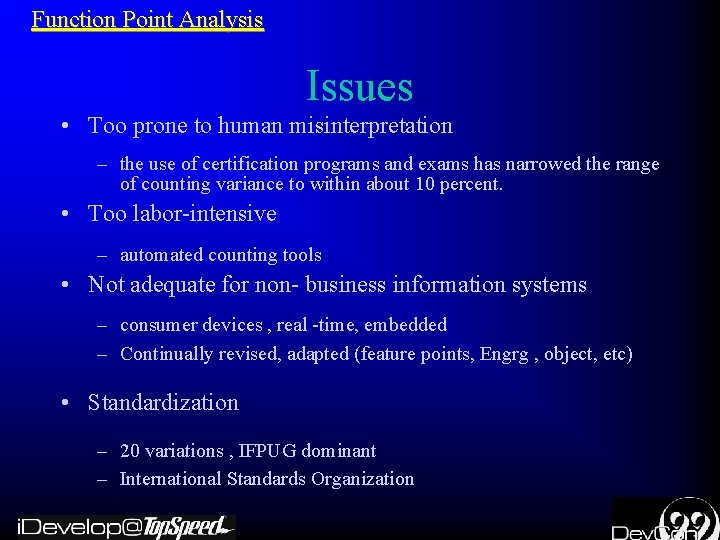
Function Point Analysis Issues • Too prone to human misinterpretation – the use of certification programs and exams has narrowed the range of counting variance to within about 10 percent. • Too labor-intensive – automated counting tools • Not adequate for non- business information systems – consumer devices , real -time, embedded – Continually revised, adapted (feature points, Engrg , object, etc) • Standardization – 20 variations , IFPUG dominant – International Standards Organization
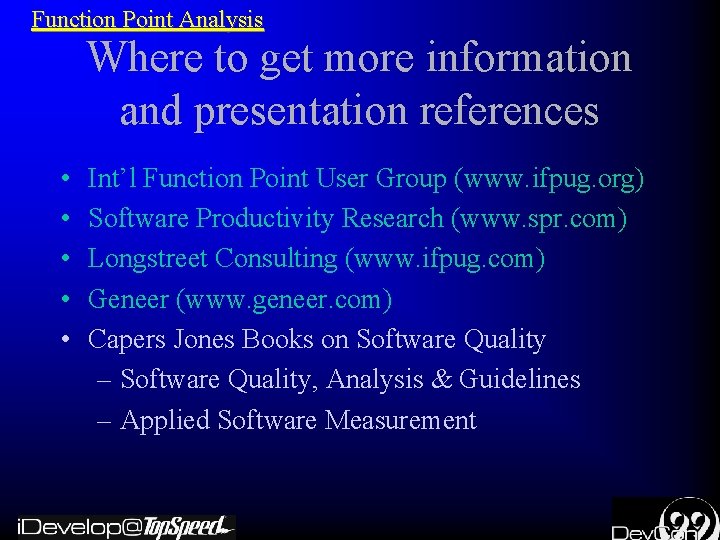
Function Point Analysis Where to get more information and presentation references • • • Int’l Function Point User Group (www. ifpug. org) Software Productivity Research (www. spr. com) Longstreet Consulting (www. ifpug. com) Geneer (www. geneer. com) Capers Jones Books on Software Quality – Software Quality, Analysis & Guidelines – Applied Software Measurement
Function Point Analysis Questions ? ?
Function Point Analysis Contact Information Mike Pasley Email Address: mpasley@logicentral. com Logic Central Web Page: http: //www. logicentral. com