
Sixth Northwest Conservation Electric Power Plan Woody Biomass
Sixth Northwest Conservation & Electric Power Plan Woody Biomass Resource Assessment Jeff King Northwest Power and Conservation Council Generating Resources Advisory Committee Portland, OR March 19, 2009 February 10, 2008
Woody biomass fuels Residue fuels: • Biogenic MSW • • Urban wood residues Unrecycled paper & cardboard Food waste Construction & demolition debris Hog fuel Orchard prunings, other woody agricultural residues Mill residues Logging slash Unmerchantable residue from forest management operations Energy crops • Hybrid poplar/cottonwood plantations in the Northwest • Higher value as fiber foreseeable future February 10, 2008
Woody biomass energy resource issues I Mature technology Well-established in the Northwest Long association with the forest products industry Boom in '80's, retirements in '90 s, some post-2000 development 335 MW operating capacity in PNW (some co-fired w/NG or FO) Generally acknowledged to be CO 2 -neutral over time Can solve waste disposal problems Some cogeneration applications Sustained peaking capacity value Could use for load-following, though not customary February 10, 2008
Woody biomass energy resource issues II Has been cost-effective only at low fuel costs Fuel supply issues: Competing uses for fuel (landscaping, animal husbandry, etc. ) Securing reliable fuel supply for independent plants has been difficult Mill & logging residue availability sensitive to economic cycles Forest product sector cogeneration value sensitive to economic cycles Sustained fire risk management has been difficult to implement on public forest lands Forest management subsidy or capped price may be needed to ensure steady and economic supply of non-merchantable forest thinnings. Not perceived as "green" as non-thermal renewable resources Lower PTC than wind ($10/MWh) (mature technology) February 10, 2008

Woody biomass residue fuels Sources: • Unused logging slash • Unused mill residues • Forest thinning residues Morbark Tub Grinder • Fire risk reduction • Pre-commercial thinning • Biogenic fraction of MSW Availability based on estimates published in Jan 2006 by the Western Governor's Association Forest thinning residue assumptions: • Plausible thinning of commercial timberland w/stand replacement fire risk at a rate sustainable for 20 years. • Additional timberland will have developed into the at-risk category following 20 years • Limited to land w/50% merchantable thinning products. February 10, 2008
Estimated fuel cost ($/MMBtu, delivered) Data (scarce, no central exchange!) California Energy Commission, 2006 Reported PNW marginal, forest thinning, 2008 Reported PNW annual average fuel supply, 2008 Sierra Nevada Conservancy, demonstration forest thinning project, 2008 Proposed $2. 50 $3. 20 $1. 80 - $2. 10 $3. 40 $3. 00 • Marginal sources will be forest thinning residues. • Sierra Nevada Conservancy demonstration project is representative, welldocumented, consistent with reported PNW forest thinning costs. • Some fraction of lower cost supply (mill residues, orchard trimmings, etc. ) will reduce average cost slightly. February 10, 2008
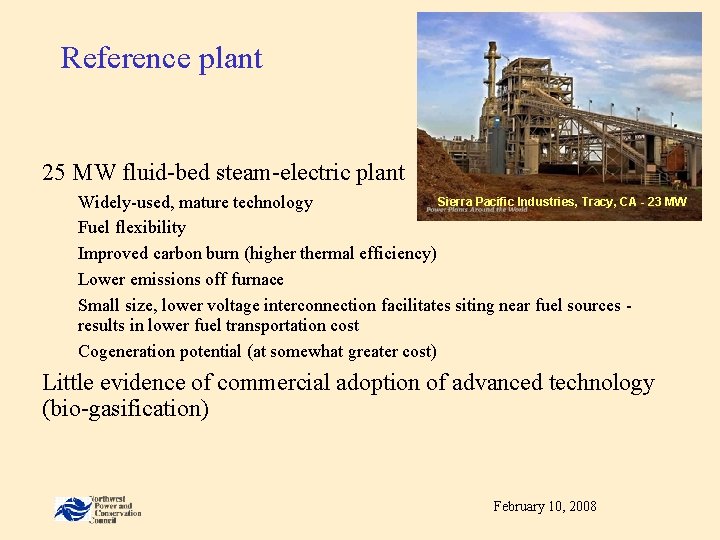
Reference plant 25 MW fluid-bed steam-electric plant Sierra Pacific Industries, Tracy, CA - 23 MW Widely-used, mature technology Fuel flexibility Improved carbon burn (higher thermal efficiency) Lower emissions off furnace Small size, lower voltage interconnection facilitates siting near fuel sources results in lower fuel transportation cost Cogeneration potential (at somewhat greater cost) Little evidence of commercial adoption of advanced technology (bio-gasification) February 10, 2008
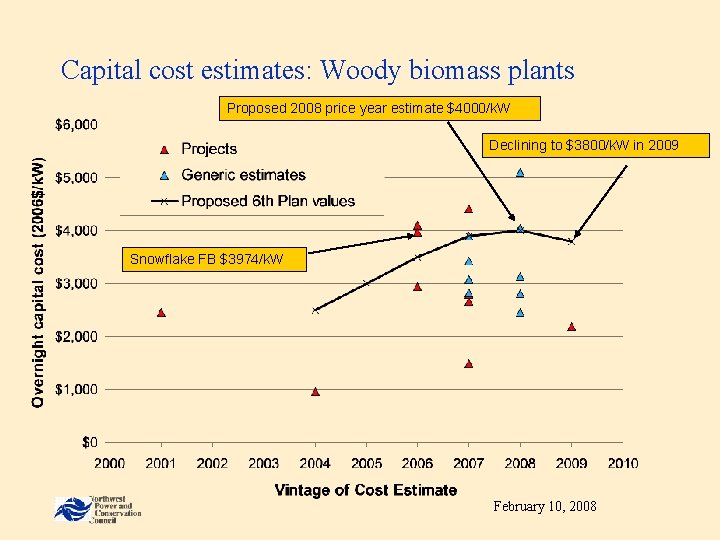
Capital cost estimates: Woody biomass plants Proposed 2008 price year estimate $4000/k. W Declining to $3800/k. W in 2009 Snowflake FB $3974/k. W February 10, 2008
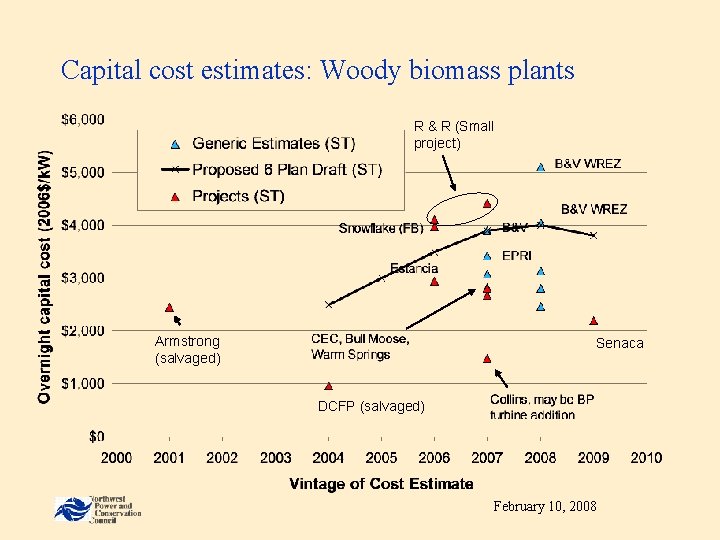
Capital cost estimates: Woody biomass plants R & R (Small project) Armstrong (salvaged) Senaca DCFP (salvaged) February 10, 2008
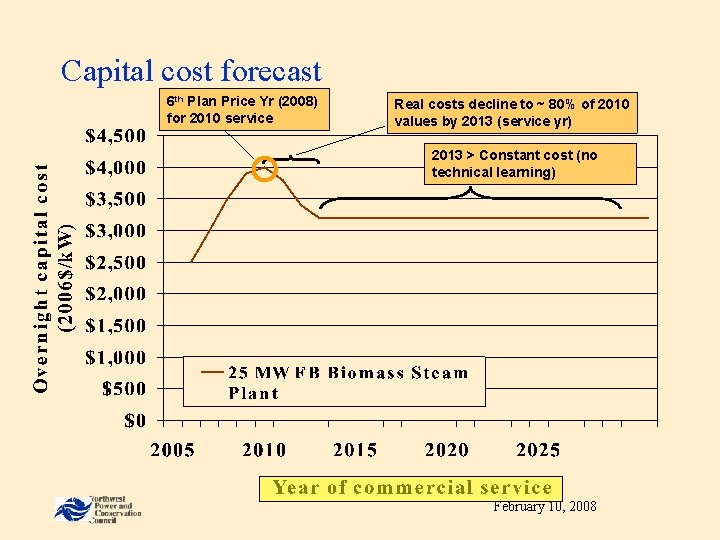
Capital cost forecast 6 th Plan Price Yr (2008) for 2010 service Real costs decline to ~ 80% of 2010 values by 2013 (service yr) 2013 > Constant cost (no technical learning) February 10, 2008
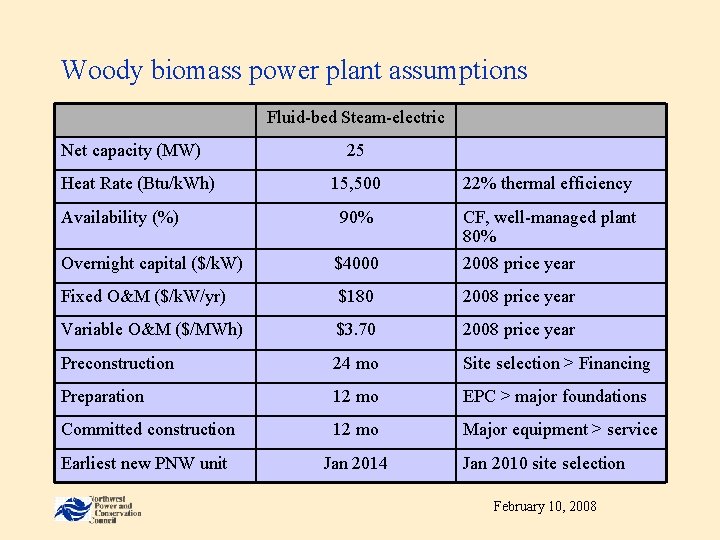
Woody biomass power plant assumptions Fluid-bed Steam-electric Net capacity (MW) Heat Rate (Btu/k. Wh) Availability (%) 25 15, 500 22% thermal efficiency 90% Overnight capital ($/k. W) $4000 CF, well-managed plant 80% 2008 price year Fixed O&M ($/k. W/yr) $180 2008 price year Variable O&M ($/MWh) $3. 70 2008 price year Preconstruction 24 mo Site selection > Financing Preparation 12 mo EPC > major foundations Committed construction 12 mo Major equipment > service Earliest new PNW unit Jan 2014 Jan 2010 site selection February 10, 2008
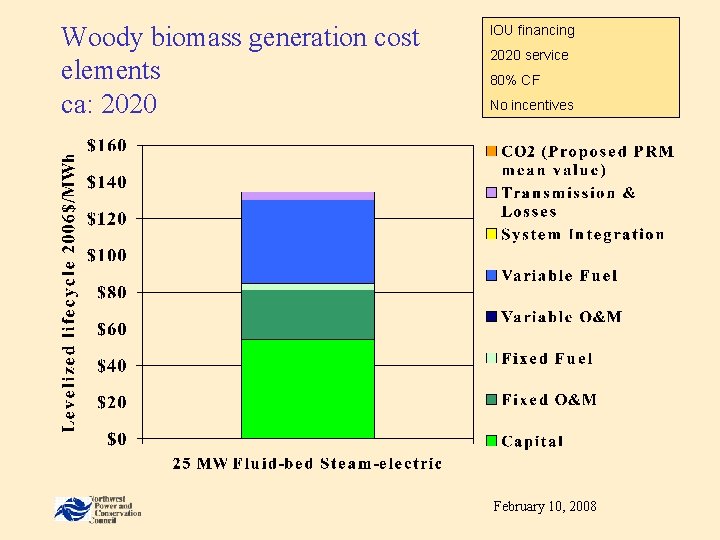
Woody biomass generation cost elements ca: 2020 IOU financing 2020 service 80% CF No incentives February 10, 2008
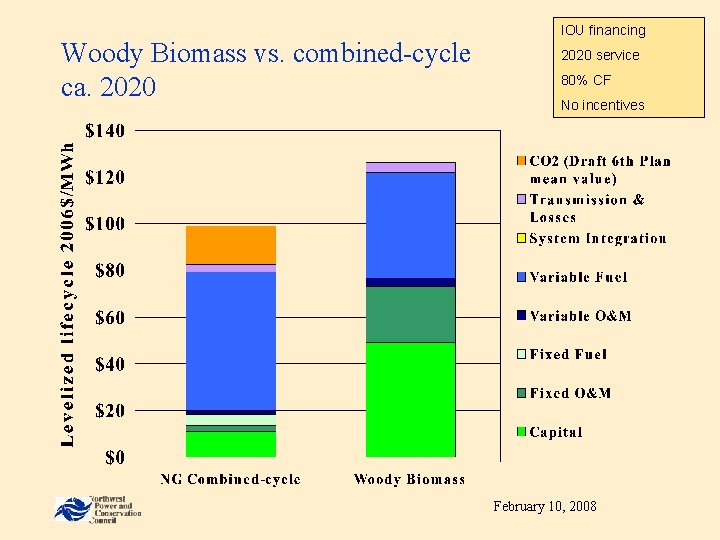
Woody Biomass vs. combined-cycle ca. 2020 IOU financing 2020 service 80% CF No incentives February 10, 2008
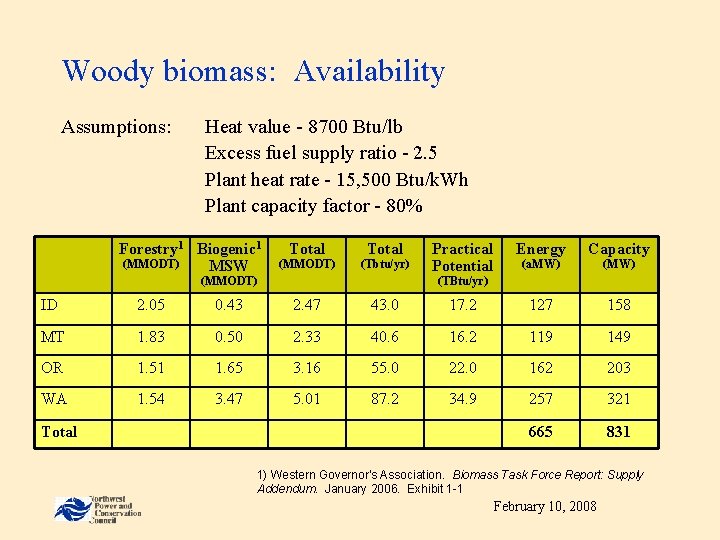
Woody biomass: Availability Assumptions: Heat value - 8700 Btu/lb Excess fuel supply ratio - 2. 5 Plant heat rate - 15, 500 Btu/k. Wh Plant capacity factor - 80% Forestry 1 Biogenic 1 (MMODT) MSW Total (MMODT) Total (Tbtu/yr) (MMODT) Practical Potential Energy Capacity (a. MW) (TBtu/yr) ID 2. 05 0. 43 2. 47 43. 0 17. 2 127 158 MT 1. 83 0. 50 2. 33 40. 6 16. 2 119 149 OR 1. 51 1. 65 3. 16 55. 0 22. 0 162 203 WA 1. 54 3. 47 5. 01 87. 2 34. 9 257 321 665 831 Total 1) Western Governor's Association. Biomass Task Force Report: Supply Addendum. January 2006. Exhibit 1 -1 February 10, 2008
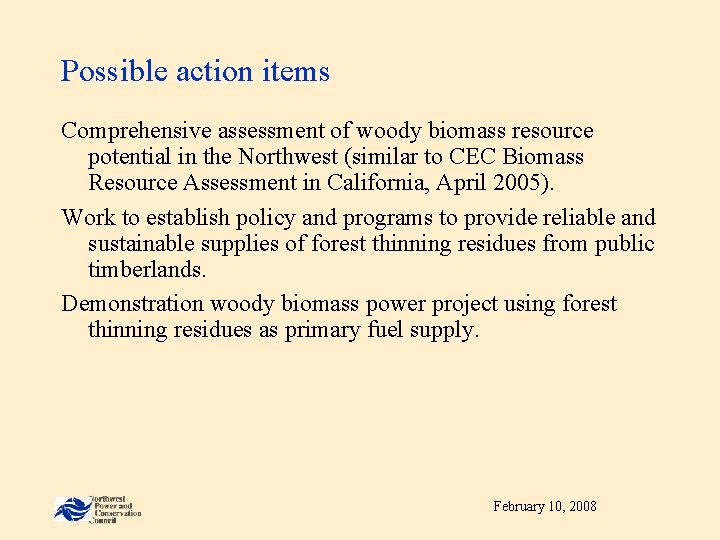
Possible action items Comprehensive assessment of woody biomass resource potential in the Northwest (similar to CEC Biomass Resource Assessment in California, April 2005). Work to establish policy and programs to provide reliable and sustainable supplies of forest thinning residues from public timberlands. Demonstration woody biomass power project using forest thinning residues as primary fuel supply. February 10, 2008
- Slides: 15