
SIX SIGMA Statistical Analysis Apply statistics to validate
- Slides: 38
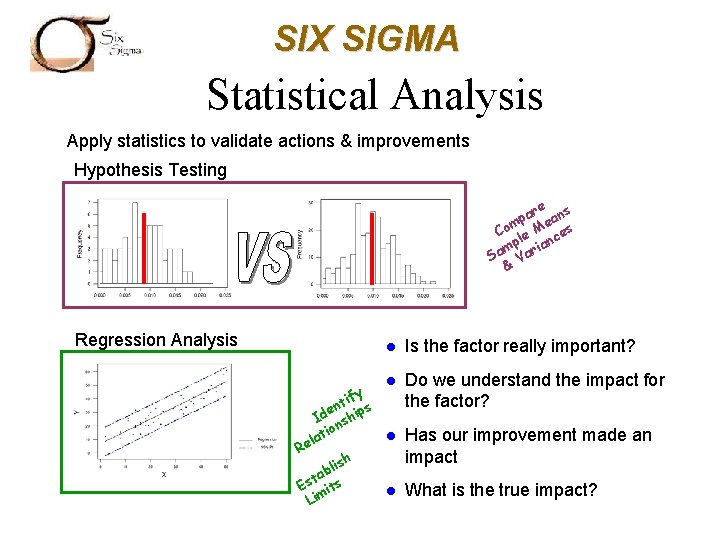
SIX SIGMA Statistical Analysis Apply statistics to validate actions & improvements Hypothesis Testing e ar ans p e m Co le M ces mp arian a S V & Regression Analysis l l y if nt ips e Id nsh tio l a l Re h lis b ta Es its l Lim Is the factor really important? Do we understand the impact for the factor? Has our improvement made an impact What is the true impact?
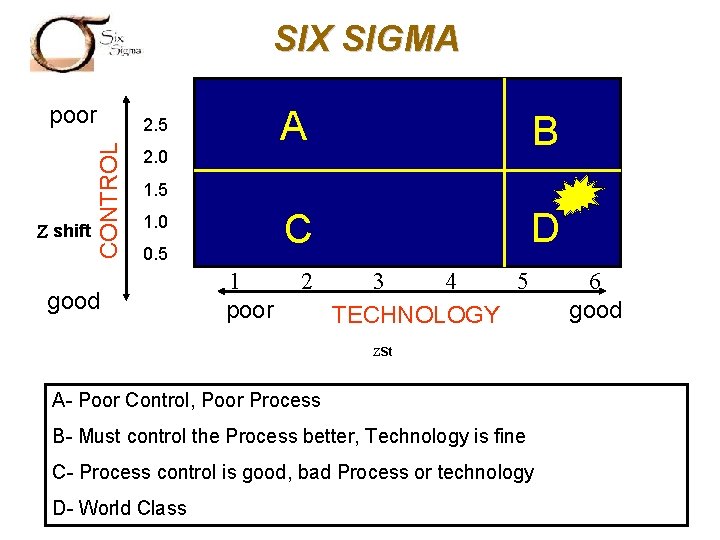
SIX SIGMA Z shift CONTROL poor 2. 5 2. 0 A B C D 1. 5 1. 0 0. 5 good 1 poor 2 3 4 5 TECHNOLOGY ZSt A- Poor Control, Poor Process B- Must control the Process better, Technology is fine C- Process control is good, bad Process or technology D- World Class 6 good
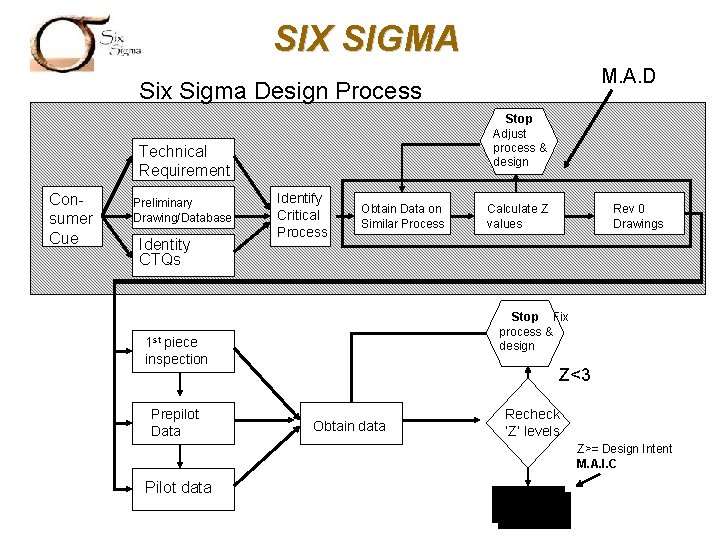
SIX SIGMA M. A. D Six Sigma Design Process Stop Adjust process & design Technical Requirement Consumer Cue Preliminary Drawing/Database Identity CTQs Identify Critical Process Obtain Data on Similar Process Rev 0 Drawings Stop Fix process & design 1 st piece inspection Prepilot Data Calculate Z values Z<3 Obtain data Recheck ‘Z’ levels Z>= Design Intent M. A. I. C Pilot data
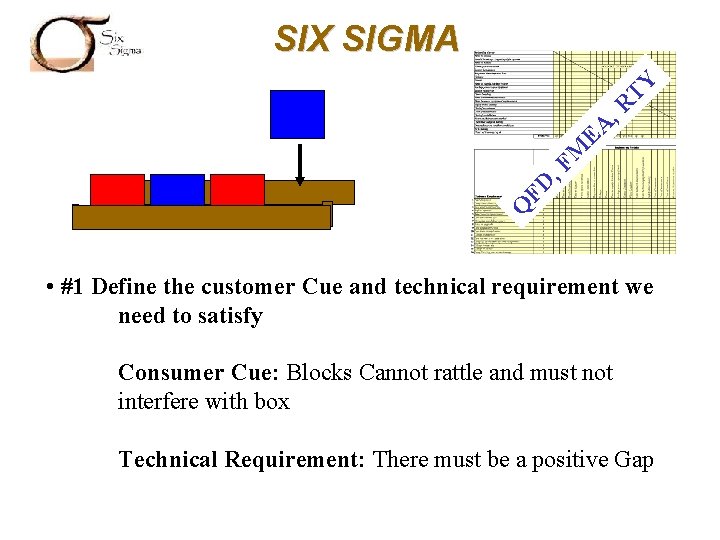
Q FD , F M EA , R TY SIX SIGMA • #1 Define the customer Cue and technical requirement we need to satisfy Consumer Cue: Blocks Cannot rattle and must not interfere with box Technical Requirement: There must be a positive Gap
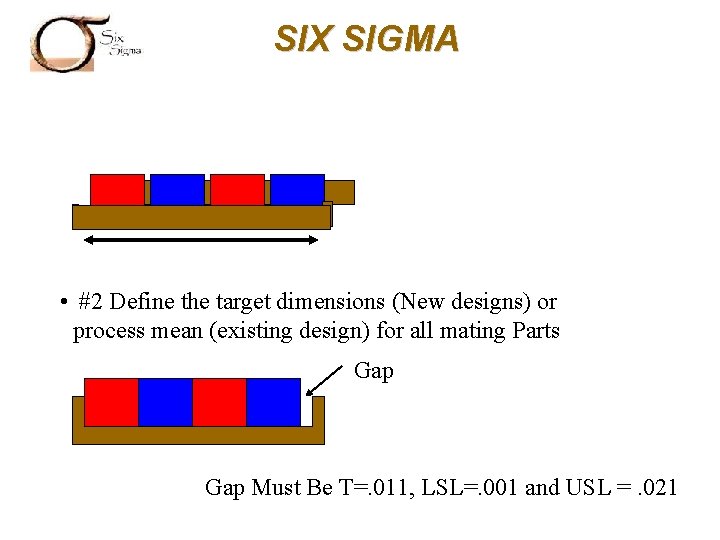
SIX SIGMA • #2 Define the target dimensions (New designs) or process mean (existing design) for all mating Parts Gap Must Be T=. 011, LSL=. 001 and USL =. 021
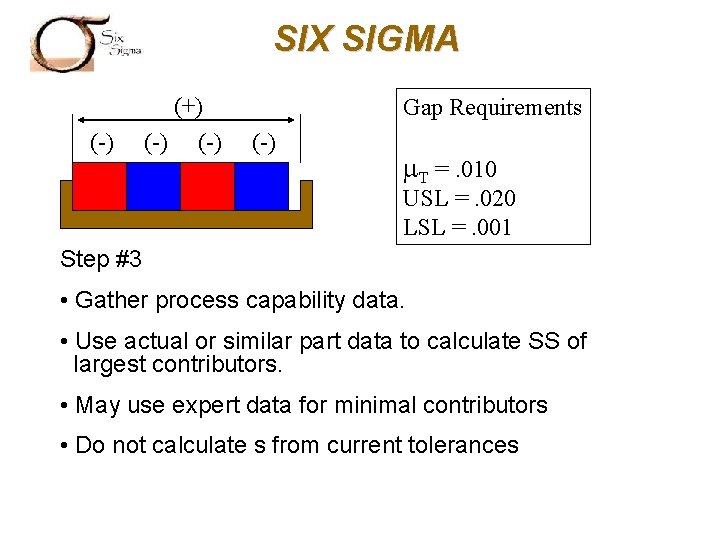
SIX SIGMA (-) (+) (-) Gap Requirements (-) m. T =. 010 USL =. 020 LSL =. 001 Step #3 • Gather process capability data. • Use actual or similar part data to calculate SS of largest contributors. • May use expert data for minimal contributors • Do not calculate s from current tolerances
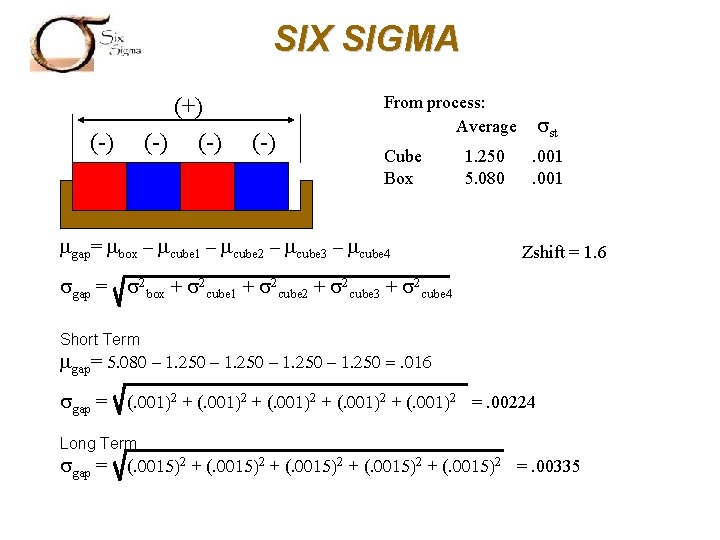
SIX SIGMA (+) (-) (-) From process: Average sst Cube Box . 001 mgap= mbox – mcube 1 – mcube 2 – mcube 3 – mcube 4 sgap = 1. 250 5. 080 Zshift = 1. 6 s 2 box + s 2 cube 1 + s 2 cube 2 + s 2 cube 3 + s 2 cube 4 Short Term mgap= 5. 080 – 1. 250 =. 016 sgap = (. 001)2 + (. 001)2 =. 00224 Long Term sgap = (. 0015)2 + (. 0015)2 =. 00335
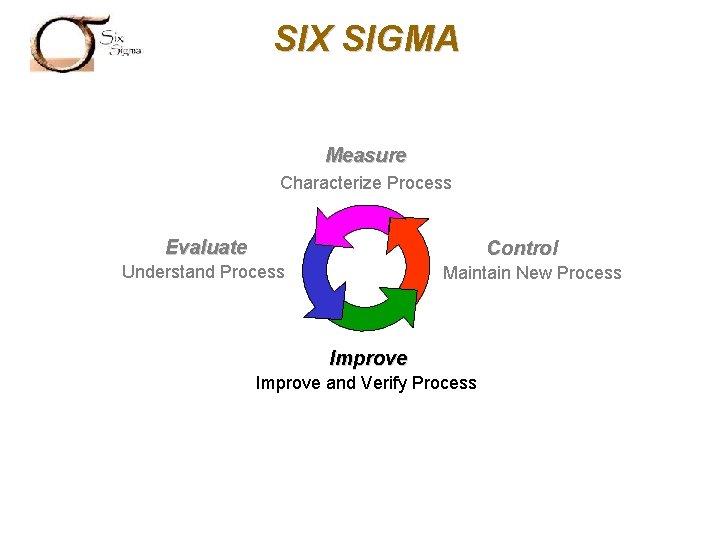
SIX SIGMA Measure Characterize Process Evaluate Control Understand Process Maintain New Process Improve and Verify Process
SIX SIGMA What Do I need to do to improve my Game? 6 GUTTER!
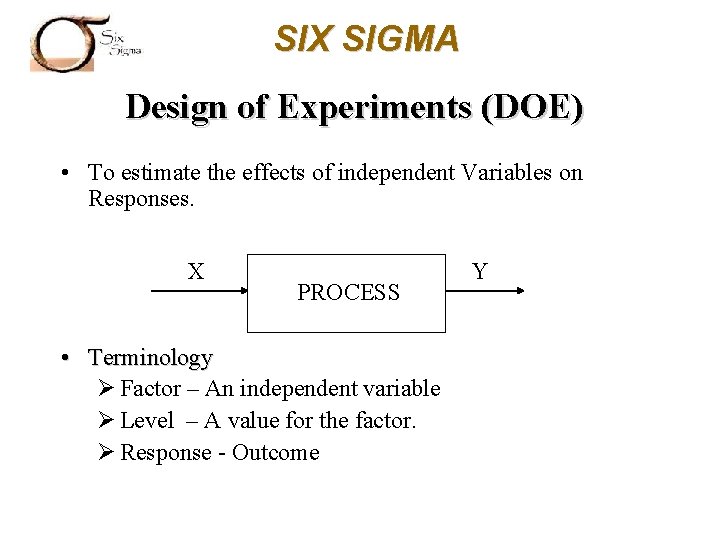
SIX SIGMA Design of Experiments (DOE) • To estimate the effects of independent Variables on Responses. X PROCESS • Terminology Ø Factor – An independent variable Ø Level – A value for the factor. Ø Response - Outcome Y
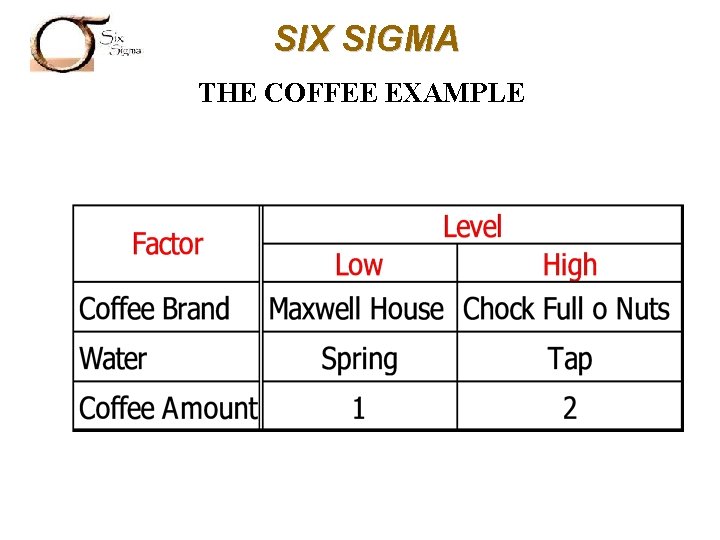
SIX SIGMA THE COFFEE EXAMPLE
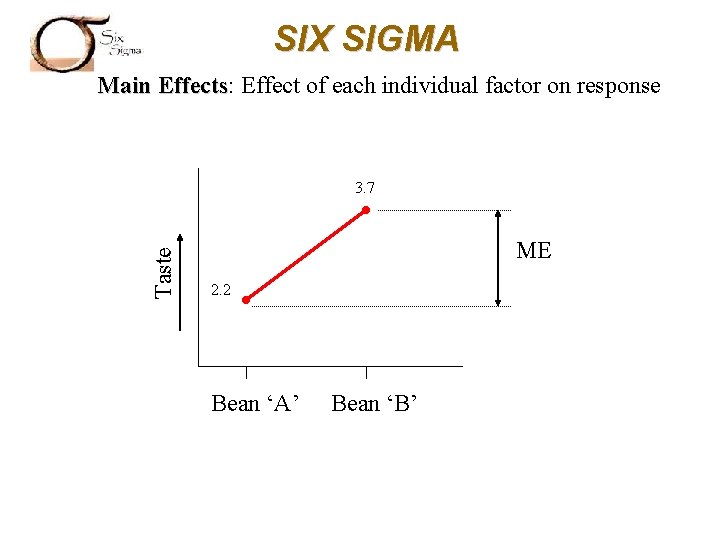
SIX SIGMA Main Effects: Effects Effect of each individual factor on response Taste 3. 7 ME 2. 2 Bean ‘A’ Bean ‘B’
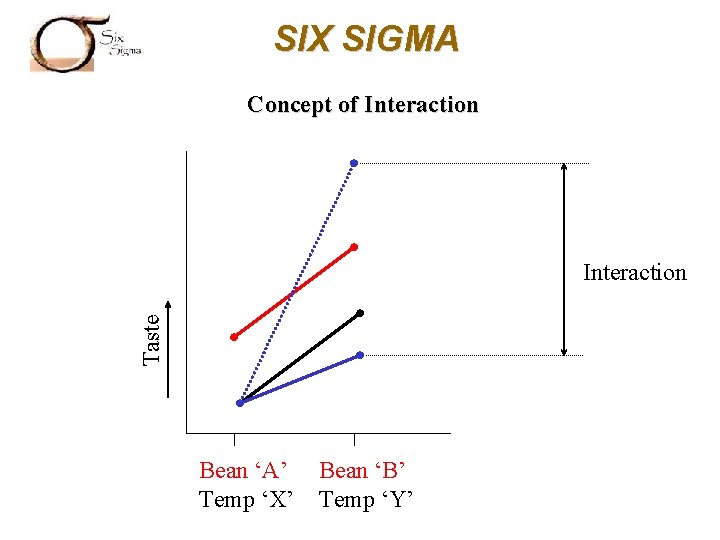
SIX SIGMA Concept of Interaction Taste Interaction Bean ‘A’ Temp ‘X’ Bean ‘B’ Temp ‘Y’
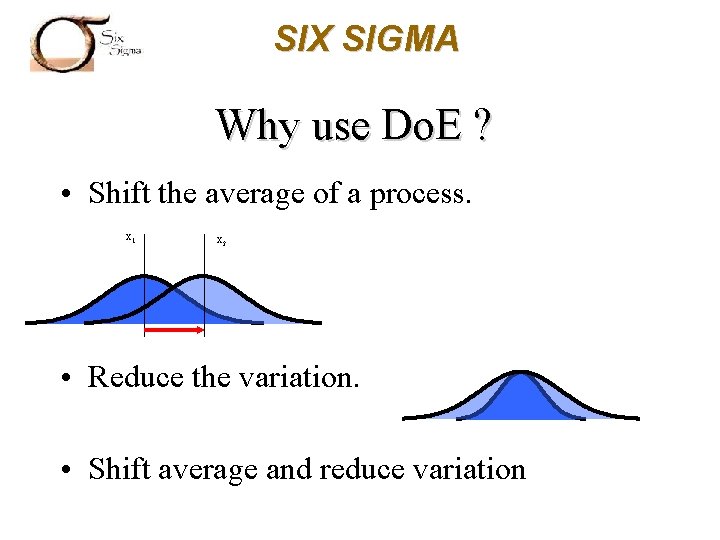
SIX SIGMA Why use Do. E ? • Shift the average of a process. x 1 x 2 • Reduce the variation. • Shift average and reduce variation
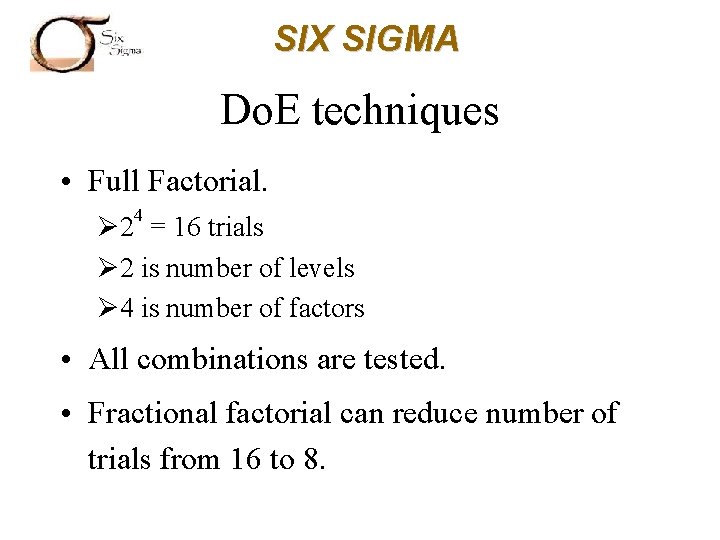
SIX SIGMA Do. E techniques • Full Factorial. 4 Ø 2 = 16 trials Ø 2 is number of levels Ø 4 is number of factors • All combinations are tested. • Fractional factorial can reduce number of trials from 16 to 8.
SIX SIGMA Do. E techniques…. contd. • Fractional Factorial • Taguchi techniques • Response Surface Methodologies • Half fraction
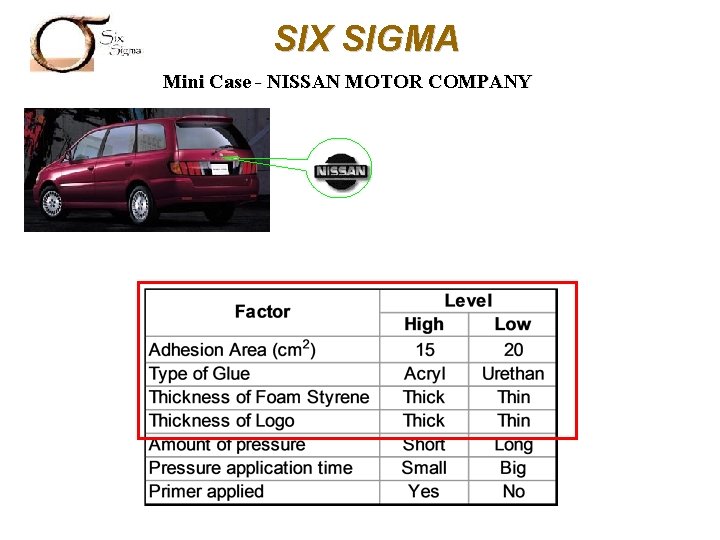
SIX SIGMA Mini Case - NISSAN MOTOR COMPANY
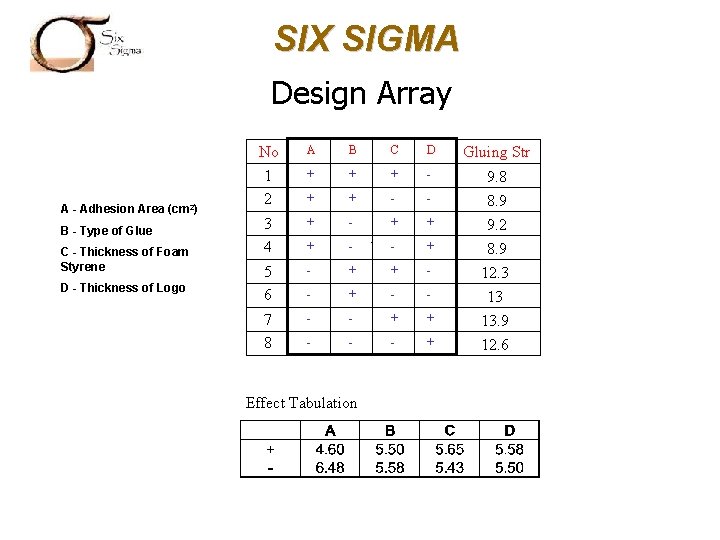
SIX SIGMA Design Array A - Adhesion Area (cm 2) B - Type of Glue C - Thickness of Foam Styrene D - Thickness of Logo No 1 2 A B C D Gluing Str + + + - - 3 4 + - + + + - - + 5 6 - + + - - 7 8 - - + + - - - + 9. 8 8. 9 9. 2 8. 9 12. 3 13 13. 9 12. 6 Effect Tabulation `
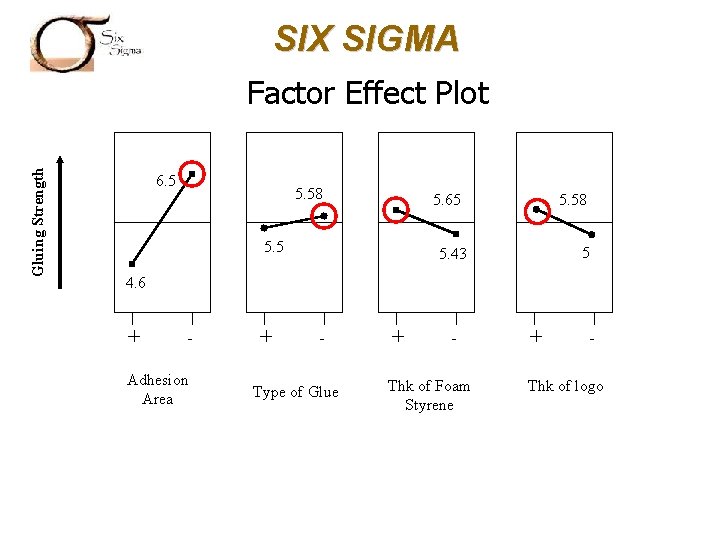
SIX SIGMA Gluing Strength Factor Effect Plot 6. 5 5. 58 5. 65 5. 58 5 5. 43 4. 6 + - Adhesion Area + - Type of Glue + - Thk of Foam Styrene + - Thk of logo
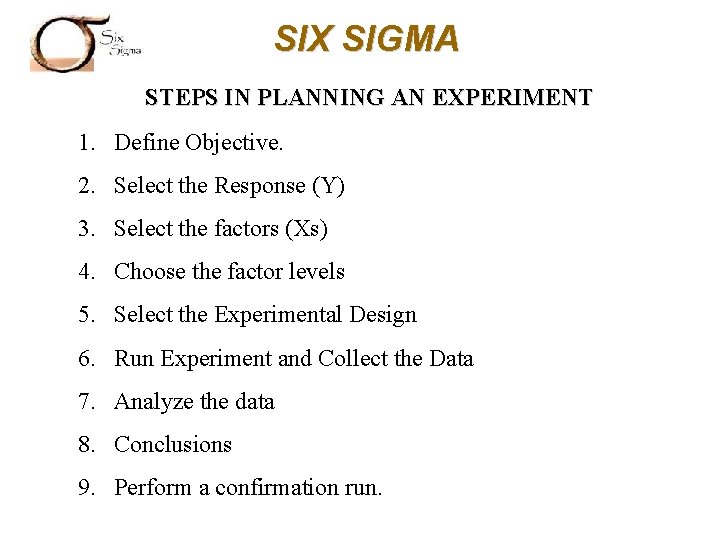
SIX SIGMA STEPS IN PLANNING AN EXPERIMENT 1. Define Objective. 2. Select the Response (Y) 3. Select the factors (Xs) 4. Choose the factor levels 5. Select the Experimental Design 6. Run Experiment and Collect the Data 7. Analyze the data 8. Conclusions 9. Perform a confirmation run.
SIX SIGMA “…. No amount of experimentation can prove me right; a single experiment can prove me wrong”. “…. Science can only ascertain what is, but not what should be, and outside of its domain value judgments of all kinds remain necessary. ” - Albert Einstein
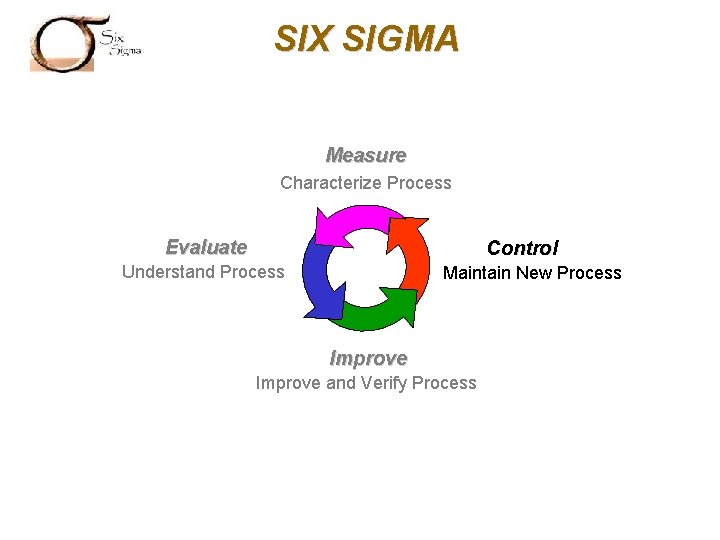
SIX SIGMA Measure Characterize Process Evaluate Control Understand Process Maintain New Process Improve and Verify Process
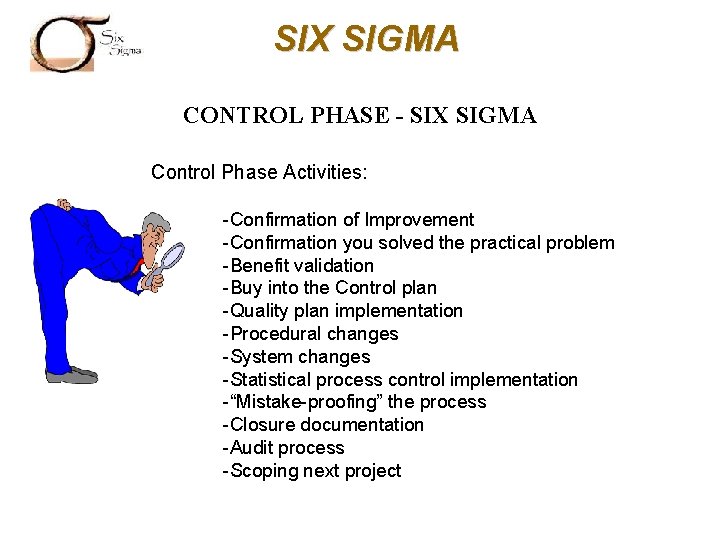
SIX SIGMA CONTROL PHASE - SIX SIGMA Control Phase Activities: -Confirmation of Improvement -Confirmation you solved the practical problem -Benefit validation -Buy into the Control plan -Quality plan implementation -Procedural changes -System changes -Statistical process control implementation -“Mistake-proofing” the process -Closure documentation -Audit process -Scoping next project
SIX SIGMA CONTROL PHASE - SIX SIGMA How to create a Control Plan: 1. Select Causal Variable(s). Proven vital few X(s) 2. Define Control Plan - 5 Ws for optimal ranges of X(s) 3. Validate Control Plan - Observe Y 4. Implement/Document Control Plan 5. Audit Control Plan 6. Monitor Performance Metrics
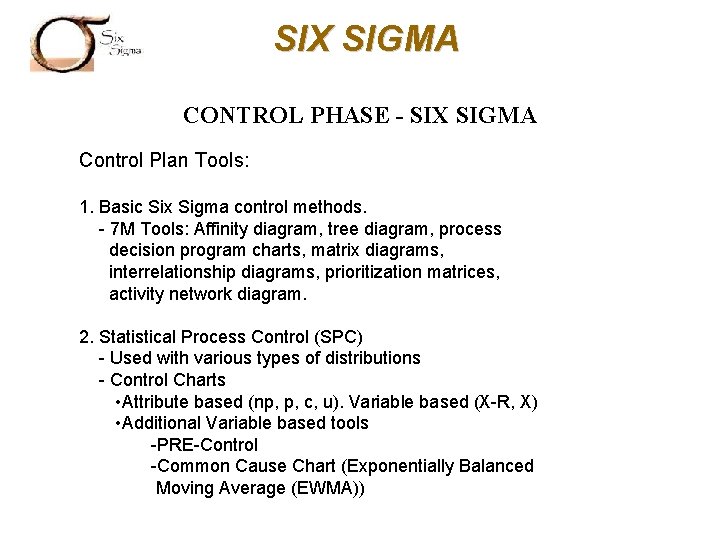
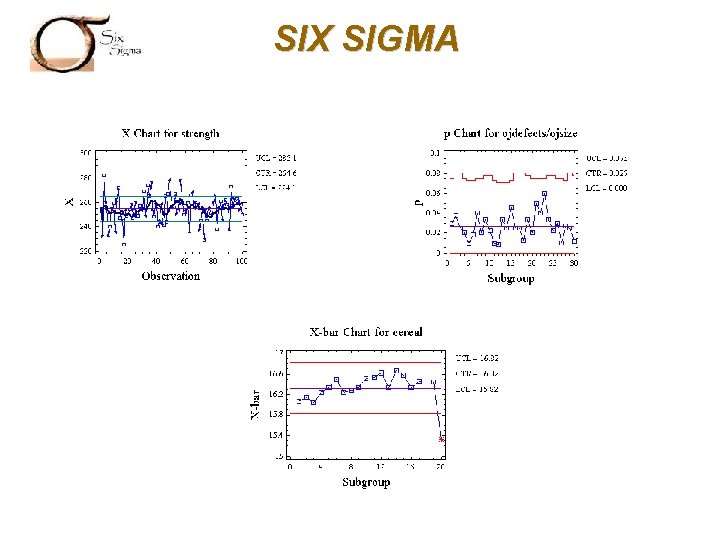
SIX SIGMA CONTROL PHASE - SIX SIGMA Control Plan Tools: 1. Basic Six Sigma control methods. - 7 M Tools: Affinity diagram, tree diagram, process decision program charts, matrix diagrams, interrelationship diagrams, prioritization matrices, activity network diagram. 2. Statistical Process Control (SPC) - Used with various types of distributions - Control Charts • Attribute based (np, p, c, u). Variable based (X-R, X) • Additional Variable based tools -PRE-Control -Common Cause Chart (Exponentially Balanced Moving Average (EWMA))
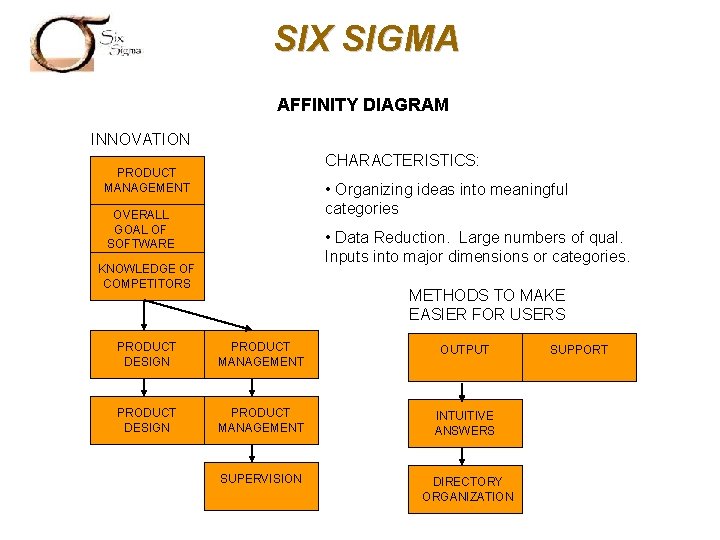
SIX SIGMA AFFINITY DIAGRAM INNOVATION CHARACTERISTICS: PRODUCT MANAGEMENT • Organizing ideas into meaningful categories OVERALL GOAL OF SOFTWARE • Data Reduction. Large numbers of qual. Inputs into major dimensions or categories. KNOWLEDGE OF COMPETITORS METHODS TO MAKE EASIER FOR USERS PRODUCT DESIGN PRODUCT MANAGEMENT OUTPUT PRODUCT DESIGN PRODUCT MANAGEMENT INTUITIVE ANSWERS SUPERVISION DIRECTORY ORGANIZATION SUPPORT
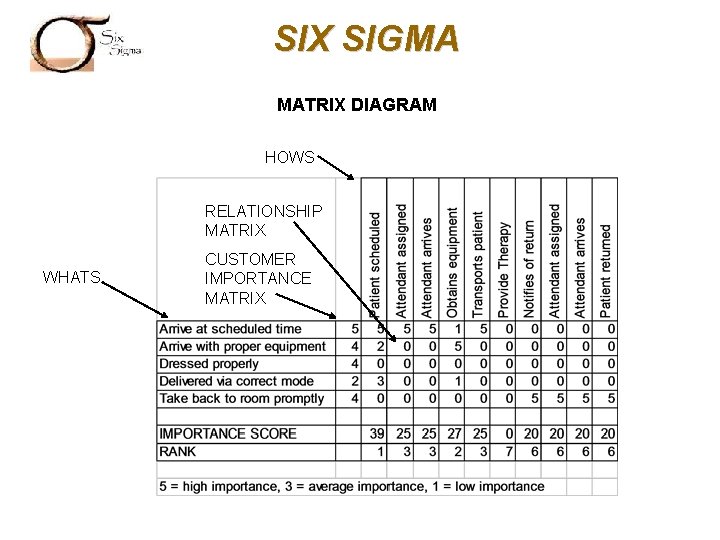
SIX SIGMA MATRIX DIAGRAM HOWS RELATIONSHIP MATRIX WHATS CUSTOMER IMPORTANCE MATRIX
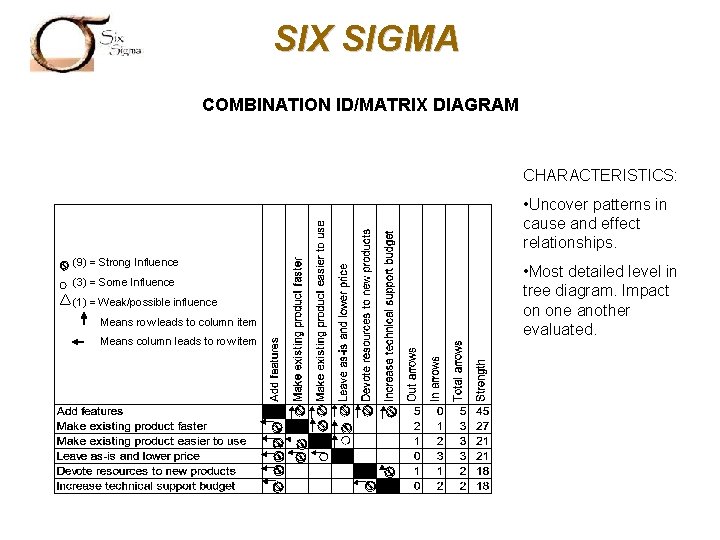
SIX SIGMA COMBINATION ID/MATRIX DIAGRAM CHARACTERISTICS: • Uncover patterns in cause and effect relationships. (9) = Strong Influence (3) = Some Influence (1) = Weak/possible influence Means row leads to column item Means column leads to row item • Most detailed level in tree diagram. Impact on one another evaluated.
SIX SIGMA CONTROL PHASE - SIX SIGMA Control Plan Tools: 1. Basic Six Sigma control methods. - 7 M Tools: Affinity diagram, tree diagram, process decision program charts, matrix diagrams, interrelationship diagrams, prioritization matrices, activity network diagram. 2. Statistical Process Control (SPC) - Used with various types of distributions - Control Charts • Attribute based (np, p, c, u). Variable based (X-R, X) • Additional Variable based tools -PRE-Control -Common Cause Chart (Exponentially Balanced Moving Average (EWMA))
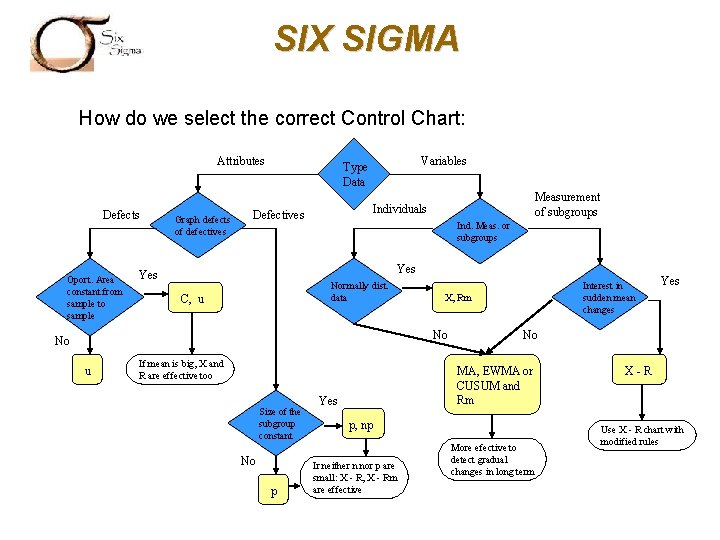
SIX SIGMA How do we select the correct Control Chart: Attributes Defects Oport. Area constant from sample to sample Graph defects of defectives Variables Type Data Measurement of subgroups Individuals Defectives Ind. Meas. or subgroups Yes Normally dist. data C, u X, Rm No No u If mean is big, X and R are effective too Size of the subgroup constant No p Interest in sudden mean changes No MA, EWMA or CUSUM and Rm Yes p, np Ir neither n nor p are small: X - R, X - Rm are effective Yes More efective to detect gradual changes in long term X-R Use X - R chart with modified rules
SIX SIGMA
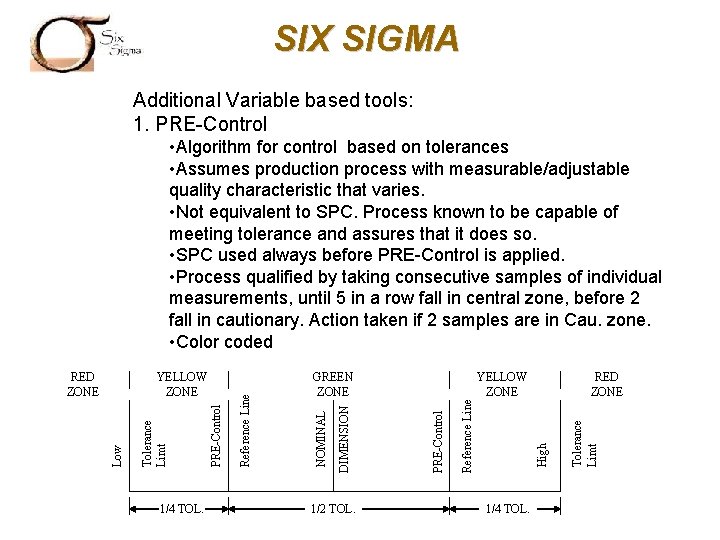
SIX SIGMA Additional Variable based tools: 1. PRE-Control 1/4 TOL. 1/2 TOL. 1/4 TOL. Tolerance Limt RED ZONE High Reference Line YELLOW ZONE PRE-Control DIMENSION GREEN ZONE NOMINAL PRE-Control Tolerance Limt YELLOW ZONE Low RED ZONE Reference Line • Algorithm for control based on tolerances • Assumes production process with measurable/adjustable quality characteristic that varies. • Not equivalent to SPC. Process known to be capable of meeting tolerance and assures that it does so. • SPC used always before PRE-Control is applied. • Process qualified by taking consecutive samples of individual measurements, until 5 in a row fall in central zone, before 2 fall in cautionary. Action taken if 2 samples are in Cau. zone. • Color coded
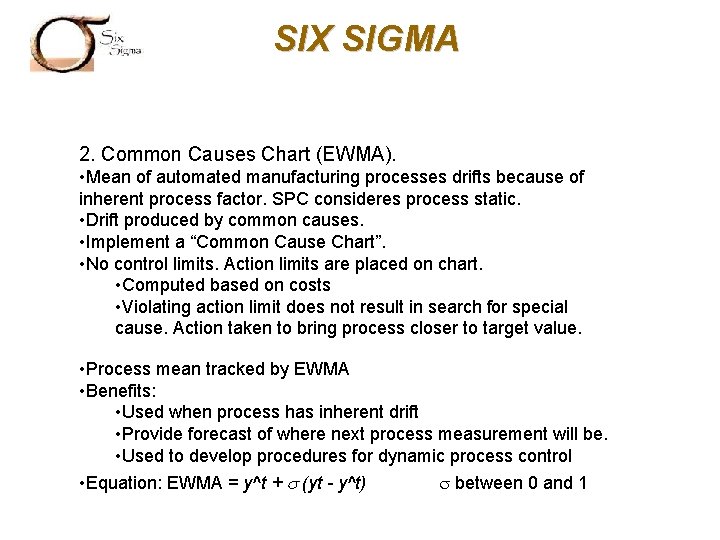
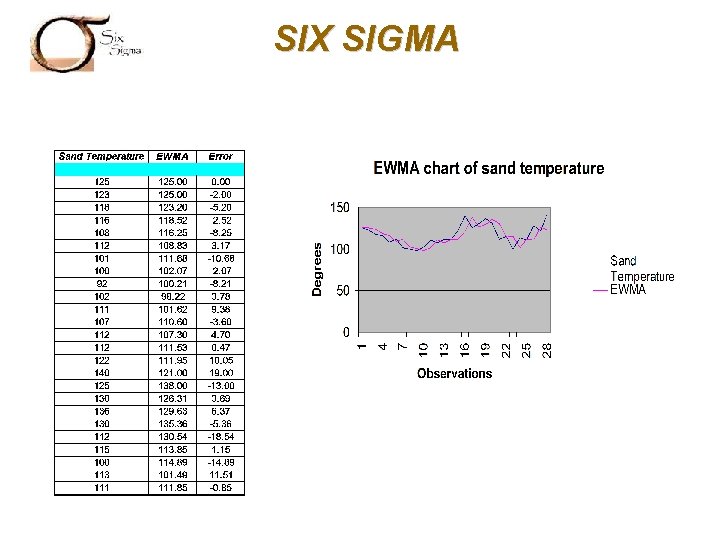
SIX SIGMA 2. Common Causes Chart (EWMA). • Mean of automated manufacturing processes drifts because of inherent process factor. SPC consideres process static. • Drift produced by common causes. • Implement a “Common Cause Chart”. • No control limits. Action limits are placed on chart. • Computed based on costs • Violating action limit does not result in search for special cause. Action taken to bring process closer to target value. • Process mean tracked by EWMA • Benefits: • Used when process has inherent drift • Provide forecast of where next process measurement will be. • Used to develop procedures for dynamic process control • Equation: EWMA = y^t + s (yt - y^t) s between 0 and 1
SIX SIGMA
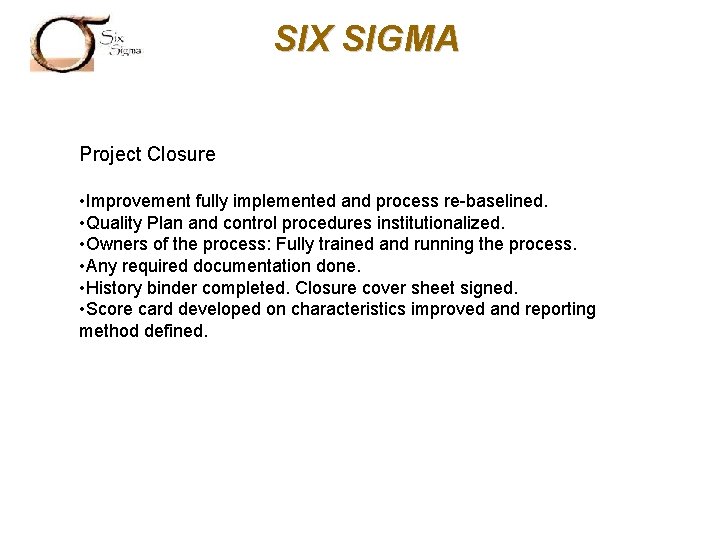
SIX SIGMA Project Closure • Improvement fully implemented and process re-baselined. • Quality Plan and control procedures institutionalized. • Owners of the process: Fully trained and running the process. • Any required documentation done. • History binder completed. Closure cover sheet signed. • Score card developed on characteristics improved and reporting method defined.
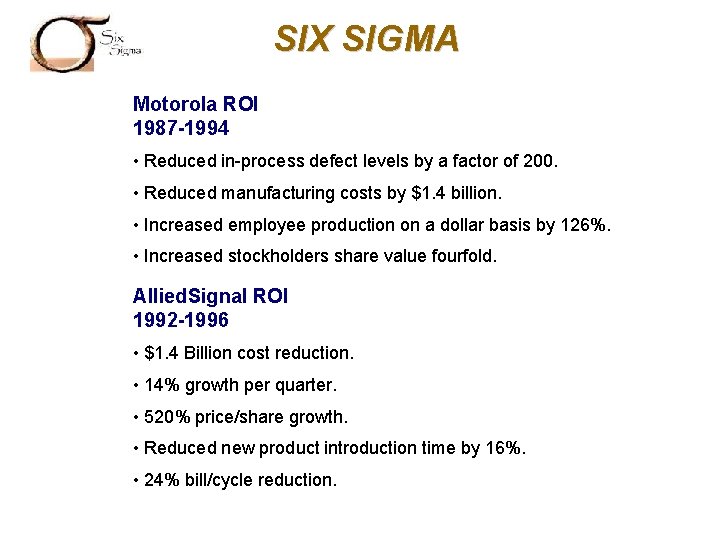
SIX SIGMA Motorola ROI 1987 -1994 • Reduced in-process defect levels by a factor of 200. • Reduced manufacturing costs by $1. 4 billion. • Increased employee production on a dollar basis by 126%. • Increased stockholders share value fourfold. Allied. Signal ROI 1992 -1996 • $1. 4 Billion cost reduction. • 14% growth per quarter. • 520% price/share growth. • Reduced new product introduction time by 16%. • 24% bill/cycle reduction.
SIX SIGMA General Electric ROI 1995 -1998 • Company wide savings of over $1 Billion. • Estimated annual savings to be $6. 6 Billion by the year 2000.
SIX SIGMA Bibliography • Control Engineering On line, “Design for Six Sigma Capability” http: //www. controleng. com/, 1999 • Forrest W. Breyfogle III, “Implementing Six Sigma”, John Wiely & Sons, Inc, 1999 • Infinity Performance Systems, “Six Sigma Overview”, http: //www. 6 sigmaworld. com/six_sigma. htm, 2000 • Motorola Inc. , “What is 3 vs. 6 sigma”, http: //www. Motorola. com/MIMS/MSPG/Special/CLM/sld 011. htm, 1997 • Sigma Holdings, Inc. , “Six Sigma Breakthrough Strategy”, http: //www. 6 -sigma. com/Bts 1. htm, 2000 • Six Sigma SPC / Jim Winings, “Six Sigma & SPC”, http: //www. sixsigmaspc. com/six_sigma. html, 2001 • Stat. Point, LLC. “Six Sigma Tour”, http: //www. sgcorp. com/six-sigma_tour. htm, 2001