
Six Sigma 1 What is Six Sigma What
- Slides: 10
Six Sigma 1
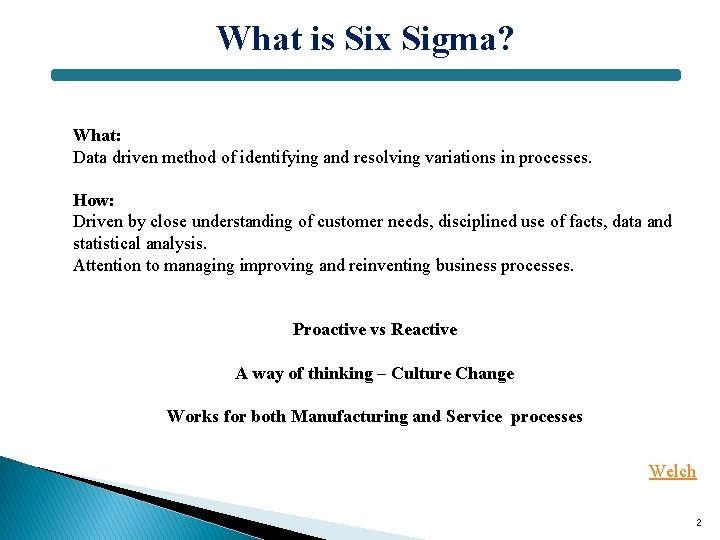
What is Six Sigma? What: Data driven method of identifying and resolving variations in processes. How: Driven by close understanding of customer needs, disciplined use of facts, data and statistical analysis. Attention to managing improving and reinventing business processes. Proactive vs Reactive A way of thinking – Culture Change Works for both Manufacturing and Service processes Welch 2
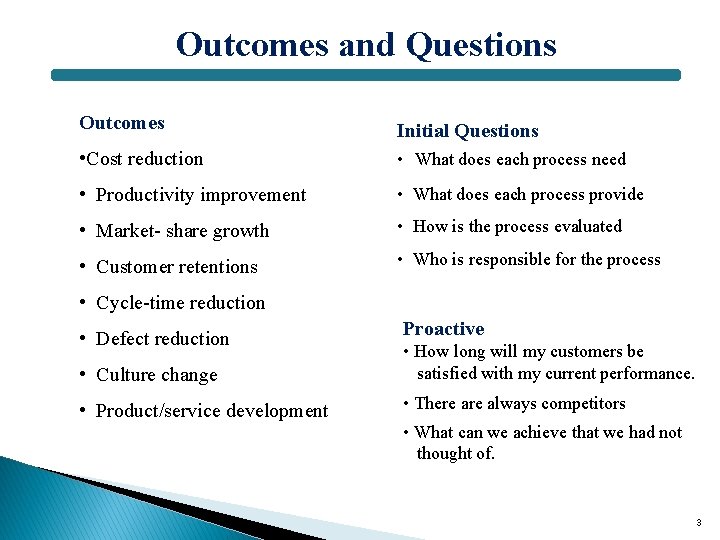
Outcomes and Questions Outcomes Initial Questions • Cost reduction • What does each process need • Productivity improvement • What does each process provide • Market- share growth • How is the process evaluated • Customer retentions • Who is responsible for the process • Cycle-time reduction • Defect reduction Proactive • Culture change • How long will my customers be satisfied with my current performance. • Product/service development • There always competitors • What can we achieve that we had not thought of. 3
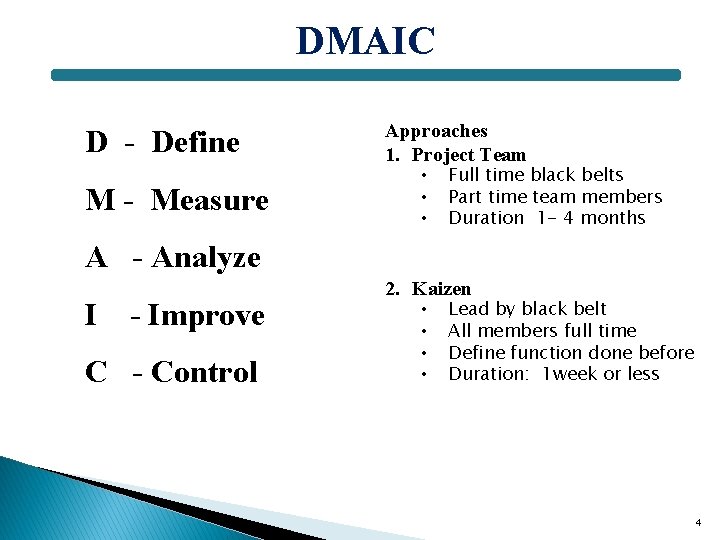
DMAIC D - Define M - Measure Approaches 1. Project Team • • • Full time black belts Part time team members Duration 1 - 4 months A - Analyze I - Improve C - Control 2. Kaizen • • Lead by black belt All members full time Define function done before Duration: 1 week or less 4
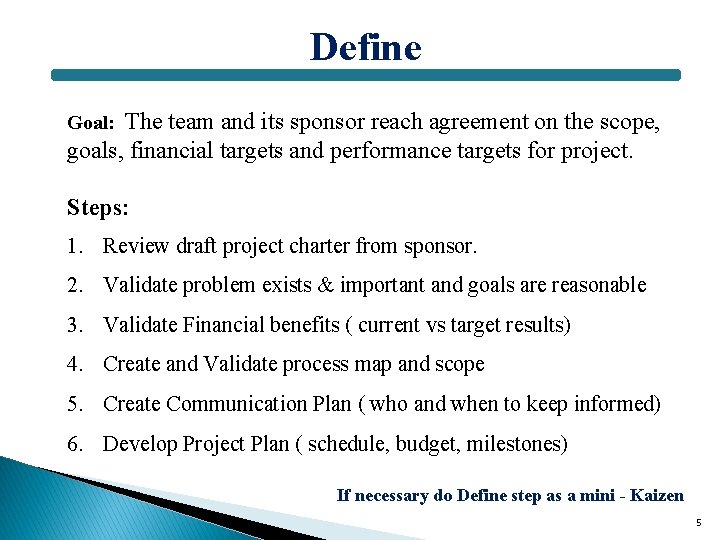
Define The team and its sponsor reach agreement on the scope, goals, financial targets and performance targets for project. Goal: Steps: 1. Review draft project charter from sponsor. 2. Validate problem exists & important and goals are reasonable 3. Validate Financial benefits ( current vs target results) 4. Create and Validate process map and scope 5. Create Communication Plan ( who and when to keep informed) 6. Develop Project Plan ( schedule, budget, milestones) If necessary do Define step as a mini - Kaizen 5
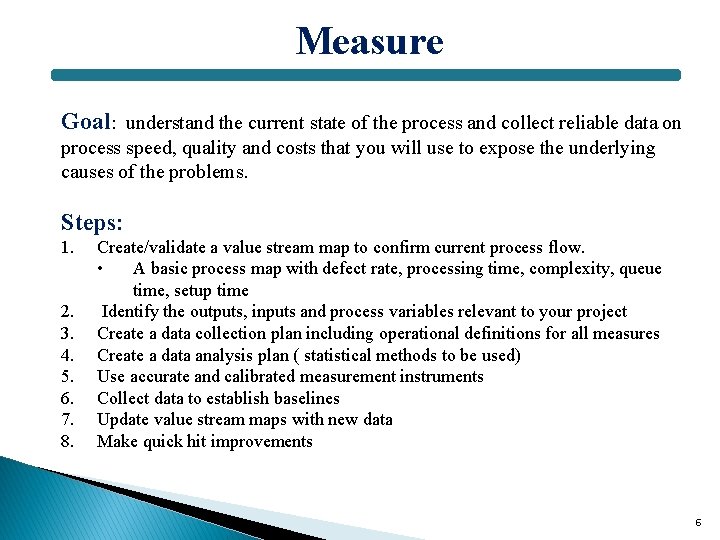
Measure Goal: understand the current state of the process and collect reliable data on process speed, quality and costs that you will use to expose the underlying causes of the problems. Steps: 1. 2. 3. 4. 5. 6. 7. 8. Create/validate a value stream map to confirm current process flow. • A basic process map with defect rate, processing time, complexity, queue time, setup time Identify the outputs, inputs and process variables relevant to your project Create a data collection plan including operational definitions for all measures Create a data analysis plan ( statistical methods to be used) Use accurate and calibrated measurement instruments Collect data to establish baselines Update value stream maps with new data Make quick hit improvements 6
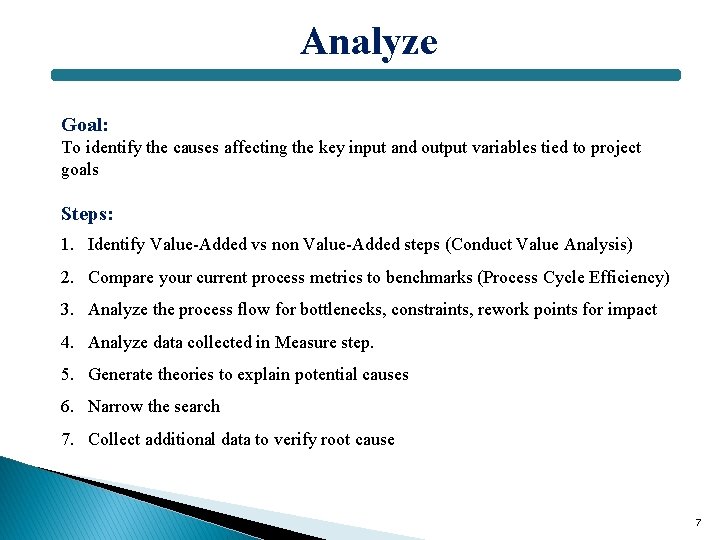
Analyze Goal: To identify the causes affecting the key input and output variables tied to project goals Steps: 1. Identify Value-Added vs non Value-Added steps (Conduct Value Analysis) 2. Compare your current process metrics to benchmarks (Process Cycle Efficiency) 3. Analyze the process flow for bottlenecks, constraints, rework points for impact 4. Analyze data collected in Measure step. 5. Generate theories to explain potential causes 6. Narrow the search 7. Collect additional data to verify root cause 7
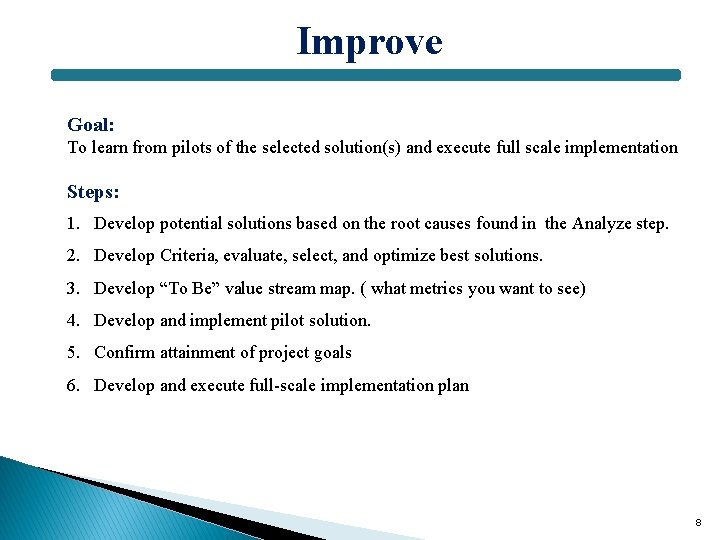
Improve Goal: To learn from pilots of the selected solution(s) and execute full scale implementation Steps: 1. Develop potential solutions based on the root causes found in the Analyze step. 2. Develop Criteria, evaluate, select, and optimize best solutions. 3. Develop “To Be” value stream map. ( what metrics you want to see) 4. Develop and implement pilot solution. 5. Confirm attainment of project goals 6. Develop and execute full-scale implementation plan 8
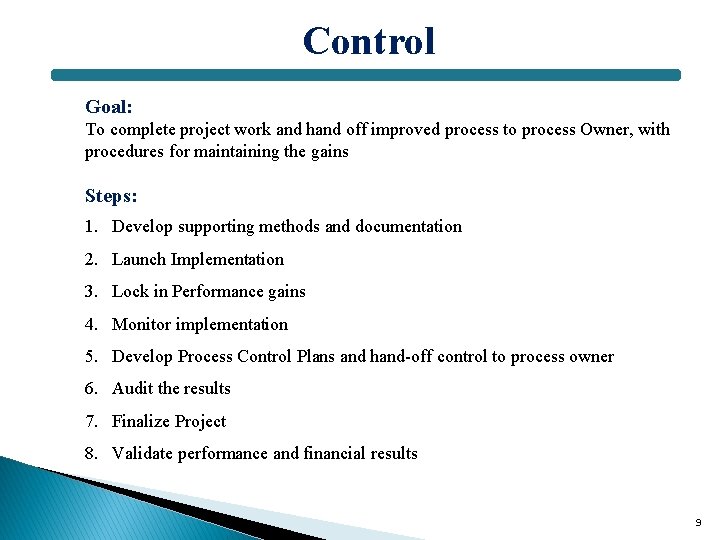
Control Goal: To complete project work and hand off improved process to process Owner, with procedures for maintaining the gains Steps: 1. Develop supporting methods and documentation 2. Launch Implementation 3. Lock in Performance gains 4. Monitor implementation 5. Develop Process Control Plans and hand-off control to process owner 6. Audit the results 7. Finalize Project 8. Validate performance and financial results 9
Videos Funny 6 Sigma Lean Mfg Cartoon 10