
Six Kingdoms of Life Prokaryotes Domain Archaea Bacteria
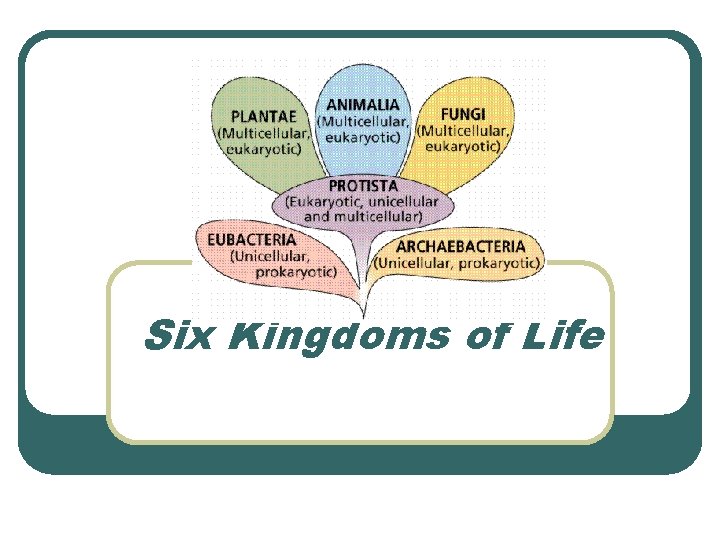
Six Kingdoms of Life
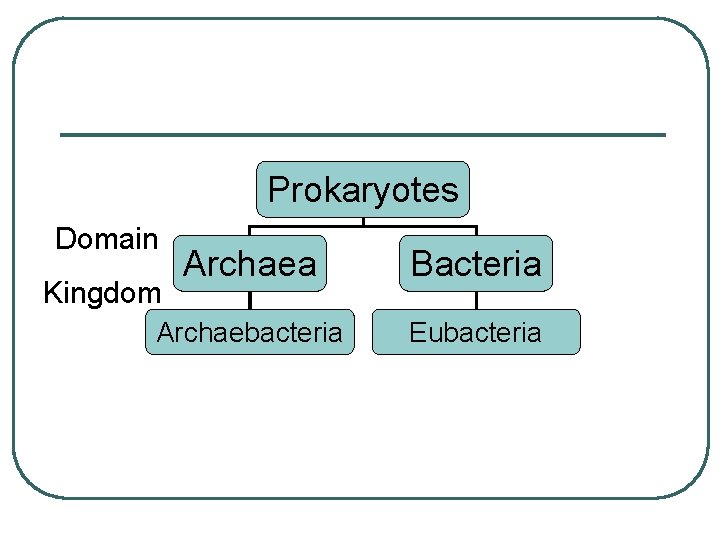
Prokaryotes Domain Archaea Bacteria Archaebacteria Eubacteria Kingdom
Archaea Prokaryotes l Unicellular l Most are heterotrophs l • Some autotrophs use chemosynthesis l DNA, ribosomes, cell wall l Asexual & sexual reproduction • Cell wall does not contain peptidoglycan
Types of Archaea l Heat-loving • Live in hot, acidic environments – hot springs, thermal vents, around volcanoes l Salt-loving • Live in salty environments – salt lakes, Dead Sea l Methane-making • Live in swamps and in human intestines • Use CO 2 during respiration and expel methane gas as waste
Eubacteria Prokaryotes l Unicellular l Most heterotrophs l • Cyanobacteria photosynthesize l DNA, ribosomes, cell wall l Asexual & sexual reproduction • Cell wall contains peptidoglycan
Shapes of Eubacteria Cocci – sphere shaped l Bacilli – rod shaped l Spirilli – spiral shaped l
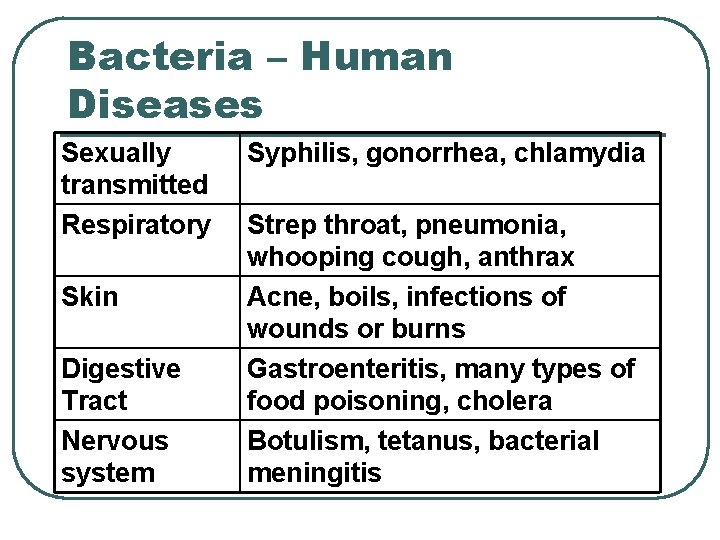
Bacteria – Human Diseases Sexually transmitted Respiratory Skin Digestive Tract Nervous system Syphilis, gonorrhea, chlamydia Strep throat, pneumonia, whooping cough, anthrax Acne, boils, infections of wounds or burns Gastroenteritis, many types of food poisoning, cholera Botulism, tetanus, bacterial meningitis

Eukaryotes Domain Kingdom Protists* Eukaryota Fungi Plants Animals
Protists – “odds and ends” Eukaryotes l Some unicellular, some multicellular l Some autotrophs, some heterotrophs l Cell wall – various composition l • Cellulose, algin, agar, calcium carbonate, silica l Asexual & sexual reproduction
Protists – three types l Animal-like - Protozoa - unicellular l Plant-like – Algae (one or more cells) l Fungus-like • Heterotrophs – eat other organisms • Ex. Amoebas, ciliates, paramecia • Autotrophs – photosynthesize • Ex. Giant kelp, algae • Heterotrophs – absorb nutrients from decaying organisms • Ex. Slime mold, water mold
Fungi l Eukaryotes l Most multicellular (yeast unicellular) Heterotrophs – digest food before consuming l l l • true nucleus & membrane bound organelles • • • absorb nutrients from decaying organisms parasitic – absorb nutrients from a living host mutualistic - lichens Cell wall – made of chitin Asexual & sexual reproduction
Plants Eukaryotes l Multicellular l Autotrophs l Specialized tissues and organs l • Cell wall contains cellulose l Sexual reproduction
Animals Eukaryotes l Multicellular l Heterotrophs l Specialized tissues and organs l • Do not have a cell wall l Sexual Reproduction
- Slides: 13