
Six Building Blocks Introduction A TeamBased Approach to
Six Building Blocks Introduction A Team-Based Approach to Improving Opioid Management in Primary Care The Six Building Blocks was developed by the University of Washington Dept. of Family Medicine and Kaiser Permanente Washington Health Research Institute. The Six Building Blocks program has received funding from Agency for Healthcare Research & Quality (#R 18 HS 023750, #HHSP 233201500013 I), Washington State Department of Health (CDC #5 NU 17 CE 002734), National Institute on Drug Abuse (#UG 1 DAO 13714), and Washington State’s Olympic Communities of Health. Its contents are solely the responsibility of the authors and do not necessarily represent the official views of AHRQ, WA DOH, NIDA, or WA OCH. .
Agenda q Introductions q What are the Six Building Blocks? q Types of Six Building Blocks support available q What do clinics need to be successful? q Learning more about your organization q Next steps
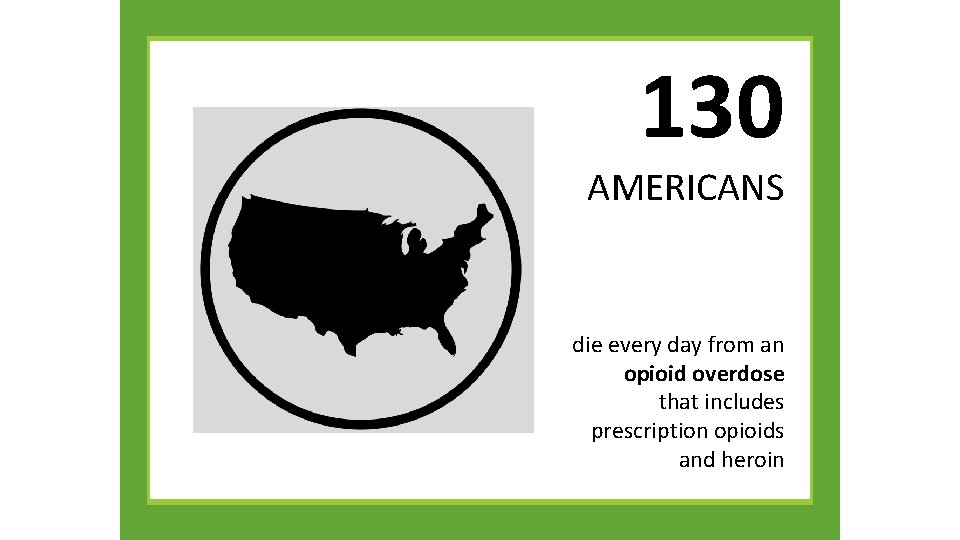
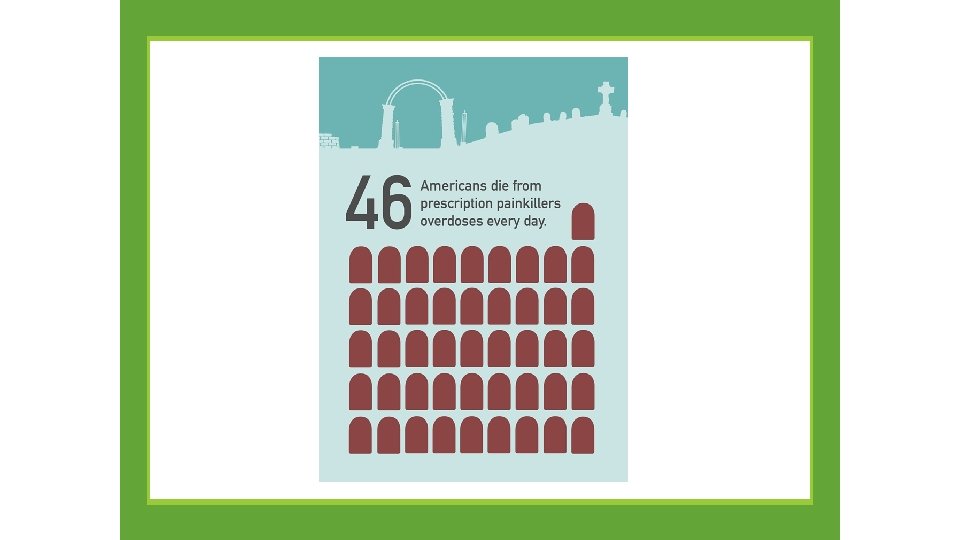
130 AMERICANS die every day from an opioid overdose that includes prescription opioids and heroin
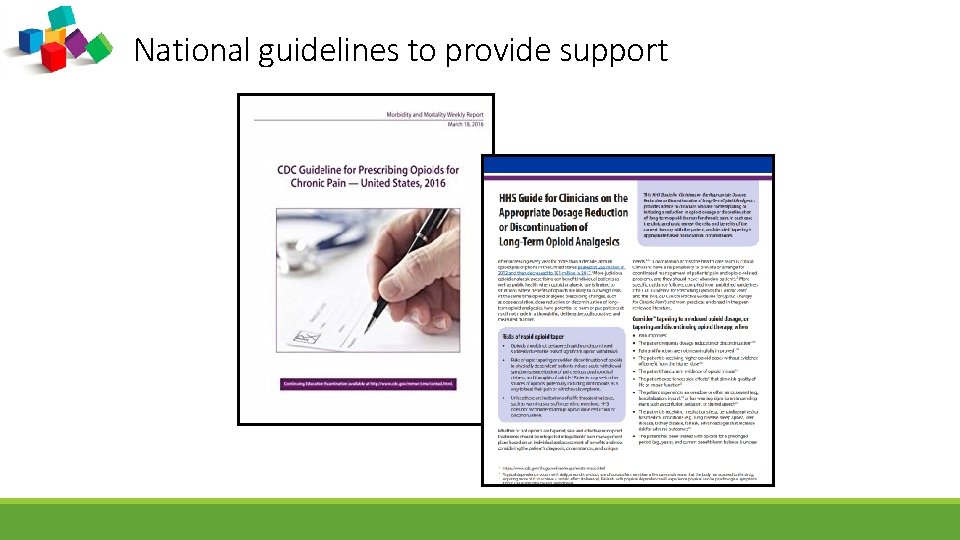
National guidelines to provide support
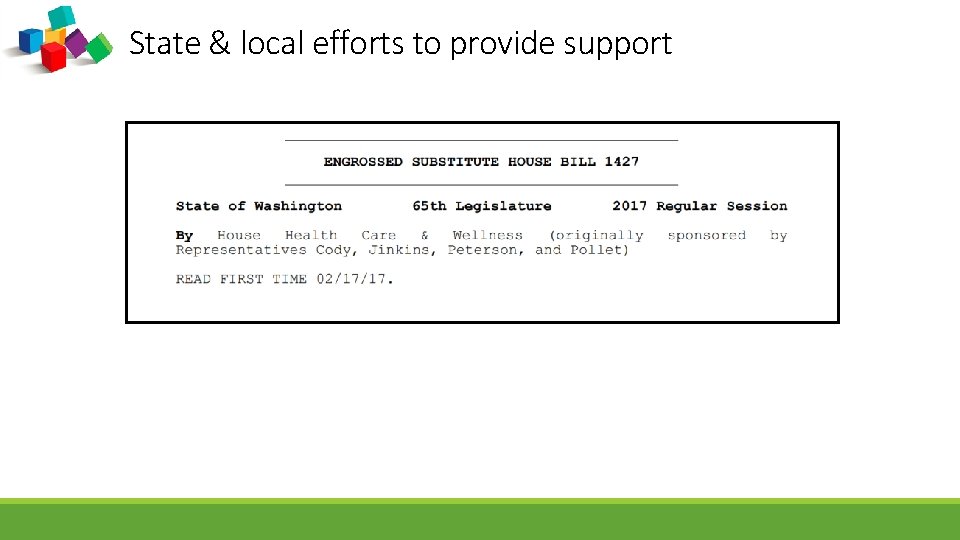
State & local efforts to provide support
The Six Building Blocks: Supporting clinics in implementing best practices for opioid management
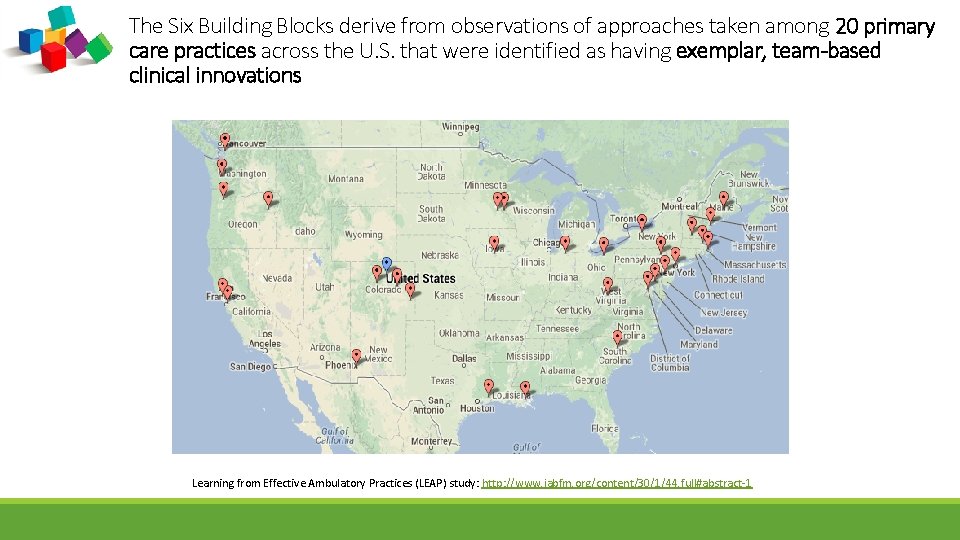
The Six Building Blocks derive from observations of approaches taken among 20 primary care practices across the U. S. that were identified as having exemplar, team-based clinical innovations Learning from Effective Ambulatory Practices (LEAP) study: http: //www. jabfm. org/content/30/1/44. full#abstract-1

The Six Building Blocks Leadership & consensus Demonstrate leadership support and build organizationwide consensus to prioritize more selective and cautious opioid prescribing. Planned, patient-centered visits Prepare and plan for the clinic visits of all patients on long-term opioid therapy. Support patient-centered, empathic communication for care of patients on longterm opioid therapy. Policies, patient agreements, & workflows Revise, align, and implement clinic policies, patient agreements, and workflows for health care team members to improve opioid prescribing and care of patients with chronic pain. Caring for complex patients Develop policies and resources to ensure that patients who develop opioid use disorder and/or who need mental/behavioral health resources are identified and provided with appropriate care, either in the care setting or by outside referral. Tracking & monitoring patient care Measuring success Implement proactive population management before, Continuously monitor progress and improve with during, and between clinic visits of all patients on longexperience. term opioid therapy. https: //www. jabfm. org/content/30/1/44
Support provided along the way • Clinic-wide Kickoff to facilitate discussions on the Six Building Blocks selfassessment • Ongoing guidance from a Practice Coach to support the opioid improvement team in developing and implementing action plans • Monthly shared learning calls at which all clinics share lessons learned and help problem-solve challenges • Provision of resources: policy, patient agreement, workflows, tracking approaches, patient education, etc. • Clinician support through UW Tele. Pain
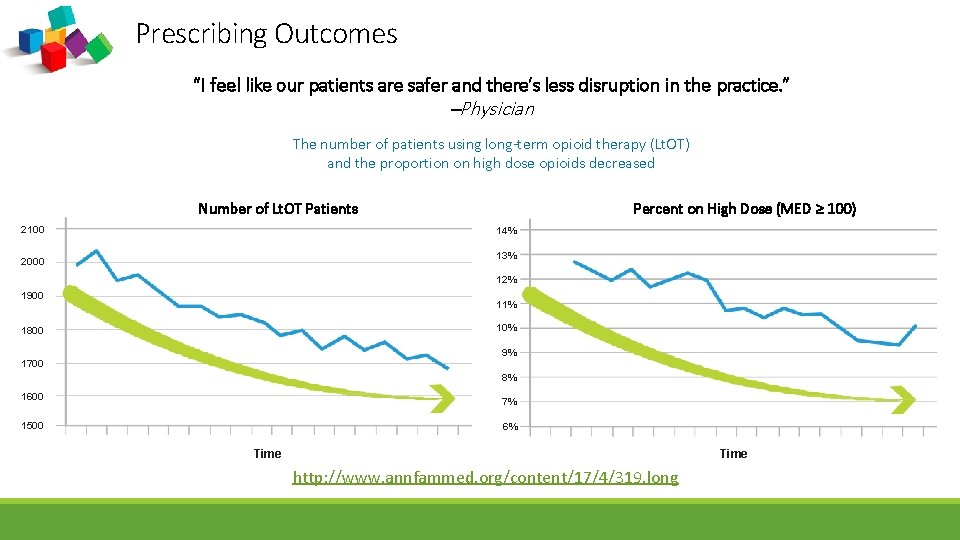
Prescribing Outcomes “I feel like our patients are safer and there’s less disruption in the practice. ” –Physician The number of patients using long-term opioid therapy (Lt. OT) and the proportion on high dose opioids decreased Number of Lt. OT Patients 2100 Percent on High Dose (MED ≥ 100) 14% 13% 2000 12% 1900 11% 10% 1800 9% 1700 8% 1600 7% 1500 6% Time http: //www. annfammed. org/content/17/4/319. long
Clinician & Staff Experiences Improved Work Life q q Increased confidence and comfort in caring for patients with chronic pain Increased collaboration and teamwork across the clinic Decreased stress in providing care to patients using long-term opioid therapy Improved relationships with patients using long-term opioid therapy ü Seeing patients were receptive to change ü Fewer negative interactions https: //www. jabfm. org/content/32/5/715. abstract? etoc
Six Building Blocks Clinician & Staff Experiences "Having a defined care pathway for an emotionally charged and complex area of care - to walk in with a plan. It's like walking into the ER and someone having a cardiac arrest. Not the most stressful thing I do because we have a clear plan. Now I have the same kind of pathway for opioids. Having what we are going to do defined. ” “Everybody that works in this clinic says to me, ‘Do you remember how much turmoil there was around it? Wow, we don’t have any of that anymore. ’” “The thing that surprised me was the number of patients that once they started churning through the standard care pathway, that said, ‘Wow, I get it, ’ and then a lot of them just ended up tapering themselves ahead of us. I just wasn't quite prepared to see the patients engage. ”
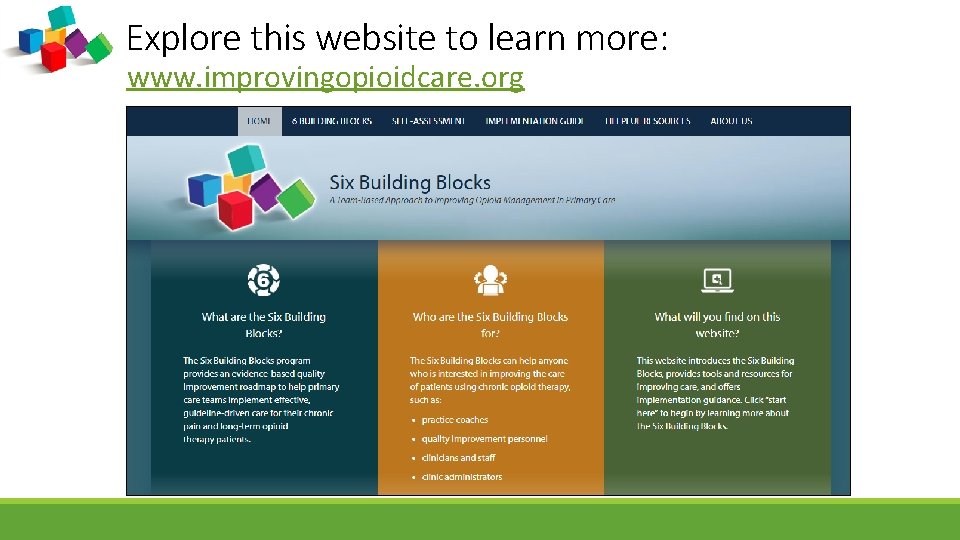
Explore this website to learn more: www. improvingopioidcare. org
We can offer different types of Six Building Blocks support to meet you where you are in efforts to improve opioid management
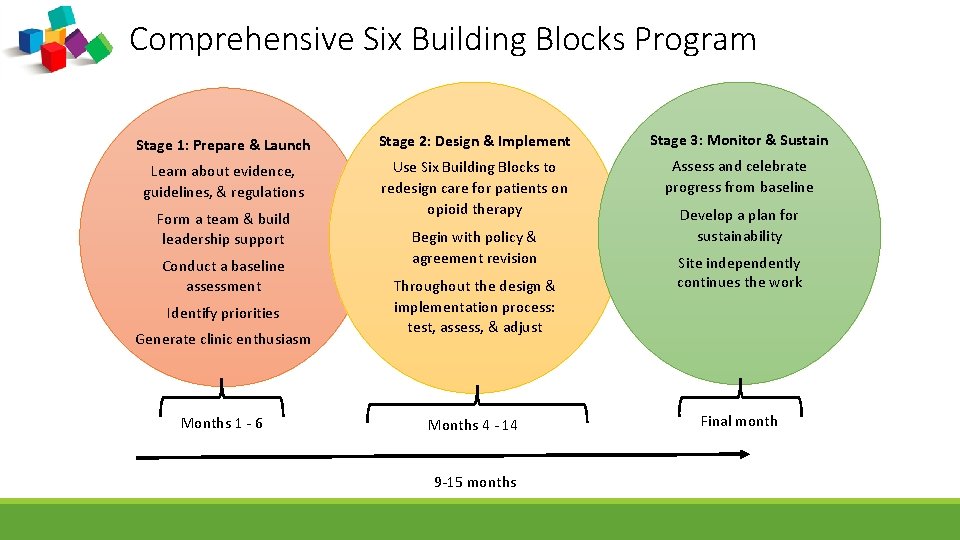
Comprehensive Six Building Blocks Program Stage 1: Prepare & Launch Stage 2: Design & Implement Stage 3: Monitor & Sustain Learn about evidence, guidelines, & regulations Use Six Building Blocks to redesign care for patients on opioid therapy Assess and celebrate progress from baseline Form a team & build leadership support Conduct a baseline assessment Identify priorities Generate clinic enthusiasm Months 1 - 6 Begin with policy & agreement revision Throughout the design & implementation process: test, assess, & adjust Months 4 - 14 9 -15 months Develop a plan for sustainability Site independently continues the work Final month
Time Commitment by the Opioid Improvement Team for the full program q. Project manager: 2 -8 hours per month q. Clinician Champion: 2 -4 hours per month q. Tracking and Monitoring Lead: time spent depends on EHR system, measures chosen, etc. q. Other team members (e. g. , Medical Assistant, Behavioral Health Provider, Pharmacist): 2 hours per month
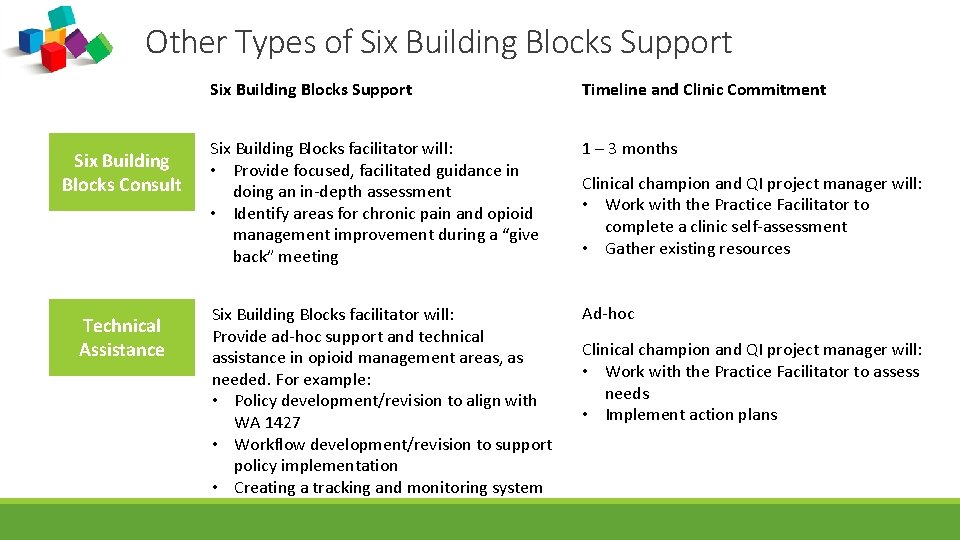
Other Types of Six Building Blocks Support Six Building Blocks Consult Technical Assistance Six Building Blocks Support Timeline and Clinic Commitment Six Building Blocks facilitator will: • Provide focused, facilitated guidance in doing an in-depth assessment • Identify areas for chronic pain and opioid management improvement during a “give back” meeting 1 – 3 months Six Building Blocks facilitator will: Provide ad-hoc support and technical assistance in opioid management areas, as needed. For example: • Policy development/revision to align with WA 1427 • Workflow development/revision to support policy implementation • Creating a tracking and monitoring system Ad-hoc Clinical champion and QI project manager will: • Work with the Practice Facilitator to complete a clinic self-assessment • Gather existing resources Clinical champion and QI project manager will: • Work with the Practice Facilitator to assess needs • Implement action plans
Factors that will help your clinic succeed in implementing the Six Building Blocks q You have identified opioids as an area of concern and prioritized it as an area to work on. q Your clinic leadership is supportive of making system-based improvements to managing chronic pain and opioid prescribing q You have a staff member with quality improvement skills and experience who is interested in leading these improvements. q You have a clinician or champion who is passionate about improving the care of patients with chronic pain using long-term opioid therapy, and has some time to dedicate to the work.
Tell us more about your organization q What kind of opioid management improvements has your organization worked on? q Who has been involved in this work? q Is your organization interested in implementing (additional) opioid management improvements? If yes, what kind of improvements? q Next steps
For more information, contact: <name of contact and how to contact>
- Slides: 21