
Situational Writing Formal Letter and Professional Email Session

![Appropriate Language for Formal Letter Writing (Standard English) [continued] Some examples: for Closure We](https://slidetodoc.com/presentation_image_h2/1d71bb68ba59290f93f23de5176b0882/image-7.jpg "Appropriate Language for Formal Letter Writing (Standard English) [continued] Some examples: for Closure We")
- Slides: 11
Situational Writing -------------Formal Letter and Professional Email
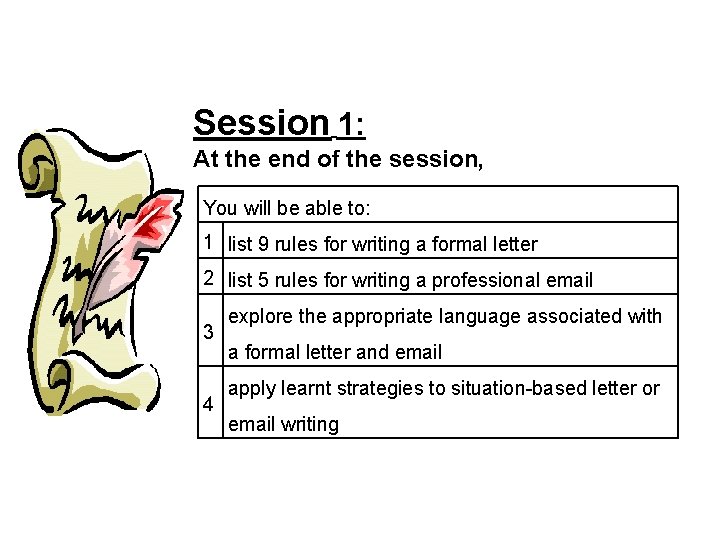
Session 1: At the end of the session, You will be able to: 1 list 9 rules for writing a formal letter 2 list 5 rules for writing a professional email 3 4 explore the appropriate language associated with a formal letter and email apply learnt strategies to situation based letter or email writing
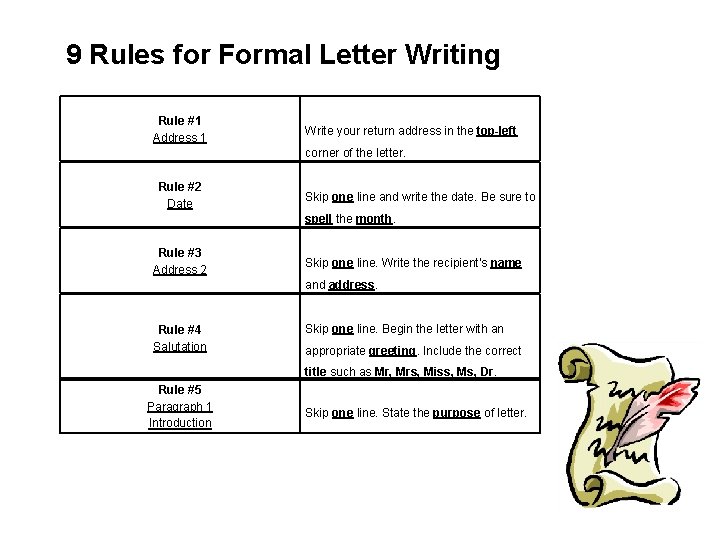
9 Rules for Formal Letter Writing Rule #1 Address 1 Write your return address in the top-left corner of the letter. Rule #2 Date Skip one line and write the date. Be sure to spell the month. Rule #3 Address 2 Skip one line. Write the recipient’s name and address. Rule #4 Salutation Skip one line. Begin the letter with an appropriate greeting. Include the correct title such as Mr, Mrs, Miss, Ms, Dr. Rule #5 Paragraph 1 Introduction Skip one line. State the purpose of letter.
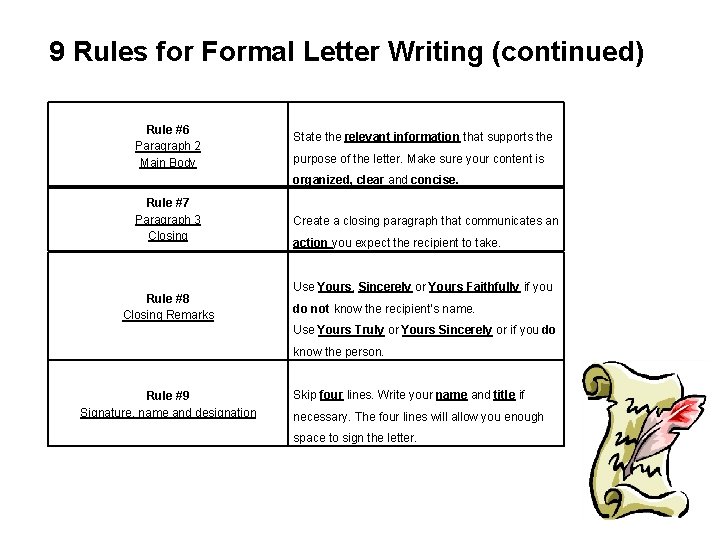
9 Rules for Formal Letter Writing (continued) Rule #6 Paragraph 2 Main Body State the relevant information that supports the purpose of the letter. Make sure your content is organized, clear and concise. Rule #7 Paragraph 3 Closing Rule #8 Closing Remarks Create a closing paragraph that communicates an action you expect the recipient to take. Use Yours, Sincerely or Yours Faithfully if you do not know the recipient’s name. Use Yours Truly or Yours Sincerely or if you do know the person. Rule #9 Signature, name and designation Skip four lines. Write your name and title if necessary. The four lines will allow you enough space to sign the letter.
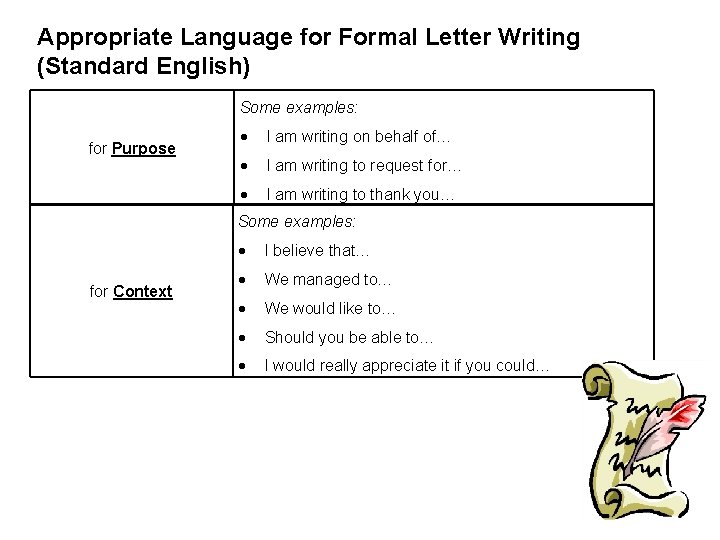
Appropriate Language for Formal Letter Writing (Standard English) Some examples: for Purpose I am writing on behalf of… I am writing to request for… I am writing to thank you… Some examples: for Context I believe that… We managed to… We would like to… Should you be able to… I would really appreciate it if you could…
Appropriate Language for Formal Letter Writing (Standard English) [continued] Some examples: for Closure We hope to… Thank you for… Please reply by… We look forward to hearing from you. We would be honoured by your attendance. On behalf of…I would like to thank you for… Some examples: Person you know for Signing Off Yours truly Yours sincerely Person you do not know Yours Sincerely Yours faithfully
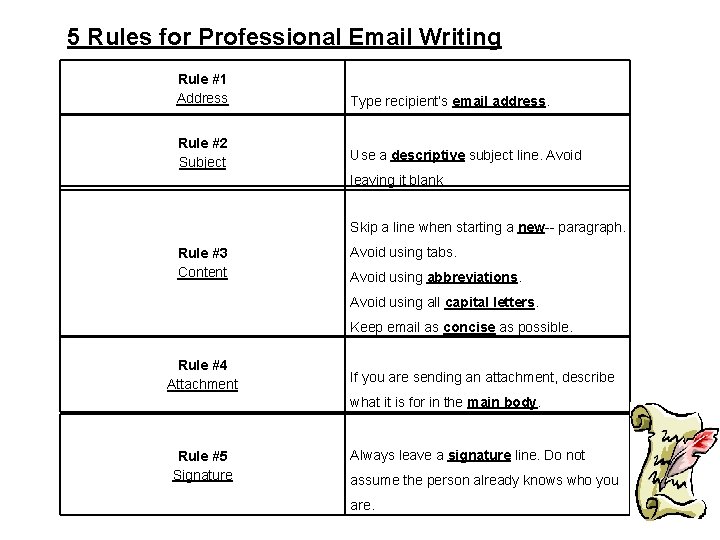
5 Rules for Professional Email Writing Rule #1 Address Rule #2 Subject Type recipient’s email address. Use a descriptive subject line. Avoid leaving it blank Skip a line when starting a new paragraph. Rule #3 Content Avoid using tabs. Avoid using abbreviations. Avoid using all capital letters. Keep email as concise as possible. Rule #4 Attachment If you are sending an attachment, describe what it is for in the main body. Rule #5 Signature Always leave a signature line. Do not assume the person already knows who you are.
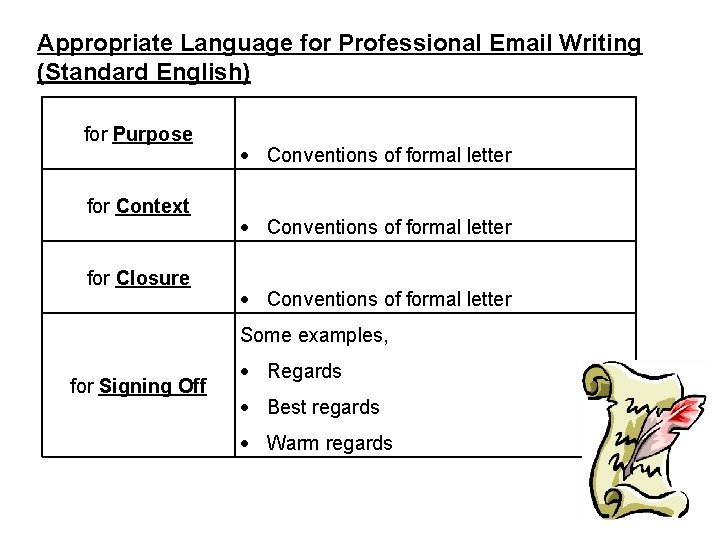
Appropriate Language for Professional Email Writing (Standard English) for Purpose for Context for Closure Conventions of formal letter Some examples, for Signing Off Regards Best regards Warm regards
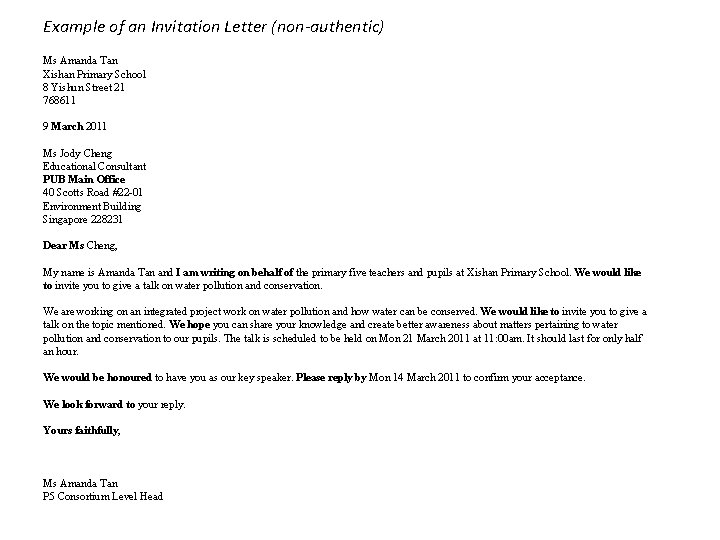
Example of an Invitation Letter (non-authentic) Ms Amanda Tan Xishan Primary School 8 Yishun Street 21 768611 9 March 2011 Ms Jody Cheng Educational Consultant PUB Main Office 40 Scotts Road #22 -01 Environment Building Singapore 228231 Dear Ms Cheng, My name is Amanda Tan and I am writing on behalf of the primary five teachers and pupils at Xishan Primary School. We would like to invite you to give a talk on water pollution and conservation. We are working on an integrated project work on water pollution and how water can be conserved. We would like to invite you to give a talk on the topic mentioned. We hope you can share your knowledge and create better awareness about matters pertaining to water pollution and conservation to our pupils. The talk is scheduled to be held on Mon 21 March 2011 at 11: 00 am. It should last for only half an hour. We would be honoured to have you as our key speaker. Please reply by Mon 14 March 2011 to confirm your acceptance. We look forward to your reply. Yours faithfully, Ms Amanda Tan P 5 Consortium Level Head