
Situational Approach Chapter 5 Northouse Leadership 8 e
- Slides: 27
Situational Approach Chapter 5 Northouse, Leadership 8 e. © SAGE Publications, 2019. 2
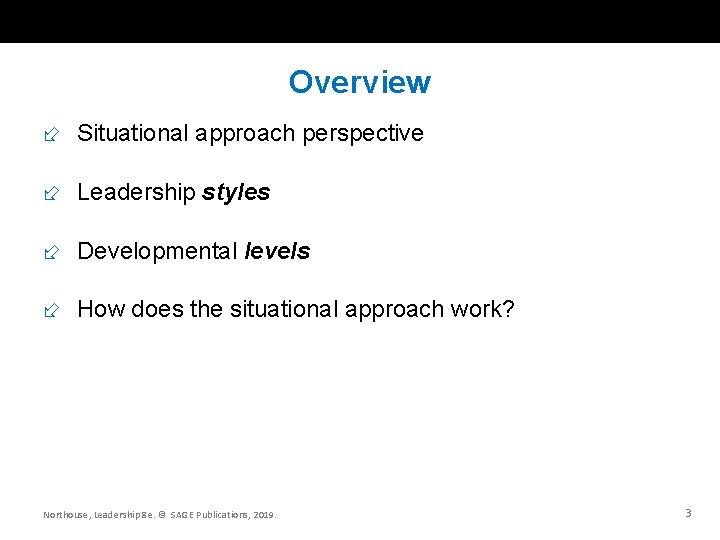
Overview ÷ Situational approach perspective ÷ Leadership styles ÷ Developmental levels ÷ How does the situational approach work? Northouse, Leadership 8 e. © SAGE Publications, 2019. 3
Northouse, Leadership 8 e. © SAGE Publications, 2019.
Northouse, Leadership 8 e. © SAGE Publications, 2019.
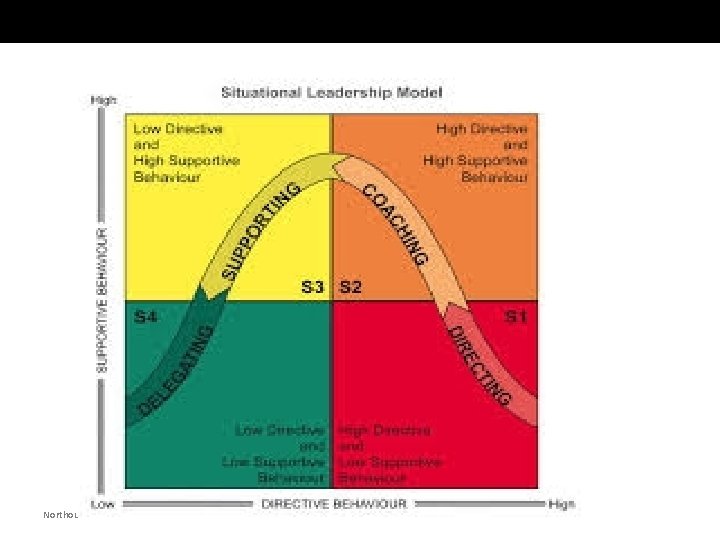
Situational Approach Description (Hersey & Blanchard, 1969) Perspective “ ÷ Focuses on leadership in situations (“e” side) ÷ Emphasizes adapting style— ® different situations demand different kinds of leadership ® What type of leadership approach is this? ÷ Used extensively ® in leadership T&D Northouse, Leadership 8 e. © SAGE Publications, 2019. 6
Situational Approach Description, cont’d (Hersey & Blanchard, 1969) ÷ Composed of two dimensions: directive supportive ® Each dimension must be applied appropriately in a given situation ® Leaders assess worker’s competence and commitment to perform a given task ®How can you do this? Northouse, Leadership 8 e. © SAGE Publications, 2019. 7
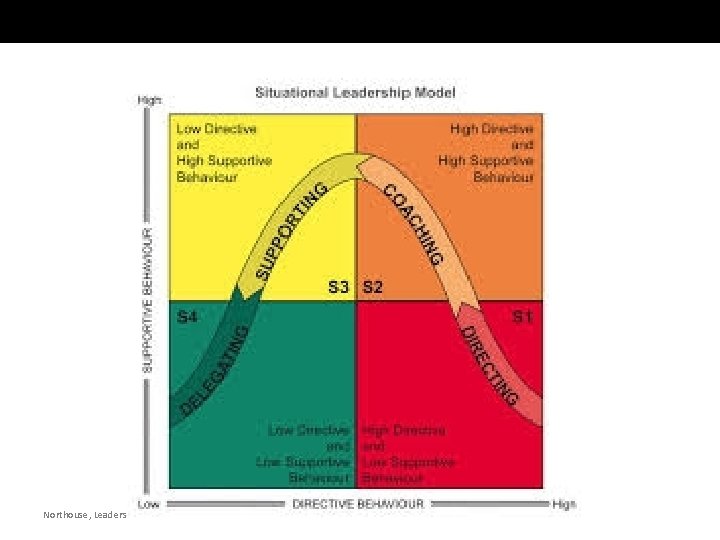
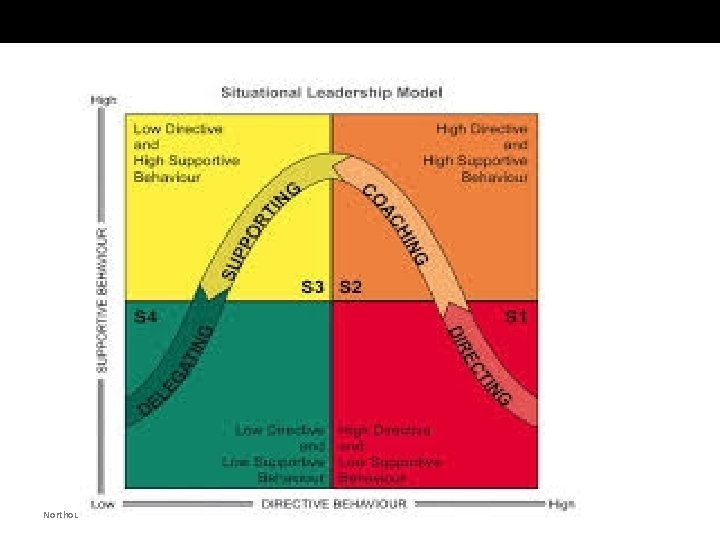
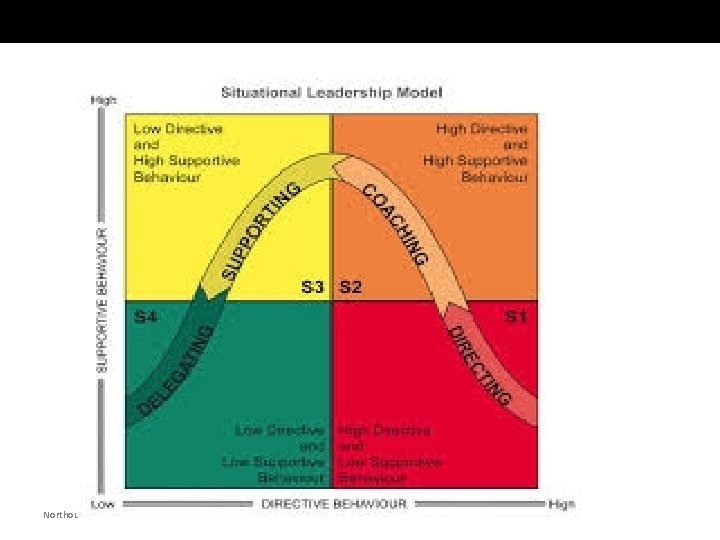
Leadership Styles ÷ Leadership style– Uses a behavior pattern to influence others It includes both: ®Directive (task) behaviors ®Supportive (relationship) behaviors Sound familiar? Northouse, Leadership 8 e. © SAGE Publications, 2019. 8
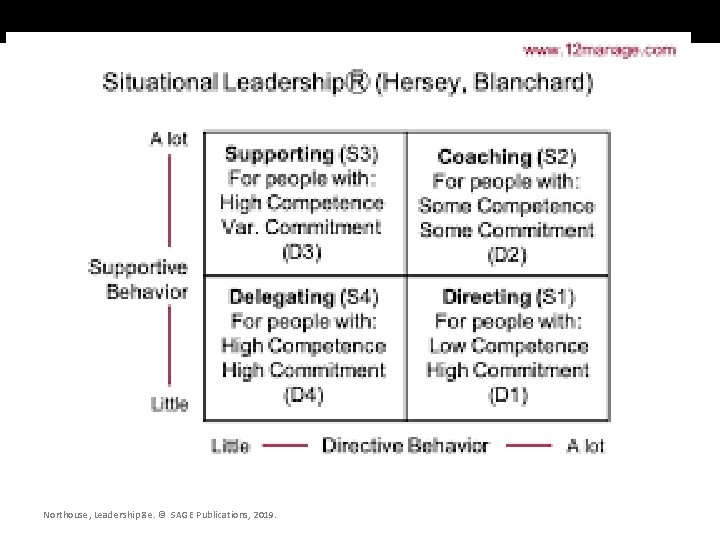
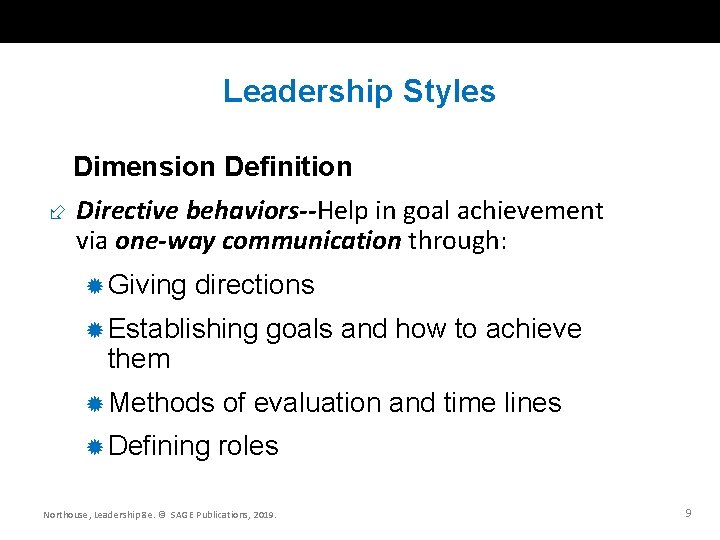
Leadership Styles Dimension Definition ÷ Directive behaviors--Help in goal achievement via one-way communication through: ® Giving directions ® Establishing them goals and how to achieve ® Methods of evaluation and time lines ® Defining roles Northouse, Leadership 8 e. © SAGE Publications, 2019. 9
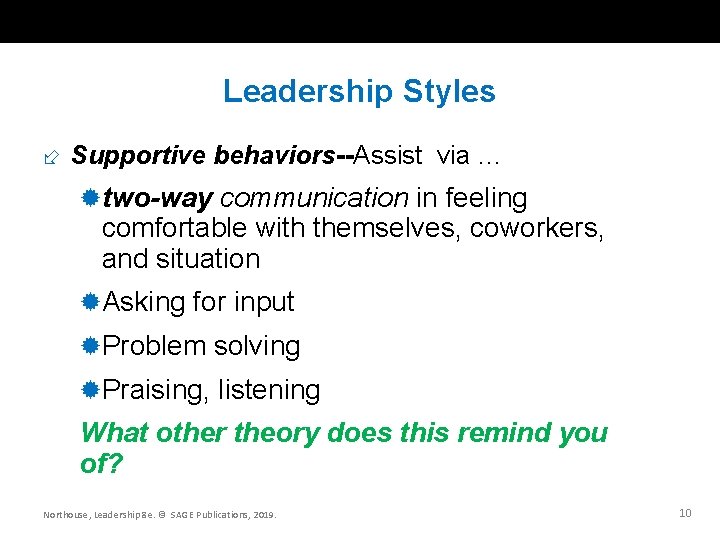
Leadership Styles ÷ Supportive behaviors--Assist via … ®two-way communication in feeling comfortable with themselves, coworkers, and situation ®Asking for input ®Problem solving ®Praising, listening What other theory does this remind you of? Northouse, Leadership 8 e. © SAGE Publications, 2019. 10
Northouse, Leadership 8 e. © SAGE Publications, 2019.
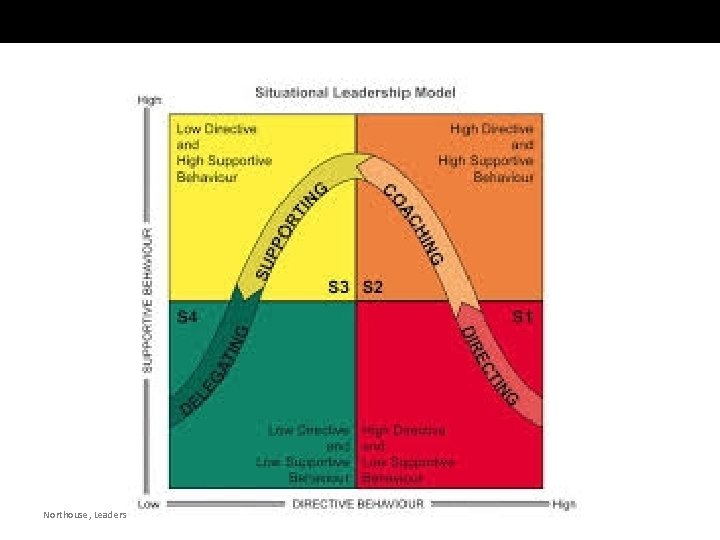
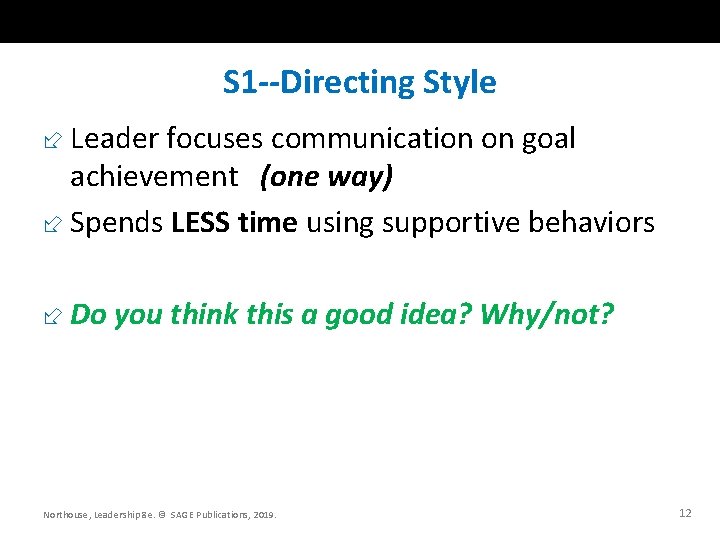
S 1 --Directing Style ÷ Leader focuses communication on goal achievement (one way) ÷ Spends LESS time using supportive behaviors ÷ Do you think this a good idea? Why/not? Northouse, Leadership 8 e. © SAGE Publications, 2019. 12
Northouse, Leadership 8 e. © SAGE Publications, 2019.
S 2 --Coaching Style ÷ Leader focuses communication on ÷ goal achievement and ÷ supporting socio-emotional needs ÷ Requires leader involvement ®Encouragement and ®soliciting subordinate input What questions would you ask? Northouse, Leadership 8 e. © SAGE Publications, 2019. 14
Northouse, Leadership 8 e. © SAGE Publications, 2019.
S 3 --Supporting Style ÷ Ldr does NOT focus solely on goals; ®uses supportive behaviors to bring out employee skills in accomplishing tasks ®(recognizes how her skills -> success) ÷ Ldr delegates day-to-day decision-making ®(“Oh boy! Now I have some autonomy!”) ® but is available to facilitate problem solving • On demand ÷ What FRLM approach is this? Northouse, Leadership 8 e. © SAGE Publications, 2019. 16
Northouse, Leadership 8 e. © SAGE Publications, 2019.
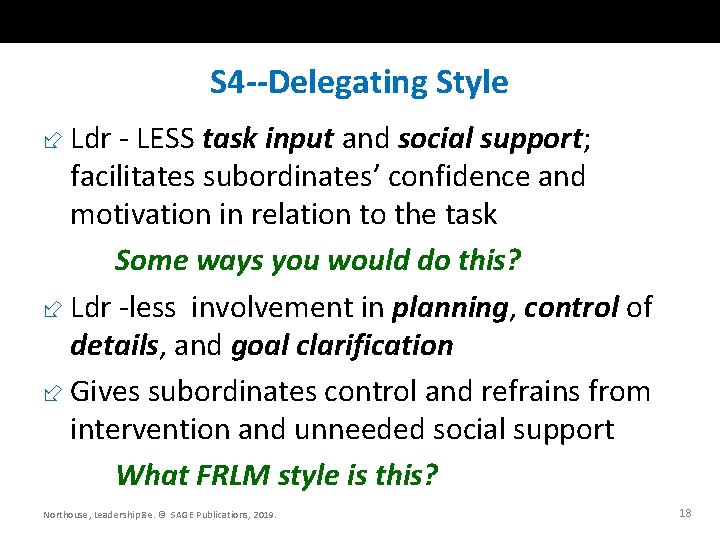
S 4 --Delegating Style ÷ Ldr - LESS task input and social support; facilitates subordinates’ confidence and motivation in relation to the task Some ways you would do this? ÷ Ldr -less involvement in planning, control of details, and goal clarification ÷ Gives subordinates control and refrains from intervention and unneeded social support What FRLM style is this? Northouse, Leadership 8 e. © SAGE Publications, 2019. 18
Development Levels The degrees of ÷ competence ÷ commitment necessary to accomplish a given task or activity How would you operationalize these? Northouse, Leadership 8 e. © SAGE Publications, 2019. 19
How Does the Situational Approach Work? ÷ Focus of situational approach ÷ Strengths ÷ Criticisms ÷ Application Northouse, Leadership 8 e. © SAGE Publications, 2019. 20
Situational Approach Focus ÷ Subordinates vacillate developmental, competence and commitment ÷ Effectiveness depends on: ® assessing subordinate’s developmental position, and ® adapting style to match subordinate developmental level Northouse, Leadership 8 e. © SAGE Publications, 2019. “requires a…strong degree of flexibility. ” 21
How Does the Situational Approach Work? Using SLII model--In any given situation the leader has two tasks: 1 st Task Diagnose the Situation Identify the developmental level Ask questions like: • What is the task • How complicated is it? • What is their skill set? • Do they have the desire Northouse, Leadership 8 e. © SAGE Publications, 2019. 2 nd Task Adapt Style Leadership style must correspond to the development level 22
Strengths ÷ Marketplace approval perceived as credible for training employees to become effective leaders. ÷ Practical straightforward approach (easily understood and applied in a variety of settings. ÷ Prescriptive what you should and should not do in various settings. Northouse, Leadership 8 e. © SAGE Publications, 2019. 23
Strengths ÷ Leader flexibility. effective leaders can change their styles based on task requirements and subordinate needs. ÷ Differential treatment. leaders need to treat each subordinate according to his/her unique needs. Northouse, Leadership 8 e. © SAGE Publications, 2019. 24
Criticisms ÷ Lack of an empirical foundation Questionable validity ÷ Further research is needed to determine how commitment and competence are conceptualized for each developmental level. . ÷ Conceptualization of commitment itself and why it varies is very unclear. ÷ Replication studies fail to support basic prescriptions of situational leadership model. Northouse, Leadership 8 e. © SAGE Publications, 2019. 25
Criticisms ÷ Does not account for how particular demographics influence the leader-subordinate prescriptions of the model. For example, experienced employees prefer less directive leadership. ÷ Fails to adequately address the issue of one-to-one versus group leadership in an organizational setting. ÷ Questionnaires are biased in favor of situational leadership. Northouse, Leadership 8 e. © SAGE Publications, 2019. 26
Application ÷ Often used in consulting because it’s easy to conceptualize and apply. ÷ You can become a certified trainer leadership ÷ Straightforward nature makes it practical for managers to apply. ÷ Breadth of situational approach facilitates its applicability in virtually all types of organizations and levels of management in organizations. Northouse, Leadership 8 e. © SAGE Publications, 2019. 27