
Situational and Dispositional Factors 1 Describe the role
Situational and Dispositional Factors 1. Describe the role of situational and dispositional factors in explaining behavior
• Tim Story… • Answer – The type of person they are – The type of situation • Causes of behavior – Dispositional factors (type of person) – Situational factors (type of situation) • Psychologist differ in how important each factors is
Dispositional Factors • Attributes behavior to a person’s internal characteristics • Refers to a person’s – Beliefs – Attitudes – Personality
Situational Factors • Attribute behavior to external factors • Examples – Immediate rewards or punishments – Social pressure – Social setting
Which one attributes more to our behavior? • Personality researchers – Dispositional factors • Social psychologists – Situational factors • Take a personality test – www. pearsonhotlinks. com – ISBN 978 0 435 032883 – Chapter 4, Weblink 4. 1
Attribution Theory • Heider, 1958 • Assumption: people are naïve scientists 1. Look for causes and reasons behind other people’s behavior – Why? Because there are reasons behind our own behavior 2. We are “intuitive psychologists” 3. Construct causal theories • Understand, predict and control the environment
Why do people do it…? • Need causal explanations – Makes the world predictable • Cultures have constructed causal explanations – Myths, religions • Tendency to see motives and dispositions may be automatic – Apply it where it doesn’t apply • Example – Computer games, electronics, witchcraft, fate
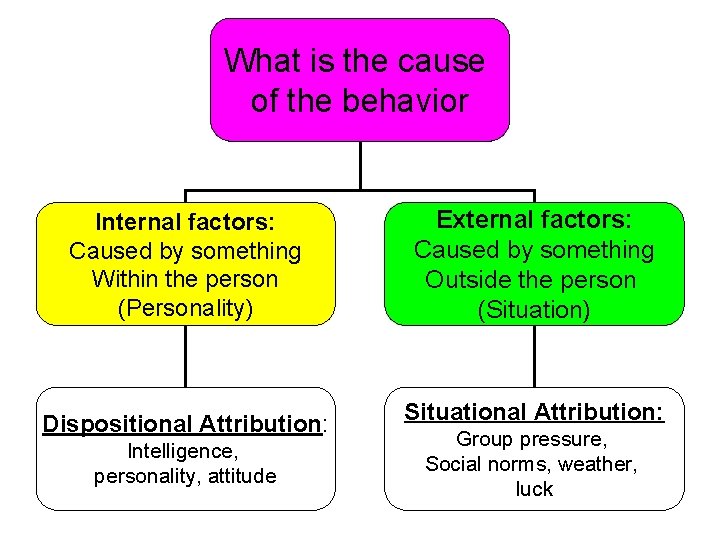
What is the cause of the behavior Internal factors: Caused by something Within the person (Personality) Dispositional Attribution: Intelligence, personality, attitude External factors: Caused by something Outside the person (Situation) Situational Attribution: Group pressure, Social norms, weather, luck
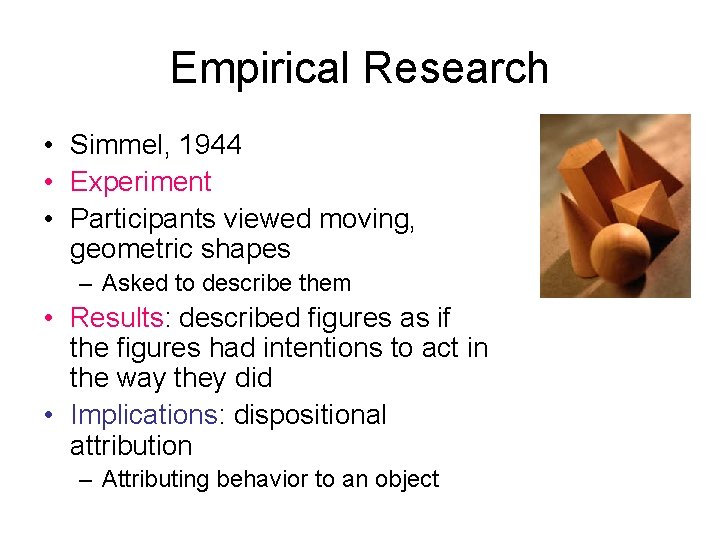
Empirical Research • Simmel, 1944 • Experiment • Participants viewed moving, geometric shapes – Asked to describe them • Results: described figures as if the figures had intentions to act in the way they did • Implications: dispositional attribution – Attributing behavior to an object
Empirical Research • • Evans-Pritchard, 1976 Case study: cultural Participants: Azande people (central Africa) Procedure – Natural event: granary doorway collapsed – Participants explained why • Results: – People said it was witchcraft and fate • Even when shown evidence of termites • Implications: the use of situational attribution is culturally created
Additional theories/research that support attribution theory • Epstein, 1983 Asch, 1951/1956 • Milgram, 1974 – Take notes Milgram (106 -107) • Bandura’s Social Learning Theory and Bobo Doll research
Activity • Connect Milgram’s research to attribution theory – Notes 106 -107
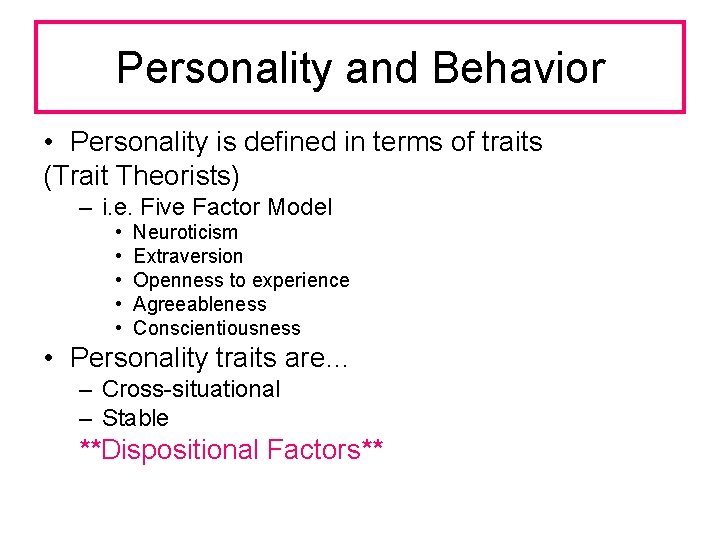
Personality and Behavior • Personality is defined in terms of traits (Trait Theorists) – i. e. Five Factor Model • • • Neuroticism Extraversion Openness to experience Agreeableness Conscientiousness • Personality traits are… – Cross-situational – Stable **Dispositional Factors**
Is behavior really consistent and stable? • Mischel disagrees – Less evidence of consistency • Only a moderate correlation between conscientiousness in different situations – Causes of behavior should look at the situation • Hartsshorne and May, 1928 – Dishonest students in one school were not always dishonest in another school
Trait Theorist’s Reponses • We never said that is was specific behaviors at specific times – Classes of behavior – Range of different situations • General tendency – Don’t compare days, compare weeks
Research to support tendencies • Roberts and Del Vecchio, 2000 – Correlational & Longitudinal Study: Surveys – Conclusion • High correlation between personality measures taken 7 years apart • Evidence supports that significant personality change beyond early adulthood is rare.
Your Test Results • Go through all factors and highlight your results – Low or high? – Write whether you or agree or disagree with each factor • Take a personality test – www. pearsonhotlinks. com – ISBN 978 0 435 032883 – Chapter 4, Weblink 4. 1
- Slides: 17