
Situation of Risk Hypertensive Disorders of Pregnancy Pam

- Slides: 43
Situation of Risk: Hypertensive Disorders of Pregnancy Pam Jordan, Ph. D, RNC
Hypertensive Disorders of Pregnancy • Leading cause of maternal mortality worldwide • Occur in 12 -22% of all pregnancies • Encompasses a spectrum of diagnoses • Chronic hypertension • Preeclampsia • Mild • Severe • Preeclampsia superimposed on chronic HTN • Gestational hypertension • How do we define hypertension? • Systolic BP ≥ 140 • Diastolic BP ≥ 90
Hypertensive Disorders of Pregnancy • Chronic hypertension Hypertension diagnosed prior to pregnancy or prior to 20 weeks gestation • If one of the other hypertensive disorders of pregnancy is diagnosed during pregnancy but persists after 12 weeks postbirth, a retroactive diagnosis of chronic hypertension may be made •
Hypertensive Disorders of Pregnancy • Preeclampsia-eclampsia • Affects 10% of all first pregnancies • A systemic disease with hypertension developing after the 20 th week of pregnancy and accompanied by proteinuria • Eclampsia is the convulsive stage of the disease • Used to be called pregnancy induced hypertension [PIH]
Hypertensive Disorders of Pregnancy • Preeclampsia superimposed on chronic HTN • Up to 25% of women with chronic hypertension develop preeclampsia • Women with hypertension who develop new onset proteinuria, proteinuria before the 20 th week gestation, or sudden uncontrolled hypertension • Has the highest rates of both maternal and fetal morbidity and mortality
Hypertensive Disorders of Pregnancy • Gestational hypertension • Develops in 5 -6% of all pregnancies in the US • Hypertension detected for the first time after 20 weeks gestation without proteinuria • Relatively benign without underlying physiological changes • May be treated with medication • Definitive diagnosis made postpartum.
Preeclampsia • Disease of pregnancy that ranges from mild to severe • Hypertension accompanied by underlying systemic pathology that can have severe maternal and fetal impact • 10% of all pregnancies • Most common complication of pregnancy • No consensus as to cause • Only cure is delivery of the placenta
Preeclampsia • Diagnosed after the 20 th week of pregnancy • Documented normal blood pressures prior to 20 weeks gestation • Mild preeclampsia • Systolic BP >140 and <160 and diastolic BP > 90 and <110 on at least two occasions at least 6 hours apart • At least 300 mg/DL of protein in a 24 hour urine • Severe preeclampsia • Systolic BP≥ 160 and diastolic BP≥ 110 on at least two occasions at least 6 hours apart • At least 5 grams of protein in a 24 hour urine
Preeclampsia • NOTE: urine protein assessed by dip sticks are not considered accurate • NOTE: urine collections for protein of less than a full 24 hours are not considered accurate • NOTE: increases of blood pressure over baseline [pre- pregnancy or pregnancy values] are not of value in the diagnosis of pre-eclampsia
Preeclampsia • In the past, a woman was considered to have pre-eclampsia if she demonstrated the triad of 1. Hypertension 2. Proteinuria 3. Edema • These are no longer the diagnostic criteria because edema is common during pregnancy
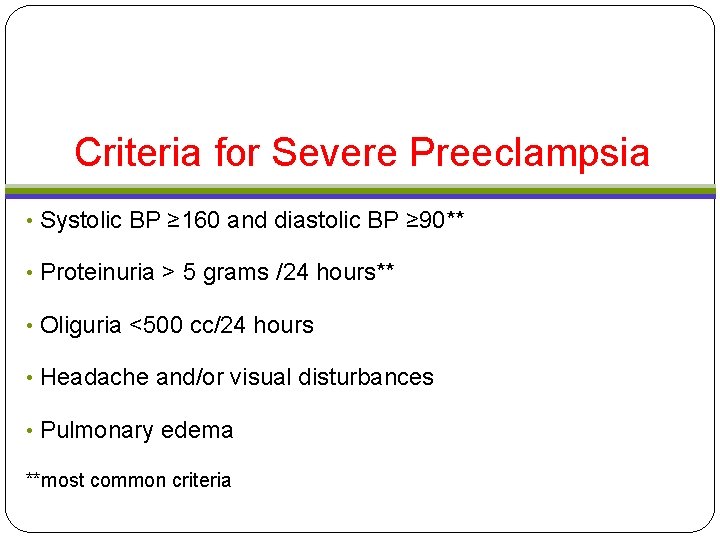
Criteria for Severe Preeclampsia • Systolic BP ≥ 160 and diastolic BP ≥ 90** • Proteinuria > 5 grams /24 hours** • Oliguria <500 cc/24 hours • Headache and/or visual disturbances • Pulmonary edema **most common criteria
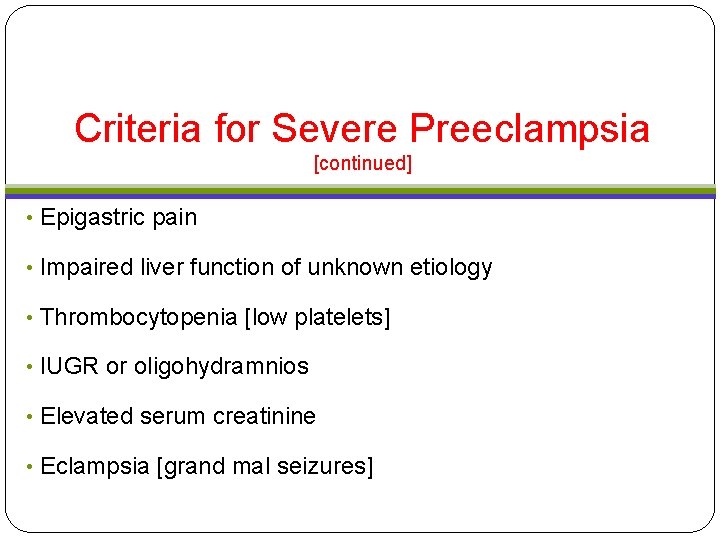
Criteria for Severe Preeclampsia [continued] • Epigastric pain • Impaired liver function of unknown etiology • Thrombocytopenia [low platelets] • IUGR or oligohydramnios • Elevated serum creatinine • Eclampsia [grand mal seizures]
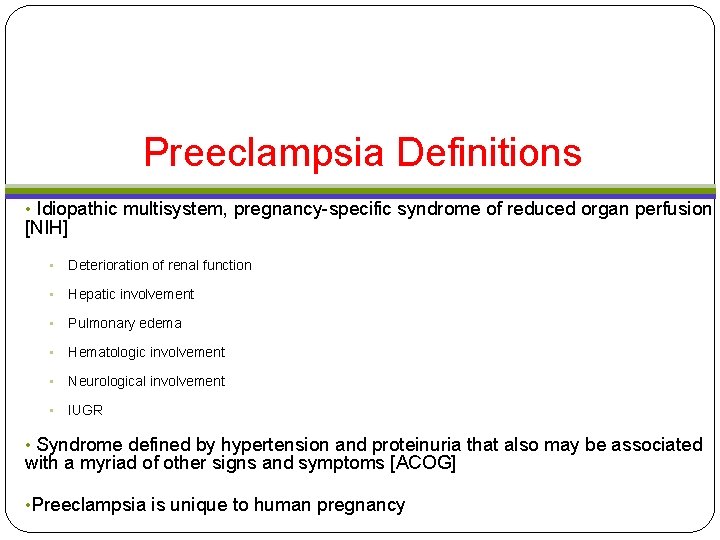
Preeclampsia Definitions • Idiopathic multisystem, pregnancy-specific syndrome of reduced organ perfusion [NIH] • Deterioration of renal function • Hepatic involvement • Pulmonary edema • Hematologic involvement • Neurological involvement • IUGR • Syndrome defined by hypertension and proteinuria that also may be associated with a myriad of other signs and symptoms [ACOG] • Preeclampsia is unique to human pregnancy
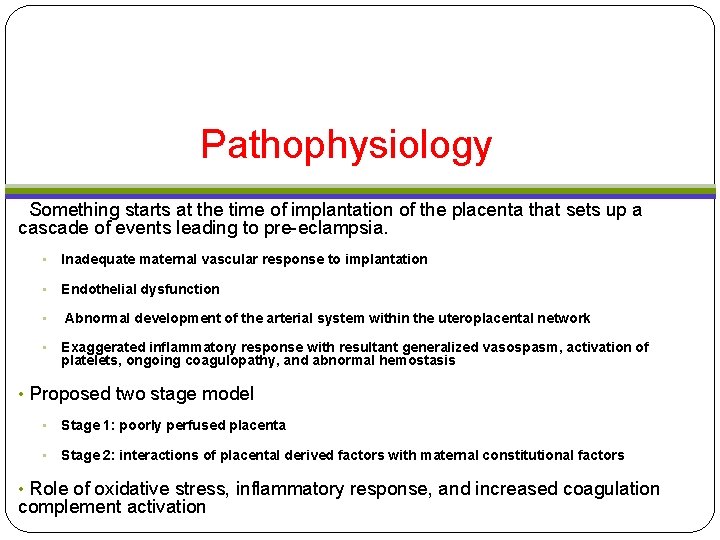
Pathophysiology Something starts at the time of implantation of the placenta that sets up a cascade of events leading to pre-eclampsia. • Inadequate maternal vascular response to implantation • Endothelial dysfunction • • Abnormal development of the arterial system within the uteroplacental network Exaggerated inflammatory response with resultant generalized vasospasm, activation of platelets, ongoing coagulopathy, and abnormal hemostasis • Proposed two stage model • Stage 1: poorly perfused placenta • Stage 2: interactions of placental derived factors with maternal constitutional factors • Role of oxidative stress, inflammatory response, and increased coagulation complement activation
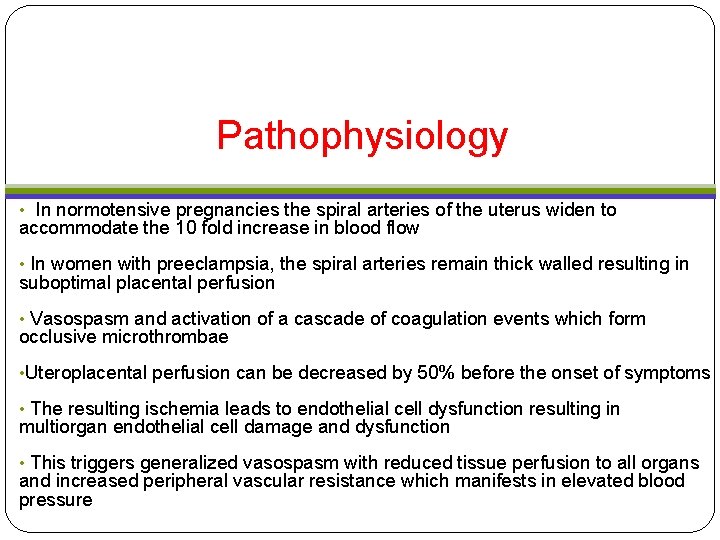
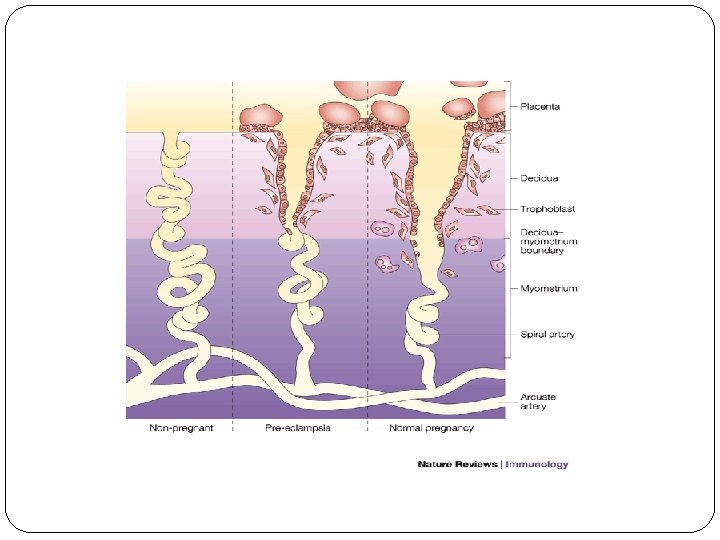
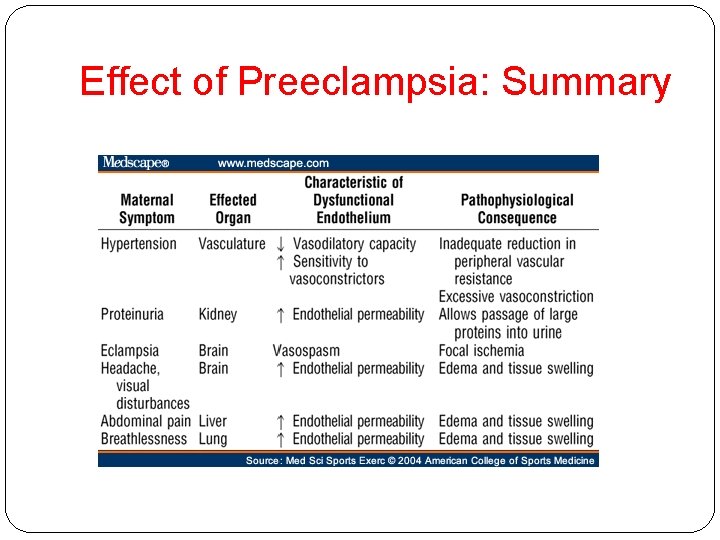
Pathophysiology • In normotensive pregnancies the spiral arteries of the uterus widen to accommodate the 10 fold increase in blood flow • In women with preeclampsia, the spiral arteries remain thick walled resulting in suboptimal placental perfusion • Vasospasm and activation of a cascade of coagulation events which form occlusive microthrombae • Uteroplacental perfusion can be decreased by 50% before the onset of symptoms • The resulting ischemia leads to endothelial cell dysfunction resulting in multiorgan endothelial cell damage and dysfunction • This triggers generalized vasospasm with reduced tissue perfusion to all organs and increased peripheral vascular resistance which manifests in elevated blood pressure
Pathophysiology: Liver • Increased microvascular fat deposits in the liver, which may be the cause of epigastric pain • There may be hemorrhagic necrosis in the liver, which can cause subcapsular hematoma and result in right upper quadrant pain or epigastric pa • Liver damage may be mild or may progress to HELLP syndrome [Hemolysis, Elevated Liver enzymes, and Low Platelets] which occurs in about 1 in 5 women with severe preeclampsia-life threatening condition
Pathophysiology: Kidney • In 70% of women with preeclampsia, glomerular endothelial damage, fibrin deposits, and resulting ischemia reduce renal plasma blood flow and glomerular filtration rate • Protein is excreted in the urine • Uric acid, creatinine, and calcium clearance are reduced and oliguria develops as the condition worsens • Oliguria is a sign of severe preeclampsia and kidney damage
Pathophysiology: Vascular • The coagulation system is activated and thrombocytopenia occurs, possibly due to increased platelet aggregation and deposition at site of endothelial damage, activating the clotting cascade • A platelet count below 100, 000 cells/mm 3 is an indication of severe preeclampsia [normal 150, 000 -400, 000 cells/mm 3] • The leakage of serum protein into interstitial spaces and into urine, by way of damaged capillary walls, results in decreased serum albumin and tissue edema • Pulmonary edema is most commonly caused by volume overload related to left ventricular failure as a result of extremely high vascular resistance
Pathophysiology: Brain • Endothelial damage to the brain results in fibrin deposits, edema, and cerebral hemorrhage, which may lead to hyperreflexia and severe headaches and can progress to eclampsia • Retinal arterial spasms may cause blurring or double vision, photophobia, or scotoma [islands of loss of vision or visual acuity surrounded by areas of normal vision]
Effect of Preeclampsia: Summary
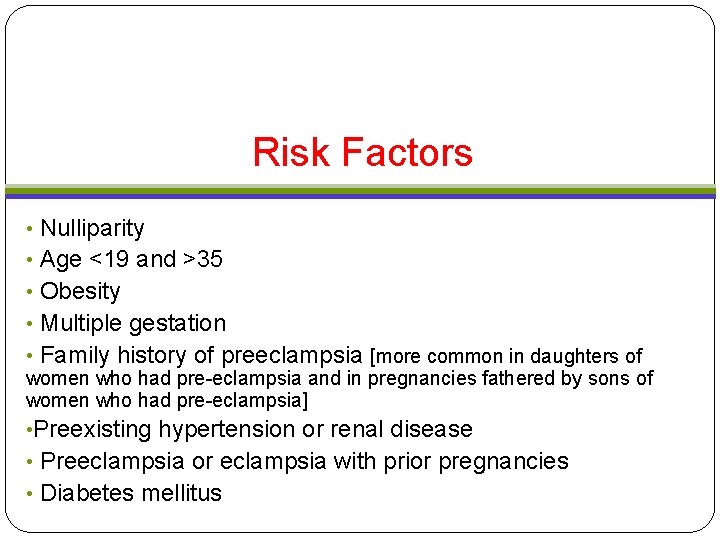
Risk Factors • Nulliparity • Age <19 and >35 • Obesity • Multiple gestation • Family history of preeclampsia [more common in daughters of women who had pre-eclampsia and in pregnancies fathered by sons of women who had pre-eclampsia] • Preexisting hypertension or renal disease • Preeclampsia or eclampsia with prior pregnancies • Diabetes mellitus
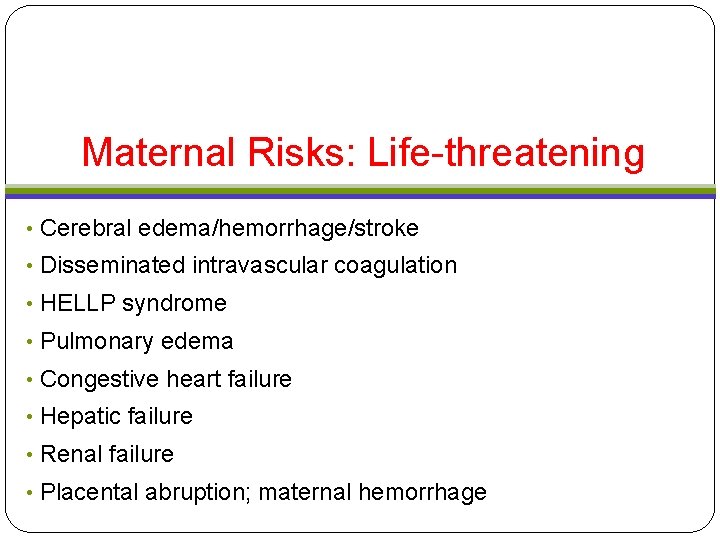
Maternal Risks: Life-threatening • Cerebral edema/hemorrhage/stroke • Disseminated intravascular coagulation • HELLP syndrome • Pulmonary edema • Congestive heart failure • Hepatic failure • Renal failure • Placental abruption; maternal hemorrhage
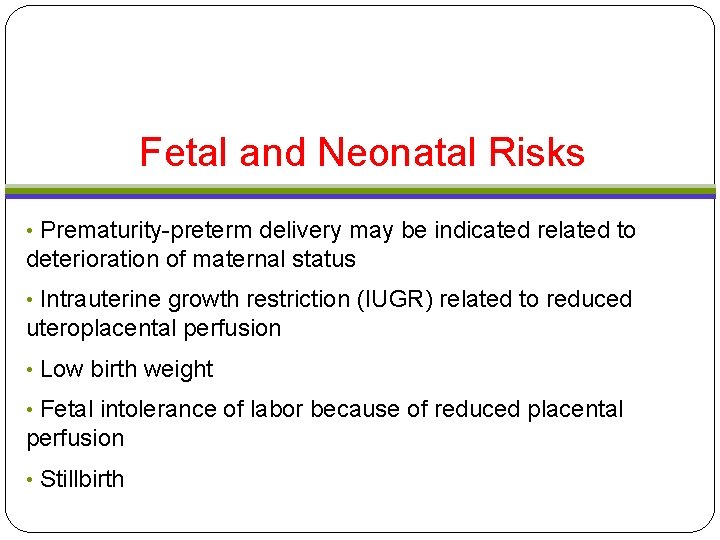
Fetal and Neonatal Risks • Prematurity-preterm delivery may be indicated related to deterioration of maternal status • Intrauterine growth restriction (IUGR) related to reduced uteroplacental perfusion • Low birth weight • Fetal intolerance of labor because of reduced placental perfusion • Stillbirth
Symptoms • General malaise • “Not feeling well. I’m just not myself. ” “Something is wrong. ” “I think I have the flu. ” • Nausea and vomiting in late pregnancy should be considered abnormal. • Severe headaches not relieved with acetaminophen. • Right upper quadrant pain [just below the ribs on the right side: liver] May be confused with heartburn. • Sudden weight gain; Sudden swelling of hands, face, feet • Problems with vision [blurred vision, flashing lights or spots before the eyes]
Assessment Criteria Edema � 1+ = slight pitting; normal � 2+ = somewhat deeper pit than in l+; may be normal � 3+ = the pit is noticeably deep and the extremity is swollen and full; abnormal � 4+ = the pit is deeper yet and Reflexes � 0 = No response; abnormal � 1+ = Diminished response; low normal � 2+ = Average response; normal � 3+ = Brisker than average; may not be abnormal � 4+ = Hyperactive, ; very brisk, jerky, or clonic response; abnormal remains when the finger is removed/the extremity is shiny with extremely taut skin; abnormal Clonus is measured in number of beats Pitting can also be documented as What is the woman’s normal? the depth of the pitting in mm
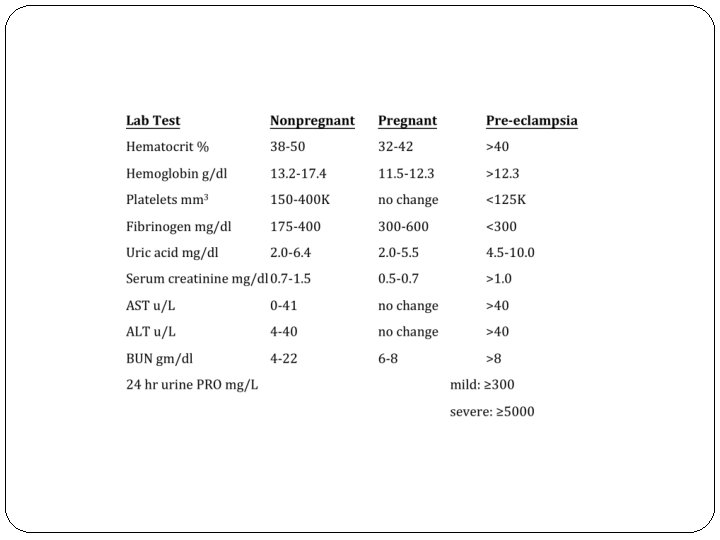
Laboratory Analyses • Complete blood count • Platelet count • Liver function tests [ALT, AST] • Renal function tests [creatinine, BUN, Uric acid] • Urinalysis and microscopy • 24 hour urine collection for protein and creatinine clearance • Blood type and antibody screen [in anticipation of possible hemorrhage]
Laboratory Analyses • Platelet count • <150, 000 = thrombocytopenia • <100, 000 extreme high risk for coagulopathy [epidural risk] • Liver function • ALT increases • AST increases • Watch for hypoglycemia • Watch for hyperbilirubinemia and jaundice • Renal function • Serum creatinine increases • Creatinine clearance decreases • BUN increases as creatinine increases • Uric acid increase may be an early finding • Urinalysis and microscopy to rule out an inflammatory process in the kidneys
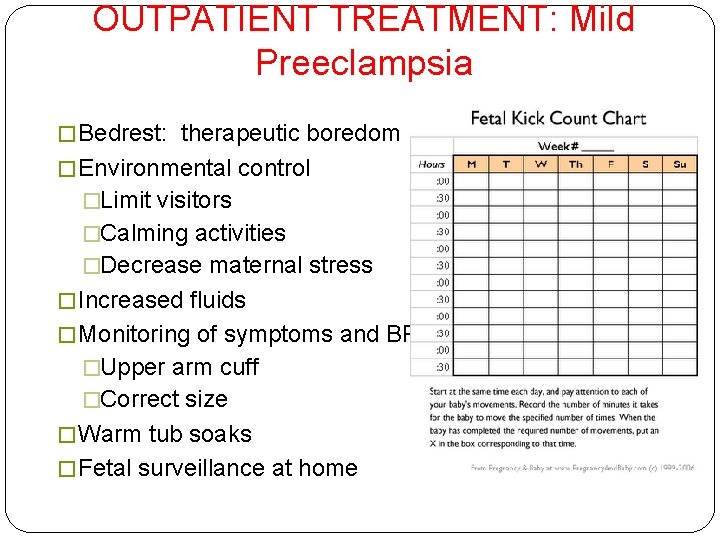
OUTPATIENT TREATMENT: Mild Preeclampsia � Bedrest: therapeutic boredom � Environmental control �Limit visitors �Calming activities �Decrease maternal stress � Increased fluids � Monitoring of symptoms and BP �Upper arm cuff �Correct size � Warm tub soaks � Fetal surveillance at home
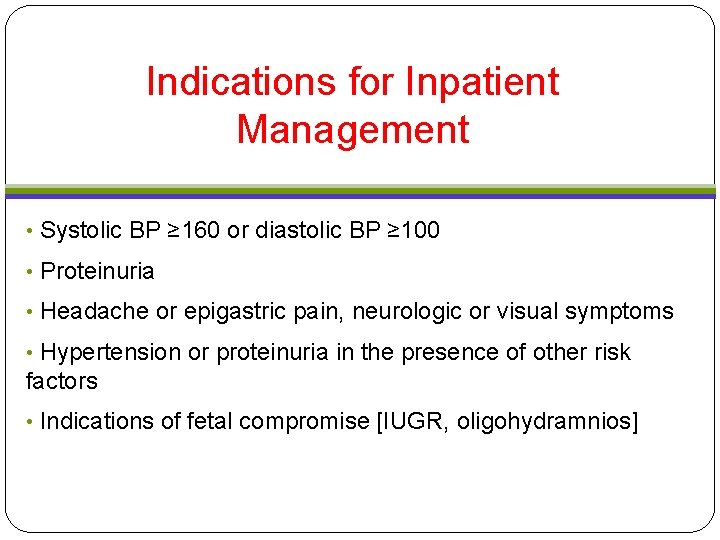
Indications for Inpatient Management • Systolic BP ≥ 160 or diastolic BP ≥ 100 • Proteinuria • Headache or epigastric pain, neurologic or visual symptoms • Hypertension or proteinuria in the presence of other risk factors • Indications of fetal compromise [IUGR, oligohydramnios]
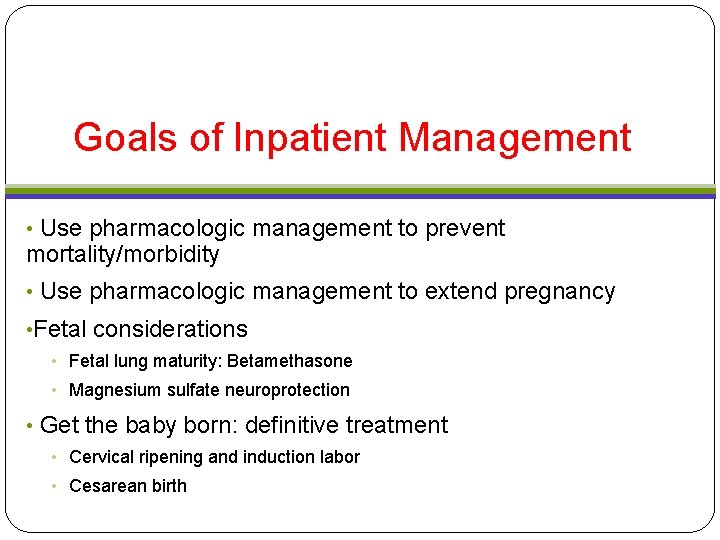
Goals of Inpatient Management • Use pharmacologic management to prevent mortality/morbidity • Use pharmacologic management to extend pregnancy • Fetal considerations • Fetal lung maturity: Betamethasone • Magnesium sulfate neuroprotection • Get the baby born: definitive treatment • Cervical ripening and induction labor • Cesarean birth
Inpatient Management • Initiation of an intravenous line • These women are usually initially volume depleted • Remember that this disease involves endothelial dysfunction • Beware of fluid overload which could lead to pulmonary edema • Insertion of a foley catheter • Strict intake and output • Fetal monitoring • Pay particular attention to baseline fetal heart rate and variability
Inpatient Management: Magnesium Sulfate • Magnesium sulfate therapy: A high alert medication • Always administer using an infusion pump • Have calcium gluconate available at the bedside to reverse magnesium toxicity • Assess for signs of magnesium toxicity • Reduced or absent deep tendon reflexes [as long as DTRs are present there is not Mg toxicity] • Confusion, reduced responsiveness [assess LOC, orientation X 3] • Respiratory depression [assess respiratory rate, depth, auscultate lungs] • Serum Mg levels
Inpatient Management: Antihypertensives • To achieve BP control to prevent cerebrovascular accident while trying to maintain pregnancy or achieve delivery • May be included as part of expectant management of severe pre-eclampsia related solely to BP criteria • Used to prevent cerebrovascular hemorrhage/stroke
Inpatient Management: Anihypertensives: Hydralazine HCl [Apresoline] • Causes direct peripheral vasodilatation • Increases cardiac output and heart rate • Dosages: 5 mg IV or 10 mg IM • 5 -10 mg every 20 to 30 minutes • Maximum dosage is 20 mg IV or 30 mg IM • If there is no response up to maximum dosage, change medications • Can cause rebound tachycardia • More likely to get rebound hypotension
Inpatient Management: Anihypertensives: Labetalol • Selective alpha and non-beta antagonist • Reduces vascular resistance without increasing cardiac output or heart rate • Dosage: initial 20 mg IV • If the effect is suboptimal, then administer 40 mg IV 10 minutes later • If the effects is still suboptimal, administer 80 mg IV 10 minutes later for two additional doses • Maximum dosage of 300 mg • May see bradycardia and hypoglycemia in the fetus/newborn
Important Notes • A respiratory rate > 24/min indicates respiratory dysfunction. • If a woman cannot say more than one word at a time, she is in respiratory failure. • A heart rate > 120 in a pregnant woman needs attention. • A heart rate > 140 in a pregnant woman is a pre-cardiac arrest heart rate. • Pregnant women can remain coherent right up until they code. • Magnesium sulfate may prevent seizures but does not effect disease progression
Nursing Care • Diligent assessment of • Blood pressure and heart rate • Respiratory rate [breath sounds]/dyspnea • Deep tendon reflexes/clonus • Level of consciousness/orientation X 3/slurred speech • Edema [presence and extent] • Intake and output • Signs of bleeding • Visual alterations • Epigastric pain/nausea/vomiting • Headache
Nursing Care • Monitor • Lab values • Uterine contractions • Fetal heart rate patterns • Effects of pharmacologic therapies [desired and untoward] • Create a calm, minimally stimulating environment • Provide emotional support and information to client/family • The woman may look completely normal, yet be critically ill • Treatment makes the woman feel worse
Postpartum: Maternal Care • Magnesium sulfate infusion 24 hours postpartum if required antenatally • New onset preeclampsia-eclampsia can develop in first 48 hours postpartum • HELLP syndrome may develop postpartum • Persistent elevated BP > 150/100 requires antihypertensive therapy • BP may be labile requiring antihypertensive therapy • Discharge planning: careful follow up, continue BP monitoring if on antihypertensives, pregnancy planning and contraception, when to call provider
Postpartum: Newborn Care Observe for signs of magnesium toxicity for 24 -28 hours if maternal magnesium administered close to birth • Increased risk associated with maternal magnesium sulfate: • May observe hypotonia and lethargy for up to 48 hours • Higher risk hypoglycemia and hypocalemia •
Resources • The key resource was the AWHONN educational webinar: Enhancing the Management of Pre-eclampsia Presented by Judith Poole, Ph. D, MBA/MHA, RNC-OB [One of the best benefits of belonging to your nursing specialty professional organization is access to evidence based practice via many different modalities. ] • Both the National Institutes of Health [NIH] and the American College of Obstetricians and Gynecologists [ACOG] have working groups and resources on hypertension in pregnancy.