
Situation Ethics Fletchers 10 Principles By the end
Situation Ethics – Fletcher’s 10 Principles By the end of this lesson you will have: • Re-capped what you know about Situation Ethics so far • Learnt the 10 principles in Fletcher’s situation ethics • Evaluated S. E as an ethical theory
Spec Check AO 1 AO 2 Fletcher’s Situation Ethics – The principles as a means of assessing morality • The degree to which agape is the only intrinsic good • Whether SE promotes injustice • Whether SE promotes immoral behaviour • Whether agape should replace religious rules
Re-Cap • 1. What type of ethical theory is S. E? • 2. Which scholar wrote ‘shaking of the foundations’ in 1950? • 3. What three approaches to ethics did Joseph Fletcher identify? • 4. How does Luke 10 justify Situation Ethics? • 5. How does Fletcher believe we should see the conscience?
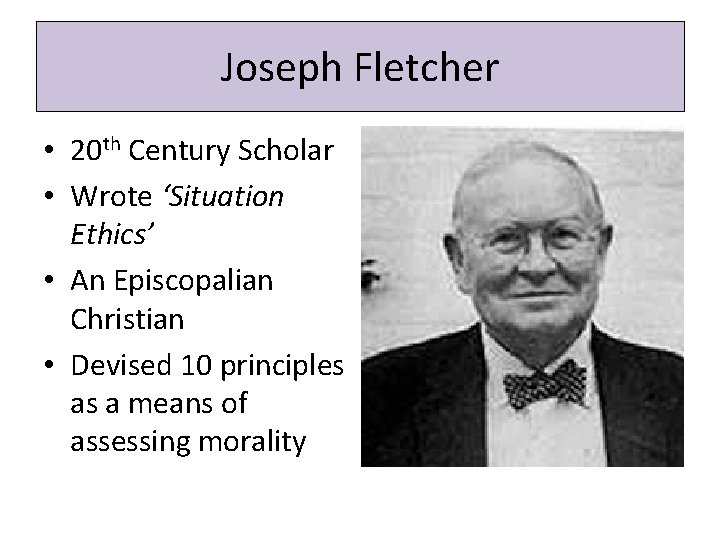
Joseph Fletcher • 20 th Century Scholar • Wrote ‘Situation Ethics’ • An Episcopalian Christian • Devised 10 principles as a means of assessing morality
10 Principles • Fletcher devised 4 working principles and 6 fundamental principles • These principles help followers of Situation Ethics know how to behave in certain situations • The main principle, or ‘boss’ principle is agape, and the 10 principles explain how to uphold the one rule of ‘agape’
10 Principles • TASK: Individually, read the four working principles o page 184 of the textbook • Summarise each working principle in one sentence in your own words • Pragmatism • Positivism • Relativism • Personalism
10 Principles • TASK: Get into groups of four • Re-read the story on Savitaa’s tragic death in your booklets. Using the 4 working and 6 fundamental principles on page 185 of your textbooks, work through each principle to see whether situation ethics would have allowed Savitaa an abortion. • We will go through the answers as a class
10 Principles • How can we remember the 6 fundamental principles? • 1. Only love is intrinsically good; nothing else • 2. The ruling norm of any Christian decision making is love • 3. Love and justice are the same for love is justice distributed • 4. Love will’s the neighbours good whether you like him or not • 5. Only the end justifies the means • 6. Love’s decisions are made situationally and not prescriptively
Evaluation – AO 2 • The degree to which agape is the only intrinsic good • Whether SE promotes injustice • Whether SE promotes immoral behaviour • Whether agape should replace religious rules • TASK: We will work through one of these questions as a class using the AO 2 grid framework. You will then complete your own grid framework on another question
- Slides: 9