
Situation and needs for international cooperation in forest
- Slides: 21
Situation and needs for international cooperation in forest research and innovation: a policy science perspective Dr. Metodi Sotirov Senior Researcher & Assistant Professor Workshop on International cooperation in research and innovation for the future European forest-based sector 05 -02 -2019; Brussels, Belgium
My background Education: • MSc & BSc in Forest Sciences • Ph. D in Forest & Environmental Policy Studies • Post-Doc in Governance, Environment & Markets Professional Experience: • Public sector: Ministry of Agriculture and Forests: 5 yrs • Private sector: Forest Sector/Land Use Consultancy: 2 yrs • Public sector: Forest Policy Research/ALU-FR: 11 yrs International and EU Research Cooperation: • IUFRO (Global Forest Governance) • EU‘s FP-7/Horizon 2020; COST actions; EU tender studies • Era-Nets (Sumforest; Biodiversa; Wood. Wisdom) • National funding (German Government; EFI-MDTF)
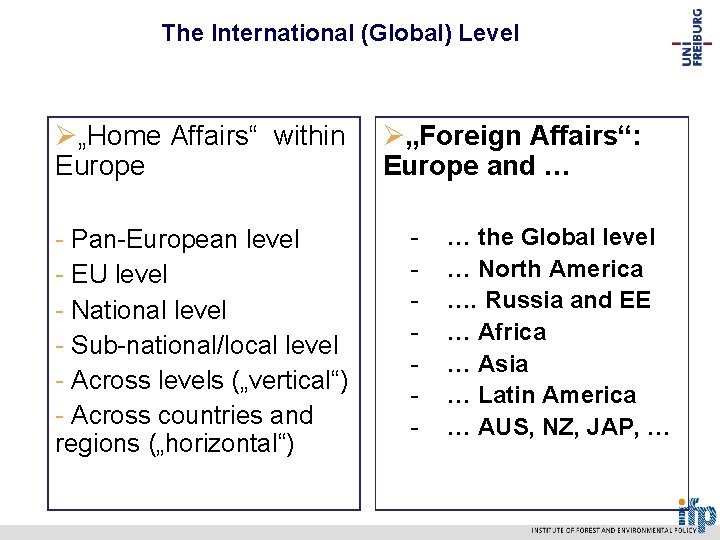
The International (Global) Level Ø„Home Affairs“ within Europe - Pan-European level - EU level - National level - Sub-national/local level - Across levels („vertical“) - Across countries and regions („horizontal“) Ø„Foreign Affairs“: Europe and … - … the Global level … North America …. Russia and EE … Africa … Asia … Latin America … AUS, NZ, JAP, …
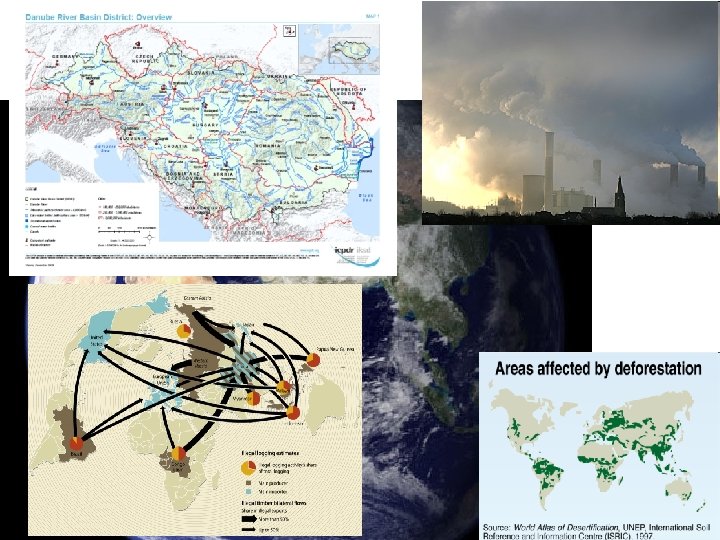
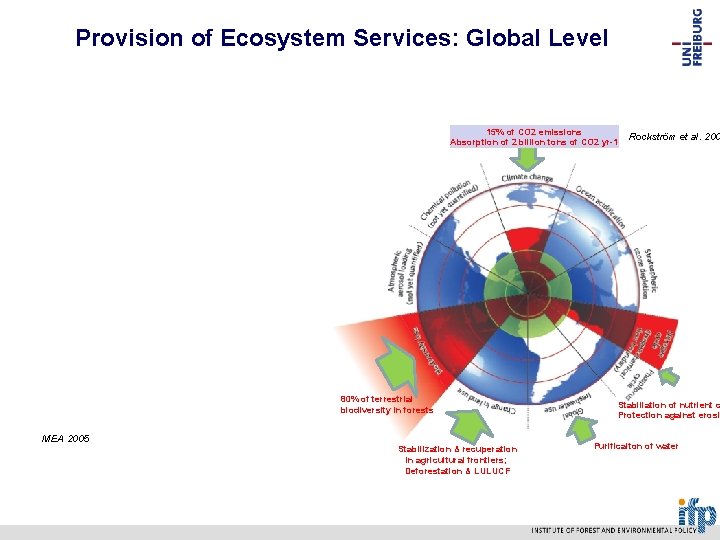
Provision of Ecosystem Services: Global Level 15% of CO 2 emissions Absorption of 2 billion tons of CO 2 yr-1 80% of terrestrial biodiversity in forests MEA 2005 Stabilization & recuperation in agricultural frontiers; Deforestation & LULUCF Rockström et al. 200 Stablilation of nutrient c Protection against erosi Purificaiton of water
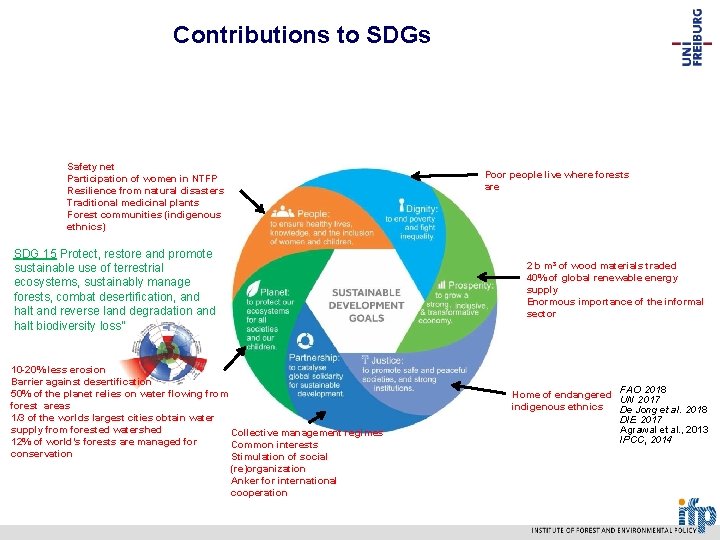
Contributions to SDGs Safety net Participation of women in NTFP Resilience from natural disasters Traditional medicinal plants Forest communities (indigenous ethnics) SDG 15 Protect, restore and promote sustainable use of terrestrial ecosystems, sustainably manage forests, combat desertification, and halt and reverse land degradation and halt biodiversity loss” 10 -20% less erosion Barrier against desertification 50% of the planet relies on water flowing from forest areas 1/3 of the worlds largest cities obtain water supply from forested watershed Collective management regimes 12% of world’s forests are managed for Common interests conservation Stimulation of social (re)organization Anker for international cooperation Poor people live where forests are 2 b m³ of wood materials traded 40% of global renewable energy supply Enormous importance of the informal sector FAO 2018 Home of endangered UN 2017 indigenous ethnics De Jong et al. 2018 DIE 2017 Agrawal et al. , 2013 IPCC, 2014
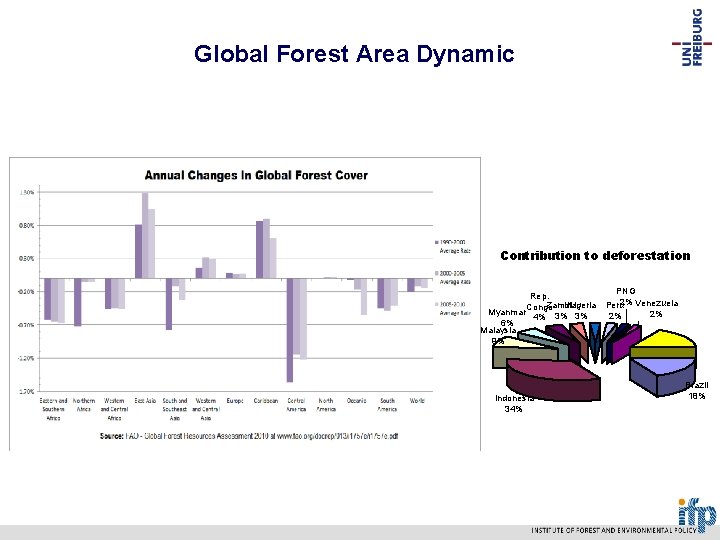
Global Forest Area Dynamic Contribution to deforestation Rep. Zambia Nigeria Congo Myanmar 3% 3% 4% 6% Malaysia 9% Indonesia 34% PNG 2% Venezuela Peru 2% 2% Brazil 18%
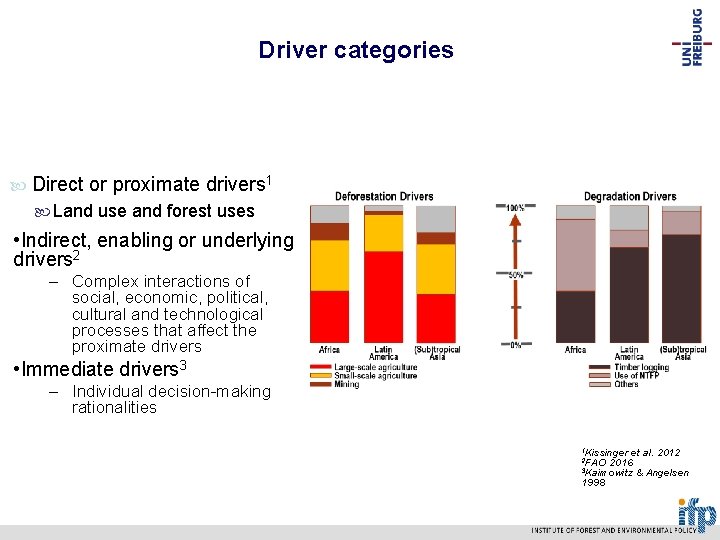
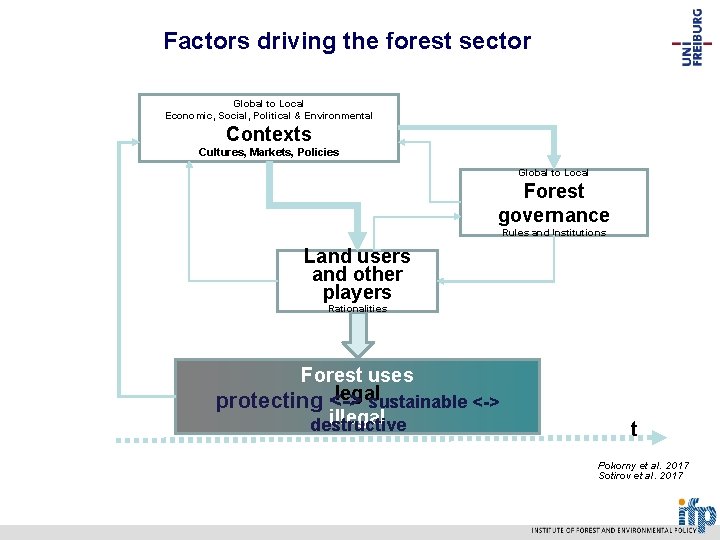
Driver categories Direct or proximate drivers 1 Land use and forest uses • Indirect, enabling or underlying drivers 2 – Complex interactions of social, economic, political, cultural and technological processes that affect the proximate drivers • Immediate drivers 3 – Individual decision-making rationalities 1 Kissinger et al. 2012 2 FAO 2016 3 Kaimowitz & Angelsen 1998
Factors driving the forest sector Global to Local Economic, Social, Political & Environmental Contexts Cultures, Markets, Policies Global to Local Forest governance Rules and Institutions Land users and other players Rationalities Forest uses legal protecting <-> sustainable <-> illegal destructive t Pokorny et al. 2017 Sotirov et al. 2017
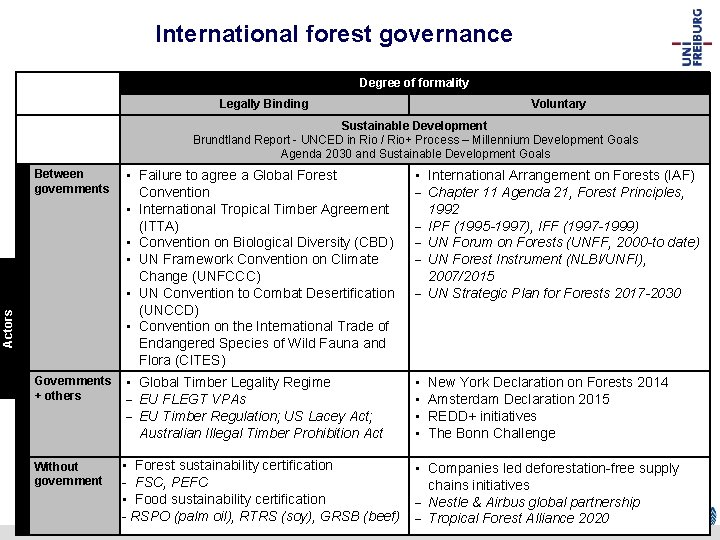
International forest governance Degree of formality Legally Binding Voluntary Sustainable Development Brundtland Report - UNCED in Rio / Rio+ Process – Millennium Development Goals Agenda 2030 and Sustainable Development Goals • Failure to agree a Global Forest Convention • International Tropical Timber Agreement (ITTA) • Convention on Biological Diversity (CBD) • UN Framework Convention on Climate Change (UNFCCC) • UN Convention to Combat Desertification (UNCCD) • Convention on the International Trade of Endangered Species of Wild Fauna and Flora (CITES) • International Arrangement on Forests (IAF) - Chapter 11 Agenda 21, Forest Principles, 1992 - IPF (1995 -1997), IFF (1997 -1999) - UN Forum on Forests (UNFF, 2000 -to date) - UN Forest Instrument (NLBI/UNFI), 2007/2015 - UN Strategic Plan for Forests 2017 -2030 Governments + others • Global Timber Legality Regime - EU FLEGT VPAs - EU Timber Regulation; US Lacey Act; Australian Illegal Timber Prohibition Act • • • Forest sustainability certification - FSC, PEFC • Food sustainability certification - RSPO (palm oil), RTRS (soy), GRSB (beef) • Companies led deforestation-free supply chains initiatives - Nestle & Airbus global partnership - Tropical Forest Alliance 2020 Actors Between governments Without government New York Declaration on Forests 2014 Amsterdam Declaration 2015 REDD+ initiatives The Bonn Challenge
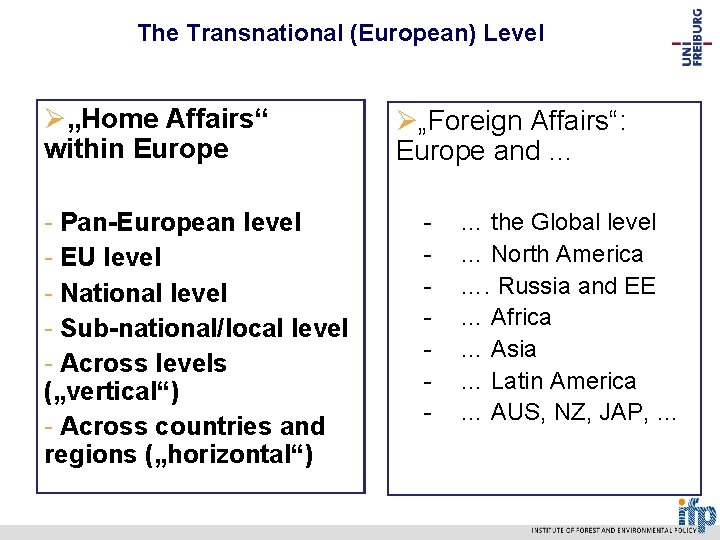
The Transnational (European) Level Ø„Home Affairs“ within Europe - Pan-European level - EU level - National level - Sub-national/local level - Across levels („vertical“) - Across countries and regions („horizontal“) Ø„Foreign Affairs“: Europe and … - … the Global level … North America …. Russia and EE … Africa … Asia … Latin America … AUS, NZ, JAP, …
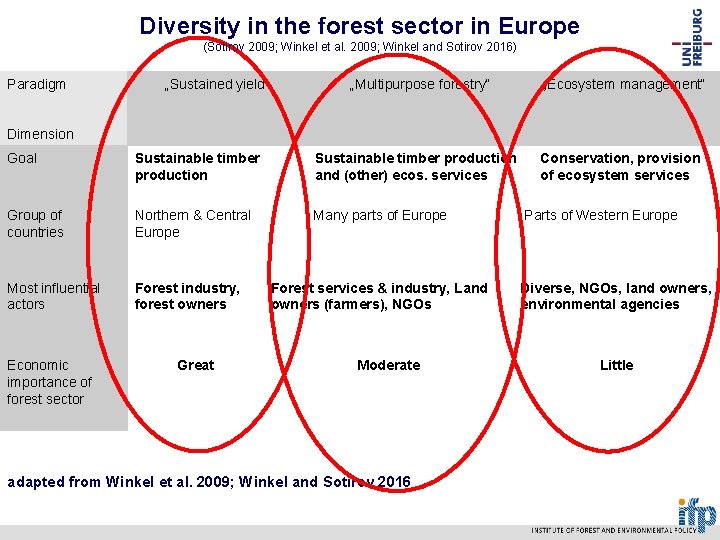
Diversity in the forest sector in Europe (Sotirov 2009; Winkel et al. 2009; Winkel and Sotirov 2016) Paradigm „Sustained yield“ „Multipurpose forestry“ „Ecosystem management“ Dimension Goal Sustainable timber production and (other) ecos. services Group of countries Northern & Central Europe Many parts of Europe Most influential actors Forest industry, forest owners Economic importance of forest sector Great Forest services & industry, Land owners (farmers), NGOs Moderate adapted from Winkel et al. 2009; Winkel and Sotirov 2016 Conservation, provision of ecosystem services Parts of Western Europe Diverse, NGOs, land owners, environmental agencies Little
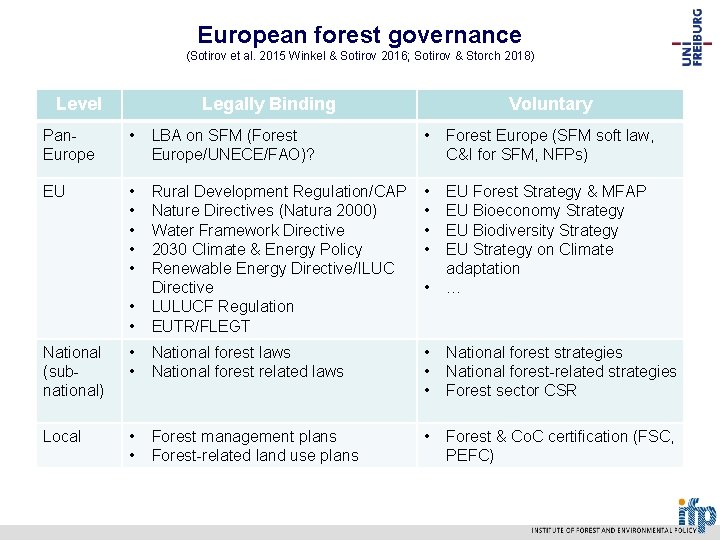
European forest governance (Sotirov et al. 2015 Winkel & Sotirov 2016; Sotirov & Storch 2018) Level Legally Binding Voluntary Pan. Europe • LBA on SFM (Forest Europe/UNECE/FAO)? • Forest Europe (SFM soft law, C&I for SFM, NFPs) EU • • • EU Forest Strategy & MFAP EU Bioeconomy Strategy EU Biodiversity Strategy EU Strategy on Climate adaptation … • • Rural Development Regulation/CAP Nature Directives (Natura 2000) Water Framework Directive 2030 Climate & Energy Policy Renewable Energy Directive/ILUC Directive LULUCF Regulation EUTR/FLEGT National (subnational) • • National forest laws National forest related laws • • • National forest strategies National forest-related strategies Forest sector CSR Local • • Forest management plans Forest-related land use plans • Forest & Co. C certification (FSC, PEFC)
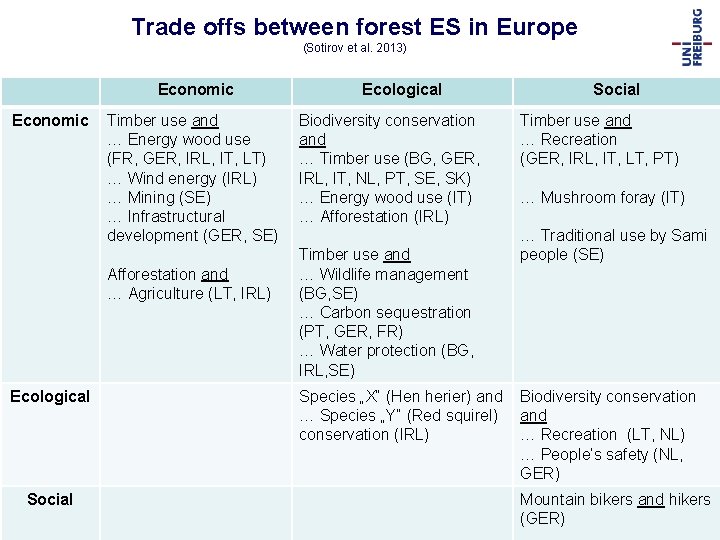
Trade offs between forest ES in Europe (Sotirov et al. 2013) Economic Timber use and … Energy wood use (FR, GER, IRL, IT, LT) … Wind energy (IRL) … Mining (SE) … Infrastructural development (GER, SE) Afforestation and … Agriculture (LT, IRL) Ecological Social Ecological Biodiversity conservation and … Timber use (BG, GER, IRL, IT, NL, PT, SE, SK) … Energy wood use (IT) … Afforestation (IRL) Timber use and … Wildlife management (BG, SE) … Carbon sequestration (PT, GER, FR) … Water protection (BG, IRL, SE) Species „X“ (Hen herier) and … Species „Y“ (Red squirel) conservation (IRL) Social Timber use and … Recreation (GER, IRL, IT, LT, PT) … Mushroom foray (IT) … Traditional use by Sami people (SE) Biodiversity conservation and … Recreation (LT, NL) … People’s safety (NL, GER) Mountain bikers and hikers (GER)
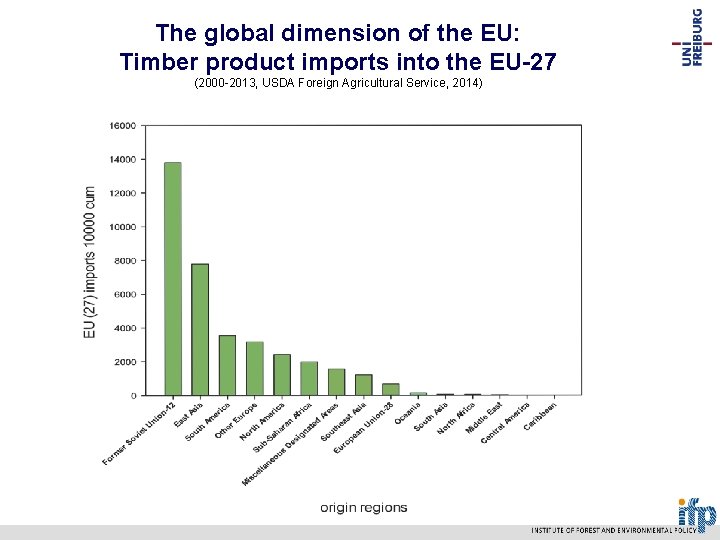
The global dimension of the EU: Timber product imports into the EU-27 (2000 -2013, USDA Foreign Agricultural Service, 2014)
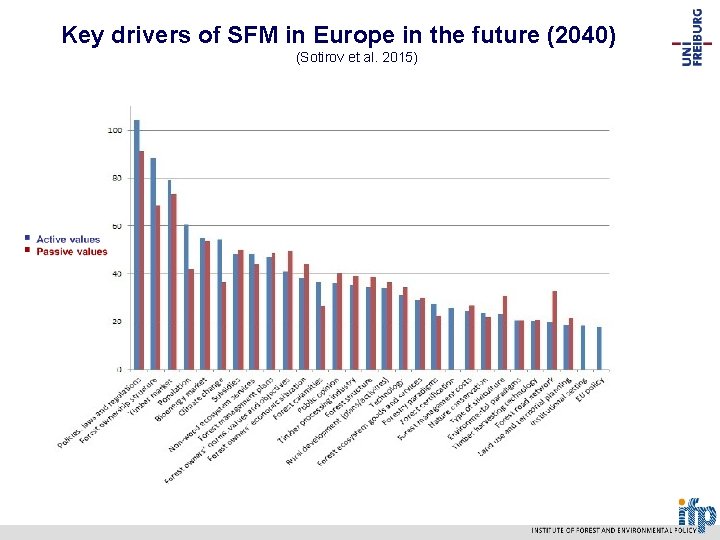
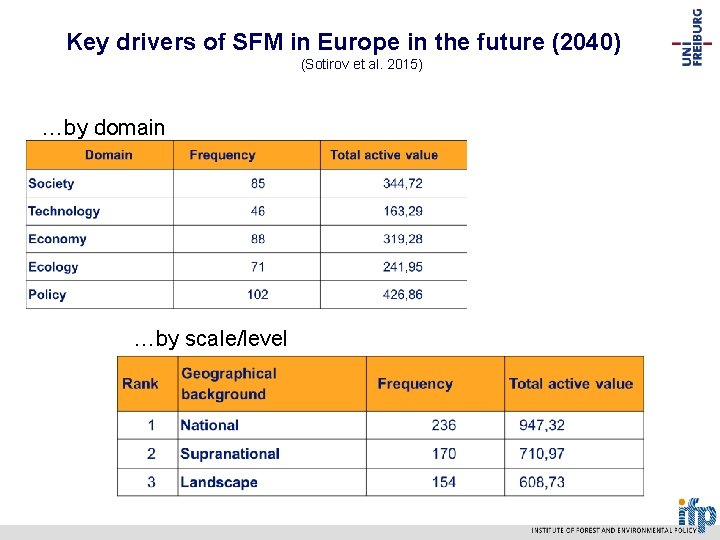
Key drivers of SFM in Europe in the future (2040) (Sotirov et al. 2015)
Key drivers of SFM in Europe in the future (2040) (Sotirov et al. 2015) …by domain …by scale/level
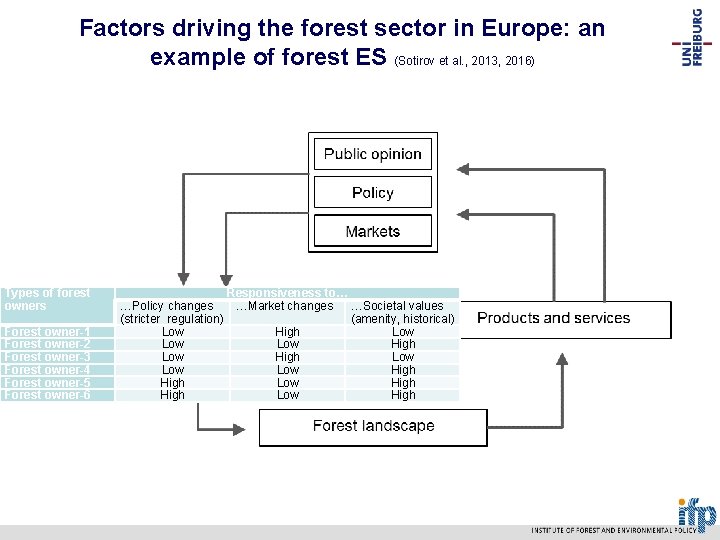
Factors driving the forest sector in Europe: an example of forest ES (Sotirov et al. , 2013, 2016) Types of forest owners Forest owner-1 Forest owner-2 Forest owner-3 Forest owner-4 Forest owner-5 Forest owner-6 Responsiveness to… …Policy changes …Market changes …Societal values (stricter regulation) (amenity, historical) Low High Low Low Low High Low High
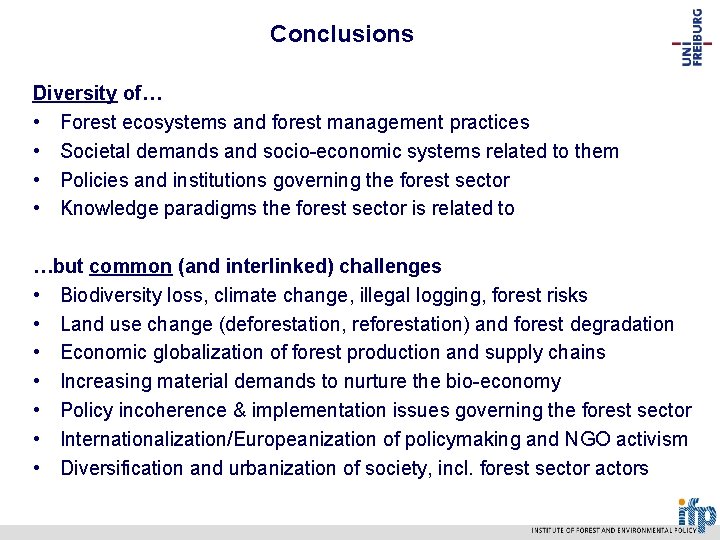
Conclusions Diversity of… • Forest ecosystems and forest management practices • Societal demands and socio-economic systems related to them • Policies and institutions governing the forest sector • Knowledge paradigms the forest sector is related to …but common (and interlinked) challenges • Biodiversity loss, climate change, illegal logging, forest risks • Land use change (deforestation, reforestation) and forest degradation • Economic globalization of forest production and supply chains • Increasing material demands to nurture the bio-economy • Policy incoherence & implementation issues governing the forest sector • Internationalization/Europeanization of policymaking and NGO activism • Diversification and urbanization of society, incl. forest sector actors
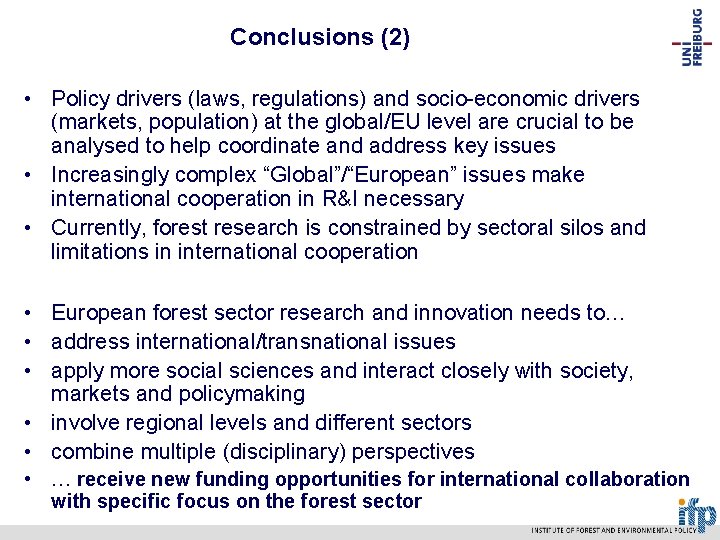
Conclusions (2) • Policy drivers (laws, regulations) and socio-economic drivers (markets, population) at the global/EU level are crucial to be analysed to help coordinate and address key issues • Increasingly complex “Global”/“European” issues make international cooperation in R&I necessary • Currently, forest research is constrained by sectoral silos and limitations in international cooperation • European forest sector research and innovation needs to… • address international/transnational issues • apply more social sciences and interact closely with society, markets and policymaking • involve regional levels and different sectors • combine multiple (disciplinary) perspectives • … receive new funding opportunities for international collaboration with specific focus on the forest sector
Thank you! Contact details: Thank you! Dr. Metodi Sotirov University of Freiburg Chair of Forest and Environmental Policy Chair of Forest- and Environmental Policy Faculty of Environment and Natural Resources Research Group: University of Freiburg, Germany Dr. Georg Winkel (georg. winkel@ifp. uni-freiburg. de), Dr. Metodi metodi. sotirov@ifp. uni-freiburg. de Sotirov (metodi. sotirov@ifp. uni-freiburg. de), B. Sc. Maike Stelter (maike. stelter@ifp. uni-freiburg. de), B. Sc. Sophie Schwer (sophie. schwer@venus. uni-freiburg. de) , M. A. Sina Leipold (sina. leipold@ifp. uni-freiburg. de)