
SITUATED COGNITION ACROSS THREE ABE PROGRAM TYPES IN
SITUATED COGNITION ACROSS THREE ABE PROGRAM TYPES IN MINNESOTA: A COMPARATIVE STUDY Jamie Kreil, M. Ed. , Doctoral Student, Adjunct Faculty, University of Minnesota kreil 009@umn. edu
OBJECTIVES Participants will: 1. Identify characteristics of low-literate learners 2. Explore situated cognition theory as it applies to work literacy programming 3. Discover 4 key arguments for the use of a situated cognition approach in program planning for lowliterate learners 4. Identify for whom and how theory applies (or does not apply) in 3 ABE program contexts 5. Design a program proposal applying situated cognition (or a modified version of it) in a workplace literacy context Attempt to apply theory to practice
BACKGROUND KNOWLEDGE Are any of you familiar with situated-cognition? Come up with a working definition of situatedcognition
INTRODUCTION • • • Overview of NRS levels, Theory and Work Literacy Key Terms • Academic Skills • Context-Specific Skills • Situated Cognition Approach 4 Key Arguments
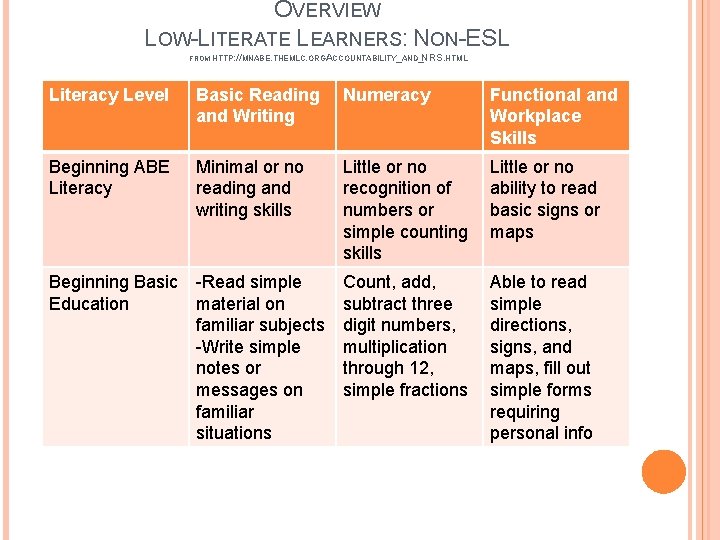
OVERVIEW LOW-LITERATE LEARNERS: NON-ESL FROM HTTP: //MNABE. THEMLC. ORGA / CCOUNTABILITY_AND_NRS. HTML Literacy Level Basic Reading and Writing Numeracy Functional and Workplace Skills Beginning ABE Literacy Minimal or no reading and writing skills Little or no recognition of numbers or simple counting skills Little or no ability to read basic signs or maps Count, add, subtract three digit numbers, multiplication through 12, simple fractions Able to read simple directions, signs, and maps, fill out simple forms requiring personal info Beginning Basic -Read simple Education material on familiar subjects -Write simple notes or messages on familiar situations
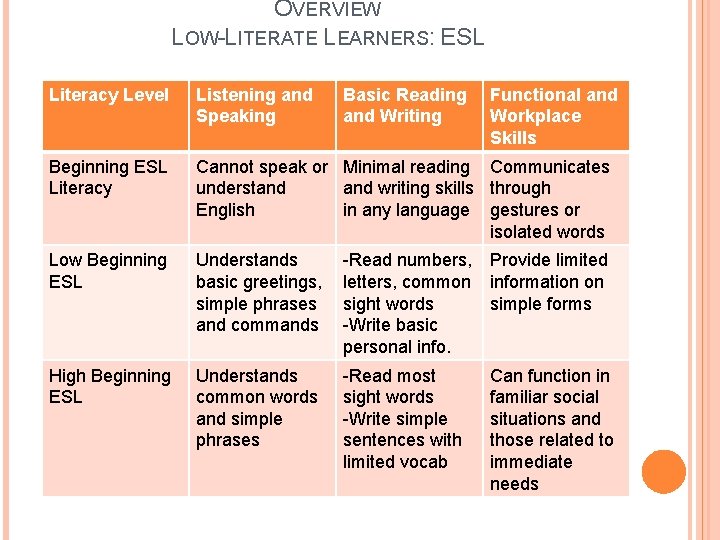
OVERVIEW LOW-LITERATE LEARNERS: ESL Literacy Level Listening and Speaking Basic Reading and Writing Functional and Workplace Skills Beginning ESL Literacy Cannot speak or Minimal reading Communicates understand writing skills through English in any language gestures or isolated words Low Beginning ESL Understands basic greetings, simple phrases and commands -Read numbers, Provide limited letters, common information on sight words simple forms -Write basic personal info. High Beginning ESL Understands common words and simple phrases -Read most sight words -Write simple sentences with limited vocab Can function in familiar social situations and those related to immediate needs
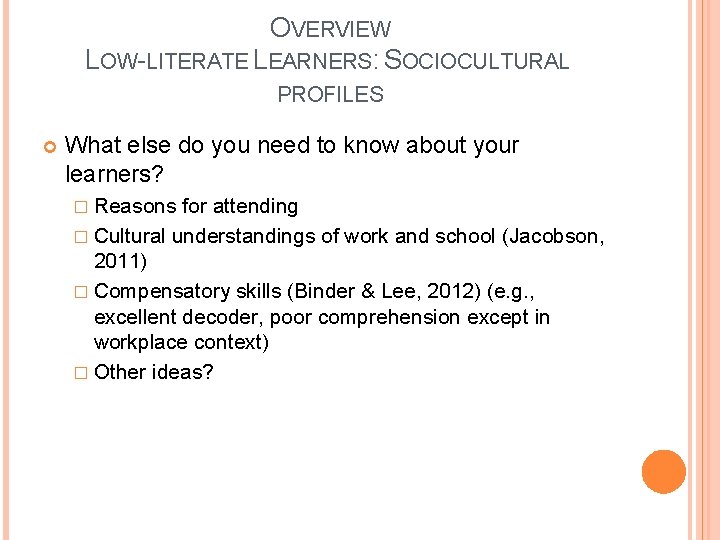
OVERVIEW LOW-LITERATE LEARNERS: SOCIOCULTURAL PROFILES What else do you need to know about your learners? � Reasons for attending � Cultural understandings of work and school (Jacobson, 2011) � Compensatory skills (Binder & Lee, 2012) (e. g. , excellent decoder, poor comprehension except in workplace context) � Other ideas?
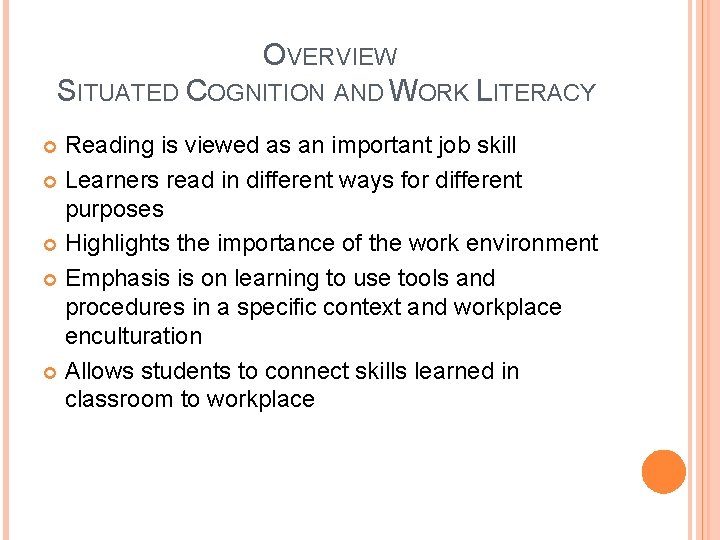
OVERVIEW SITUATED COGNITION AND WORK LITERACY Reading is viewed as an important job skill Learners read in different ways for different purposes Highlights the importance of the work environment Emphasis is on learning to use tools and procedures in a specific context and workplace enculturation Allows students to connect skills learned in classroom to workplace
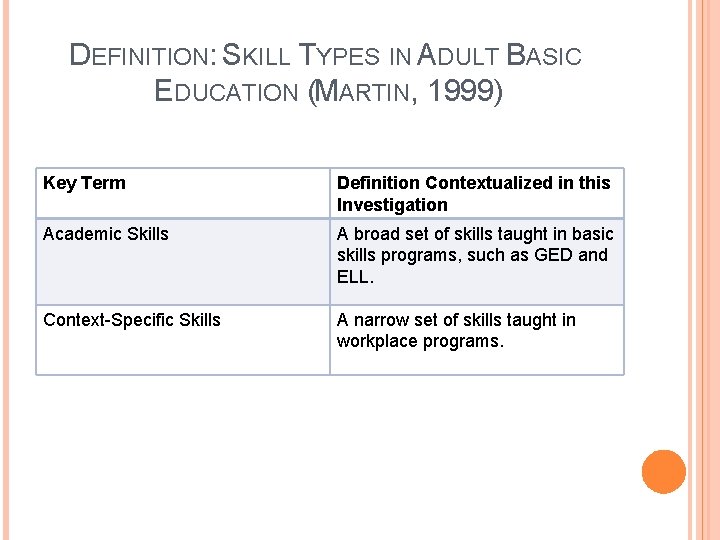
DEFINITION: SKILL TYPES IN ADULT BASIC EDUCATION (MARTIN, 1999) Key Term Definition Contextualized in this Investigation Academic Skills A broad set of skills taught in basic skills programs, such as GED and ELL. Context-Specific Skills A narrow set of skills taught in workplace programs.
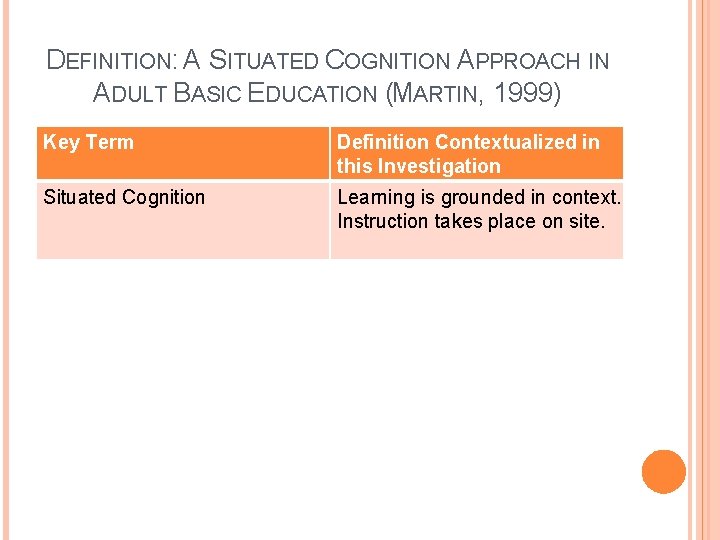
DEFINITION: A SITUATED COGNITION APPROACH IN ADULT BASIC EDUCATION (MARTIN, 1999) Key Term Definition Contextualized in this Investigation Situated Cognition Learning is grounded in context. Instruction takes place on site.
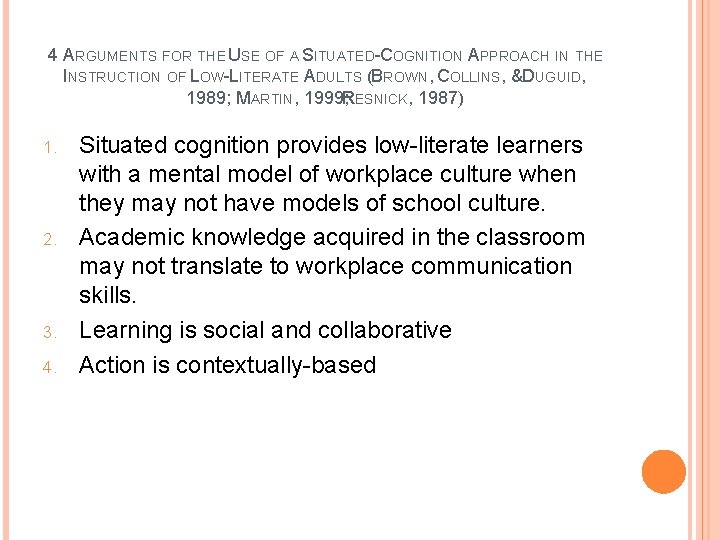
4 ARGUMENTS FOR THE USE OF A SITUATED-COGNITION APPROACH IN THE INSTRUCTION OF LOW-LITERATE ADULTS (BROWN, COLLINS, &DUGUID, 1989; MARTIN, 1999; RESNICK, 1987) 1. 2. 3. 4. Situated cognition provides low-literate learners with a mental model of workplace culture when they may not have models of school culture. Academic knowledge acquired in the classroom may not translate to workplace communication skills. Learning is social and collaborative Action is contextually-based
DISCUSSION Given these arguments and what you now know about situated cognition, do you any of your programs use a situated-cognition approach? If so, what are some examples? If not, where do you see it (or not) fitting into your context?
METHODOLOGY AND METHOD • Preliminary investigation of 3 ABE sites in MN • Interviews and document analysis conducted
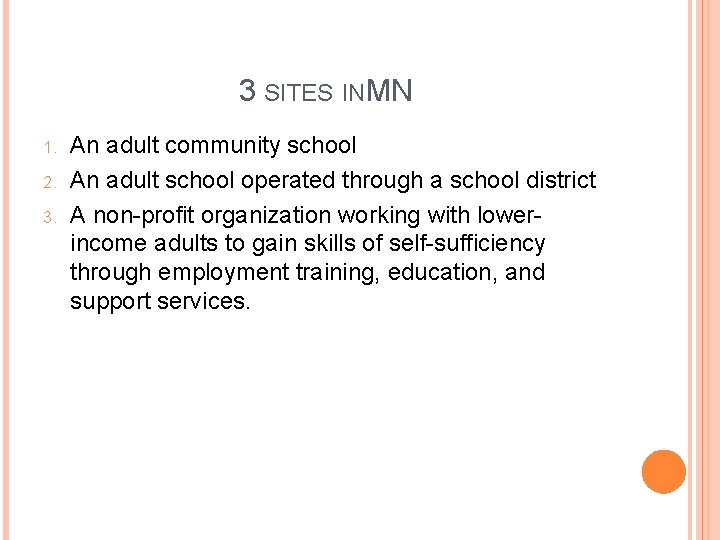
3 SITES INMN 1. 2. 3. An adult community school An adult school operated through a school district A non-profit organization working with lowerincome adults to gain skills of self-sufficiency through employment training, education, and support services.
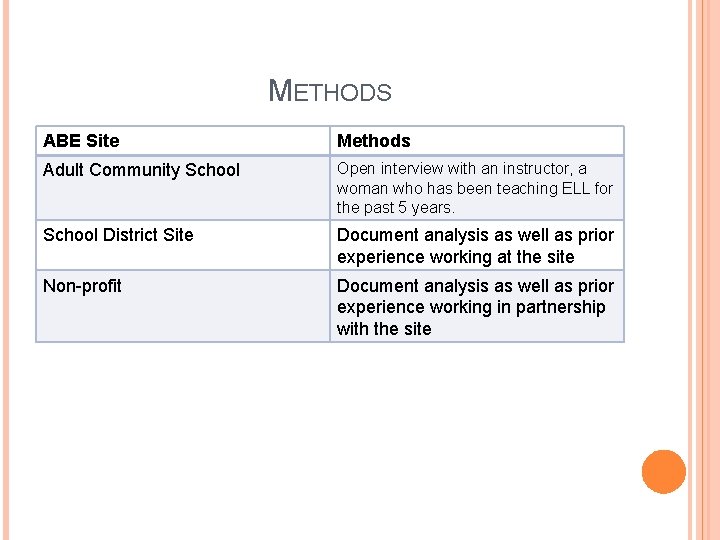
METHODS ABE Site Methods Adult Community School Open interview with an instructor, a woman who has been teaching ELL for the past 5 years. School District Site Document analysis as well as prior experience working at the site Non-profit Document analysis as well as prior experience working in partnership with the site
INTERVIEW: COMMUNITY SCHOOL INSTRUCTOR Semi-Structured Questions Focusing on Work. Related Literacy Program Content and Delivery
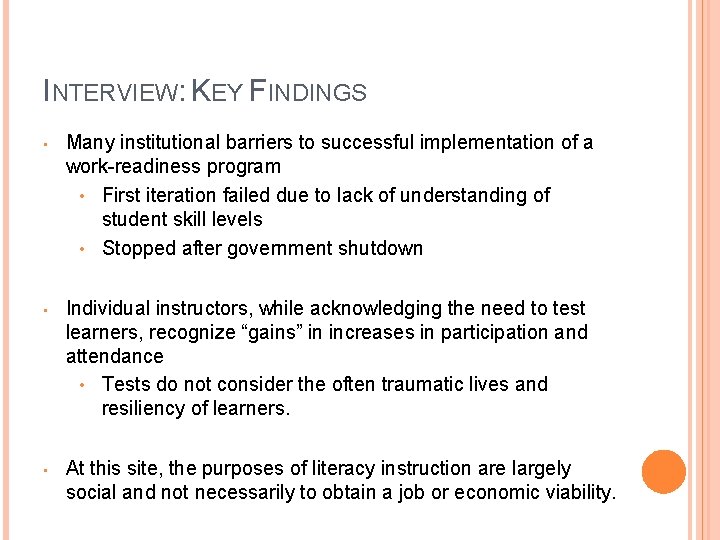
INTERVIEW: KEY FINDINGS • Many institutional barriers to successful implementation of a work-readiness program • First iteration failed due to lack of understanding of student skill levels • Stopped after government shutdown • Individual instructors, while acknowledging the need to test learners, recognize “gains” in increases in participation and attendance • Tests do not consider the often traumatic lives and resiliency of learners. • At this site, the purposes of literacy instruction are largely social and not necessarily to obtain a job or economic viability.
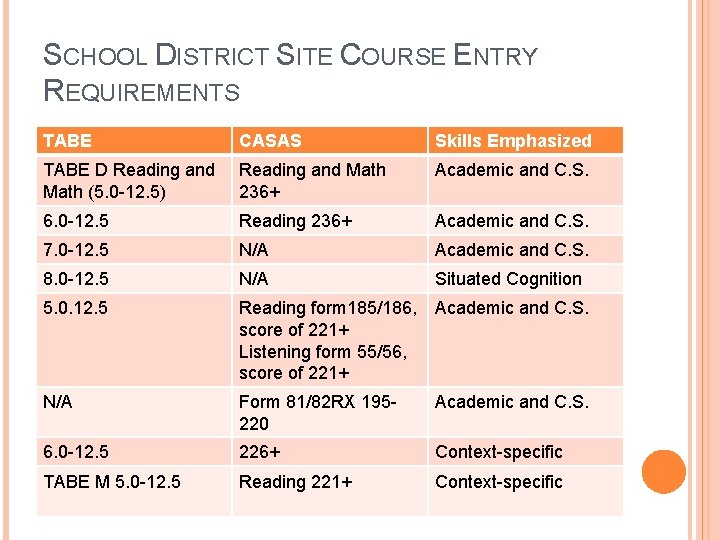
SCHOOL DISTRICT SITE COURSE ENTRY REQUIREMENTS TABE CASAS Skills Emphasized TABE D Reading and Math (5. 0 -12. 5) Reading and Math 236+ Academic and C. S. 6. 0 -12. 5 Reading 236+ Academic and C. S. 7. 0 -12. 5 N/A Academic and C. S. 8. 0 -12. 5 N/A Situated Cognition 5. 0. 12. 5 Reading form 185/186, Academic and C. S. score of 221+ Listening form 55/56, score of 221+ N/A Form 81/82 RX 195220 Academic and C. S. 6. 0 -12. 5 226+ Context-specific TABE M 5. 0 -12. 5 Reading 221+ Context-specific
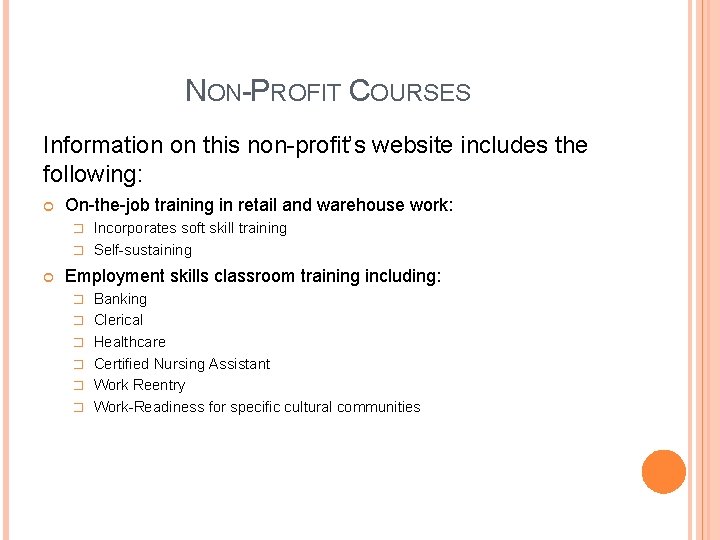
NON-PROFIT COURSES Information on this non-profit’s website includes the following: On-the-job training in retail and warehouse work: Incorporates soft skill training � Self-sustaining � Employment skills classroom training including: � � � Banking Clerical Healthcare Certified Nursing Assistant Work Reentry Work-Readiness for specific cultural communities
RESULTS • An Integrated Approach May Work for Low-Literate Adults • 4 Core Finding • Comparison Table
AN INTEGRATED APPROACH An integrated approach to work-related literacy may be more effective for low-literate adult learners due to the simultaneous development of jobspecific skills, soft skills and academic skills (i. e. , “bridge” classes) Includes both academic and context-specific skills as well as job acquisition and retention, time management, and communication
FINDINGS Findings reflected that: effectiveness and sustainability of the work literacy program depended upon the degree to which the program Tailored work literacy programming to the English, reading, and math levels of their students in the provision of “bridge” classes Understood the reasons for which students attend work literacy classes and different modes of participation Indicating that a situated cognition approach may “fit” in more homogeneous classrooms where there is less variability among reading and math skill levels, but may not be appropriate for heterogeneous groups
FOUR CORE FINDINGS UNDERSTANDING THE WHO AND WHAT OF SITUATED COGNITION 1. 2. 3. 4. Understanding who is in your class is key: Classes with a wide range of skills and abilities may benefit more from an integrated class Partnerships among several agencies are critical A situated cognition approach (alone) tends to work for learners in employment/skills training programs An integrated academic and context-specific approaches tend to work for work-readiness courses
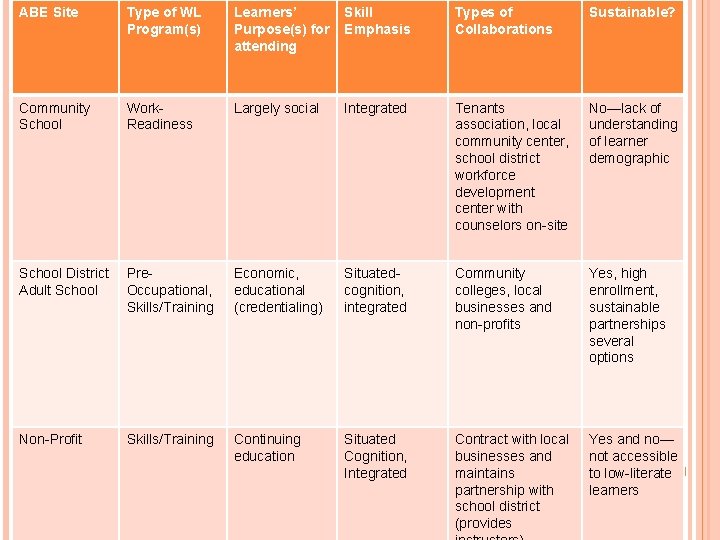
ABE Site Type of WL Program(s) Learners’ Purpose(s) for attending Skill Emphasis Types of Collaborations Sustainable? Community School Work. Readiness Largely social Integrated Tenants association, local community center, school district workforce development center with counselors on-site No—lack of understanding of learner demographic School District Adult School Pre. Occupational, Skills/Training Economic, educational (credentialing) Situatedcognition, integrated Community colleges, local businesses and non-profits Yes, high enrollment, sustainable partnerships several options Non-Profit Skills/Training Continuing education Situated Cognition, Integrated Contract with local businesses and maintains partnership with school district (provides Yes and no— not accessible to low-literate learners

IMPLICATIONS FOR RESEARCH AND PRACTICE
IMPLICATIONS FOR FURTHER RESEARCH Research Additional models or examples of situated-cognition approaches—explicitly stated as such—are needed
IMPLICATIONS FOR PRACTICE Practice All stakeholders must be aware of learner purposes and goals in regard to their participation in the program Create “bridge-to-bridge” programs to strengthen English, reading, and math skills for a particular career path Substitute student portfolios of written work and work experience for test scores Use situated cognition to assist in job-specific academic skills and work context-specific skills to be practiced at work sites Attention must be given to capacity building through partnerships and collaboration
DISCUSSION Think about the work-readiness courses you provide in your respective contexts. Do you see situated-cognition as a viable approach for lowerlevel learners? Why or why not? What would a viable approach look like?
ACTIVITY: PROGRAM DESIGN (15 MINUTES) If you were to design a work literacy course using an situated cognition or integrated approach (depending on your answer): � Where would you hold the classes? � What would you need to know about your learners? � What key stakeholders/collaborations would you need to include and what information would you need to know from them? � What job-related content (job skills, expectations, duties, etc. ) would you need to know? Time Permitting � What would three key learning objectives be? � Design a simple lesson.
THINK-PAIR-SHARE (10 MINUTES) Share what you’ve done with a partner Pay attention and provide feedback on what they have listed: � Are there any additional support services that are needed to maximize skill development? � Reiterate how you think your partner’s design reflects either situated cognition or an integrated approach. Be prepared to report out after 10 minutes
CONCLUSION • Integrated programs and collaborations are key
CONCLUSION: STRETCHING SITUATED COGNITION Integrated programs can use literacy practitioners and occupational and related skills specialists to design short-term learning experiences that teach literacy skills applicable to job-related tasks and the development of broad-based soft skills and academic skills Collaboration with businesses or agencies willing to train are key to program sustainability and continuous development of basic skills
REFERENCES Alfred, M. V. (2010). The role of social capital in developing economic self-sufficiency. In M. V. Alfred (Ed. ), Learning for economic self-sufficiency: Constructing pedagogies of hope among low-income, low-literate adults (pp. 213 -228). Charlotte, NC: Information Age Publishers, Inc. Allik, J. , & Realo, A. (2004). Individualism-Collectivism and social capital. Journal of Cross Cultural Psychology, 35(1), 29 -49. doi: 10. 1177/0022022103260381 Bierema, L. L. (2010). No worker left behind: Low-wage workers’ equitable access to workplace learning. In M. V. Alfred (Ed. ), Learning for economic self-sufficiency: Constructing pedagogies of hope among low-income, low-literate adults (pp. 103 -120). Charlotte, NC: Information Age Publishers, Inc. Brown, J. S. , Collins, A. , & Duguid, P. (1989). Situated cognition and the culture of learning. Educational Researcher, 18(1), 32 -42. Retrieved from edr. sagepub. com Commission on the Skills of the American Workforce (2006). Executive Summary. Tough Choices or Tough Times. National center on Education and the Economy. Retrieved from www. skillscommission. org/executive. htm Engestrom, Y. (2000). From individual to collective activity and back: Developmental work research as an Interventionist methodology. In P. Luff, J. Hindmarsh, & C. Heath (Eds. ), Workplace studies: Recovering work practice and informing system design (pp. 150 -166). Cambridge, United Kingdom: Cambridge University Press. Gee, J. P. (2000). The new literacy studies: From “socially situated” to the work of the social. In D. Barton, M. Hamilton, & R. Ivanict (Eds. ), Situated literacies: Reading and writing in context (180 -197). London: Routledge. Gerber, R. , & Oaklief, C. (2000). Transfer of learning to strengthen workplace training. In R. Gerber & C. Lankshear (Eds. ), Training for a smart workforce (pp. 177 -192). New York, NY: Routledge.
Groen, J. , & Hyland-Russell, T. (2010). Riches from the poor: Teaching humanities in the margins. In M. V. Alfred (Ed. ), Learning for economic self-sufficiency: Constructing pedagogies of hope among low- income, low-literate adults (pp. 1 -13). Charlotte, NC: Information Age Publishing, Inc. Knowles, M. S. , Holton, E. F. , & Swanson, R. A. (1998). The adult learner: The definitive classic in adult education and human resource development. Kidlington, Oxford: Elsevier Inc. Martin, L. G. (1999). Continuum of literacy program models: Alternative approaches for low-literate welfare recipients. New Directions for Adult and Continuing Education (Fall 1999 ed. , No. 83, pp. 43 -57). San Francisco: Jossey- Bass. Mina, L. , Fulmer, D. D. , & Smith, R. O. (2010). The role of the community college in redirecting careers of low-literate, low-income, and low-skilled citizens. In M. V. Alfred (Ed. ), Learning for economic self- sufficiency: Constructing pedagogies of hope among low- income, low-literate adults (pp. 15 -28). Charlotte, NC: Information Age Publishing, Inc. Merriam, S. B. , Caffarella, R. S. , & Baumgartner, L. M. (2007). Learning in adulthood: A comprehensive guide. San Francisco: Jossey-Bass. O’Connor, P. (2000). Workers’ texts, identities and learning possibilities in the smart workforce. In R. Gerber & C. Lankshear (Eds. ), Training for a smart workforce (pp. 151 -176). New York, NY: Routledge. Resnick, L. B. (1987). Learning in school and out. Educational Researcher, 16(9), 13 -20. Retrieved from edr. sagepub. com U. S. Department of Education, Office of Vocational and Adult Education, Division of Adult Education and Literacy. (1992). Workplace literacy: Reshaping the American workforce (USDE Publication No. 1. 2: L 71/2). Washington, DC: Author.
- Slides: 34