
Sister Callista Roy Adaptation Model Background Received bachelors
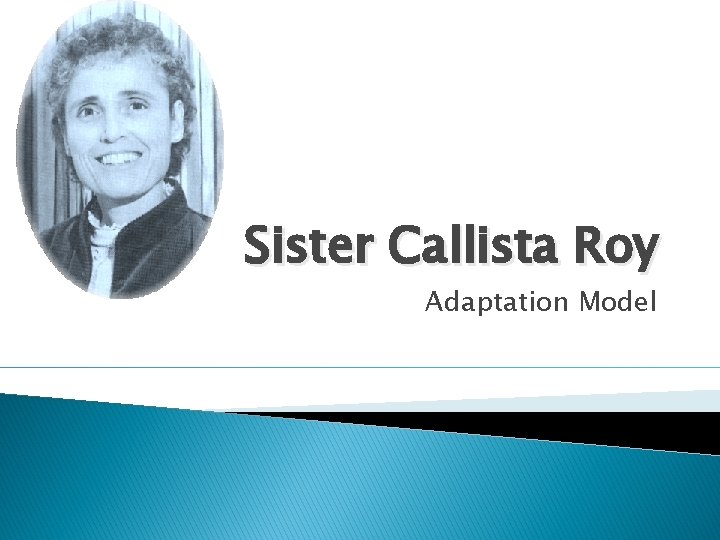
Sister Callista Roy Adaptation Model
Background • • Received bachelors degree of nursing in 1963 from Mound Saint Mary College in Los Angeles. (Martha & Tomey, 2010) Received masters degree in nursing from University of California in 1966. (Martha & Tomey, 2010) Received masters degree in sociology in 1973(Martha & Tomey, 2010) Received doctorate in sociology in 1977 from the university of California. (Martha & Tomey, 2010)
Origin • • The foundation of The Adaptation model was from the work of Harry Helson Adaptation Theory. (Martha & Tomey, 2010) Roy developed concept for the model while she was a graduate student at University of college. (Martha & Tomey, 2010) Roy along with several other colleagues combined the concepts along with Helson’s adaptation theory and the Adaptation model was developed. (Martha & Tomey, 2010) After completion, the model was presented as a framework for nursing practice, research and education. (Martha & Tomey, 2010)
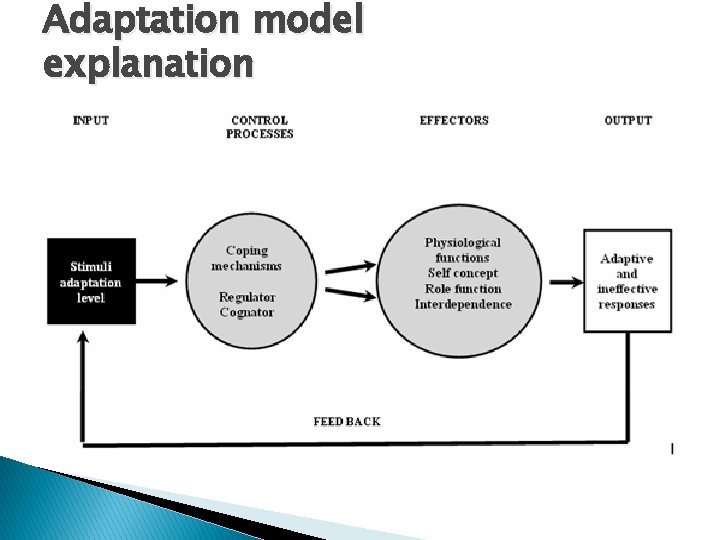
Adaptation model explanation �
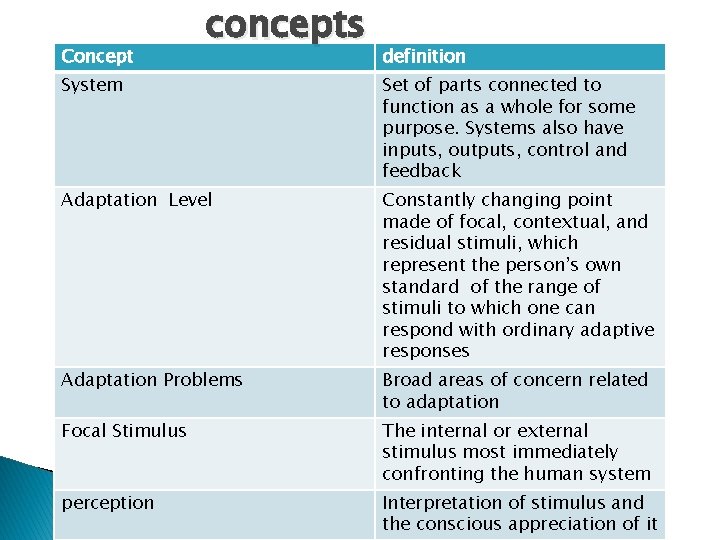
Concept concepts definition System Set of parts connected to function as a whole for some purpose. Systems also have inputs, outputs, control and feedback Adaptation Level Constantly changing point made of focal, contextual, and residual stimuli, which represent the person’s own standard of the range of stimuli to which one can respond with ordinary adaptive responses Adaptation Problems Broad areas of concern related to adaptation Focal Stimulus The internal or external stimulus most immediately confronting the human system perception Interpretation of stimulus and the conscious appreciation of it
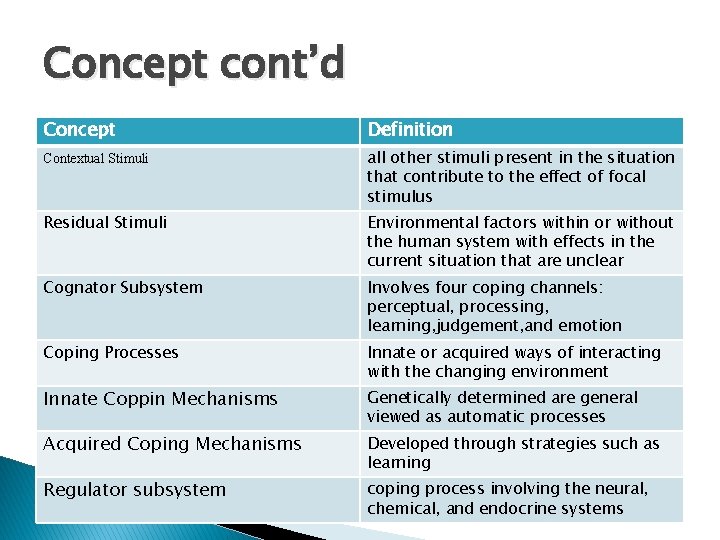
Concept cont’d Concept Definition Contextual Stimuli all other stimuli present in the situation that contribute to the effect of focal stimulus Residual Stimuli Environmental factors within or without the human system with effects in the current situation that are unclear Cognator Subsystem Involves four coping channels: perceptual, processing, learning, judgement, and emotion Coping Processes Innate or acquired ways of interacting with the changing environment Innate Coppin Mechanisms Genetically determined are general viewed as automatic processes Acquired Coping Mechanisms Developed through strategies such as learning Regulator subsystem coping process involving the neural, chemical, and endocrine systems
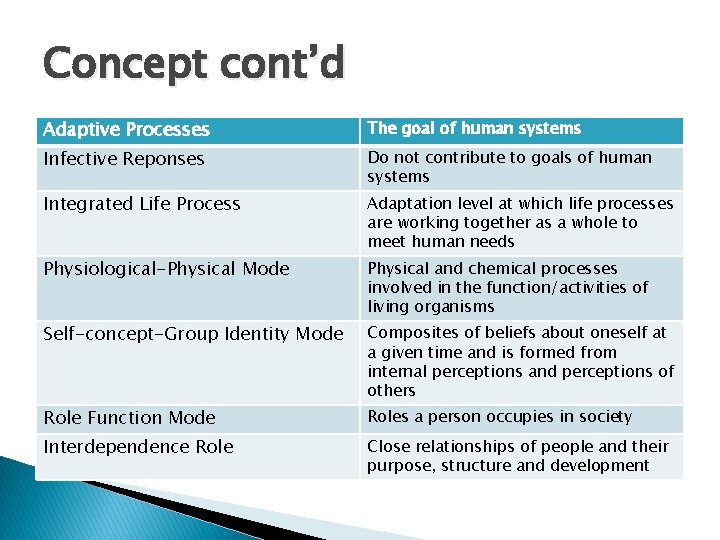
Concept cont’d Adaptive Processes The goal of human systems Infective Reponses Do not contribute to goals of human systems Integrated Life Process Adaptation level at which life processes are working together as a whole to meet human needs Physiological-Physical Mode Physical and chemical processes involved in the function/activities of living organisms Self-concept-Group Identity Mode Composites of beliefs about oneself at a given time and is formed from internal perceptions and perceptions of others Role Function Mode Roles a person occupies in society Interdependence Role Close relationships of people and their purpose, structure and development
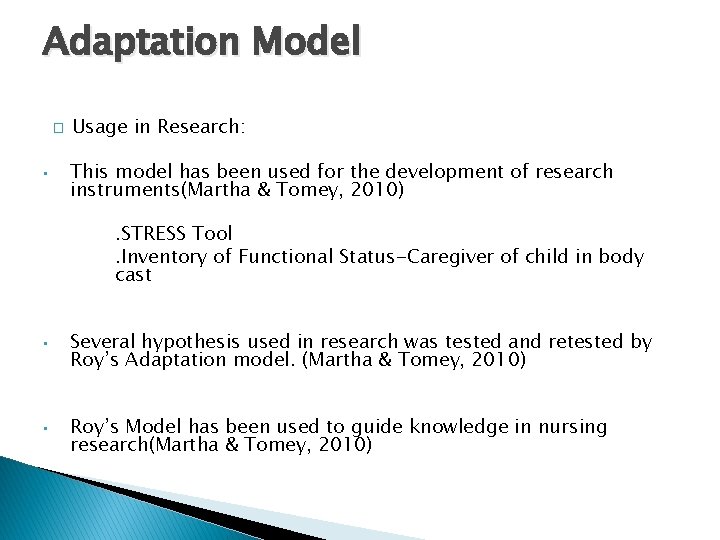
Adaptation Model � • Usage in Research: This model has been used for the development of research instruments(Martha & Tomey, 2010). STRESS Tool. Inventory of Functional Status-Caregiver of child in body cast • • Several hypothesis used in research was tested and retested by Roy’s Adaptation model. (Martha & Tomey, 2010) Roy’s Model has been used to guide knowledge in nursing research(Martha & Tomey, 2010)
Adaptation Model � Usage • • in Education: This model distinguishes nursing sciences from medical sciences. (Martha & Tomey, 2010) Defines the purpose of nursing for students, which is to promote the adaptation of persons in each of the adaptive modes in situations of health and illness. (Martha & Tomey, 2010)
Adaptation Model � Usage • • in practice: Outlines the features of the discipline and provides direction for practice, education and research. The nursing process was developed through Roy’s Adaptation Model.
Article Citation � Contributions to Nursing Science: Synthesis of findings from Adaptation Model Research �Researchers took findings from studies that used the RAM and tested reliability of results.
Article Citation � Use in nursing. “Roy's Adaptation Model to Promote Physical Activity Among Sedentary Old Adults. ” • RAM was used to guide in developing interventions to promote increase in sedentary lifestyle for the older adult.
References � � � Martha, A. R. , & Tomey, A. M. (2010). Nursing Theories. In A. R. Martha, & A. M. Tomey, Nursing Theories and Their Work (seventh ed. , pp. 335 -365). Missouri: Elsevier. Roy's Rogers, C. , & Keller, C. (1994). Roy's Adaptation Model to Promote Physical Activity Among Sedentary Older Adults. Journal of Geriatric Nursing, 8(4), 361 -372. Retrieved from www. ncbi. nlm. nih/gov Susan, P. E. , Frederickson, K. , Carson, M. A. , Massey, V. H. , & Roy, C. (1994). Contributions to Nursing Science: Synthesis of Finding From Adaptation Model Research. International Journal, 8(4), 361 -372. Retrieved from www. jpkcsb. bjmu. edu. cn/fundamentals nursing
- Slides: 13