
SISTEMA Examples Example 1 StartStop Facility with Emergency

- Slides: 25
SISTEMA Examples
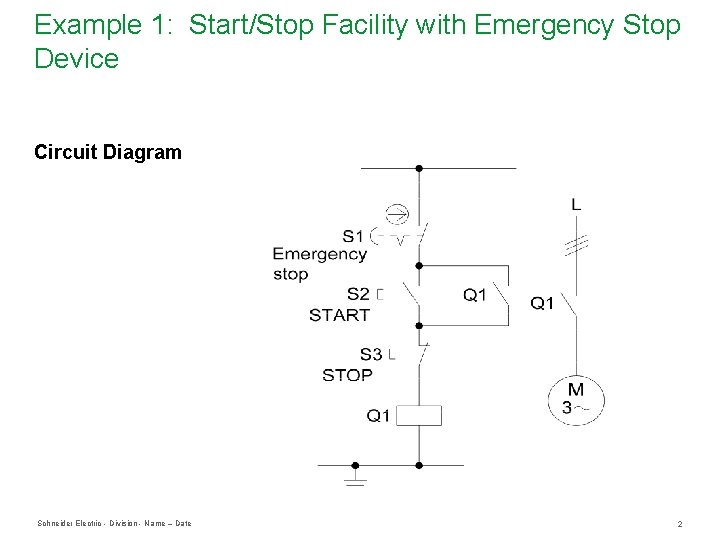
Example 1: Start/Stop Facility with Emergency Stop Device Circuit Diagram Schneider Electric - Division - Name – Date 2
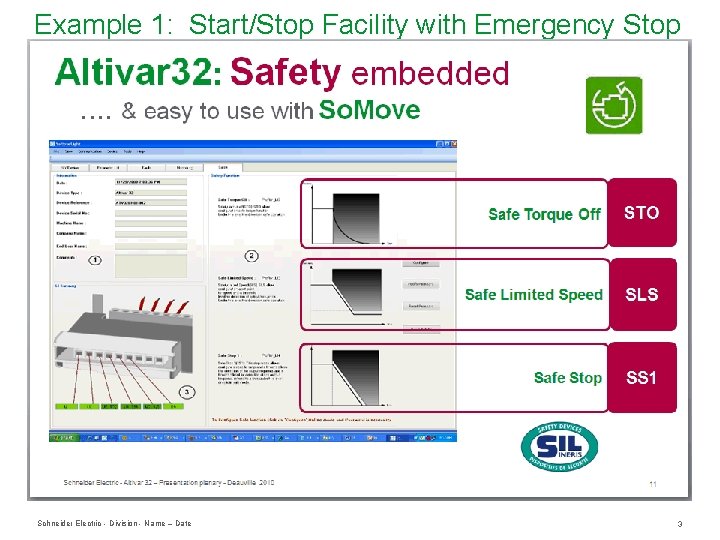
Example 1: Start/Stop Facility with Emergency Stop Device Safety function ● Emergency stop function, STO – safe torque off by actuation of the emergency stop device Functions ● Hazardous movements or states are de-energized by interruption of the control voltage of contactor Q 1 when the emergency stop device S 1 is actuated. ● The safety function cannot be maintained with all component failures, and is dependent upon the reliability of the components. ● No measures for fault detection are implemented Schneider Electric - Division - Name – Date 3
Example 1: Start/Stop Facility with Emergency Stop Device Design Features ● Basic and well-tried safety principles are observed and the requirements of Category B are met. Protective circuits (e. g. contact protection) as described in the initial paragraphs of Chapter 8 are implemented. The closed-circuit current principle is employed as a basic safety principle. The control circuit is also earthed, as a well-tried safety principle. ● The emergency stop device S 1 is a switch with direct mode of actuation in accordance with IEC 60947 -5 -1, Annex K, and is therefore a welltried component in accordance with Table D. 4 of EN ISO 13849 -2. ● The signal is processed by a contactor (stop category 0 to EN 60204 -1). ● Contactor Q 1 is a well-tried component provided the additional conditions in accordance with Table D. 4 of EN ISO 13849 -2 are observed. Schneider Electric - Division - Name – Date 4
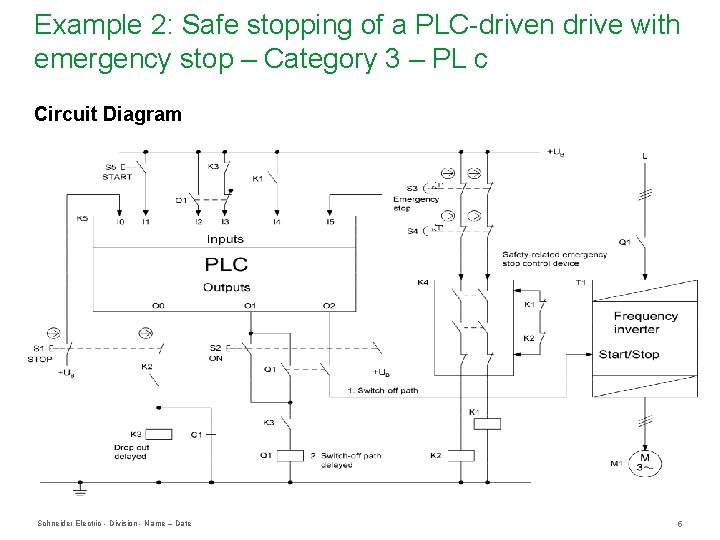
Example 2: Safe stopping of a PLC-driven drive with emergency stop – Category 3 – PL c Circuit Diagram Schneider Electric - Division - Name – Date 5
Example 2: Safe stopping of a PLC-driven drive with emergency stop – Category 3 – PL c Safety function ● Safety-related stop function/emergency stop function: following a stop or emergency stop command, the drive is halted (SS 1 – safe stop 1). Functional Description ● The hazardous movement is interrupted redundantly if either the stop button S 1 or one of the emergency stop devices S 3 or S 4 is actuated. The drive is halted in an emergency following actuation of S 3/S 4, resulting in deactivation of the safety-related emergencystop control device K 4 and de-energization of the contactor relays. K 1 and K 2. Opening of the make contact K 1 on input I 4 of the PLC K 5 causes the starting signal on the frequency inverter (FI) T 1 to be cancelled via the PLC output O 2. Redundantly to the K 1 -K 5 -T 1 chain, opening of the make contact K 2 upstream of the contactor relay K 3 (with drop-out delay) initiates a braking timer. Schneider Electric - Division - Name – Date 6
Example 2: Safe stopping of a PLC-driven drive with emergency stop – Category 3 – PL c Functional Description Cont. ● Upon timeout of the braking timer the actuating signal for the mains contactor Q 1 is interrupted. The timer setting is selected such that under unfavorable operating conditions, the machine movement is halted before the mains contactor Q 1 has dropped out. ● Functional stopping of the drive following a stop command is caused by the opening of the two break contacts of the stop button S 1. As with stopping in an emergency, the status is first queried by PLC K 5, in this case via input I 0, and the FI is shut down by resetting of the PLC output O 2. Redundantly to this process, the contactor relay K 3 is de-energized – with drop-out delay provided by the capacitor C 1 and following timeout of the set braking time, the activation signal to mains contactor Q 1 is interrupted. Schneider Electric - Division - Name – Date 7
Example 2: Safe stopping of a PLC-driven drive with emergency stop – Category 3 – PL c Functional Description Cont. ● In the event of failure of the PLC K 5, the frequency inverter T 1, the mains contactor Q 1, the contactor relays K 1/K 2 or the contactor relay with drop-out delay K 3, stopping of the drive is assured since two mutually independent de-energization paths are always present. Failure of the contactor relays K 1 and K 2 to drop out is detected, at the latest, following resetting of the actuated emergency stop device. This is achieved by monitoring of the mechanically linked break contacts within the safety-related emergency stop control device K 4. Failure of the auxiliary contactor K 3 to drop out is detected, at the latest, before renewed start-up of the machine movement through feedback of the mechanically linked break contact to the PLC input I 3. Failure of the mains contactor Q 1 to drop out is detected by the mirror contact read in on PLC input I 3. Schneider Electric - Division - Name – Date 8
Example 2: Safe stopping of a PLC-driven drive with emergency stop – Category 3 – PL c Design Features ● Basic and well-tried safety principles are observed and the requirements of Category B are met. Protective circuits (e. g. contact protection) as described in the initial paragraphs of Chapter 8 are implemented. ● The contactor relays K 1, K 2 and K 3 possess mechanically linked contact elements in accordance with IEC 60947 -5 -1, Annex L. ● The contacts of the pushbuttons S 1, S 3 and S 4 are mechanically linked in accordance with IEC 60947 -5 -1, Annex K. ● The contactor Q 1 possesses a mirror contact according to IEC 60947 -41, Annex F. ● The standard components K 5 and T 1 are employed in accordance with the instructions in Section 6. 3. 10. Schneider Electric - Division - Name – Date 9
Example 2: Safe stopping of a PLC-driven drive with emergency stop – Category 3 – PL c Design Features Cont. ● The software (SRASW) is programmed in accordance with the requirements for PL b (downgraded owing to diversity) and the instructions in Section 6. 3. ● The delayed initiation of the stopping by the second de-energization path alone in the event of a fault must not involve an unacceptably high residual risk. ● The safety-related control part of the safety-related emergency stop control device K 4 satisfies all requirements for Category 3 and PL d. Schneider Electric - Division - Name – Date 10
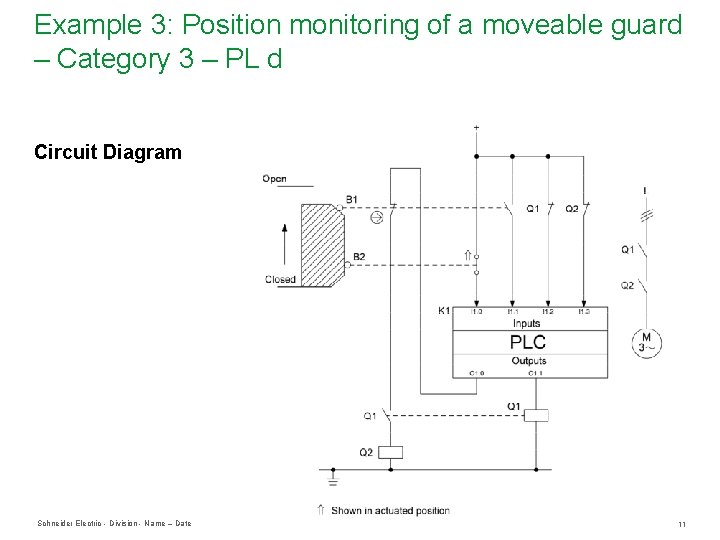
Example 3: Position monitoring of a moveable guard – Category 3 – PL d Circuit Diagram Schneider Electric - Division - Name – Date 11
Example 3: Position monitoring of a moveable guard – Category 3 – PL d Safety Function ● Safety-related stop function, initiated by a protective device: opening of the moveable guard (protective grating) initiates the safety function STO (safe torque off). Functional Description ● Opening of the moveable guard (e. g. safety guard) is detected by two position switches B 1 and B 2 in a break contact/make contact combination. The position switch B 1 with direct opening contact actuates a contactor Q 2 which interrupts/prevents hazardous movements or states when it drops out. The position switch B 2 with make contact is read in by a standard PLC K 1, which can bring about the same de-energization response by actuation of a second contactor Q 1. ● The safety function is retained in the event of a component failure. Schneider Electric - Division - Name – Date 12
Example 3: Position monitoring of a moveable guard – Category 3 – PL d Functional Description Cont. ● The switching position of B 1 is also read into the PLC K 1 by means of a make contact, and is compared for plausibility with the switching position of B 2. The switching positions of the contactors Q 1 and Q 2 are likewise monitored in K 1 by mechanically linked read back contacts. Component failures in B 1, B 2, Q 1 and Q 2 are detected by K 1 and lead to operating inhibition owing to the dropping out of Q 1 and Q 2. Faults in the PLC K 1 are detected only by the function (fault detection by the process). Schneider Electric - Division - Name – Date 13
Example 3: Position monitoring of a moveable guard – Category 3 – PL d Design Features ● Basic and well-tried safety principles are observed and the requirements of Category B are met. Protective circuits (e. g. contact protection) as described in the initial paragraphs of Chapter 8 are implemented. ● A stable arrangement of the protective device is assured for actuation of the position switch. ● B 1 is a position switch with direct opening contact in accordance with IEC 60947 -5 -1, Annex K. ● The supply conductors to the position switches are laid separately or withprotection. ● Faults in the start-up and actuation mechanism are detected by the use of two position switches differing in the principle of their actuation (break and make contacts). . Schneider Electric - Division - Name – Date 14
Example 3: Position monitoring of a moveable guard – Category 3 – PL d Design Features Cont. ● Q 1 and Q 2 possess mechanically linked contact elements to IEC 60947 -5 -1, Annex L. ● The PLC K 1 satisfies the normative requirements described in Section 6. 3 Schneider Electric - Division - Name – Date 15
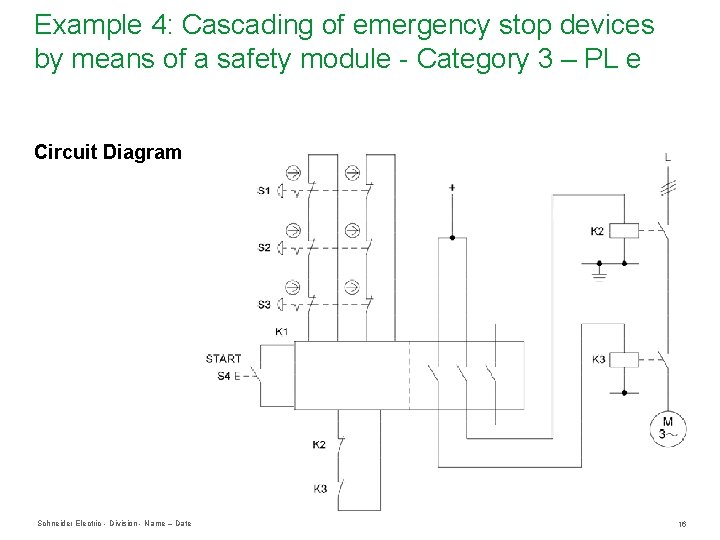
Example 4: Cascading of emergency stop devices by means of a safety module - Category 3 – PL e Circuit Diagram Schneider Electric - Division - Name – Date 16
Example 4: Cascading of emergency stop devices by means of a safety module - Category 3 – PL e Safety Function ● Emergency stop function, STO by actuation of an emergency stop device Functional Description ● Hazardous movements or states are interrupted or prevented by actuation of an emergency stop device. As shown by Example 3 in Section 5. 3. 2, each emergency stop device triggers a safety function of its own. S 1 is considered below as being representative of all the devices. S 1 is evaluated in a safety module K 1, which actuates two redundant contactor relays K 2 and K 3. Schneider Electric - Division - Name – Date 17
Example 4: Cascading of emergency stop devices by means of a safety module - Category 3 – PL e Functional Description Cont. ● The signals from the emergency stop devices are read redundantly into the safety module K 1 for fault detection. K 1 also features internal test measures. The contactor relays K 2 and K 3 are also monitored in K 1, by means of mechanically linked readback contacts. K 2 and K 3 are operated by switch S 4 at each start-up command, approximately twice each month. An accumulation of more than two faults in the period between two successive actuations may lead to loss of the safety function. ● It is not assumed that more than one emergency stop device is pressed simultaneously. Schneider Electric - Division - Name – Date 18
Example 4: Cascading of emergency stop devices by means of a safety module - Category 3 – PL e Design Features ● Basic and well-tried safety principles are observed and the requirements of Category B are met. Protective circuits (e. g. contact protection) as described in the initial paragraphs of Chapter 8 are implemented. ● The emergency stop devices S 1, S 2 and S 3 are switching devices with direct opening contacts in accordance with IEC 60947 -5 -1, Annex K. ● The supply conductors to the switching devices are laid separately or with protection. ● The safety module K 1 satisfies all requirements for Category 4 and PL e. ● K 2 and K 3 possess mechanically linked contact elements to IEC 60947 -5 -1, Annex L. Schneider Electric - Division - Name – Date 19
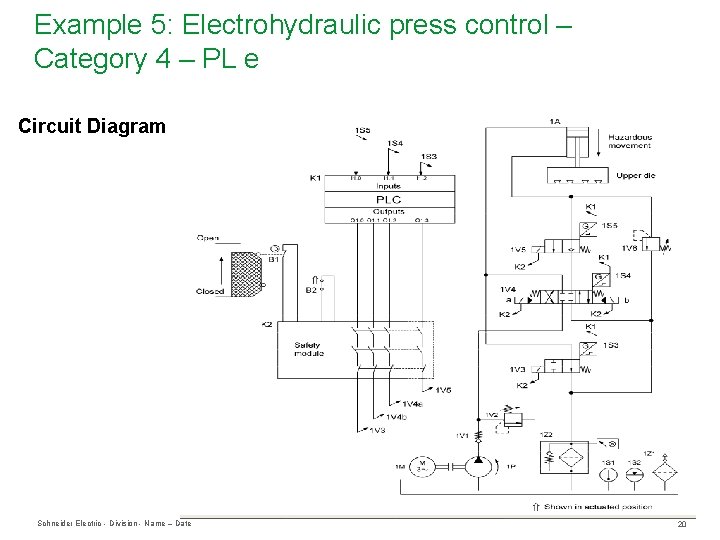
Example 5: Electrohydraulic press control – Category 4 – PL e Circuit Diagram Schneider Electric - Division - Name – Date 20
Example 5: Electro-hydraulic press control – Category 4 – PL e Safety Function ● Safety-related stop function, initiated by a protective device: stopping of the hazardous movement Functional Description ● The hazardous area is safeguarded by means of a moveable guard, the position of which is detected by two position switches B 1 and B 2 in the form of a break contact/make contact combination. The signals are read into a standard safety module K 2 which is looped into the enabling path for the electrical pilot control K 1 (a conventional PLC) for the hydraulic actuators. Hazardous movements or states are controlled by three directional control valves (1 V 3, 1 V 4 and 1 V 5) on the actuator side. Schneider Electric - Division - Name – Date 21
Example 5: Electro-hydraulic press control – Category 4 – PL e Functional Description Cont. ● In response to a demand upon the safety function, all valves are deenergized by K 2, and are placed by their return springs in the closed centre position (1 V 4) or closed position (1 V 3 and 1 V 5). The oil return from the lower piston side of the cylinder to the reservoir is interrupted by 1 V 4 and 1 V 5 at the same time. 1 V 5 is a poppet valve which is designed to shut off the volumetric flow without leakage. Valve 1 V 4, which also controls the direction of movement of the cylinder, is a piston-type directional control valve which also exhibits a certain degree of leakage in the closed centre position. Although 1 V 3 is only indirectly involved in the stop function, it can influence the safety function dangerously. Should 1 V 3 and 1 V 4 get stuck at the same time, there would be pressure on the upper side mof the cylinder while the lower side is shut off by 1 V 5. Due to the pressure translation in the cylinder the pressure-relief valve 1 V 6 would open and the upper die descend. Schneider Electric - Division - Name – Date 22
Example 5: Electro-hydraulic press control – Category 4 – PL e Functional Description Cont. ● Failure of one of the valves does not result in loss of the safety function. All valves are actuated cyclically. ● Each valve is equipped with a position monitoring, 1 S 3, 1 S 4 and 1 S 5, for fault detection purposes. Failure of either of the valves is detected in the conventional PLC K 1, which prevents initiation of the next hazardous movement following a fault. ● A single fault in one safety component does not result in loss of the safety function. In addition, single faults are detected at or prior to the next demand. An accumulation of undetected faults does not result in loss of the safety function. Schneider Electric - Division - Name – Date 23
Example 5: Electro-hydraulic press control – Category 4 – PL e Design Features ● Basic and well-tried safety principles and the requirements of Category B are observed. Protective circuits (e. g. contact protection) as described in the initial paragraphs of Chapter 8 are implemented. ● A stable arrangement of the protective device is assured for actuation of the position switch. ● Switch B 1 is a position switch with a direct opening contact in accordance with IEC 60947 -5 -1, Annex K. ● The safety module K 2 satisfies all requirements for Category 4 and PL e. ● The supply conductors to the position switches are laid separately or with protection. Schneider Electric - Division - Name – Date 24
Example 5: Electro-hydraulic press control – Category 4 – PL e Design Features Cont. ● A standard PLC without safety functions is employed for K 1. ● The valves 1 V 3, 1 V 4 and 1 V 5 possess a closed centre position and closed position respectively with sufficient overlap, spring centering/return and position monitoring. ● The safety-oriented switching position is assumed from any position by removal of the control signal. ● The pressure-relief valve 1 V 6 to protect the cylinder 1 A and the components below against “pressure intensifier effect” fulfils the requirements of EN 693: 2001, cl. 5. 2. 4. 4. Schneider Electric - Division - Name – Date 25