
SISTEM INFORMASI UNIVERSITAS GUNADARMA SISTEM TERDISTRIBUSI M 07
SISTEM INFORMASI UNIVERSITAS GUNADARMA SISTEM TERDISTRIBUSI M 07 Clocks and Time
Objectives Time service � Requirements and problems � Source of time Clock synchronisation algorithms � Clock skew & drift � Cristian algorithm � Berkeley algorithm � Network Time Protocal Logical clocks � Lamport’s timestamps
Time Service Why Need? � To measure delays between distributed components. � To synchronise streams, e. g. sound and video � To establish event ordering Causal ordering (did A happen before B? ) Concurrent/overlapping execution (no casual relationship) � For accurate timestamps to identify/authenticate Business transactions Serializability in distributed databases Security protocols
Clocks Internal hardware clock � Built-in electronic device � Counts oscillations occuring in a quartz crystal at a definite frequency � Store the result in a counter register � Interrupt generated at regular intervals � Interrupt handler reads the counter register, scales it to convert to time units (seconds, nanoseconds) and updates sofware clock. e. g. seconds elapsed since 1/01/1970
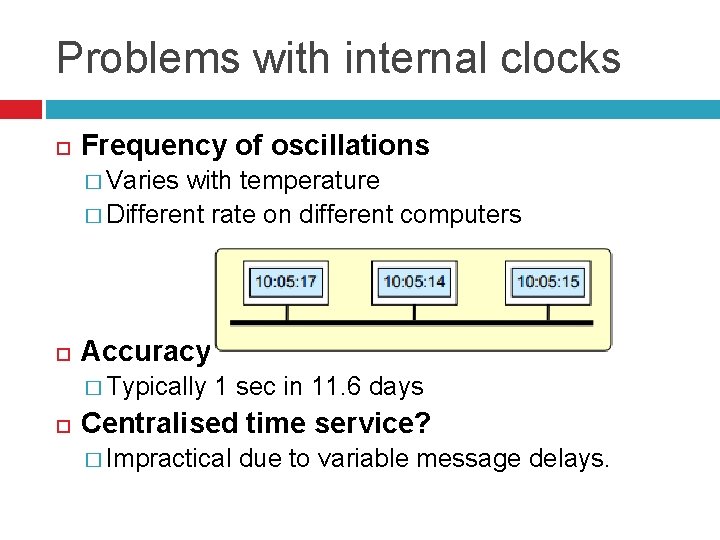
Problems with internal clocks Frequency of oscillations � Varies with temperature � Different rate on different computers Accuracy � Typically 1 sec in 11. 6 days Centralised time service? � Impractical due to variable message delays.
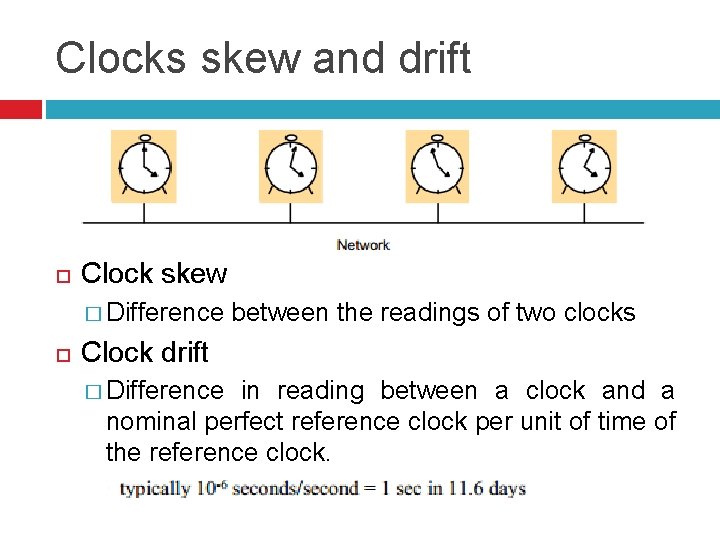
Clocks skew and drift Clock skew � Difference between the readings of two clocks Clock drift � Difference in reading between a clock and a nominal perfect reference clock per unit of time of the reference clock.
Source of time Universal Coordinated Time (UTC, from French) � Based on atomic time but leas seconds inserted to keep in phase with astronomical time (Earth’s orbit) � UTC signals broadcast every second from radio and satellite stations. Land station accuracy 0. 1 -10 ms due to atmospheric conditions
Source of time Global Positioning System (GPS) � Broadcast UTC Recievers for UTS and GPS � Available commercially � Used to synchronise local clocks
Clock Synchronisation External: syncronise with authoritative source of time � The abolute value of difference between the clock and the source is bounded above by D at every point in the synchronisation interval � Time accurate to within D
Clock Synchronisation Internal: syncronise clocks with each other � The abolute value of difference between the clock is bounded above by D at every point in the synchronisation interval � Clocks agree to within D (not necessarily accurate time)
Clock Compensation Assume 2 clocks can each drift at rate R msecs/sec � Maximum difference 2 R msec/sec � Must resynchronise every D/2 R to agree within D Clock correction � Get UTC and correct software clock
Clock Compensation Problems! � What happen if local clock is 5 secs fast and it is set right? � Timespamped versions of files get confused � Time must never run backwards! � Better to scale the value of internal clock in software without changing the clock rate
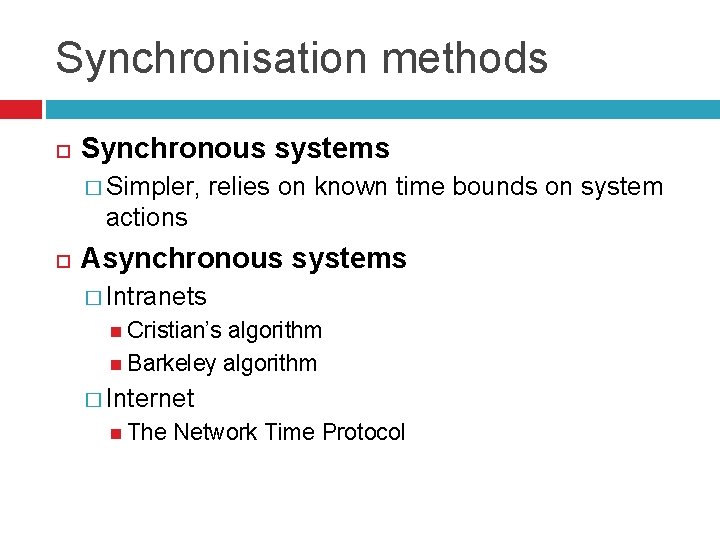
Synchronisation methods Synchronous systems � Simpler, relies on known time bounds on system actions Asynchronous systems � Intranets Cristian’s algorithm Barkeley algorithm � Internet The Network Time Protocol
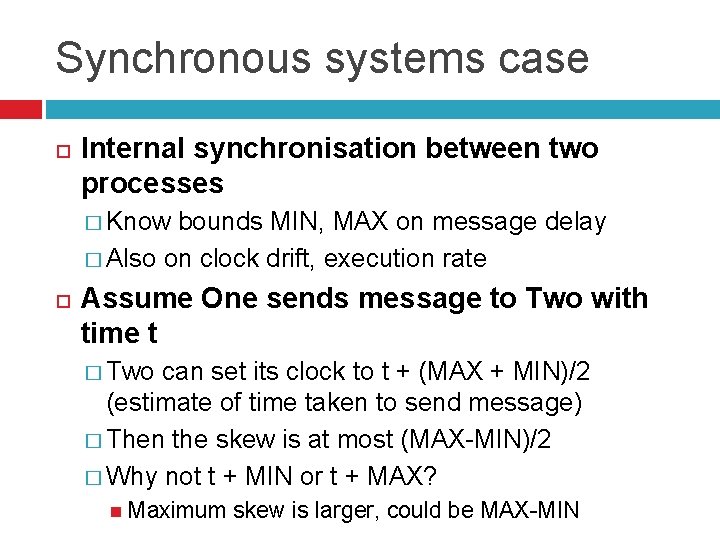
Synchronous systems case Internal synchronisation between two processes � Know bounds MIN, MAX on message delay � Also on clock drift, execution rate Assume One sends message to Two with time t � Two can set its clock to t + (MAX + MIN)/2 (estimate of time taken to send message) � Then the skew is at most (MAX-MIN)/2 � Why not t + MIN or t + MAX? Maximum skew is larger, could be MAX-MIN
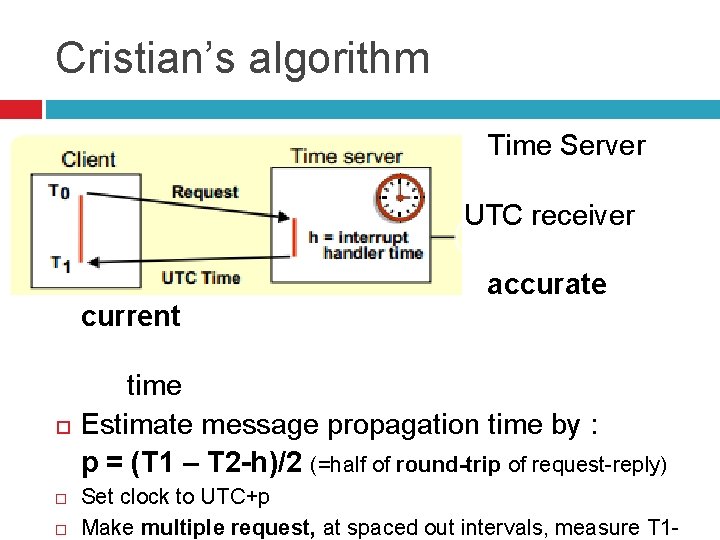
Cristian’s algorithm with gives current Time Server UTC receiver accurate time Estimate message propagation time by : p = (T 1 – T 2 -h)/2 (=half of round-trip of request-reply) Set clock to UTC+p Make multiple request, at spaced out intervals, measure T 1 -
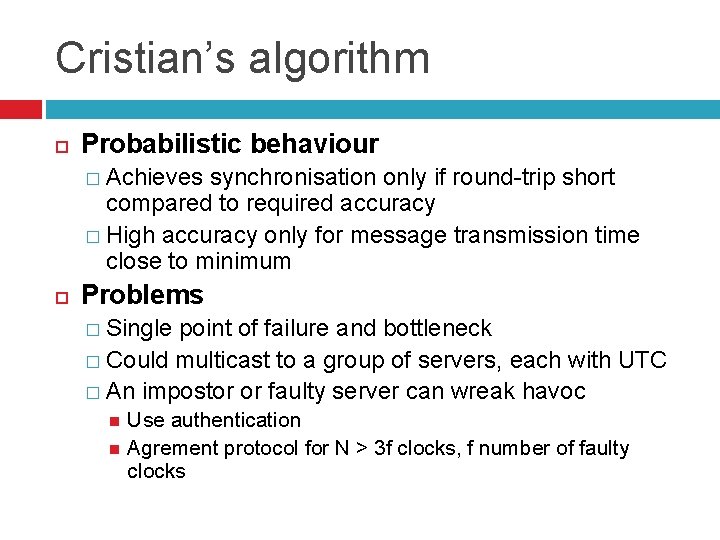
Cristian’s algorithm Probabilistic behaviour � Achieves synchronisation only if round-trip short compared to required accuracy � High accuracy only for message transmission time close to minimum Problems � Single point of failure and bottleneck � Could multicast to a group of servers, each with UTC � An impostor or faulty server can wreak havoc Use authentication Agrement protocol for N > 3 f clocks, f number of faulty clocks
The Berkeley Algorithm Choose master co-ordinator which periodically pools slaves Master estimates slaves local time based on round-trip Calculates average time of all, ignoring readings with exceptionally large propagation delay or clocks out of synch Sends message to each slave indicating clock adjustment
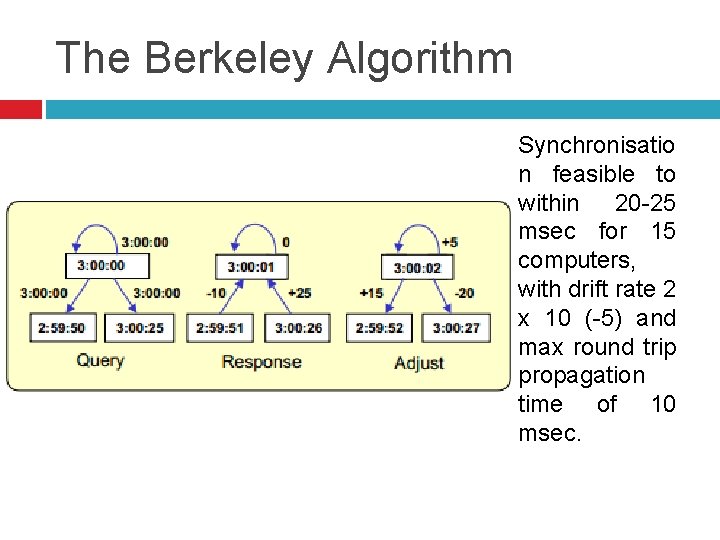
The Berkeley Algorithm Synchronisatio n feasible to within 20 -25 msec for 15 computers, with drift rate 2 x 10 (-5) and max round trip propagation time of 10 msec.
The Berkeley Algorithm Accuracy � Depends on the round-trip time Fault-tolerant average: � Eliminates readings of faulty clocks – probabilistically � Average over the subset of clocks that differ by up to a specified amount What if master fails? � Elect another leader
Network Time Protocol (NTP) Multiple time servers across the Internet Primary servers: directly connected to UTC receivers Secondary servers : synchronise with primaries Tertiary servers: synchronise with secondary, etc. Scales up to large numbers of servers and clients.
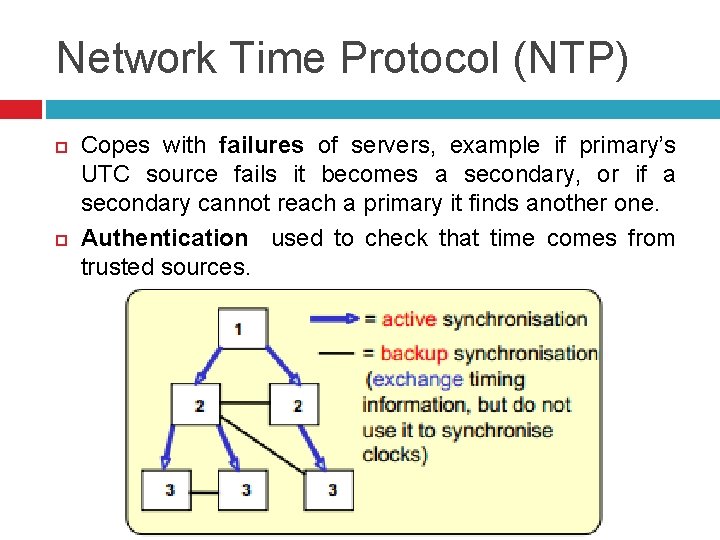
Network Time Protocol (NTP) Copes with failures of servers, example if primary’s UTC source fails it becomes a secondary, or if a secondary cannot reach a primary it finds another one. Authentication used to check that time comes from trusted sources.
NTP Synchronisation Modes Multicast � One or more servers periodically multicast to other servers on high speed LAN � They set clocks assuming small delay Procedure Call Mode � Similar to Cristian’s algorithm: client request time from a few other servers � Used for higher accuracy or where no multicast
NTP Synchronisation Modes Symmetric Protocol � Used by master servers on LANs and layers closest to primaries � Highest accuracy, based on pairwise synchronisation
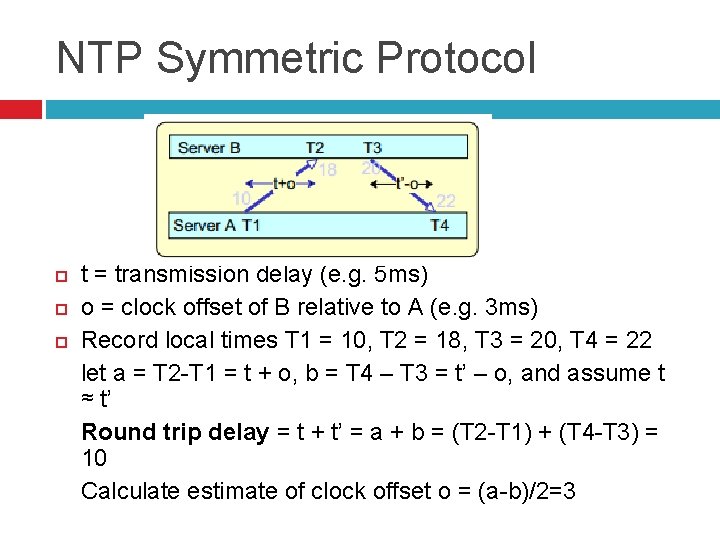
NTP Symmetric Protocol t = transmission delay (e. g. 5 ms) o = clock offset of B relative to A (e. g. 3 ms) Record local times T 1 = 10, T 2 = 18, T 3 = 20, T 4 = 22 let a = T 2 -T 1 = t + o, b = T 4 – T 3 = t’ – o, and assume t ≈ t’ Round trip delay = t + t’ = a + b = (T 2 -T 1) + (T 4 -T 3) = 10 Calculate estimate of clock offset o = (a-b)/2=3
NTP Symmetric Protocol T 4 = current message receive time determined at receiver Every message contains � � � T 3 = current message send time T 2 = previous receive message receive time T 1 = previous receive message send time Data filtering (obtain avarage values of clock offset from values of o corresponding to minimum t) Peer selection (exchange messages with several peers favouring those closer to primaries) How good is it? 20 -30 primaries and 2000 secondaries can synchronise to within 30 ms.
Logical Time For many purposes it is sufficient to agree on the same time (e. g. internal consistency) which need not be UTC time. Can decude causal event ordering a -> b (a occurs before b) Logical time denotes causal relationships But the -> relationship may not reflect real causality, only accidental.
Event ordering Define a -> b (a occurs before b) if � a and b are events in the same process and a occurs before b, or � a is the event of message sent from process A dan B is the event of message receipt by process B If a -> b and b -> c then a -> c. -> is partial order. For events such that neither a -> b nor b -> a we say a, b are concurrent, denoted a || b.
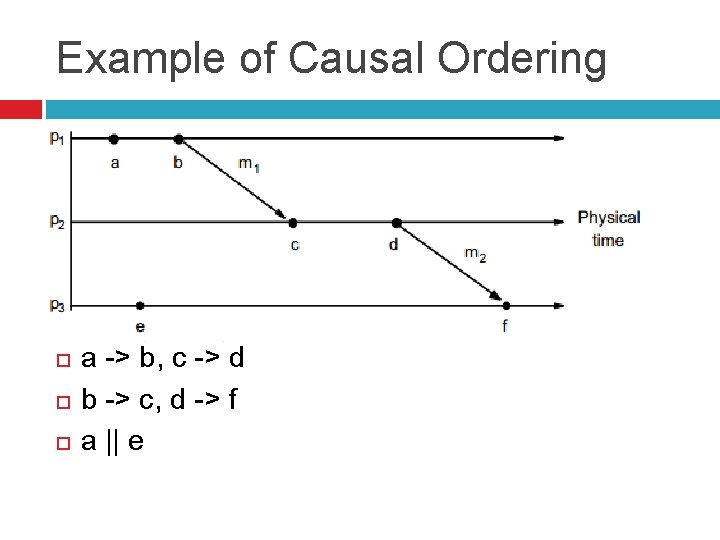
Example of Causal Ordering a -> b, c -> d b -> c, d -> f a || e
![Logical clocks [Lamport] Logical clock = monotonically increasing software counter (not real time!). How](http://slidetodoc.com/presentation_image/516d11063c9f93083be0dc40a1e4c041/image-29.jpg "Logical clocks [Lamport] Logical clock = monotonically increasing software counter (not real time!). How")
Logical clocks [Lamport] Logical clock = monotonically increasing software counter (not real time!). How it works � Lp incremented before assigning a timestamp to an event � When P sends message m, P timestamps it with current value t of Lp (after incrementing it), piggybacking t with m � On receiving message (m, t), Q sets its own clock Lq to maximum of Lq and t, then increments Lq before timestamping the message receive event Note a -> b implies T(a) < T (b)
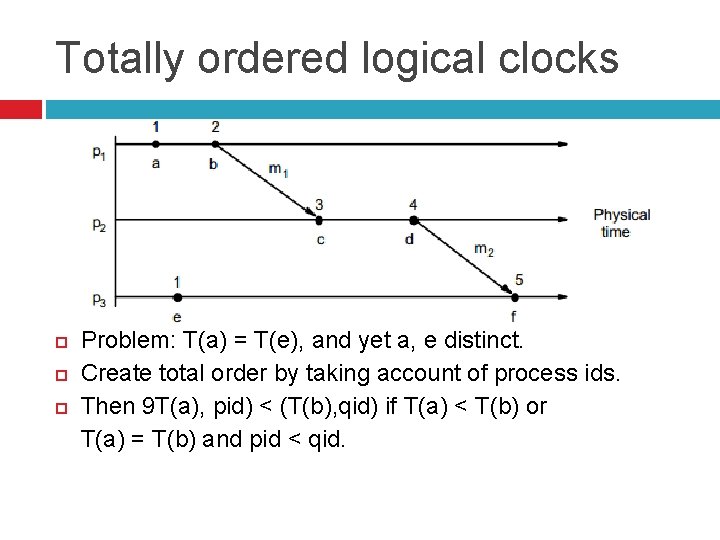
Totally ordered logical clocks Problem: T(a) = T(e), and yet a, e distinct. Create total order by taking account of process ids. Then 9 T(a), pid) < (T(b), qid) if T(a) < T(b) or T(a) = T(b) and pid < qid.
Vector clocks Totally ordered logical clocks � Arbitrary event order, depends on order of process ids � i. e. (T(a), pid) < (T(b), qid) does not imply a->b, see a, e Vector clocks � Array of N logical clocks in each proces, if N processes � Vector timestamps piggybacked on the messages � Rules for incrementing similar to lamport’s, except Processes own component in array modified Componentwise maximum and comparison Problems � Storage requirements

Vector timestamps VT(b) < VT(c), hence b -> c Neither VT(b) < VT(e), nor VT(b) < VT(e), hence b||e
Summary Local clocks � Drift! � But needed for timestamping Synchronisation algorithms � Must handle variable message delays Clock compensation estimate average delays � Adjust clocks � Can deal with fault clocks Logical clocks � Sufficient for causal ordering
- Slides: 33