
Sisal Henequen Leaf Fibers Sisal Agave sisilana Sisal
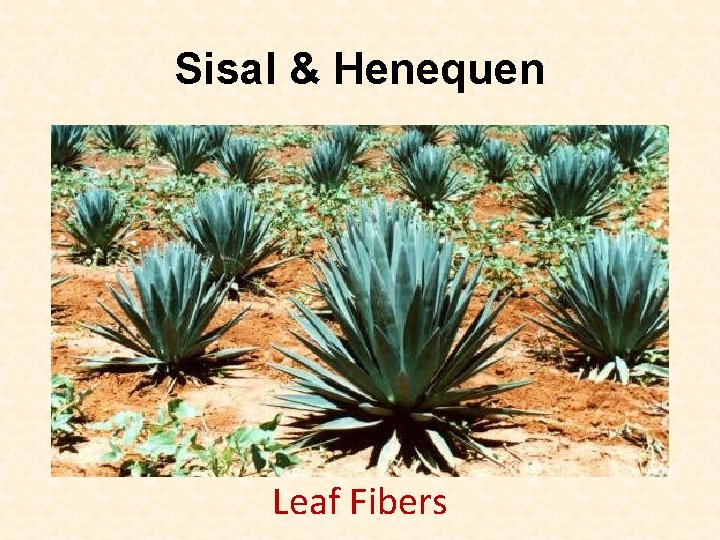
Sisal & Henequen Leaf Fibers
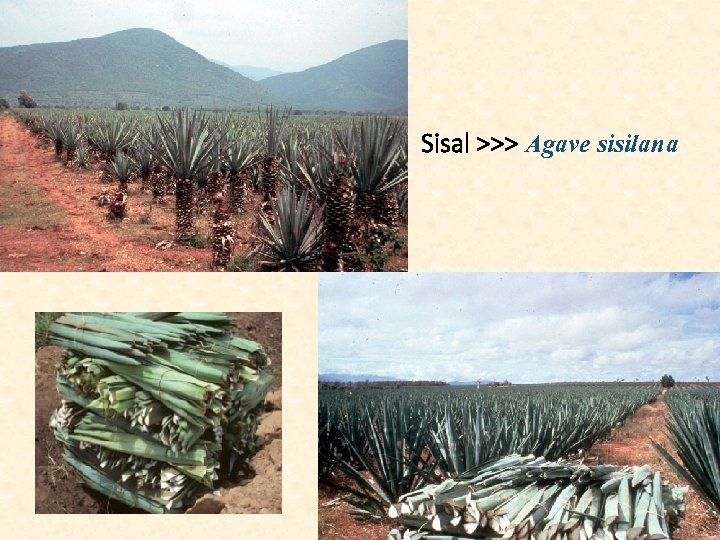
Sisal >>> Agave sisilana
Sisal and henequén • Sisal comes from the leaves of Agave sisilana • Henequén from the leaves of Agave fourcroydes. • Cultivation countries: Sisal cultivation spread to Florida, the Caribbean islands, and Brazil, as well as to countries in Africa, notably Tanzania, Kenya, and Asia.
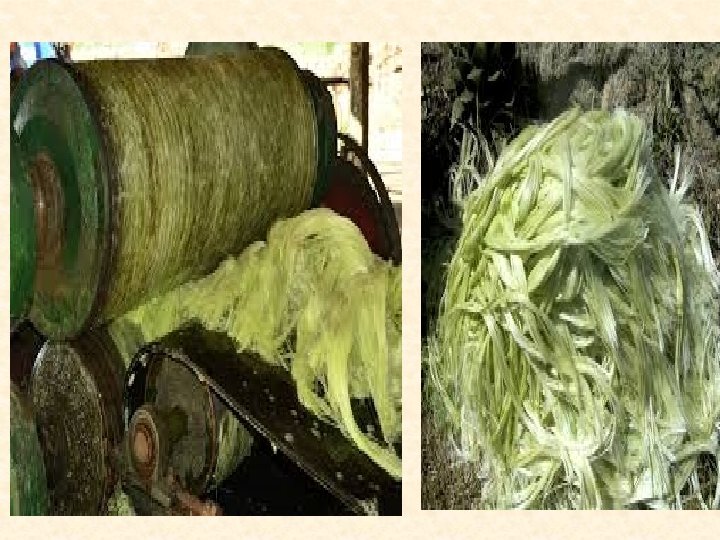
Sisal Fiber: ØSisal Plant >>> 7 -10 year life-span. ØCut first after 2 -3 years and then at 6 -12 month intervals. ØA typical plant will produce 200 -250 commercially usable leaves in its life-time (hybrid varieties up to 400 -450 leaves) ØEach leaf contains an average of around 1000 fibres. ØThe fibre element, which accounts for only about 4% of the plant by weight, is extracted by a process known as decortication.
Decortication >>> Removal of the bark, husk, or outer layer, or peel of an object. Fiber Length >>> 1~2 meter Shorter Fibers are known as “Tow” • The thickness, length, and strength of fiber in the leaf depend on the maturity of the leaf at the time of cutting. • The mature leaves are those closest to the ground; they contain the coarsest and the longest fibers. • Fiber extracted from immature leaves is finer, shorter, and probably weaker than the mature fiber
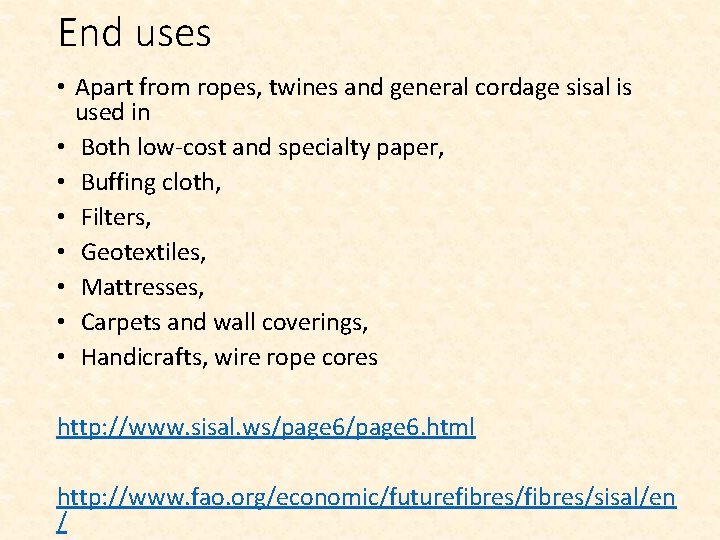
• The leaves are cut at the base, carried to the factory, rolled and the water squeezed out, and the other mushy tissues scraped away from the fibers. • The fibers are then washed and hung out in the sun. • They can be dyed directly.
End uses • Apart from ropes, twines and general cordage sisal is used in • Both low-cost and specialty paper, • Buffing cloth, • Filters, • Geotextiles, • Mattresses, • Carpets and wall coverings, • Handicrafts, wire rope cores http: //www. sisal. ws/page 6. html http: //www. fao. org/economic/futurefibres/sisal/en /
• Traditionally sisal was the leading material for agricultural twine ("binder" and "baler" twine) but the importance of this has now diminished (with competition from polypropylene and other techniques) although there is still a major business between Brazil and the United States. • Apart from ropes, twines and general cordage sisal is used in both low-cost and speciality paper, dartboards, buffing cloth, filters, geotextiles, mattresses, carpets and wall coverings, handicrafts, wire rope cores. • It is also used as a binding material for plaster mouldings as well as in the construction industry to reinforce plaster in ceilings and walls. • In recent years sisal has been utilised as a strengthening agent to replace asbestos and fibreglass and is increasingly a component used in the automobile industry, where its strength, "naturalness" and environmentally friendly characteristics are greatly appreciated.
- Slides: 9