
Sir James Smiths Community School STEPS GRID handbook
Sir James Smith’s Community School STEPS GRID handbook A practical guide Key Stage 3

STEPS and the STEP Grid Handbook Dear Parent/Carer, Monitoring and reporting attainment and progress throughout Key Stage 3 Over the past 12 months we have been using the STEPS assessment model with our Key Stage 3 students. Each subject has a STEPS grid. Each grid is comprised of 9 ‘steps’ and a number of ‘strands’. The grid contains descriptors for what your child needs to be able to do to complete a ‘step’. After using the STEPS model for the past year, we have refined and updated some grids. Your son/daughter will start with a baseline ‘step’ in Year 7, which will be derived from KS 2 data and baseline assessments they will complete in their opening weeks of Year 7. For Year 7 students, we will report the baseline step for each subject in the first report in mid-November. For Year 8 and 9 we will report the next progress data at this time. It is expected that most students would move up each strand by at least 1 step each year (3 steps over the course of the key stage)*. We feel very confident that what your son/ daughter experiences at Sir Jim’s is indeed a very comprehensive and professional package. This assessment model allows you as parents and carers the opportunity to be closely involved in their attainment, progress and target setting over the entire key stage. Below you will find a copy of the STEPs grid. Please keep this safe and use it to cross reference attainment on each report with content of the KS 3 courses for each subject studied. You should receive three attainment reports throughout the year, as detailed below: Finally, please feel free to contact me directly if you have a specific question about the system which needs further explanation. Yours faithfully Mr. E. Mc. Guffie Assistant Head Teacher – Curriculum
Introduction What is STEPS? Strategic Targets for Educational Progress and Success (STEPS) is an assessment and progress monitoring, tracking and reporting programme for secondary schools. How does it work? Upon arrival in Year-7, every student is assessed via a broad range of information and results available to the school. Subject teachers then place students at a baseline Step in each Strand this becomes the starting point for each subject. A Step Point Score is generated which is an overall score for a subject. Each student is expected to make at least one Step of progress in the Step Point Score per year, with the exception of Science where progress has been built implicitly into the scheme of work. School reports You will receive three reports per year showing your child’s attainment and progress in every Strand in every subject and it will also show you the overall Step Point Score. When used in conjunction with this handbook, it will give you both a detailed and quick method of reviewing attainment and progress so far. It will also allow you to discuss targets to progress to the next Step. The STEPS grids Each subject has its own grid, these form the rest of this handbook. Each grid is a basic summary of all the work that can be covered in each of the Key Stage 3 Programmes of Study. Each subject follows a similar approach. • Strands: these run along the top of the grid, they break a subject down into smaller topics or areas. There are between three and seven Strands per subject. • Steps: These break a subject down into progressive Steps. There are nine Steps per Strand per subject; 1 is the lowest Step and 9 is the highest. • Statements: Each Step has one or more statements. Students have to achieve all of these, and all of the ones in the Steps below, to be at that Step level. The Step Point Score Students will be given a Step score for each individual Strand in each subject. The Step Point Score combines these individual scores to give an overall score in a subject. If 3. 6 was the baseline at the start of year-7, then the students would be expected to reach: • 4. 6 by the end of Year-7 • 5. 6 by the end of Year-8 • 6. 6 by the end of Year-9. This would be a minimum expectation and targets could be adjusted each year to maintain challenge for each individual.

Modern Foreign Languages
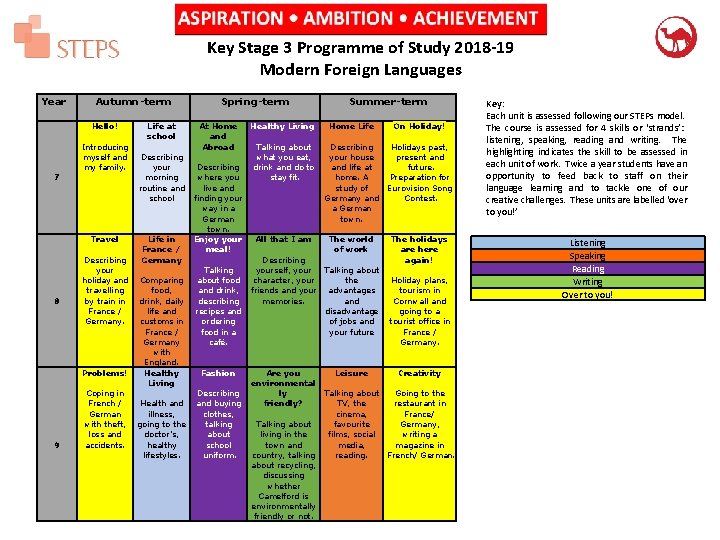
Key Stage 3 Programme of Study 2018 -19 Modern Foreign Languages Year Autumn-term Hello! Introducing myself and my family. 7 Travel 8 Describing your holiday and travelling by train in France / Germany. Problems! 9 Coping in French / German with theft, loss and accidents. Life at school Describing your morning routine and school Life in France / Germany Comparing food, drink, daily life and customs in France / Germany with England. Healthy Living Health and illness, going to the doctor’s, healthy lifestyles. Spring-term At Home and Abroad Describing where you live and finding your way in a German town. Enjoy your meal! Talking about food and drink, describing recipes and ordering food in a café. Fashion Describing and buying clothes, talking about school uniform. Summer-term Healthy Living Home Life On Holiday! Talking about what you eat, drink and do to stay fit. Describing your house and life at home. A study of Germany and a German town. Holidays past, present and future. Preparation for Eurovision Song Contest. All that I am The world of work The holidays are here again! Describing yourself, your Talking about character, your the friends and your advantages memories. and disadvantage of jobs and your future Are you environmental ly friendly? Talking about living in the town and country, talking about recycling, discussing whether Camelford is environmentally friendly or not. Holiday plans, tourism in Cornwall and going to a tourist office in France / Germany. Leisure Creativity Talking about TV, the cinema, favourite films, social media, reading. Going to the restaurant in France/ Germany, writing a magazine in French/ German. Key: Each unit is assessed following our STEPs model. The course is assessed for 4 skills or ‘strands’: listening, speaking, reading and writing. The highlighting indicates the skill to be assessed in each unit of work. Twice a year students have an opportunity to feed back to staff on their language learning and to tackle one of our creative challenges. These units are labelled ‘over to you!’ Listening Speaking Reading Writing Over to you!
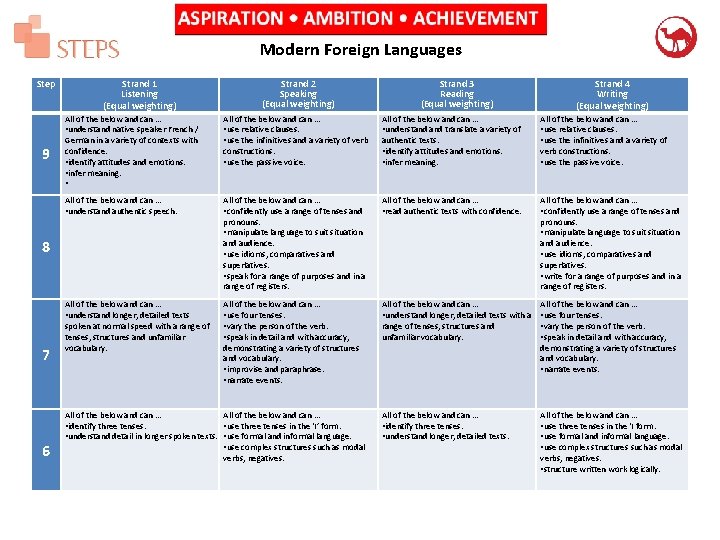
Modern Foreign Languages Step 9 Strand 1 Listening (Equal weighting) Strand 2 Speaking (Equal weighting) Strand 3 Reading (Equal weighting) Strand 4 Writing (Equal weighting) All of the below and can … • understand native speaker French / German in a variety of contexts with confidence. • identify attitudes and emotions. • infer meaning. All of the below and can … • use relative clauses. • use the infinitives and a variety of verb constructions. • use the passive voice. All of the below and can … • understand translate a variety of authentic texts. • identify attitudes and emotions. • infer meaning. All of the below and can … • use relative clauses. • use the infinitives and a variety of verb constructions. • use the passive voice. All of the below and can … • understand authentic speech. All of the below and can … • confidently use a range of tenses and pronouns. • manipulate language to suit situation and audience. • use idioms, comparatives and superlatives. • speak for a range of purposes and in a range of registers. All of the below and can … • read authentic texts with confidence. All of the below and can … • confidently use a range of tenses and pronouns. • manipulate language to suit situation and audience. • use idioms, comparatives and superlatives. • write for a range of purposes and in a range of registers. All of the below and can … • understand longer, detailed texts spoken at normal speed with a range of tenses, structures and unfamiliar vocabulary. All of the below and can … • use four tenses. • vary the person of the verb. • speak in detail and with accuracy, demonstrating a variety of structures and vocabulary. • improvise and paraphrase. • narrate events. All of the below and can … • understand longer, detailed texts with a range of tenses, structures and unfamiliar vocabulary. All of the below and can … • use four tenses. • vary the person of the verb. • speak in detail and with accuracy, demonstrating a variety of structures and vocabulary. • narrate events. All of the below and can … • identify three tenses. • understand longer, detailed texts. All of the below and can … • use three tenses in the ‘I form. • use formal and informal language. • use complex structures such as modal verbs, negatives. • structure written work logically. • 8 7 6 All of the below and can … • identify three tenses. • use three tenses in the ‘I’ form. • understand detail in longer spoken texts. • use formal and informal language. • use complex structures such as modal verbs, negatives.
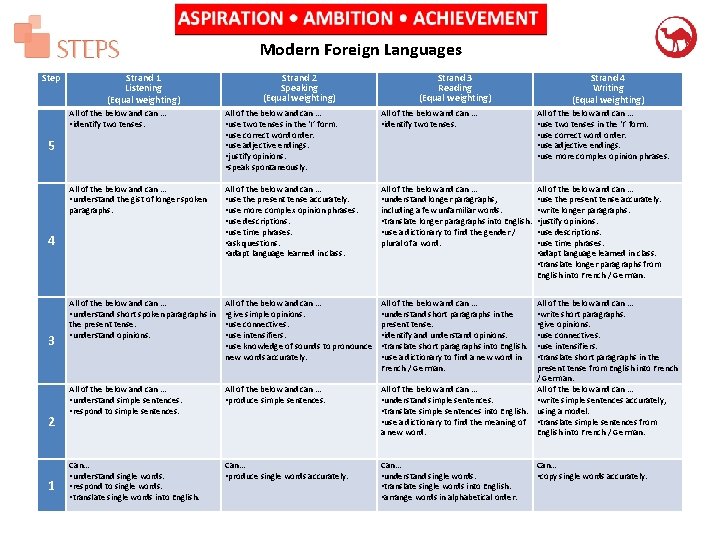
Modern Foreign Languages Step Strand 1 Listening (Equal weighting) 1 Strand 4 Writing (Equal weighting) All of the below and can … • use two tenses in the ‘I’ form. • use correct word order. • use adjective endings. • justify opinions. • speak spontaneously. All of the below and can … • identify two tenses. All of the below and can … • use two tenses in the ‘I’ form. • use correct word order. • use adjective endings. • use more complex opinion phrases. All of the below and can … • understand the gist of longer spoken paragraphs. All of the below and can … • use the present tense accurately. • use more complex opinion phrases. • use descriptions. • use time phrases. • ask questions. • adapt language learned in class. All of the below and can … • understand longer paragraphs, including a few unfamiliar words. • translate longer paragraphs into English. • use a dictionary to find the gender / plural of a word. All of the below and can … • use the present tense accurately. • write longer paragraphs. • justify opinions. • use descriptions. • use time phrases. • adapt language learned in class. • translate longer paragraphs from English into French / German. All of the below and can … • understand short spoken paragraphs in the present tense. • understand opinions. All of the below and can … • give simple opinions. • use connectives. • use intensifiers. • use knowledge of sounds to pronounce new words accurately. All of the below and can … • understand short paragraphs in the present tense. • identify and understand opinions. • translate short paragraphs into English. • use a dictionary to find a new word in French / German. All of the below and can … • understand simple sentences. • respond to simple sentences. All of the below and can … • produce simple sentences. Can… • understand single words. • respond to single words. • translate single words into English. Can… • produce single words accurately. 4 2 Strand 3 Reading (Equal weighting) All of the below and can … • identify two tenses. 5 3 Strand 2 Speaking (Equal weighting) All of the below and can … • write short paragraphs. • give opinions. • use connectives. • use intensifiers. • translate short paragraphs in the present tense from English into French / German. All of the below and can … • understand simple sentences. • write simple sentences accurately, • translate simple sentences into English. using a model. • use a dictionary to find the meaning of • translate simple sentences from a new word. English into French / German. Can… • understand single words. • translate single words into English. • arrange words in alphabetical order. Can… • copy single words accurately.
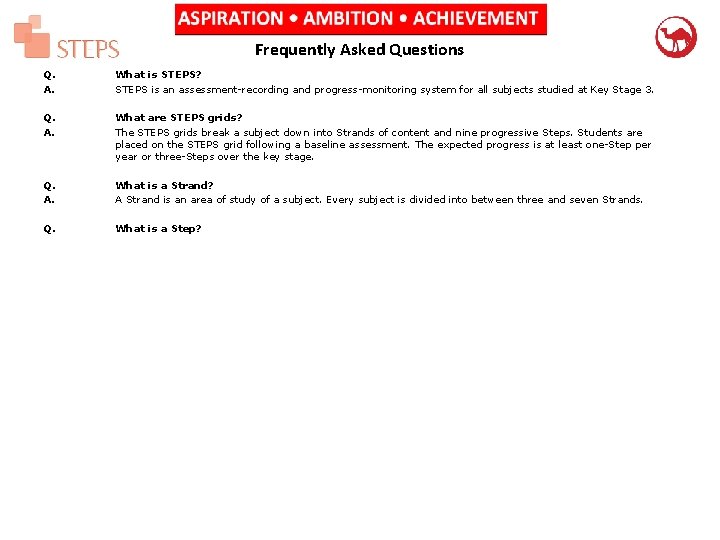
Frequently Asked Questions Q. A. What is STEPS? STEPS is an assessment-recording and progress-monitoring system for all subjects studied at Key Stage 3. Q. A. What are STEPS grids? The STEPS grids break a subject down into Strands of content and nine progressive Steps. Students are placed on the STEPS grid following a baseline assessment. The expected progress is at least one-Step per year or three-Steps over the key stage. Q. A. What is a Strand? A Strand is an area of study of a subject. Every subject is divided into between three and seven Strands. Q. What is a Step?
- Slides: 8