
SIR Basics 1 Shared Registration System SRS User
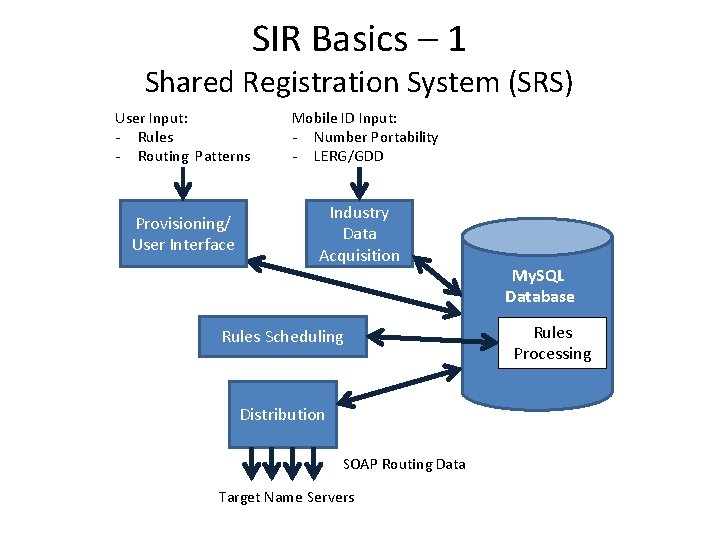
SIR Basics – 1 Shared Registration System (SRS) User Input: - Rules - Routing Patterns Provisioning/ User Interface Mobile ID Input: - Number Portability - LERG/GDD Industry Data Acquisition Rules Scheduling Distribution SOAP Routing Data Target Name Servers My. SQL Database Rules Processing
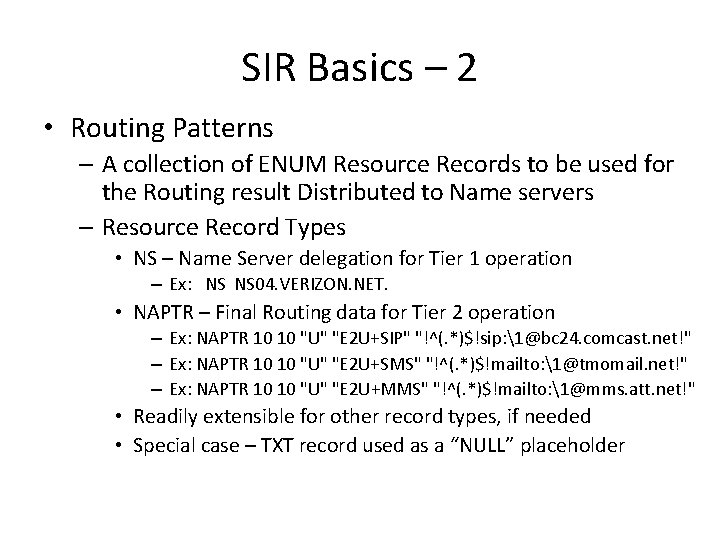
SIR Basics – 2 • Routing Patterns – A collection of ENUM Resource Records to be used for the Routing result Distributed to Name servers – Resource Record Types • NS – Name Server delegation for Tier 1 operation – Ex: NS NS 04. VERIZON. NET. • NAPTR – Final Routing data for Tier 2 operation – Ex: NAPTR 10 10 "U" "E 2 U+SIP" "!^(. *)$!sip: 1@bc 24. comcast. net!" – Ex: NAPTR 10 10 "U" "E 2 U+SMS" "!^(. *)$!mailto: 1@tmomail. net!" – Ex: NAPTR 10 10 "U" "E 2 U+MMS" "!^(. *)$!mailto: 1@mms. att. net!" • Readily extensible for other record types, if needed • Special case – TXT record used as a “NULL” placeholder
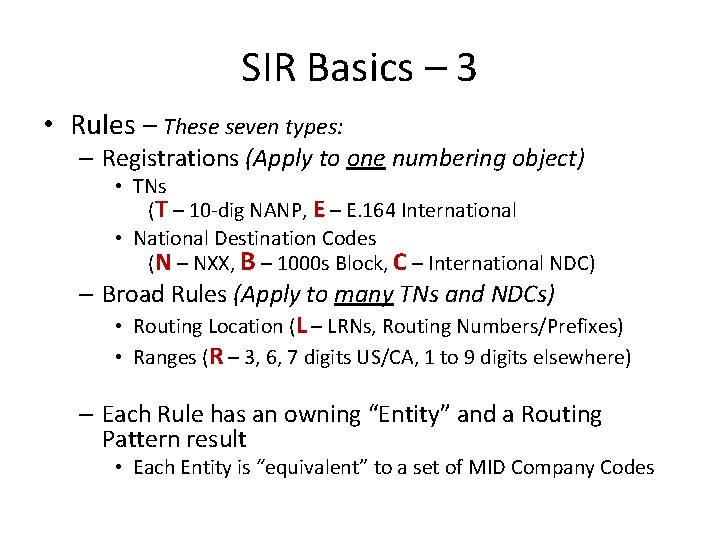
SIR Basics – 3 • Rules – These seven types: – Registrations (Apply to one numbering object) • TNs (T – 10 -dig NANP, E – E. 164 International • National Destination Codes (N – NXX, B – 1000 s Block, C – International NDC) – Broad Rules (Apply to many TNs and NDCs) • Routing Location (L – LRNs, Routing Numbers/Prefixes) • Ranges (R – 3, 6, 7 digits US/CA, 1 to 9 digits elsewhere) – Each Rule has an owning “Entity” and a Routing Pattern result • Each Entity is “equivalent” to a set of MID Company Codes
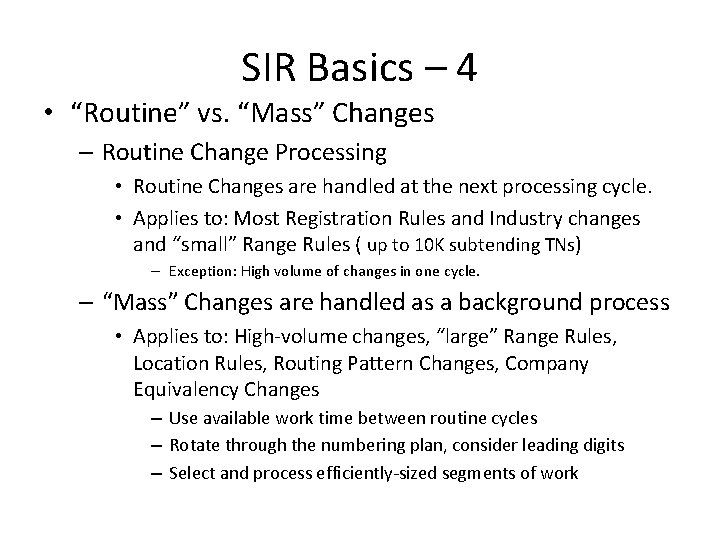
SIR Basics – 4 • “Routine” vs. “Mass” Changes – Routine Change Processing • Routine Changes are handled at the next processing cycle. • Applies to: Most Registration Rules and Industry changes and “small” Range Rules ( up to 10 K subtending TNs) – Exception: High volume of changes in one cycle. – “Mass” Changes are handled as a background process • Applies to: High-volume changes, “large” Range Rules, Location Rules, Routing Pattern Changes, Company Equivalency Changes – Use available work time between routine cycles – Rotate through the numbering plan, consider leading digits – Select and process efficiently-sized segments of work
SIR Routing Examples • A Hypothetical Service-Provider with realistic Industry Data (Entity ID AT 001) – In NPA 732, uses a broad rule to leverage very detailed TNby-TN LNP data for all assigned TNs – For one particular set of TNs, wants to provide a new TNspecific routing • Pick a Numbering Object, TN 1 • Follow a Rule creation for TN 1, and then a port for TN 1
SIR Examples: What Happens 1 (Per-TN Rule overrides NPA range Rule) Initially, TN 1 (+1 732 -895 -2443) assigned to AT 001 – Range rule for NPA 732 gives Routing Pattern ATRP 14, one NS record result Step 1. AT 001 adds a Rule for TN 1, giving RP ATRP 15, one NAPTR record results
SIR Examples: What Happens 2 (Per-TN Rule becomes inoperative on Port-Out) After previous step, TN 1 (+1 732 -895 -2443) still assigned to AT 001 – TN rule for gives Routing Pattern ATRP 15, one NAPTR record result Step 2. Port TN 1 to a non-participating SP – Picks up ‘NULL’ RP, one TXT record result (returns no-record when queried for NAPTR)
- Slides: 7