
Sir Arthur Conan Doyle and The Lost World
- Slides: 11
Sir Arthur Conan Doyle and The Lost World
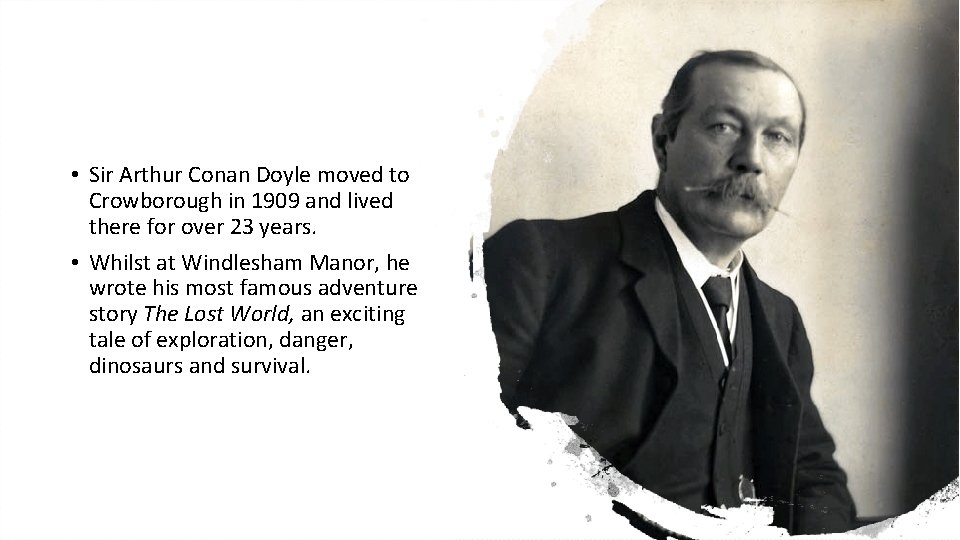
• Sir Arthur Conan Doyle moved to Crowborough in 1909 and lived there for over 23 years. • Whilst at Windlesham Manor, he wrote his most famous adventure story The Lost World, an exciting tale of exploration, danger, dinosaurs and survival.
Facts about Sir Arthur Conan Doyle • In his early life he trained as a surgeon. His first job was medic on-board a whaling ship to the Artic Circle. This unlocked a sense of adventure that stayed with him throughout his entire life. • He was a professional cricketer and he played soccer in goal for Portsmouth FC. • He created the famous character Sherlock Holmes. • Without Doyle there would be no Jurassic Park. When he wrote The Lost World, the term dinosaur hadn’t been around for two centuries. The book was hugely influential in bringing dinosaurs into fiction and inspired loads of novels and films, including Jurassic Park and King Kong.
Facts about Sir Arthur Conan Doyle (cont. ) • He had a friendship with the famous magician Houdini. • He was an amateur detective. He took on a number of mysterious cases including the infamous hunt in Whitechapel for Jack the Ripper. • He believed in fairies. When a photograph emerged showing a young girl surrounded by fairies, Doyle hailed its authenticity, believing it was clear evidence of psychic phenomena. He wrote a book called The Coming of the Fairies and spent a million dollars promoting their validity. It wasn’t until long after Doyle’s death that the girl eventually admitted it was a hoax
Dinosaur Discovery • It is said that a fossilised footprint of an Iguanodon, found in a quarry near his home in 1909 fired Conan Doyle’s imagination and The Lost World, written in 1912, was the result. True or not, the book became a worldwide success and generations continue to be enthralled by dinosaurs. • Doyle made his own casts of the dinosaur footprints and displayed them in his house, Windlesham Manor, in Crowborough. • His discovery was never mentioned in scientific publications.
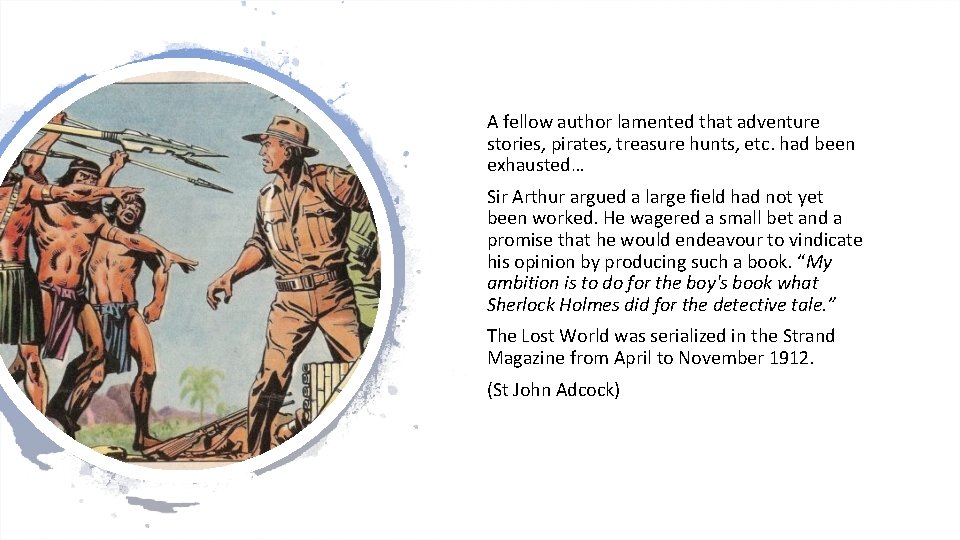
A fellow author lamented that adventure stories, pirates, treasure hunts, etc. had been exhausted… Sir Arthur argued a large field had not yet been worked. He wagered a small bet and a promise that he would endeavour to vindicate his opinion by producing such a book. “My ambition is to do for the boy's book what Sherlock Holmes did for the detective tale. ” The Lost World was serialized in the Strand Magazine from April to November 1912. (St John Adcock)
Extracts from The Lost World By Arthur Conan Doyle
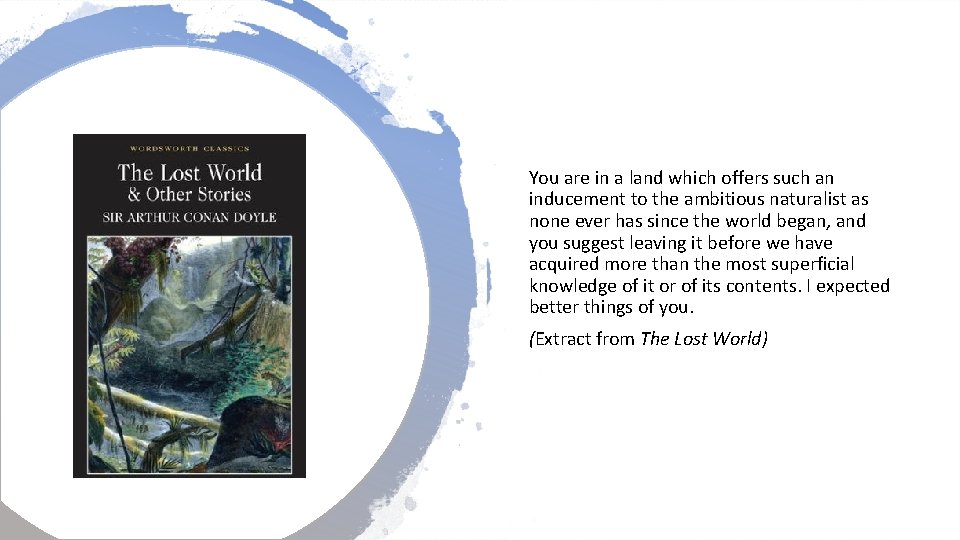
You are in a land which offers such an inducement to the ambitious naturalist as none ever has since the world began, and you suggest leaving it before we have acquired more than the most superficial knowledge of it or of its contents. I expected better things of you. (Extract from The Lost World)
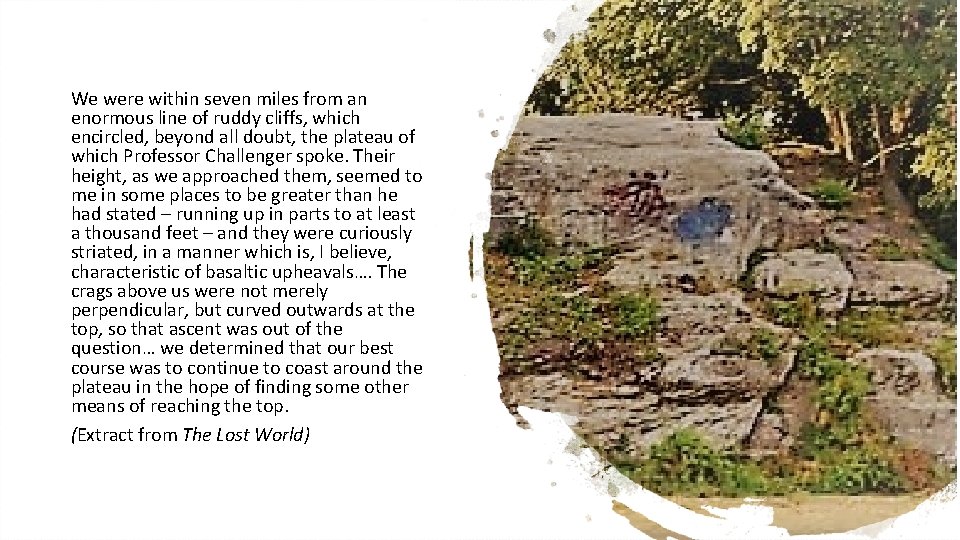
We were within seven miles from an enormous line of ruddy cliffs, which encircled, beyond all doubt, the plateau of which Professor Challenger spoke. Their height, as we approached them, seemed to me in some places to be greater than he had stated – running up in parts to at least a thousand feet – and they were curiously striated, in a manner which is, I believe, characteristic of basaltic upheavals…. The crags above us were not merely perpendicular, but curved outwards at the top, so that ascent was out of the question… we determined that our best course was to continue to coast around the plateau in the hope of finding some other means of reaching the top. (Extract from The Lost World)
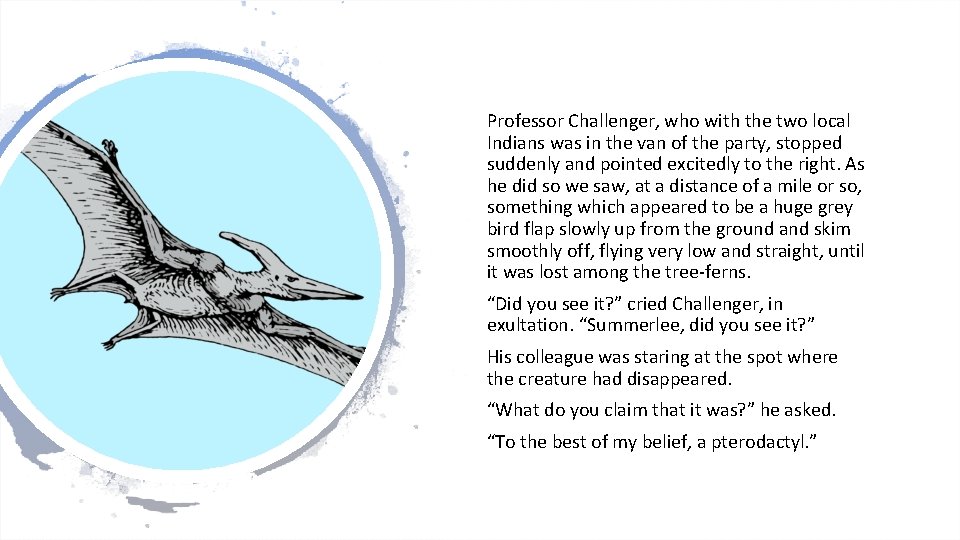
Professor Challenger, who with the two local Indians was in the van of the party, stopped suddenly and pointed excitedly to the right. As he did so we saw, at a distance of a mile or so, something which appeared to be a huge grey bird flap slowly up from the ground and skim smoothly off, flying very low and straight, until it was lost among the tree-ferns. “Did you see it? ” cried Challenger, in exultation. “Summerlee, did you see it? ” His colleague was staring at the spot where the creature had disappeared. “What do you claim that it was? ” he asked. “To the best of my belief, a pterodactyl. ”
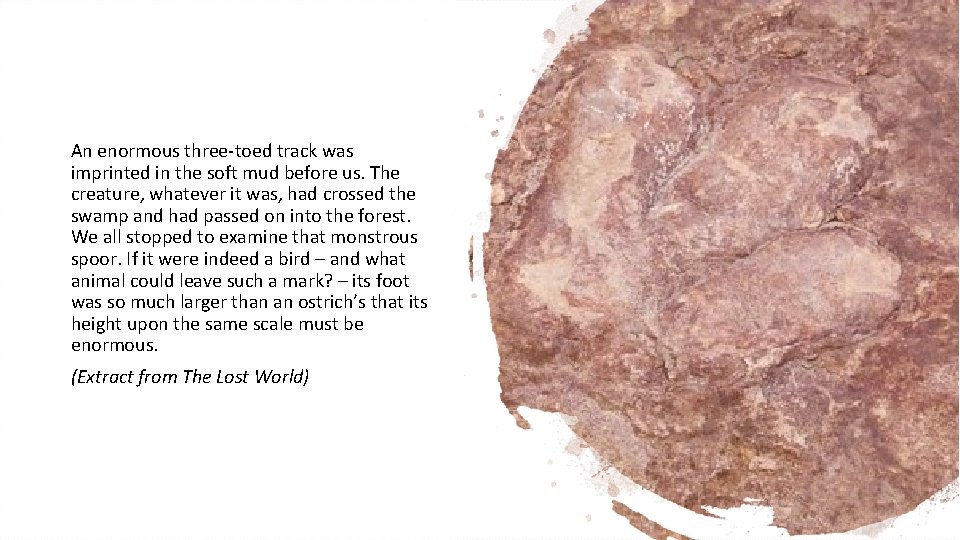
An enormous three-toed track was imprinted in the soft mud before us. The creature, whatever it was, had crossed the swamp and had passed on into the forest. We all stopped to examine that monstrous spoor. If it were indeed a bird – and what animal could leave such a mark? – its foot was so much larger than an ostrich’s that its height upon the same scale must be enormous. (Extract from The Lost World)