
SIP Improvement Current initiatives Anna Marie Wood Director
- Slides: 10
SIP Improvement: Current initiatives Anna Marie Wood Director Air Quality Policy Division Office of Air Quality Planning and Standards U. S. EPA WESTAR Spring Business Meeting April 17, 2012
Overview Questions �What state/local concerns are we addressing? �How are we addressing them? �What are we ultimately trying to achieve? �Where do we go from here? 2
What state/local concerns are we addressing? � EPA has been engaging with states through different means over many months to better understand state concerns associated with SIP guidance, development, and processing. ◦ For example, the ECOS/NACAA SIP Reform Work Group started with a list of the 13 highest-priority potential SIP process reforms � Through these various modes, we have come to identify two broad categories of issues: ◦ Consistent, timely, and efficient SIP processing ◦ Timely completion of EPA guidance documents, including state involvement in guidance development process 3
How are we addressing these issues? � There a number of efforts underway to address these issues ◦ Some have been completed and others are ongoing � With input from states (via the ECOS/NACAA SIP Reform WG and others), we are focusing our efforts on: ◦ Developing tools to assist with implementing the NAAQS � Focus is on SIP consistency and timely and efficient processing ◦ Providing for more timely issuance of guidance and involving states in the development of regulations and guidance that affect them as appropriate 4
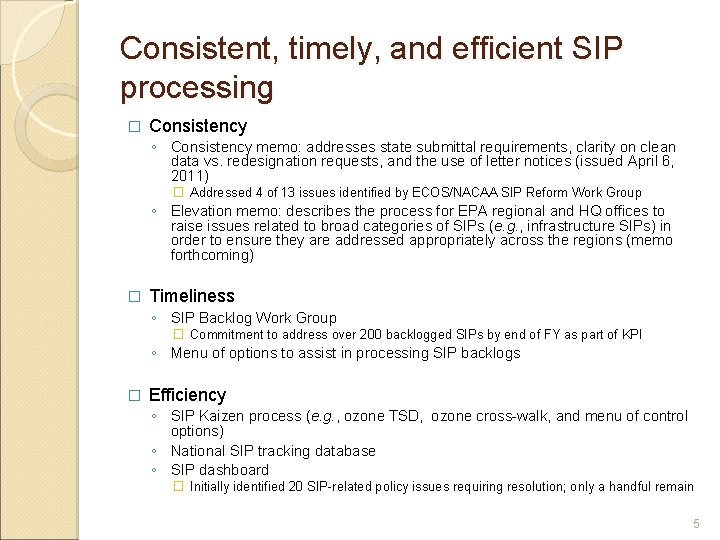
Consistent, timely, and efficient SIP processing � Consistency ◦ Consistency memo: addresses state submittal requirements, clarity on clean data vs. redesignation requests, and the use of letter notices (issued April 6, 2011) � Addressed 4 of 13 issues identified by ECOS/NACAA SIP Reform Work Group ◦ Elevation memo: describes the process for EPA regional and HQ offices to raise issues related to broad categories of SIPs (e. g. , infrastructure SIPs) in order to ensure they are addressed appropriately across the regions (memo forthcoming) � Timeliness ◦ SIP Backlog Work Group � Commitment to address over 200 backlogged SIPs by end of FY as part of KPI ◦ Menu of options to assist in processing SIP backlogs � Efficiency ◦ SIP Kaizen process (e. g. , ozone TSD, ozone cross-walk, and menu of control options) ◦ National SIP tracking database ◦ SIP dashboard � Initially identified 20 SIP-related policy issues requiring resolution; only a handful remain 5
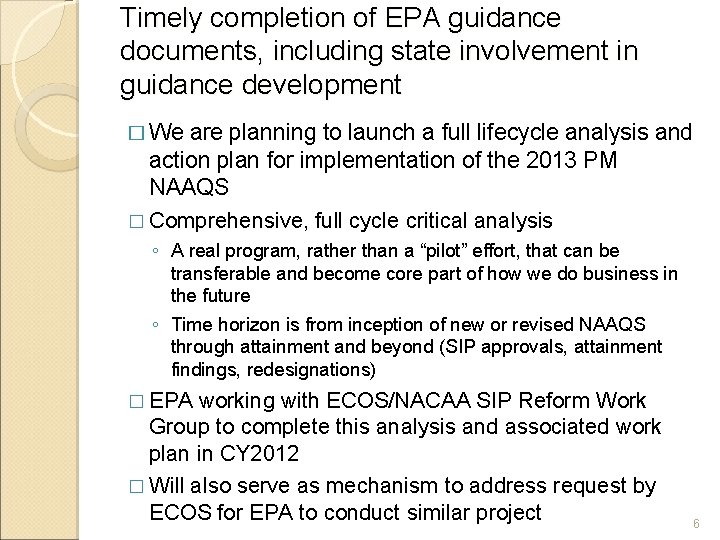
Timely completion of EPA guidance documents, including state involvement in guidance development � We are planning to launch a full lifecycle analysis and action plan for implementation of the 2013 PM NAAQS � Comprehensive, full cycle critical analysis ◦ A real program, rather than a “pilot” effort, that can be transferable and become core part of how we do business in the future ◦ Time horizon is from inception of new or revised NAAQS through attainment and beyond (SIP approvals, attainment findings, redesignations) � EPA working with ECOS/NACAA SIP Reform Work Group to complete this analysis and associated work plan in CY 2012 � Will also serve as mechanism to address request by ECOS for EPA to conduct similar project 6
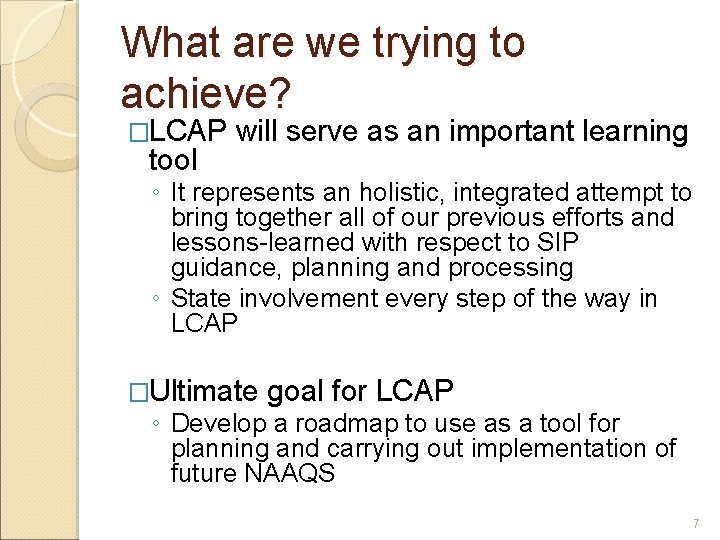
What are we trying to achieve? �LCAP tool will serve as an important learning ◦ It represents an holistic, integrated attempt to bring together all of our previous efforts and lessons-learned with respect to SIP guidance, planning and processing ◦ State involvement every step of the way in LCAP �Ultimate goal for LCAP ◦ Develop a roadmap to use as a tool for planning and carrying out implementation of future NAAQS 7
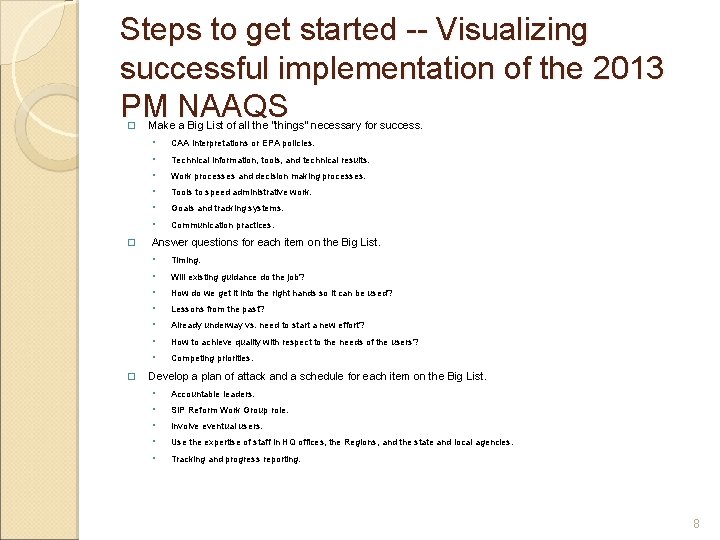
Steps to get started -- Visualizing successful implementation of the 2013 PM NAAQS � � � Make a Big List of all the “things” necessary for success. ◦ CAA interpretations or EPA policies. ◦ Technical information, tools, and technical results. ◦ Work processes and decision making processes. ◦ Tools to speed administrative work. ◦ Goals and tracking systems. ◦ Communication practices. Answer questions for each item on the Big List. ◦ Timing. ◦ Will existing guidance do the job? ◦ How do we get it into the right hands so it can be used? ◦ Lessons from the past? ◦ Already underway vs. need to start a new effort? ◦ How to achieve quality with respect to the needs of the users? ◦ Competing priorities. Develop a plan of attack and a schedule for each item on the Big List. ◦ Accountable leaders. ◦ SIP Reform Work Group role. ◦ Involve eventual users. ◦ Use the expertise of staff in HQ offices, the Regions, and the state and local agencies. ◦ Tracking and progress reporting. 8
Where do we go from here? �Initiate and complete work on the “Big List” for PM LCAP in summer 2012 ◦ Work with ECOS/NACAA SIP Reform Work Group and non-NACAA states for input �Create work plan to address items on Big List, initiate certain actions and complete work by December 2012 ◦ Leverage tools and guidance already completed �Bottom line: Use LCAP exercise to help develop roadmap for implementing future NAAQS 9
Questions or comments? 10