
SIP Extensions for Enhanced Location Based Services in
SIP Extensions for Enhanced Location Based Services in 3 G Networks International SIP 2004, Paris Pavitra Krishnaswamy pavitra@ccpu. com Application-Ready Platform Solutions™
AGENDA n SIP in 3 G Networks – An Introduction n Location Based Services n Role of SIP in Location Based Services n Proposed Solutions n Sample Call Flows n Q&A 2
SIP in 3 G Networks – An Introduction n SIP chosen to be protocol of choice for signaling in 3 G release 5 IP Multimedia subsystem. n Motivation n n Need for a Converged Network Simplicity of the protocol Extensibility Support for Mobility in SIP 3
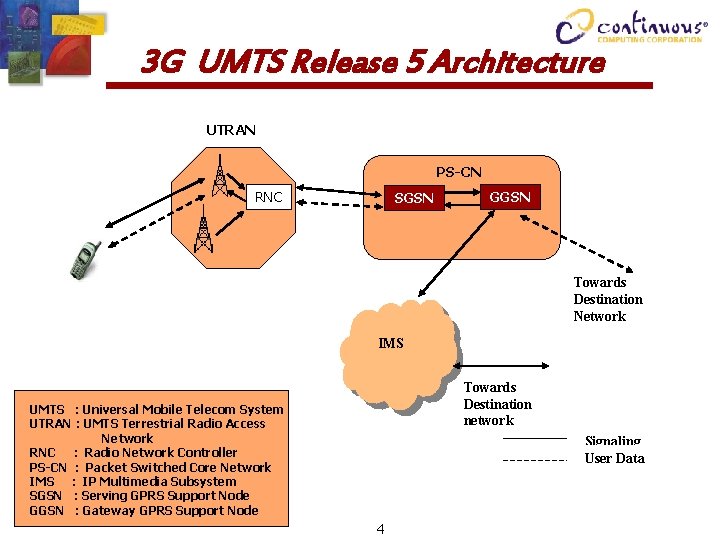
3 G UMTS Release 5 Architecture UTRAN PS-CN RNC SGSN GGSN Towards Destination Network IMS Towards Destination network UMTS : Universal Mobile Telecom System UTRAN : UMTS Terrestrial Radio Access Network RNC : Radio Network Controller PS-CN : Packet Switched Core Network IMS : IP Multimedia Subsystem SGSN : Serving GPRS Support Node GGSN : Gateway GPRS Support Node Signaling User Data 4
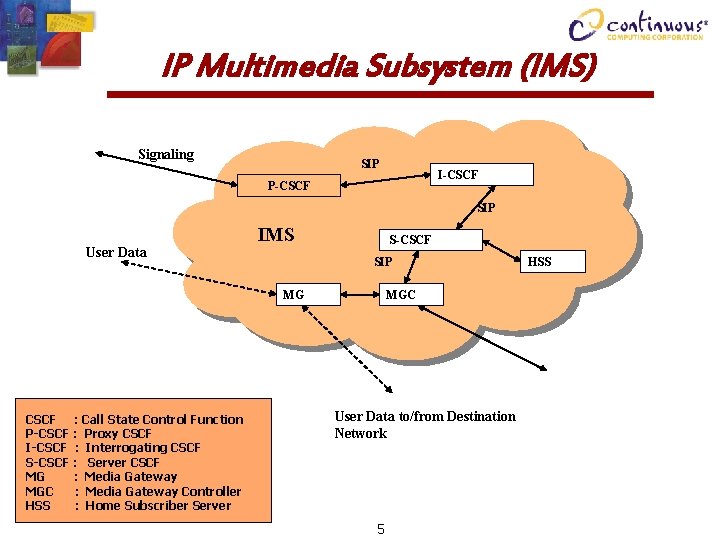
IP Multimedia Subsystem (IMS) Signaling SIP I-CSCF P-CSCF SIP User Data IMS S-CSCF SIP MG CSCF : Call State Control Function P-CSCF : Proxy CSCF I-CSCF : Interrogating CSCF S-CSCF : Server CSCF MG : Media Gateway MGC : Media Gateway Controller HSS : Home Subscriber Server MGC User Data to/from Destination Network 5 HSS
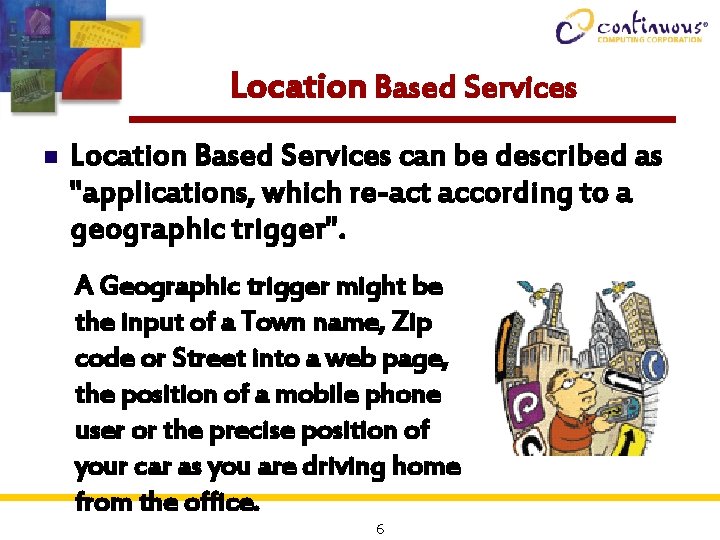
Location Based Services n Location Based Services can be described as "applications, which re-act according to a geographic trigger". A Geographic trigger might be the input of a Town name, Zip code or Street into a web page, the position of a mobile phone user or the precise position of your car as you are driving home from the office. 6
Location Based Services (LBS) n Need For LBS n n n Commercial Uses: e. g. : Location based entertainment information. Network Uses e. g. : Network service related procedures Emergency Uses e. g. : 911 calls 7
Traditional Location Services Model 1. To support Location based services the 3 G Network provides a method to discover the location of a UE. This procedure is termed as Location Services (LCS). Ø Two types of location services are possible: - Network Initiated : Initiated by SGSN - Client Initiated : Initiated by external client node or by the originating mobile device(UE) 8
Traditional Location Services Model The following steps are involved in Location Services: v. A remote client or a requests the SGSN for location information. v. SGSN requests the radio network (UTRAN) to locate the mobile device. v. UTRAN provides location coordinates after communicating with the device. v. SGSN provides the co-ordinates to the requested nodes/ clients 9
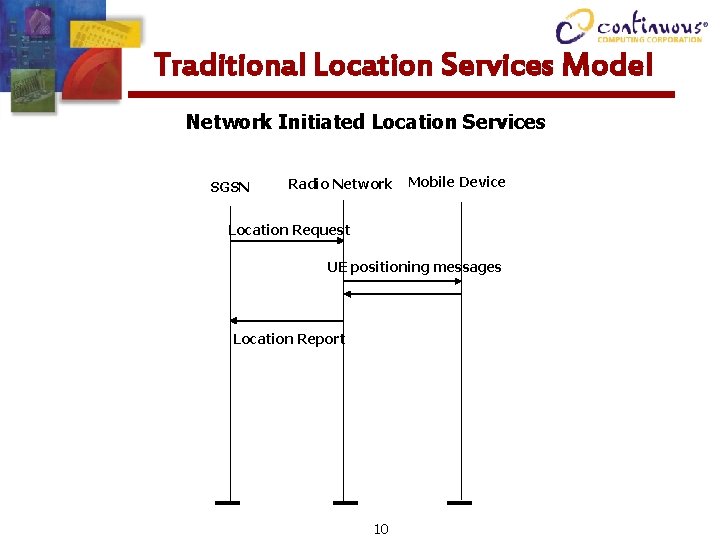
Traditional Location Services Model Network Initiated Location Services SGSN Radio Network Mobile Device Location Request UE positioning messages Location Report 10
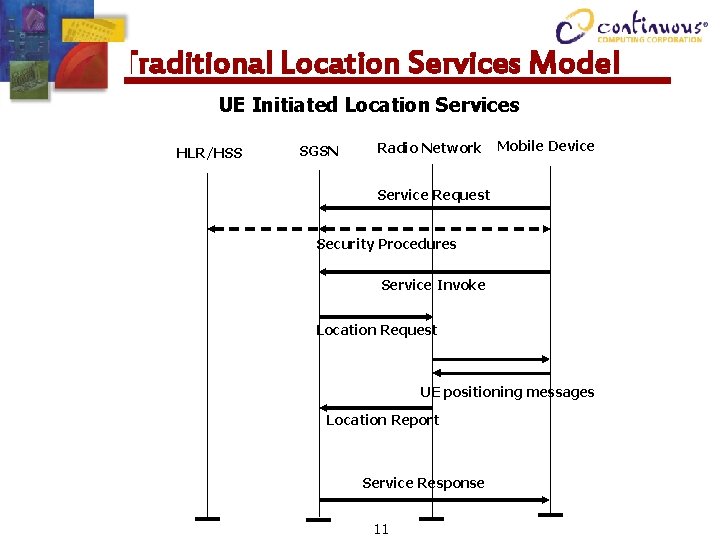
Traditional Location Services Model UE Initiated Location Services HLR/HSS SGSN Radio Network Mobile Device Service Request Security Procedures Service Invoke Location Request UE positioning messages Location Report Service Response 11
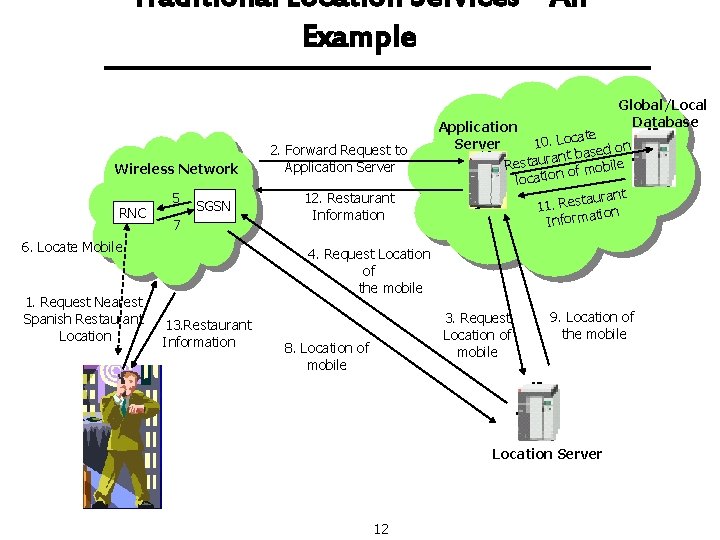
Traditional Location Services – An Example Global/Local Database Wireless Network RNC 5 SGSN 7 6. Locate Mobile 1. Request Nearest Spanish Restaurant Location 2. Forward Request to Application Server 12. Restaurant Information Application ate 10. Loc Server sed on a b t n a r e Restau of mobil n io t a c lo taurant s e R. 1 1 tion Informa 4. Request Location of the mobile 13. Restaurant Information 3. Request Location of mobile 8. Location of mobile 9. Location of the mobile Location Server 12
SIP & Location Based Services n For multimedia calls and calls that require location based services SIP can be used to carry the location co-ordinates of the mobile device(UE) to the application server. n UE’s can request special location based service by inserting a specific SIP header into the message. 13
SIP & Location Based Services n Why use SIP for LBS? n n SIP message headers can be easily extended to carry location information and to request location based services. By inserting the location data for multimedia calls when initiating call signaling, additional location services procedures need not be initiated by application servers on receiving the request thus saving time & network bandwidth. 14
Proposed Solutions – Solution 1 Two solutions have been proposed to use SIP to enhance location based services(LBS) in a 3 G network. Solution 1: - The mobile device initiates the LCS procedures to discover its geographical co-ordinates, for calls requiring LBS. - The LCS procedures used will be that prescribed in the normal 3 G procedures. - The Mobile device inserts location information into SIP signaling on completion of LCS 15 procedures.
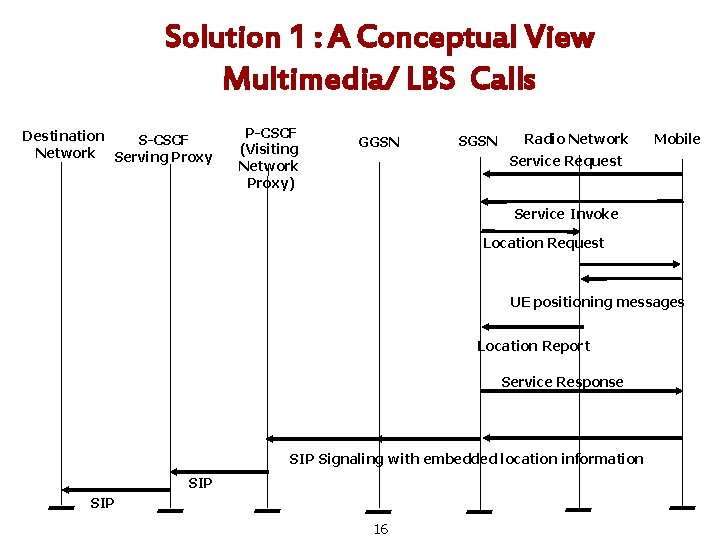
Solution 1 : A Conceptual View Multimedia/ LBS Calls Destination S-CSCF Network Serving Proxy P-CSCF (Visiting Network Proxy) GGSN SGSN Radio Network Mobile Service Request Service Invoke Location Request UE positioning messages Location Report Service Response SIP Signaling with embedded location information SIP 16
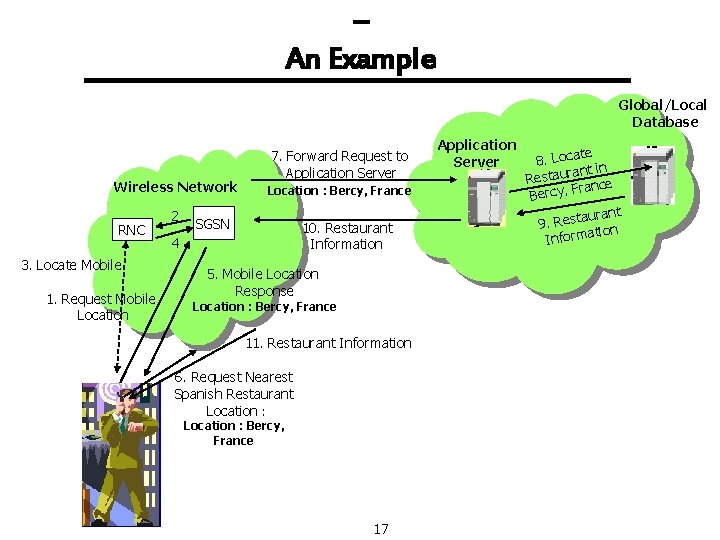
– An Example Global/Local Database Wireless Network RNC 3. Locate Mobile 1. Request Mobile Location 2 7. Forward Request to Application Server Location : Bercy, France SGSN 10. Restaurant Information 4 5. Mobile Location Response Location : Bercy, France 11. Restaurant Information 6. Request Nearest Spanish Restaurant Location : Bercy, France 17 Application Server e 8. Locat ant in Restaur nce ra Bercy, F urant 9. Resta tion Informa
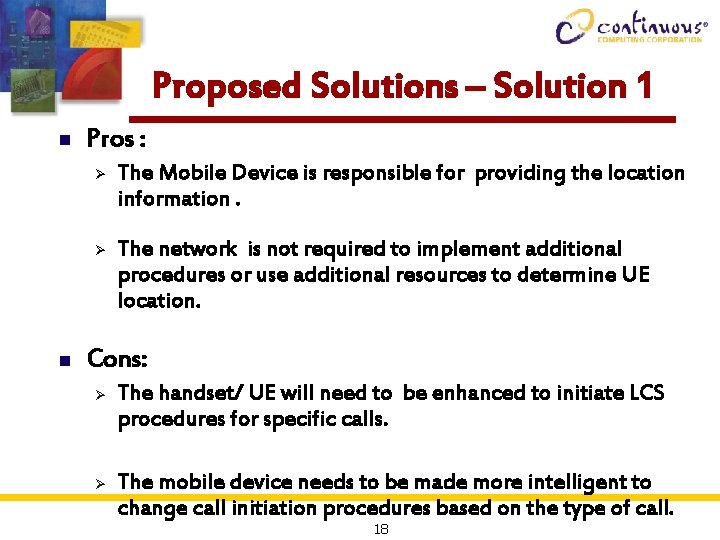
Proposed Solutions – Solution 1 n Pros : Ø Ø n The Mobile Device is responsible for providing the location information. The network is not required to implement additional procedures or use additional resources to determine UE location. Cons: Ø Ø The handset/ UE will need to be enhanced to initiate LCS procedures for specific calls. The mobile device needs to be made more intelligent to change call initiation procedures based on the type of call. 18
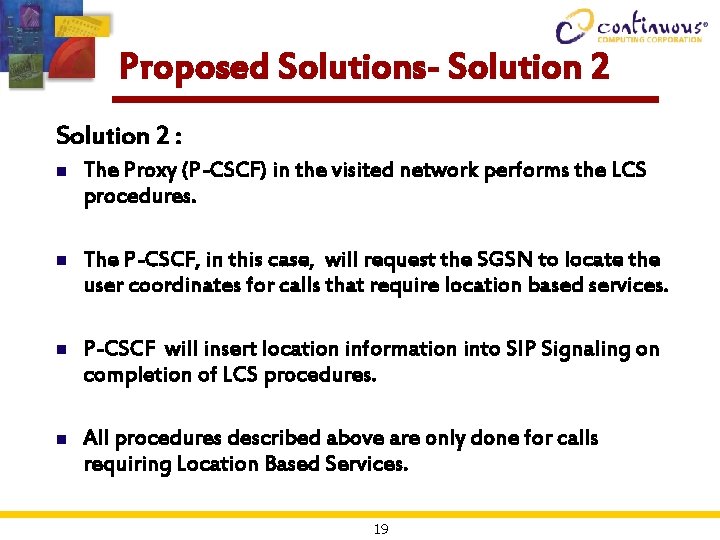
Proposed Solutions- Solution 2 : n The Proxy (P-CSCF) in the visited network performs the LCS procedures. n The P-CSCF, in this case, will request the SGSN to locate the user coordinates for calls that require location based services. n P-CSCF will insert location information into SIP Signaling on completion of LCS procedures. n All procedures described above are only done for calls requiring Location Based Services. 19
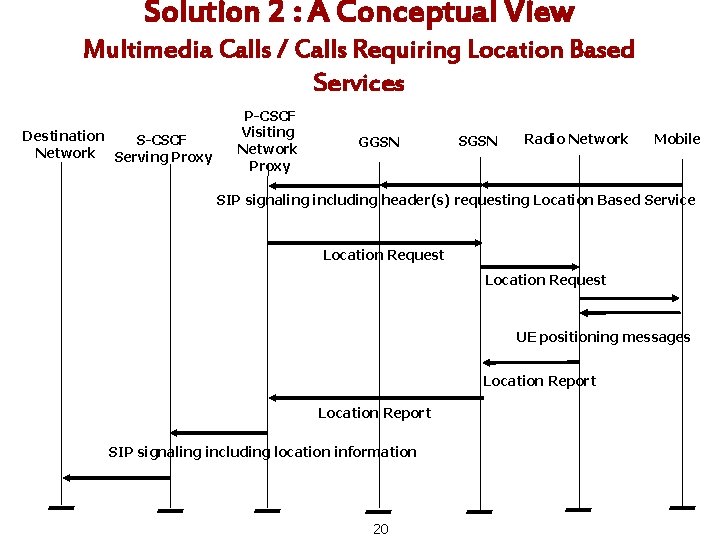
Solution 2 : A Conceptual View Multimedia Calls / Calls Requiring Location Based Services Destination S-CSCF Network Serving Proxy P-CSCF Visiting Network Proxy GGSN SGSN Radio Network Mobile SIP signaling including header(s) requesting Location Based Service Location Request UE positioning messages Location Report SIP signaling including location information 20
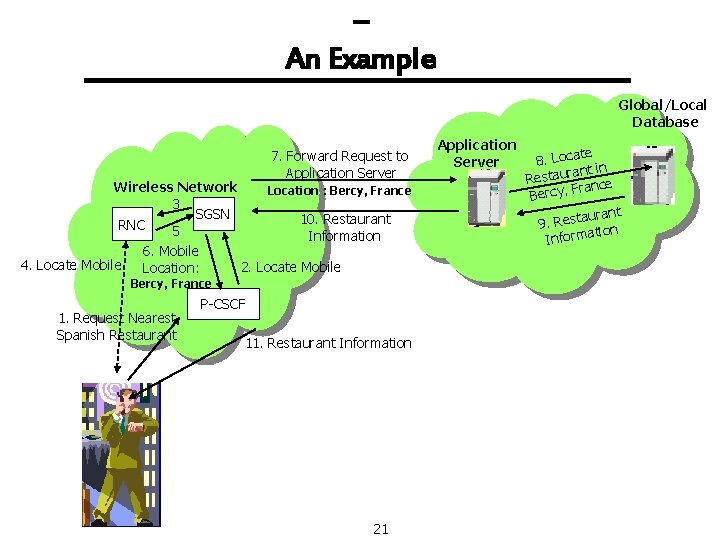
– An Example Global/Local Database 7. Forward Request to Application Server Wireless Network 3 SGSN RNC 5 4. Locate Mobile 6. Mobile Location: Location : Bercy, France 10. Restaurant Information 2. Locate Mobile Bercy, France 1. Request Nearest Spanish Restaurant P-CSCF 11. Restaurant Information 21 Application Server e 8. Locat ant in Restaur nce ra Bercy, F urant 9. Resta tion Informa
Proposed Solutions – Solution 2 n Pros : - Time and network bandwidth Savings : n n Implementing LCS at the initiating end can help avoid separate procedures to do the same at the destination network. Cons: - The Proxy CSCF will need to be enhanced to communicate with the SGSN, to initiate LCS procedures. - Complicated P-CSCF (proxy) Implementation. § The P-CSCF will need additional intelligence to insert the location information into the SIP signaling. § The proxy-CSCF might now require a B 2 BUA implementation of the SIP stack instead of a regular SIP 22 proxy.
Extensions to SIP for use in 3 G LCS Based on the earlier proposals, the following extensions are required in the SIP protocol to support location services: 1) New parameter in Request URI n n The new parameter , ”user = lcs” will be added to the Request URI field in the SIP header. The parameter will inform the network entities that a call requires location based services. 23
Extensions to SIP for use in 3 G LCS 2 ) New SIP header n n n The new header, ‘location : ’, will carry location coordinates and wireless cell information. This header will be filled by the proxy (P-CSCF) or the UE when it wants to send location information inside the SIP message. The new SIP header concept may have security implications. Alternatively, the location data could be inserted into the SIP body, to avoid this issue. 24
Summary n SIP selected as protocol of choice for 3 G IM subsystems. n SIP can be enhanced easily to improve Location based services in 3 G Networks. n Two solutions proposed to use SIP for Location Based Services. n New Headers required in SIP for use in LCS procedures. 25
Continuous Computing Mission To be the leading provider of high availability, Application-Ready Platform solutions for telecom equipment manufacturers and carriers Voice-over. Packet Intelligent Networks 26 2. 5 G & 3 G Wireless
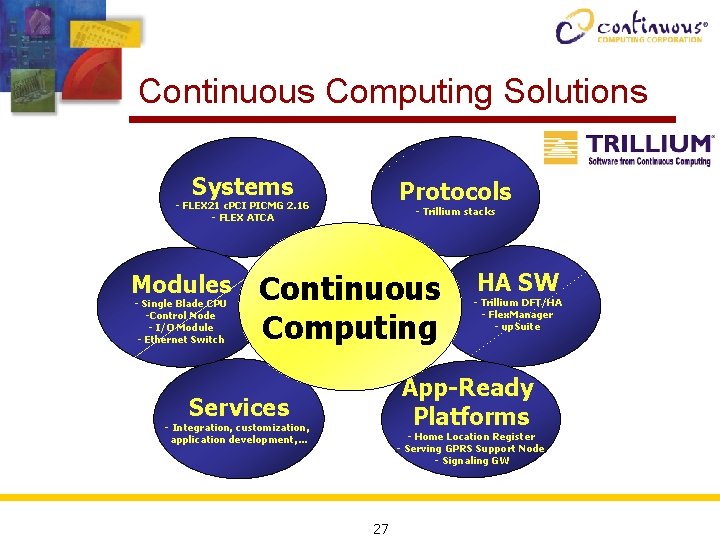
Continuous Computing Solutions Systems Protocols - FLEX 21 c. PCI PICMG 2. 16 - FLEX ATCA Modules - Single Blade CPU -Control Node - I/O Module - Ethernet Switch - Trillium stacks Continuous Computing HA SW - Trillium DFT/HA - Flex. Manager - up. Suite App-Ready Platforms Services - Integration, customization, application development, … - Home Location Register - Serving GPRS Support Node - Signaling GW 27
Contact Continuous Computing 9380 Carroll Park Drive San Diego, CA 92121 Tel: (858) 882 8800 marketing@ccpu. com www. ccpu. com Pioneering Application-Ready Platforms™ 28
- Slides: 28