
Sioux Falls Vet Center Presented by Doug Mc
Sioux Falls Vet Center Presented by: Doug Mc. Cuddin, MHA
Vet Center History Ø Established by Congress in 1979. Ø Originally for Vietnam combat vets. Ø Readjustment counseling services are now extended to all war zone vets and their families and sexual harassment/assault victims of any era. Ø Bereavement counseling available. Ø Goal is to provide a broad range of counseling, outreach and referral services, to help vets make a successful post-war readjustment to civilian life.
Mission Currently there are 300 Vet Centers in all 50 states, District of Columbia, Guam, Puerto Rico and the US Virgin Islands whose mission is to provide a broad range of counseling, outreach, and referral services to assist veterans and family members overcome the readjustment problems associated with war and personal trauma.
Vet Center Services Ø Individual Counseling Ø Telehealth Ø Group Counseling Ø Liaison with VA & Community Ø Military Sexual Trauma Counseling Ø Marital/Family Counseling Ø Bereavement Counseling Ø Drug and Alcohol Referral Ø Community Education and Career Referral Resources Ø Benefits Assistance Referral
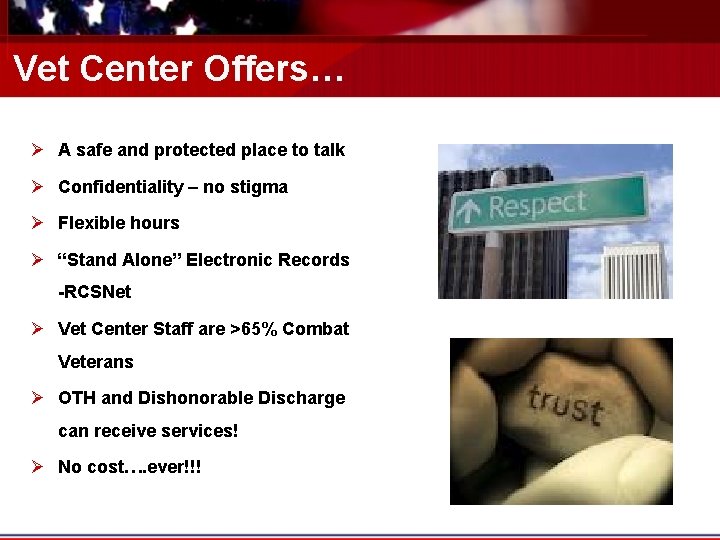
Vet Center Offers… Ø A safe and protected place to talk Ø Confidentiality – no stigma Ø Flexible hours Ø “Stand Alone” Electronic Records -RCSNet Ø Vet Center Staff are >65% Combat Veterans Ø OTH and Dishonorable Discharge can receive services! Ø No cost…. ever!!!

Vet Center Telehealth • VA Video Connect (VVC) memorandum outlines the need for VA Video Connect (VVC) at the Sioux Falls Vet Center. In addition, procedural guidelines for its implementation and continued use will be covered.
Background • VVC is a new VA solution that enables Veterans to virtually meet with their VA healthcare providers, in a virtual medical room, using encrypted video to ensure the session is secure and private. It allows Veterans to talk to their health care team from anywhere making VA healthcare more convenient and reducing travel times for Veterans, especially for those in very rural areas with limited access to VA health care facilities (note: The Sioux Falls Vet Center’s catchment area consists of 44 counties spread over 37, 000 square miles).
Purpose • Deliver needed readjustment counseling services to eligible Veterans and their families located in areas where mental health providers are unavailable, such as in remote or rural areas. Moreover, VVC allows Vet Center counselors to see Veterans more frequently unencumbered by distance, transportation issues, inclement weather, illness/injury, or monetary concerns (e. g. , gas money).
Procedures & Responsibilities Director • Ensure all counselors have successfully completed required Talent Management System (TMS) training (VA Video Connect: Video on Demand Provider Training), Telehealth Management Platform (TMP)-New Account Request Form and the creation of a desktop link for ondemand scheduling. • Ensure all counselors have required equipment to include: computer, internet/internet browser, and webcam +microphone. • Vet Center Director will be responsible for coordination with Sioux Falls VA Health Care System Facility Telehealth Coordinator. Vet Center Director will be the approval authority for all VVC requests from Vet Center clinical staff.
Procedures & Responsibilities Director (Continued) • Responsible for creating a template for security verification and visit documentation. • Responsible for establishing emergency procedures to include backup or contingency plans. • Responsible for ensuring Vet Center providers are licensed for independent practice. Vet Center Directors must also consider the scope of the individual’s clinical competence as determined by peer references, professional experience, education, and training.
Counselors • Responsible for ensuring that Veteran’s lethality rating is mild or below. Veteran’s with moderate are higher will not be seen through VVC (only face-to-face). Any change in lethality status must be reported to the Vet Center Director. • Counselors will be responsible for completing all required RCS documentation (e. g. , intake, military history, etc. ) prior to starting and VVC sessions. As per policy, this will be done face-to-face. • Responsible for entering a non-visit progress note after case presentation/consultation to the Vet Center Director. Note must include approval from Director prior to first use of VVC. • Counselors will only use VVC when there are prohibitive factors (distance, inclement weather, illness, injury, etc. ) that prevent the Veteran and/or family member from coming to the Vet Center’s physical location, and will only use during working hours. • Counselors must ensure suitable video/audio quality (e. g. , light, focus, limit background distractions, volume, webcam placement, etc. ).
Critical Musts • Counselors must: – Assess Clinical Considerations: » Determine want or need for Clinical Video Telehealth » Veteran has adequate sensory abilities to participate » Veteran does not need to be in a VA Facility or Vet Center when receiving care via telehealth » Veteran does not require peripherals » Veteran has their own home/mobile device and agrees to use it » Veteran’s home/mobile device has a webcam and microphone available » Veteran has internet access » Veteran orientation
Critical Musts • At the initial VVC visit the counselor must confirm and document that the Veteran consents to the appointment being conducted via. telehealth technology. At the start of each subsequent VVC visit the counselor must document that the appointment is being conducted via. telehealth. • Record the address of the Veteran’s current location during the appointment. • Obtain numbers the Veteran may be contacted at in the case of technology disruption or emergency (e. g. , home, primary phone, secondary phone, etc. ). A contingency plan must be in place of how the appointment will continue in the event of a technology failure.
Critical Musts • The counselor must ask if there are others in the home or local area that may be contacted in an urgent situation. If so, the names and numbers of those persons must be documented. Additionally, the local emergency phone number for the Veteran’s location must be obtained prior to commencing the appointment. • Identify if there any privacy concerns (ensure Veteran is in a private place for the visit. If not, have the Veteran move to a private location). • Verify equipment is functioning properly. • Comply with all RCS policies and procedures!!!
Thank You…Questions? Sioux Falls Vet Center 3200 W. 49 th Street (605) 330 -4552 Rapid City Vet Center 621 6 th Street, Suite 101 (605) 348 -0077 Sioux City Vet Center 4280 Sergeant Rd, Suite 104 (712) 255 -3808
- Slides: 15