
Sinusoids 7 1 Phasors 7 3 Complex Numbers
Sinusoids (7. 1); Phasors (7. 3); Complex Numbers (Appendix) Prof. Phillips April 16, 2003 lecture 19 1
Introduction • Any steady-state voltage or current in a linear circuit with a sinusoidal source is a sinusoid. – This is a consequence of the nature of particular solutions for sinusoidal forcing functions. – All steady-state voltages and currents have the same frequency as the source. lecture 19 2
Introduction (cont. ) • In order to find a steady-state voltage or current, all we need to know is its magnitude and its phase relative to the source (we already know its frequency). • Usually, an AC steady-state voltage or current is given by the particular solution to a differential equation. lecture 19 3
The Good News! • We do not have to find this differential equation from the circuit, nor do we have to solve it. • Instead, we use the concepts of phasors and complex impedances. • Phasors and complex impedances convert problems involving differential equations into simple circuit analysis problems. lecture 19 4
Phasors • A phasor is a complex number that represents the magnitude and phase of a sinusoidal voltage or current. • Remember, for AC steady-state analysis, this is all we need---we already know the frequency of any voltage or current. lecture 19 5
Complex Impedance • Complex impedance describes the relationship between the voltage across an element (expressed as a phasor) and the current through the element (expressed as a phasor). • Impedance is a complex number. • Impedance depends on frequency. lecture 19 6
Complex Impedance (cont. ) • Phasors and complex impedance allow us to use Ohm’s law with complex numbers to compute current from voltage, and voltage from current. lecture 19 7
Sinusoids • Period: T – Time necessary to go through one cycle • Frequency: f = 1/T – Cycles per second (Hz) • Angular frequency (rads/sec): w = 2 p f • Amplitude: VM lecture 19 8
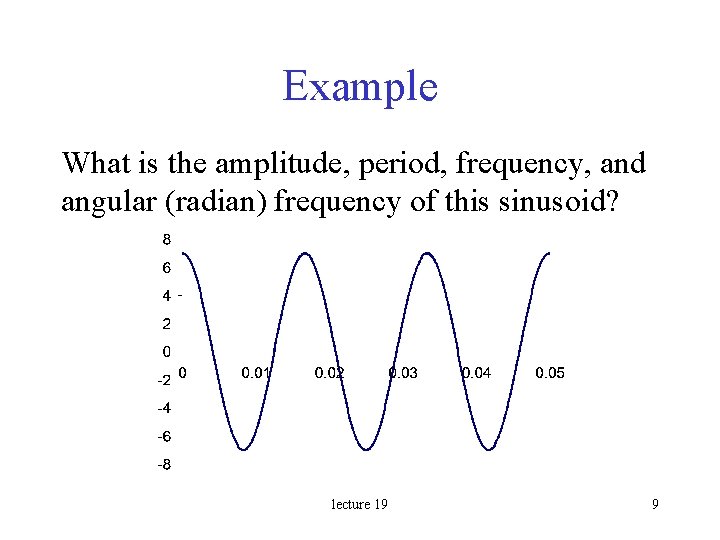
Example What is the amplitude, period, frequency, and angular (radian) frequency of this sinusoid? lecture 19 9
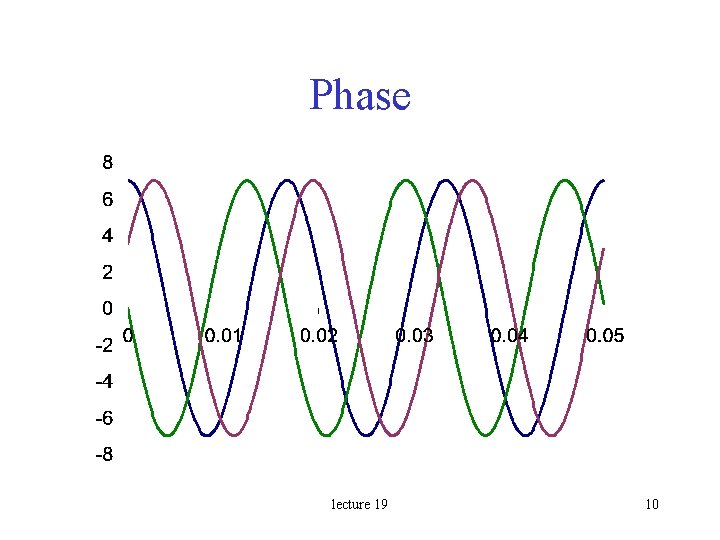
Phase lecture 19 10
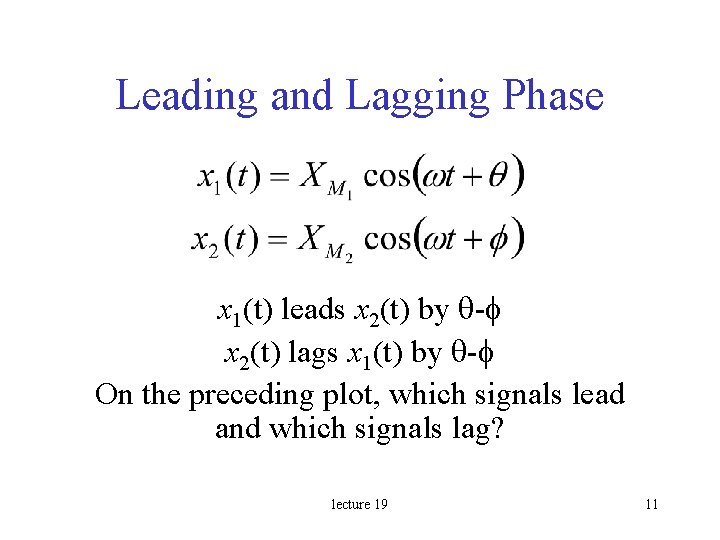
Leading and Lagging Phase x 1(t) leads x 2(t) by q- x 2(t) lags x 1(t) by q- On the preceding plot, which signals lead and which signals lag? lecture 19 11
Class Examples lecture 19 12
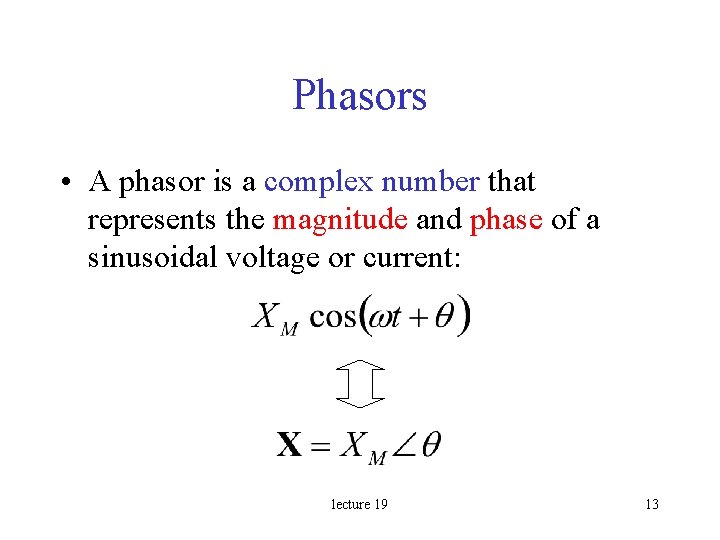
Phasors • A phasor is a complex number that represents the magnitude and phase of a sinusoidal voltage or current: lecture 19 13
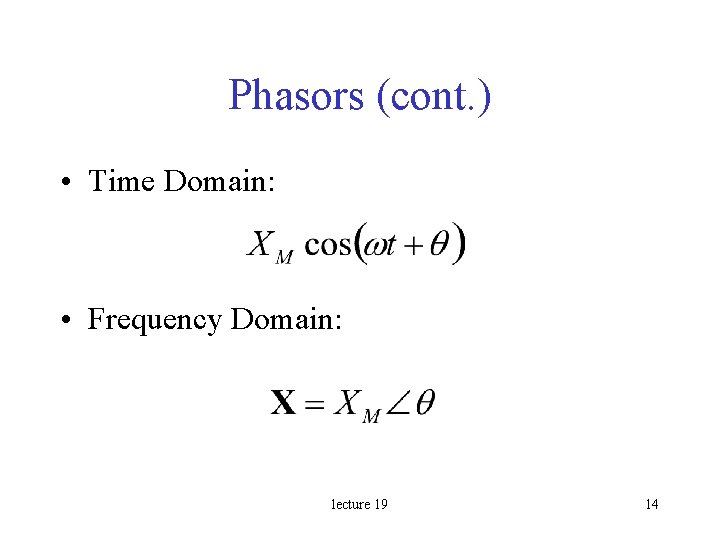
Phasors (cont. ) • Time Domain: • Frequency Domain: lecture 19 14
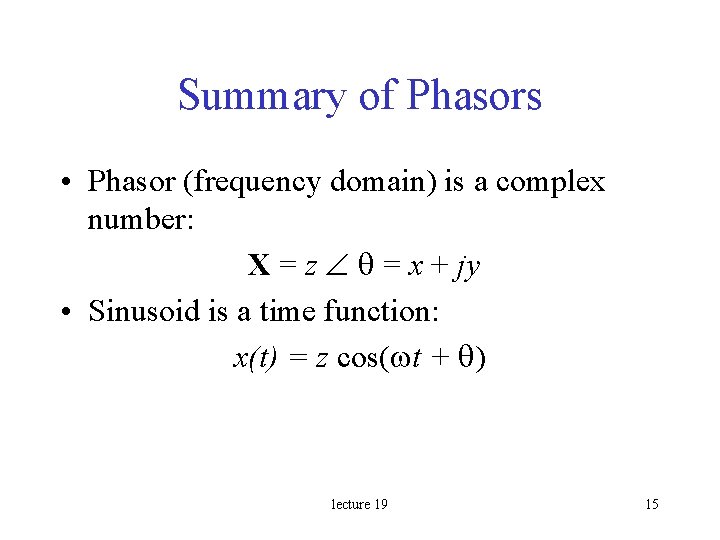
Summary of Phasors • Phasor (frequency domain) is a complex number: X = z q = x + jy • Sinusoid is a time function: x(t) = z cos(wt + q) lecture 19 15
Class Examples lecture 19 16
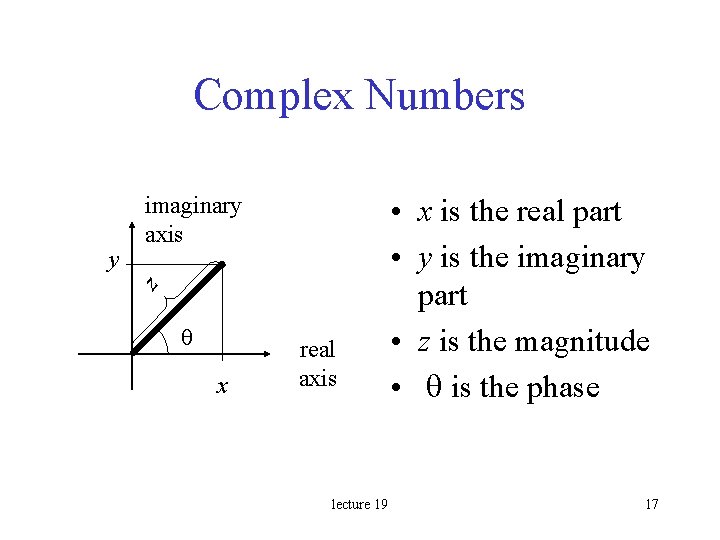
Complex Numbers z y imaginary axis q x real axis lecture 19 • x is the real part • y is the imaginary part • z is the magnitude • q is the phase 17
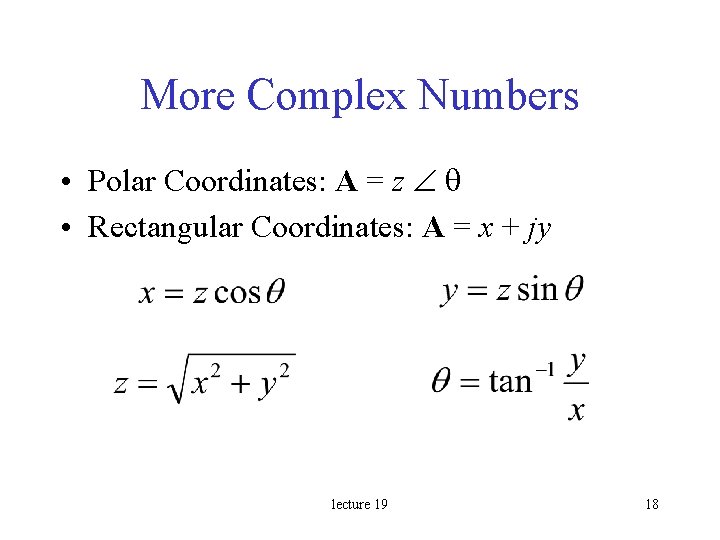
More Complex Numbers • Polar Coordinates: A = z q • Rectangular Coordinates: A = x + jy lecture 19 18
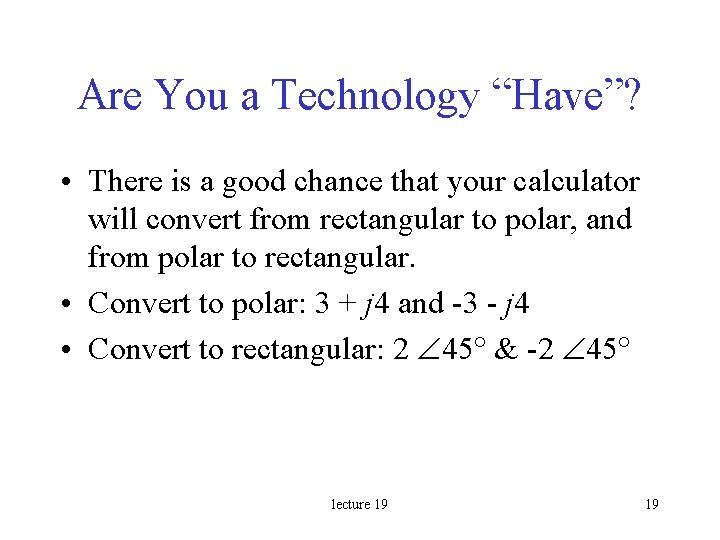
Are You a Technology “Have”? • There is a good chance that your calculator will convert from rectangular to polar, and from polar to rectangular. • Convert to polar: 3 + j 4 and -3 - j 4 • Convert to rectangular: 2 45 & -2 45 lecture 19 19
Arithmetic With Complex Numbers • To compute phasor voltages and currents, we need to be able to perform computation with complex numbers. – Addition – Subtraction – Multiplication – Division lecture 19 20
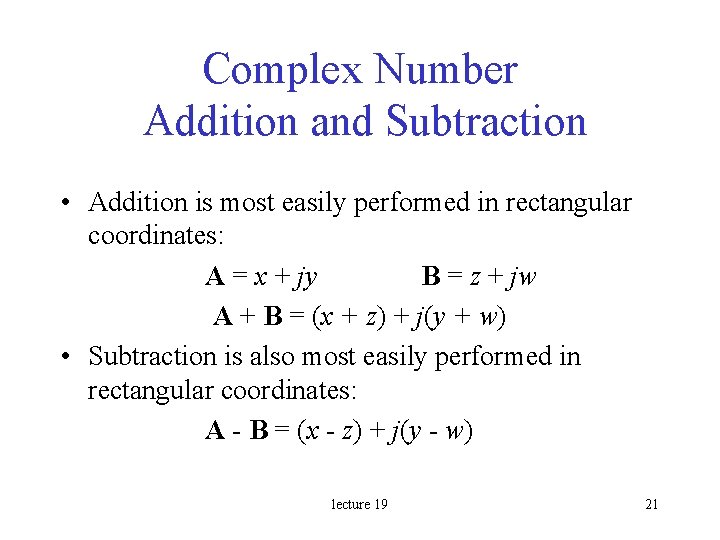
Complex Number Addition and Subtraction • Addition is most easily performed in rectangular coordinates: A = x + jy B = z + jw A + B = (x + z) + j(y + w) • Subtraction is also most easily performed in rectangular coordinates: A - B = (x - z) + j(y - w) lecture 19 21
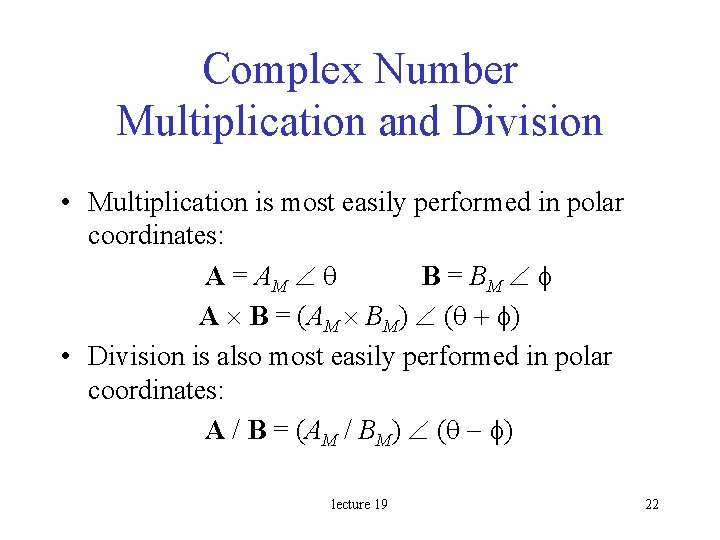
Complex Number Multiplication and Division • Multiplication is most easily performed in polar coordinates: A = AM q B = BM A B = (AM BM) (q + ) • Division is also most easily performed in polar coordinates: A / B = (AM / BM) (q - ) lecture 19 22
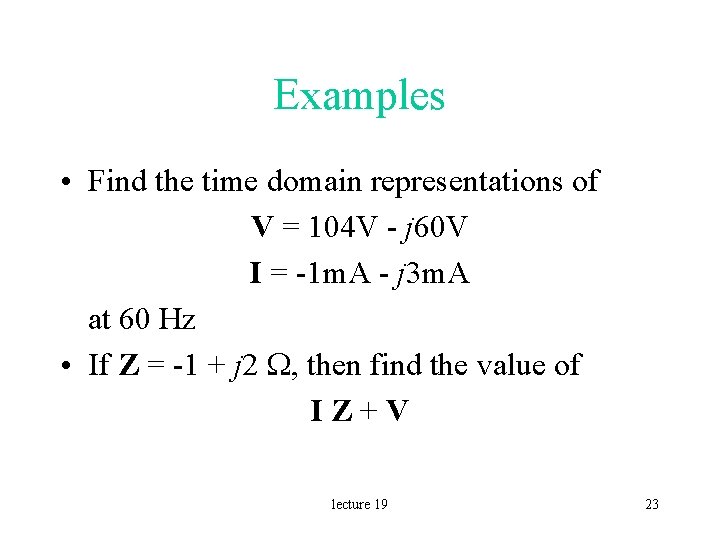
Examples • Find the time domain representations of V = 104 V - j 60 V I = -1 m. A - j 3 m. A at 60 Hz • If Z = -1 + j 2 , then find the value of IZ+V lecture 19 23
- Slides: 23