
Singular perturbation based nonlinear control strategies for complex
Singular perturbation based nonlinear control strategies for complex systems Sergio Esteban sesteban@us. es Department of Aerospace Engineering University of Seville, Spain
Outline n Introduction. n Mathematical Model. n Singular Perturbation Formulation. n Control Strategy: Singular Perturbation Formulation. n Stability Analysis: Singular Perturbation Formulation. n Conclusions. n Open Research Lines 2
Motivation n Complex nonlinear systems: n n High maneuverability with inherent instability. Mathematical modeling complexity: n High order dynamics n n n Example: Rotatory parts Increase complexity of models. Control problem difficult to approach due to nonlinearities. High order dynamics systems: n Present stiffness associated to small parasitic constants. n n small time constants, masses, resistances, inductances, capacitances, moments of inertia, Reynolds number… Source of increased order and stiffness n produces multiple time-scale behavior: simultaneous occurrence of SLOW and FAST phenomena. 3
Proposed Solution n Strategy: Sequential Singular Perturbation (SP) Methodology n n n Time Scale (TS) Analysis Control strategy Stability Analysis Mathematical upperbounds Approach: n Singular Perturbation (SP) Methods: n Yields degenerated (singularly perturbed) systems: SLOW and FAST n n Model order reduction. The analysis has NO SIMPLIFICATIONS. Each system can be stabilized separately. Simplifies the burden associated to control design and stability analysis. 4
Singular Perturbation Solution n Define Singular Perturbation methodology that permits: n Analyze time scale properties of singular perturbation problems. n Provide appropriate control laws for SP 3 -Time-Scale (3 TS) systems. n n Define methodology that permits to demonstrate the asymptotic stability properties of the resulting closed loop full system: n n n Select desired degree of stability of each of the time-scale subsystems. Select Lyapunov functions for each of the singularly perturbed systems. Construct associated composite Lyapunov function for the full system. Provide a general SP Analysis methodology for Nth-time-scale systems. n n n Time scale analysis. Control strategy Asymptotic Stability. 5
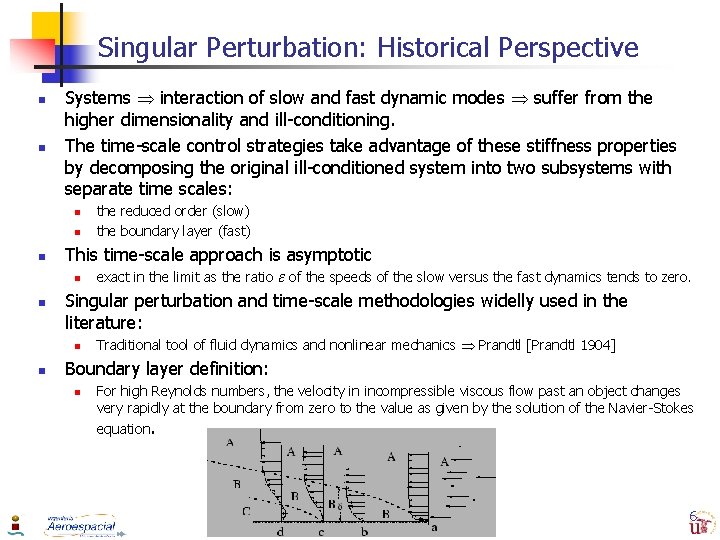
Singular Perturbation: Historical Perspective n n Systems interaction of slow and fast dynamic modes suffer from the higher dimensionality and ill-conditioning. The time-scale control strategies take advantage of these stiffness properties by decomposing the original ill-conditioned system into two subsystems with separate time scales: n n n This time-scale approach is asymptotic n n exact in the limit as the ratio ε of the speeds of the slow versus the fast dynamics tends to zero. Singular perturbation and time-scale methodologies widelly used in the literature: n n the reduced order (slow) the boundary layer (fast) Traditional tool of fluid dynamics and nonlinear mechanics Prandtl [Prandtl 1904] Boundary layer definition: n For high Reynolds numbers, the velocity in incompressible viscous flow past an object changes very rapidly at the boundary from zero to the value as given by the solution of the Navier-Stokes equation. 6
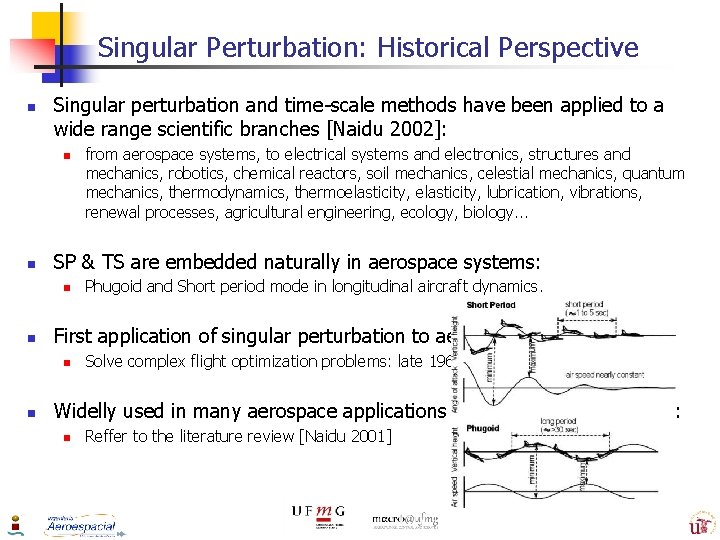
Singular Perturbation: Historical Perspective n Singular perturbation and time-scale methods have been applied to a wide range scientific branches [Naidu 2002]: n n SP & TS are embedded naturally in aerospace systems: n n Phugoid and Short period mode in longitudinal aircraft dynamics. First application of singular perturbation to aerospace systems: n n from aerospace systems, to electrical systems and electronics, structures and mechanics, robotics, chemical reactors, soil mechanics, celestial mechanics, quantum mechanics, thermodynamics, thermoelasticity, lubrication, vibrations, renewal processes, agricultural engineering, ecology, biology. . . Solve complex flight optimization problems: late 1960 s [Mehra 1979] Widelly used in many aerospace applications in which SP & TS present: n Reffer to the literature review [Naidu 2001]
Proposed Problems n Problem 1 n n Underactuated Test Bench Problem 2 n n Regulate the vertical displacement of a helicopter model on a platform desired final altitude. Underactuated control signals: n n n collective pitch angle blade angular velocity Problem 3 -4 n Control of UAV in the longitudinal plane (longitudinal dynamics): n n Control problem→ difficult to approach due to nonlinearities Under-actuated model: n n Elevator deflection - δe & Thrust deflection – δT Control of UAV in the vertical plane (lateral-directional dynamics): n n Control problem→ difficult to approach due to nonlinearities Under-actuated model: n Rudder deflection - δr & Aileron deflection – δa 8

Underactuated Test Bench Problem

Underactuated System - I n Underactuated nature of the test Bench selected model n n n Control signals are allocated only in two of the singularly perturbed subsystems The variable that it is desired to be regulated is the underactuated one: TD Control Strategy Use of the simplified example to visualize the TD control strategy 10
Helicopter Mathematical Model
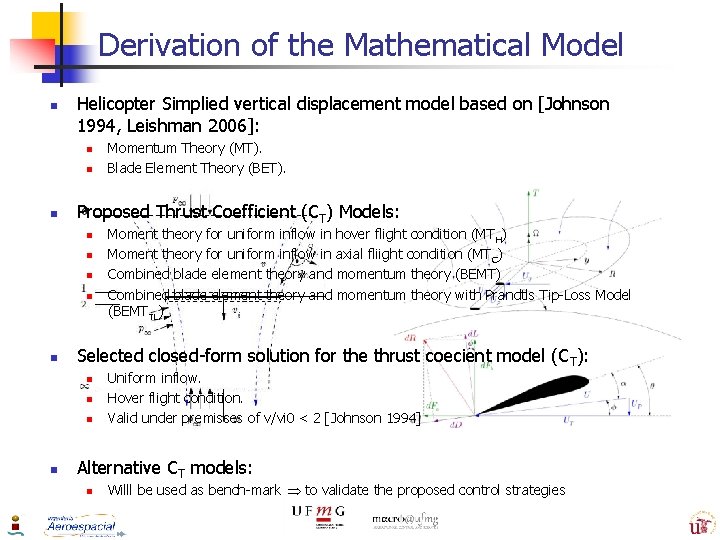
Derivation of the Mathematical Model n Helicopter Simplied vertical displacement model based on [Johnson 1994, Leishman 2006]: n n n Proposed Thrust Coefficient (CT) Models: n n n Moment theory for uniform inflow in hover flight condition (MT H) Moment theory for uniform inflow in axial fliight condition (MT C) Combined blade element theory and momentum theory (BEMT) Combined blade element theory and momentum theory with Prandtls Tip-Loss Model (BEMTTL) Selected closed-form solution for the thrust coecient model (C T): n n Momentum Theory (MT). Blade Element Theory (BET). Uniform inflow. Hover flight condition. Valid under premisses of v/vi 0 < 2 [Johnson 1994] Alternative CT models: n Willl be used as bench-mark to validate the proposed control strategies
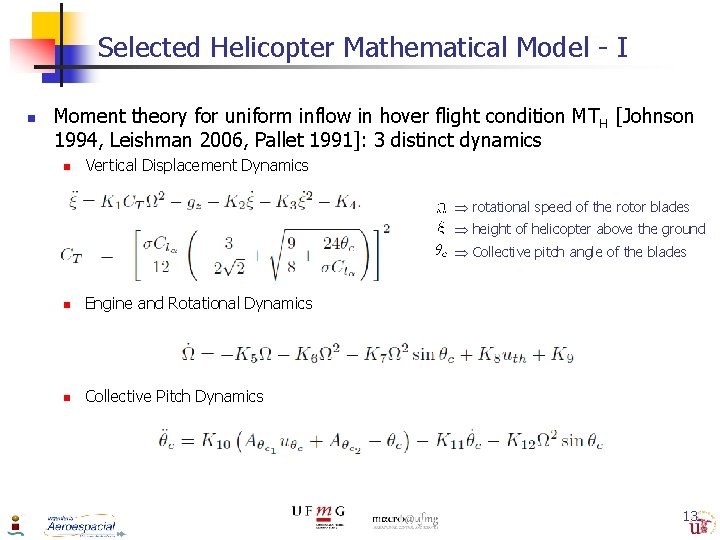
Selected Helicopter Mathematical Model - I n Moment theory for uniform inflow in hover flight condition MT H [Johnson 1994, Leishman 2006, Pallet 1991]: 3 distinct dynamics n Vertical Displacement Dynamics rotational speed of the rotor blades height of helicopter above the ground Collective pitch angle of the blades n Engine and Rotational Dynamics n Collective Pitch Dynamics 13
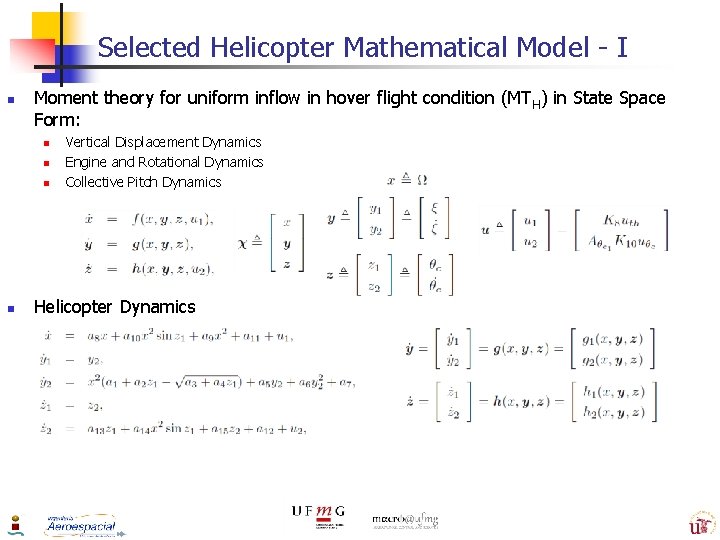
Selected Helicopter Mathematical Model - I n Moment theory for uniform inflow in hover flight condition (MT H) in State Space Form: n n Vertical Displacement Dynamics Engine and Rotational Dynamics Collective Pitch Dynamics Helicopter Dynamics
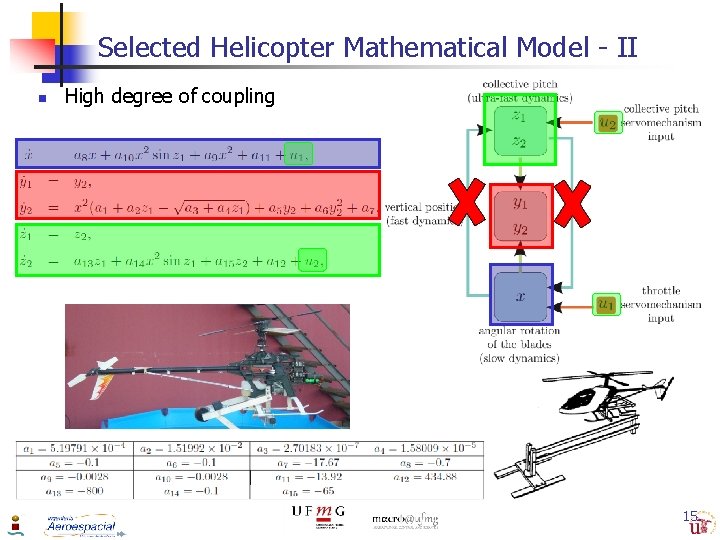
Selected Helicopter Mathematical Model - II n High degree of coupling 15
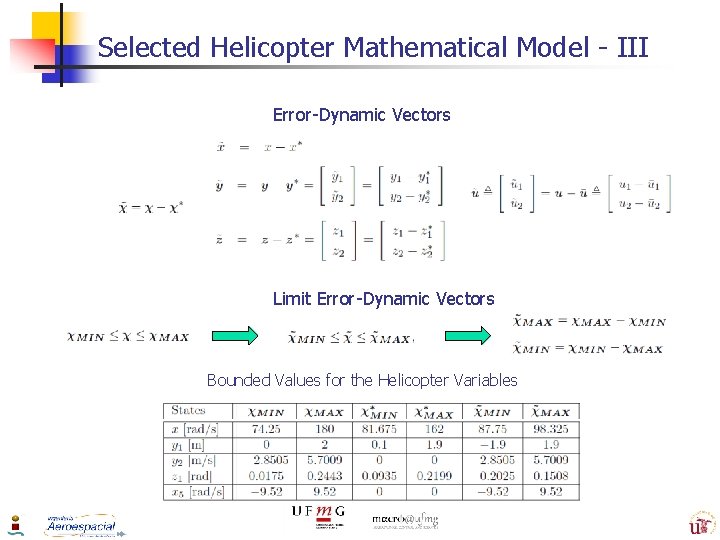
Selected Helicopter Mathematical Model - III Error-Dynamic Vectors Limit Error-Dynamic Vectors Bounded Values for the Helicopter Variables
Singular Perturbation Control of the Longitudinal and Lateral-Directional Flight Dynamics of an UAV
18
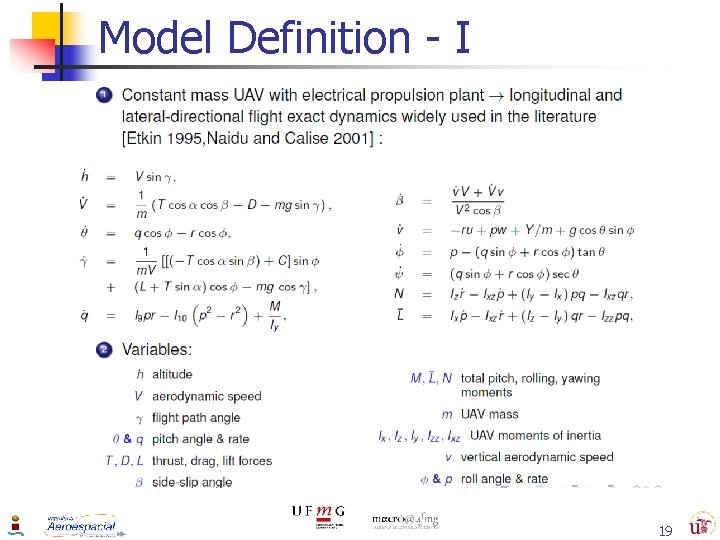
Model Definition - I 19

Model Definition - II 20
Singular Perturbation Formulation

Outline: Singular Perturbation n n n Introduction to SP Introduction to 2 TS SP Top-Down and Bottom Up Methodologies Intuitive Description of 3 TS Decomposition TD & BU Extension for Nth-Time-Scale System Time-Scale Selection: n n n Simplified Example Helicopter Problem Longitudinal and Lateral-Directional Flight Dynamics 22
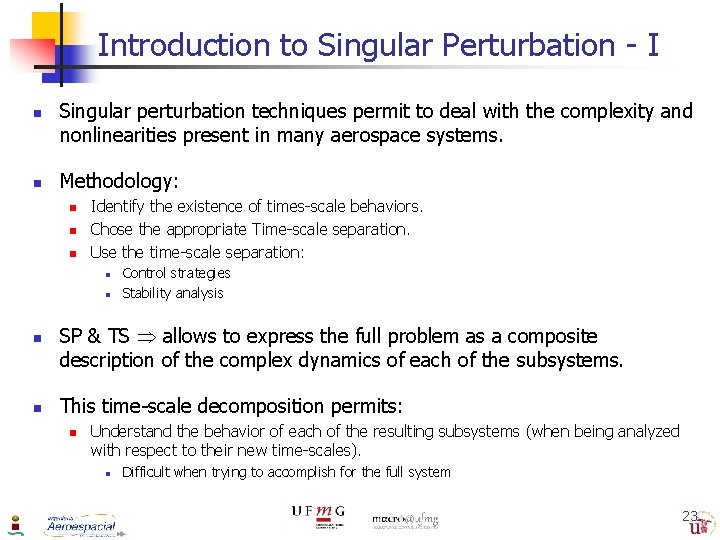
Introduction to Singular Perturbation - I n n Singular perturbation techniques permit to deal with the complexity and nonlinearities present in many aerospace systems. Methodology: n n n Identify the existence of times-scale behaviors. Chose the appropriate Time-scale separation. Use the time-scale separation: n n Control strategies Stability analysis SP & TS allows to express the full problem as a composite description of the complex dynamics of each of the subsystems. This time-scale decomposition permits: n Understand the behavior of each of the resulting subsystems (when being analyzed with respect to their new time-scales). n Difficult when trying to accomplish for the full system 23

Introduction to Singular Perturbation - II n Proposed SP & TS Step-by-Step n n The time-scale analysis here presented is based in a extension from the general two-timescale singular perturbation formulation [Kokotovic 86] n n Design proper control laws with a desired degree of stability. Select appropriate composite Lyapunov function for the complete singularly perturbed system. Demonstrate asymptotic stability for the resulting closed-loop nonlinear SP system. Two-Time-Scale Singularly Perturbed Systems (2 TS SP) Contribution: Top-Down (TD) and Bottom-Up (BU) methodologies: n Analysis of Three-Time-Scale Singularly Perturbed Systems (3 TS SP) n n n Control strategy Stability analysis Provide a more general Nth-time-scale singular perturbation formulation 24
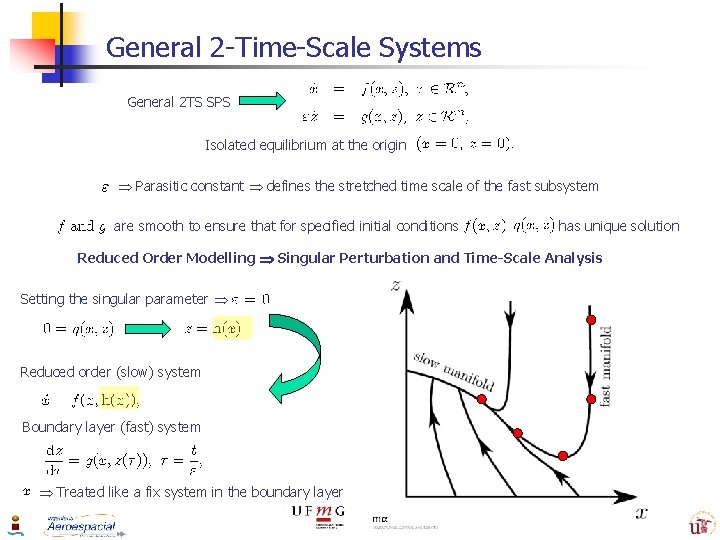
General 2 -Time-Scale Systems General 2 TS SPS Isolated equilibrium at the origin Parasitic constant defines the stretched time scale of the fast subsystem are smooth to ensure that for specified initial conditions has unique solution Reduced Order Modelling Singular Perturbation and Time-Scale Analysis Setting the singular parameter Reduced order (slow) system Boundary layer (fast) system Treated like a fix system in the boundary layer
Top-Down and Bottom-Up Time-Scale Analysis - I n n Two different, and equivalent approaches that help to analyze the time-scale singularly perturbed systems. The strategy consists on treating 3 TS 2 distinct 2 TS SP problems n n Each one of the two resulting 2 TS SP sub-problems is considerably simplified: n n n Obtain appropriate control laws that stabilize each of the resulting subsystems. Eases the complexity associated to guarantee the interconnection properties among the different time-scale subsystems. Each of 2 TS SP sub-problems consists of a slow and a fast subsystem, n n n using the standard two-time-scale analysis. Selection of the appropriate control laws ensures that the associated subsystems are each asymptotically stable. Necessary to demonstrate the validity of the Boundary Layer that defines slow and fast systems. Diversity: TD, or the BU methodologies, n Permits the designer to select either methodology. 26
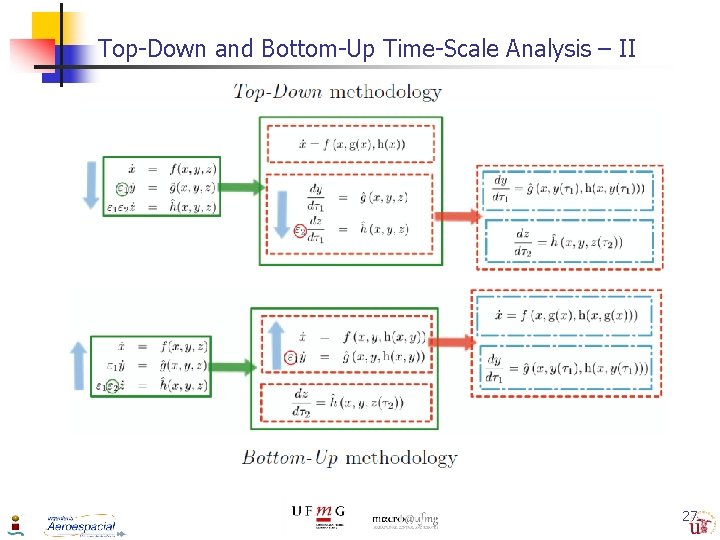
Top-Down and Bottom-Up Time-Scale Analysis – II 27
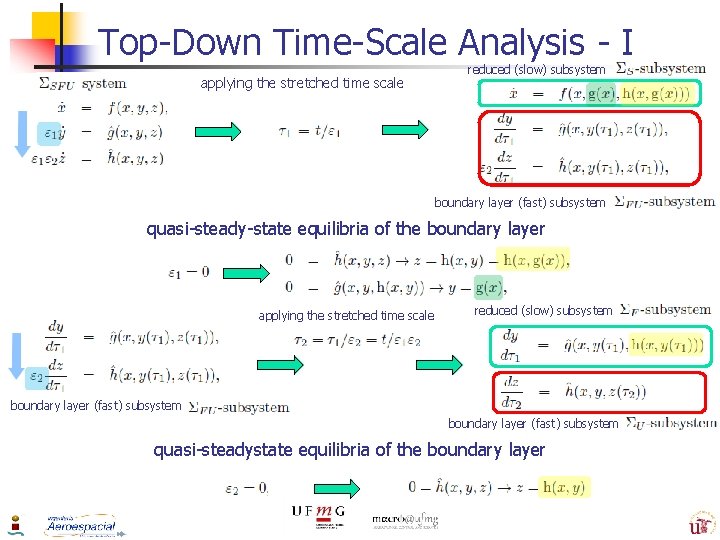
Top-Down Time-Scale Analysis - I applying the stretched time scale reduced (slow) subsystem boundary layer (fast) subsystem quasi-steady-state equilibria of the boundary layer applying the stretched time scale reduced (slow) subsystem boundary layer (fast) subsystem quasi-steadystate equilibria of the boundary layer
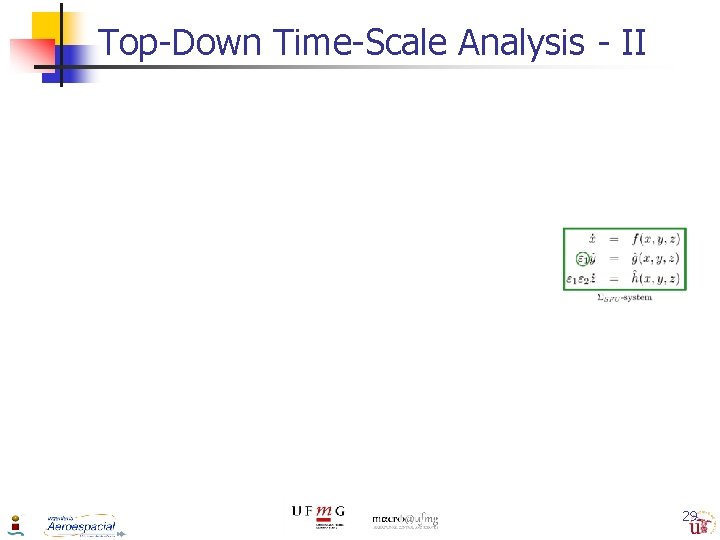
Top-Down Time-Scale Analysis - II 29
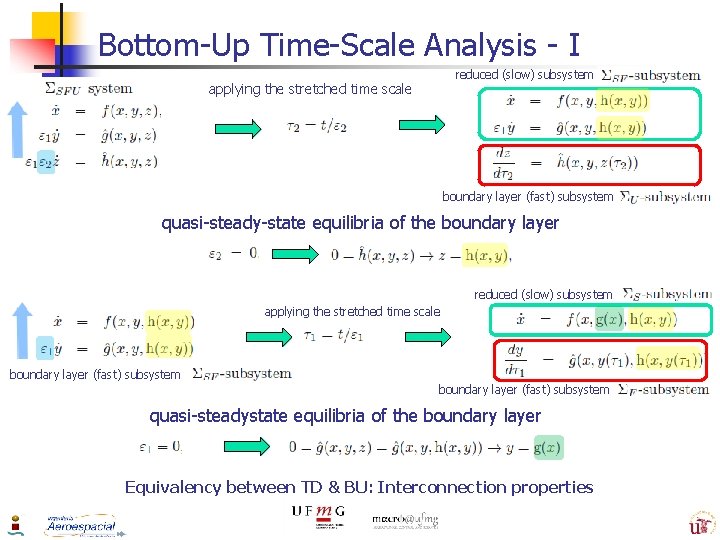
Bottom-Up Time-Scale Analysis - I reduced (slow) subsystem applying the stretched time scale boundary layer (fast) subsystem quasi-steady-state equilibria of the boundary layer reduced (slow) subsystem applying the stretched time scale boundary layer (fast) subsystem quasi-steadystate equilibria of the boundary layer Equivalency between TD & BU: Interconnection properties
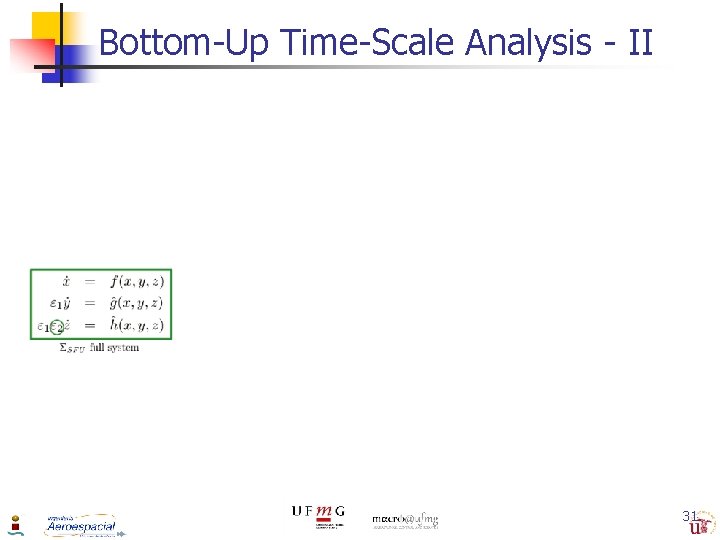
Bottom-Up Time-Scale Analysis - II 31
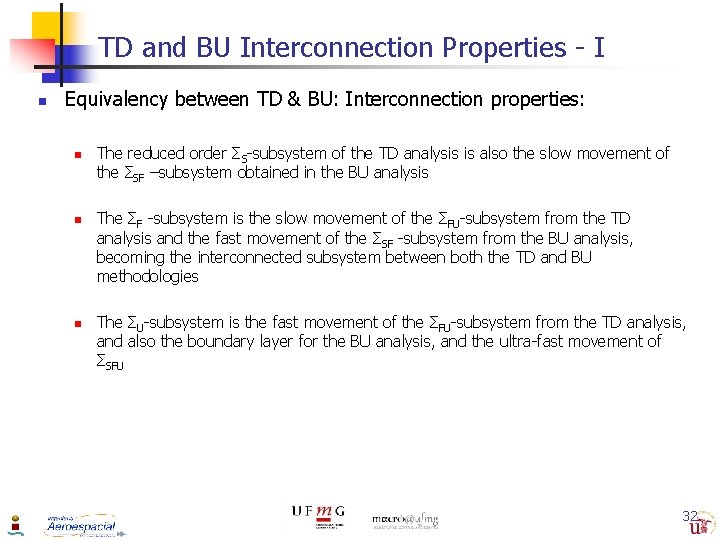
TD and BU Interconnection Properties - I n Equivalency between TD & BU: Interconnection properties: n n n The reduced order ΣS-subsystem of the TD analysis is also the slow movement of the ΣSF –subsystem obtained in the BU analysis The ΣF -subsystem is the slow movement of the ΣFU-subsystem from the TD analysis and the fast movement of the ΣSF -subsystem from the BU analysis, becoming the interconnected subsystem between both the TD and BU methodologies The ΣU-subsystem is the fast movement of the ΣFU-subsystem from the TD analysis, and also the boundary layer for the BU analysis, and the ultra-fast movement of ΣSFU 32

TD and BU Interconnection Properties - II 33

Intuitive Description of the Three-Time-Scale Decomposition - I n n Natural evolution of a generic 3 TS model: BU sequential TS analysis. Evolution of the ultra-fast variable z as it moves through the configuration space of the boundary layer ΣU-subsystem: ΣU-subsystem CONFIGURATION SPACE z surface quasi-steady-state equilibrium of the ΣU-subsystem x and y behave as fixed parameters 34
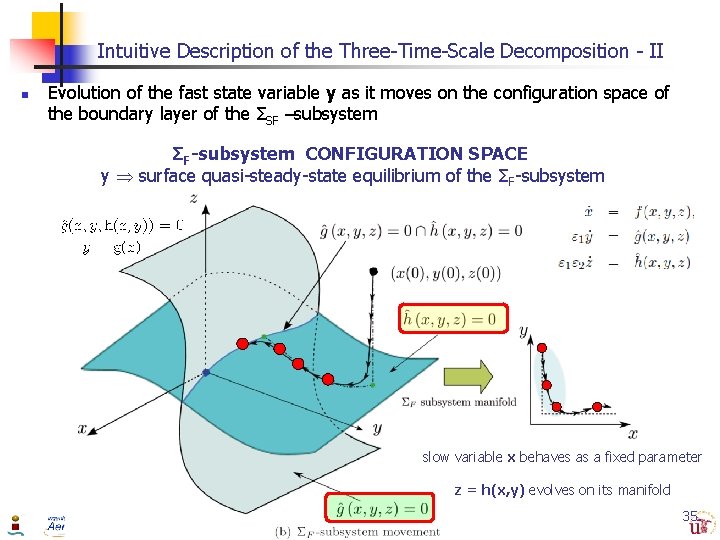
Intuitive Description of the Three-Time-Scale Decomposition - II n Evolution of the fast state variable y as it moves on the configuration space of the boundary layer of the ΣSF –subsystem ΣF-subsystem CONFIGURATION SPACE y surface quasi-steady-state equilibrium of the ΣF-subsystem slow variable x behaves as a fixed parameter z = h(x, y) evolves on its manifold 35
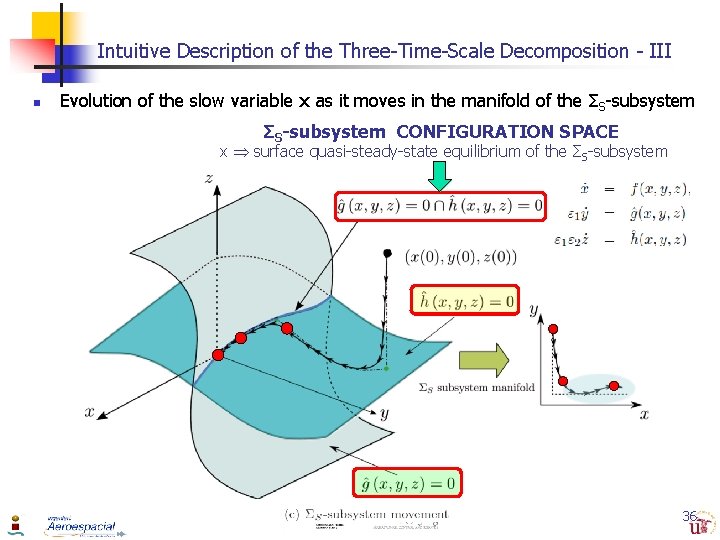
Intuitive Description of the Three-Time-Scale Decomposition - III n Evolution of the slow variable x as it moves in the manifold of the ΣS-subsystem CONFIGURATION SPACE x surface quasi-steady-state equilibrium of the ΣS-subsystem 36
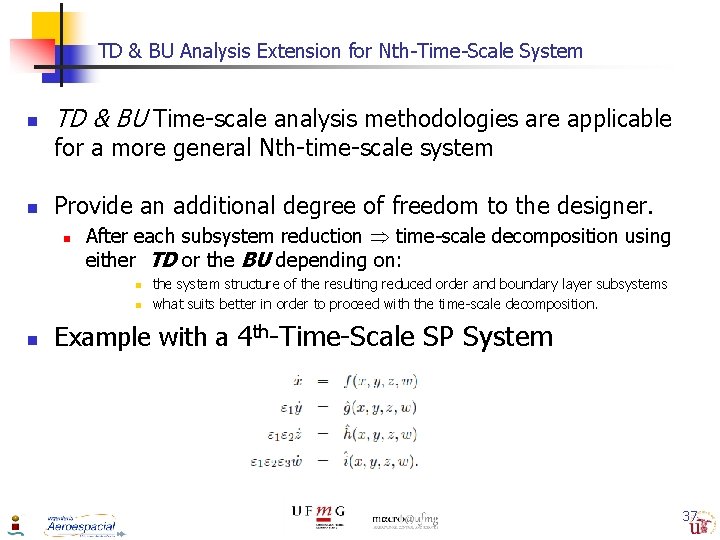
TD & BU Analysis Extension for Nth-Time-Scale System n TD & BU Time-scale analysis methodologies are applicable for a more general Nth-time-scale system n Provide an additional degree of freedom to the designer. n After each subsystem reduction time-scale decomposition using either TD or the BU depending on: n n n the system structure of the resulting reduced order and boundary layer subsystems what suits better in order to proceed with the time-scale decomposition. Example with a 4 th-Time-Scale SP System 37
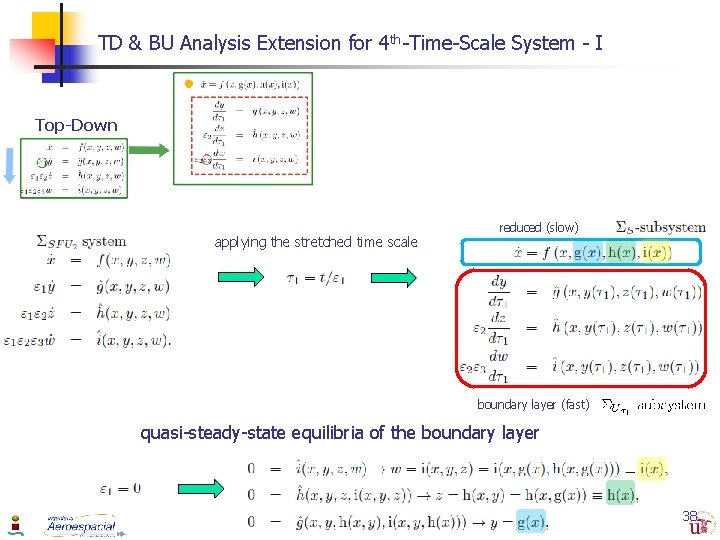
TD & BU Analysis Extension for 4 th-Time-Scale System - I Top-Down applying the stretched time scale reduced (slow) boundary layer (fast) quasi-steady-state equilibria of the boundary layer 38
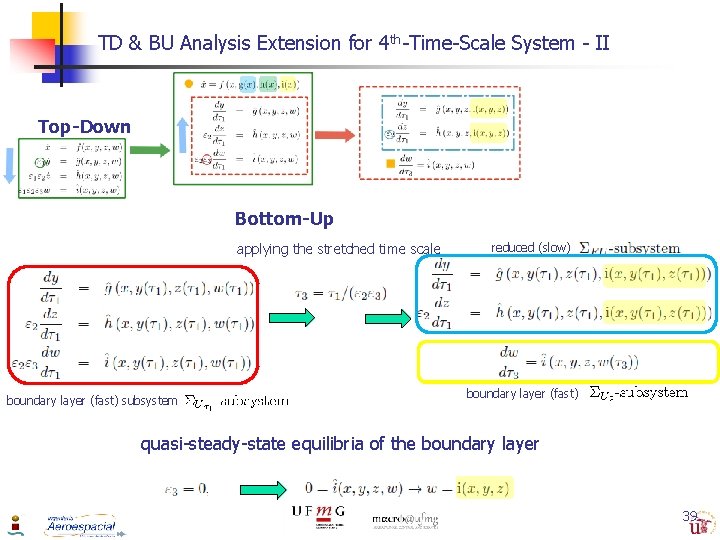
TD & BU Analysis Extension for 4 th-Time-Scale System - II Top-Down Bottom-Up applying the stretched time scale boundary layer (fast) subsystem reduced (slow) boundary layer (fast) quasi-steady-state equilibria of the boundary layer 39
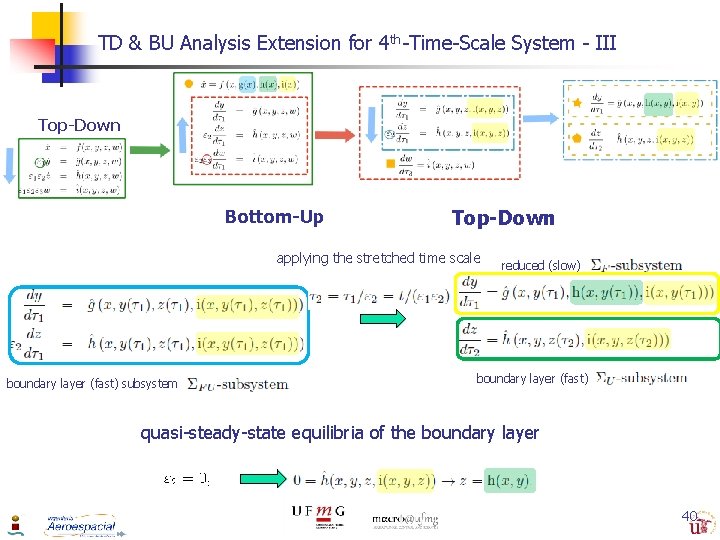
TD & BU Analysis Extension for 4 th-Time-Scale System - III Top-Down Bottom-Up Top-Down applying the stretched time scale boundary layer (fast) subsystem reduced (slow) boundary layer (fast) quasi-steady-state equilibria of the boundary layer 40
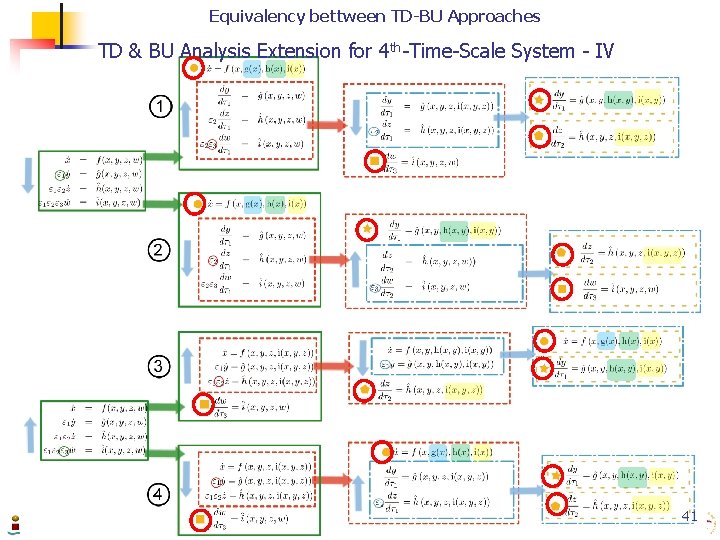
Equivalency bettween TD-BU Approaches TD & BU Analysis Extension for 4 th-Time-Scale System - IV 41
Time Scale Selection

Time Scale Selection: Simplified Example n To ease the understanding of the proposed methods introduce simplified nonlinear example: 43
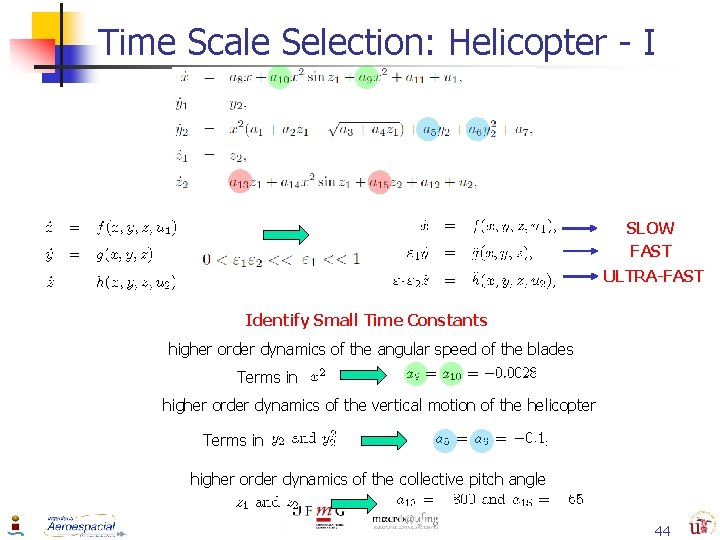
Time Scale Selection: Helicopter - I SLOW FAST ULTRA-FAST Identify Small Time Constants higher order dynamics of the angular speed of the blades Terms in higher order dynamics of the vertical motion of the helicopter Terms in higher order dynamics of the collective pitch angle 44
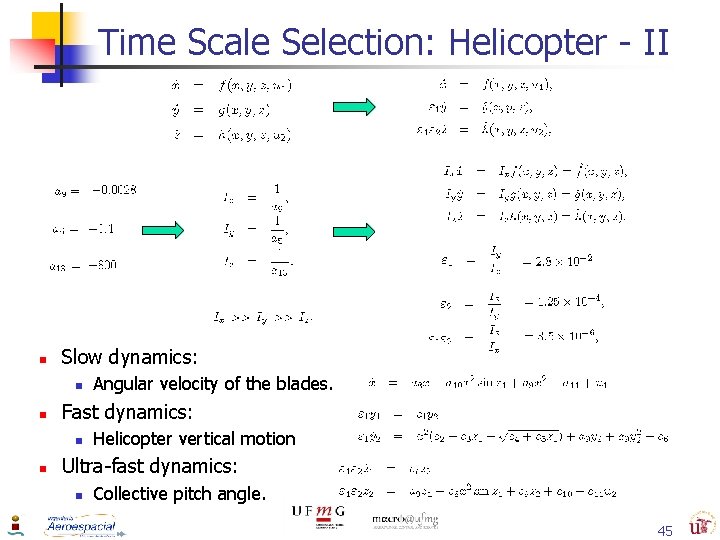
Time Scale Selection: Helicopter - II n Slow dynamics: n n Fast dynamics: n n Angular velocity of the blades. Helicopter vertical motion Ultra-fast dynamics: n Collective pitch angle. 45
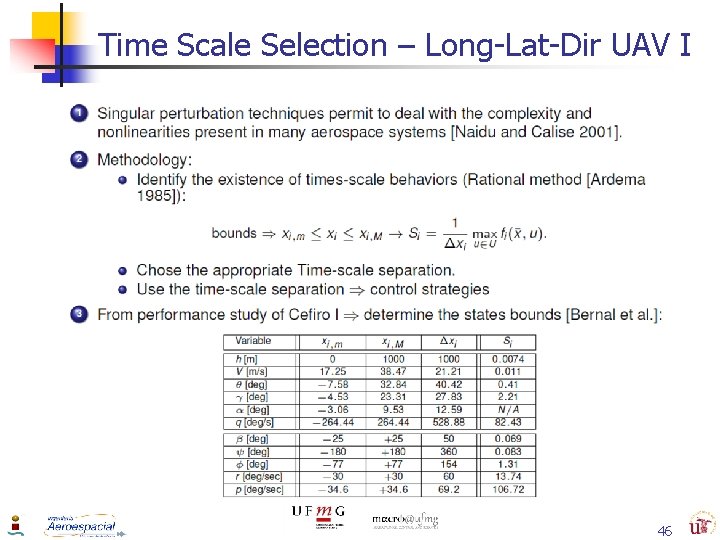
Time Scale Selection – Long-Lat-Dir UAV I 46

Time Scale Selection – Long-Lat-Dir UAV II 47
Time Scale Sequential Decomposition
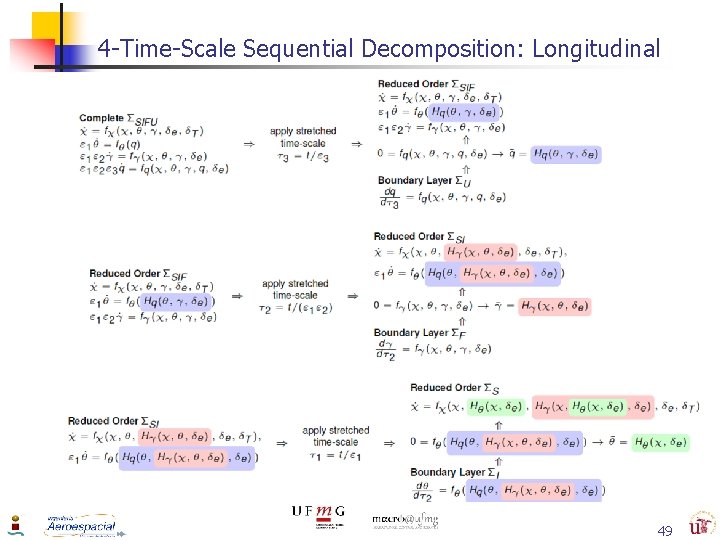
4 -Time-Scale Sequential Decomposition: Longitudinal 49
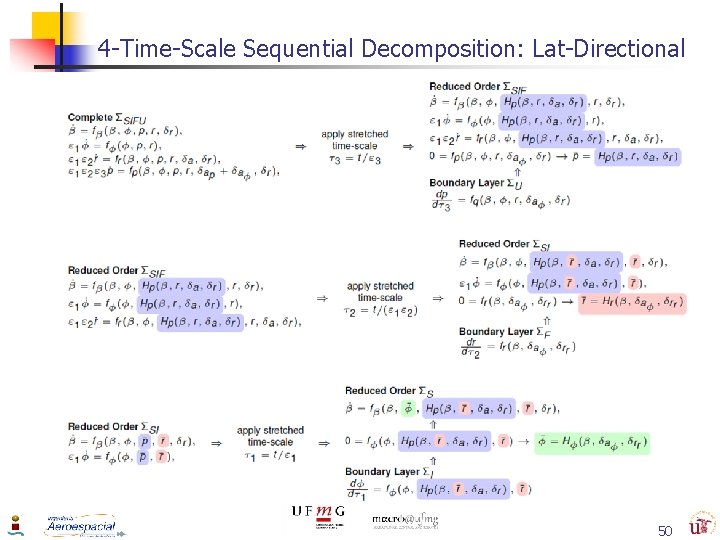
4 -Time-Scale Sequential Decomposition: Lat-Directional 50
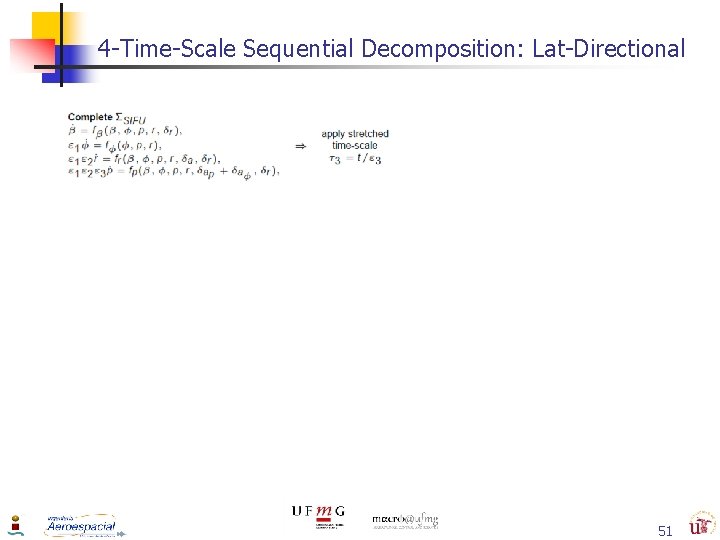
4 -Time-Scale Sequential Decomposition: Lat-Directional 51
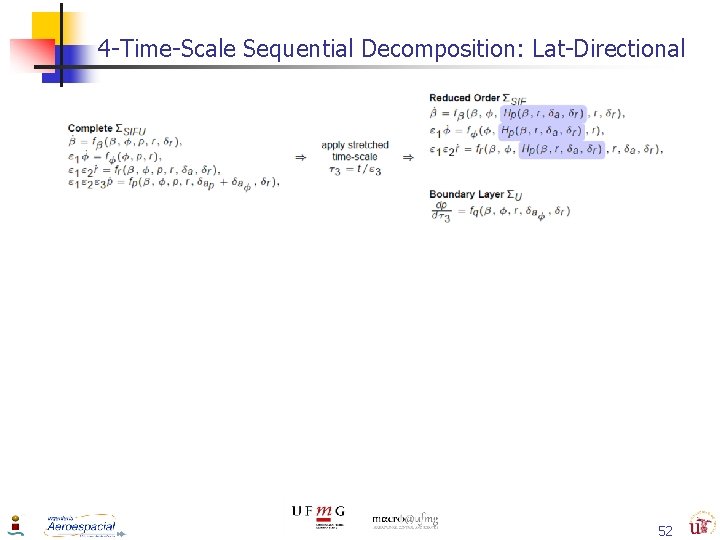
4 -Time-Scale Sequential Decomposition: Lat-Directional 52
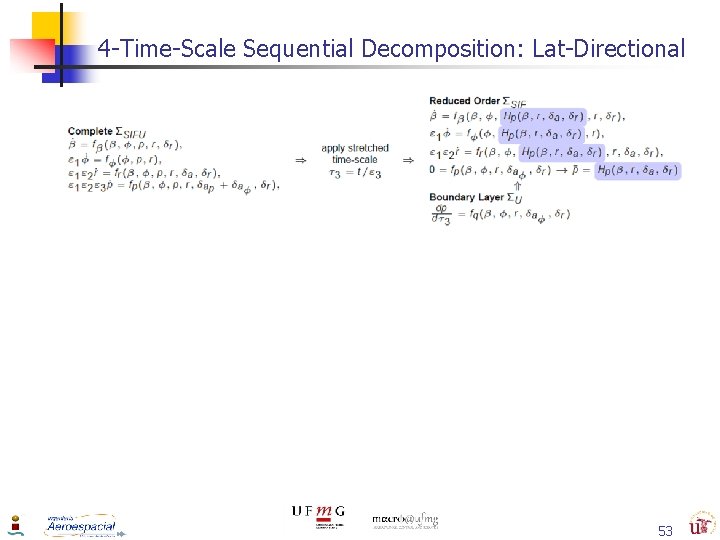
4 -Time-Scale Sequential Decomposition: Lat-Directional 53
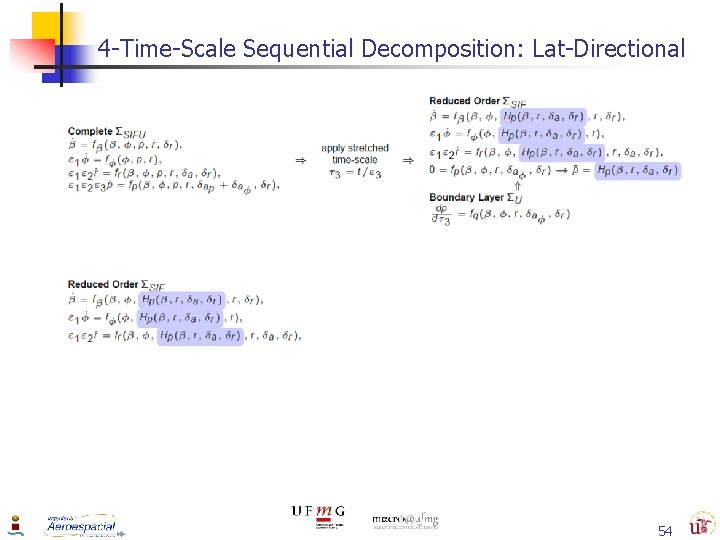
4 -Time-Scale Sequential Decomposition: Lat-Directional 54
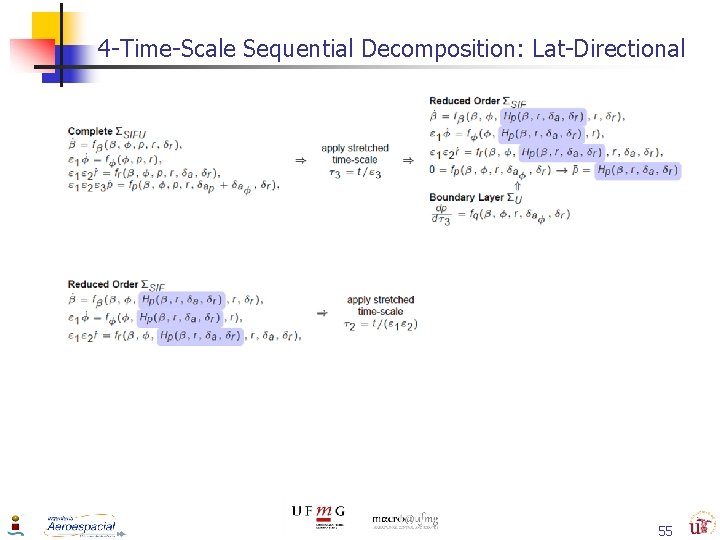
4 -Time-Scale Sequential Decomposition: Lat-Directional 55
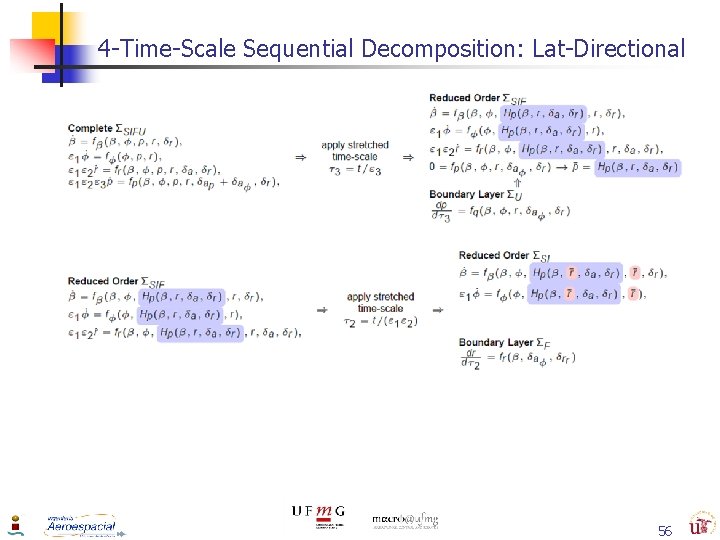
4 -Time-Scale Sequential Decomposition: Lat-Directional 56
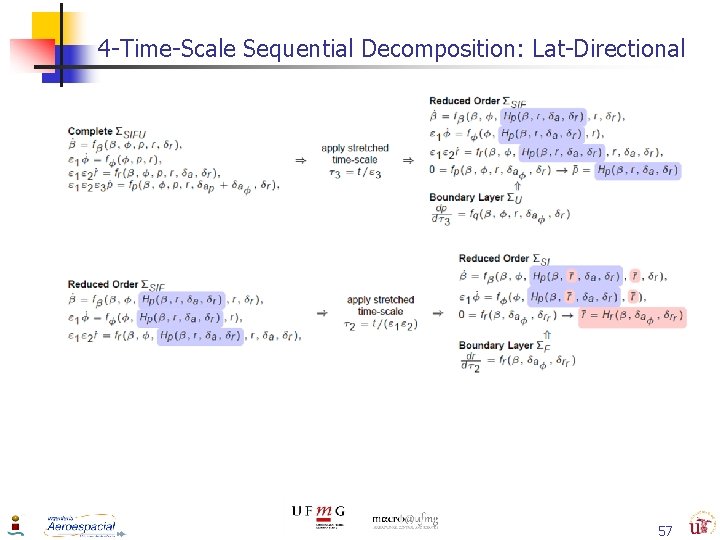
4 -Time-Scale Sequential Decomposition: Lat-Directional 57
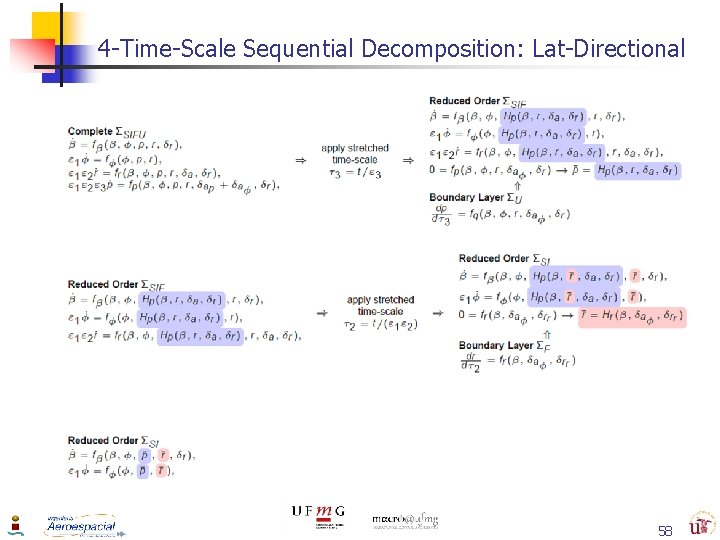
4 -Time-Scale Sequential Decomposition: Lat-Directional 58
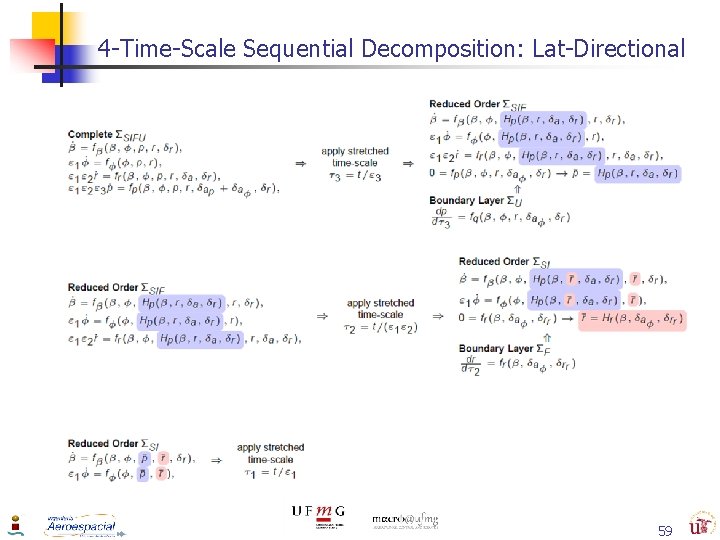
4 -Time-Scale Sequential Decomposition: Lat-Directional 59
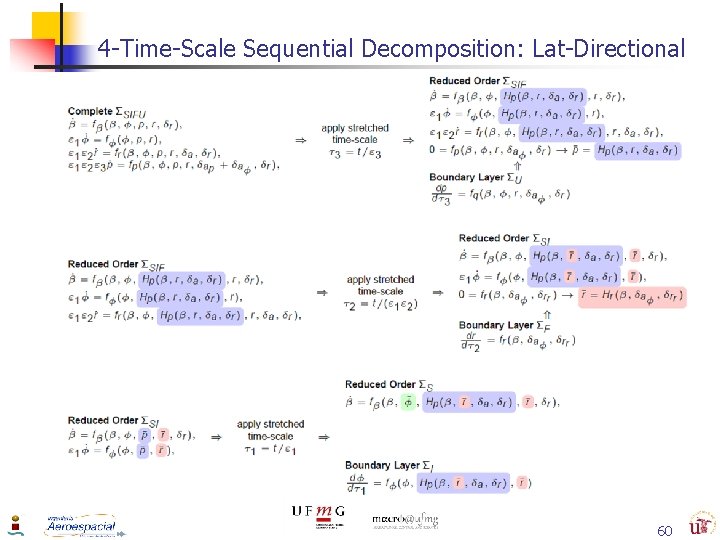
4 -Time-Scale Sequential Decomposition: Lat-Directional 60
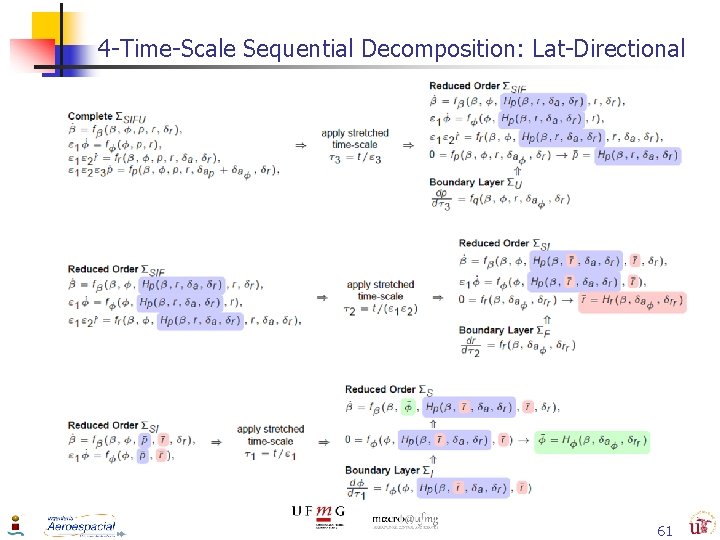
4 -Time-Scale Sequential Decomposition: Lat-Directional 61
Singular Perturbation Control Strategy Break? ?
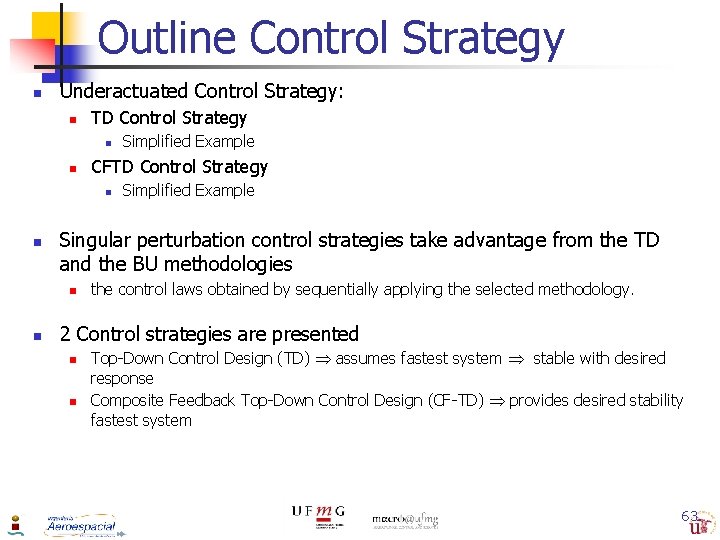
Outline Control Strategy n Underactuated Control Strategy: n TD Control Strategy n n CFTD Control Strategy n n Simplified Example Singular perturbation control strategies take advantage from the TD and the BU methodologies n n Simplified Example the control laws obtained by sequentially applying the selected methodology. 2 Control strategies are presented n n Top-Down Control Design (TD) assumes fastest system stable with desired response Composite Feedback Top-Down Control Design (CF-TD) provides desired stability fastest system 63
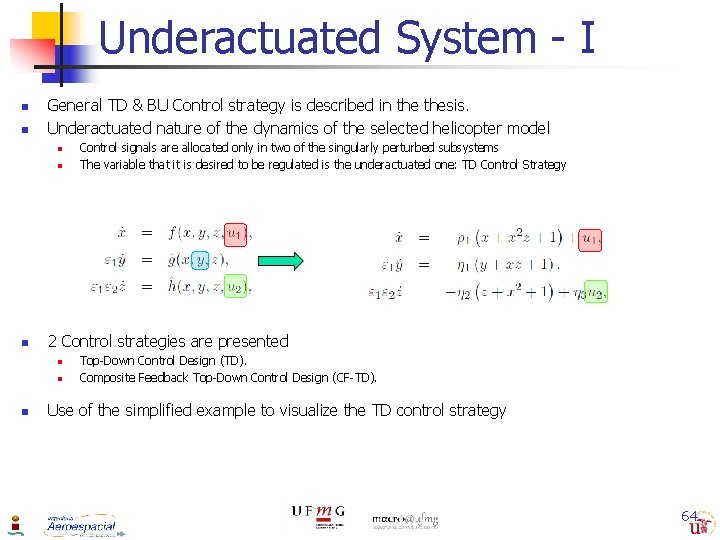
Underactuated System - I n n General TD & BU Control strategy is described in thesis. Underactuated nature of the dynamics of the selected helicopter model n n n 2 Control strategies are presented n n n Control signals are allocated only in two of the singularly perturbed subsystems The variable that it is desired to be regulated is the underactuated one: TD Control Strategy Top-Down Control Design (TD). Composite Feedback Top-Down Control Design (CF-TD). Use of the simplified example to visualize the TD control strategy 64
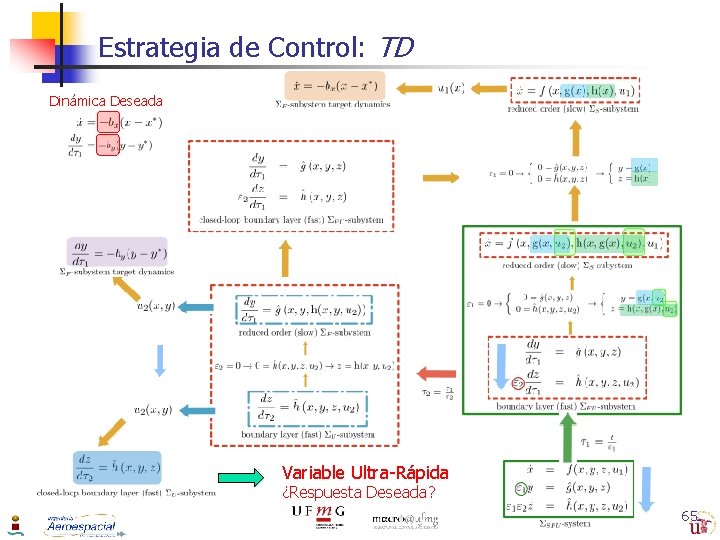
Estrategia de Control: TD Dinámica Deseada Variable Ultra-Rápida ¿Respuesta Deseada? 65
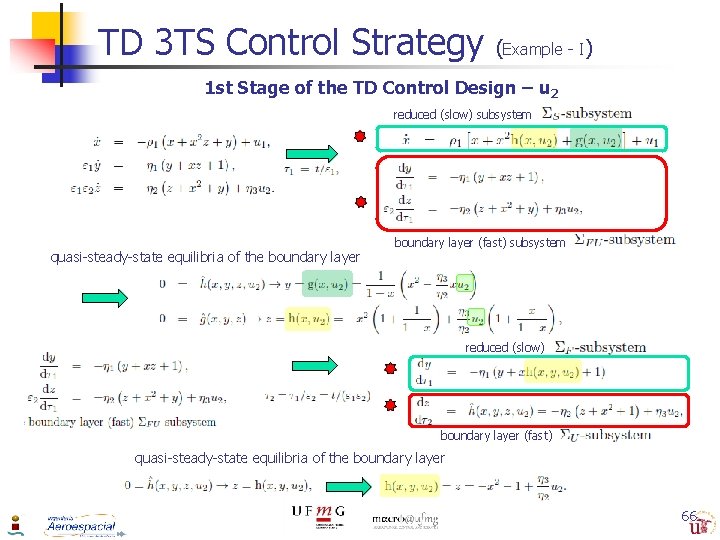
TD 3 TS Control Strategy (Example - I) 1 st Stage of the TD Control Design – u 2 reduced (slow) subsystem quasi-steady-state equilibria of the boundary layer (fast) subsystem reduced (slow) boundary layer (fast) quasi-steady-state equilibria of the boundary layer 66
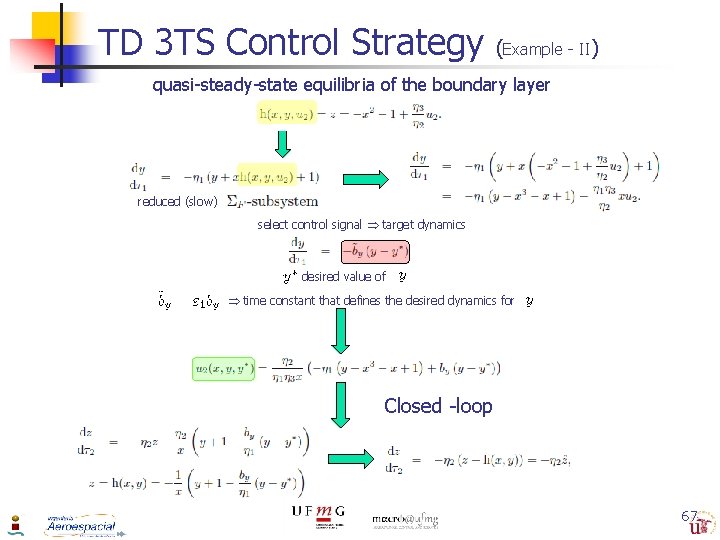
TD 3 TS Control Strategy (Example - II) quasi-steady-state equilibria of the boundary layer reduced (slow) select control signal target dynamics desired value of time constant that defines the desired dynamics for Closed -loop 67
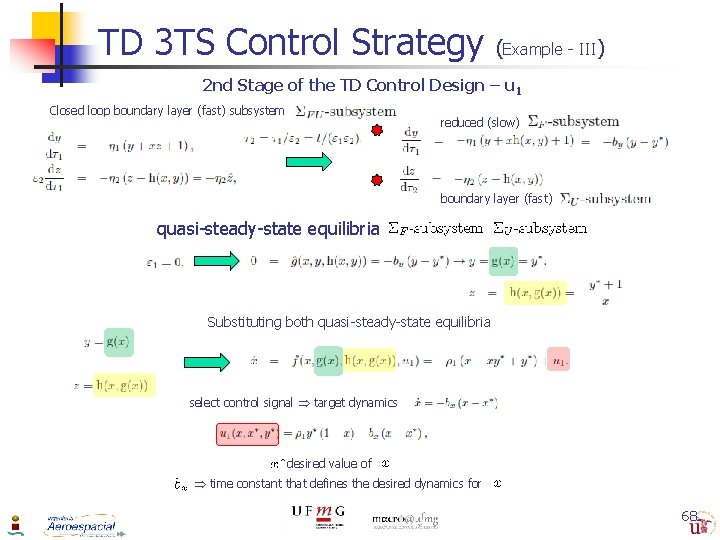
TD 3 TS Control Strategy (Example - III) 2 nd Stage of the TD Control Design – u 1 Closed loop boundary layer (fast) subsystem reduced (slow) boundary layer (fast) quasi-steady-state equilibria Substituting both quasi-steady-state equilibria select control signal target dynamics desired value of time constant that defines the desired dynamics for 68

TD 3 TS Control Strategy Closed-Loop of the Simplified Model (Example - V) CONTROL Feedback Linearization Control design parameter transient response of the slow variable Control design parameter transient response of the fast variable quasi-static equilibrium Ultra-fast variable Desired Response? 69

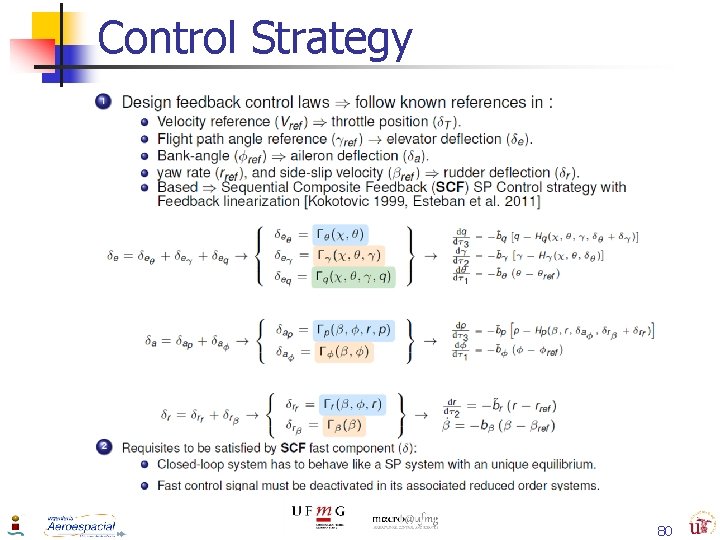
CF-TD 3 TS Control Strategy n n Solve the problem of selecting the response of the ultra-fast dynamics [Esteban, Balakrishnan, Gordillo & Aracil 2008] Provide stability and desired response to the ultra-fast system : n n Decomposition of the control signal in fast and slow components. Requirements that the fast component has to satisfy n Closed loop systems have to behave like a SP system with a single equilibrium. n The fast control signal must be deactivated in the reduced system. 70
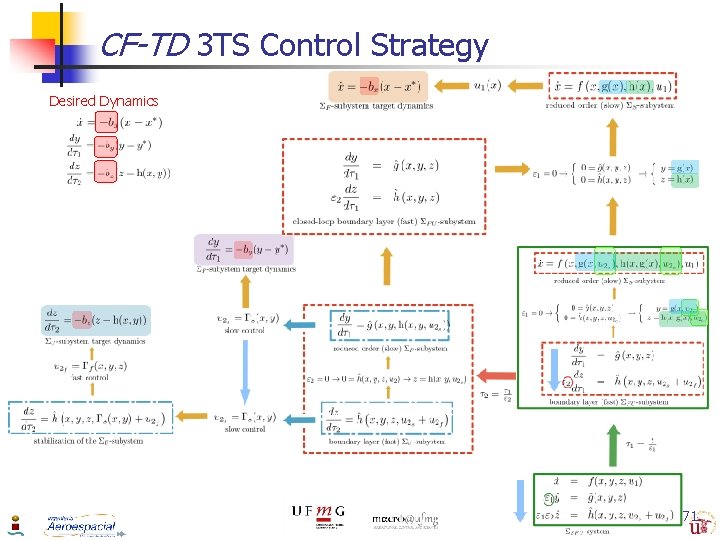
CF-TD 3 TS Control Strategy Desired Dynamics 71
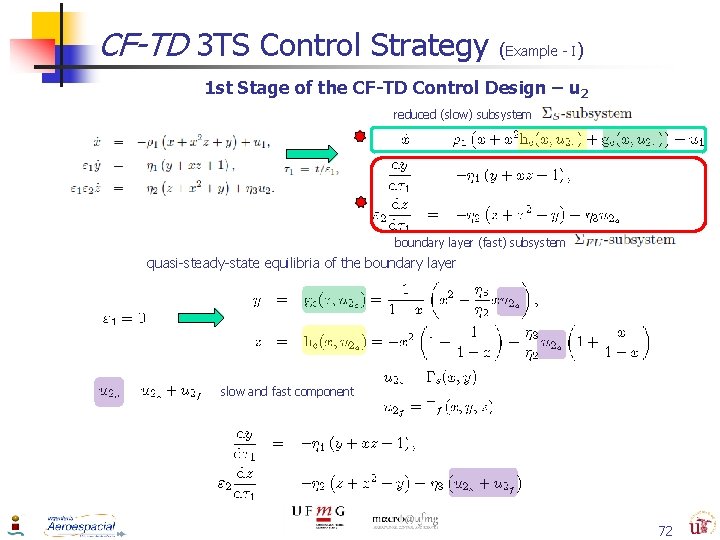
CF-TD 3 TS Control Strategy (Example - I) 1 st Stage of the CF-TD Control Design – u 2 reduced (slow) subsystem boundary layer (fast) subsystem quasi-steady-state equilibria of the boundary layer slow and fast component 72
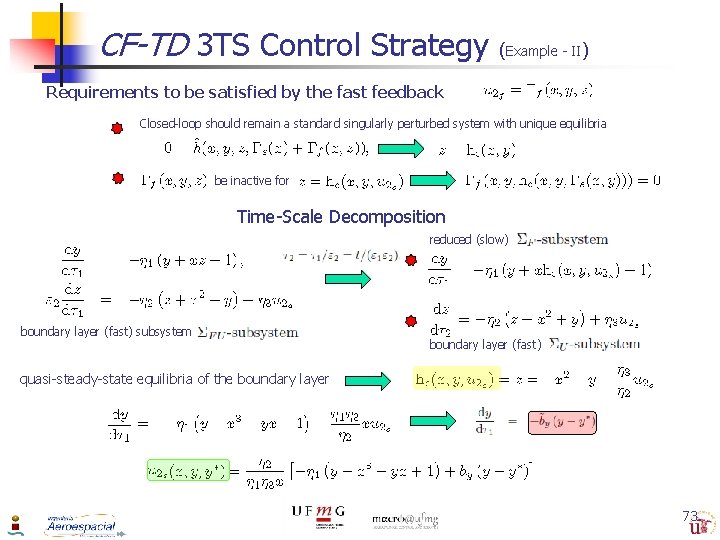
CF-TD 3 TS Control Strategy (Example - II) Requirements to be satisfied by the fast feedback Closed-loop should remain a standard singularly perturbed system with unique equilibria be inactive for Time-Scale Decomposition reduced (slow) boundary layer (fast) subsystem boundary layer (fast) quasi-steady-state equilibria of the boundary layer 73
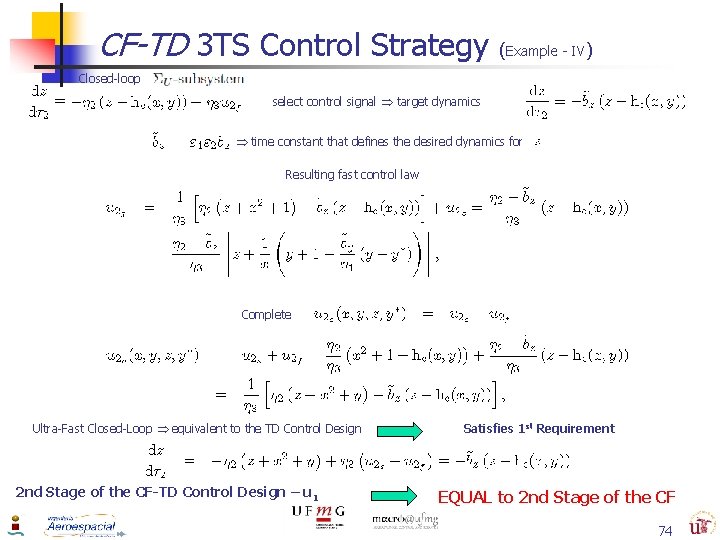
CF-TD 3 TS Control Strategy (Example - IV) Closed-loop select control signal target dynamics time constant that defines the desired dynamics for Resulting fast control law Complete Ultra-Fast Closed-Loop equivalent to the TD Control Design 2 nd Stage of the CF-TD Control Design – u 1 Satisfies 1 st Requirement EQUAL to 2 nd Stage of the CF 74
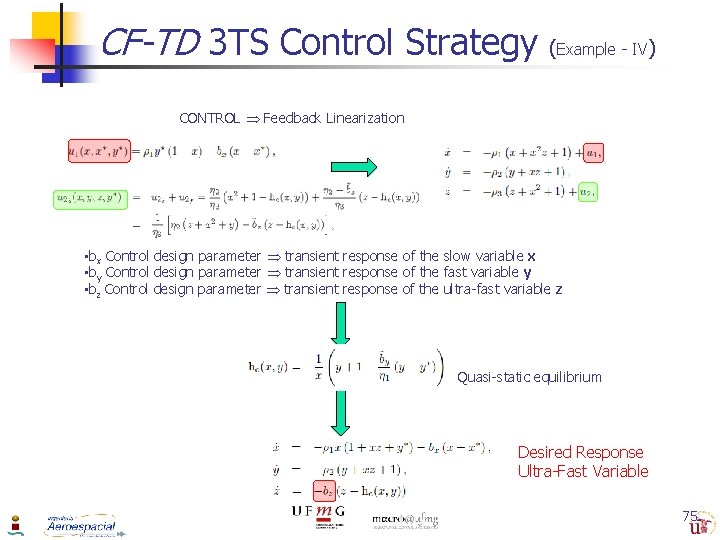
CF-TD 3 TS Control Strategy (Example - IV) CONTROL Feedback Linearization • bx Control design parameter transient response of the slow variable x • by Control design parameter transient response of the fast variable y • bz Control design parameter transient response of the ultra-fast variable z Quasi-static equilibrium Desired Response Ultra-Fast Variable 75
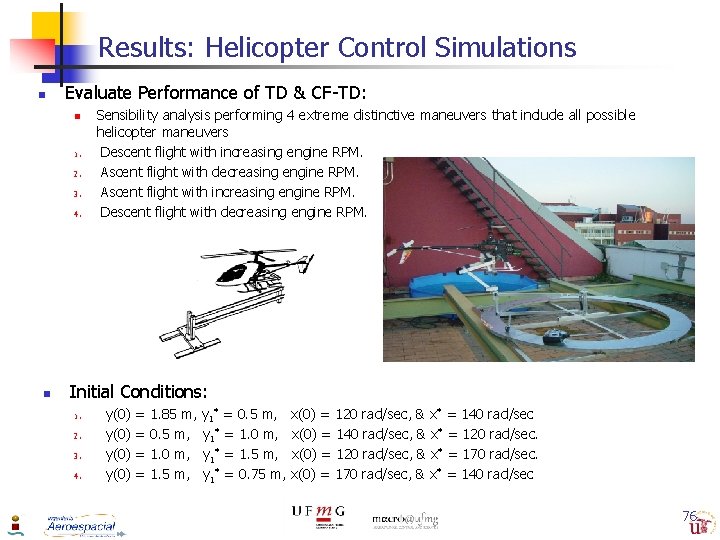
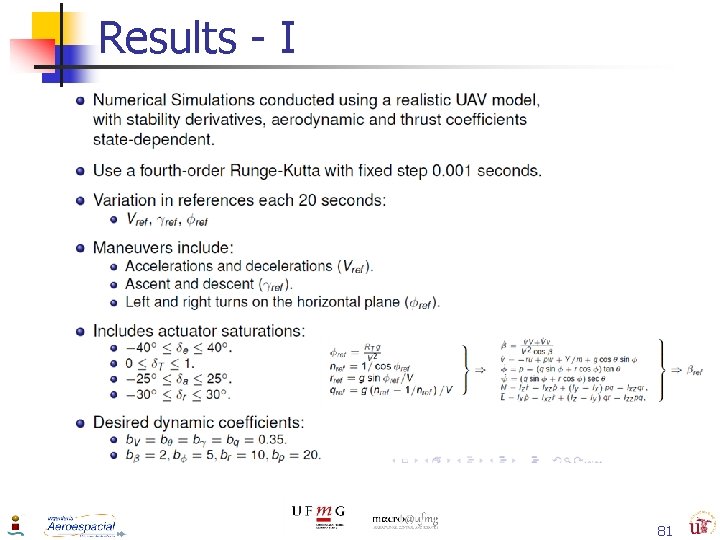
Results: Helicopter Control Simulations n Evaluate Performance of TD & CF-TD: n 1. 2. 3. 4. n Sensibility analysis performing 4 extreme distinctive maneuvers that include all possible helicopter maneuvers Descent flight with increasing engine RPM. Ascent flight with decreasing engine RPM. Ascent flight with increasing engine RPM. Descent flight with decreasing engine RPM. Initial Conditions: 1. 2. 3. 4. y(0) = = 1. 85 m, 0. 5 m, 1. 0 m, 1. 5 m, y 1* = 0. 5 m, y 1* = 1. 0 m, y 1* = 1. 5 m, y 1* = 0. 75 m, x(0) = 120 rad/sec, & x* = 140 rad/sec x(0) = 140 rad/sec, & x* = 120 rad/sec. x(0) = 120 rad/sec, & x* = 170 rad/sec. x(0) = 170 rad/sec, & x* = 140 rad/sec 76
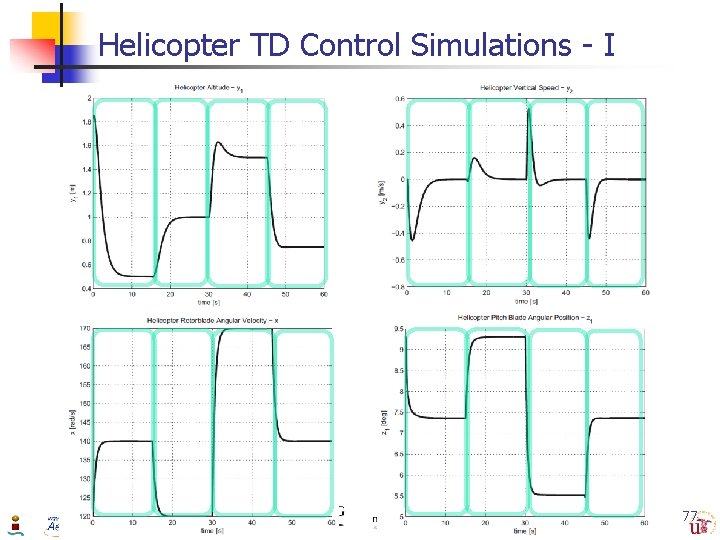
Helicopter TD Control Simulations - I 77
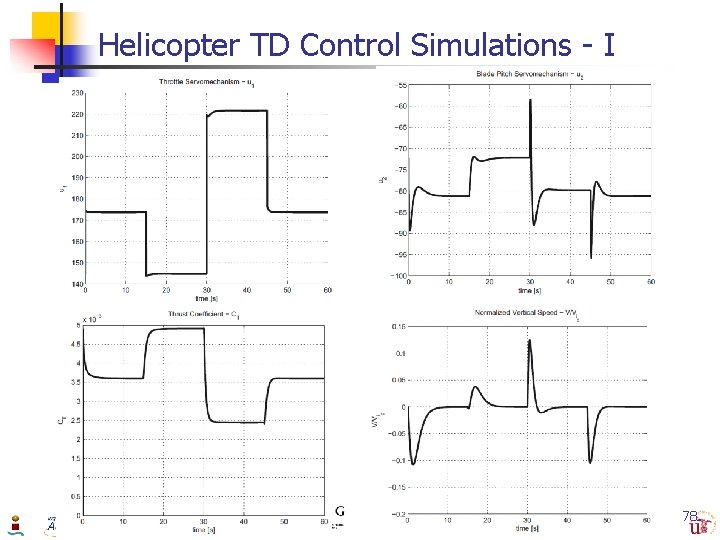
Helicopter TD Control Simulations - I 78
79
Control Strategy 80
Results - I 81
Results - II State Following Reference 82
Results - III Control Signals 83
Asymptotic Stability Analysis
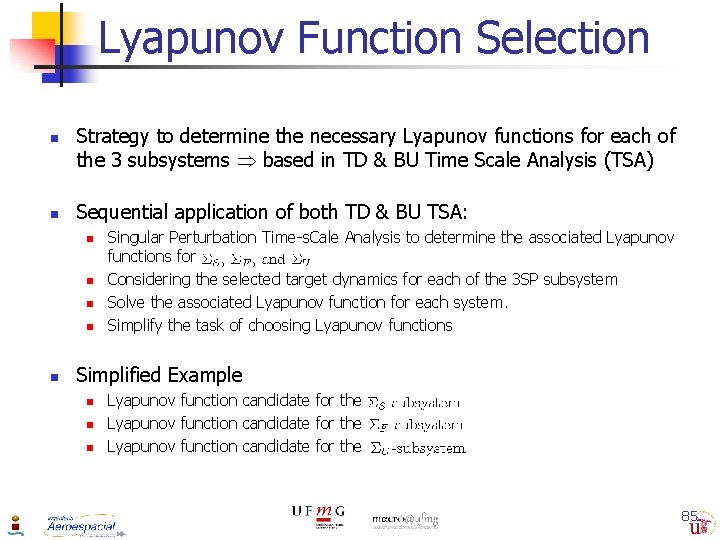
Lyapunov Function Selection n n Strategy to determine the necessary Lyapunov functions for each of the 3 subsystems based in TD & BU Time Scale Analysis (TSA) Sequential application of both TD & BU TSA: n n n Singular Perturbation Time-s. Cale Analysis to determine the associated Lyapunov functions for Considering the selected target dynamics for each of the 3 SP subsystem Solve the associated Lyapunov function for each system. Simplify the task of choosing Lyapunov functions Simplified Example n n n Lyapunov function candidate for the 85
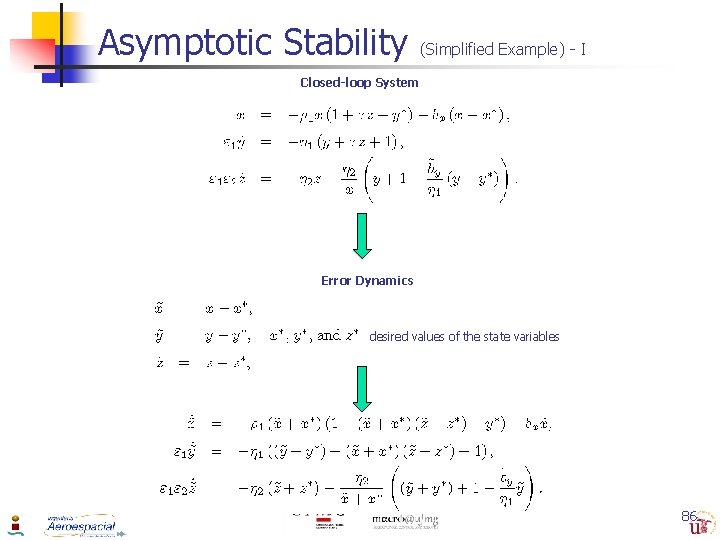
Asymptotic Stability (Simplified Example) - I Closed-loop System Error Dynamics desired values of the state variables 86
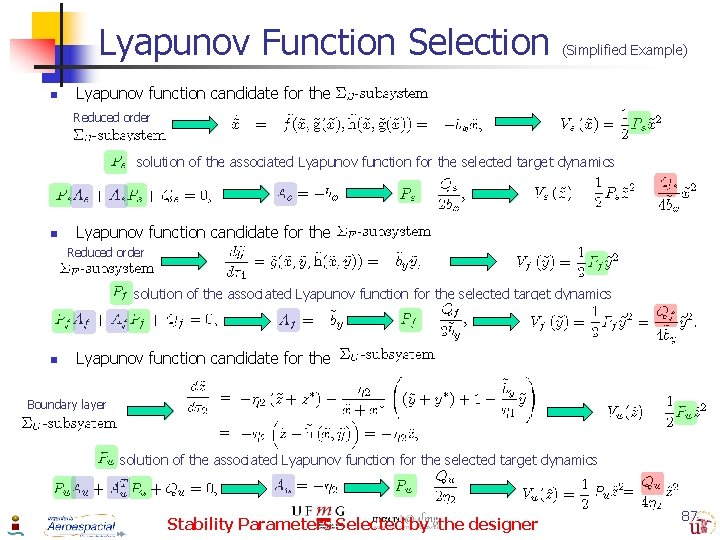
Lyapunov Function Selection n (Simplified Example) Lyapunov function candidate for the Reduced order solution of the associated Lyapunov function for the selected target dynamics n Lyapunov function candidate for the Boundary layer solution of the associated Lyapunov function for the selected target dynamics Stability Parameters Selected by the designer 87
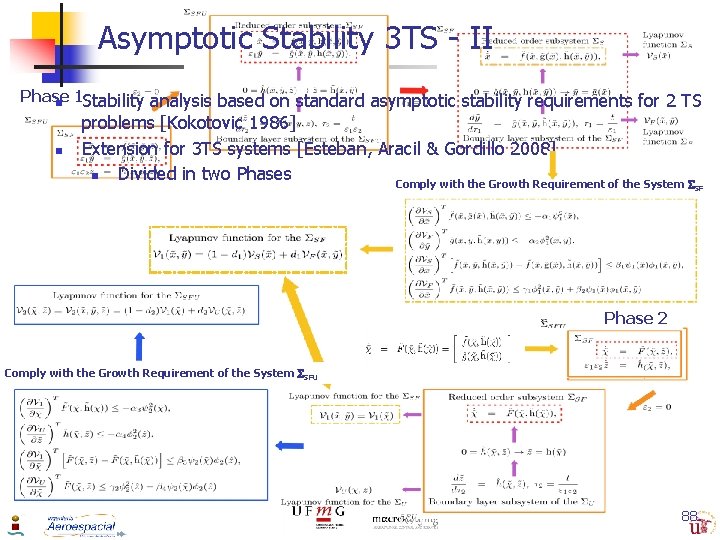
Asymptotic Stability 3 TS - II Phase n 1 Stability analysis based on standard asymptotic stability requirements for 2 TS n problems [Kokotovic 1986] Extension for 3 TS systems [Esteban, Aracil & Gordillo 2008] n Divided in two Phases Comply with the Growth Requirement of the System SF Phase 2 Comply with the Growth Requirement of the System SFU 88
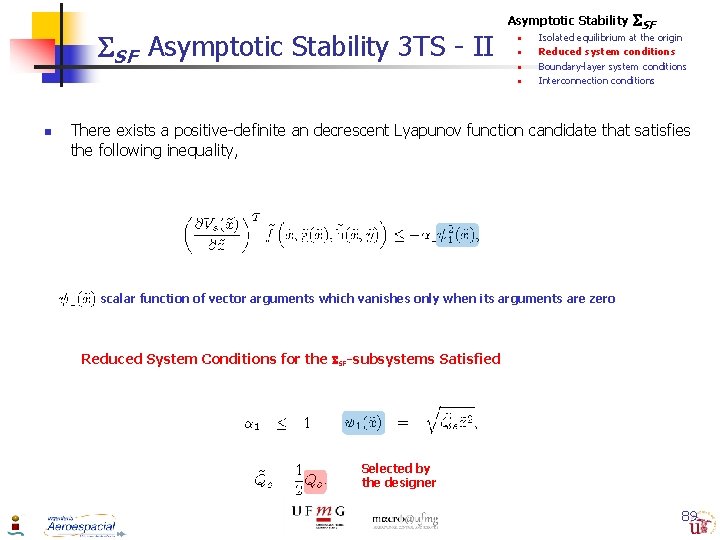
Asymptotic Stability SF Asymptotic Stability 3 TS - II n n n SF Isolated equilibrium at the origin Reduced system conditions Boundary-layer system conditions Interconnection conditions There exists a positive-definite an decrescent Lyapunov function candidate that satisfies the following inequality, scalar function of vector arguments which vanishes only when its arguments are zero Reduced System Conditions for the SF-subsystems Satisfied Selected by the designer 89
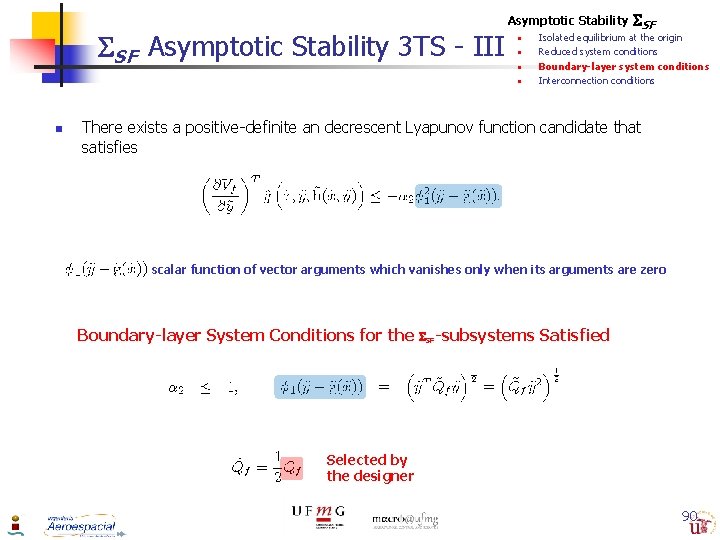
Asymptotic Stability SF Asymptotic Stability 3 TS - III n n n SF Isolated equilibrium at the origin Reduced system conditions Boundary-layer system conditions Interconnection conditions There exists a positive-definite an decrescent Lyapunov function candidate that satisfies scalar function of vector arguments which vanishes only when its arguments are zero Boundary-layer System Conditions for the SF-subsystems Satisfied Selected by the designer 90

Asymptotic Stability SF Asymptotic Stability 3 TS - IV n n SF Isolated equilibrium at the origin Reduced system conditions Boundary-layer system conditions 1 st Interconnection conditions Determines the allowed growth of First Interconnection Condition for the SF-subsystems Satisfied Entire range admissible state values Selected by the designer 91
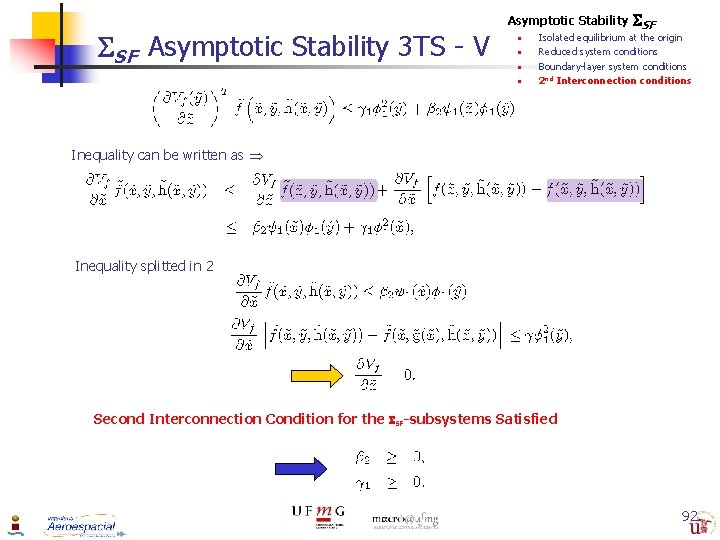
Asymptotic Stability SF Asymptotic Stability 3 TS - V n n SF Isolated equilibrium at the origin Reduced system conditions Boundary-layer system conditions 2 nd Interconnection conditions Inequality can be written as Inequality splitted in 2 Second Interconnection Condition for the SF-subsystems Satisfied 92
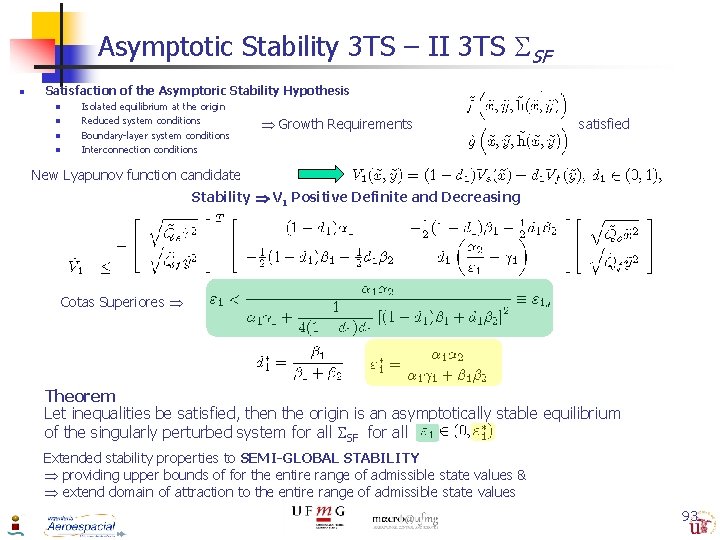
Asymptotic Stability 3 TS – II 3 TS SF n Satisfaction of the Asymptoric Stability Hypothesis n n Isolated equilibrium at the origin Reduced system conditions Boundary-layer system conditions Interconnection conditions Growth Requirements satisfied New Lyapunov function candidate Stability V 1 Positive Definite and Decreasing Cotas Superiores Theorem Let inequalities be satisfied, then the origin is an asymptotically stable equilibrium of the singularly perturbed system for all SF for all Extended stability properties to SEMI-GLOBAL STABILITY providing upper bounds of for the entire range of admissible state values & extend domain of attraction to the entire range of admissible state values 93
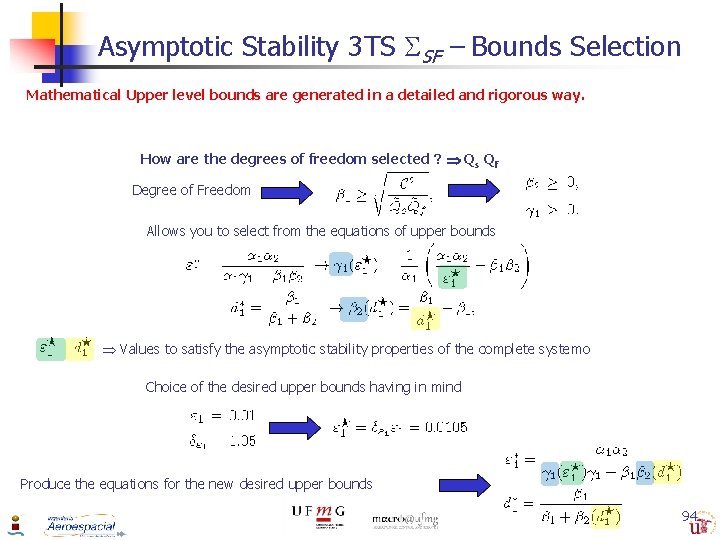
Asymptotic Stability 3 TS SF – Bounds Selection Mathematical Upper level bounds are generated in a detailed and rigorous way. How are the degrees of freedom selected ? Qs Qf Degree of Freedom Allows you to select from the equations of upper bounds Values to satisfy the asymptotic stability properties of the complete systemo Choice of the desired upper bounds having in mind Produce the equations for the new desired upper bounds 94
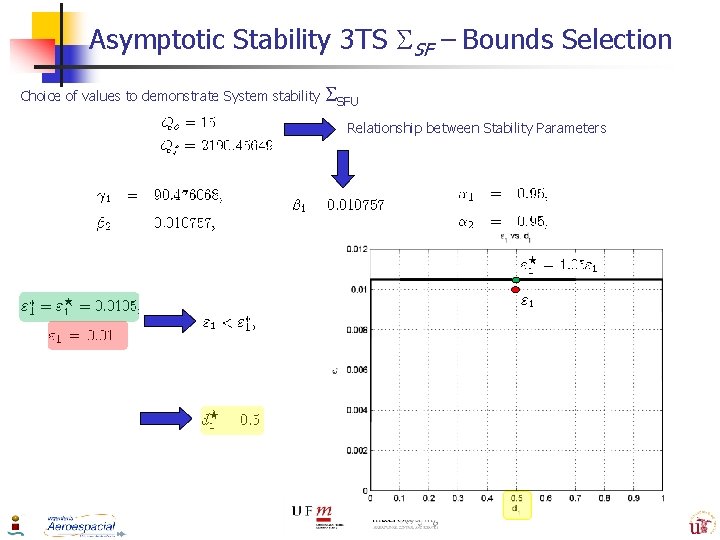
Asymptotic Stability 3 TS SF – Bounds Selection Choice of values to demonstrate System stability SFU Relationship between Stability Parameters
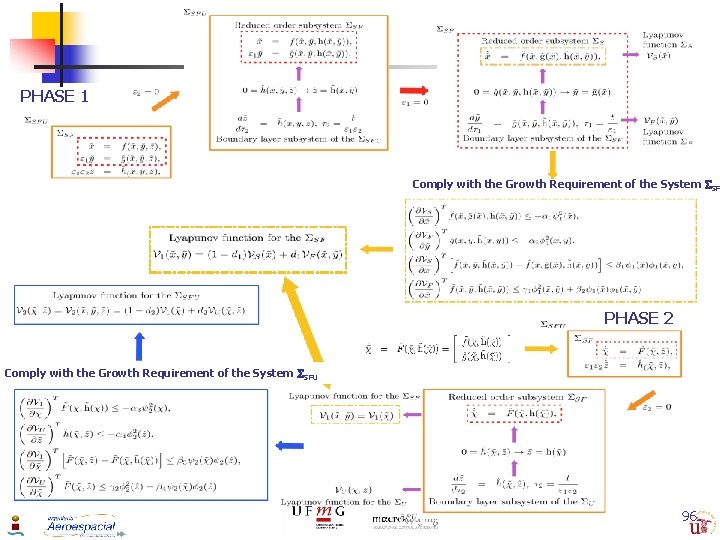
PHASE 1 Comply with the Growth Requirement of the System SF PHASE 2 Comply with the Growth Requirement of the System SFU 96
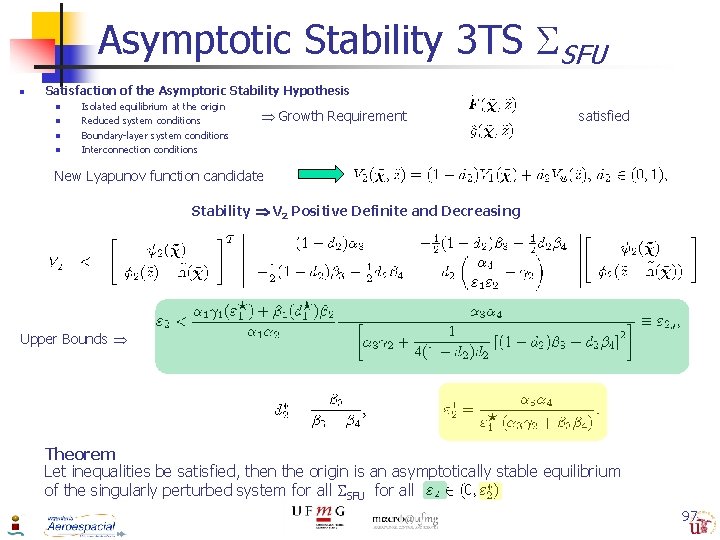
Asymptotic Stability 3 TS SFU n Satisfaction of the Asymptoric Stability Hypothesis n n Isolated equilibrium at the origin Reduced system conditions Boundary-layer system conditions Interconnection conditions Growth Requirement satisfied New Lyapunov function candidate Stability V 2 Positive Definite and Decreasing Upper Bounds Theorem Let inequalities be satisfied, then the origin is an asymptotically stable equilibrium of the singularly perturbed system for all SFU for all 97

Asymptotic Stability 3 TS SFU – Upper Bounds - I Equations to define the desired upper bounds Similarly Qs Qf Qu degrees of freedom that we have determine the stability characteristics 98
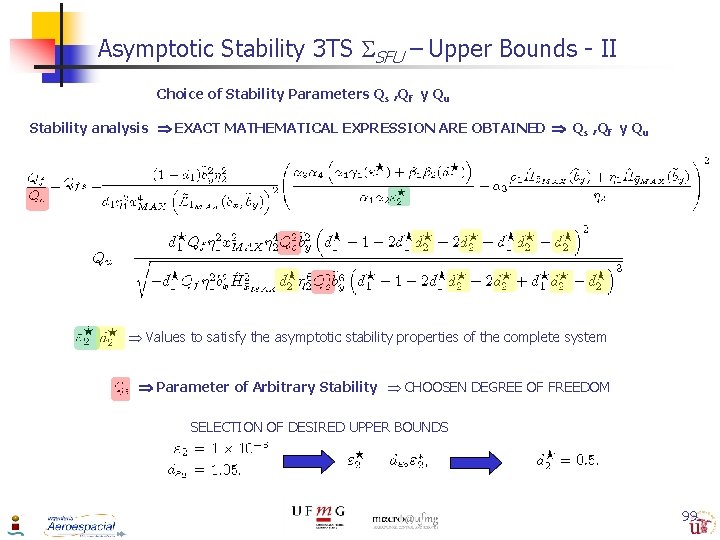
Asymptotic Stability 3 TS SFU – Upper Bounds - II Choice of Stability Parameters Qs , Qf y Qu Stability analysis EXACT MATHEMATICAL EXPRESSION ARE OBTAINED Qs , Qf y Qu Values to satisfy the asymptotic stability properties of the complete system Parameter of Arbitrary Stability CHOOSEN DEGREE OF FREEDOM SELECTION OF DESIRED UPPER BOUNDS 99
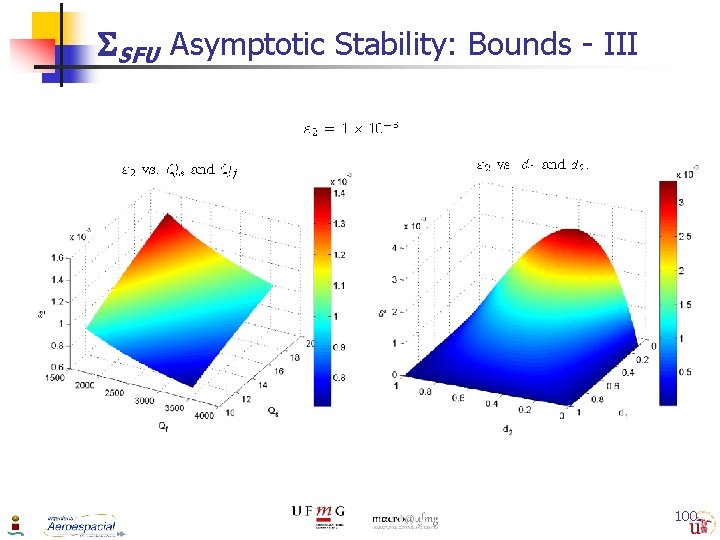
SFU Asymptotic Stability: Bounds - III 100
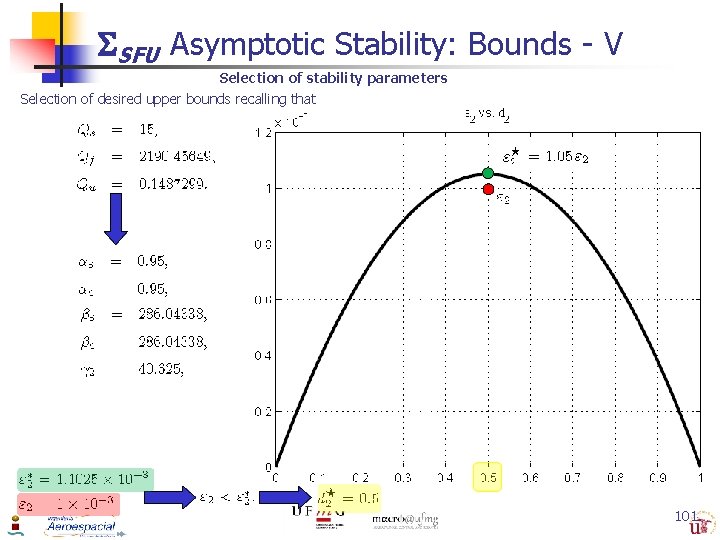
SFU Asymptotic Stability: Bounds - V Selection of stability parameters Selection of desired upper bounds recalling that 101
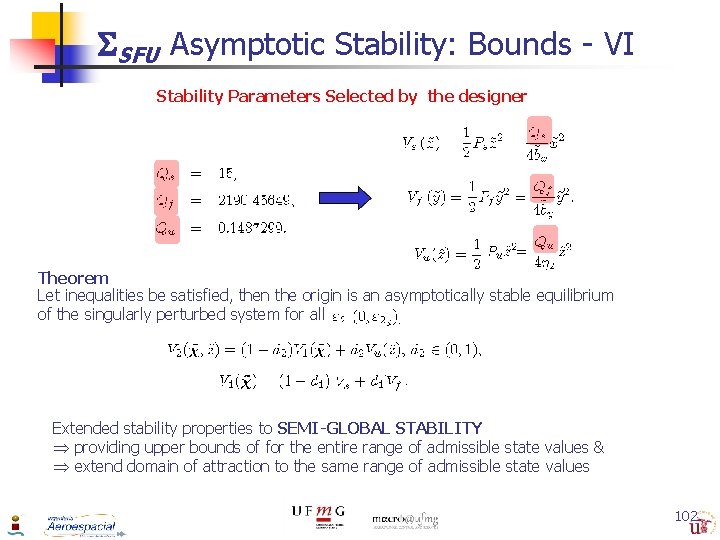
SFU Asymptotic Stability: Bounds - VI Stability Parameters Selected by the designer Theorem Let inequalities be satisfied, then the origin is an asymptotically stable equilibrium of the singularly perturbed system for all Extended stability properties to SEMI-GLOBAL STABILITY providing upper bounds of for the entire range of admissible state values & extend domain of attraction to the same range of admissible state values 102
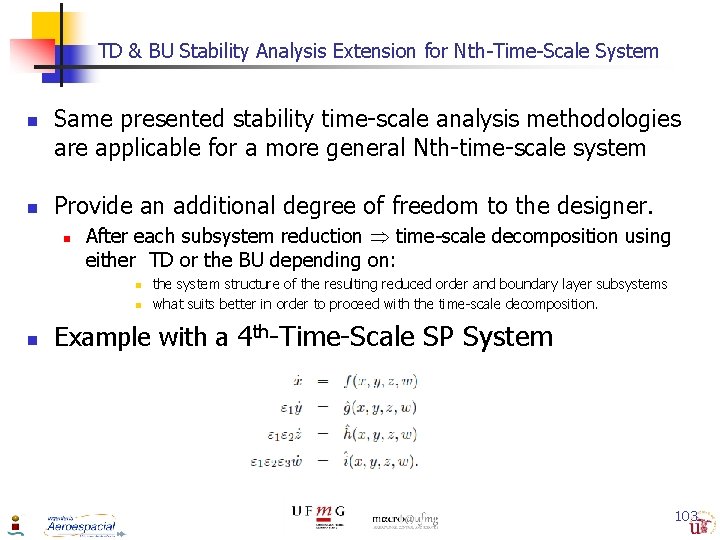
TD & BU Stability Analysis Extension for Nth-Time-Scale System n n Same presented stability time-scale analysis methodologies are applicable for a more general Nth-time-scale system Provide an additional degree of freedom to the designer. n After each subsystem reduction time-scale decomposition using either TD or the BU depending on: n n n the system structure of the resulting reduced order and boundary layer subsystems what suits better in order to proceed with the time-scale decomposition. Example with a 4 th-Time-Scale SP System 103
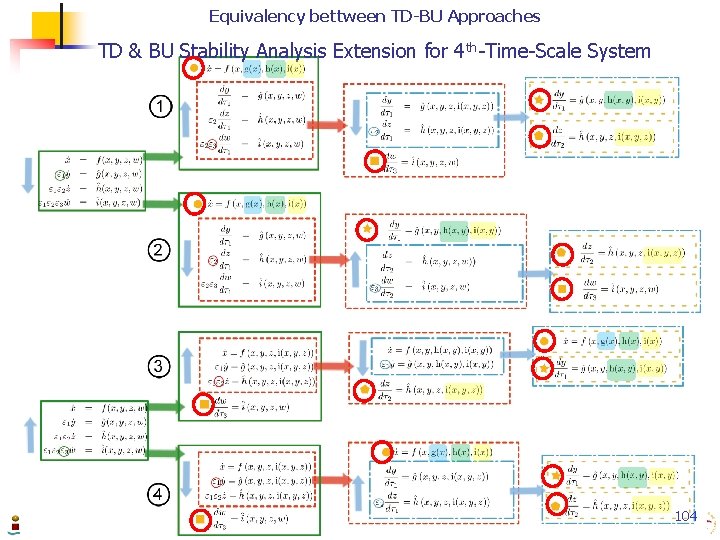
Equivalency bettween TD-BU Approaches TD & BU Stability Analysis Extension for 4 th-Time-Scale System 104
Conclusions n Proposed and proved a TD & BU methodology to analyze the asymptotical stability properties of a 3 TS SP systems. n Design proper control laws with a desired degree of response n n Degenerated systems can be stabilized separately simplifying considerably the control design Provides a methodology to obtain a Lyapunov function candidate for the entire system Using a weighted sum of the proposed Lyapunov function candidates of the 3 TS subsystems Demostrate stablity of the closed-loop system n n n The validity of the methodology has been proved by: n n n Obtaining stability upper bound limits on both boundary layers Satisfying that the selected parasitic constants for the control law proposed TD & BU Time-scale analysis methodologies are extended for a more general Nth-time-scale system n n Provide an additional degree of freedom to the designer. Sensitivity allows has been conducted on the proposed control laws under unmodeled dynamics using the presented alternative test bench C T models. 105
Open Problems n Theoretical line: focused on the asymptotic stability analysis : n Comprehensive study of how the upper bounds on the parasitic parameters are affected by the variation of the Fixed Parameters. n n Model Based Control design parameters Apply the same control strategy to different models Extension of the asymptotic stability properties at the origin and the semiglobal stability to exponential stability. n Actuator saturations. n Study Robustness SP for disturbance rejection n Estudy different control solutions: n n n Optimal control: SDRE … 106

muito obrigado… perguntas? … 107
![Bibliography - I n n n n [Abed 1985] Stability of multiparameter singular perturbation](http://slidetodoc.com/presentation_image_h2/76bb5de593ef255b0eb1e5f09aae6bd3/image-108.jpg "Bibliography - I n n n n [Abed 1985] Stability of multiparameter singular perturbation")
Bibliography - I n n n n [Abed 1985] Stability of multiparameter singular perturbation problems with parameters bounds, in time varying systems with conerestricted perturbations. Technical Report TR-85 -5, Department of Electrical Engineering and Systems Research Center, University of Maryland, College Park, 1985. [Ardema 1976] M. D. Ardema. Solution of the minimum time-to-climb problem by matched asymptotic expansions. AIAA Journal, 14: 843– 850, 1976. [Etkin 1982] B. Etkin and L. D. Reid. Dynamics of flight: stability and control. [Johnson 1994] W. Johnson. Helicopter Theory. Dover Pubns, 1994. [Kelley 1971] H. J. Kelley. Flight path optimization with multiple time scales. Journal of Aircraft, 8: 238– 240, 1971. [Khalil 1987] H. K. Khalil Stability analysis of nonlinear multiparameter singularly perturbed systems. IEEE Transactions on Automatic Control, (3): 260– 263, 1987. [Oh & Khalil 1997] S. Oh and H. K. Khalil. Nonlinear Output-Feedback Tracking Using High-gain Observer and Variable Structure Control. Automatica, 33(10): 1845– 1856, 1997. [Kokotovic & O’Reilly 1986] P. V. Kokotovic, J. O’Reilly, and H. K. Khalil. Singular Perturbation Methods in Control: Analysis and Design. Academic Press, Inc. , Orlando, FL, USA, 1986. n n n [Kokotovic et al 1987] P. V. Kokotovic, A. Bensoussan, and G. Blankenship. Singular perturbations and asymptotic analysis in control systems. Number 90. Springer-Verlag Berlin, 1987. [Leishman 2006] J. G. Leishman. Principles of helicopter aerodynamics. Cambridge University Press, 2006. [López & Valenzuela 2010] O. López and A. Valenzuela. Temario Helicópteros, volume Astronáutica y Aeronaves Diversas of Asignaturas en la Red 2009 -2010. Universidad de Sevilla - Enseñanza Virtual, 2010. [Mehra 1979] R. Mehra, R. Washburn, S. Sajan, and J. Carrol. A study of the application of singular perturbation theory. NASA CR 3167, 1979. [Naidu 2001] D. S. Naidu and A. J. Calise. Singular perturbations and time scales in guidance and control of aerospace systems: A survey. Journal of Guidance, Control and Dynamics, 24(6): 1057– 1078, 2001. [Naidu 2002] D. S. Naidu. Singular perturbations and time scales in control theory and applications: an overview. Dynamics of Continuous Discrete and Impulsive Systems Series B, 9: 233– 278, 2002. n n [Pallet 1991] T. J. Pallet and S. Ahmad. Real-time helicopter flight control: Modelling and control. Technical Report TR-EE 91 -35, 1991. [Prandtl 1904] L. Prandtl. Uber Flussigkeits bewegung bei sehr kleiner Reibung, Verhaldlg III Int. Math. Kong. (Heidelberg: Teubner), pages 484– 491, 1904. 108
- Slides: 108