
SingletTriplet Coupling and the NonSymmetric Bending Modes of
Singlet-Triplet Coupling and the Non-Symmetric Bending Modes of Acetylene 1Ãu SEELEM spectroscopy of metastable states Kyle Bittinger, Wilton Virgo, R. W. Field Massachusetts Institute of Technology
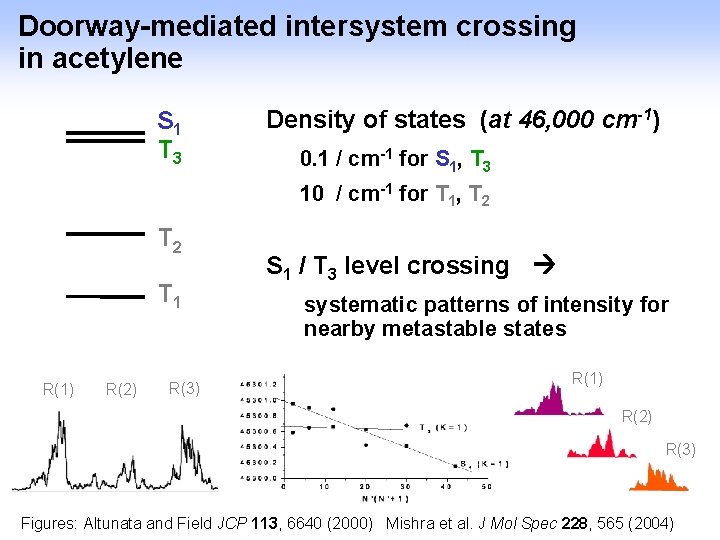
Doorway-mediated intersystem crossing in acetylene S 1 T 3 Density of states (at 46, 000 cm-1) 0. 1 / cm-1 for S 1, T 3 10 / cm-1 for T 1, T 2 T 1 R(1) R(2) R(3) S 1 / T 3 level crossing systematic patterns of intensity for nearby metastable states R(1) R(2) R(3) Figures: Altunata and Field JCP 113, 6640 (2000) Mishra et al. J Mol Spec 228, 565 (2004)
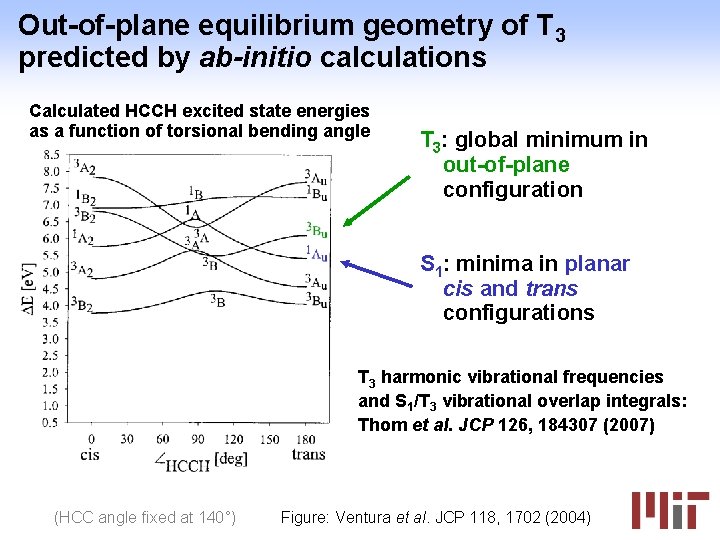
Out-of-plane equilibrium geometry of T 3 predicted by ab-initio calculations Calculated HCCH excited state energies as a function of torsional bending angle T 3: global minimum in out-of-plane configuration S 1: minima in planar cis and trans configurations T 3 harmonic vibrational frequencies and S 1/T 3 vibrational overlap integrals: Thom et al. JCP 126, 184307 (2007) (HCC angle fixed at 140°) Figure: Ventura et al. JCP 118, 1702 (2004)
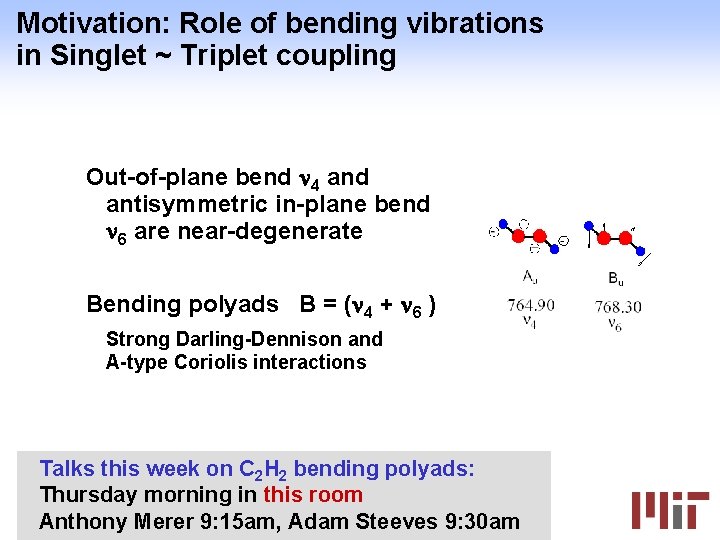
Motivation: Role of bending vibrations in Singlet ~ Triplet coupling Out-of-plane bend 4 and antisymmetric in-plane bend 6 are near-degenerate Bending polyads B = ( 4 + 6 ) Strong Darling-Dennison and A-type Coriolis interactions Talks this week on C 2 H 2 bending polyads: Thursday morning in this room Anthony Merer 9: 15 am, Adam Steeves 9: 30 am
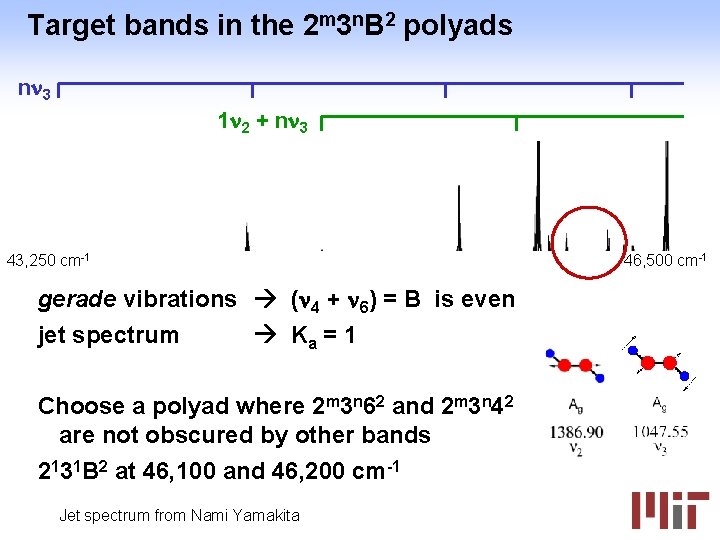
Target bands in the 2 m 3 n. B 2 polyads n 3 1 2 + n 3 43, 250 cm-1 gerade vibrations ( 4 + 6) = B is even jet spectrum Ka = 1 Choose a polyad where 2 m 3 n 62 and 2 m 3 n 42 are not obscured by other bands 2131 B 2 at 46, 100 and 46, 200 cm-1 Jet spectrum from Nami Yamakita 46, 500 cm-1
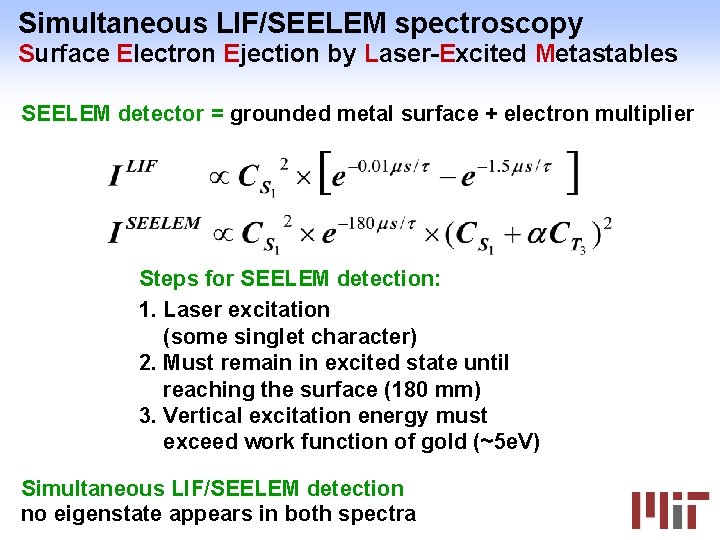
Simultaneous LIF/SEELEM spectroscopy Surface Electron Ejection by Laser-Excited Metastables SEELEM detector = grounded metal surface + electron multiplier Steps for SEELEM detection: 1. Laser excitation (some singlet character) 2. Must remain in excited state until reaching the surface (180 mm) 3. Vertical excitation energy must exceed work function of gold (~5 e. V) Simultaneous LIF/SEELEM detection no eigenstate appears in both spectra
Simultaneous LIF/SEELEM in the 2131 B 2 polyad (Ka = 1) 2 13 16 2 2 13 14 2
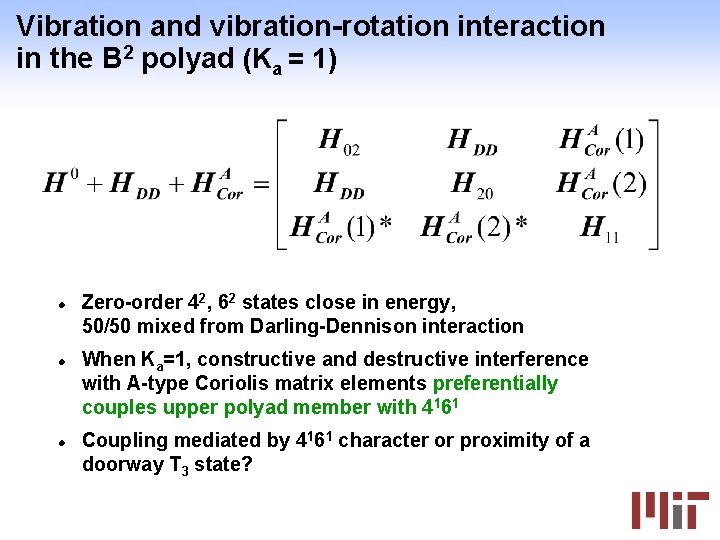
Vibration and vibration-rotation interaction in the B 2 polyad (Ka = 1) Zero-order 42, 62 states close in energy, 50/50 mixed from Darling-Dennison interaction When Ka=1, constructive and destructive interference with A-type Coriolis matrix elements preferentially couples upper polyad member with 4161 Coupling mediated by 4161 character or proximity of a doorway T 3 state?
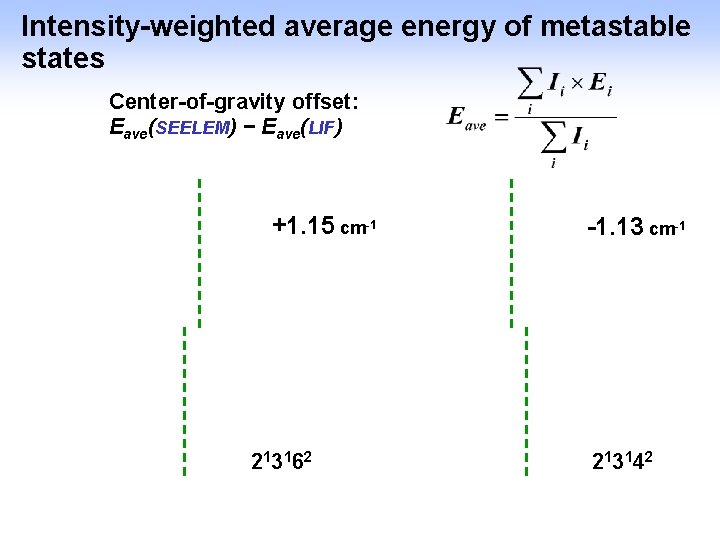
Intensity-weighted average energy of metastable states Center-of-gravity offset: Eave(SEELEM) − Eave(LIF) +1. 15 cm-1 2 13 16 2 -1. 13 cm-1 2 13 14 2
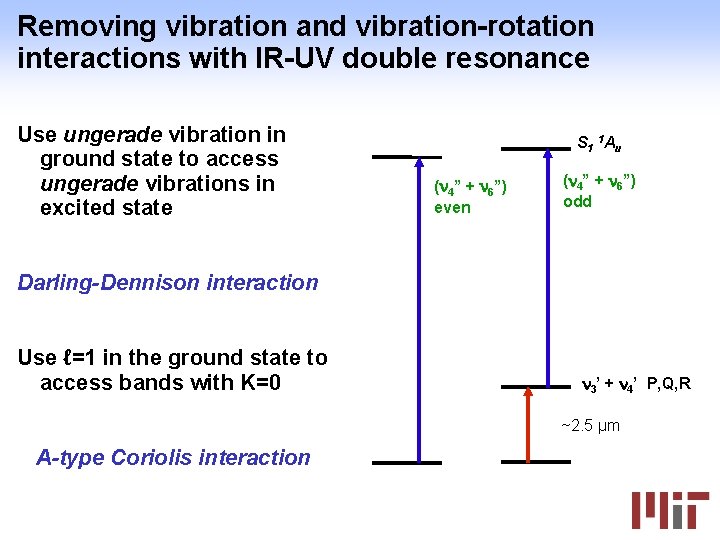
Removing vibration and vibration-rotation interactions with IR-UV double resonance Use ungerade vibration in ground state to access ungerade vibrations in excited state S 1 1 Au ( 4” + 6”) even ( 4” + 6”) odd Darling-Dennison interaction Use ℓ=1 in the ground state to access bands with K=0 3’ + 4’ P, Q, R ~2. 5 μm A-type Coriolis interaction
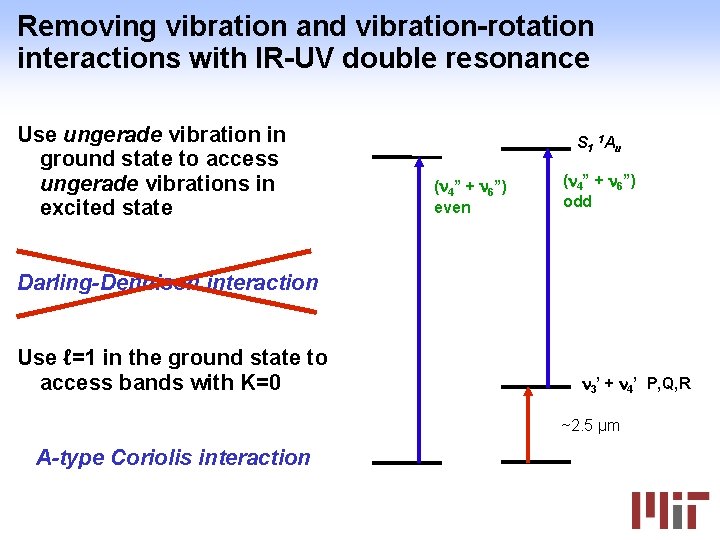
Removing vibration and vibration-rotation interactions with IR-UV double resonance Use ungerade vibration in ground state to access ungerade vibrations in excited state S 1 1 Au ( 4” + 6”) even ( 4” + 6”) odd Darling-Dennison interaction Use ℓ=1 in the ground state to access bands with K=0 3’ + 4’ P, Q, R ~2. 5 μm A-type Coriolis interaction
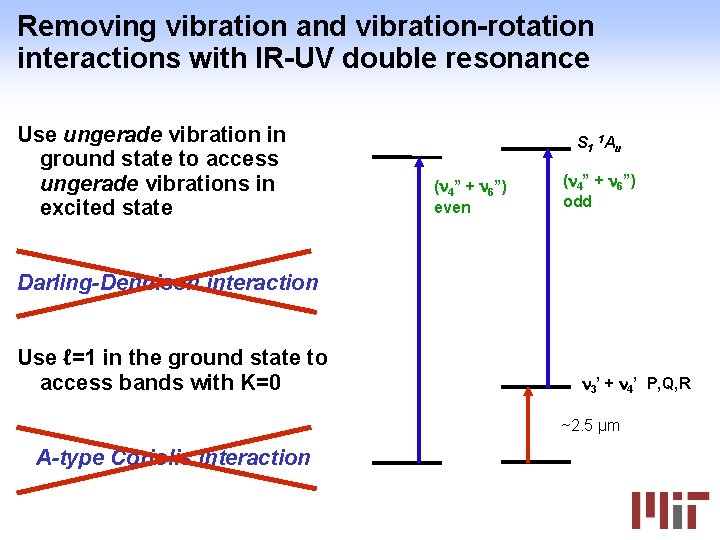
Removing vibration and vibration-rotation interactions with IR-UV double resonance Use ungerade vibration in ground state to access ungerade vibrations in excited state S 1 1 Au ( 4” + 6”) even ( 4” + 6”) odd Darling-Dennison interaction Use ℓ=1 in the ground state to access bands with K=0 3’ + 4’ P, Q, R ~2. 5 μm A-type Coriolis interaction
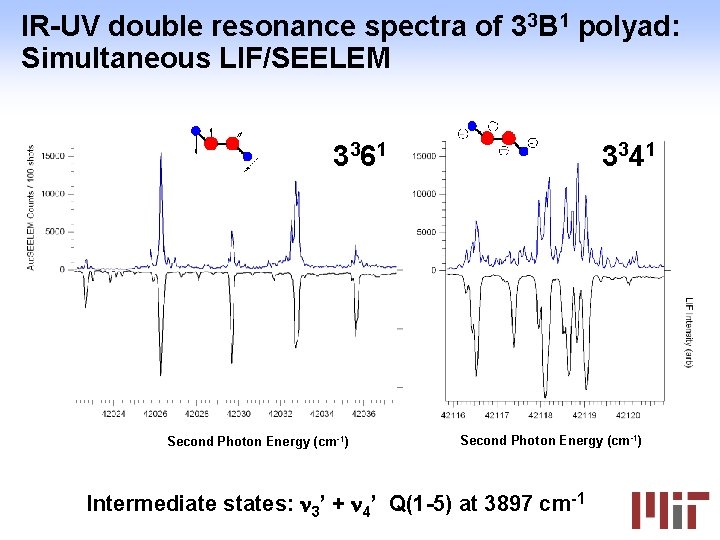
IR-UV double resonance spectra of 33 B 1 polyad: Simultaneous LIF/SEELEM 3 36 1 Second Photon Energy (cm -1) 3 34 1 Second Photon Energy (cm -1) Intermediate states: 3’ + 4’ Q(1 -5) at 3897 cm-1
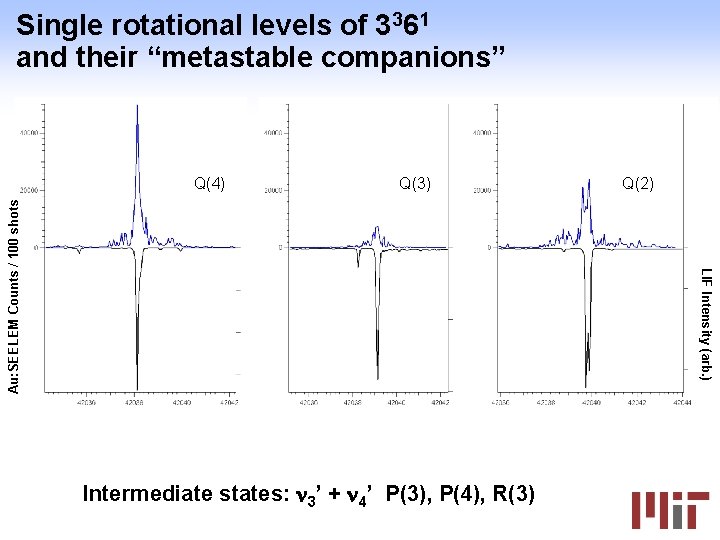
Single rotational levels of 3361 and their “metastable companions” Q(3) Q(2) LIF Intensity (arb. ) Au: SEELEM Counts / 100 shots Q(4) Intermediate states: 3’ + 4’ P(3), P(4), R(3)
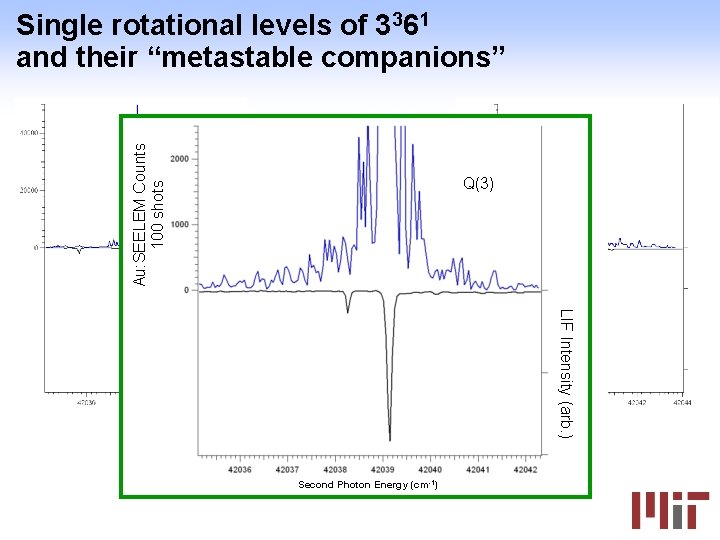
Au: SEELEM Counts 100 shots Single rotational levels of 3361 and their “metastable companions” Q(3) LIF Intensity (arb. ) Second Photon Energy (cm-1)
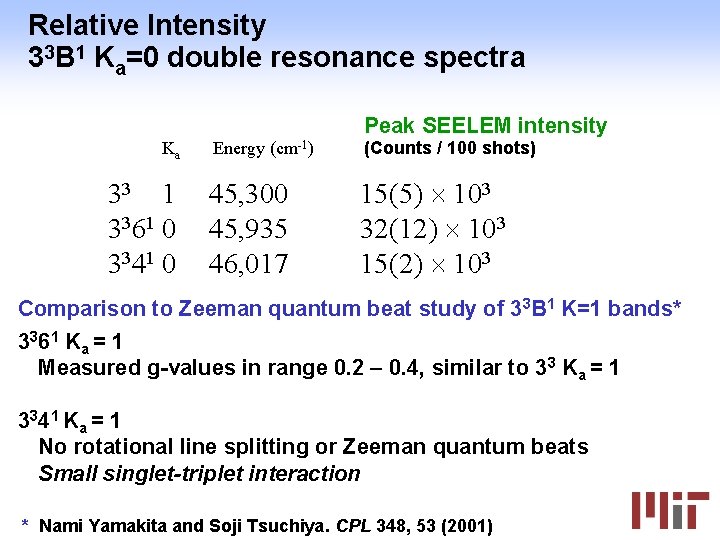
Relative Intensity 33 B 1 Ka=0 double resonance spectra Peak SEELEM intensity Ka 33 1 3361 0 3341 0 Energy (cm-1) (Counts / 100 shots) 45, 300 45, 935 46, 017 15(5) 103 32(12) 103 15(2) 103 Comparison to Zeeman quantum beat study of 33 B 1 K=1 bands* 3 36 1 K a = 1 Measured g-values in range 0. 2 – 0. 4, similar to 33 Ka = 1 3 34 1 K a = 1 No rotational line splitting or Zeeman quantum beats Small singlet-triplet interaction * Nami Yamakita and Soji Tsuchiya. CPL 348, 53 (2001)
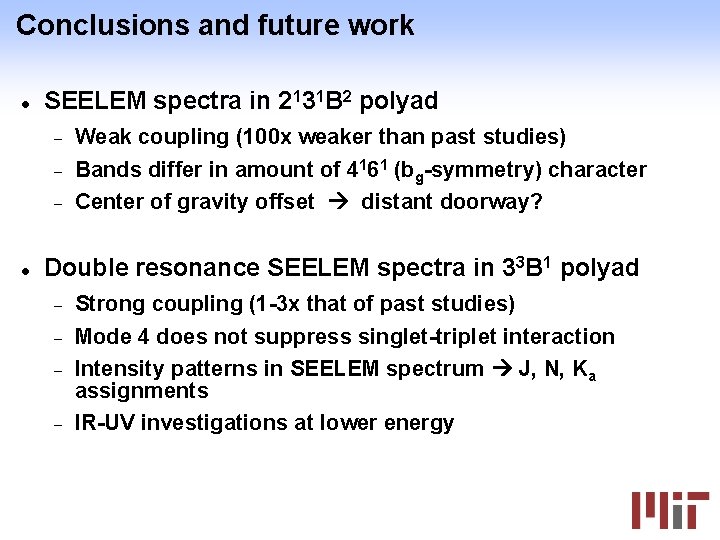
Conclusions and future work SEELEM spectra in 2131 B 2 polyad Weak coupling (100 x weaker than past studies) Bands differ in amount of 4161 (bg-symmetry) character Center of gravity offset distant doorway? Double resonance SEELEM spectra in 33 B 1 polyad Strong coupling (1 -3 x that of past studies) Mode 4 does not suppress singlet-triplet interaction Intensity patterns in SEELEM spectrum J, N, Ka assignments IR-UV investigations at lower energy
Acknowledgements Experimental assistance Hans Bechtel Assignments and perturbation-hunting Adam Steeeves Anthony Merer Soji Tsuchiya T 3 calculations Bryan Wong Ryan Thom Triplet Project Sam Lipoff Yukyung Jung Funding AFOSR
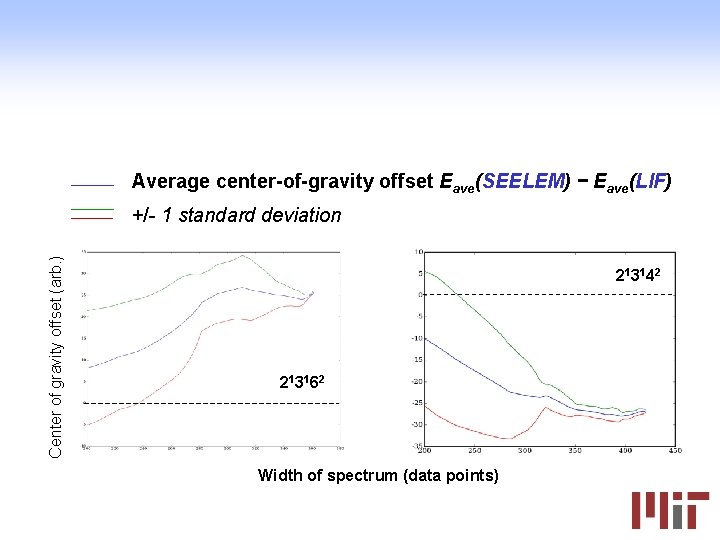
Average center-of-gravity offset Eave(SEELEM) − Eave(LIF) Center of gravity offset (arb. ) +/- 1 standard deviation 21 31 42 21 31 62 Width of spectrum (data points)
- Slides: 20