
Singleton vs utility class at first glance the
![public class Mutable. Key { public static void main(String[] args) { Map<Date, String> m](https://slidetodoc.com/presentation_image_h2/55e30b352a4605a40e089ea9d301bd1a/image-23.jpg "public class Mutable. Key { public static void main(String[] args) { Map<Date, String> m")
![public class Phone. Number. Client { public static void main(String[] args) { Phone. Number](https://slidetodoc.com/presentation_image_h2/55e30b352a4605a40e089ea9d301bd1a/image-28.jpg "public class Phone. Number. Client { public static void main(String[] args) { Phone. Number")
- Slides: 29
Singleton vs utility class at first glance, the singleton pattern does not seem to offer any advantages to using a utility class i. e. , a utility class with non-final static fields looks a lot like a single object with non-static fields there is a fundamental difference between a singleton and a utility class: 1 a singleton represents an object whereas a utility is a class
Singleton vs utility class suppose that you want your singleton/utility class to implement an interface up to and including Java 7, a utility class could not implement an interface a singleton can freely implement interfaces Java 8 now allows static methods in interfaces a utility class can now implement an interface that has all static methods 2 but a utility class still cannot implement an interface having nonstatic methods (such as Iterable)
Singleton vs utility class suppose that you decide later on that you need multiple instances rather than a singleton/utility class 3 a utility class cannot be used to create objects of the utility class type a singleton can be converted to a non-singleton
Singleton vs utility class can you create a method that has a parameter whose type is a utility class? no, a parameter is a variable that stores a reference to an object and there are no utility class objects can you create a method that has a parameter whose type is a singleton? 4 yes, a parameter is a variable that stores a reference to an object and there is one singleton object
Immutable classes 5
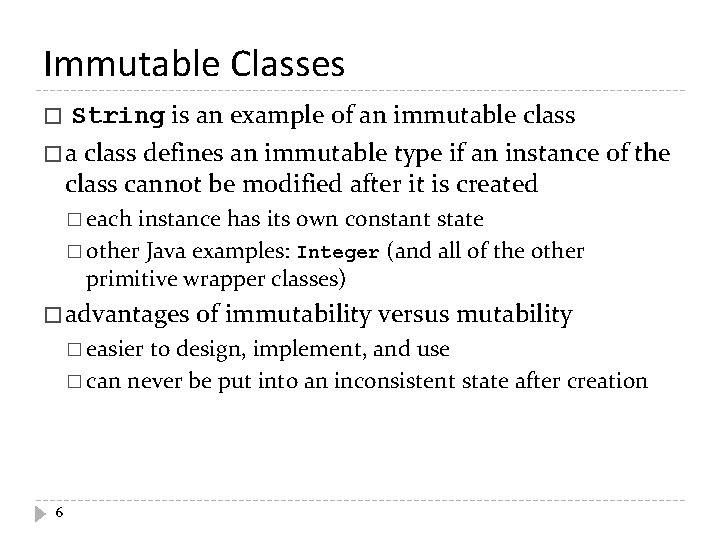
Immutable Classes String is an example of an immutable class � a class defines an immutable type if an instance of the class cannot be modified after it is created � � each instance has its own constant state � other Java examples: Integer (and all of the other primitive wrapper classes) � advantages � easier of immutability versus mutability to design, implement, and use � can never be put into an inconsistent state after creation 6
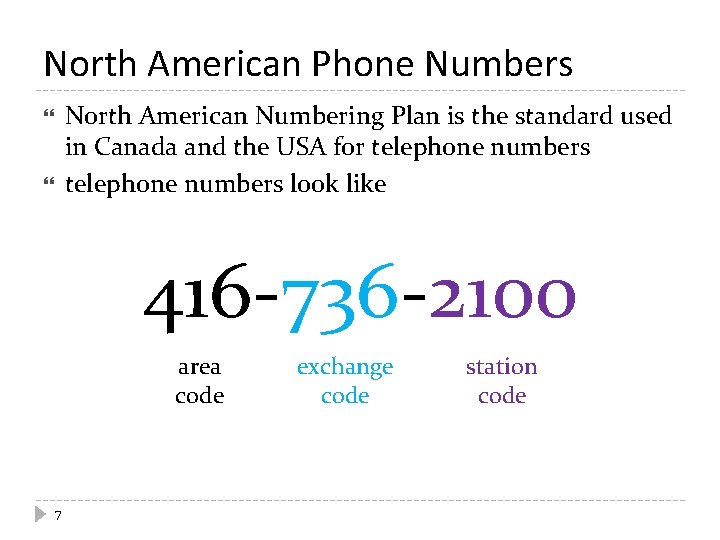
North American Phone Numbers North American Numbering Plan is the standard used in Canada and the USA for telephone numbers look like 416 -736 -2100 area code 7 exchange code station code
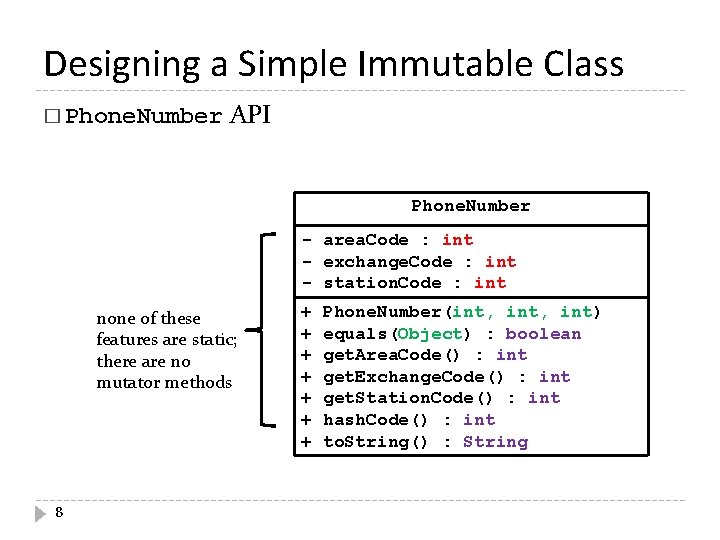
Designing a Simple Immutable Class � Phone. Number API Phone. Number - area. Code : int - exchange. Code : int - station. Code : int none of these features are static; there are no mutator methods 8 + + + + Phone. Number(int, int) equals(Object) : boolean get. Area. Code() : int get. Exchange. Code() : int get. Station. Code() : int hash. Code() : int to. String() : String
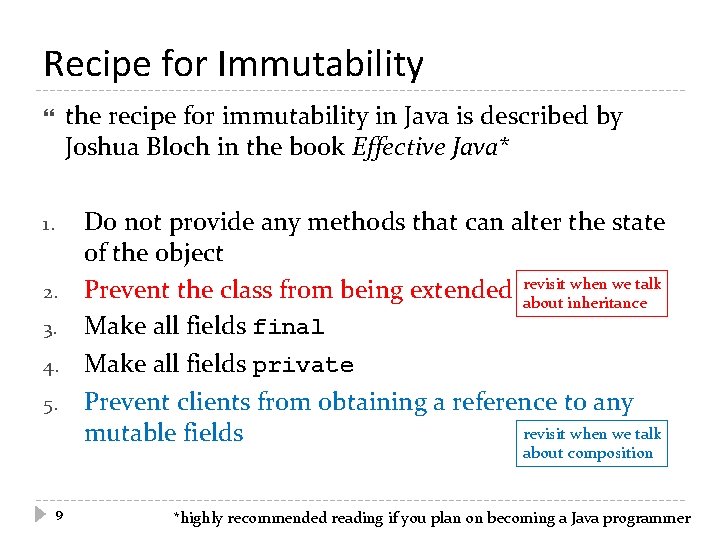
Recipe for Immutability the recipe for immutability in Java is described by Joshua Bloch in the book Effective Java* 1. 2. 3. 4. 5. Do not provide any methods that can alter the state of the object when we talk Prevent the class from being extended revisit about inheritance Make all fields final Make all fields private Prevent clients from obtaining a reference to any revisit when we talk mutable fields about composition 9 *highly recommended reading if you plan on becoming a Java programmer
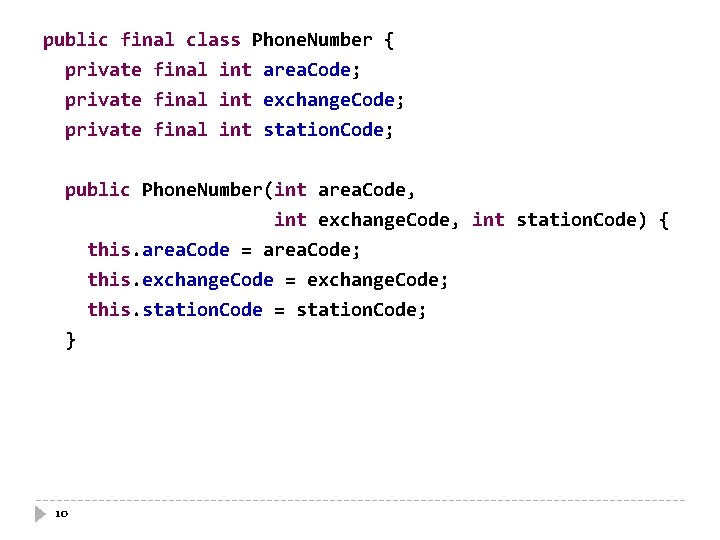
public final class Phone. Number { private final int area. Code; private final int exchange. Code; private final int station. Code; public Phone. Number(int area. Code, int exchange. Code, int station. Code) { this. area. Code = area. Code; this. exchange. Code = exchange. Code; this. station. Code = station. Code; } 10
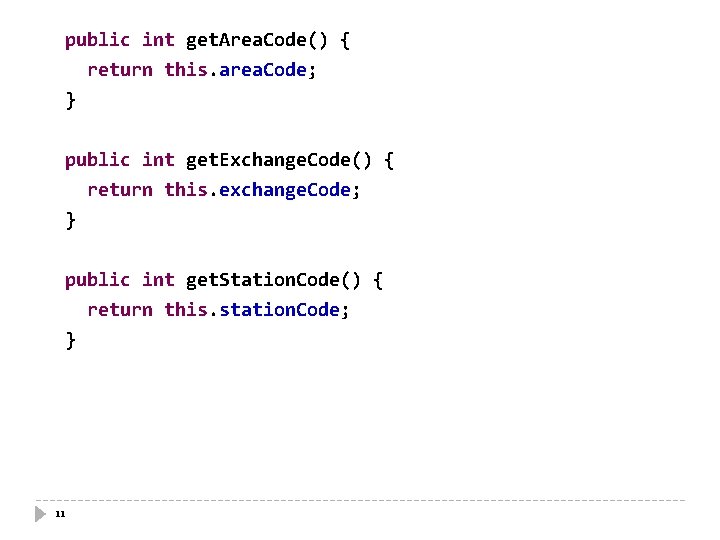
public int get. Area. Code() { return this. area. Code; } public int get. Exchange. Code() { return this. exchange. Code; } public int get. Station. Code() { return this. station. Code; } 11
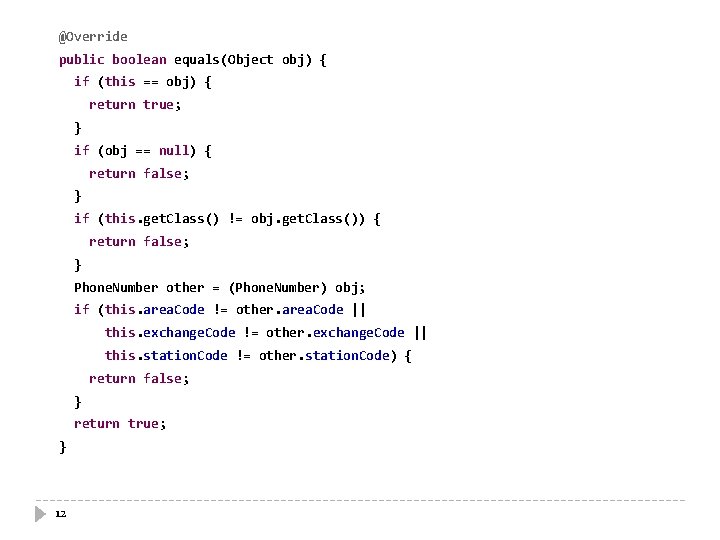
@Override public boolean equals(Object obj) { if (this == obj) { return true; } if (obj == null) { return false; } if (this. get. Class() != obj. get. Class()) { return false; } Phone. Number other = (Phone. Number) obj; if (this. area. Code != other. area. Code || this. exchange. Code != other. exchange. Code || this. station. Code != other. station. Code) { return false; } return true; } 12
Mixing Static and Non-static Multiton 13
Goals for Today � Multiton � review maps � static factory methods 14
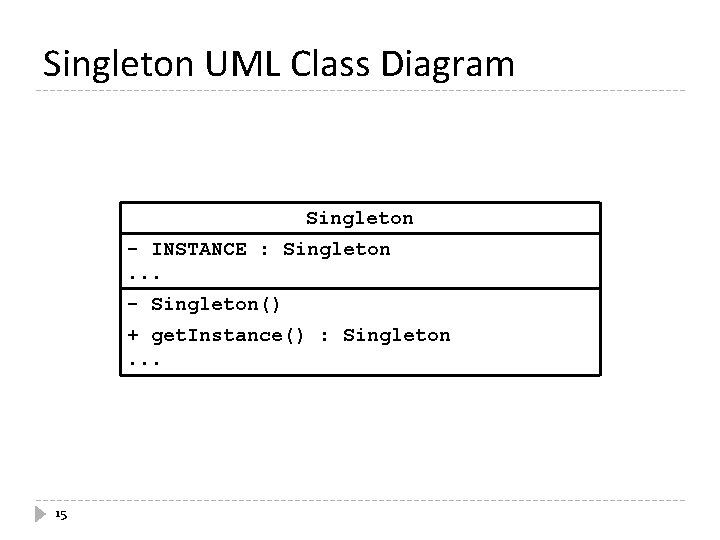
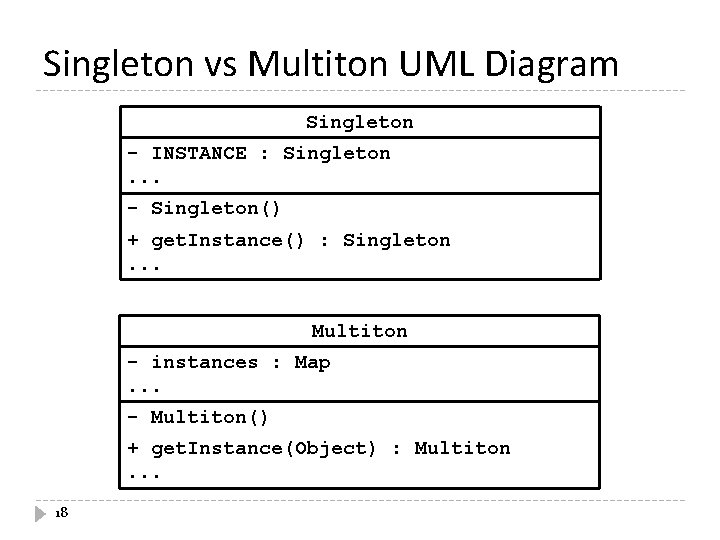
Singleton UML Class Diagram Singleton - INSTANCE : Singleton. . . - Singleton() + get. Instance() : Singleton. . . 15
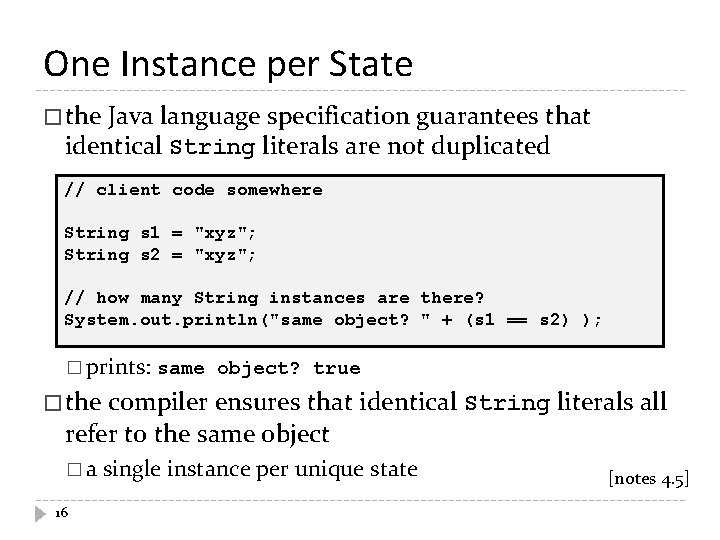
One Instance per State � the Java language specification guarantees that identical String literals are not duplicated // client code somewhere String s 1 = "xyz"; String s 2 = "xyz"; // how many String instances are there? System. out. println("same object? " + (s 1 == s 2) ); � prints: same object? true � the compiler ensures that identical String literals all refer to the same object �a 16 single instance per unique state [notes 4. 5]
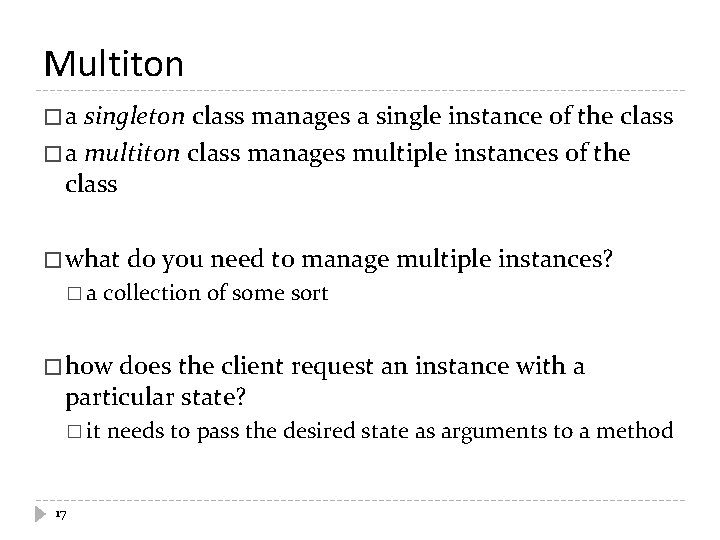
Multiton �a singleton class manages a single instance of the class � a multiton class manages multiple instances of the class � what �a do you need to manage multiple instances? collection of some sort � how does the client request an instance with a particular state? � it 17 needs to pass the desired state as arguments to a method
Singleton vs Multiton UML Diagram Singleton - INSTANCE : Singleton. . . - Singleton() + get. Instance() : Singleton. . . Multiton - instances : Map. . . - Multiton() + get. Instance(Object) : Multiton. . . 18
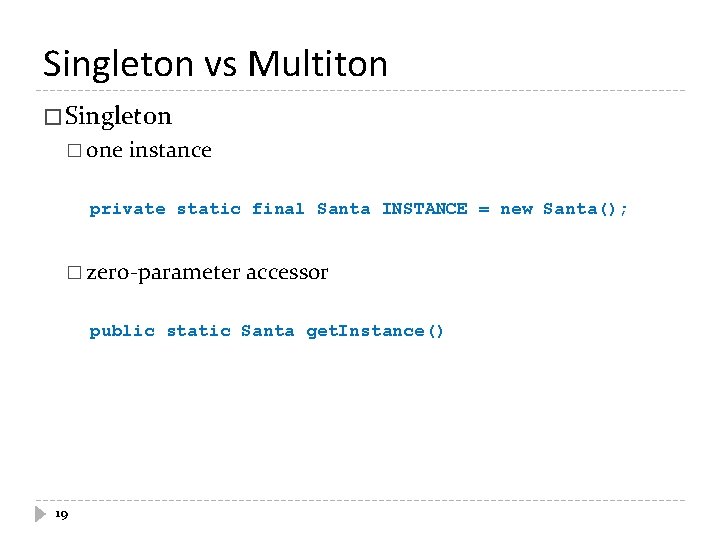
Singleton vs Multiton � Singleton � one instance private static final Santa INSTANCE = new Santa(); � zero-parameter accessor public static Santa get. Instance() 19
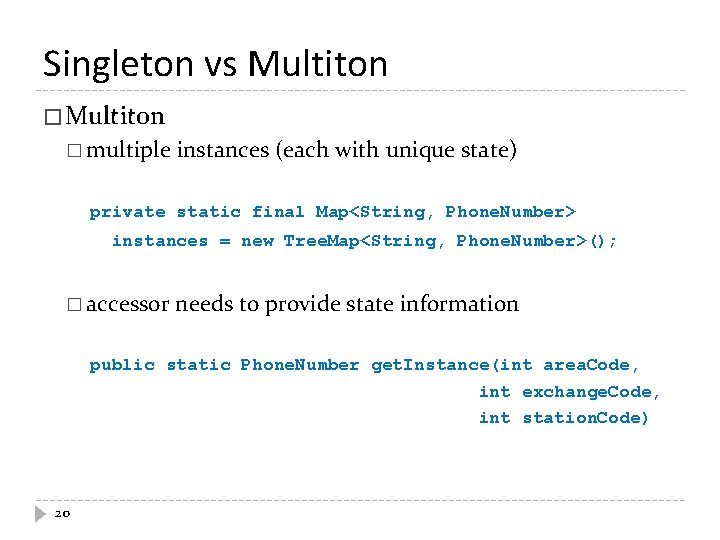
Singleton vs Multiton � multiple instances (each with unique state) private static final Map<String, Phone. Number> instances = new Tree. Map<String, Phone. Number>(); � accessor needs to provide state information public static Phone. Number get. Instance(int area. Code, int exchange. Code, int station. Code) 20
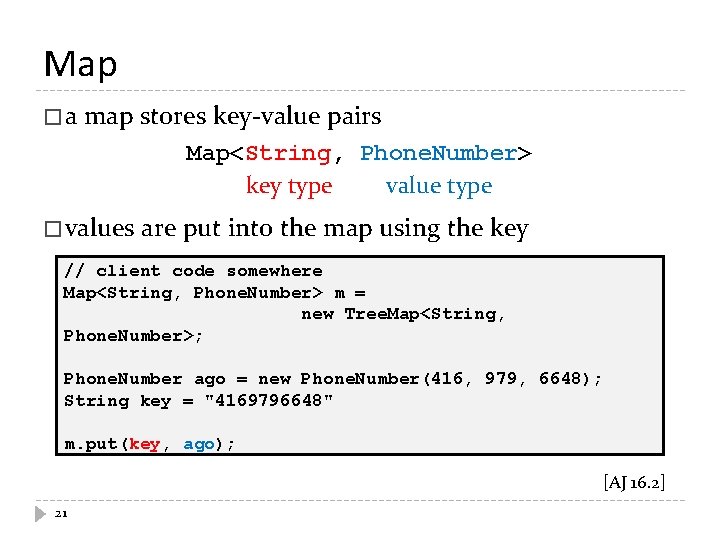
Map �a map stores key-value pairs Map<String, Phone. Number> key type value type � values are put into the map using the key // client code somewhere Map<String, Phone. Number> m = new Tree. Map<String, Phone. Number>; Phone. Number ago = new Phone. Number(416, 979, 6648); String key = "4169796648" m. put(key, ago); [AJ 16. 2] 21
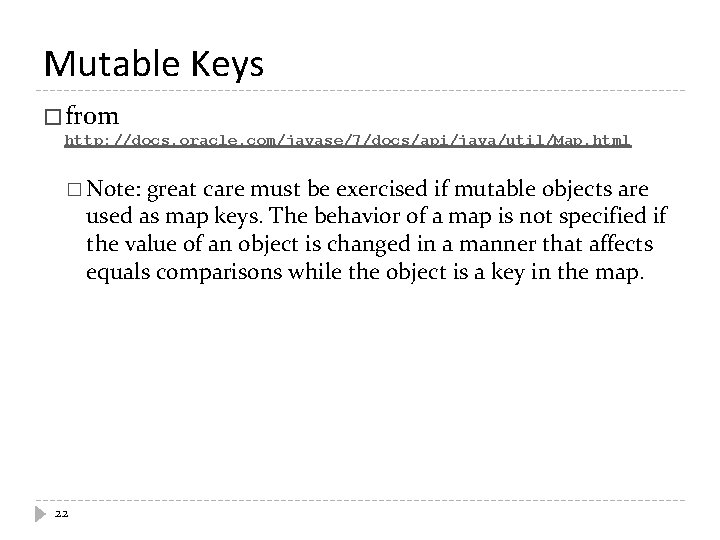
Mutable Keys � from http: //docs. oracle. com/javase/7/docs/api/java/util/Map. html � Note: great care must be exercised if mutable objects are used as map keys. The behavior of a map is not specified if the value of an object is changed in a manner that affects equals comparisons while the object is a key in the map. 22
public class Mutable. Key { public static void main(String[] args) { Map<Date, String> m = new Tree. Map<Date, String>(); Date d 1 = new Date(100, 0, 1); Date d 2 = new Date(100, 0, 2); Date d 3 = new Date(100, 0, 3); m. put(d 1, "Jan 1, 2000"); m. put(d 2, "Jan 2, 2000"); m. put(d 3, "Jan 3, 2000"); d 2. set. Year(101); // mutator don't mutate keys; bad things will happen System. out. println("d 1 " + m. get(d 1)); // d 1 Jan 1, 2000 System. out. println("d 2 " + m. get(d 2)); // d 2 Jan 2, 2000 System. out. println("d 3 " + m. get(d 3)); // d 3 null } } change Tree. Map to Hash. Map and see what happens 23
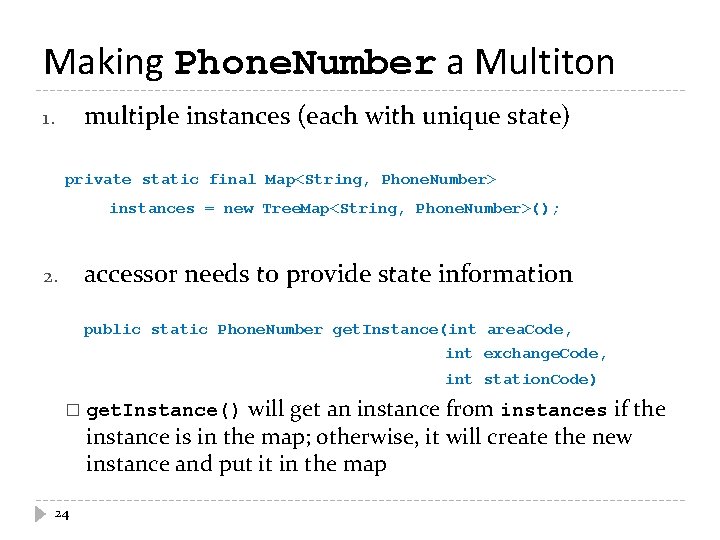
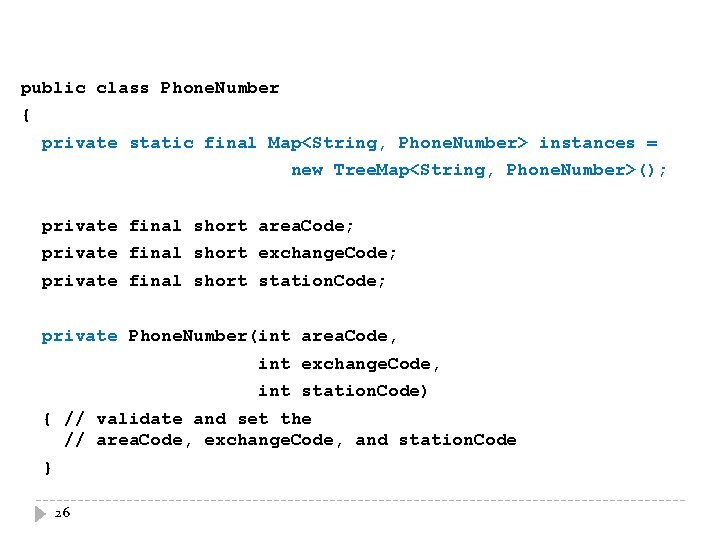
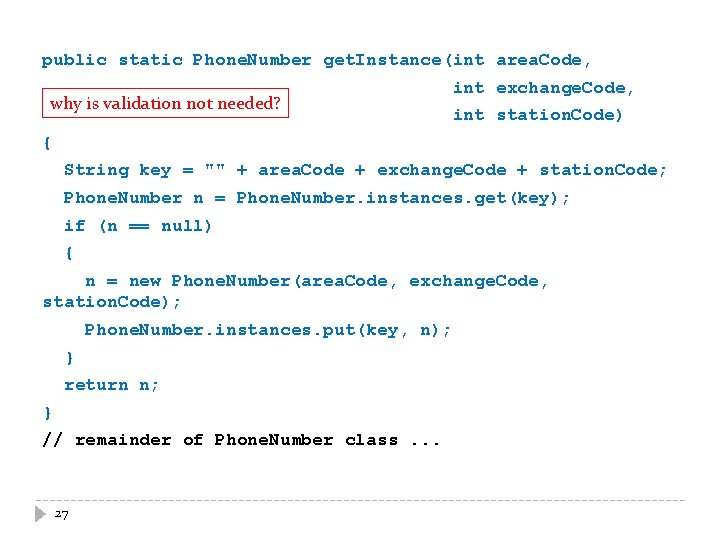
Making Phone. Number a Multiton multiple instances (each with unique state) 1. private static final Map<String, Phone. Number> instances = new Tree. Map<String, Phone. Number>(); accessor needs to provide state information 2. public static Phone. Number get. Instance(int area. Code, int exchange. Code, int station. Code) � get. Instance() will get an instance from instances if the instance is in the map; otherwise, it will create the new instance and put it in the map 24
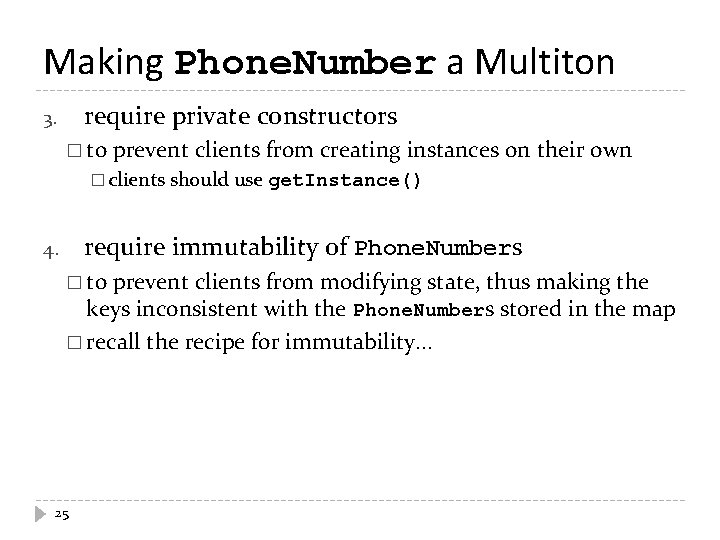
Making Phone. Number a Multiton require private constructors 3. � to prevent clients from creating instances on their own � clients should use get. Instance() require immutability of Phone. Numbers 4. � to prevent clients from modifying state, thus making the keys inconsistent with the Phone. Numbers stored in the map � recall the recipe for immutability. . . 25
public class Phone. Number { private static final Map<String, Phone. Number> instances = new Tree. Map<String, Phone. Number>(); private final short area. Code; private final short exchange. Code; private final short station. Code; private Phone. Number(int area. Code, int exchange. Code, int station. Code) { // validate and set the // area. Code, exchange. Code, and station. Code } 26
public static Phone. Number get. Instance(int area. Code, why is validation not needed? int exchange. Code, int station. Code) { String key = "" + area. Code + exchange. Code + station. Code; Phone. Number n = Phone. Number. instances. get(key); if (n == null) { n = new Phone. Number(area. Code, exchange. Code, station. Code); Phone. Number. instances. put(key, n); } return n; } // remainder of Phone. Number class. . . 27
public class Phone. Number. Client { public static void main(String[] args) { Phone. Number x = Phone. Number. get. Instance(416, 736, 2100); Phone. Number y = Phone. Number. get. Instance(416, 736, 2100); Phone. Number z = Phone. Number. get. Instance(905, 867, 5309); System. out. println("x equals y: " + x. equals(y) + " and x == y: " + (x == y)); System. out. println("x equals z: " + x. equals(z) + " and x == z: " + (x == z)); } } x equals y: true and x == y: true x equals z: false and x == z: false 28
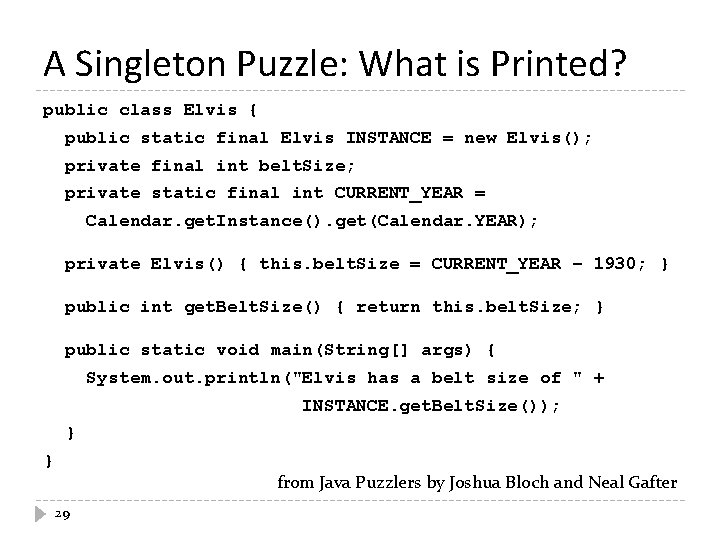
A Singleton Puzzle: What is Printed? public class Elvis { public static final Elvis INSTANCE = new Elvis(); private final int belt. Size; private static final int CURRENT_YEAR = Calendar. get. Instance(). get(Calendar. YEAR); private Elvis() { this. belt. Size = CURRENT_YEAR – 1930; } public int get. Belt. Size() { return this. belt. Size; } public static void main(String[] args) { System. out. println("Elvis has a belt size of " + INSTANCE. get. Belt. Size()); } } from Java Puzzlers by Joshua Bloch and Neal Gafter 29