
SingleFactor Experiments What is a true experiment Betweensubjects
Single-Factor Experiments • What is a true experiment? • Between-subjects designs • Within-subjects designs
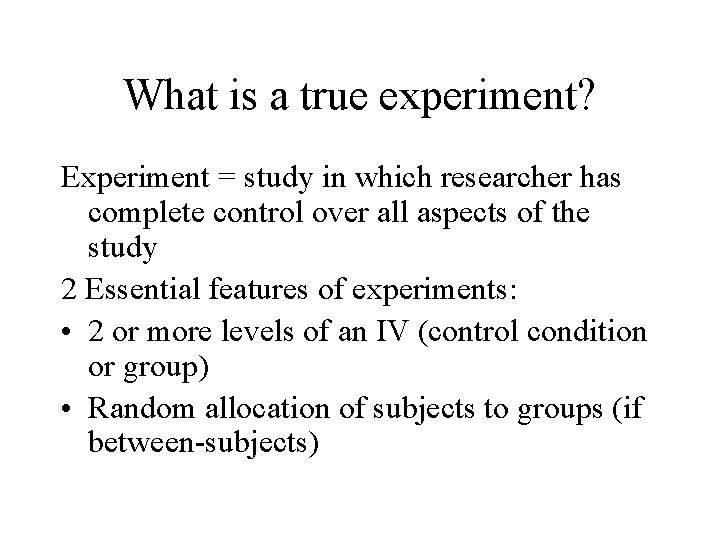
What is a true experiment? Experiment = study in which researcher has complete control over all aspects of the study 2 Essential features of experiments: • 2 or more levels of an IV (control condition or group) • Random allocation of subjects to groups (if between-subjects)
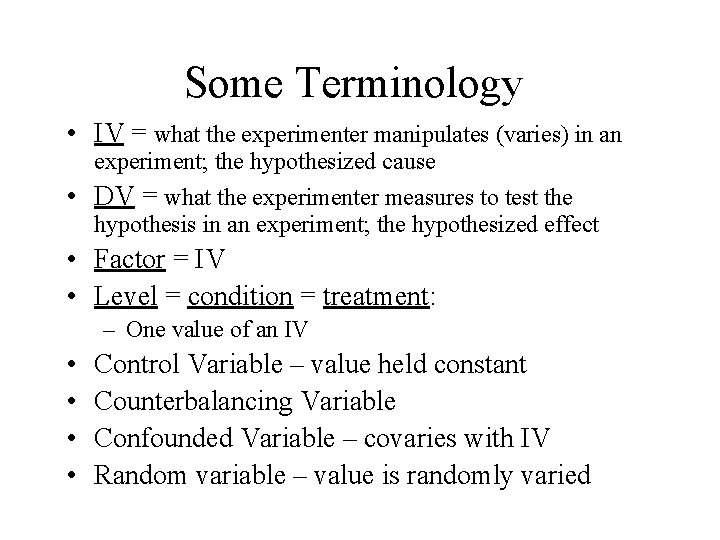
Some Terminology • IV = what the experimenter manipulates (varies) in an experiment; the hypothesized cause • DV = what the experimenter measures to test the hypothesis in an experiment; the hypothesized effect • Factor = IV • Level = condition = treatment: – One value of an IV • • Control Variable – value held constant Counterbalancing Variable Confounded Variable – covaries with IV Random variable – value is randomly varied
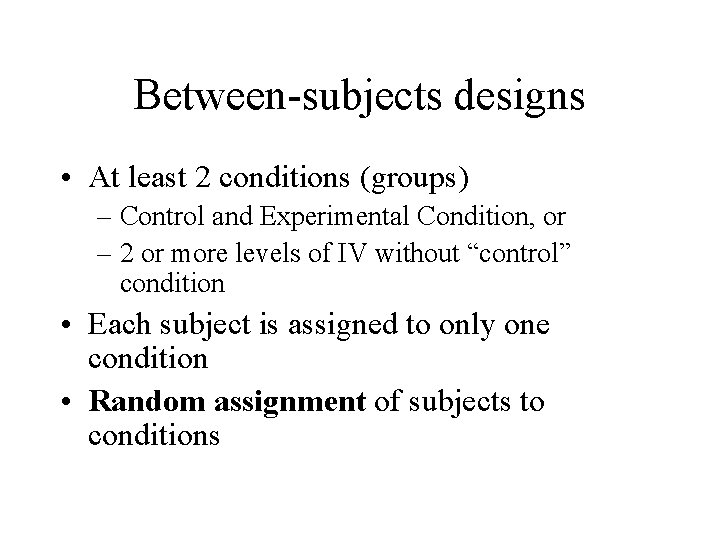
Between-subjects designs • At least 2 conditions (groups) – Control and Experimental Condition, or – 2 or more levels of IV without “control” condition • Each subject is assigned to only one condition • Random assignment of subjects to conditions
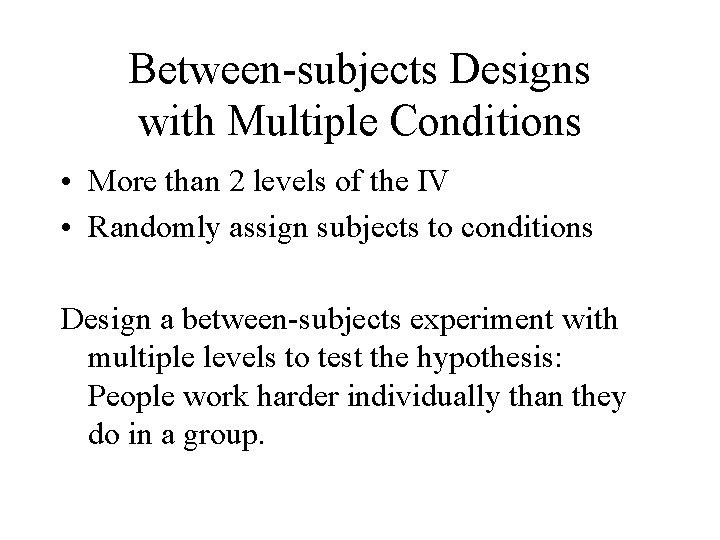
Between-subjects Designs with Multiple Conditions • More than 2 levels of the IV • Randomly assign subjects to conditions Design a between-subjects experiment with multiple levels to test the hypothesis: People work harder individually than they do in a group.
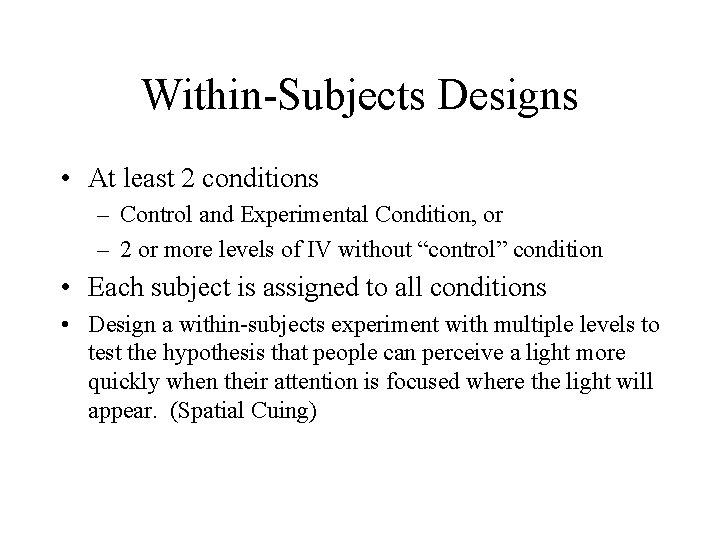
Within-Subjects Designs • At least 2 conditions – Control and Experimental Condition, or – 2 or more levels of IV without “control” condition • Each subject is assigned to all conditions • Design a within-subjects experiment with multiple levels to test the hypothesis that people can perceive a light more quickly when their attention is focused where the light will appear. (Spatial Cuing)
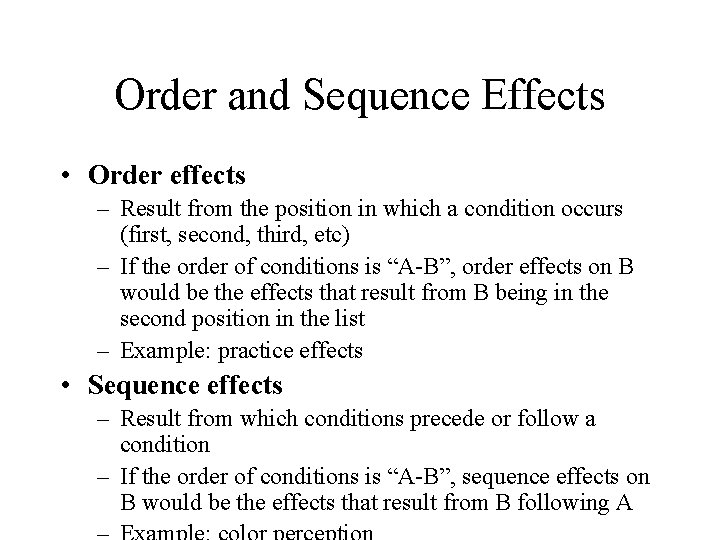
Order and Sequence Effects • Order effects – Result from the position in which a condition occurs (first, second, third, etc) – If the order of conditions is “A-B”, order effects on B would be the effects that result from B being in the second position in the list – Example: practice effects • Sequence effects – Result from which conditions precede or follow a condition – If the order of conditions is “A-B”, sequence effects on B would be the effects that result from B following A
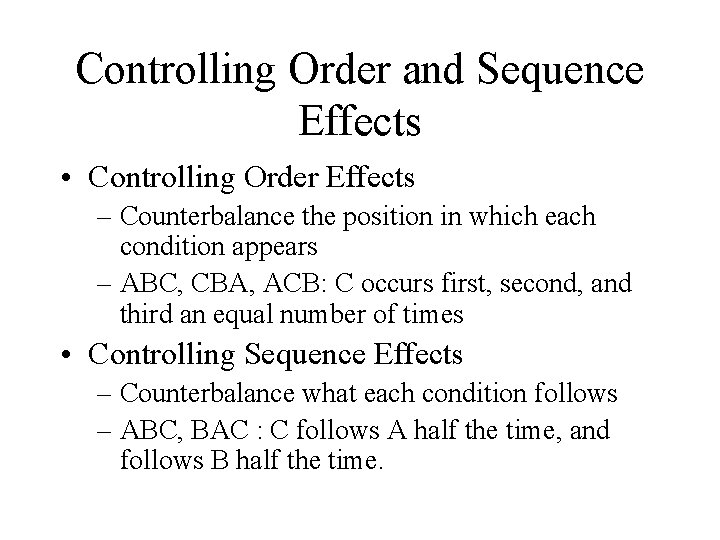
Controlling Order and Sequence Effects • Controlling Order Effects – Counterbalance the position in which each condition appears – ABC, CBA, ACB: C occurs first, second, and third an equal number of times • Controlling Sequence Effects – Counterbalance what each condition follows – ABC, BAC : C follows A half the time, and follows B half the time.
Counterbalancing in Within-Subjects Designs • Counterbalancing within subjects – Useful when each level of the IV occurs multiple times for each subject – Each subject gets all sequences of the conditions (ideally) • Counterbalancing within groups (not within each subject) – Useful when there are many (more than 2) conditions – Necessary if each condition occurs only once per subject – An equal number of subjects get each sequence of the conditions (ideally)
Controlling Order and Sequence Effects Within Subjects • Only possible when each condition occurs at least twice for each subject • Method depends on how many times each condition occurs per subject: – Many times: randomize order of conditions – A few times: use block randomization of conditions – Twice: use reverse counterbalancing
Controlling Order and Sequence Effects Within Groups • When it is not possible or practical to control within subjects • Necessary if each condition occurs only once for each subject • Sequences and orders controlled within a group of subjects, but not within each subject • Latin Square – a technique for partial counterbalancing (when full counterbalancing is impractical)
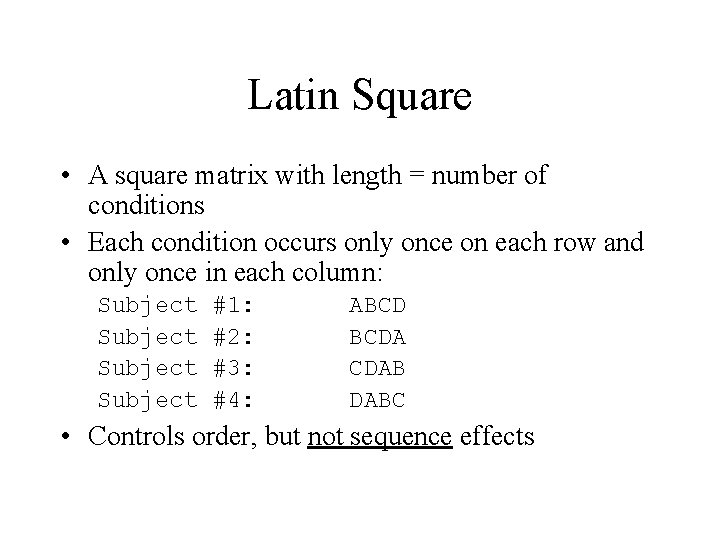
Latin Square • A square matrix with length = number of conditions • Each condition occurs only once on each row and only once in each column: Subject #1: #2: #3: #4: ABCD BCDA CDAB DABC • Controls order, but not sequence effects
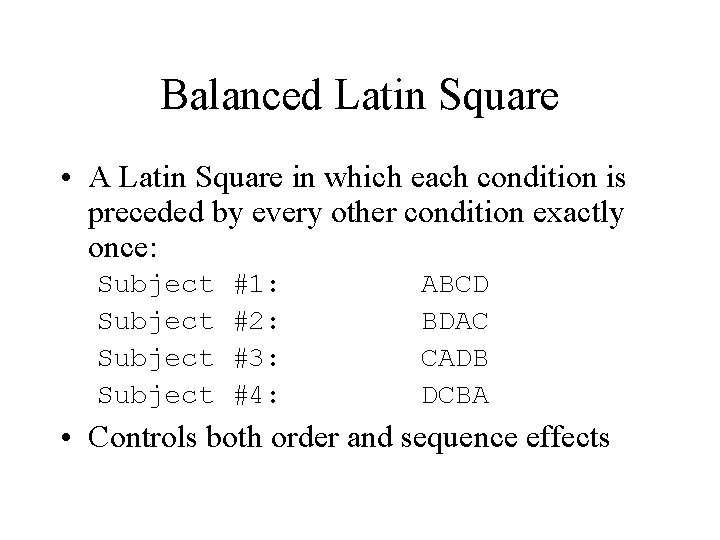
Balanced Latin Square • A Latin Square in which each condition is preceded by every other condition exactly once: Subject #1: #2: #3: #4: ABCD BDAC CADB DCBA • Controls both order and sequence effects
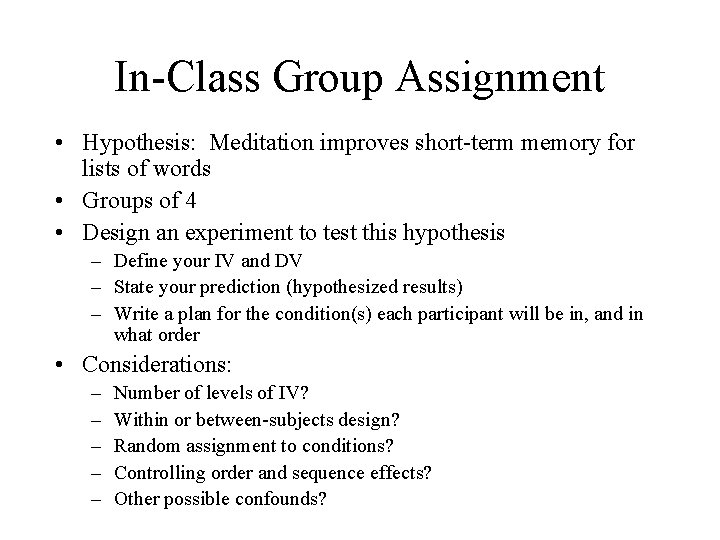
In-Class Group Assignment • Hypothesis: Meditation improves short-term memory for lists of words • Groups of 4 • Design an experiment to test this hypothesis – Define your IV and DV – State your prediction (hypothesized results) – Write a plan for the condition(s) each participant will be in, and in what order • Considerations: – – – Number of levels of IV? Within or between-subjects design? Random assignment to conditions? Controlling order and sequence effects? Other possible confounds?
- Slides: 14