
Single wavelength channel optical communication Tx 1 Modulator







- Slides: 34
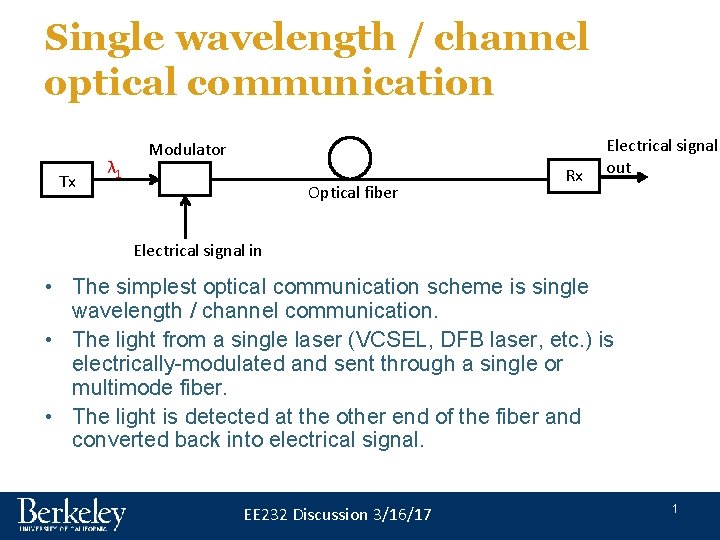
Single wavelength / channel optical communication Tx λ 1 Modulator Optical fiber Rx Electrical signal out Electrical signal in • The simplest optical communication scheme is single wavelength / channel communication. • The light from a single laser (VCSEL, DFB laser, etc. ) is electrically-modulated and sent through a single or multimode fiber. • The light is detected at the other end of the fiber and converted back into electrical signal. EE 232 Discussion 3/16/17 1
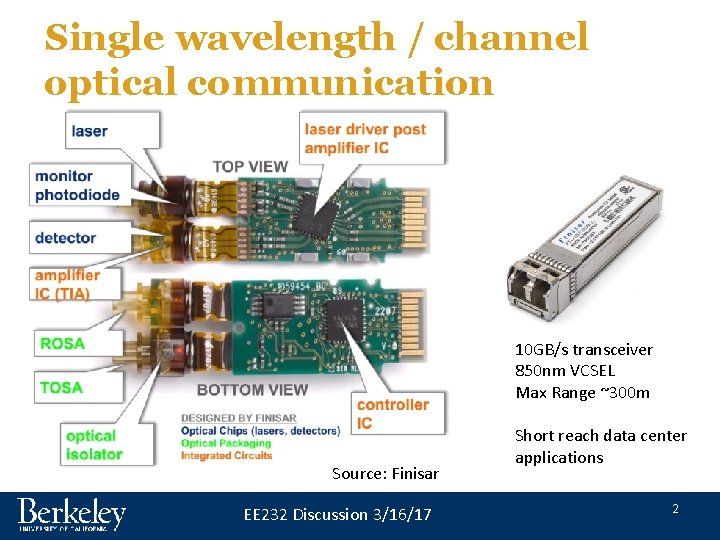
Single wavelength / channel optical communication 10 GB/s transceiver 850 nm VCSEL Max Range ~300 m Source: Finisar EE 232 Discussion 3/16/17 Short reach data center applications 2
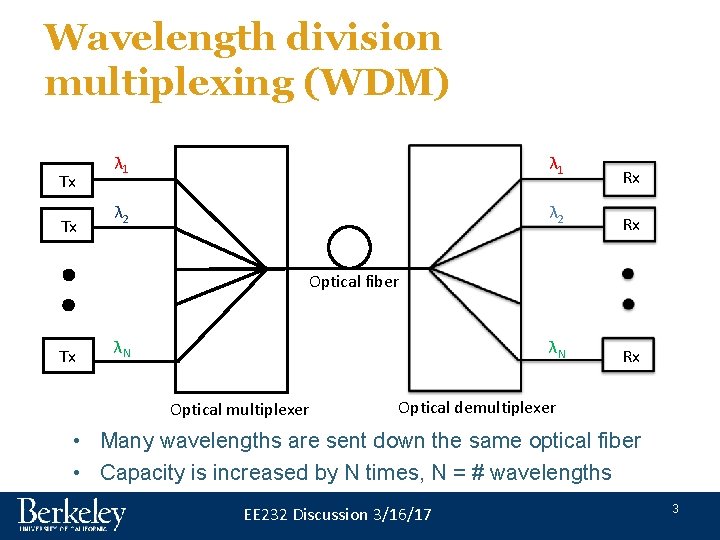
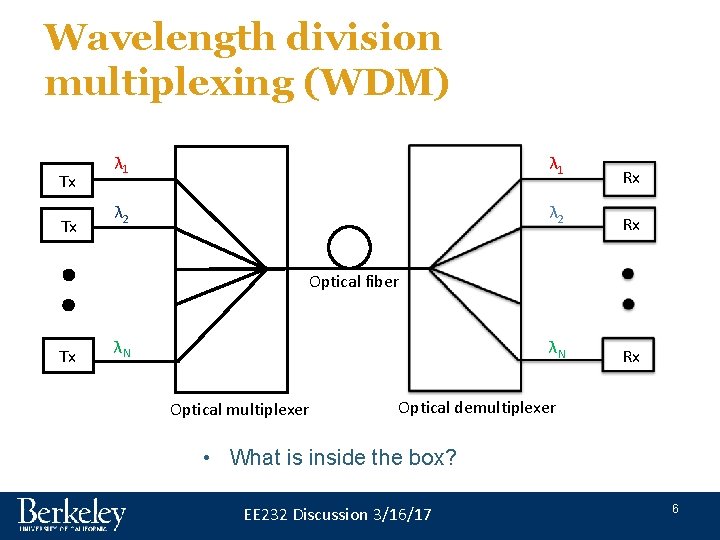
Wavelength division multiplexing (WDM) Tx Tx λ 1 λ 2 Rx Rx Optical fiber Tx λN λN Optical multiplexer Rx Optical demultiplexer • Many wavelengths are sent down the same optical fiber • Capacity is increased by N times, N = # wavelengths EE 232 Discussion 3/16/17 3
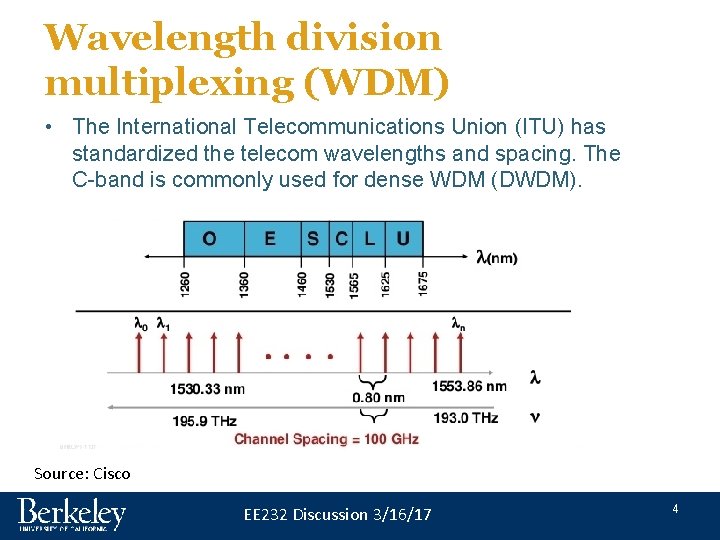
Wavelength division multiplexing (WDM) • The International Telecommunications Union (ITU) has standardized the telecom wavelengths and spacing. The C-band is commonly used for dense WDM (DWDM). Source: Cisco EE 232 Discussion 3/16/17 4
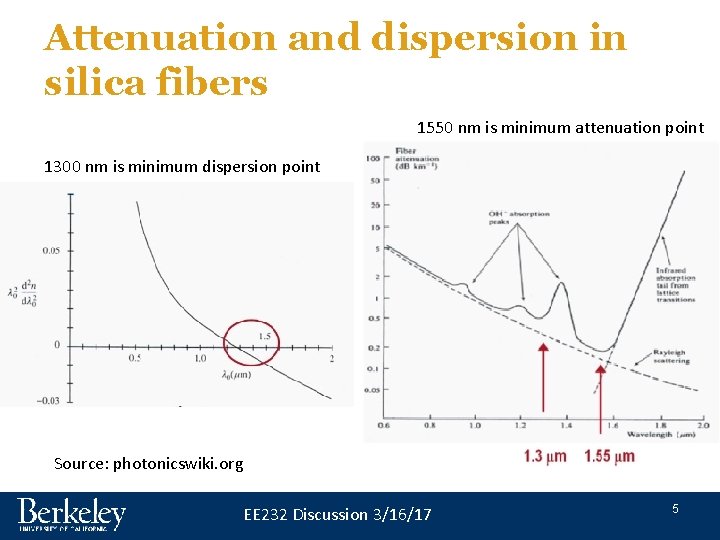
Attenuation and dispersion in silica fibers 1550 nm is minimum attenuation point 1300 nm is minimum dispersion point Source: photonicswiki. org EE 232 Discussion 3/16/17 5
Wavelength division multiplexing (WDM) Tx Tx λ 1 λ 2 Rx Rx Optical fiber Tx λN λN Optical multiplexer Rx Optical demultiplexer • What is inside the box? EE 232 Discussion 3/16/17 6
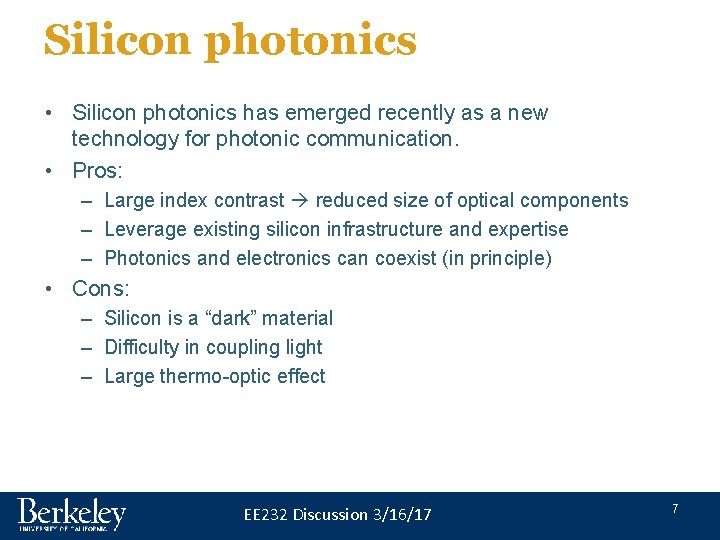
Silicon photonics • Silicon photonics has emerged recently as a new technology for photonic communication. • Pros: – Large index contrast reduced size of optical components – Leverage existing silicon infrastructure and expertise – Photonics and electronics can coexist (in principle) • Cons: – Silicon is a “dark” material – Difficulty in coupling light – Large thermo-optic effect EE 232 Discussion 3/16/17 7
Silicon photonics • For the next three class periods we will discuss strategies to demodulate and modulate optical signals • We will primarily focus on ring resonator based designs although by no means the only way to multiplex or demultiplex light. • First, we need to discuss one important passive optical component called the directional coupler. EE 232 Discussion 3/16/17 8
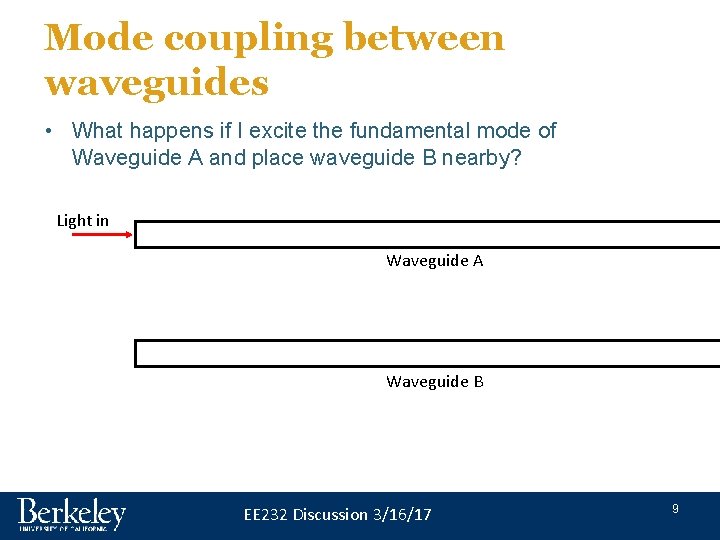
Mode coupling between waveguides • What happens if I excite the fundamental mode of Waveguide A and place waveguide B nearby? Light in Waveguide A Waveguide B EE 232 Discussion 3/16/17 9
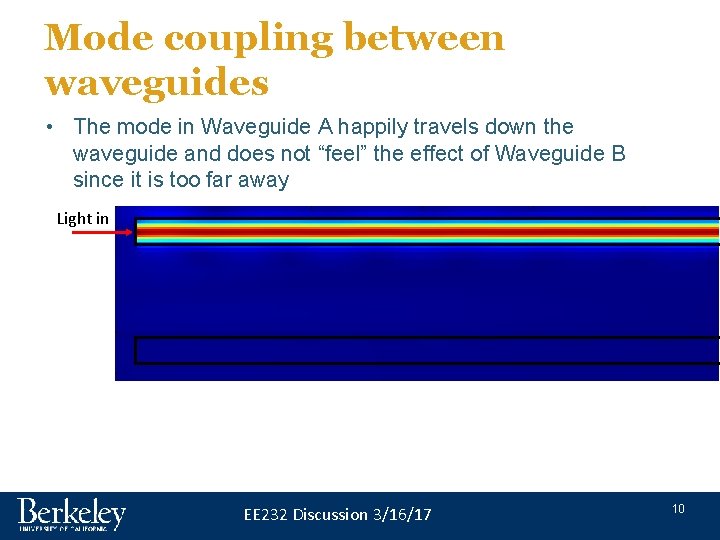
Mode coupling between waveguides • The mode in Waveguide A happily travels down the waveguide and does not “feel” the effect of Waveguide B since it is too far away Light in EE 232 Discussion 3/16/17 10
Mode coupling between waveguides • Now, what if waveguide A and waveguide B are placed right next to each other. The fundamental modes of each waveguide are coupled and will form a “supermode”. • What if we excite the supermode? Light in Waveguide A Waveguide B EE 232 Discussion 3/16/17 11
Mode coupling between waveguides • The “supermode” happily travels down the waveguide Light in Waveguide A Waveguide B EE 232 Discussion 3/16/17 12
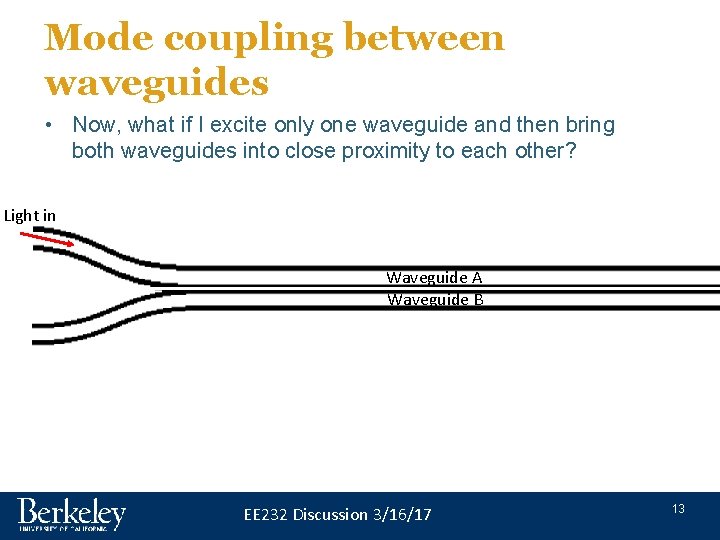
Mode coupling between waveguides • Now, what if I excite only one waveguide and then bring both waveguides into close proximity to each other? Light in Waveguide A Waveguide B EE 232 Discussion 3/16/17 13
Mode coupling between waveguides • Energy periodically sloshes back and forth between both waveguides. Waveguide A Waveguide B EE 232 Discussion 3/16/17 14
Mode coupling between waveguides Power in Waveguide A EE 232 Discussion 3/16/17 Power in Waveguide B 15
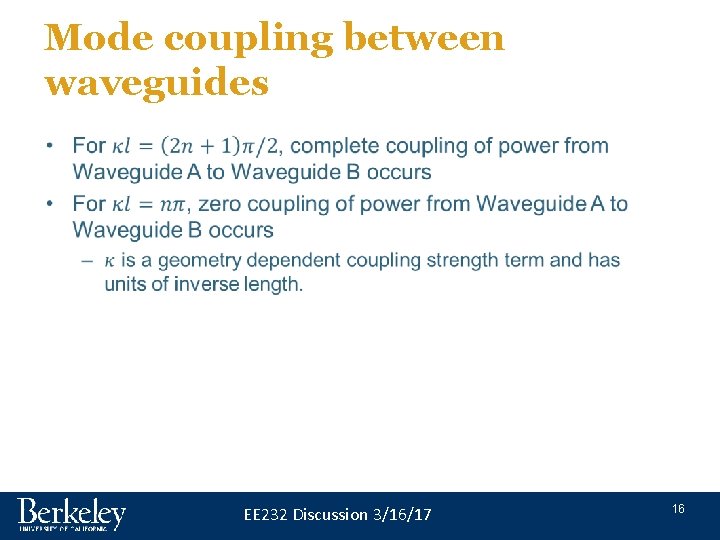
Mode coupling between waveguides • EE 232 Discussion 3/16/17 16
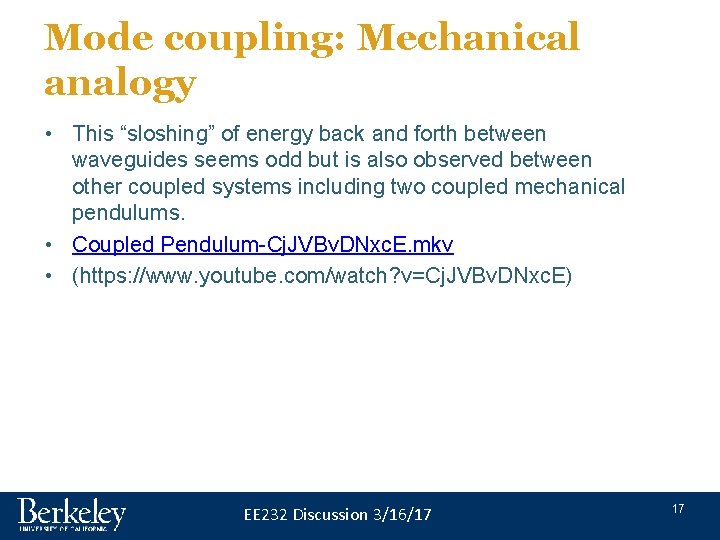
Mode coupling: Mechanical analogy • This “sloshing” of energy back and forth between waveguides seems odd but is also observed between other coupled systems including two coupled mechanical pendulums. • Coupled Pendulum-Cj. JVBv. DNxc. E. mkv • (https: //www. youtube. com/watch? v=Cj. JVBv. DNxc. E) EE 232 Discussion 3/16/17 17
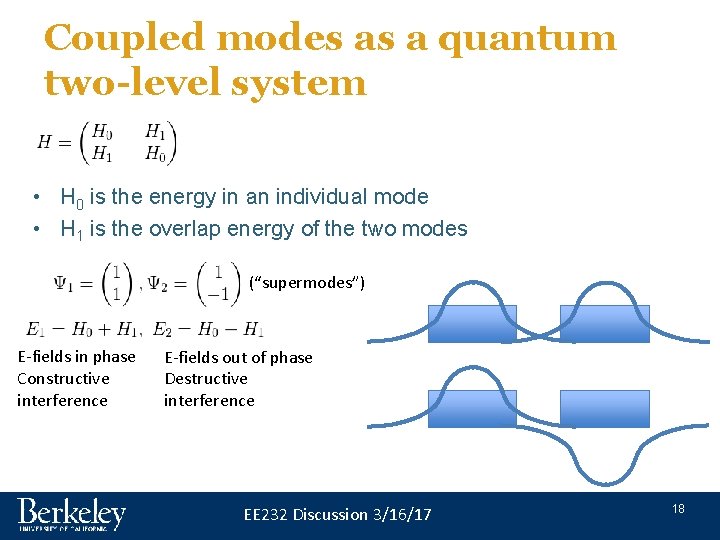
Coupled modes as a quantum two-level system • H 0 is the energy in an individual mode • H 1 is the overlap energy of the two modes (“supermodes”) E-fields in phase Constructive interference E-fields out of phase Destructive interference EE 232 Discussion 3/16/17 18
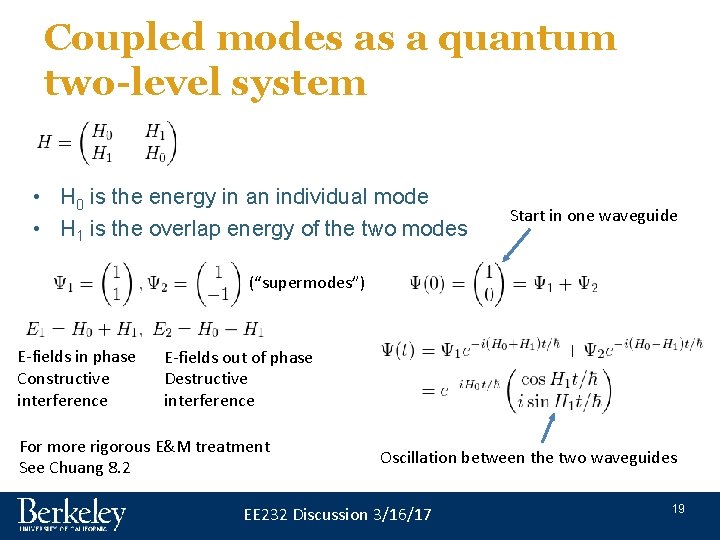
Coupled modes as a quantum two-level system • H 0 is the energy in an individual mode • H 1 is the overlap energy of the two modes Start in one waveguide (“supermodes”) E-fields in phase Constructive interference E-fields out of phase Destructive interference For more rigorous E&M treatment See Chuang 8. 2 Oscillation between the two waveguides EE 232 Discussion 3/16/17 19
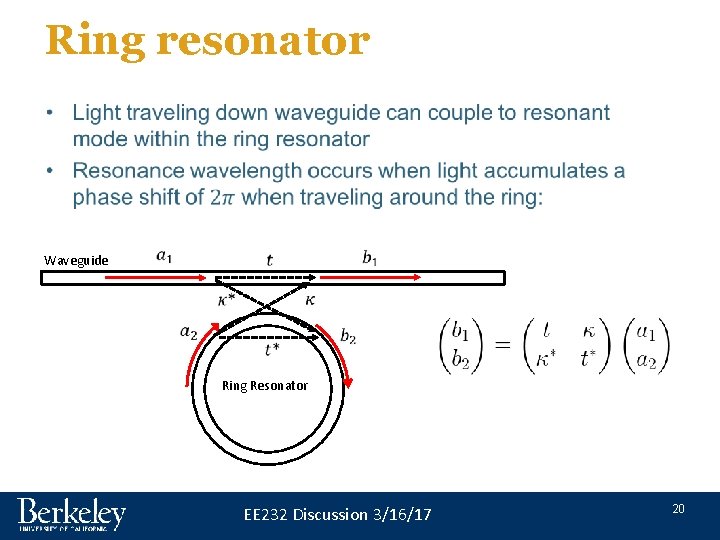
Ring resonator • Waveguide Ring Resonator EE 232 Discussion 3/16/17 20
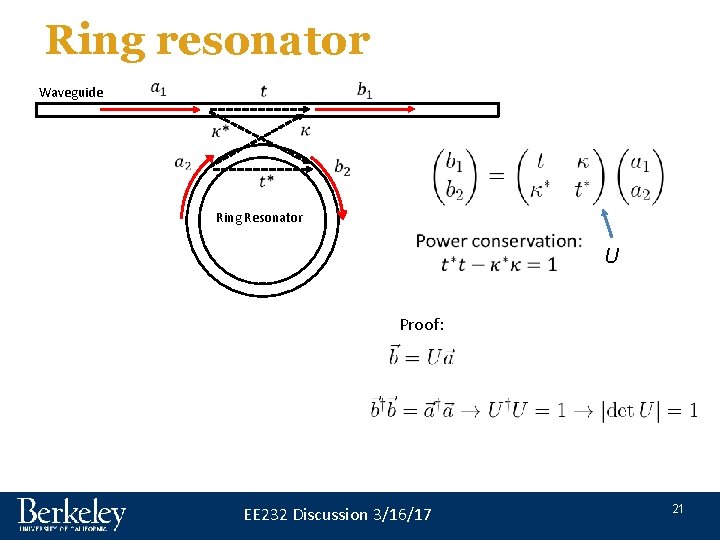
Ring resonator Waveguide Ring Resonator U Proof: EE 232 Discussion 3/16/17 21
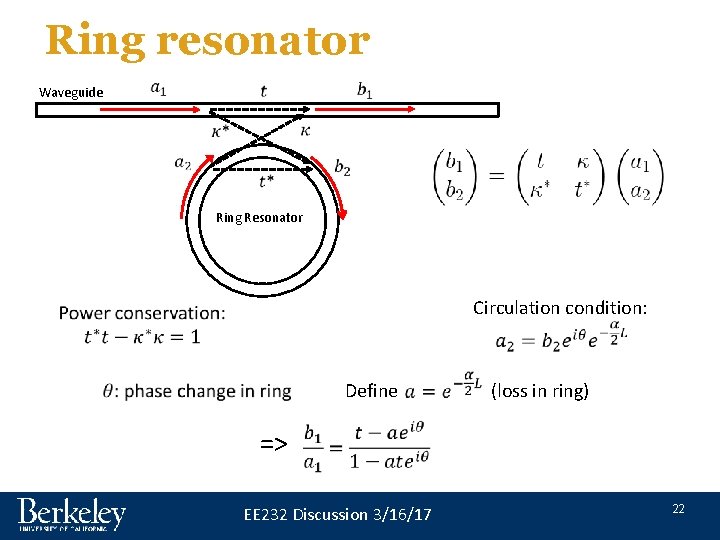
Ring resonator Waveguide Ring Resonator Circulation condition: Define => (loss in ring) EE 232 Discussion 3/16/17 22
Power transmission EE 232 Discussion 3/16/17 23
Ring resonator example • Hewlett Packard Enterprise - Silicon Microring Resonators -jd. AYo 5 b. M 01 k. mp 4 • (https: //www. youtube. com/watch? v=jd. AYo 5 b. M 01 k) EE 232 Discussion 3/16/17 24
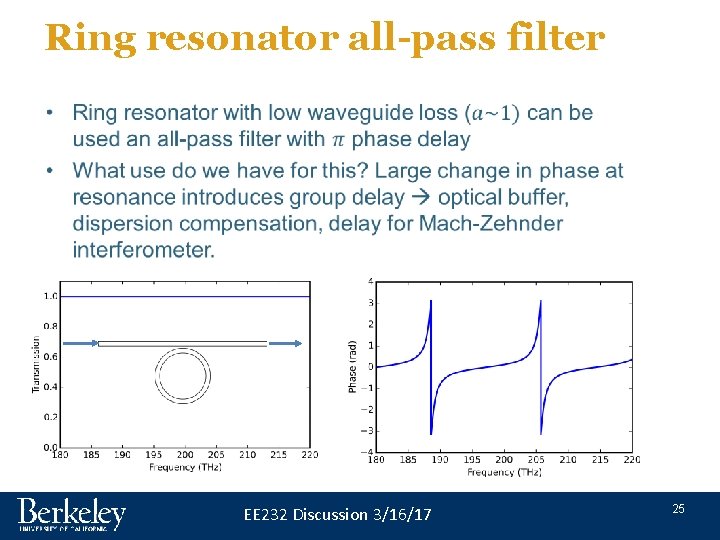
Ring resonator all-pass filter • EE 232 Discussion 3/16/17 25
Ring resonator all-pass filter Mach-Zehnder interferometer (MZI) Light in Light out Mach-Zehnder interferometer (MZI) w/ ring resonator delay stage Light in Light out Compact delay stage EE 232 Discussion 3/16/17 26
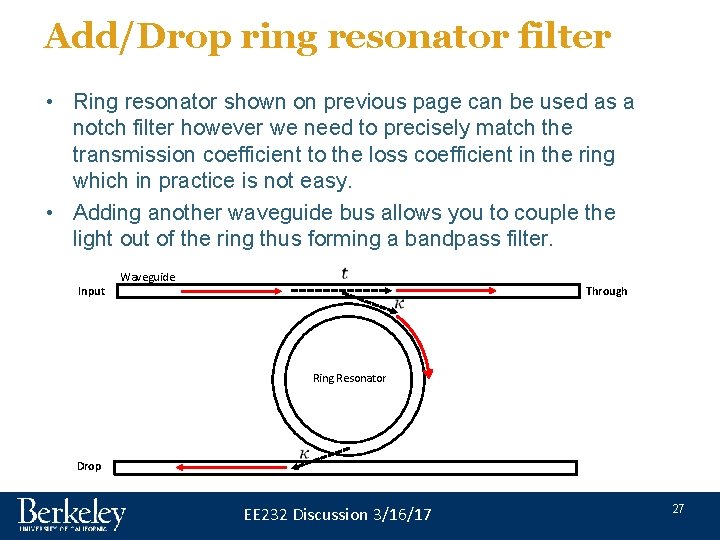
Add/Drop ring resonator filter • Ring resonator shown on previous page can be used as a notch filter however we need to precisely match the transmission coefficient to the loss coefficient in the ring which in practice is not easy. • Adding another waveguide bus allows you to couple the light out of the ring thus forming a bandpass filter. Input Waveguide Through Ring Resonator Drop EE 232 Discussion 3/16/17 27
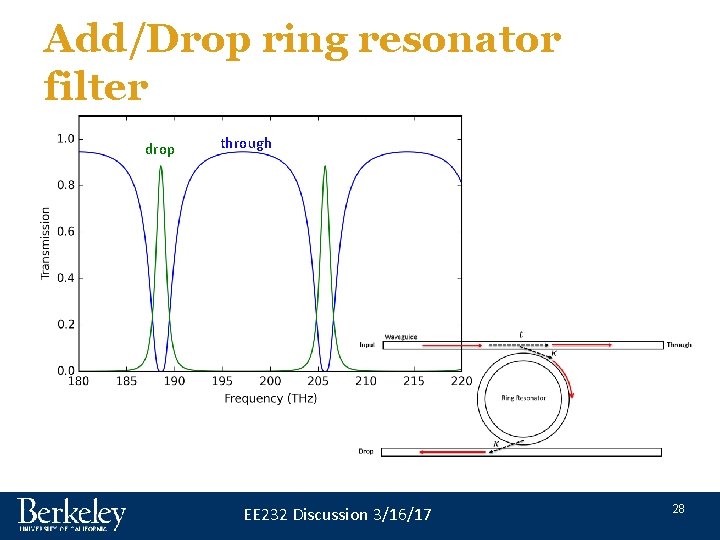
Add/Drop ring resonator filter drop through EE 232 Discussion 3/16/17 28
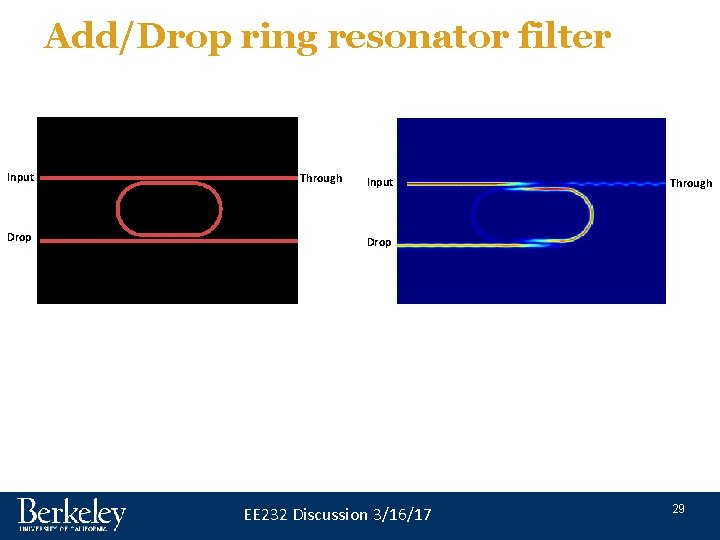
Add/Drop ring resonator filter Input Drop Through Input Through Drop EE 232 Discussion 3/16/17 29
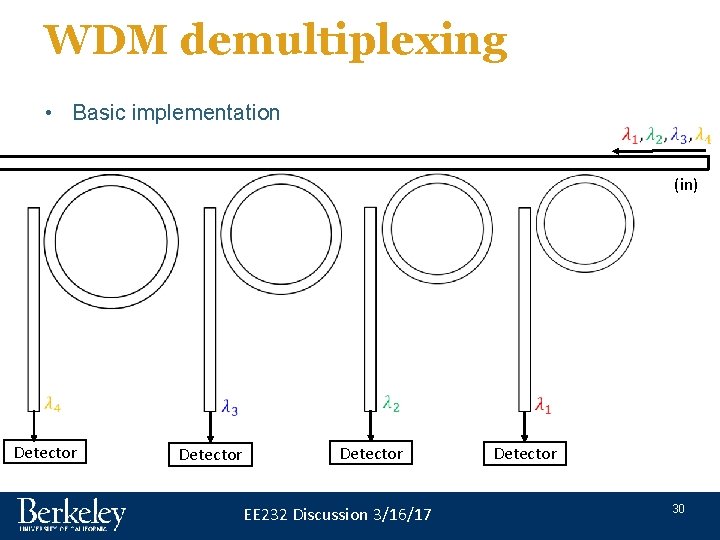
WDM demultiplexing • Basic implementation (in) Detector EE 232 Discussion 3/16/17 Detector 30
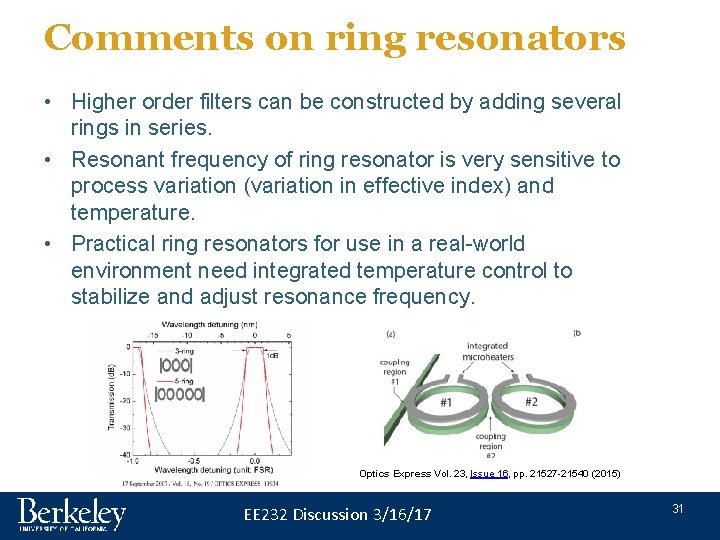
Comments on ring resonators • Higher order filters can be constructed by adding several rings in series. • Resonant frequency of ring resonator is very sensitive to process variation (variation in effective index) and temperature. • Practical ring resonators for use in a real-world environment need integrated temperature control to stabilize and adjust resonance frequency. Optics Express Vol. 23, Issue 16, pp. 21527 -21540 (2015) EE 232 Discussion 3/16/17 31
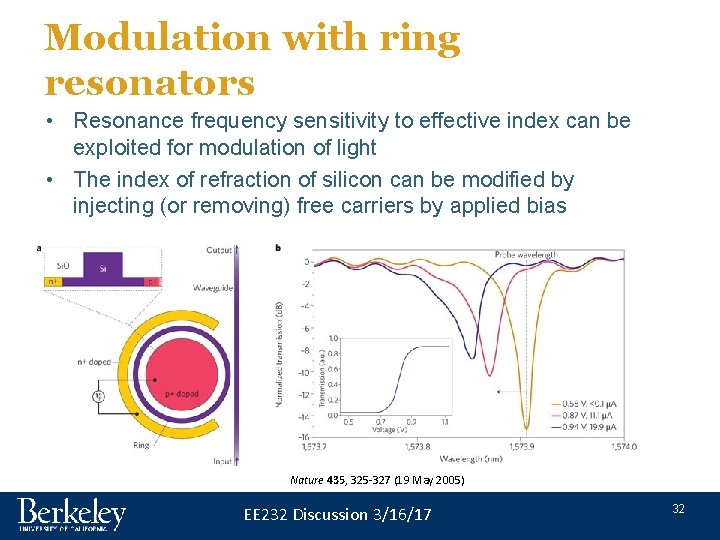
Modulation with ring resonators • Resonance frequency sensitivity to effective index can be exploited for modulation of light • The index of refraction of silicon can be modified by injecting (or removing) free carriers by applied bias Nature 435, 325 -327 (19 May 2005) EE 232 Discussion 3/16/17 32
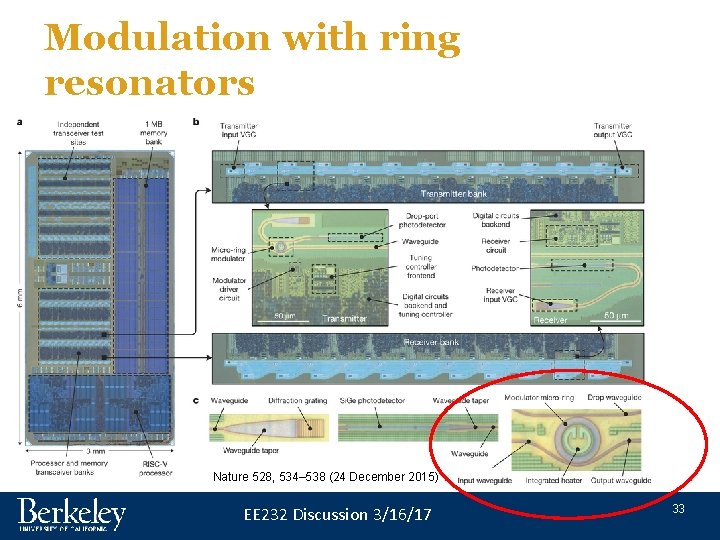
Modulation with ring resonators Nature 528, 534– 538 (24 December 2015) EE 232 Discussion 3/16/17 33
Next week • We will discuss modulation with ring resonators and begin designing a modulator based on change in refractive index of silicon with applied bias. • Please download and install Lumerical DEVICE (device simulator) if you have not already done so. EE 232 Discussion 3/16/17 34