
Single Trapped Ions for Atomic Parity Violation Measurements






- Slides: 41
Single Trapped Ions for Atomic Parity Violation Measurements Symmetries in Subatomic Physics 2018 Aachen, June 11 -15, 2018 Lorenz Willmann
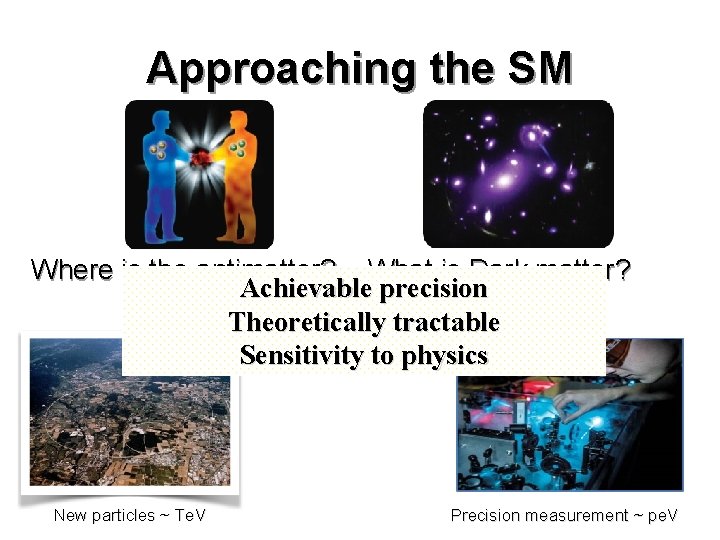
Approaching the SM Where is the antimatter? What is Dark matter? Achievable precision Theoretically tractable Sensitivity to physics New particles ~ Te. V Precision measurement ~ pe. V
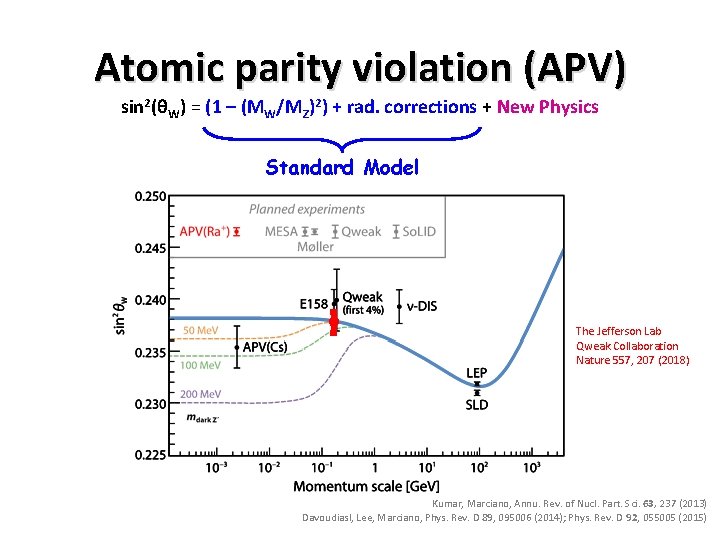
Atomic parity violation (APV) sin 2(θW) = (1 – (MW/MZ)2) + rad. corrections + New Physics Standard Model The Jefferson Lab Qweak Collaboration Nature 557, 207 (2018) Kumar, Marciano, Annu. Rev. of Nucl. Part. Sci. 63, 237 (2013) Davoudiasl, Lee, Marciano, Phys. Rev. D 89, 095006 (2014); Phys. Rev. D 92, 055005 (2015)
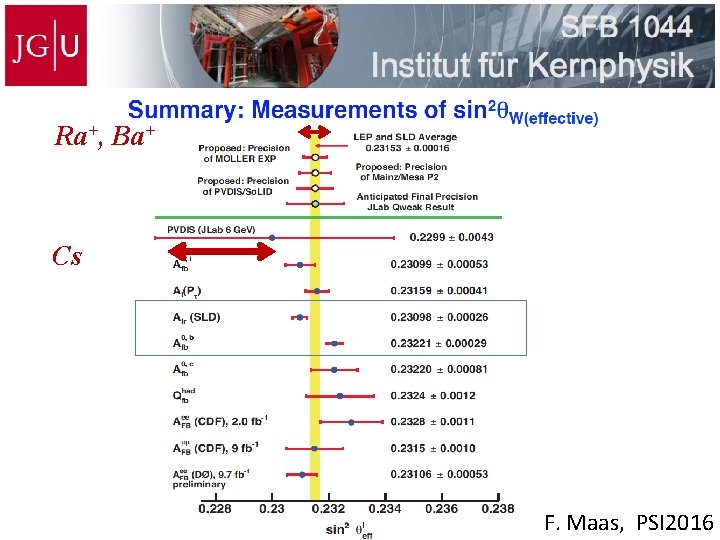
Ra+, Ba+ Cs F. Maas, PSI 2016
Single Ion APV ATOMIC SYSTEMS
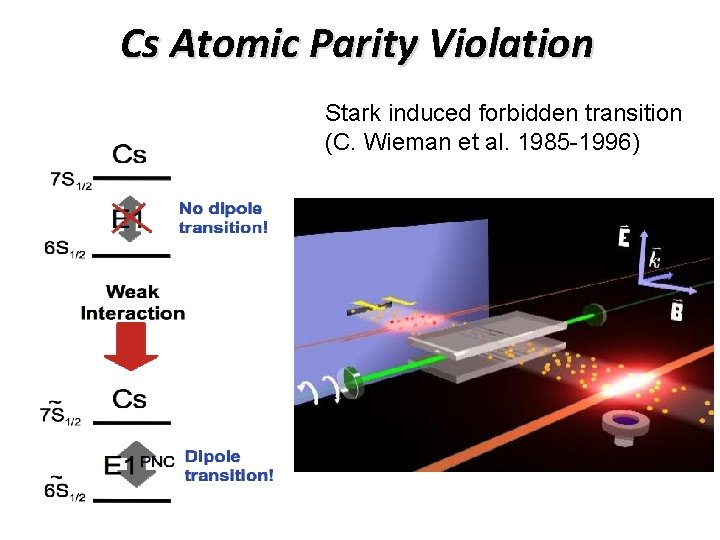
Cs Atomic Parity Violation Stark induced forbidden transition (C. Wieman et al. 1985 -1996)
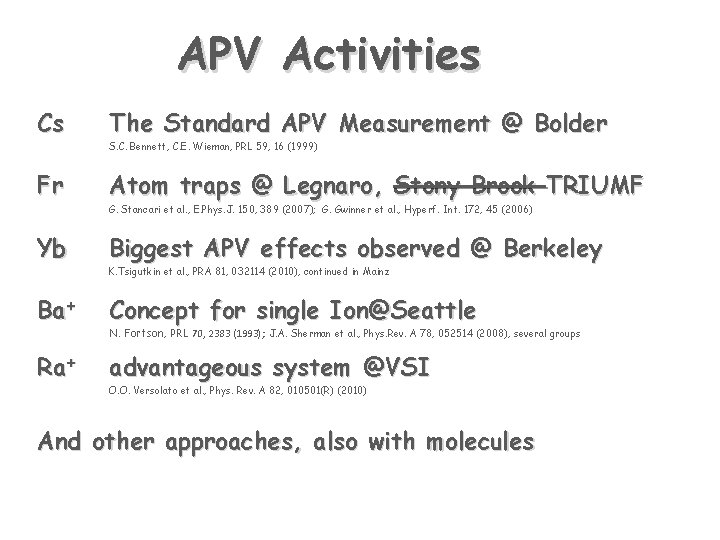
APV Activities Cs The Standard APV Measurement @ Bolder S. C. Bennett, C. E. Wieman, PRL 59, 16 (1999) Fr Atom traps @ Legnaro, Stony Brook TRIUMF G. Stancari et al. , E. Phys. J. 150, 389 (2007); G. Gwinner et al. , Hyperf. Int. 172, 45 (2006) Yb Biggest APV effects observed @ Berkeley K. Tsigutkin et al. , PRA 81, 032114 (2010), continued in Mainz Ba+ Concept for single Ion@Seattle Ra+ advantageous system @VSI N. Fortson, PRL 70, 2383 (1993); J. A. Sherman et al. , Phys. Rev. A 78, 052514 (2008), several groups O. O. Versolato et al. , Phys. Rev. A 82, 010501(R) (2010) And other approaches, also with molecules
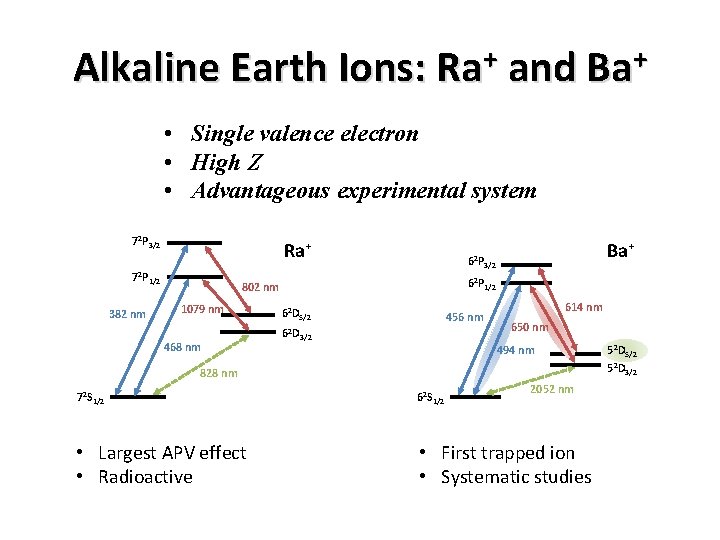
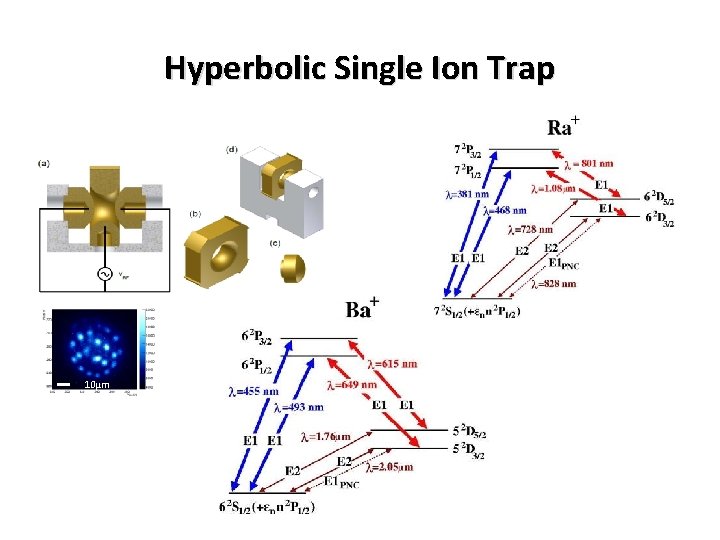
Alkaline Earth Ions: Ra+ and Ba+ • Single valence electron • High Z • Advantageous experimental system 72 P 3/2 Ra+ 72 P 1/2 382 nm 62 P 1/2 802 nm 1079 nm 468 nm Ba+ 62 P 3/2 62 D 5/2 456 nm 62 D 3/2 614 nm 650 nm 494 nm 52 D 5/2 52 D 3/2 828 nm 2052 nm 72 S 1/2 62 S 1/2 • Largest APV effect • Radioactive • First trapped ion • Systematic studies
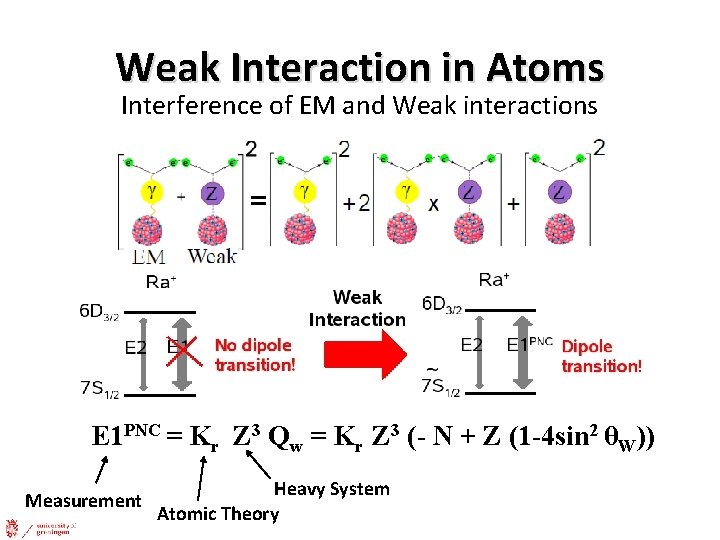
Weak Interaction in Atoms Interference of EM and Weak interactions E 1 PNC = Kr Z 3 Qw = Kr Z 3 (- N + Z (1 -4 sin 2 θW)) Measurement Heavy System Atomic Theory
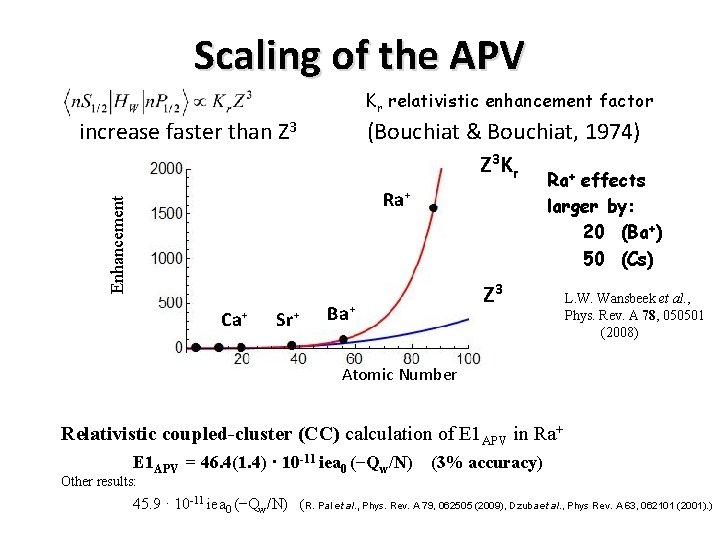
Scaling of the APV Kr relativistic enhancement factor increase faster than Z 3 (Bouchiat & Bouchiat, 1974) Z 3 K r + Ra effects larger by: 20 (Ba+) 50 (Cs) Enhancement Ra+ Ca+ Sr+ Z 3 Ba+ L. W. Wansbeek et al. , Phys. Rev. A 78, 050501 (2008) Atomic Number Relativistic coupled-cluster (CC) calculation of E 1 APV in Ra+ E 1 APV = 46. 4(1. 4) · 10 -11 iea 0 (−Qw/N) (3% accuracy) Other results: 45. 9 · 10 -11 iea 0 (−Qw/N) (R. Pal et al. , Phys. Rev. A 79, 062505 (2009), Dzuba et al. , Phys Rev. A 63, 062101 (2001). )
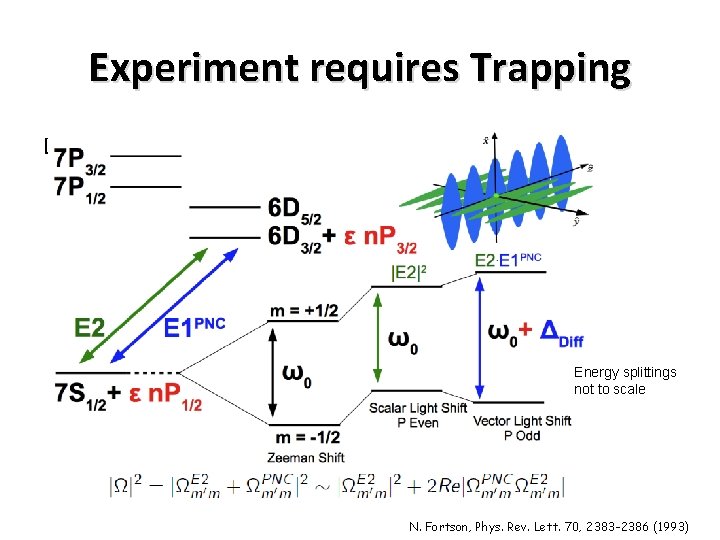
Experiment requires Trapping Differential Light shift Energy splittings not to scale N. Fortson, Phys. Rev. Lett. 70, 2383 -2386 (1993)
Trapping of short-lived Isotopes RADIUM ION
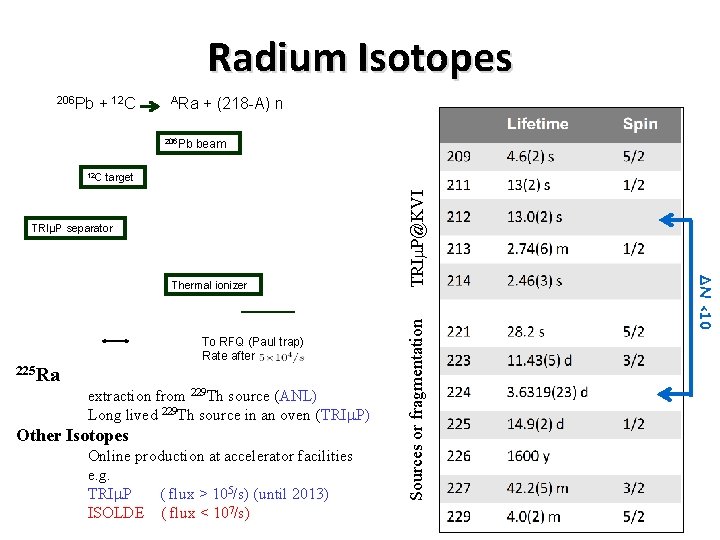
Radium Isotopes + 12 C ARa 206 Pb beam target TRIμP separator To RFQ (Paul trap) Rate after TI 225 Ra extraction from 229 Th source (ANL) Long lived 229 Th source in an oven (TRI P) Other Isotopes Online production at accelerator facilities e. g. TRI P ( flux > 105/s) (until 2013) ISOLDE ( flux < 107/s) ΔN <10 Thermal ionizer TRI P@KVI 12 C + (218 -A) n Sources or fragmentation 206 Pb
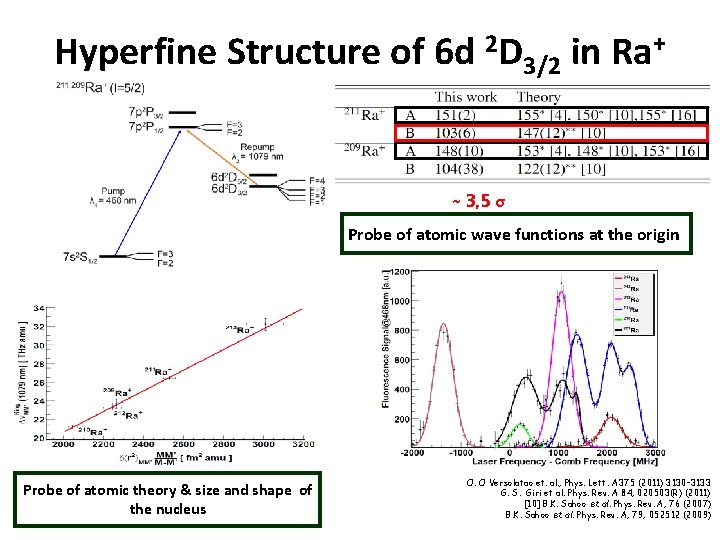
Hyperfine Structure of 6 d 2 D 3/2 in + Ra 3, 5 σ Probe of atomic wave functions at the origin Probe of atomic theory & size and shape of the nucleus O. O Versolatao et. al. , Phys. Lett. A 375 (2011) 3130– 3133 G. S. Giri et al. Phys. Rev. A 84, 020503(R) (2011) [10] B. K. Sahoo et al. Phys. Rev. A, 76 (2007) B. K. Sahoo et al. Phys. Rev. A, 79, 052512 (2009)
Atomic Properties RELATED RADIUM EXPERIMENTS
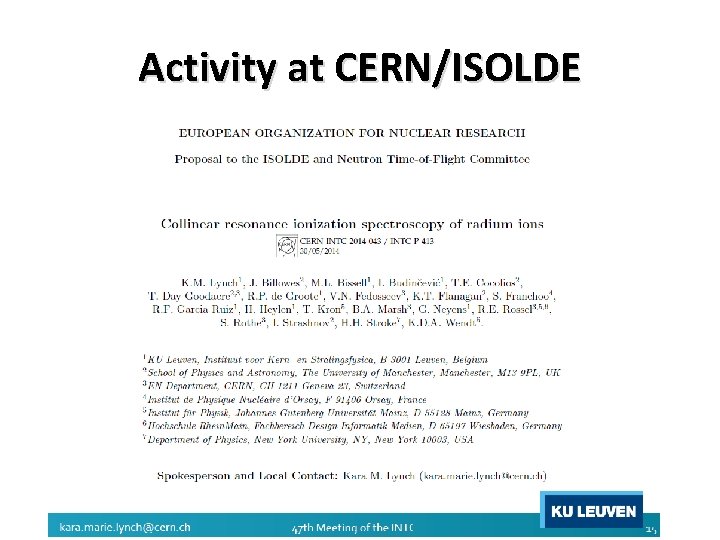
Activity at CERN/ISOLDE
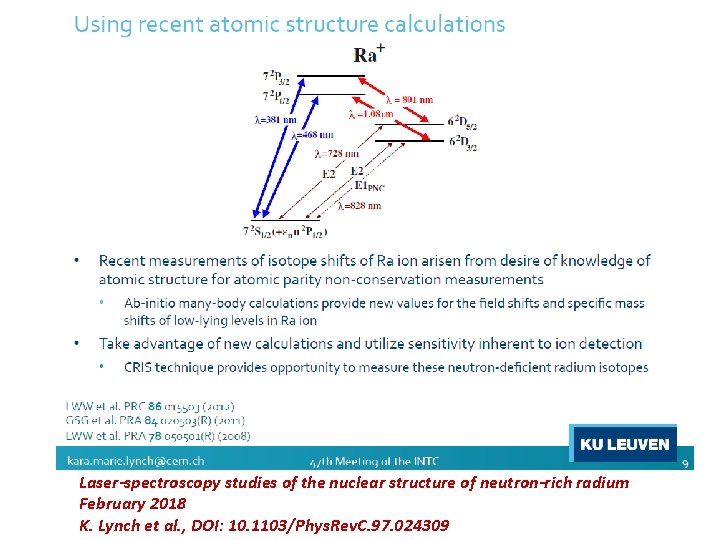
Laser-spectroscopy studies of the nuclear structure of neutron-rich radium February 2018 K. Lynch et al. , DOI: 10. 1103/Phys. Rev. C. 97. 024309
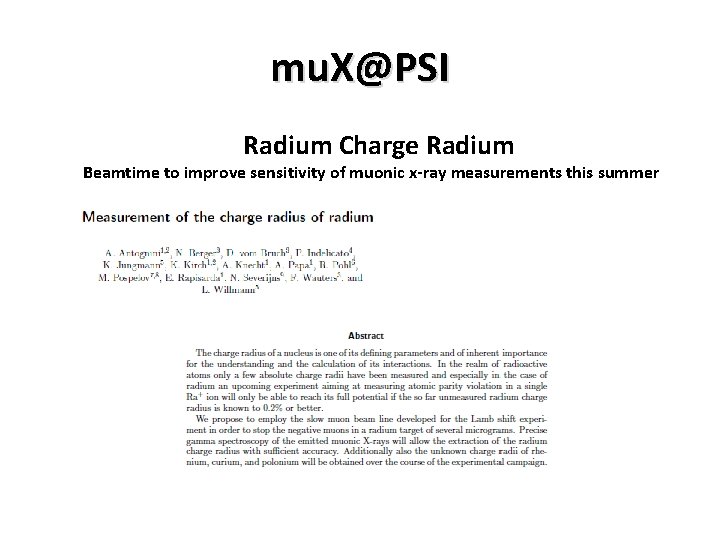
mu. X@PSI Radium Charge Radium Beamtime to improve sensitivity of muonic x-ray measurements this summer
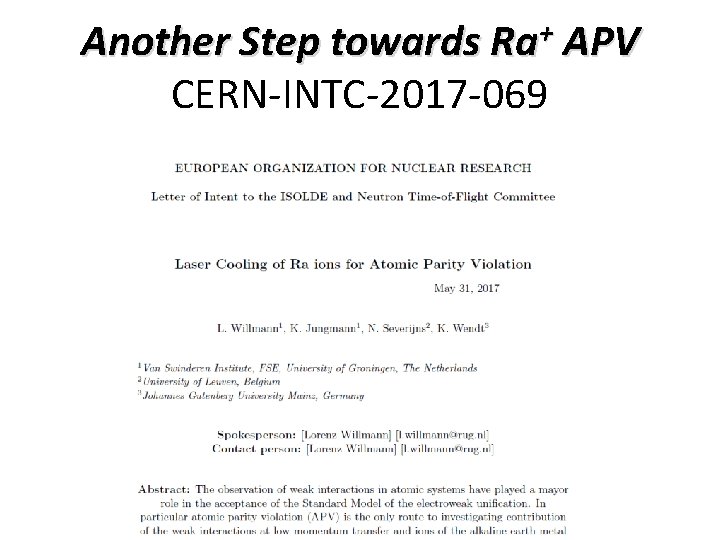
Another Step towards Ra+ APV CERN-INTC-2017 -069
Ba+ Atomic Parity Violation BARIUM ION
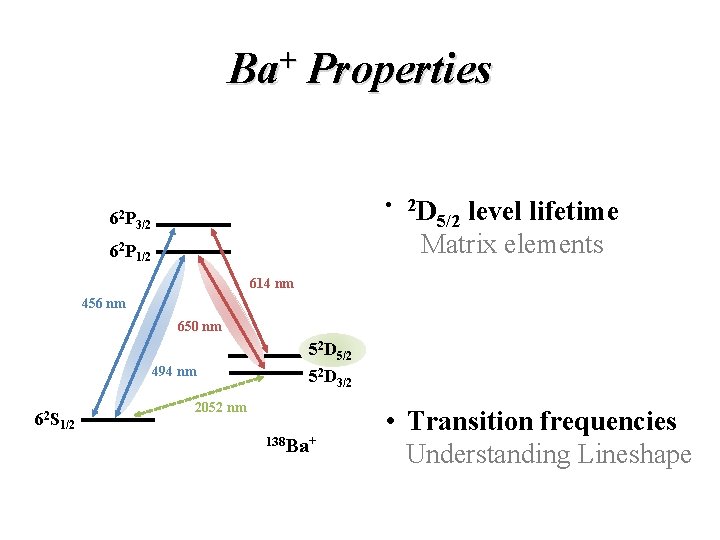
Ba+ Properties 62 P • 2 D level lifetime Matrix elements 3/2 62 P 1/2 5/2 614 nm 456 nm 650 nm 494 nm 62 S 1/2 52 D 5/2 52 D 3/2 2052 nm 138 Ba+ • Transition frequencies Understanding Lineshape
Hyperbolic Single Ion Trap 10µm
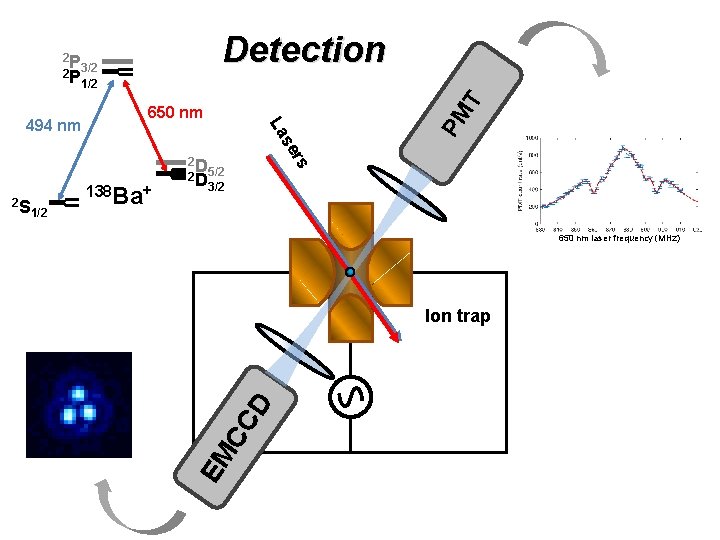
2 D 2 D 5/2 3/2 rs 650 nm laser frequency (MHz) D Ion trap EM CC 1/2 138 Ba+ se 2 S 650 nm La 494 nm PM T Detection 2 P 2 P 3/2 1/2
Transition Matrix Elements METASTABLE STATE LIFETIME
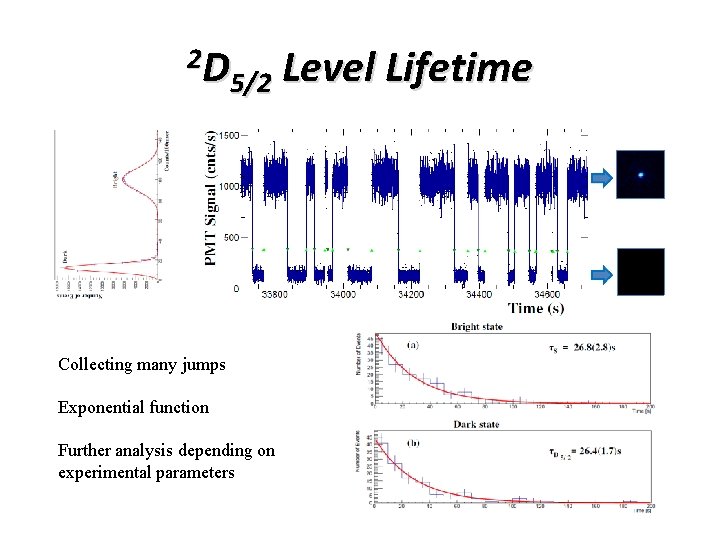
2 D 5/2 Collecting many jumps Exponential function Further analysis depending on experimental parameters Level Lifetime
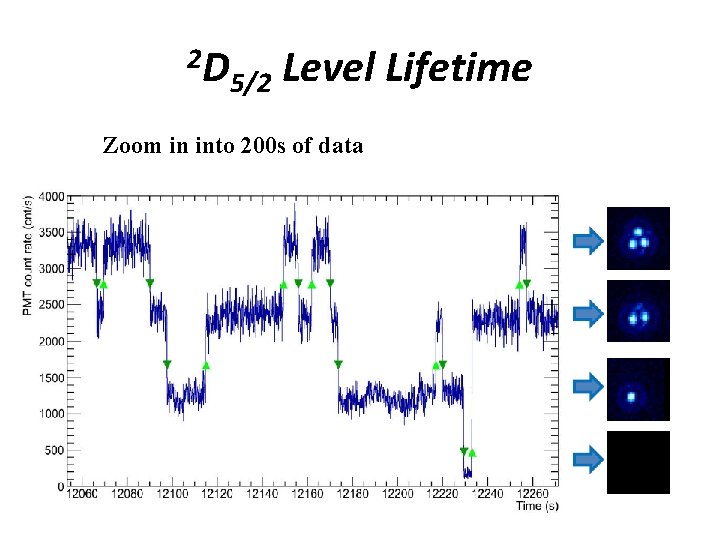
2 D 5/2 Level Lifetime Zoom in into 200 s of data
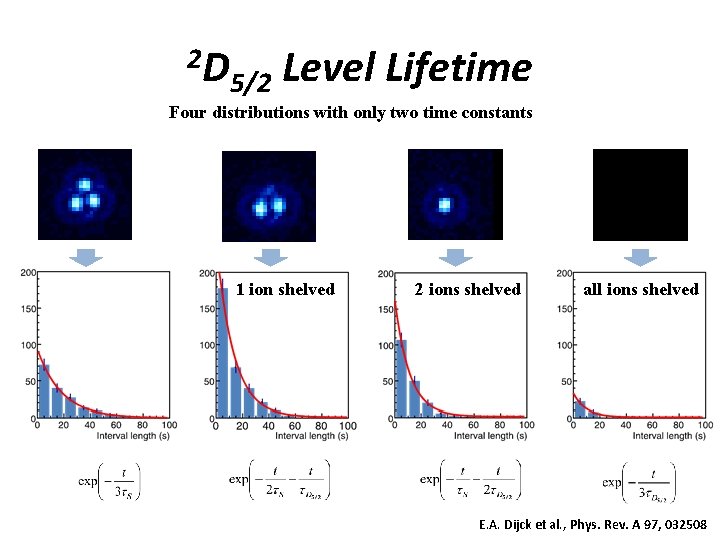
2 D 5/2 Level Lifetime Four distributions with only two time constants 1 ion shelved 2 ions shelved all ions shelved E. A. Dijck et al. , Phys. Rev. A 97, 032508
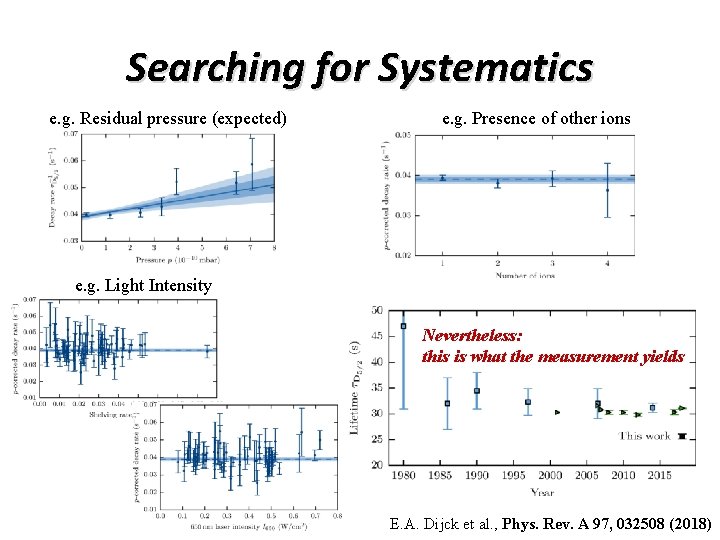
Searching for Systematics e. g. Residual pressure (expected) e. g. Presence of other ions e. g. Light Intensity Nevertheless: this is what the measurement yields E. A. Dijck et al. , Phys. Rev. A 97, 032508 (2018)
Ba+ Atomic Parity Violation LIGHT SHIFT AND LINE SHAPE
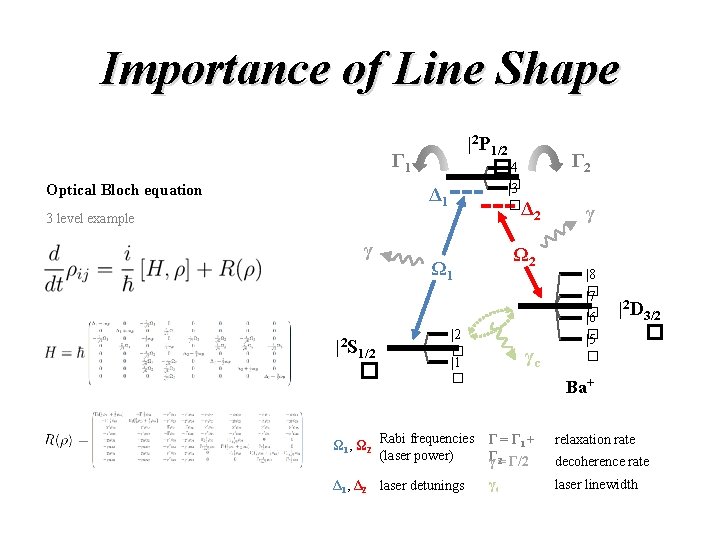
Importance of Line Shape |2 P 1/2 �|4 Γ 1 Optical Bloch equation � |3 �Δ Δ 1 3 level example γ |2 S 1/2 � Γ 2 2 Ω 1 |2 � |1 � γc γ |8 � |7 � |6 � |5 |2 D 3/2 � � Ba+ Ω 1, Ω 2 Rabi frequencies (laser power) Γ = Γ 1 + Γ 2 Γ/2 γ= relaxation rate Δ 1, Δ 2 laser detunings γc laser linewidth decoherence rate
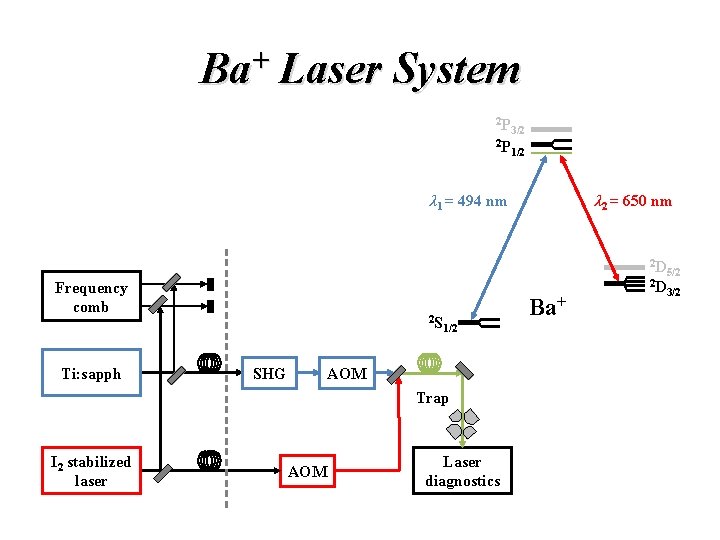
Ba+ Laser System 2 P 3/2 2 P 1/2 λ 1 = 494 nm λ 2 = 650 nm 2 D Frequency comb Ti: sapph 2 S SHG Ba 1/2 AOM Trap I 2 stabilized laser AOM Laser diagnostics + 2 D 5/2 3/2
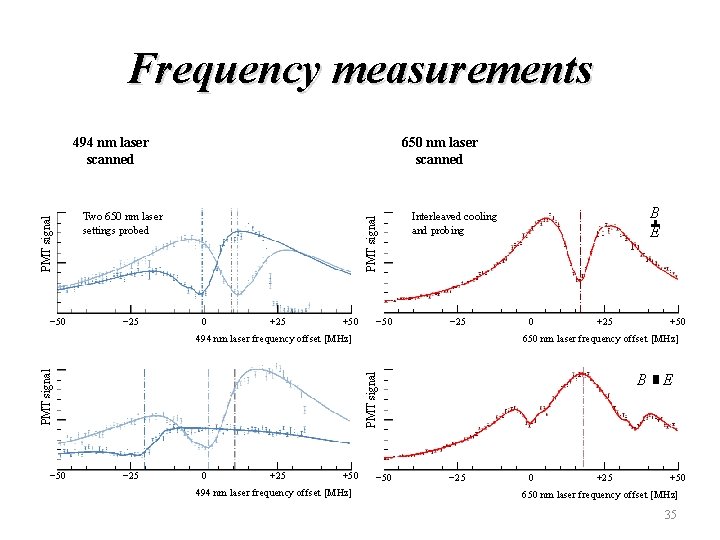
Frequency measurements 494 nm laser scanned + 50% λ 2 50% Two 650 nm laser settings probed − 25 0 +25 +50 − 50 λ 2 − 25 0 +25 +50 494 nm laser frequency offset [MHz] 20% B E − 25 0 +25 +50 650 nm laser frequency offset [MHz] B PMT signal 80% Interleaved cooling and probing 494 nm laser frequency offset [MHz] − 50 + λ 1 PMT signal λ 1 − 50 650 nm laser scanned − 50 − 25 0 +25 E +50 650 nm laser frequency offset [MHz] 35
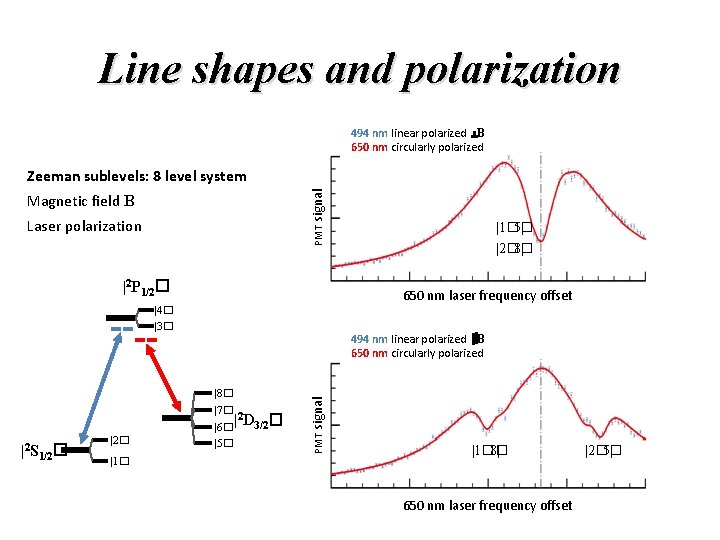
Line shapes and polarization 494 nm linear polarized B 650 nm circularly polarized PMT signal Zeeman sublevels: 8 level system Magnetic field B Laser polarization |2 P 1/2� |7� |6� |1� |5� |2 D 3/2� PMT signal 494 nm linear polarized B 650 nm circularly polarized |8� |2�� 8| 650 nm laser frequency offset |4� |3� |2 S 1/2� |1�� 5| |1�� 8| 650 nm laser frequency offset |2�� 5|
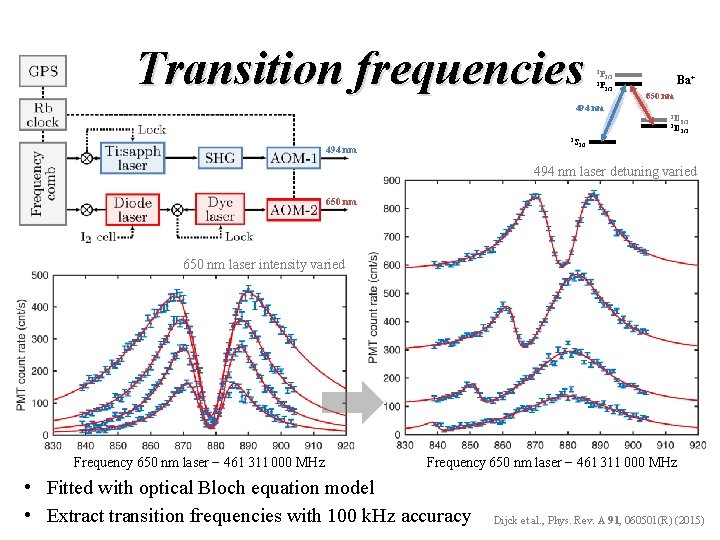
Transition frequencies 2 P 2 P Ba+ 3/2 1/2 650 nm 494 nm 2 D 2 D 5/2 3/2 2 S 1/2 494 nm laser detuning varied 650 nm laser intensity varied Frequency 650 nm laser − 461 311 000 MHz • Fitted with optical Bloch equation model • Extract transition frequencies with 100 k. Hz accuracy Dijck et al. , Phys. Rev. A 91, 060501(R) (2015)
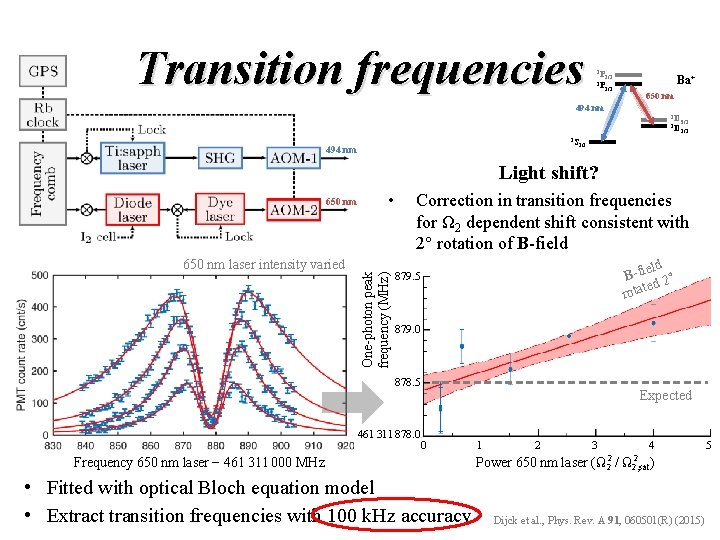
Transition frequencies 2 P 2 P Ba+ 3/2 1/2 650 nm 494 nm 2 D 2 D 5/2 3/2 2 S 1/2 494 nm Light shift? 650 nm laser intensity varied • One-photon peak frequency (MHz) 650 nm Correction in transition frequencies for Ω 2 dependent shift consistent with 2° rotation of B-field B-fi 2° ted rota 879. 5 879. 0 878. 5 461 311 878. 0 Expected 0 Frequency 650 nm laser − 461 311 000 MHz • Fitted with optical Bloch equation model • Extract transition frequencies with 100 k. Hz accuracy 1 2 Power 650 nm laser 3 (Ω 22 / 4 2 Ω 2, sat ) Dijck et al. , Phys. Rev. A 91, 060501(R) (2015) 5
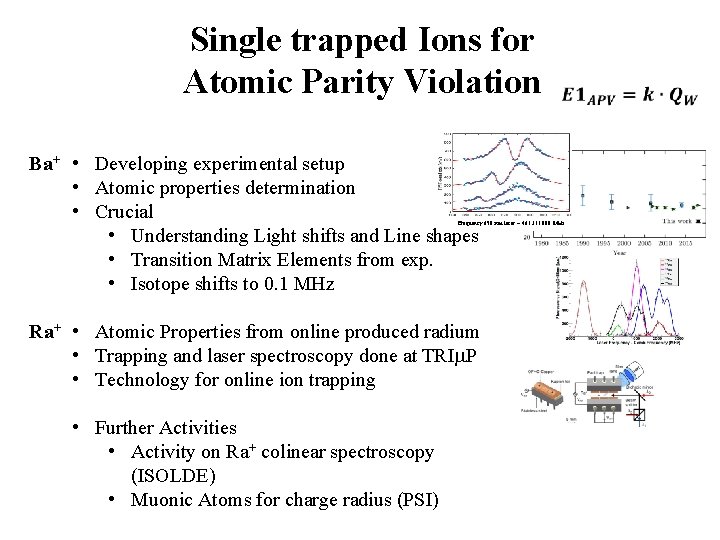
Single trapped Ions for Atomic Parity Violation Ba+ • Developing experimental setup • Atomic properties determination • Crucial • Understanding Light shifts and Line shapes • Transition Matrix Elements from exp. • Isotope shifts to 0. 1 MHz Frequency 650 nm laser − 461 311 000 MHz Ra+ • Atomic Properties from online produced radium • Trapping and laser spectroscopy done at TRI P • Technology for online ion trapping • Further Activities • Activity on Ra+ colinear spectroscopy (ISOLDE) • Muonic Atoms for charge radius (PSI)
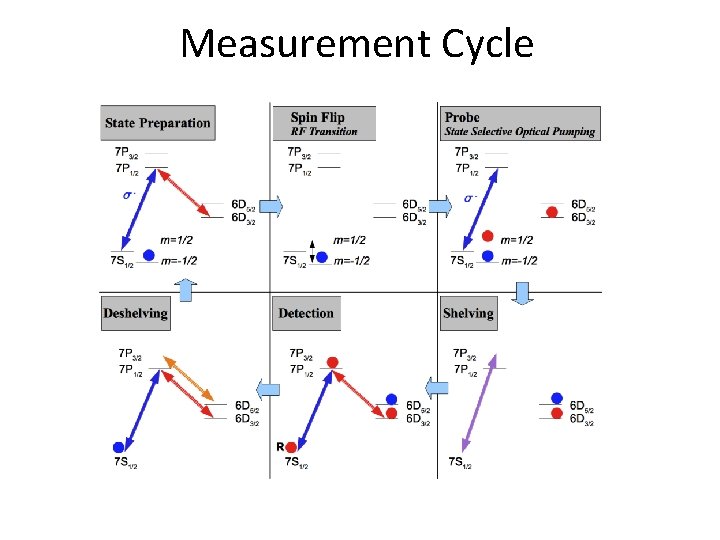
Measurement Cycle
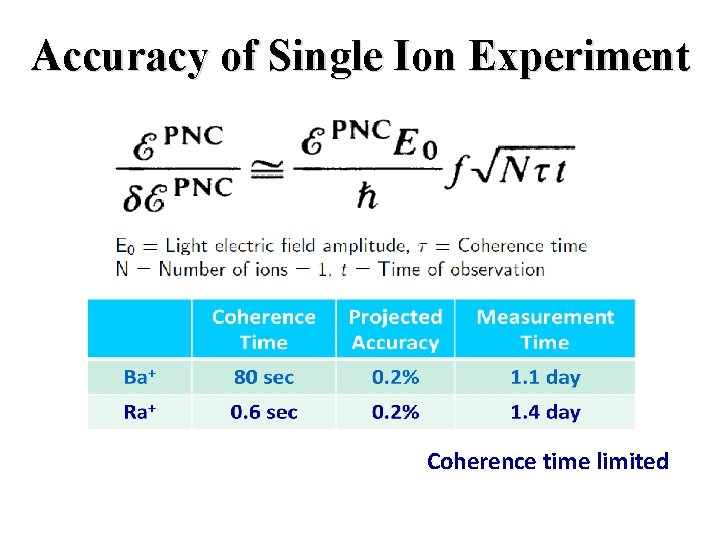
Accuracy of Single Ion Experiment Coherence time limited
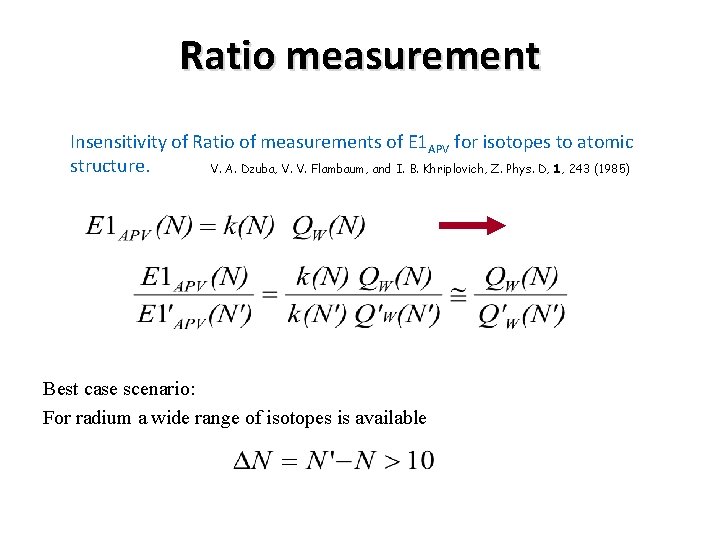
Ratio measurement Insensitivity of Ratio of measurements of E 1 APV for isotopes to atomic structure. V. A. Dzuba, V. V. Flambaum, and I. B. Khriplovich, Z. Phys. D, 1, 243 (1985) Best case scenario: For radium a wide range of isotopes is available
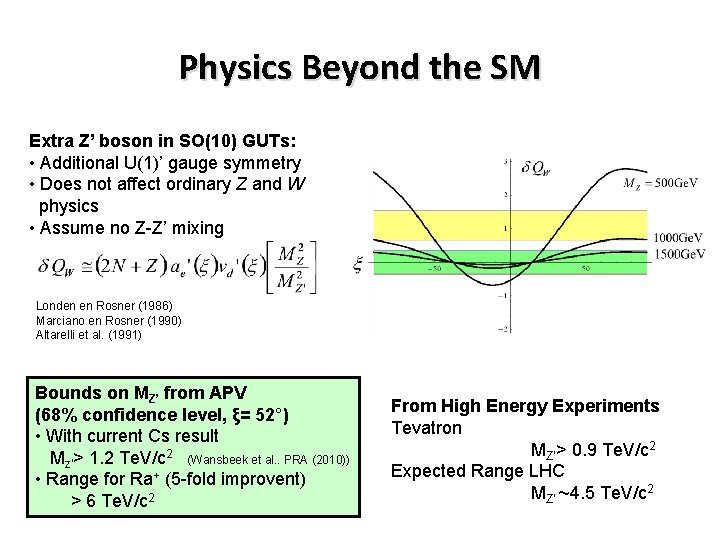
Physics Beyond the SM Extra Z’ boson in SO(10) GUTs: • Additional U(1)’ gauge symmetry • Does not affect ordinary Z and W physics • Assume no Z-Z’ mixing Londen en Rosner (1986) Marciano en Rosner (1990) Altarelli et al. (1991) Bounds on MZ’ from APV (68% confidence level, ξ= 52°) • With current Cs result Mz’> 1. 2 Te. V/c 2 (Wansbeek et al. . PRA (2010)) • Range for Ra+ (5 -fold improvent) > 6 Te. V/c 2 From High Energy Experiments Tevatron MZ’> 0. 9 Te. V/c 2 Expected Range LHC MZ’ ~4. 5 Te. V/c 2