
Single Table Clusters an alternative to partitioning David
Single Table Clusters, an alternative to partitioning? David Kurtz Go-Faster Consultancy Ltd. david@go-faster. co. uk www. go-faster. co. uk Go-Faster Consultancy Ltd. 1
Who am I? • DBA – Independent Consultant – Performance Tuning Go-Faster Consultancy Ltd. 2
What is this all about? • • A single table cluster Why it reduced contention? Why it worked on the test system? Why it failed on the production system? Go-Faster Consultancy Ltd. 3
What was our environment? • Swiss Payroll System – Retrospective (not like P. A. Y. E. ) • Oracle 8. 0. 5 64 -bit – Rule Based Optimiser – Now 8. 1. 6. 2. 0 • HP-UX 11. 00 • 35, 000 employees Go-Faster Consultancy Ltd. 4
How many values are calculated? – 100 values / employee / month retained • Writes 3. 5 M values to balance table – 78 million rows on balance table – (after 20 months) Go-Faster Consultancy Ltd. 5
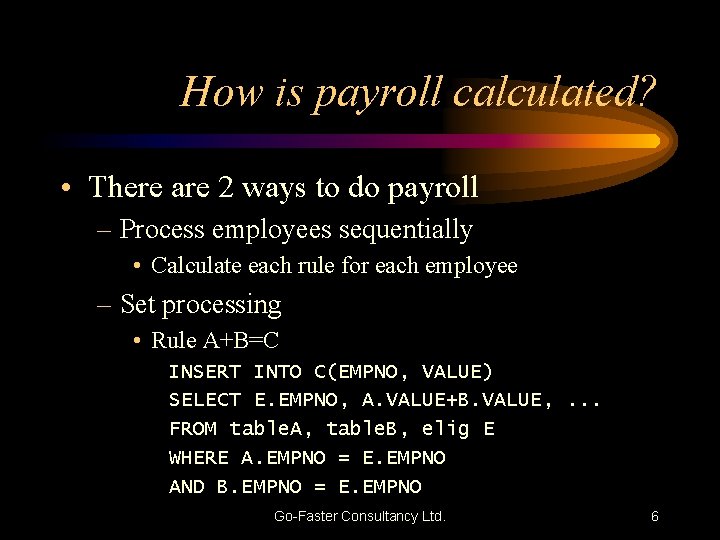
How is payroll calculated? • There are 2 ways to do payroll – Process employees sequentially • Calculate each rule for each employee – Set processing • Rule A+B=C INSERT INTO C(EMPNO, VALUE) SELECT E. EMPNO, A. VALUE+B. VALUE, . . . FROM table. A, table. B, elig E WHERE A. EMPNO = E. EMPNO AND B. EMPNO = E. EMPNO Go-Faster Consultancy Ltd. 6
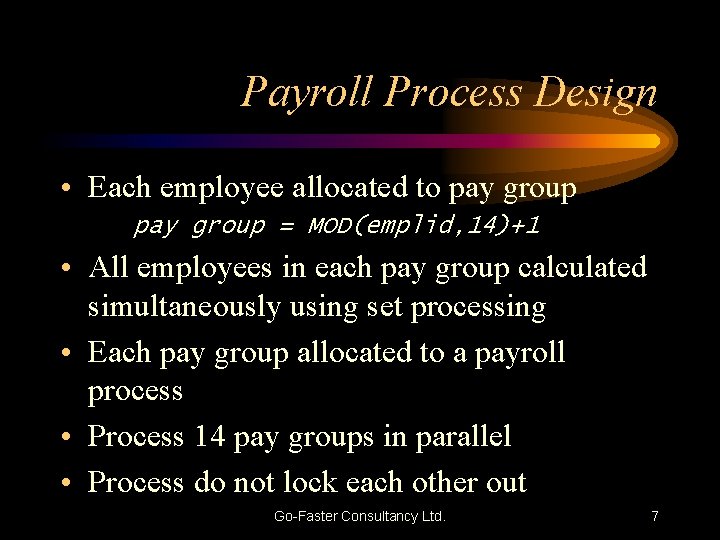
Payroll Process Design • Each employee allocated to pay group = MOD(emplid, 14)+1 • All employees in each pay group calculated simultaneously using set processing • Each pay group allocated to a payroll process • Process 14 pay groups in parallel • Process do not lock each other out Go-Faster Consultancy Ltd. 7
Payroll Process Design • Single balance table • For each month for each retro date – Deletes all pay element rows for eligible employees – Recalculate – Insert freshly calculated rows Go-Faster Consultancy Ltd. 8
Effects of streaming • 14 processes concurrently deleting from and inserting in the same balance table. • 14 updates to the same block • 14 versions of the block in the rollback segment • Recalculation process reads rows from balance table from previous month Go-Faster Consultancy Ltd. 9
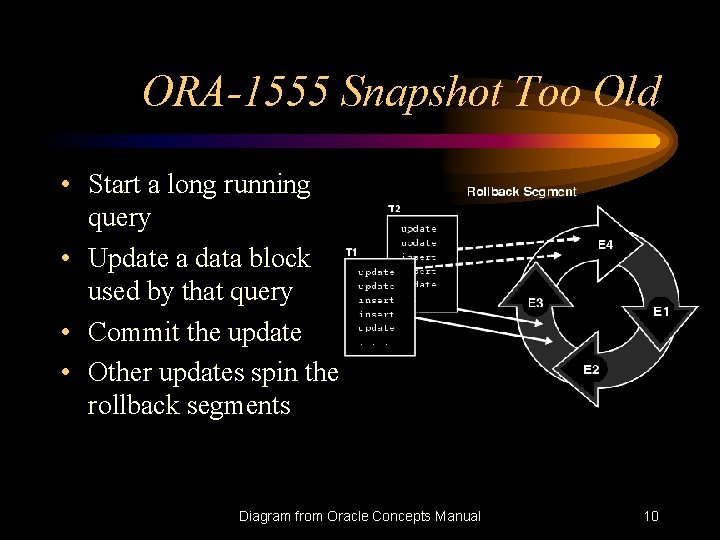
ORA-1555 Snapshot Too Old • Start a long running query • Update a data block used by that query • Commit the update • Other updates spin the rollback segments Diagram from Oracle Concepts Manual 10
ORA-1555 Snapshot Too Old • Long running query on balance table as part of calculation • Deletes in other streams • Huge rollback segments (to avoid ORA 1555) – 15 x 2100 Mb segments • SET TRANSACTION USE ROLLBACK SEGMENT Go-Faster Consultancy Ltd. 11
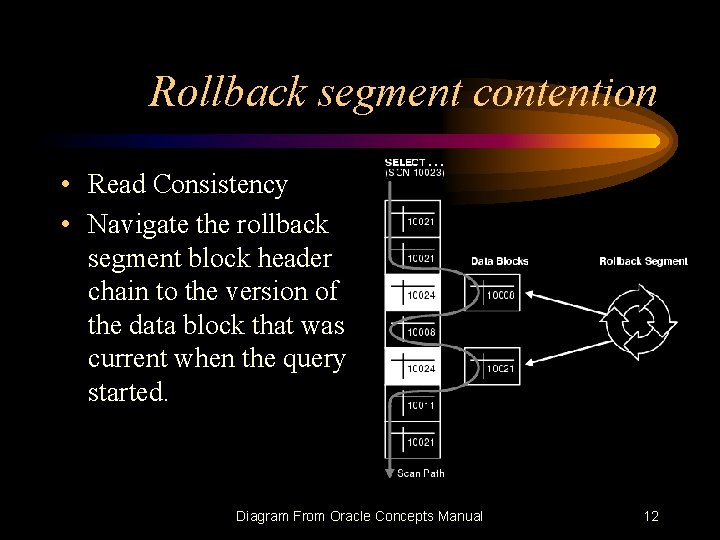
Rollback segment contention • Read Consistency • Navigate the rollback segment block header chain to the version of the data block that was current when the query started. Diagram From Oracle Concepts Manual 12
Rollback segment contention • Navigation of segment block header chain CPU intensive • Re-read rollback segment blocks from disk that have been aged out of the block buffer cache. Go-Faster Consultancy Ltd. 13
How to avoid inter-process contention? • Avoid updating a data block in one process while it referencing/updating it in another. • Make sure that data for different streams is in different data blocks • How about partitioning the data? Go-Faster Consultancy Ltd. 14
Partitioning • Range Partition (Oracle 8. 0) • Hash Partition (Oracle 8. 1) – (Hash within a range) • We considered changing the mod(, 14) function to hash(, 14) • BUT, partitioning invokes the Cost Based Optimiser. Go-Faster Consultancy Ltd. 15
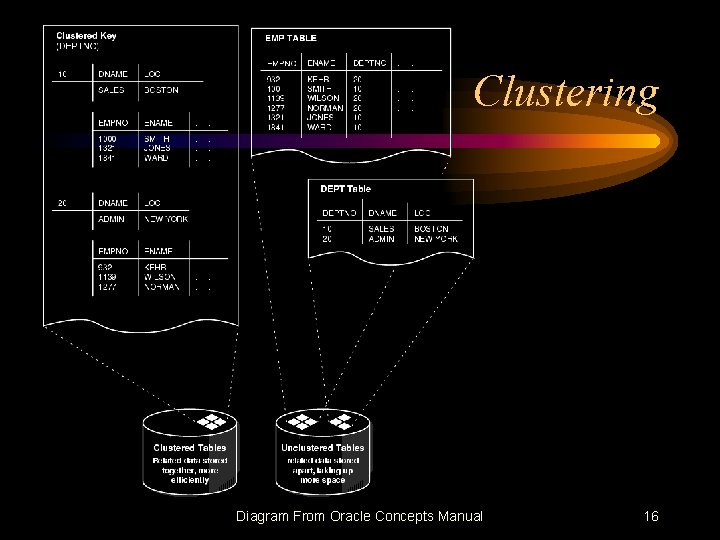
Clustering Diagram From Oracle Concepts Manual 16
Clustering • Physically arranges the data within a table. • Define a cluster key • All rows that have the same cluster key values are kept together • Old technology - dates back to Oracle 6 • can still used Rule Based Optimiser Go-Faster Consultancy Ltd. 17
Clustering • All rows that have the same cluster key values are kept together – All the rows in any one block share the same cluster key • Rows with different cluster key values must exist in different blocks. Go-Faster Consultancy Ltd. 18
Clustered Balance Table by Employee ID • Inter-process contention disappeared – Each block contained rows for one and only one employee ID – Although one emplid may actually be stored in many blocks. • Rollback HWMs dropped Go-Faster Consultancy Ltd. 19
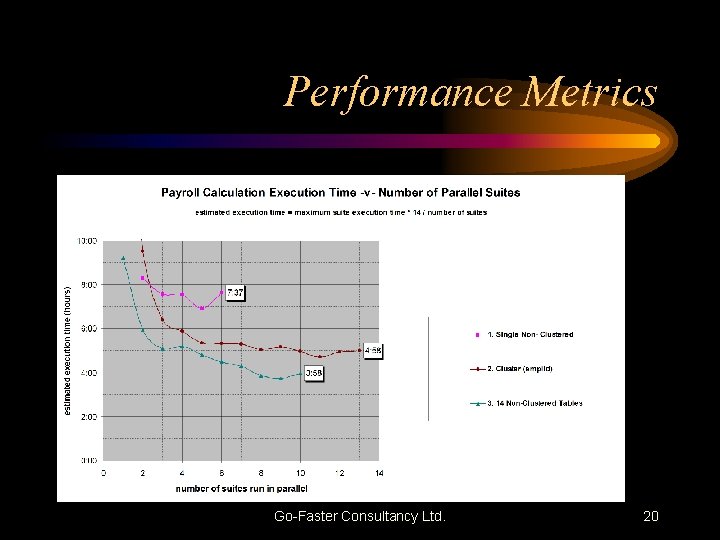
Performance Metrics Go-Faster Consultancy Ltd. 20
When are clusters faster? • For a single threaded process, inserting/deleting a cluster was slower than similar heap table. • Clusters faster when 3 or more processes in parallel updating a single clustered table. Go-Faster Consultancy Ltd. 21
Clustered Balance Table by Employee ID) • Unique index not used (unless hinted) • Considered dropping it – Application design permitted it • So after successful testing we planned to put it in production Go-Faster Consultancy Ltd. 22
And when we moved it to production. . . • Disaster • 50% INCREASE in execution time • big jump in I/O • Why? Go-Faster Consultancy Ltd. 23
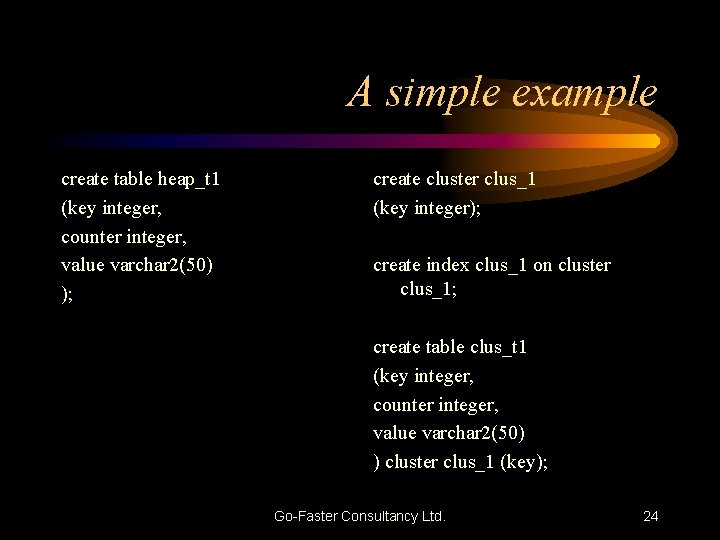
A simple example create table heap_t 1 (key integer, counter integer, value varchar 2(50) ); create cluster clus_1 (key integer); create index clus_1 on cluster clus_1; create table clus_t 1 (key integer, counter integer, value varchar 2(50) ) cluster clus_1 (key); Go-Faster Consultancy Ltd. 24
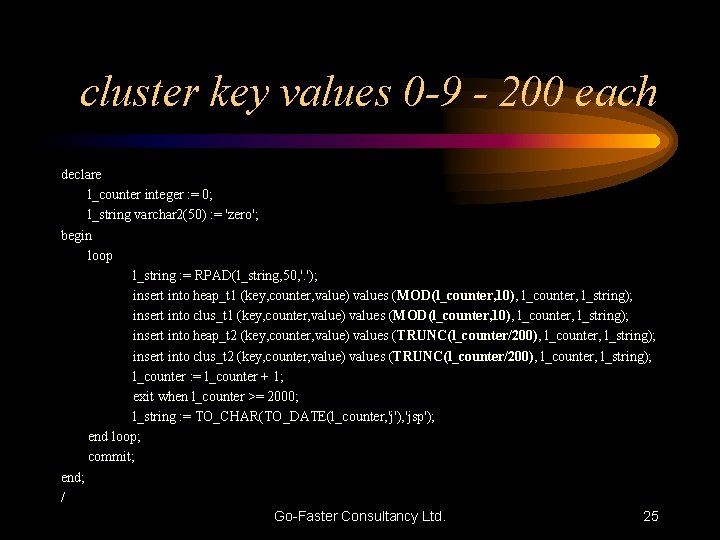
cluster key values 0 -9 - 200 each declare l_counter integer : = 0; l_string varchar 2(50) : = 'zero'; begin loop l_string : = RPAD(l_string, 50, '. '); insert into heap_t 1 (key, counter, value) values (MOD(l_counter, 10), l_counter, l_string); insert into clus_t 1 (key, counter, value) values (MOD(l_counter, 10), l_counter, l_string); insert into heap_t 2 (key, counter, value) values (TRUNC(l_counter/200), l_counter, l_string); insert into clus_t 2 (key, counter, value) values (TRUNC(l_counter/200), l_counter, l_string); l_counter : = l_counter + 1; exit when l_counter >= 2000; l_string : = TO_CHAR(TO_DATE(l_counter, 'j'), 'jsp'); end loop; commit; end; / Go-Faster Consultancy Ltd. 25
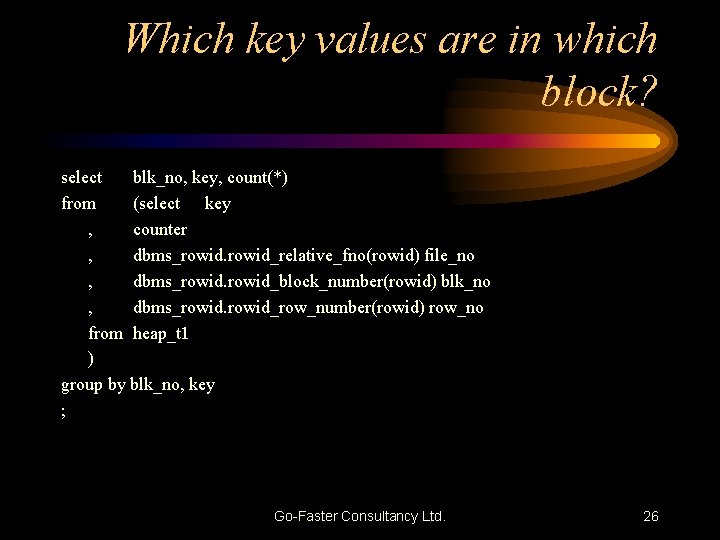
Which key values are in which block? select blk_no, key, count(*) from (select key , counter , dbms_rowid_relative_fno(rowid) file_no , dbms_rowid_block_number(rowid) blk_no , dbms_rowid_row_number(rowid) row_no from heap_t 1 ) group by blk_no, key ; Go-Faster Consultancy Ltd. 26
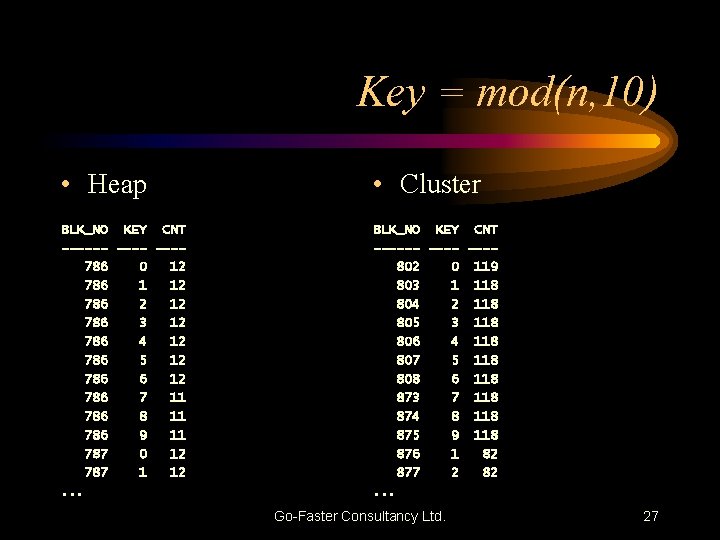
Key = mod(n, 10) • Heap • Cluster BLK_NO KEY CNT ------ ---786 0 12 786 1 12 786 2 12 786 3 12 786 4 12 786 5 12 786 6 12 786 7 11 786 8 11 786 9 11 787 0 12 787 1 12. . . BLK_NO KEY CNT ------ ---802 0 119 803 1 118 804 2 118 805 3 118 806 4 118 807 5 118 808 6 118 873 7 118 874 8 118 875 9 118 876 1 82 877 2 82. . . Go-Faster Consultancy Ltd. 27
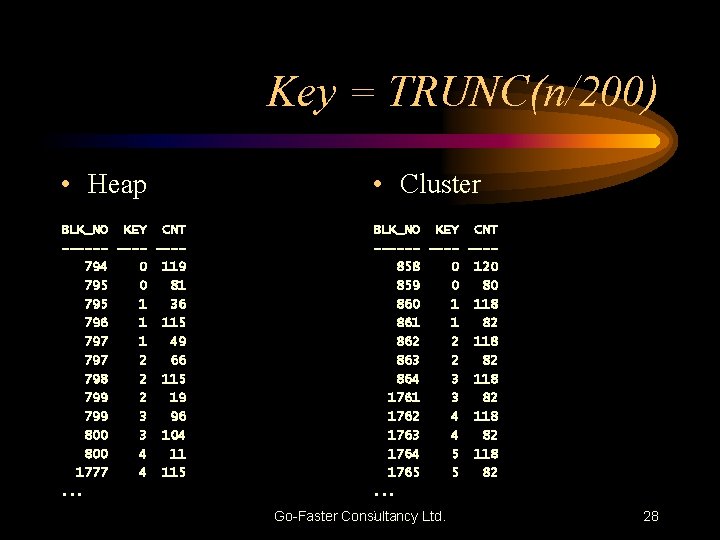
Key = TRUNC(n/200) • Heap • Cluster BLK_NO KEY CNT ------ ---794 0 119 795 0 81 795 1 36 796 1 115 797 1 49 797 2 66 798 2 115 799 2 19 799 3 96 800 3 104 800 4 11 1777 4 115. . . BLK_NO KEY CNT ------ ---858 0 120 859 0 80 860 1 118 861 1 82 862 2 118 863 2 82 864 3 118 1761 3 82 1762 4 118 1763 4 82 1764 5 118 1765 5 82. . . ; Go-Faster Consultancy Ltd. 28
Why did the behaviour change? • Test System – 7 blocks / emplid • Production (at time of move) – 10 blocks / emplid • mutliblock_read_count = 8 • 2 I/Os to read all blocks for an emplid indicated by cluster key Go-Faster Consultancy Ltd. 29
Solution • Cluster key on two columns – emplid, – curr_pay_end_dt • If blocks/key << 1 – space wastage – increase I/O Go-Faster Consultancy Ltd. 30
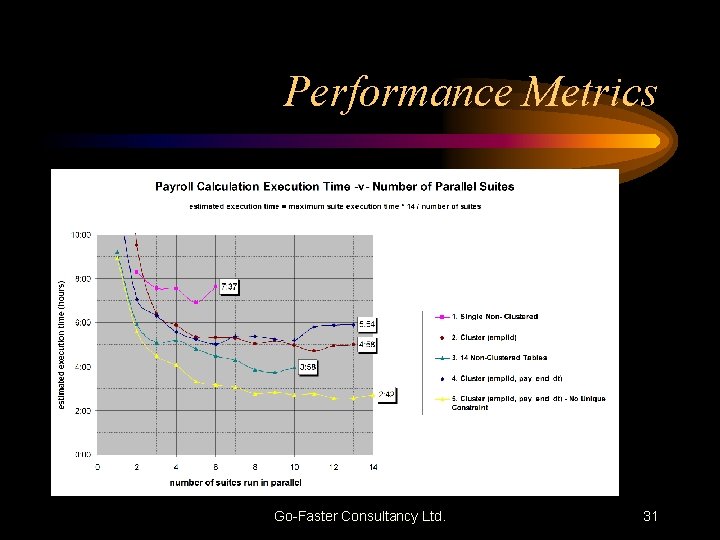
Performance Metrics Go-Faster Consultancy Ltd. 31
Moral of the story • Make sure you test environment accurately mirrors production – Now – AND FOR THE FUTURE Go-Faster Consultancy Ltd. 32
What actually happened next? • • Upgraded to Oracle 8. 1. 6 Global Temporary Tables Developed incremental processing Retro-date changed to 1. 1. 2000 – thus reducing the processing • It has now changed again to 1. 1. 2001 • New payroll system being implemented Go-Faster Consultancy Ltd. 33
Related Reading • Causes of ORA-1555 - Oracle Scene • Jonathan Lewis, Practical Oracle 8 i • Dan Hotka’s Geeky Block Internals presentations – UKOUG 1999 & 2000 Go-Faster Consultancy Ltd. 34

Questions? Go-Faster Consultancy Ltd. 35
Single Table Clusters, an alternative to partitioning? David Kurtz Go-Faster Consultancy Ltd. david@go-faster. co. uk www. go-faster. co. uk Go-Faster Consultancy Ltd. 36
- Slides: 36