
Single Stage v Two Stage Tendering within the
- Slides: 28
Single Stage v Two Stage Tendering within the YORhub frameworks 7 th June 2019
Single stage v 2 stage tendering Fergus Aitken BSc MRICS MAPM YORbuild 2 Programme Manager East Riding of Yorkshire Council Chris Bourne BSc MRICS YORbuild 2 Framework Manager – North Area Scarborough Borough Council
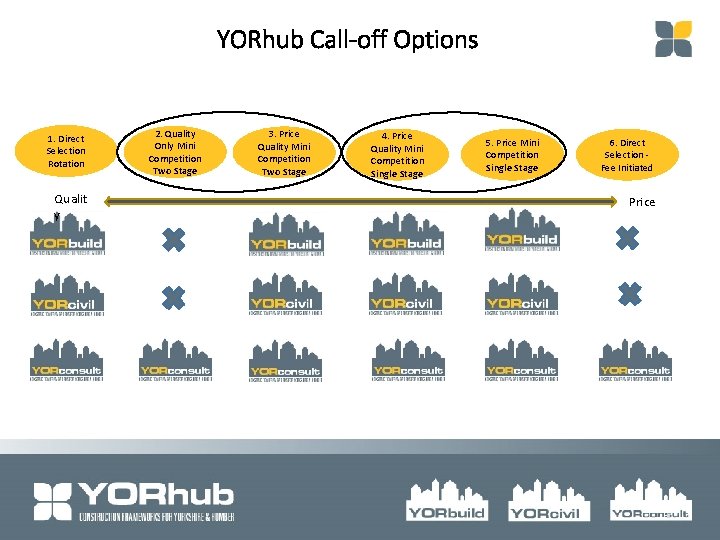
YORhub Call-off Options 1. Direct Selection Rotation 2. Quality Only Mini Competition Two Stage 3. Price Quality Mini Competition Two Stage 4. Price Quality Mini Competition Single Stage Qualit y Qu 5. Price Mini Competition Single Stage Price alit Pri ce 6. Direct Selection - Fee Initiated y
Format • Definition - what is single stage and 2 stage tendering within the YORhub frameworks • How do they operate • What are the pros and cons of each method • Summary
Definition
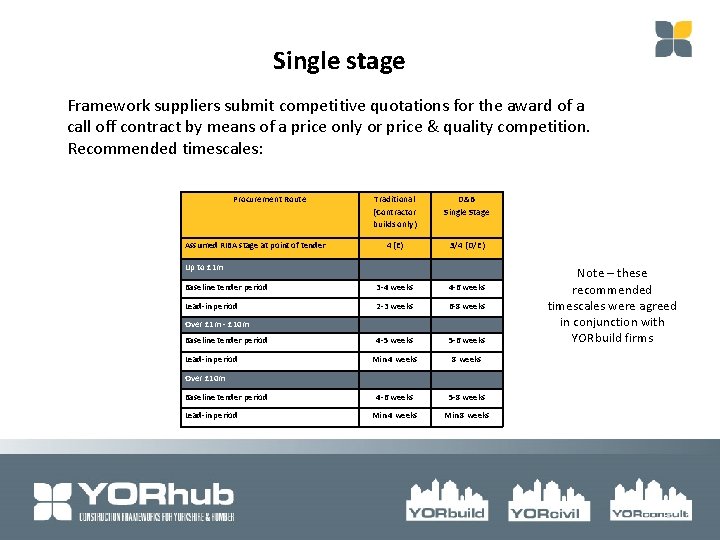
Single stage Framework suppliers submit competitive quotations for the award of a call off contract by means of a price only or price & quality competition. Recommended timescales: Procurement Route Traditional (Contractor builds only) D&B Single Stage 4 (E) 3/4 (D/E) Baseline tender period 3 -4 weeks 4 -6 weeks Lead-in period 2 -3 weeks 6 -8 weeks 4 -5 weeks 5 -6 weeks Min 4 weeks 8 weeks 4 -6 weeks 5 -8 weeks Min 4 weeks Min 8 weeks Assumed RIBA stage at point of tender Up to £ 1 m Over £ 1 m - £ 10 m Baseline tender period Lead-in period Over £ 10 m Baseline tender period Lead-in period Note – these recommended timescales were agreed in conjunction with YORbuild firms
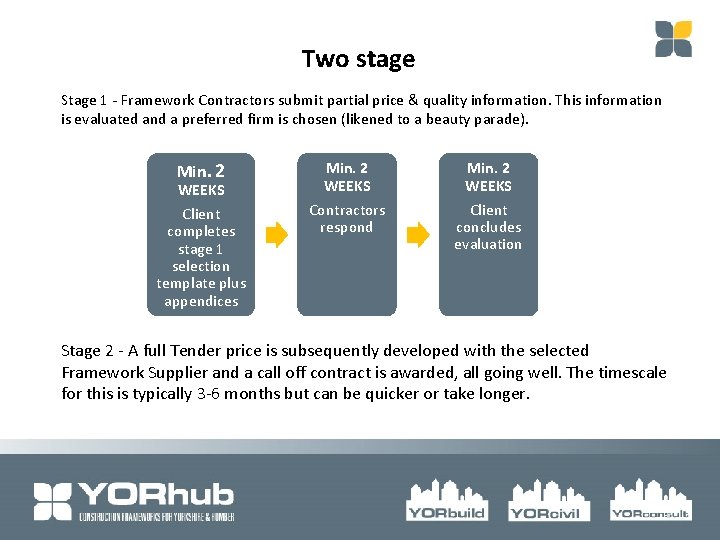
Two stage Stage 1 - Framework Contractors submit partial price & quality information. This information is evaluated and a preferred firm is chosen (likened to a beauty parade). Min. 2 WEEKS Client completes stage 1 selection template plus appendices Contractors respond Client concludes evaluation WEEKS Stage 2 - A full Tender price is subsequently developed with the selected Framework Supplier and a call off contract is awarded, all going well. The timescale for this is typically 3 -6 months but can be quicker or take longer.
How do they operate
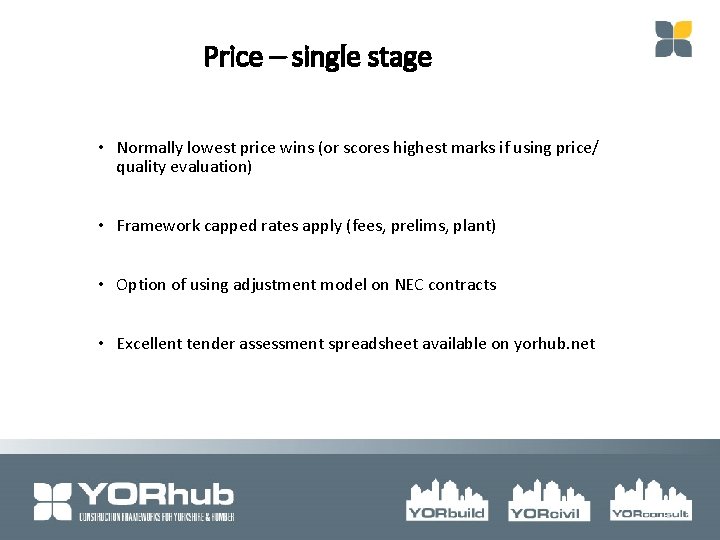
Price – single stage • Normally lowest price wins (or scores highest marks if using price/ quality evaluation) • Framework capped rates apply (fees, prelims, plant) • Option of using adjustment model on NEC contracts • Excellent tender assessment spreadsheet available on yorhub. net
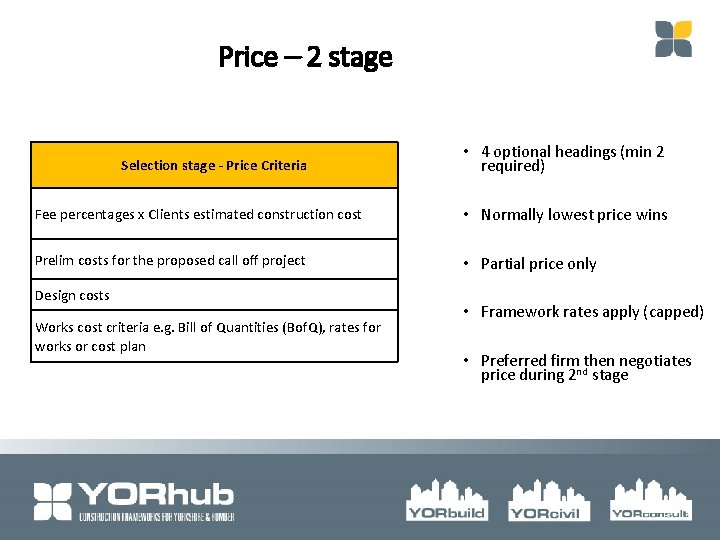
Price – 2 stage Selection stage - Price Criteria • 4 optional headings (min 2 required) Fee percentages x Clients estimated construction cost • Normally lowest price wins Prelim costs for the proposed call off project • Partial price only Design costs Works cost criteria e. g. Bill of Quantities (Bof. Q), rates for works or cost plan • Framework rates apply (capped) • Preferred firm then negotiates price during 2 nd stage
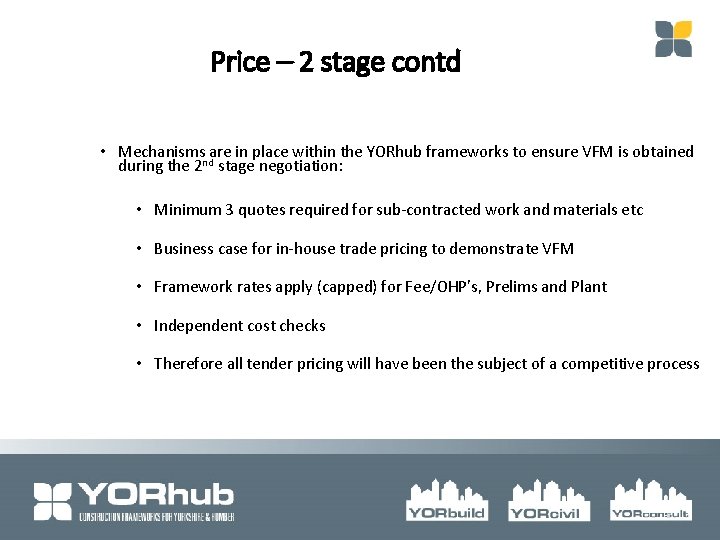
Price – 2 stage contd • Mechanisms are in place within the YORhub frameworks to ensure VFM is obtained during the 2 nd stage negotiation: • Minimum 3 quotes required for sub-contracted work and materials etc • Business case for in-house trade pricing to demonstrate VFM • Framework rates apply (capped) for Fee/OHP’s, Prelims and Plant • Independent cost checks • Therefore all tender pricing will have been the subject of a competitive process
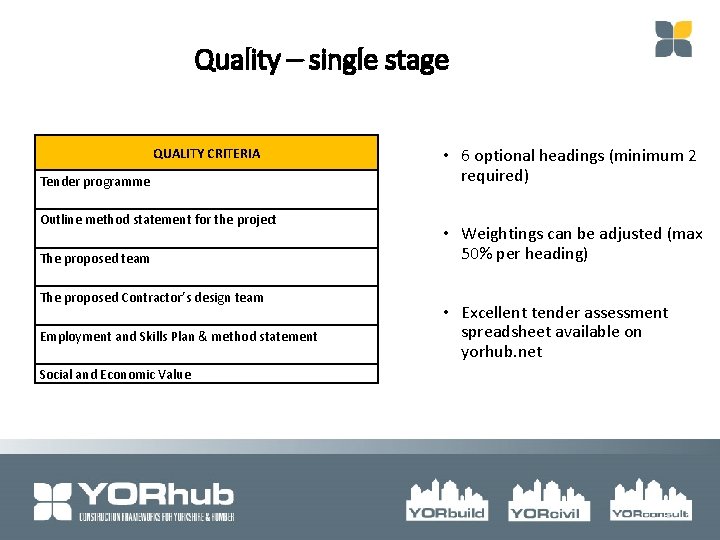
Quality – single stage QUALITY CRITERIA Tender programme Outline method statement for the project The proposed team The proposed Contractor’s design team Employment and Skills Plan & method statement Social and Economic Value • 6 optional headings (minimum 2 required) • Weightings can be adjusted (max 50% per heading) • Excellent tender assessment spreadsheet available on yorhub. net
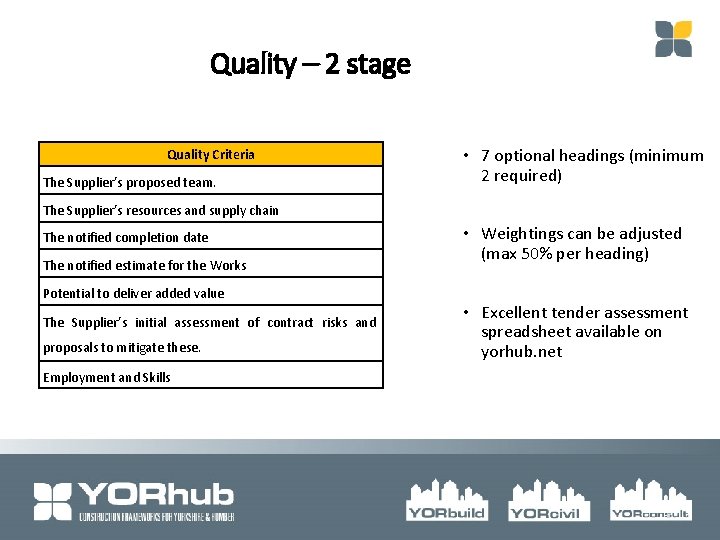
Quality – 2 stage The Supplier’s proposed team. • 7 optional headings (minimum 2 required) The Supplier’s resources and supply chain The notified completion date • Weightings can be adjusted (max 50% per heading) Quality Criteria The notified estimate for the Works Potential to deliver added value The Supplier’s initial assessment of contract risks and proposals to mitigate these. Employment and Skills • Excellent tender assessment spreadsheet available on yorhub. net
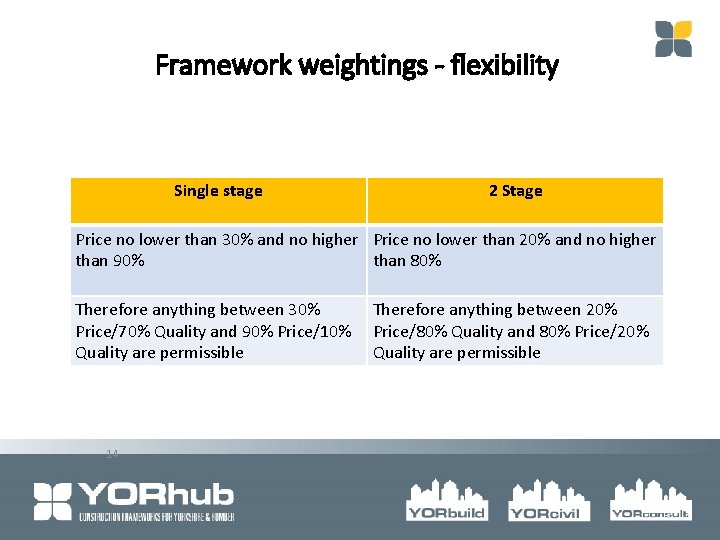
Framework weightings - flexibility Single stage 2 Stage Price no lower than 30% and no higher Price no lower than 20% and no higher than 90% than 80% Therefore anything between 30% Therefore anything between 20% Price/70% Quality and 90% Price/10% Price/80% Quality and 80% Price/20% Quality are permissible 14
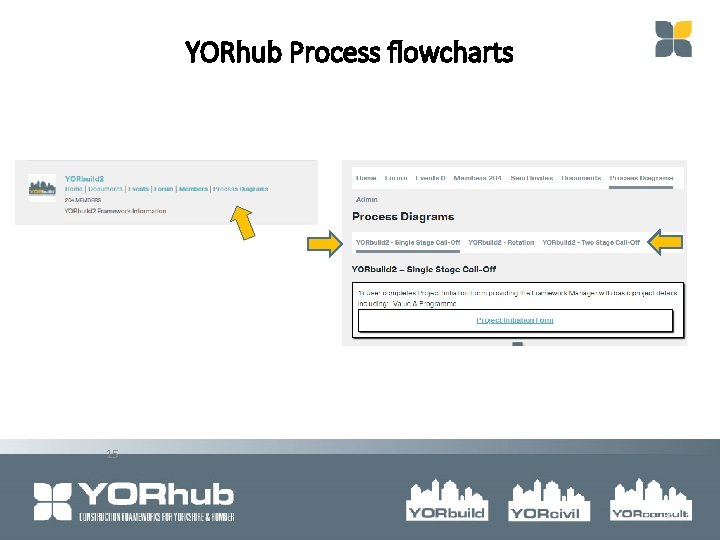
YORhub Process flowcharts 15
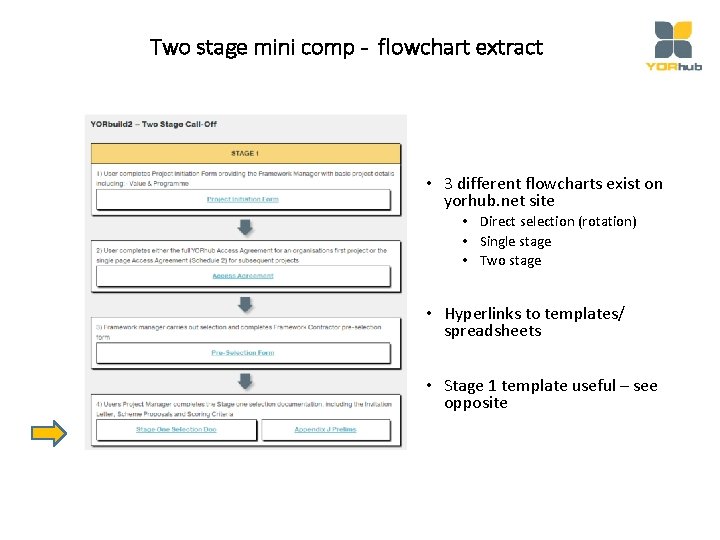
Two stage mini comp - flowchart extract • 3 different flowcharts exist on yorhub. net site • Direct selection (rotation) • Single stage • Two stage • Hyperlinks to templates/ spreadsheets • Stage 1 template useful – see opposite
Pros and cons
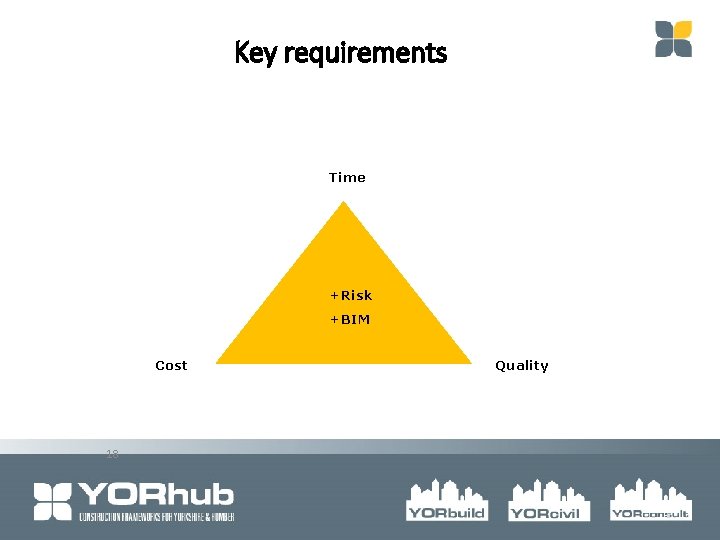
Key requirements Time +Risk +BIM Cost 18 Quality
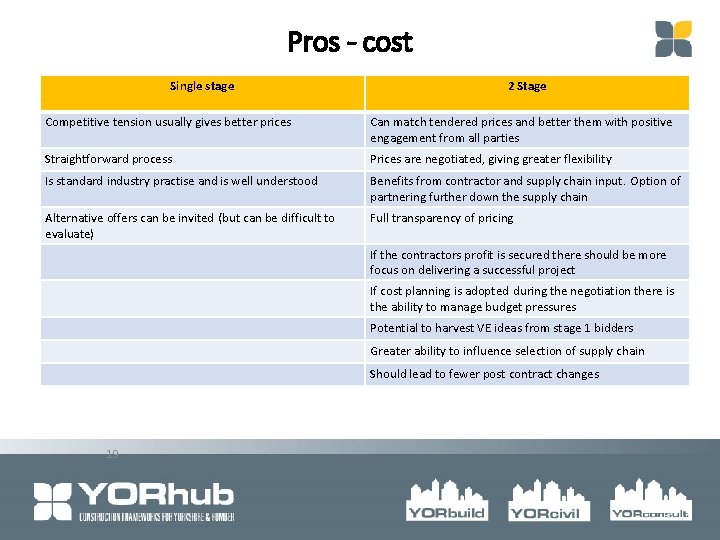
Pros - cost Single stage 2 Stage Competitive tension usually gives better prices Can match tendered prices and better them with positive engagement from all parties Straightforward process Prices are negotiated, giving greater flexibility Is standard industry practise and is well understood Benefits from contractor and supply chain input. Option of partnering further down the supply chain Alternative offers can be invited (but can be difficult to evaluate) Full transparency of pricing If the contractors profit is secured there should be more focus on delivering a successful project If cost planning is adopted during the negotiation there is the ability to manage budget pressures Potential to harvest VE ideas from stage 1 bidders Greater ability to influence selection of supply chain Should lead to fewer post contract changes 19
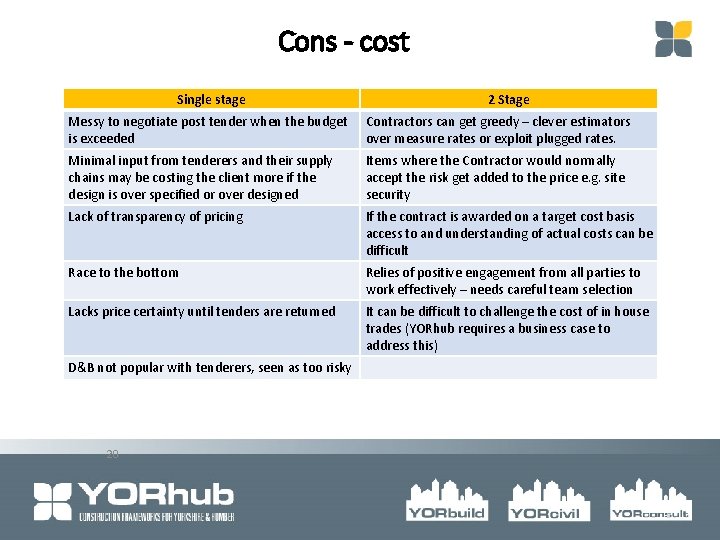
Cons - cost Single stage 2 Stage Messy to negotiate post tender when the budget is exceeded Contractors can get greedy – clever estimators over measure rates or exploit plugged rates. Minimal input from tenderers and their supply chains may be costing the client more if the design is over specified or over designed Items where the Contractor would normally accept the risk get added to the price e. g. site security Lack of transparency of pricing If the contract is awarded on a target cost basis access to and understanding of actual costs can be difficult Race to the bottom Relies of positive engagement from all parties to work effectively – needs careful team selection Lacks price certainty until tenders are returned It can be difficult to challenge the cost of in house trades (YORhub requires a business case to address this) D&B not popular with tenderers, seen as too risky 20
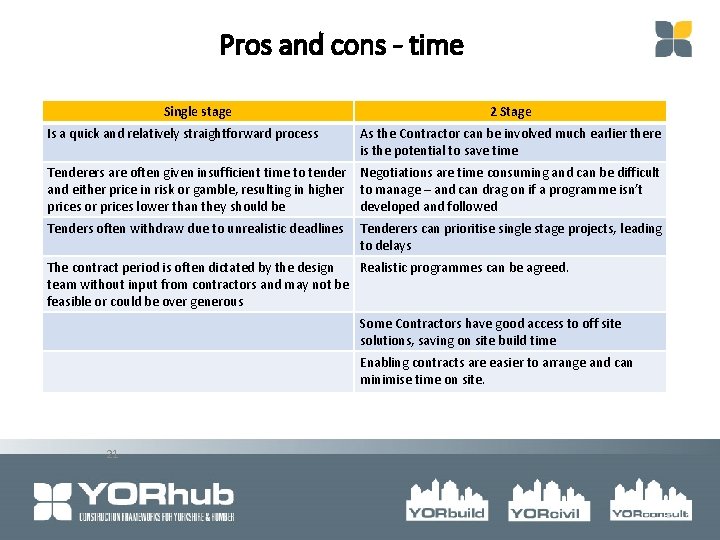
Pros and cons - time Single stage Is a quick and relatively straightforward process 2 Stage As the Contractor can be involved much earlier there is the potential to save time Tenderers are often given insufficient time to tender Negotiations are time consuming and can be difficult and either price in risk or gamble, resulting in higher to manage – and can drag on if a programme isn’t prices or prices lower than they should be developed and followed Tenders often withdraw due to unrealistic deadlines Tenderers can prioritise single stage projects, leading to delays The contract period is often dictated by the design Realistic programmes can be agreed. team without input from contractors and may not be feasible or could be over generous Some Contractors have good access to off site solutions, saving on site build time Enabling contracts are easier to arrange and can minimise time on site. 21
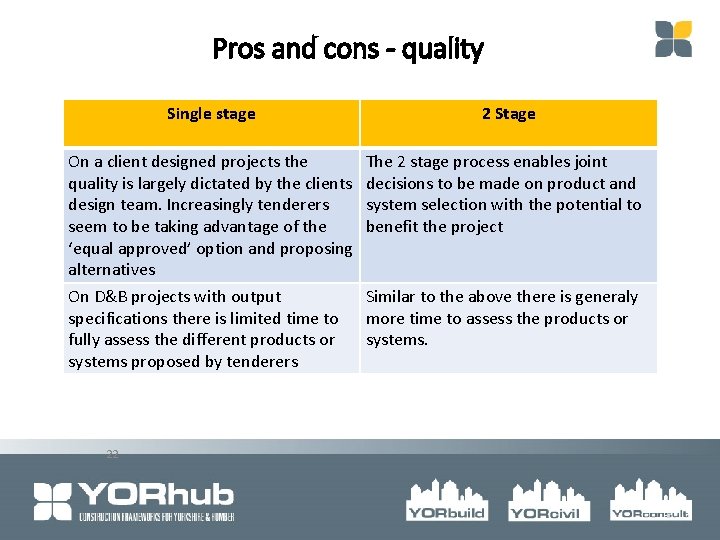
Pros and cons - quality Single stage 2 Stage On a client designed projects the quality is largely dictated by the clients design team. Increasingly tenderers seem to be taking advantage of the ‘equal approved’ option and proposing alternatives On D&B projects with output specifications there is limited time to fully assess the different products or systems proposed by tenderers The 2 stage process enables joint decisions to be made on product and system selection with the potential to benefit the project 22 Similar to the above there is generaly more time to assess the products or systems.
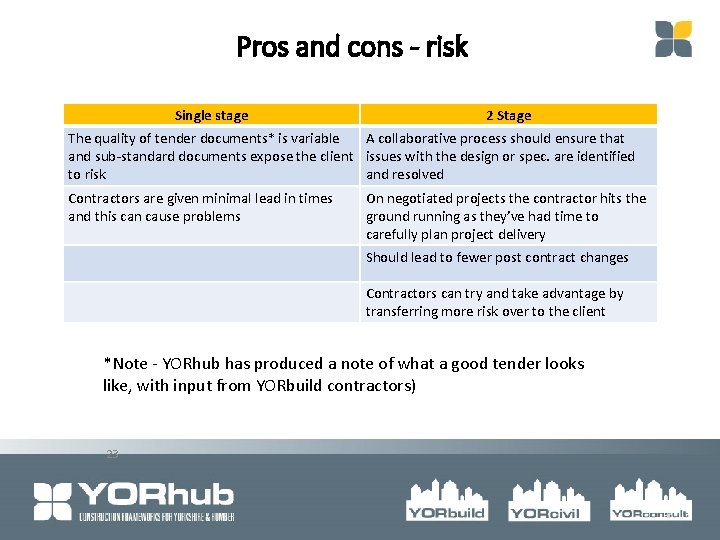
Pros and cons - risk Single stage 2 Stage The quality of tender documents* is variable A collaborative process should ensure that and sub-standard documents expose the client issues with the design or spec. are identified to risk and resolved Contractors are given minimal lead in times and this can cause problems On negotiated projects the contractor hits the ground running as they’ve had time to carefully plan project delivery Should lead to fewer post contract changes Contractors can try and take advantage by transferring more risk over to the client *Note - YORhub has produced a note of what a good tender looks like, with input from YORbuild contractors) 23
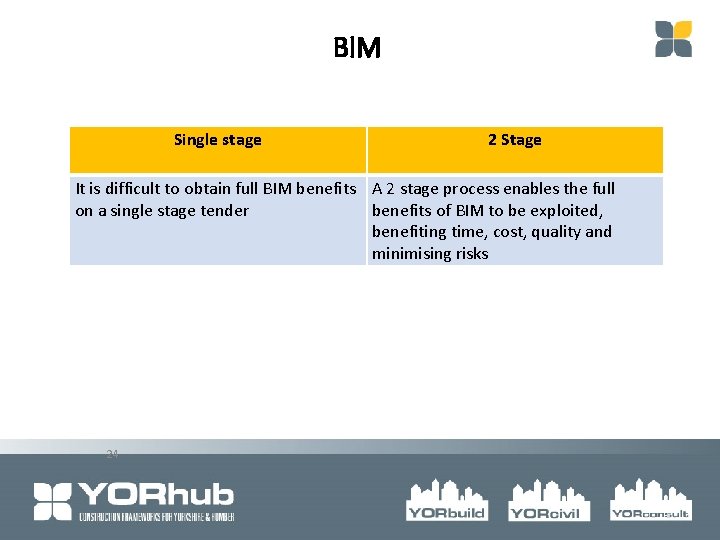
BIM Single stage 2 Stage It is difficult to obtain full BIM benefits A 2 stage process enables the full on a single stage tender benefits of BIM to be exploited, benefiting time, cost, quality and minimising risks 24
Summary
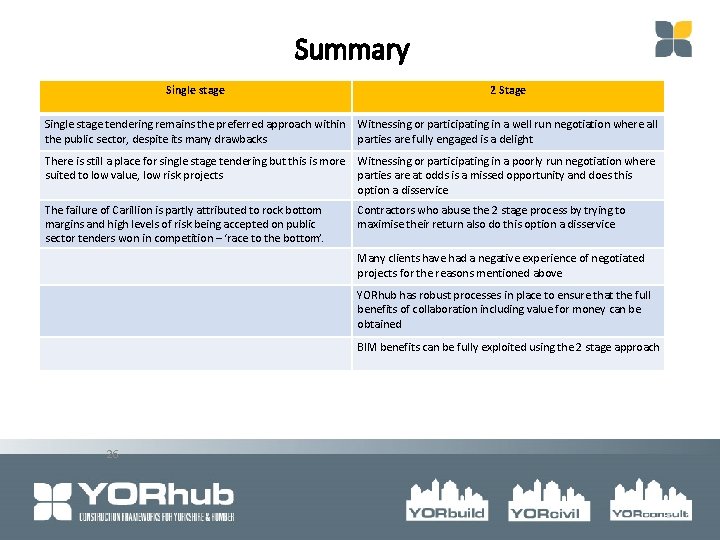
Summary Single stage 2 Stage Single stage tendering remains the preferred approach within Witnessing or participating in a well run negotiation where all the public sector, despite its many drawbacks parties are fully engaged is a delight There is still a place for single stage tendering but this is more Witnessing or participating in a poorly run negotiation where suited to low value, low risk projects parties are at odds is a missed opportunity and does this option a disservice The failure of Carillion is partly attributed to rock bottom margins and high levels of risk being accepted on public sector tenders won in competition – ‘race to the bottom’. Contractors who abuse the 2 stage process by trying to maximise their return also do this option a disservice Many clients have had a negative experience of negotiated projects for the reasons mentioned above YORhub has robust processes in place to ensure that the full benefits of collaboration including value for money can be obtained BIM benefits can be fully exploited using the 2 stage approach 26
Tender procedure choice So which procedure would you choose? : 1. Time – which procedure is more likely to ensure the project starts on time 2. Cost – which procedure will give better value 3. Quality – which procedure will give me a better product 4. Risk – which procedure is better at dealing with risk Both can be used on the YORbuild 2 framework.
Q&A/ Close