
Single source shortest path with negative cost edges
![Shortest Paths: implementation Shortest-Path(G, t) { for each node v V M[0, v] =](https://slidetodoc.com/presentation_image_h2/d4f4195f9cacee57d2cd05d6300a18e0/image-3.jpg "Shortest Paths: implementation Shortest-Path(G, t) { for each node v V M[0, v] =")
![Shortest Paths: Practical implementations Practical improvements. • Maintain only one array M[v] = shortest](https://slidetodoc.com/presentation_image_h2/d4f4195f9cacee57d2cd05d6300a18e0/image-4.jpg "Shortest Paths: Practical implementations Practical improvements. • Maintain only one array M[v] = shortest")
![Bellman-Ford: Efficient Implementation Push-Based-Shortest-Path(G, s, t) { for each node v V { M[v]](https://slidetodoc.com/presentation_image_h2/d4f4195f9cacee57d2cd05d6300a18e0/image-5.jpg "Bellman-Ford: Efficient Implementation Push-Based-Shortest-Path(G, s, t) { for each node v V { M[v]")
![Continue: • • • DIJKSTRA(G, w, s): INITIALIZE-SINGLE-SOURCE(G, s) S Q V[G] while Q](https://slidetodoc.com/presentation_image_h2/d4f4195f9cacee57d2cd05d6300a18e0/image-22.jpg "Continue: • • • DIJKSTRA(G, w, s): INITIALIZE-SINGLE-SOURCE(G, s) S Q V[G] while Q")
- Slides: 36
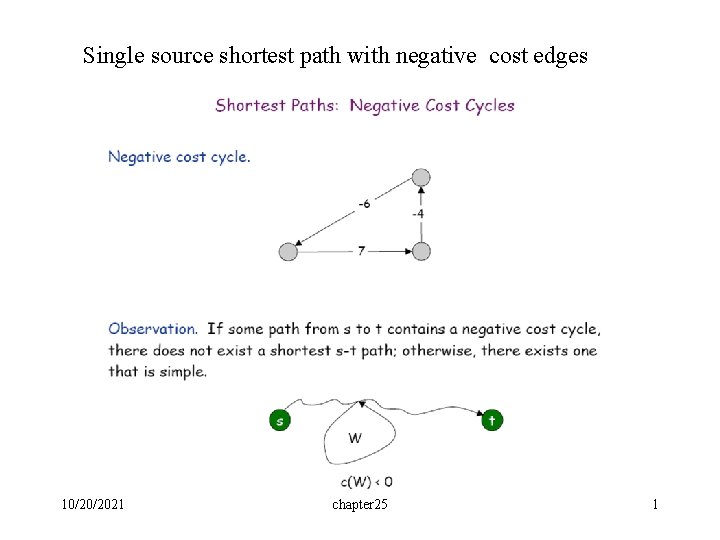
Single source shortest path with negative cost edges 10/20/2021 chapter 25 1
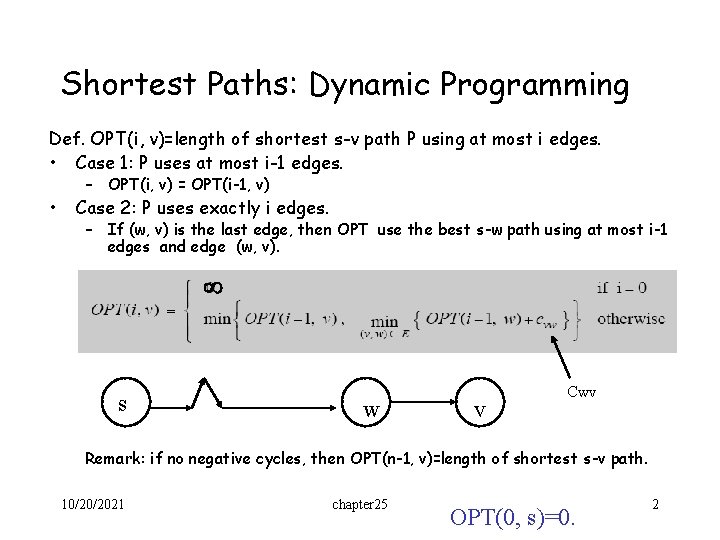
Shortest Paths: Dynamic Programming Def. OPT(i, v)=length of shortest s-v path P using at most i edges. • Case 1: P uses at most i-1 edges. • – OPT(i, v) = OPT(i-1, v) Case 2: P uses exactly i edges. – If (w, v) is the last edge, then OPT use the best s-w path using at most i-1 edges and edge (w, v). s w v Cwv Remark: if no negative cycles, then OPT(n-1, v)=length of shortest s-v path. 10/20/2021 chapter 25 OPT(0, s)=0. 2
Shortest Paths: implementation Shortest-Path(G, t) { for each node v V M[0, v] = M[0, s] = 0 for i = 1 to n-1 for each node w V M[i, w] = M[i-1, w] for each edge (w, v) E M[i, v] = min { M[i, v], M[i-1, w] + cwv } } Analysis. O(mn) time, O(n 2) space. m--no. of edges, n—no. of nodes Finding the shortest paths. Maintain a "successor" for each table entry. 10/20/2021 chapter 25 3
Shortest Paths: Practical implementations Practical improvements. • Maintain only one array M[v] = shortest v-t path that we have found so far. • No need to check edges of the form (w, v) unless M[w] changed in previous iteration. Theorem. Throughout the algorithm, M[v] is the length of some s-v path, and after i rounds of updates, the value M[v] the length of shortest s-v path using i edges. Overall impact. • Memory: O(m + n). • Running time: O(mn) worst case, but substantially faster in practice. 10/20/2021 chapter 25 4
Bellman-Ford: Efficient Implementation Push-Based-Shortest-Path(G, s, t) { for each node v V { M[v] = successor[v] = empty } M[s] = 0 for i = 1 to n-1 { for each node w V { if (M[w] has been updated in previous iteration) { for each node v such that (w, v) E { if (M[v] > M[w] + cwv) { M[v] = M[w] + cwv successor[v] = w } } } If no M[w] value changed in iteration i, stop. } } Note: Dijkstra’s Algorithm select a w with the smallest M[w]. Time O(mn), space O(n). 10/20/2021 chapter 25 5
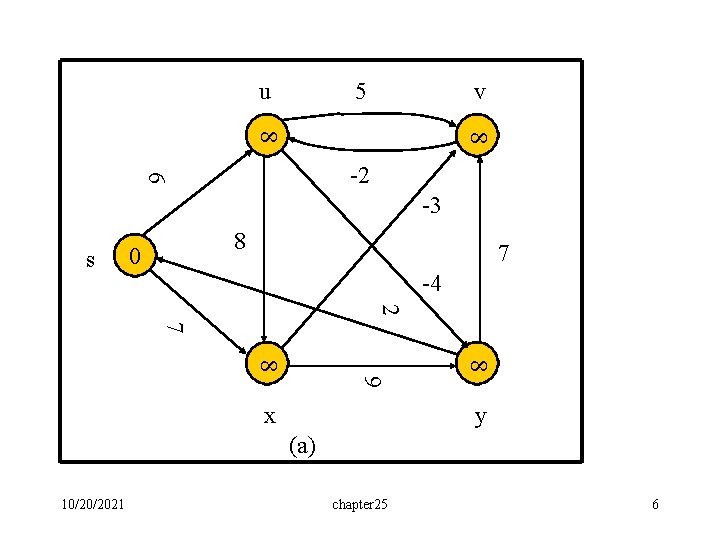
u 5 v 8 8 6 -2 -3 s 8 0 7 -4 2 7 8 8 9 x y (a) 10/20/2021 chapter 25 6
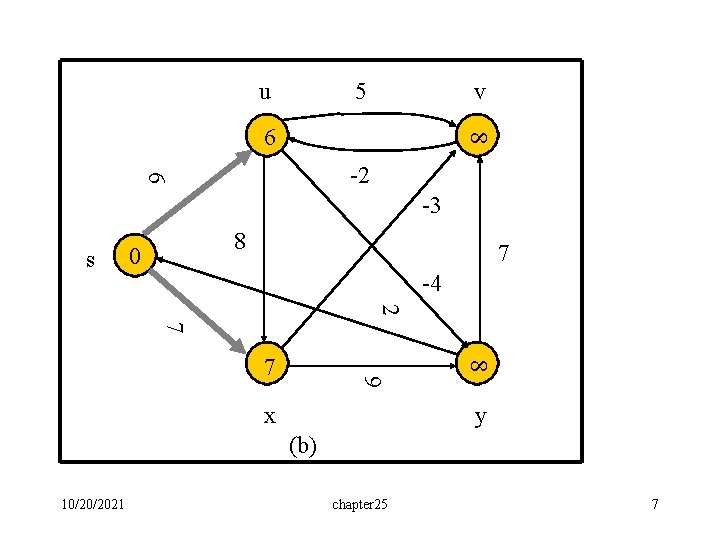
u 5 v 8 6 6 -2 -3 s 8 0 7 -4 2 7 8 7 9 x y (b) 10/20/2021 chapter 25 7
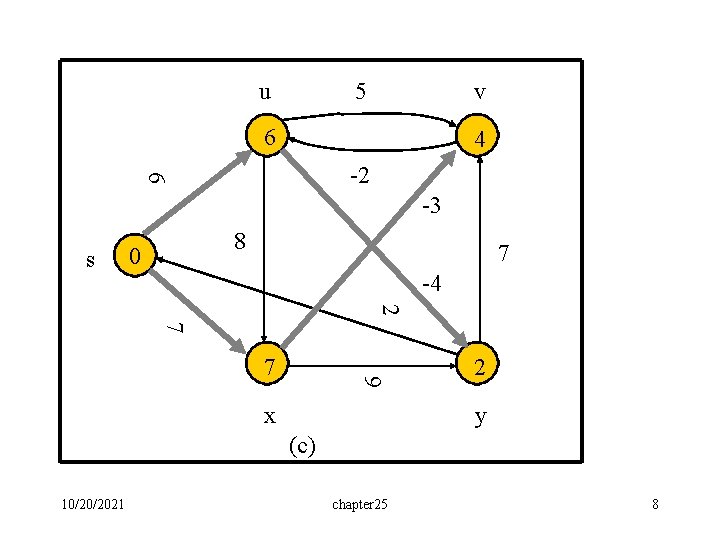
u 5 v 6 4 6 -2 -3 s 8 0 7 -4 2 7 9 7 x 2 y (c) 10/20/2021 chapter 25 8
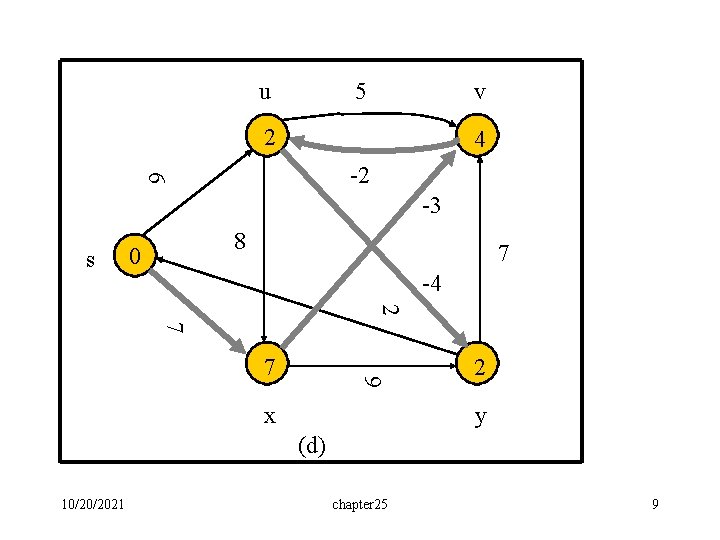
u 5 v 2 4 6 -2 -3 s 8 0 7 -4 2 7 9 7 x 2 y (d) 10/20/2021 chapter 25 9
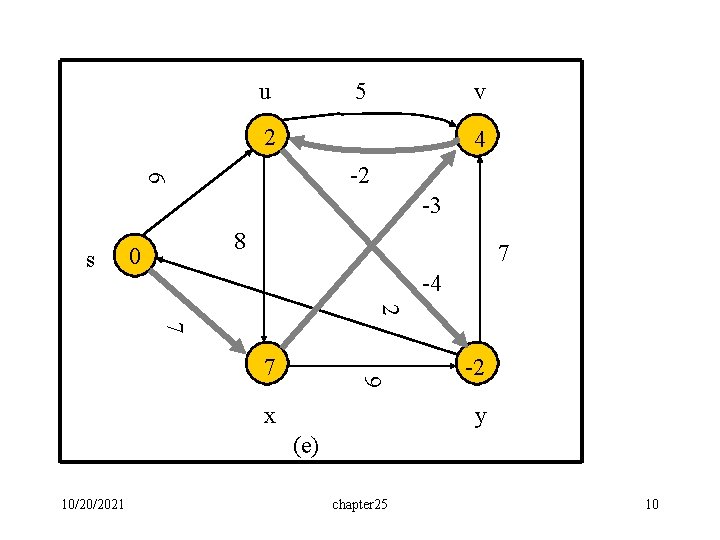
u 5 v 2 4 6 -2 -3 s 8 0 7 -4 2 7 9 7 x -2 y (e) 10/20/2021 chapter 25 10
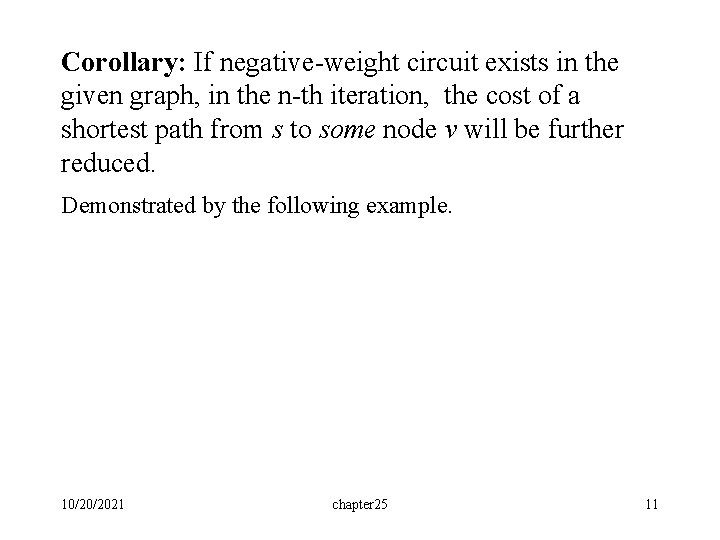
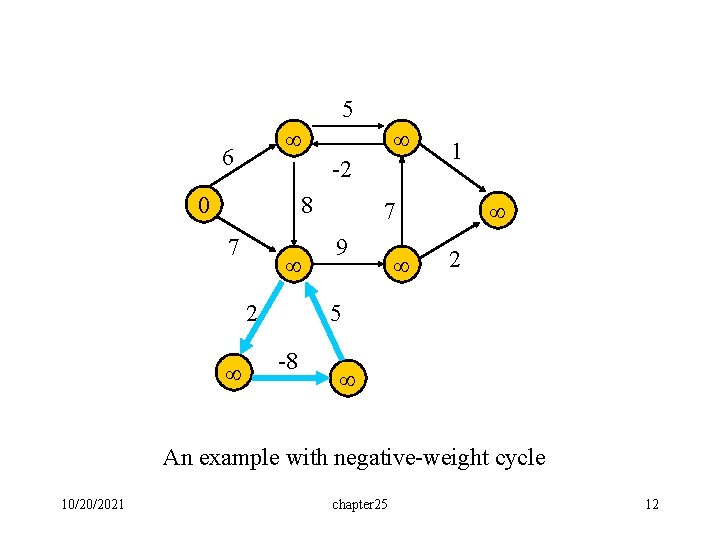
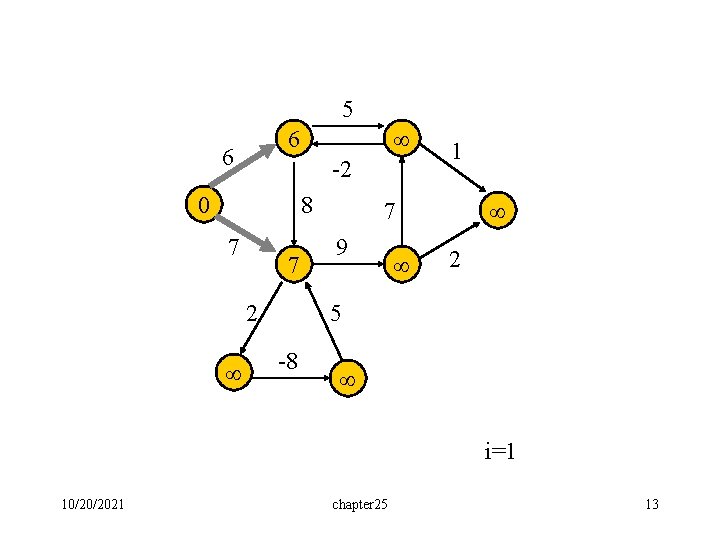
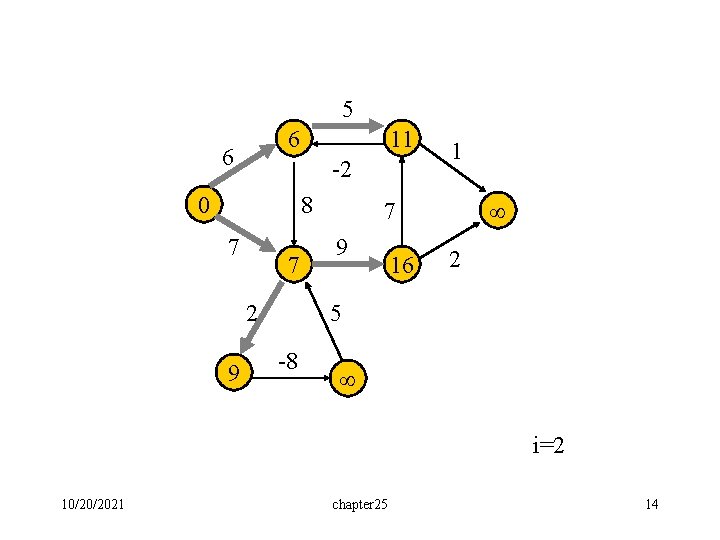
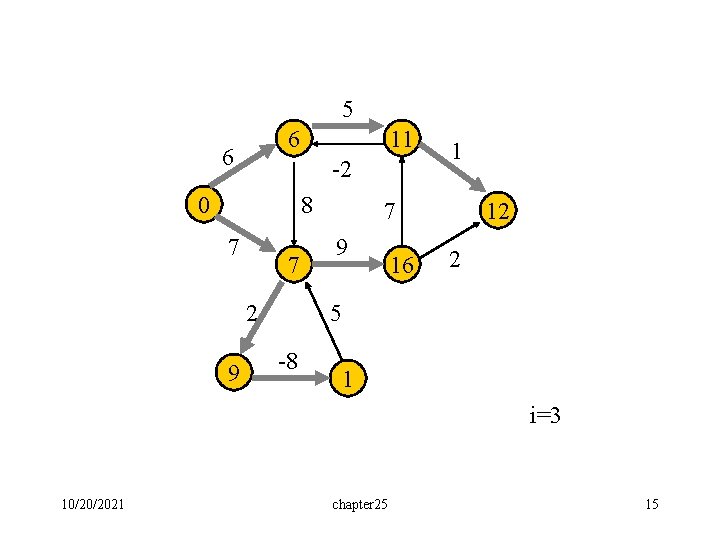
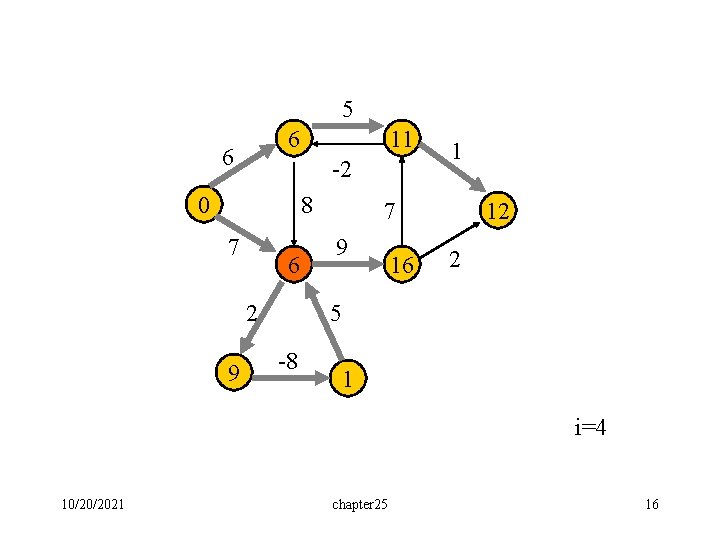
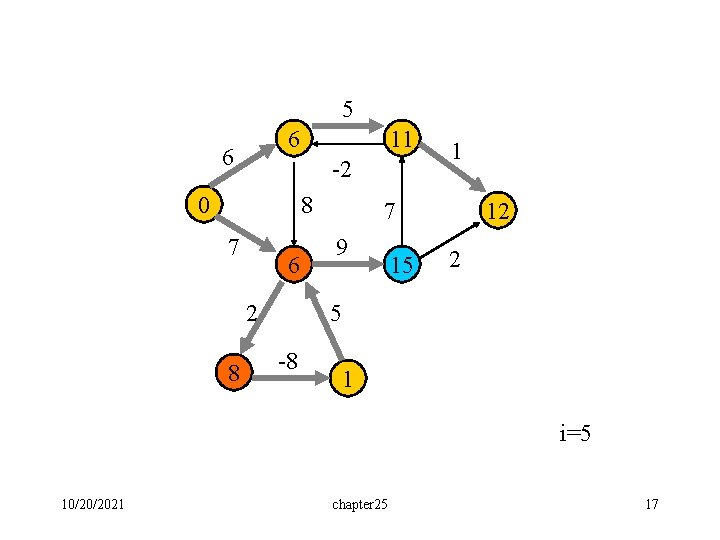
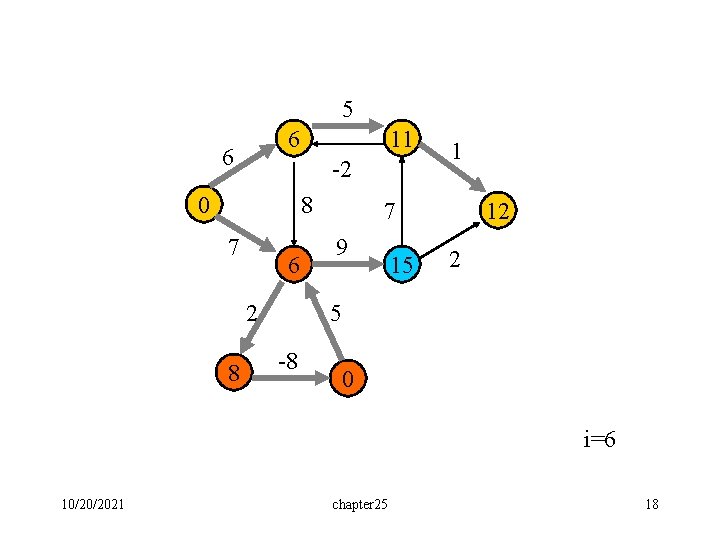
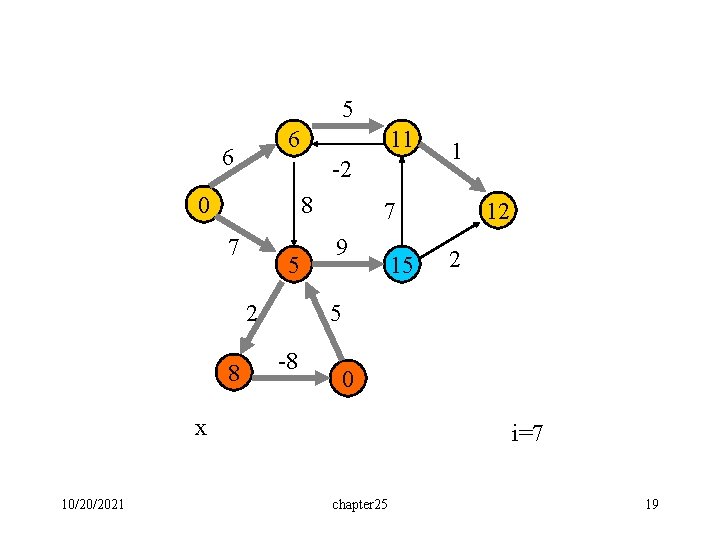
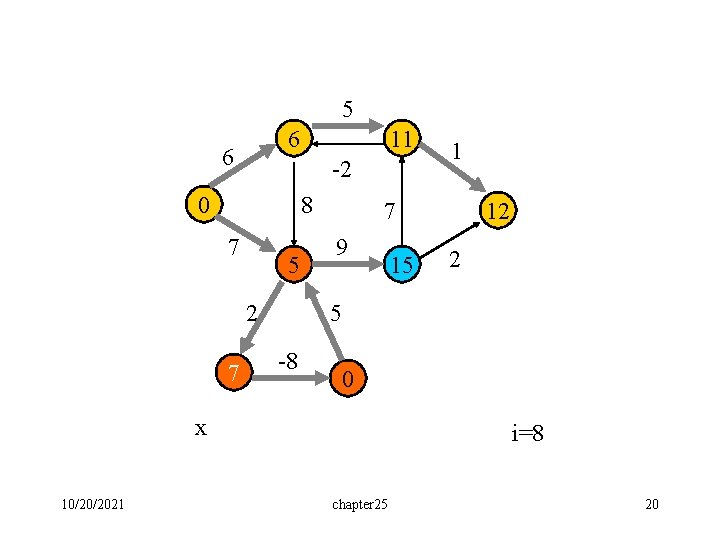
Corollary: If negative-weight circuit exists in the given graph, in the n-th iteration, the cost of a shortest path from s to some node v will be further reduced. Demonstrated by the following example. 10/20/2021 chapter 25 11
5 6 -2 0 8 7 2 1 7 9 2 5 -8 An example with negative-weight cycle 10/20/2021 chapter 25 12
5 6 6 -2 0 8 7 7 2 1 7 9 2 5 -8 i=1 10/20/2021 chapter 25 13
5 6 6 11 -2 0 8 7 7 2 9 1 7 9 16 2 5 -8 i=2 10/20/2021 chapter 25 14
5 6 6 11 -2 0 8 7 7 2 9 1 12 7 9 16 2 5 -8 1 i=3 10/20/2021 chapter 25 15
5 6 6 11 -2 0 8 7 6 2 9 1 12 7 9 16 2 5 -8 1 i=4 10/20/2021 chapter 25 16
5 6 6 11 -2 0 8 7 6 2 8 1 7 9 15 12 2 5 -8 1 i=5 10/20/2021 chapter 25 17
5 6 6 11 -2 0 8 7 6 2 8 1 12 7 9 15 2 5 -8 0 i=6 10/20/2021 chapter 25 18
5 6 6 11 -2 0 8 7 5 2 8 7 9 15 12 2 5 -8 0 x 10/20/2021 1 i=7 chapter 25 19
5 6 6 11 -2 0 8 7 5 2 7 7 9 15 12 2 5 -8 0 x 10/20/2021 1 i=8 chapter 25 20
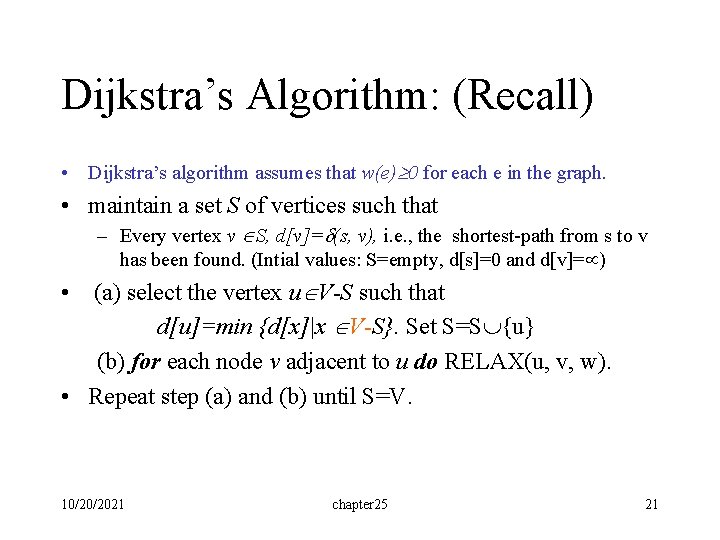
Dijkstra’s Algorithm: (Recall) • Dijkstra’s algorithm assumes that w(e) 0 for each e in the graph. • maintain a set S of vertices such that – Every vertex v S, d[v]= (s, v), i. e. , the shortest-path from s to v has been found. (Intial values: S=empty, d[s]=0 and d[v]= ) • (a) select the vertex u V-S such that d[u]=min {d[x]|x V-S}. Set S=S {u} (b) for each node v adjacent to u do RELAX(u, v, w). • Repeat step (a) and (b) until S=V. 10/20/2021 chapter 25 21
Continue: • • • DIJKSTRA(G, w, s): INITIALIZE-SINGLE-SOURCE(G, s) S Q V[G] while Q do u EXTRACT -MIN(Q) S S {u} for each vertex v Adj[u] do RELAX(u, v, w) 10/20/2021 chapter 25 22
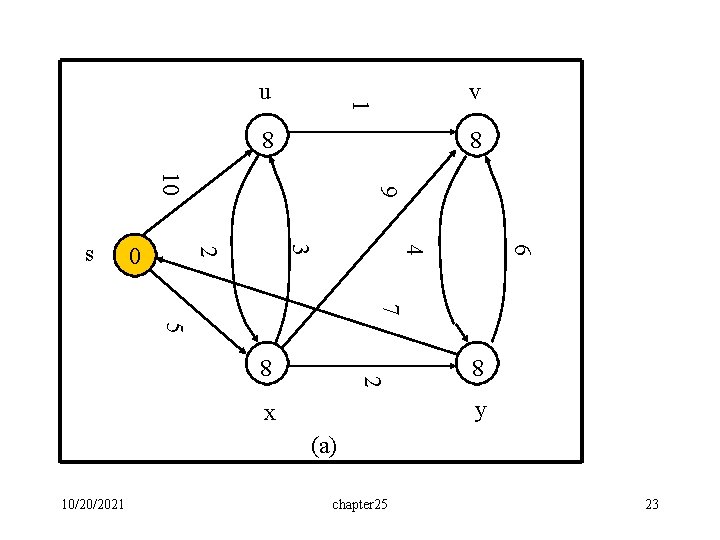
v 1 u 8 6 8 4 3 2 0 9 10 s 7 5 8 8 2 y x (a) 10/20/2021 chapter 25 23
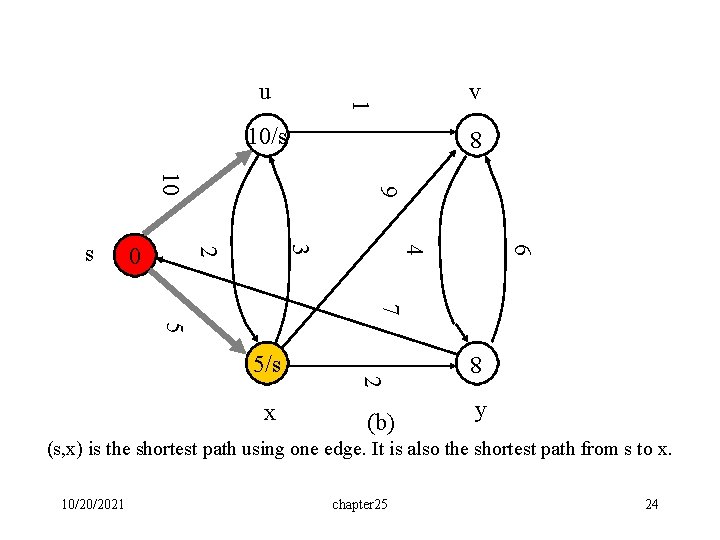
v 1 u 10/s 8 6 4 3 2 0 9 10 s 7 5 (b) 8 x 2 5/s y (s, x) is the shortest path using one edge. It is also the shortest path from s to x. 10/20/2021 chapter 25 24
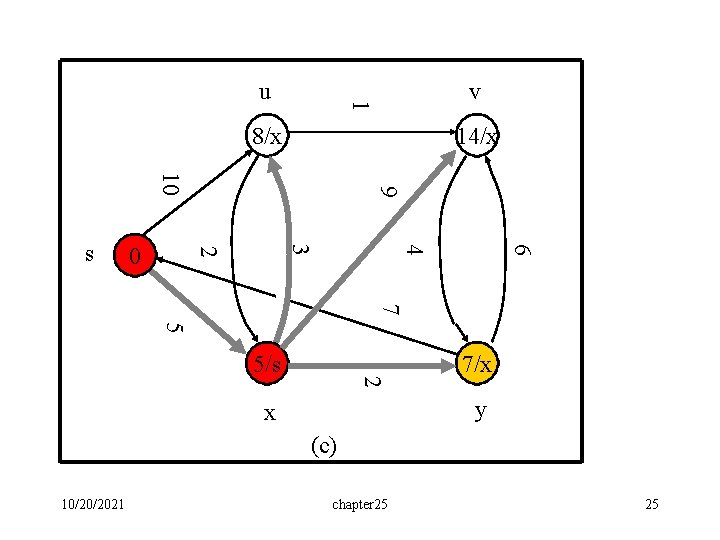
v 1 u 8/x 14/x 6 4 3 2 0 9 10 s 7 5 2 5/s 7/x y x (c) 10/20/2021 chapter 25 25
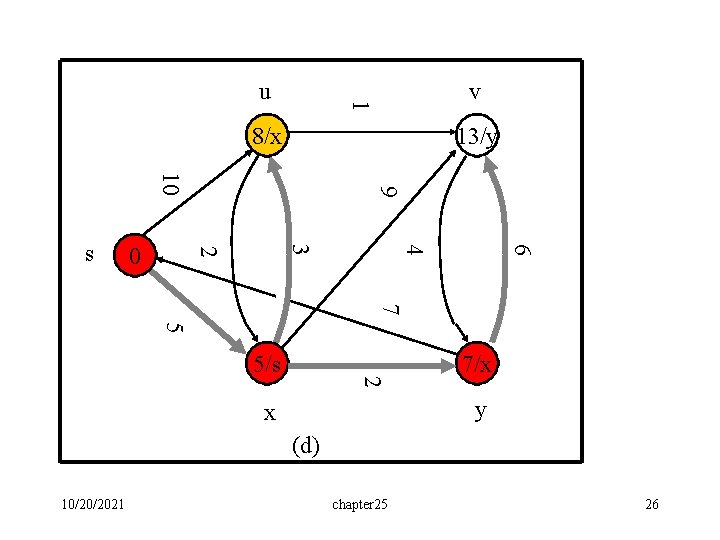
v 1 u 8/x 13/y 6 4 3 2 0 9 10 s 7 5 2 5/s 7/x y x (d) 10/20/2021 chapter 25 26
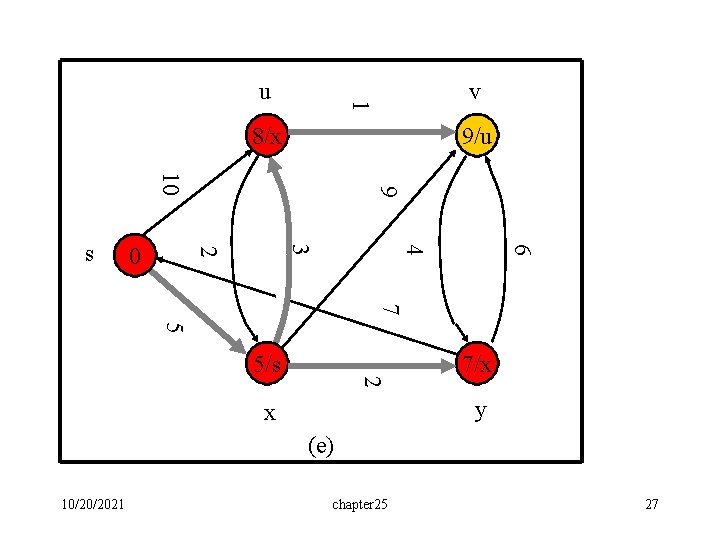
v 1 u 8/x 9/u 6 4 3 2 0 9 10 s 7 5 2 5/s 7/x y x (e) 10/20/2021 chapter 25 27
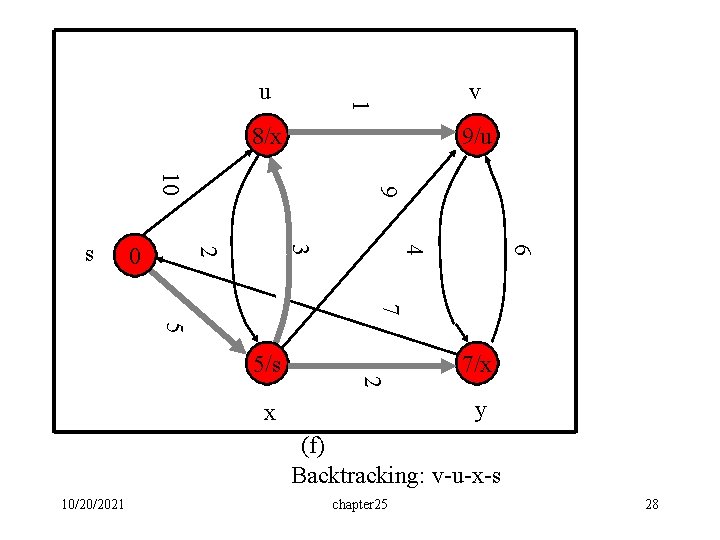
v 1 u 8/x 9/u 6 4 3 2 0 9 10 s 7 5 2 5/s 7/x y x (f) Backtracking: v-u-x-s 10/20/2021 chapter 25 28
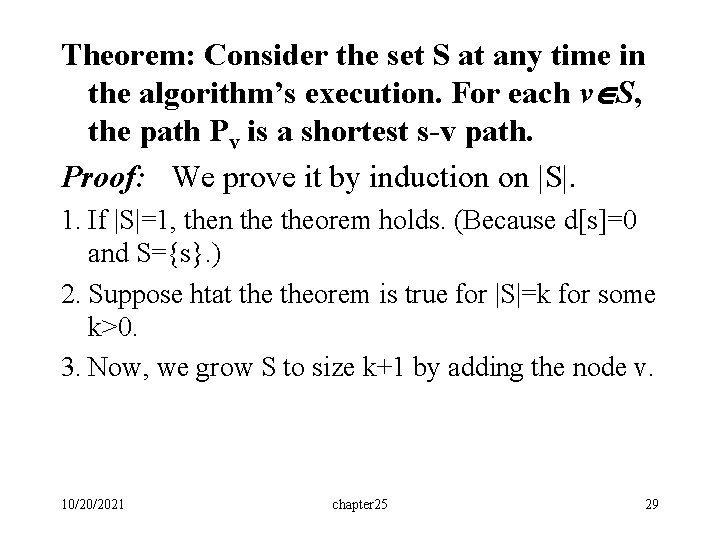
Theorem: Consider the set S at any time in the algorithm’s execution. For each v S, the path Pv is a shortest s-v path. Proof: We prove it by induction on |S|. 1. If |S|=1, then theorem holds. (Because d[s]=0 and S={s}. ) 2. Suppose htat theorem is true for |S|=k for some k>0. 3. Now, we grow S to size k+1 by adding the node v. 10/20/2021 chapter 25 29
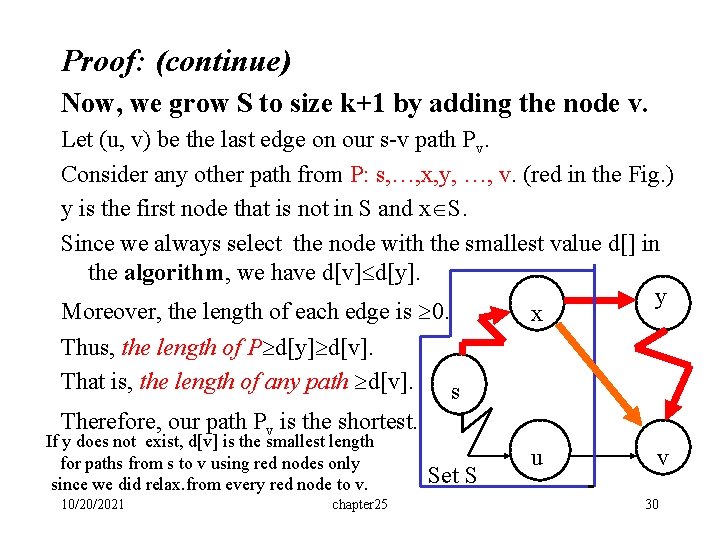
Proof: (continue) Now, we grow S to size k+1 by adding the node v. Let (u, v) be the last edge on our s-v path Pv. Consider any other path from P: s, …, x, y, …, v. (red in the Fig. ) y is the first node that is not in S and x S. Since we always select the node with the smallest value d[] in the algorithm, we have d[v] d[y]. y Moreover, the length of each edge is 0. x Thus, the length of P d[y] d[v]. That is, the length of any path d[v]. s Therefore, our path Pv is the shortest. If y does not exist, d[v] is the smallest length for paths from s to v using red nodes only since we did relax. from every red node to v. 10/20/2021 chapter 25 Set S u v 30
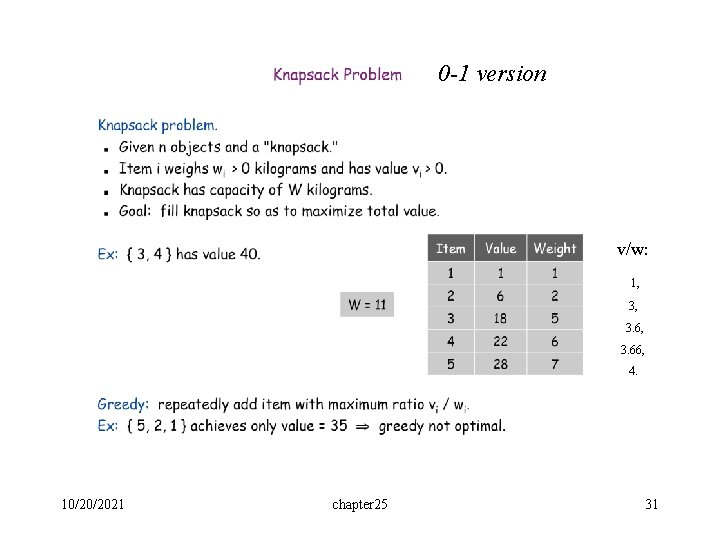
0 -1 version v/w: 1, 3, 3. 66, 4. 10/20/2021 chapter 25 31
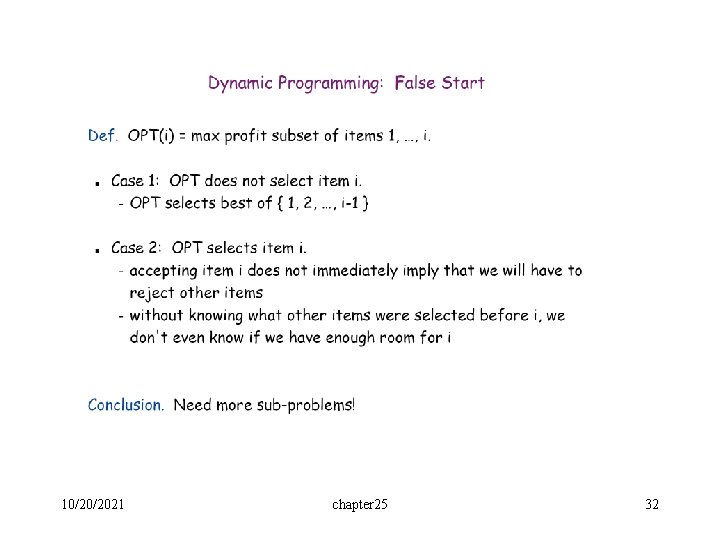
10/20/2021 chapter 25 32
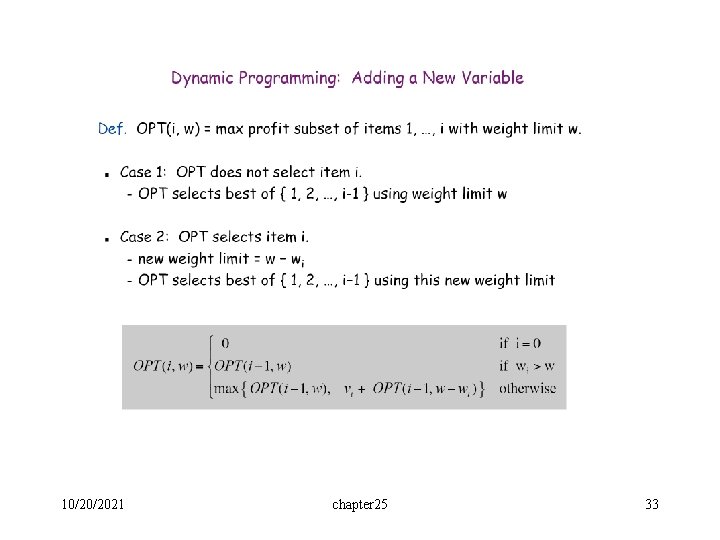
10/20/2021 chapter 25 33
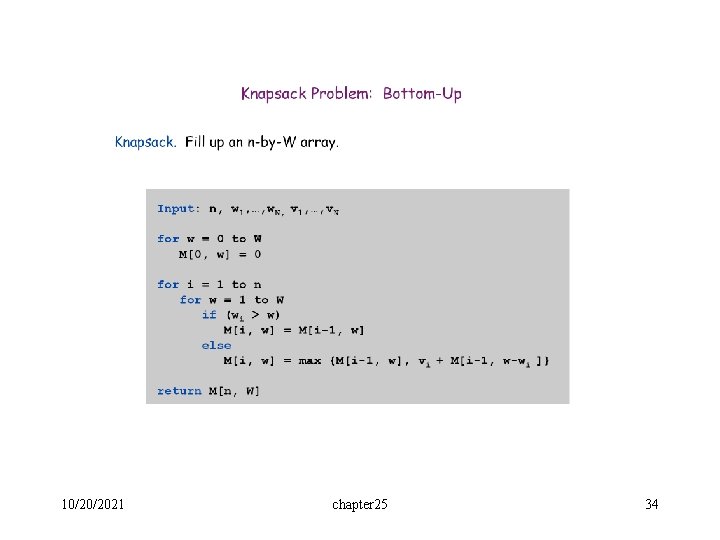
10/20/2021 chapter 25 34
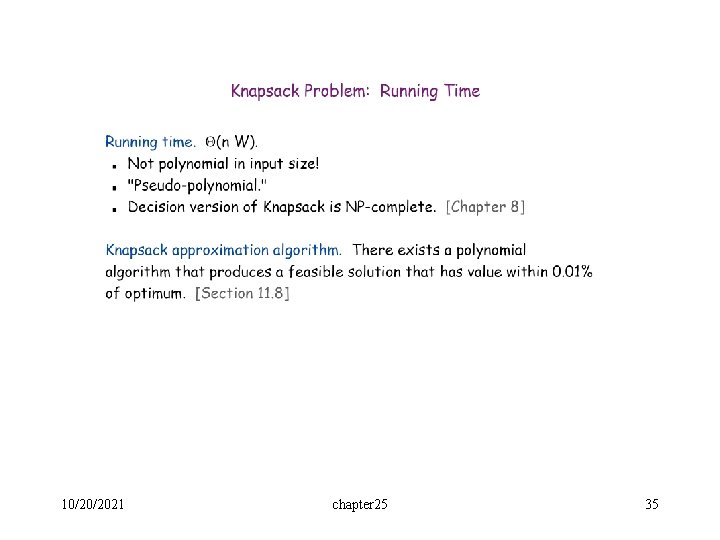
10/20/2021 chapter 25 35
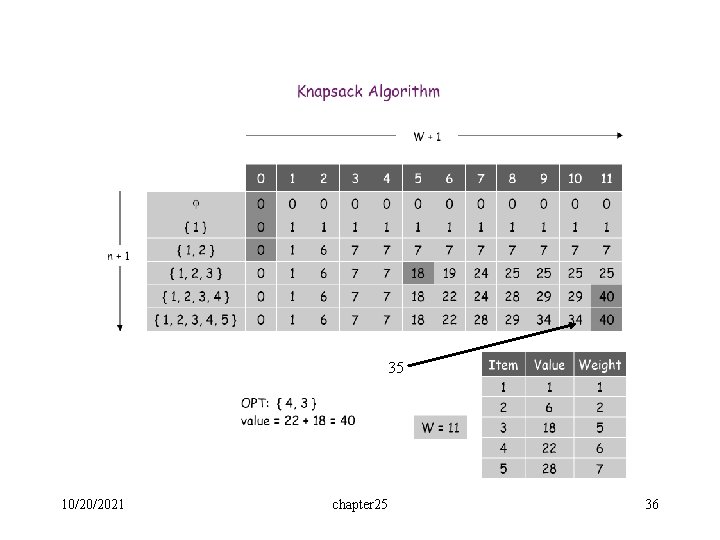
35 10/20/2021 chapter 25 36