
Single Molecule Mass Spectrometry Using a Single Nanopore

- Slides: 8
Single Molecule Mass Spectrometry Using a Single Nanopore Dr. John J. Kasianowicz Colleagues: NIST: J. Robertson, V. Stanford Brazil: O. Krasilnikov, C. Rodrigues
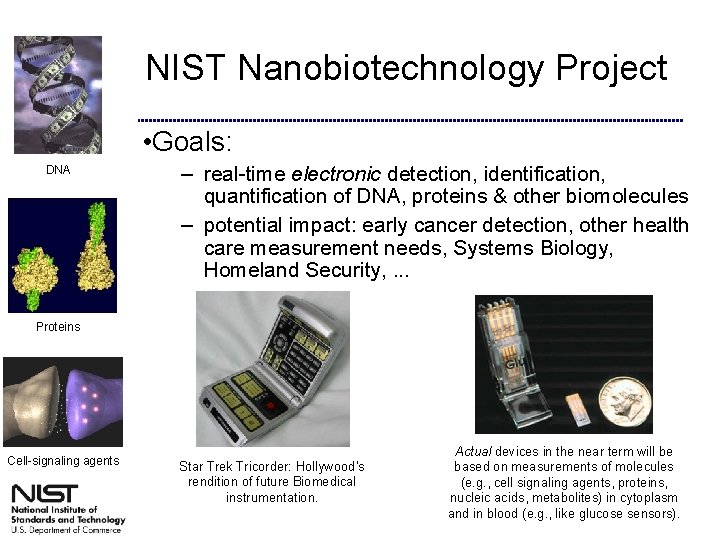
Targets NIST Nanobiotechnology Project • Goals: DNA – real-time electronic detection, identification, quantification of DNA, proteins & other biomolecules – potential impact: early cancer detection, other health care measurement needs, Systems Biology, Homeland Security, . . . Proteins Cell-signaling agents Star Trek Tricorder: Hollywood’s rendition of future Biomedical instrumentation. Actual devices in the near term will be based on measurements of molecules (e. g. , cell signaling agents, proteins, nucleic acids, metabolites) in cytoplasm and in blood (e. g. , like glucose sensors).
Why Electronics for Future Bio-Measurement Needs? –Electronic measurements revolutionized biological research twice in the past 70 years – ~ 1940 s-1950 s: Crucial for understanding how nerves work – ~ 1970 s: Single biological molecule measurements –The need to obtain more detailed & quantitative information about many small molecules simultaneously requires an approach that uses nano& micro-fabrication, systems integration, & rapid measurement: i. e. , the realm of electronics.
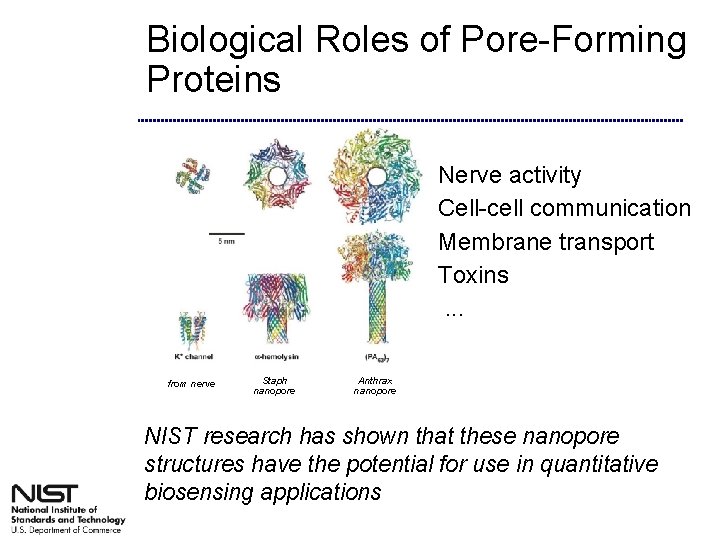
Biological Roles of Pore-Forming Proteins Nerve activity Cell-cell communication Membrane transport Toxins. . . from nerve Staph nanopore Anthrax nanopore NIST research has shown that these nanopore structures have the potential for use in quantitative biosensing applications
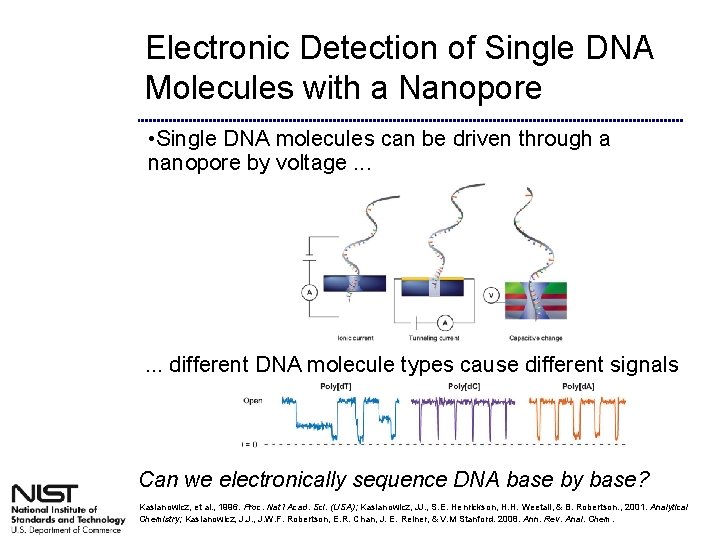
Electronic Detection of Single DNA Molecules with a Nanopore • Single DNA molecules can be driven through a nanopore by voltage. . . different DNA molecule types cause different signals Can we electronically sequence DNA base by base? Kasianowicz, et al. , 1996. Proc. Nat’l Acad. Sci. (USA); Kasianowicz, JJ. , S. E. Henrickson, H. H. Weetall, & B. Robertson. , 2001. Analytical Chemistry; Kasianowicz, J. J. , J. W. F. Robertson, E. R. Chan, J. E. Reiner, & V. M Stanford. 2008. Ann. Rev. Anal. Chem.
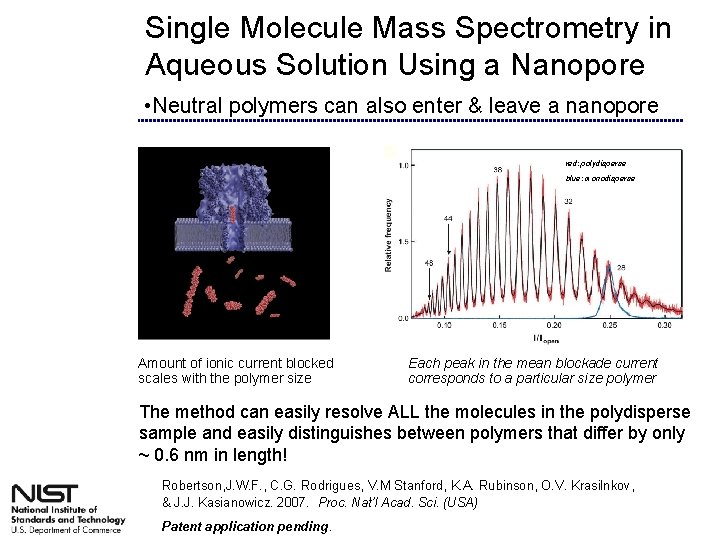
Single Molecule Mass Spectrometry in Aqueous Solution Using a Nanopore • Neutral polymers can also enter & leave a nanopore red: polydisperse blue: monodisperse Amount of ionic current blocked scales with the polymer size Each peak in the mean blockade current corresponds to a particular size polymer The method can easily resolve ALL the molecules in the polydisperse sample and easily distinguishes between polymers that differ by only ~ 0. 6 nm in length! Robertson, J. W. F. , C. G. Rodrigues, V. M Stanford, K. A. Rubinson, O. V. Krasilnkov, & J. J. Kasianowicz. 2007. Proc. Nat’l Acad. Sci. (USA) Patent application pending.
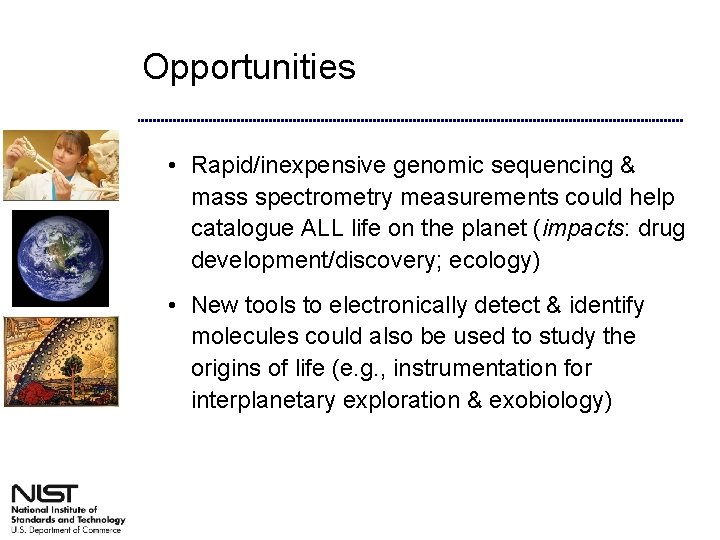
Opportunities • Rapid/inexpensive genomic sequencing & mass spectrometry measurements could help catalogue ALL life on the planet (impacts: drug development/discovery; ecology) • New tools to electronically detect & identify molecules could also be used to study the origins of life (e. g. , instrumentation for interplanetary exploration & exobiology)
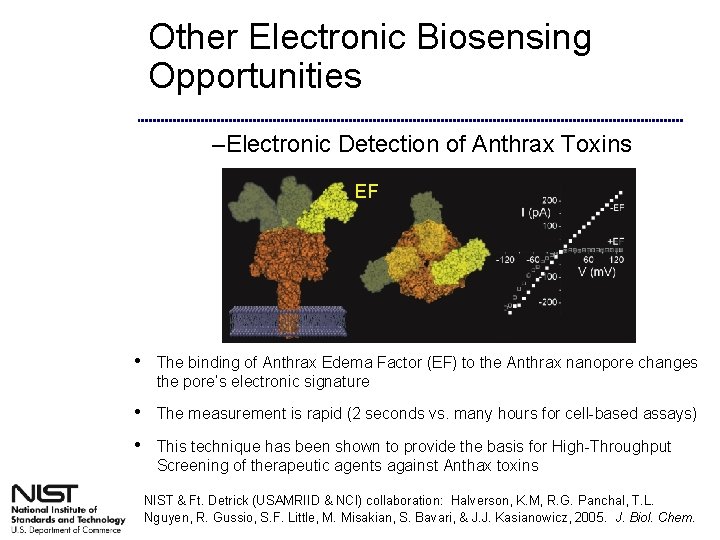
Other Electronic Biosensing Opportunities –Electronic Detection of Anthrax Toxins EF • The binding of Anthrax Edema Factor (EF) to the Anthrax nanopore changes the pore’s electronic signature • The measurement is rapid (2 seconds vs. many hours for cell-based assays) • This technique has been shown to provide the basis for High-Throughput Screening of therapeutic agents against Anthax toxins NIST & Ft. Detrick (USAMRIID & NCI) collaboration: Halverson, K. M, R. G. Panchal, T. L. Nguyen, R. Gussio, S. F. Little, M. Misakian, S. Bavari, & J. J. Kasianowicz, 2005. J. Biol. Chem.