
Single image superresolution with limited number of filters

Single image superresolution with limited number of filters Yusuke Nakahara, Takuro Yamaguchi, Masaaki Ikehara from Keio Univ. 1
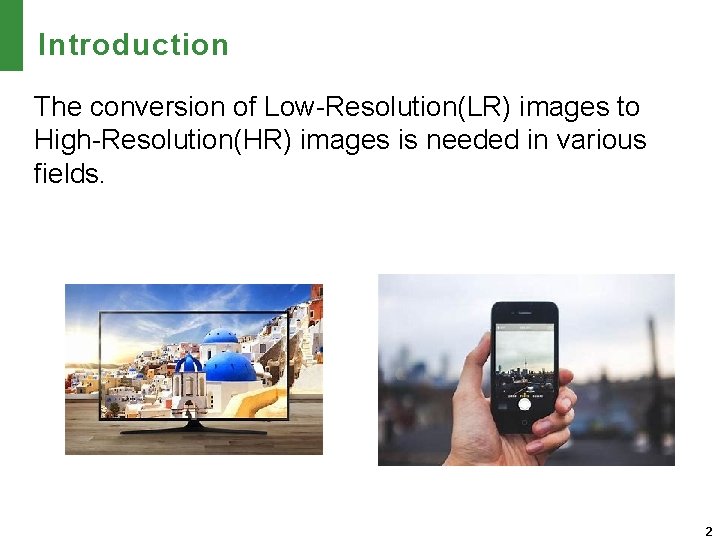
Introduction The conversion of Low-Resolution(LR) images to High-Resolution(HR) images is needed in various fields. 2
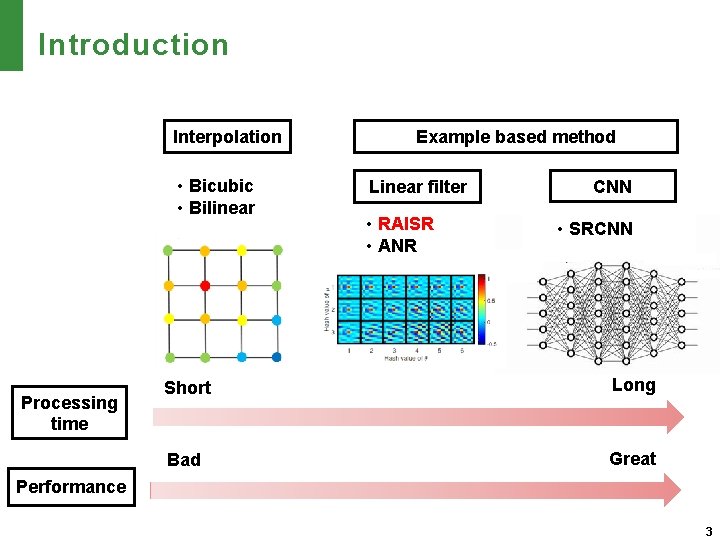
Introduction Interpolation ・Bicubic ・Bilinear Processing time Example based method Linear filter ・RAISR ・ANR CNN ・SRCNN Short Long Bad Great Performance 3
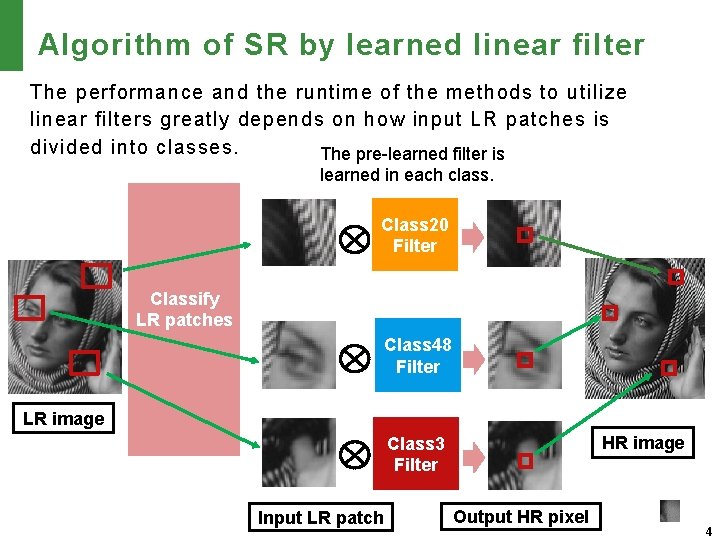
Algorithm of SR by learned linear filter The performance and the runtime of the methods to utilize linear filters greatly depends on how input LR patches is divided into classes. The pre-learned filter is learned in each class. Class 20 Filter Classify LR patches Class 48 Filter LR image HR image Class 3 Filter Input LR patch Output HR pixel 4
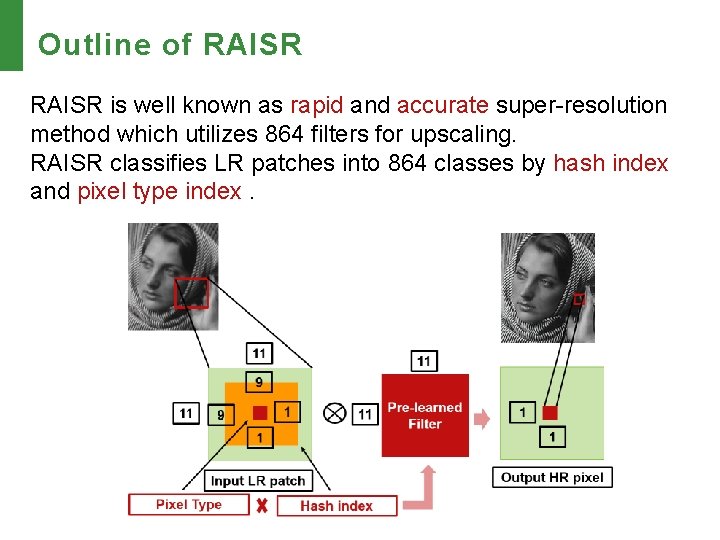
Outline of RAISR is well known as rapid and accurate super-resolution method which utilizes 864 filters for upscaling. RAISR classifies LR patches into 864 classes by hash index and pixel type index.
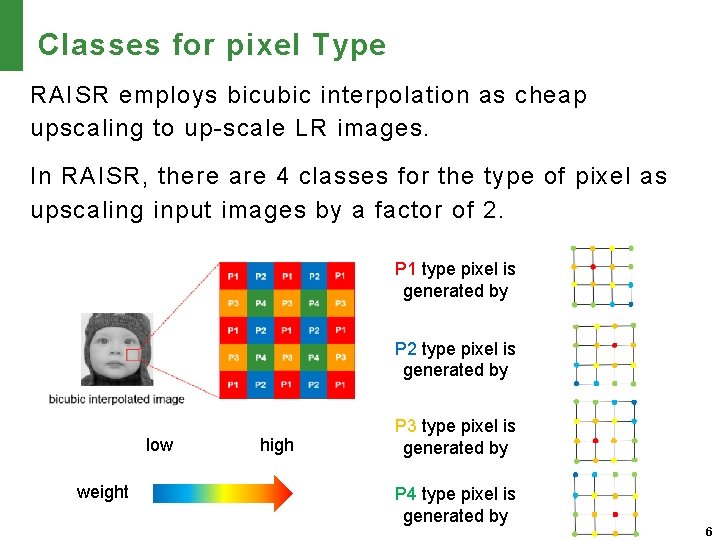
Classes for pixel Type RAISR employs bicubic interpolation as cheap upscaling to up-scale LR images. In RAISR, there are 4 classes for the type of pixel as upscaling input images by a factor of 2. P 1 type pixel is generated by P 2 type pixel is generated by low weight high P 3 type pixel is generated by P 4 type pixel is generated by 6
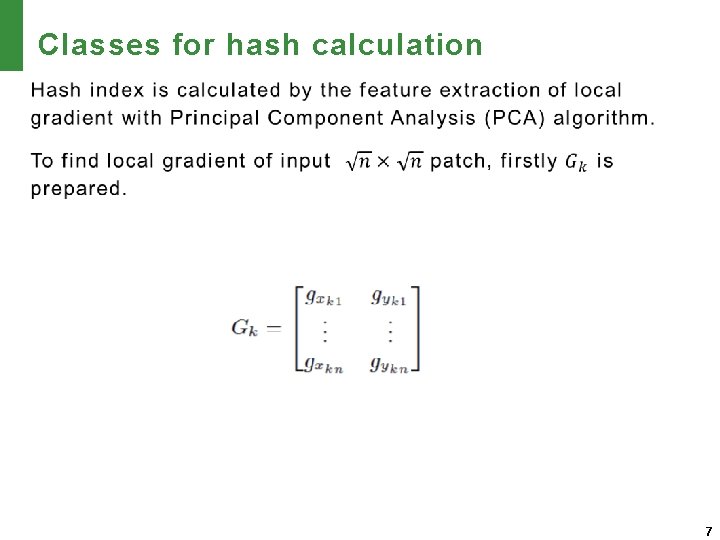
Classes for hash calculation 7
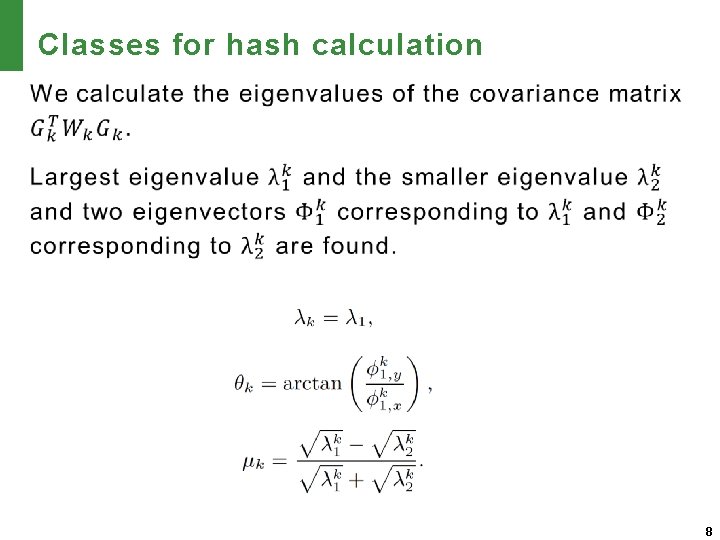
Classes for hash calculation 8
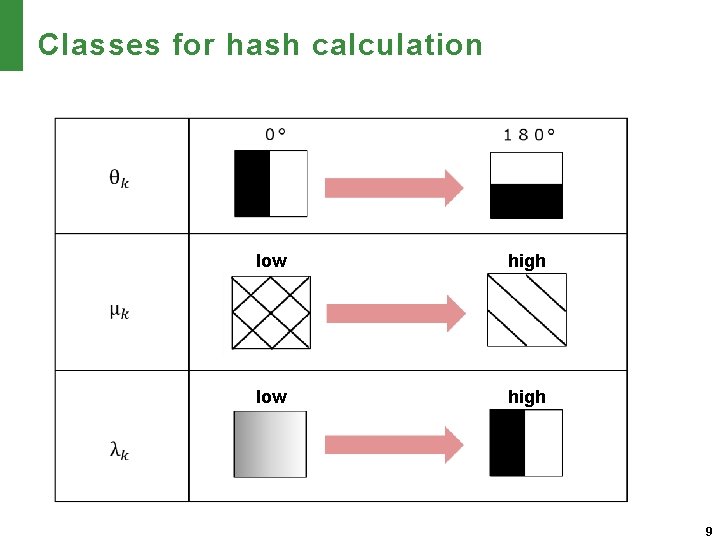
Classes for hash calculation low high 9
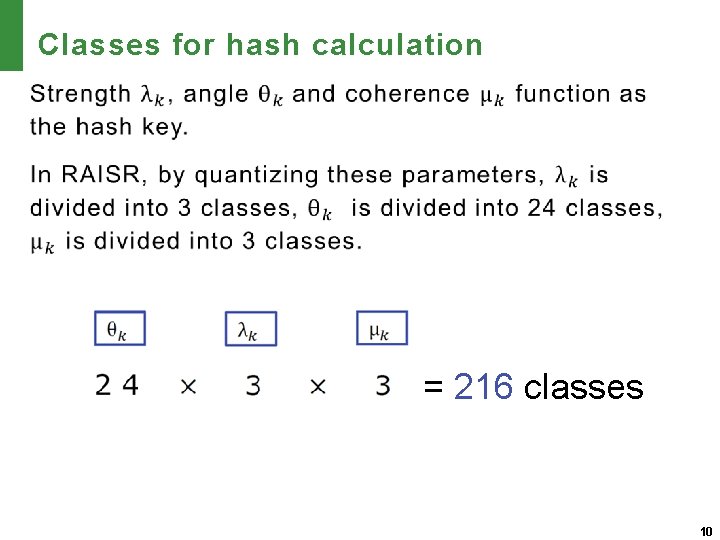
Classes for hash calculation = 216 classes 10
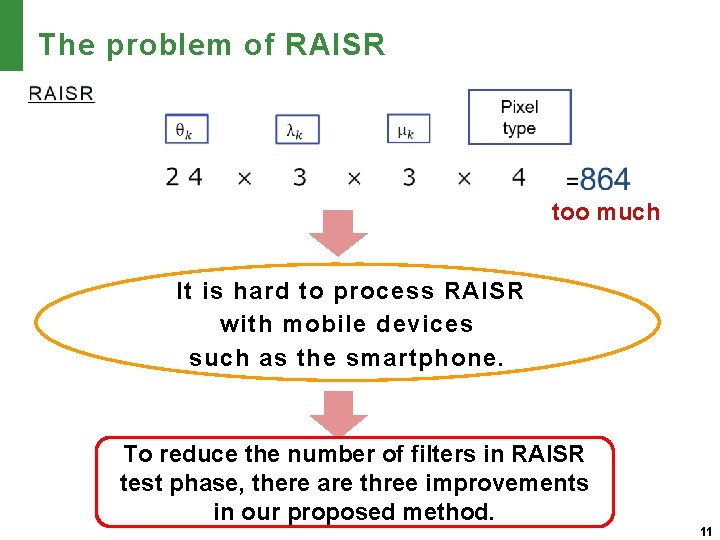
The problem of RAISR too much It is hard to process RAISR with mobile devices such as the smartphone. To reduce the number of filters in RAISR test phase, there are three improvements in our proposed method. 11
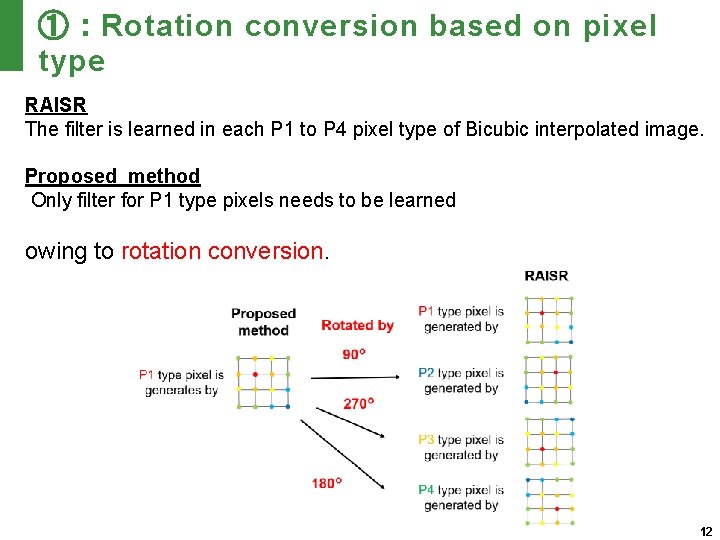
①:Rotation conversion based on pixel type RAISR The filter is learned in each P 1 to P 4 pixel type of Bicubic interpolated image. Proposed method Only filter for P 1 type pixels needs to be learned owing to rotation conversion. 12
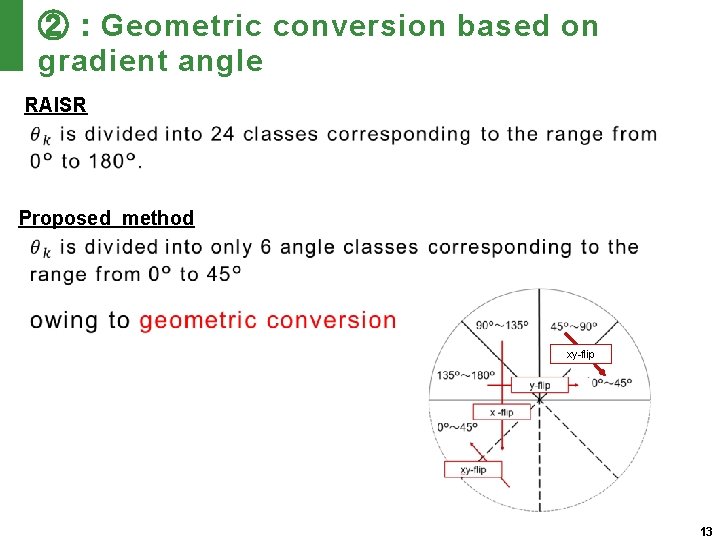
②:Geometric conversion based on gradient angle RAISR Proposed method xy-flip 13
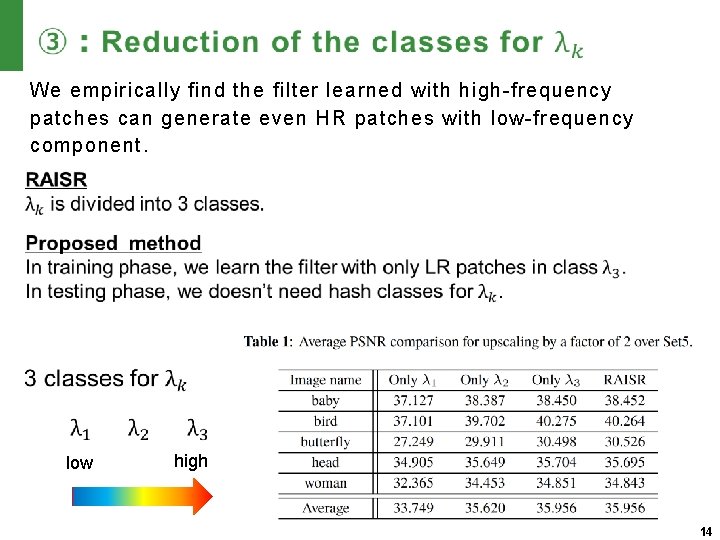
We empirically find the filter learned with high-frequency patches can generate even HR patches with low-frequency component. low high 14
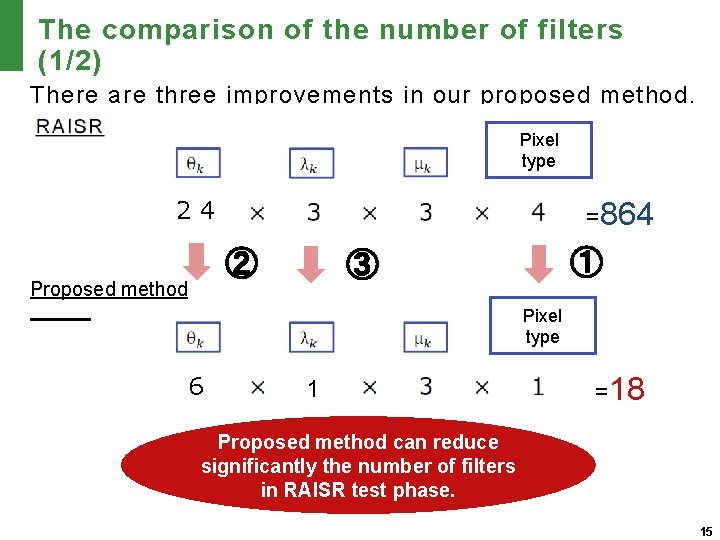
The comparison of the number of filters (1/2) There are three improvements in our proposed method. Pixel type 24 =864 ② Proposed method ① ③ Pixel type 6 1 =18 Proposed method can reduce significantly the number of filters in RAISR test phase. 15
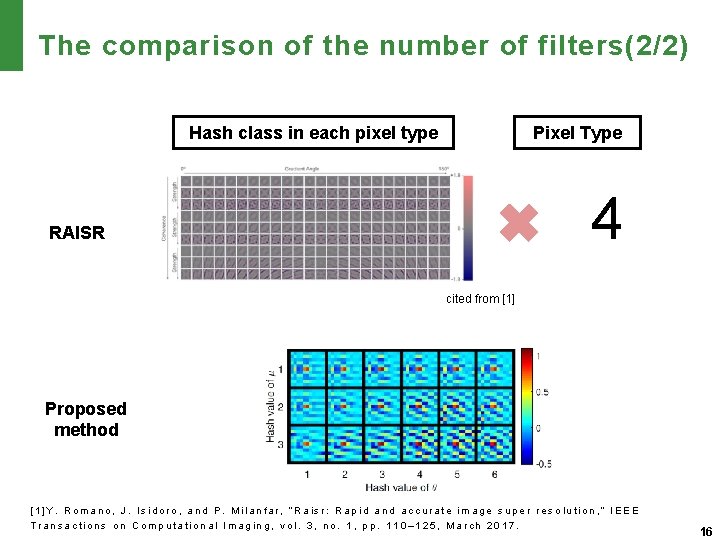
The comparison of the number of filters(2/2) Hash class in each pixel type Pixel Type 4 RAISR cited from [1] Proposed method [1]Y. Romano, J. Isidoro, and P. Milanfar, “Raisr: Rapid and accurate image super resolution, ” IEEE Transactions on Computational Imaging, vol. 3, no. 1, pp. 110– 125, March 2017. 16
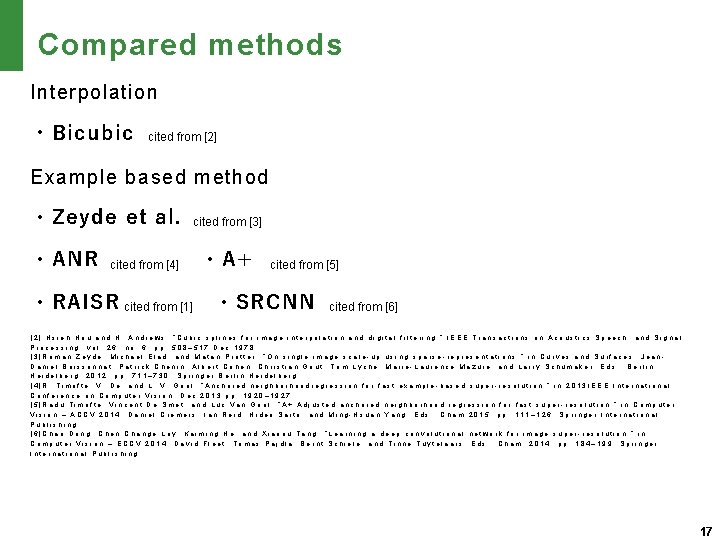
Compared methods Interpolation ・Bicubic cited from [2] Example based method ・Zeyde et al. ・ANR cited from [3] cited from [4] ・RAISR cited from [1] ・A+ cited from [5] ・SRCNN cited from [6] [2] Hsieh Hou and H. Andrews, “Cubic splines for image interpolation and digital filtering, ” IEEE Transactions on Acoustics, Speech, and Signal Processing, vol. 26, no. 6, pp. 508– 517, Dec 1978. [3]Roman Zeyde, Michael Elad, and Matan Protter, “On single image scale-up using sparse-representations, ” in Curves and Surfaces, Jean. Daniel Boissonnat, Patrick Chenin, Albert Cohen, Christian Gout, Tom Lyche, Marie-Laurence Mazure, and Larry Schumaker, Eds. , Berlin, Heidelberg, 2012, pp. 711– 730, Springer Berlin Heidelberg. [4]R. Timofte, V. De, and L. V. Gool, “Anchored neighborhoodregression for fast example-based super-resolution, ” in 2013 IEEE International Conference on Computer Vision, Dec 2013, pp. 1920– 1927. [5]Radu Timofte, Vincent De Smet, and Luc Van Gool, “A+: Adjusted anchored neighborhood regression for fast super-resolution, ” in Computer Vision – ACCV 2014, Daniel Cremers, Ian Reid, Hideo Saito, and Ming-Hsuan Yang, Eds. , Cham, 2015, pp. 111– 126, Springer International Publishing. [6]Chao Dong, Chen Change Loy, Kaiming He, and Xiaoou Tang, “Learning a deep convolutional network for image super-resolution, ” in Computer Vision – ECCV 2014, David Fleet, Tomas Pajdla, Bernt Schiele, and Tinne Tuytelaars, Eds. , Cham, 2014, pp. 184– 199, Springer International Publishing. 17
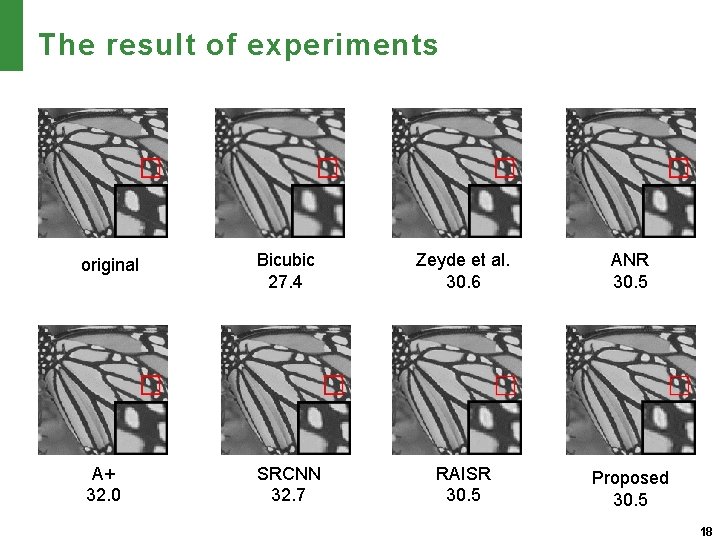
The result of experiments original Bicubic 27. 4 Zeyde et al. 30. 6 ANR 30. 5 A+ 32. 0 SRCNN 32. 7 RAISR 30. 5 Proposed 30. 5 18
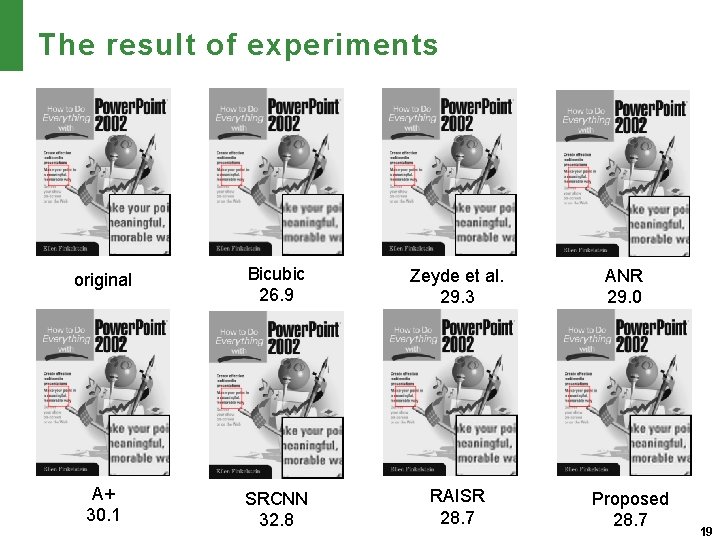
The result of experiments original Bicubic 26. 9 Zeyde et al. 29. 3 A+ 30. 1 SRCNN 32. 8 RAISR 28. 7 ANR 29. 0 Proposed 28. 7 19
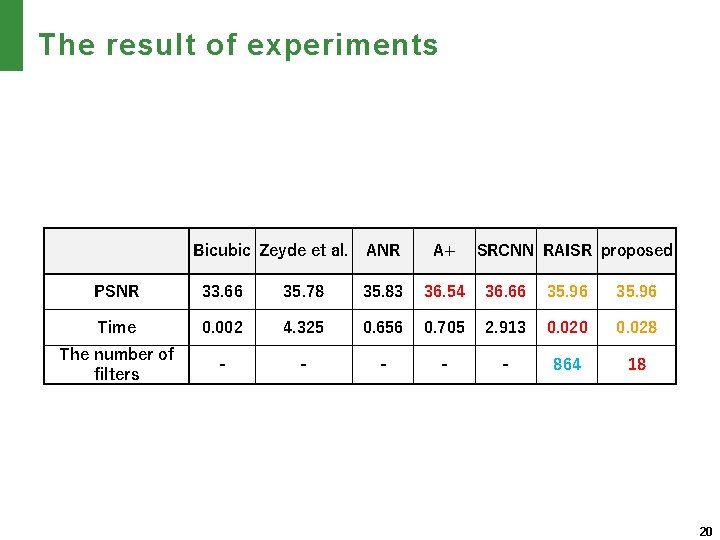
The result of experiments Bicubic Zeyde et al. ANR A+ SRCNN RAISR proposed PSNR 33. 66 35. 78 35. 83 36. 54 36. 66 35. 96 Time 0. 002 4. 325 0. 656 0. 705 2. 913 0. 020 0. 028 The number of filters - - - 864 18 20
Conclusion ・We proposed a rapid and accurate learning-based method for single image super-resolution with the significantly small number of filters. ・Our method needs only simple conversion including geometric flip and rotation addition for hash calculation and CTblending used in RAISR. ・The important advantage of our method is that only 18 filters can make the same accurate image in the same runtime as RAISR while RAISR needs 864 filters to do that. 21
- Slides: 21