
Single Dimensional Arrays COMPUTER PROGRAMMING I ObjectiveEssential Standard
Single Dimensional Arrays COMPUTER PROGRAMMING I
Objective/Essential Standard �Essential Standard: 7. 00 Apply Advanced Logic �Indicator: 7. 02 Apply One-Dimensional Arrays (7%)
Arrays �What is an array? �An array is a “container” that holds more than one value. �Each value is called an element. �Each element of the array must be the same data type.
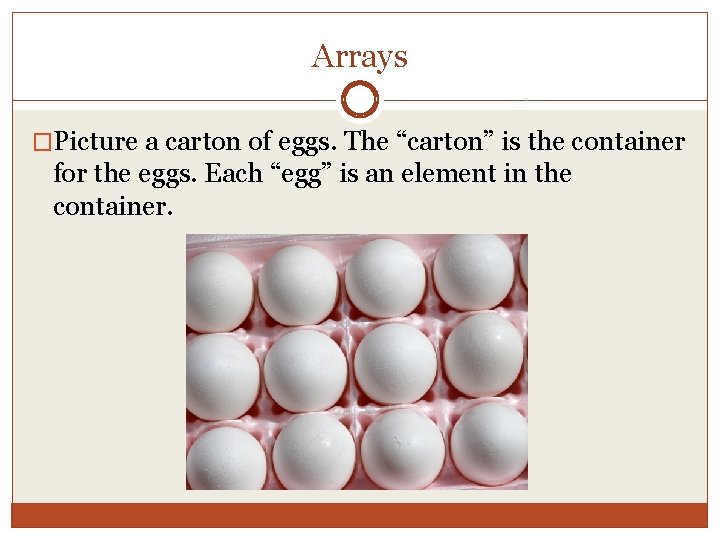
Arrays �Picture a carton of eggs. The “carton” is the container for the eggs. Each “egg” is an element in the container.

Declaring an Array � An array like all variables must be declared before it can be used. � Dim array. Name(int. Last. Index) As Data. Type � Dim int. Array(5) as Integer 0 1 2 3 4 5 � The first element is always be located at the index position of zero � The index position points to the location of a value in an array. � In VB this array will have six elements.

Declaring an Array �Using our egg/egg carton analogy, each position would be numbered, starting at 0. 0 4 8 1 2 5 6 9 10 3 7 11
Populating an Array �In the previous slide we declared an array but did not give the elements any values. �Since the data type was integer all elements have a value of zero. �Unless given values, the array will be initialized as follows Numeric Values 0 String Value Nothing
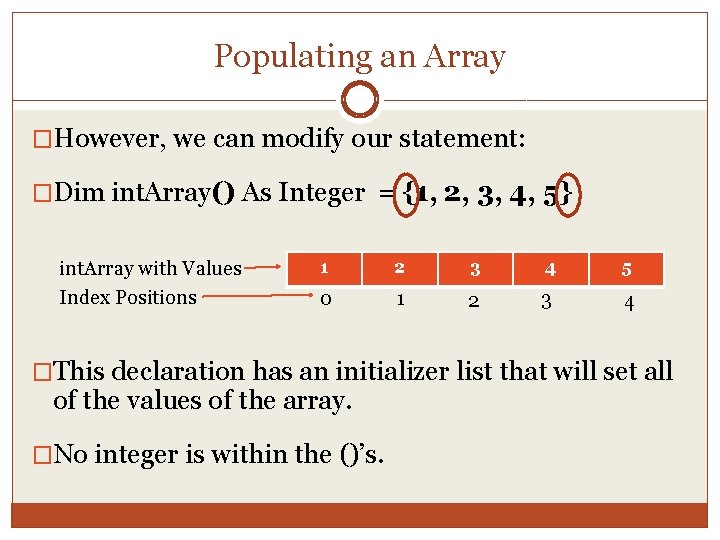
Populating an Array �However, we can modify our statement: �Dim int. Array() As Integer = {1, 2, 3, 4, 5} int. Array with Values Index Positions 1 2 3 4 5 0 1 2 3 4 �This declaration has an initializer list that will set all of the values of the array. �No integer is within the ()’s.
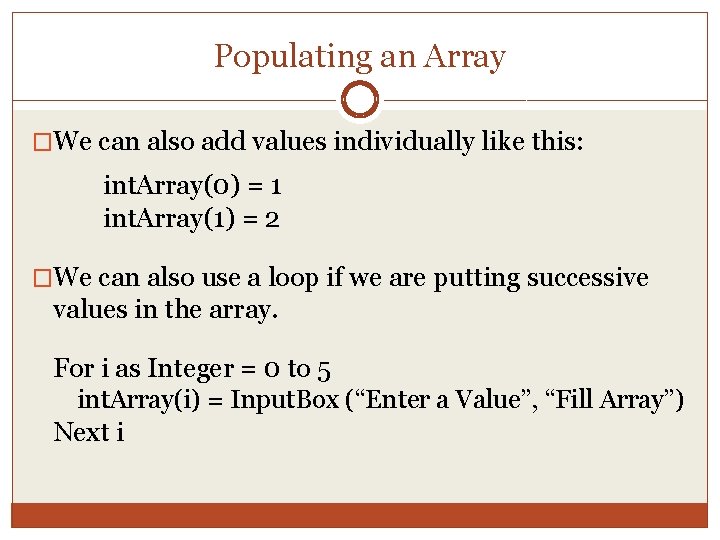
Populating an Array �We can also add values individually like this: int. Array(0) = 1 int. Array(1) = 2 �We can also use a loop if we are putting successive values in the array. For i as Integer = 0 to 5 int. Array(i) = Input. Box (“Enter a Value”, “Fill Array”) Next i
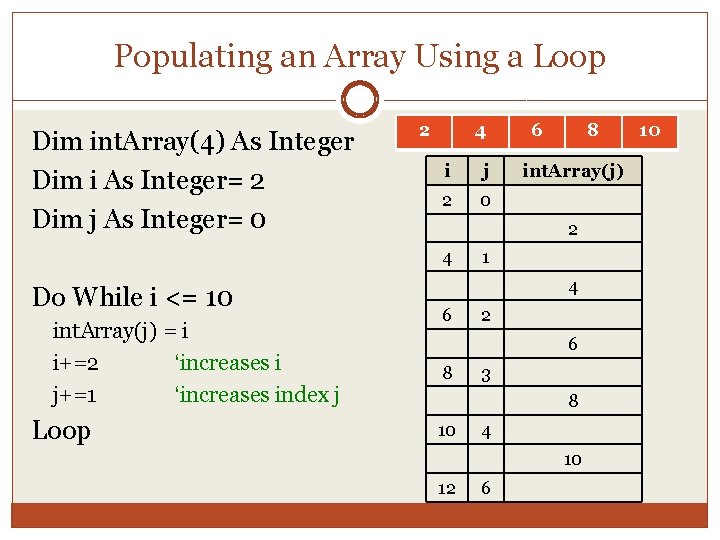
Populating an Array Using a Loop Dim int. Array(4) As Integer Dim i As Integer= 2 Dim j As Integer= 0 2 4 i j 2 0 int. Array(j) = i i+=2 ‘increases i j+=1 ‘increases index j Loop 8 int. Array(j) 2 4 Do While i <= 10 6 1 4 6 2 6 8 3 8 10 4 10 12 6 10
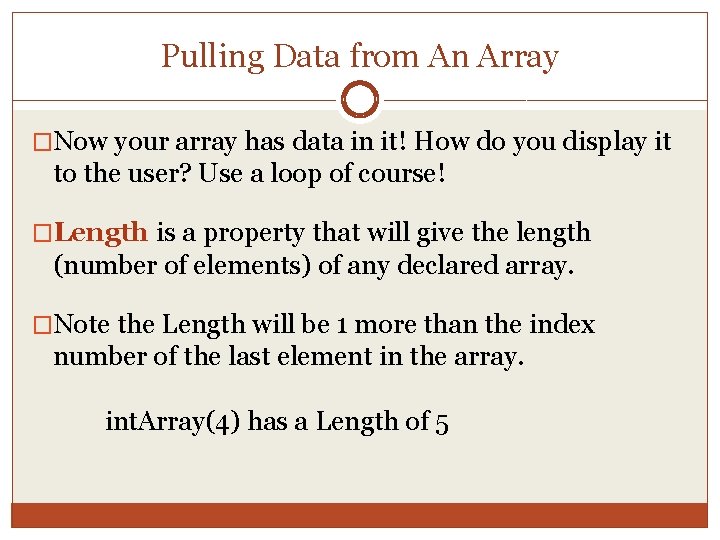
Pulling Data from An Array �Now your array has data in it! How do you display it to the user? Use a loop of course! �Length is a property that will give the length (number of elements) of any declared array. �Note the Length will be 1 more than the index number of the last element in the array. int. Array(4) has a Length of 5
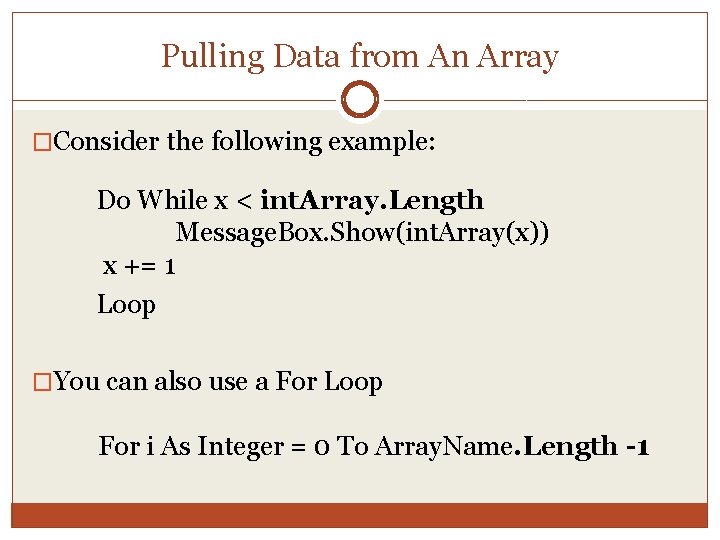
Pulling Data from An Array �Consider the following example: Do While x < int. Array. Length Message. Box. Show(int. Array(x)) x += 1 Loop �You can also use a For Loop For i As Integer = 0 To Array. Name. Length -1
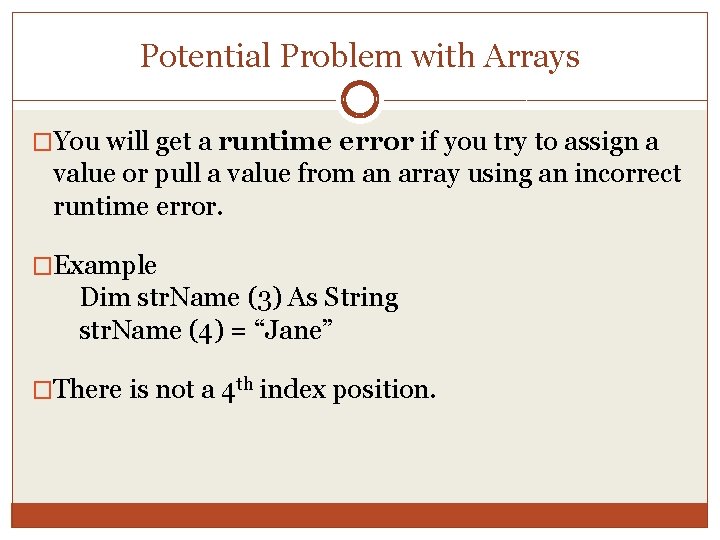
Potential Problem with Arrays �You will get a runtime error if you try to assign a value or pull a value from an array using an incorrect runtime error. �Example Dim str. Name (3) As String str. Name (4) = “Jane” �There is not a 4 th index position.
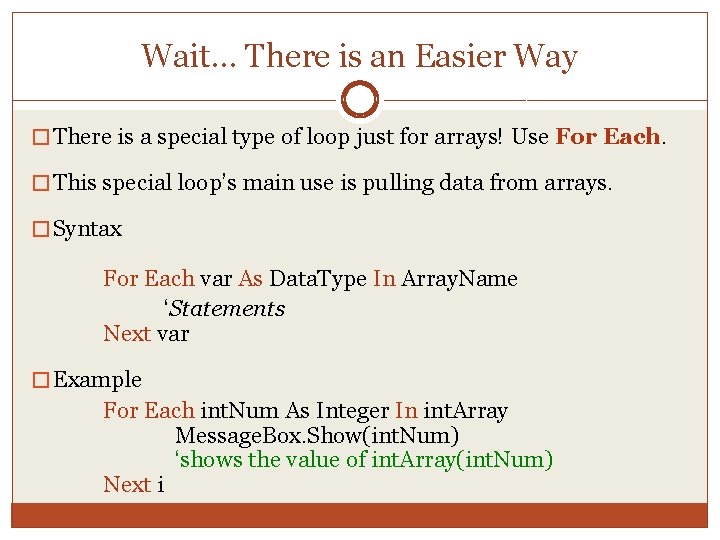
Wait… There is an Easier Way � There is a special type of loop just for arrays! Use For Each. � This special loop’s main use is pulling data from arrays. � Syntax For Each var As Data. Type In Array. Name ‘Statements Next var � Example For Each int. Num As Integer In int. Array Message. Box. Show(int. Num) ‘shows the value of int. Array(int. Num) Next i
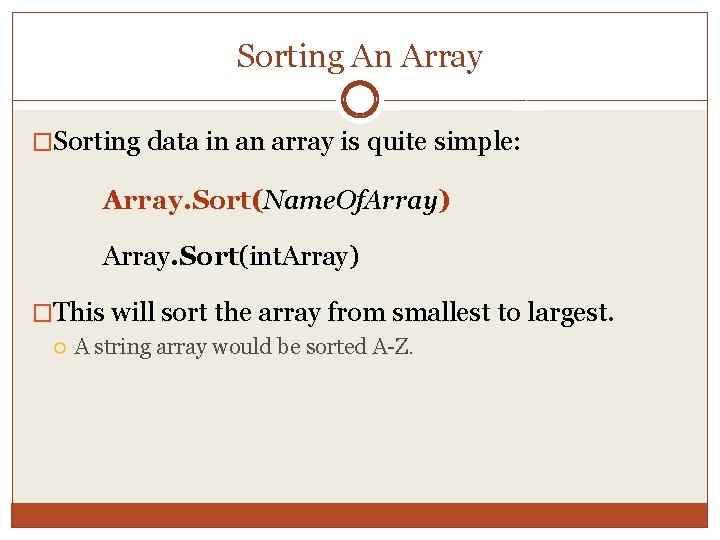
Sorting An Array �Sorting data in an array is quite simple: Array. Sort(Name. Of. Array) Array. Sort(int. Array) �This will sort the array from smallest to largest. A string array would be sorted A-Z.
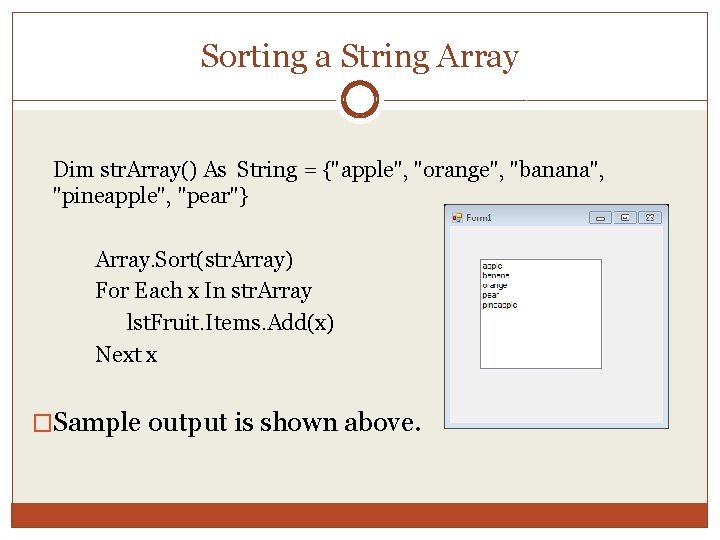
Sorting a String Array Dim str. Array() As String = {"apple", "orange", "banana", "pineapple", "pear"} Array. Sort(str. Array) For Each x In str. Array lst. Fruit. Items. Add(x) Next x �Sample output is shown above.
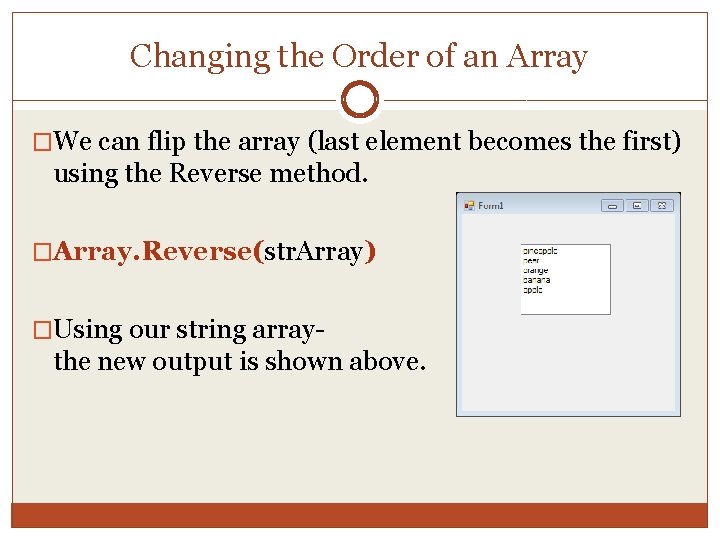
Changing the Order of an Array �We can flip the array (last element becomes the first) using the Reverse method. �Array. Reverse(str. Array) �Using our string array- the new output is shown above.
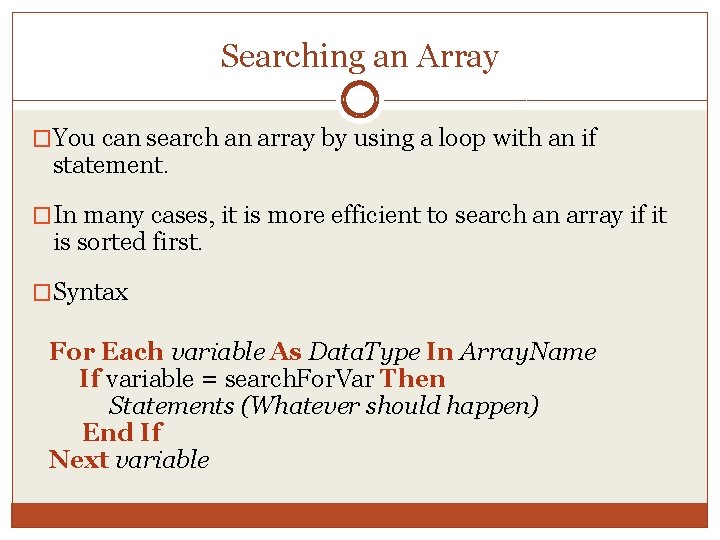
Searching an Array �You can search an array by using a loop with an if statement. �In many cases, it is more efficient to search an array if it is sorted first. �Syntax For Each variable As Data. Type In Array. Name If variable = search. For. Var Then Statements (Whatever should happen) End If Next variable
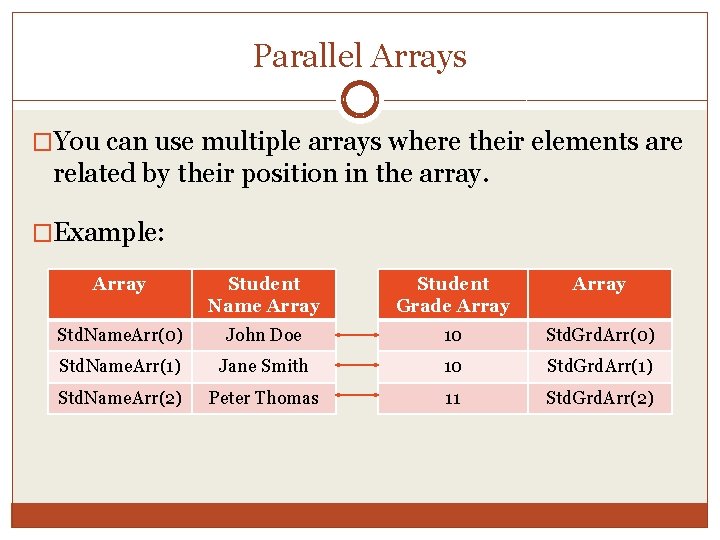
Parallel Arrays �You can use multiple arrays where their elements are related by their position in the array. �Example: Array Student Name Array Student Grade Array Std. Name. Arr(0) John Doe 10 Std. Grd. Arr(0) Std. Name. Arr(1) Jane Smith 10 Std. Grd. Arr(1) Std. Name. Arr(2) Peter Thomas 11 Std. Grd. Arr(2)
Re-Declaring an Array �If you find you need a larger array, you will need to re -declare the array as arrays are not dynamic. Once you set the size of an array, you cannot change it. �Use the Re. Dim statement to re-declare the array. �Syntax: Re. Dim array. Name(new. Size) �Re-declaring an array this way will delete all existing values in the array.
Re-Declaring an Array �To re-declare the array AND hold the values, add the Preserve keyword. �Syntax Re. Dim Preserve array. Name(new. Size)
Sample Program �Write a program that accepts three numbers and shows them to the user smallest to largest. �Use textboxes for input and output.
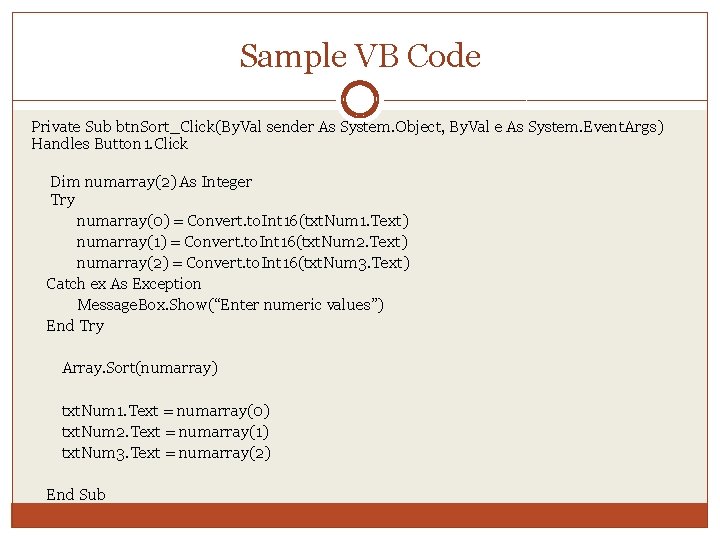
Sample VB Code Private Sub btn. Sort_Click(By. Val sender As System. Object, By. Val e As System. Event. Args) Handles Button 1. Click Dim numarray(2) As Integer Try numarray(0) = Convert. to. Int 16(txt. Num 1. Text) numarray(1) = Convert. to. Int 16(txt. Num 2. Text) numarray(2) = Convert. to. Int 16(txt. Num 3. Text) Catch ex As Exception Message. Box. Show(“Enter numeric values”) End Try Array. Sort(numarray) txt. Num 1. Text = numarray(0) txt. Num 2. Text = numarray(1) txt. Num 3. Text = numarray(2) End Sub
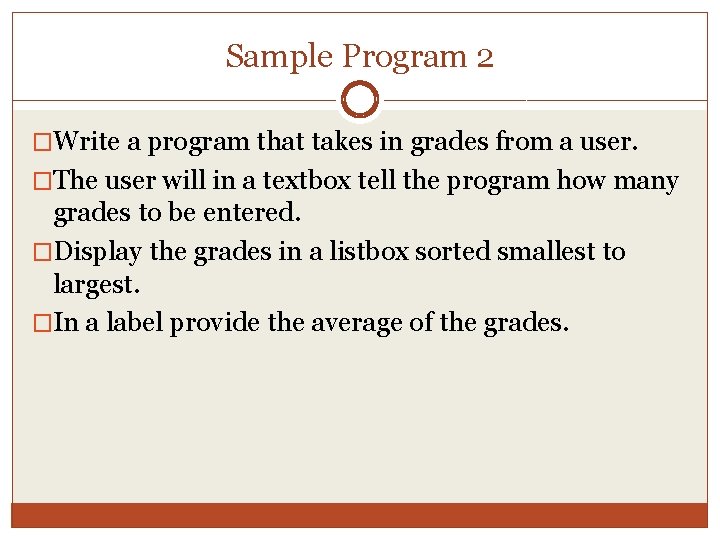
Sample Program 2 �Write a program that takes in grades from a user. �The user will in a textbox tell the program how many grades to be entered. �Display the grades in a listbox sorted smallest to largest. �In a label provide the average of the grades.
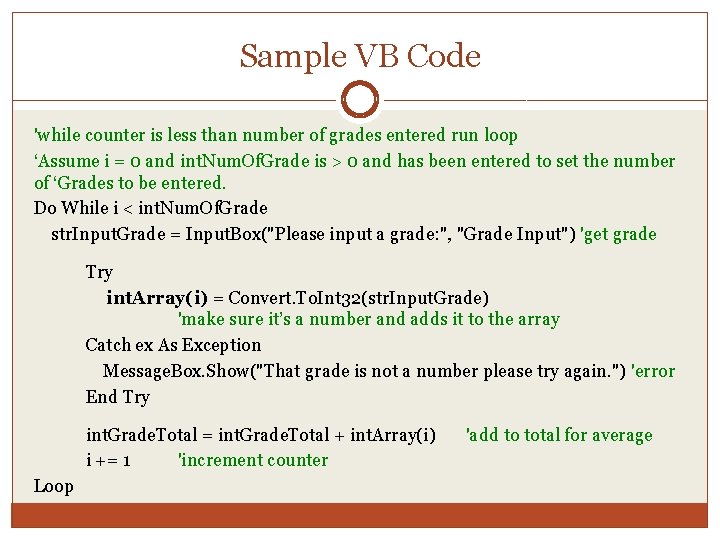
Sample VB Code 'while counter is less than number of grades entered run loop ‘Assume i = 0 and int. Num. Of. Grade is > 0 and has been entered to set the number of ‘Grades to be entered. Do While i < int. Num. Of. Grade str. Input. Grade = Input. Box("Please input a grade: ", "Grade Input") 'get grade Try int. Array(i) = Convert. To. Int 32(str. Input. Grade) 'make sure it’s a number and adds it to the array Catch ex As Exception Message. Box. Show("That grade is not a number please try again. ") 'error End Try int. Grade. Total = int. Grade. Total + int. Array(i) i += 1 'increment counter Loop 'add to total for average
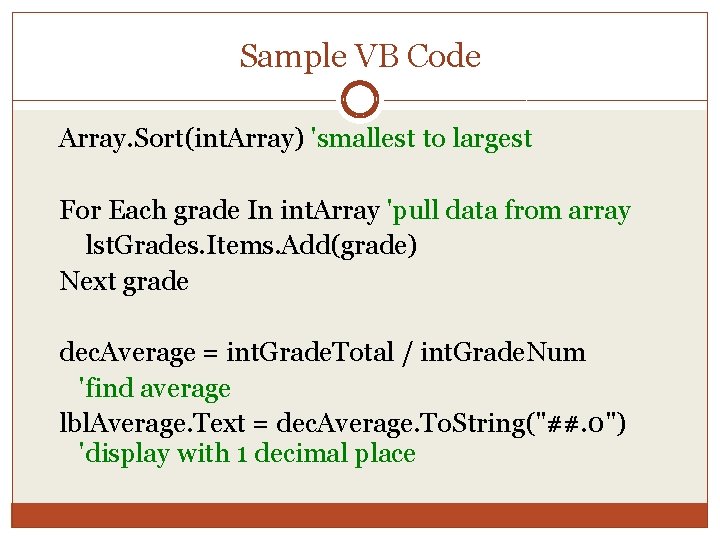
Sample VB Code Array. Sort(int. Array) 'smallest to largest For Each grade In int. Array 'pull data from array lst. Grades. Items. Add(grade) Next grade dec. Average = int. Grade. Total / int. Grade. Num 'find average lbl. Average. Text = dec. Average. To. String("##. 0") 'display with 1 decimal place
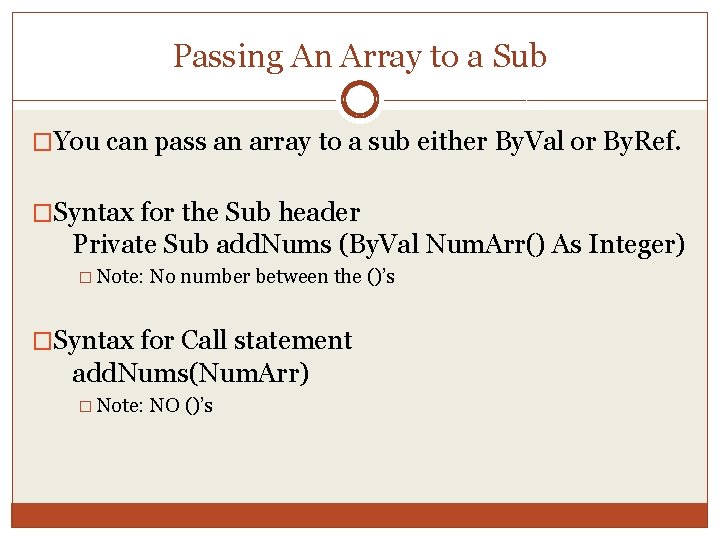
Passing An Array to a Sub �You can pass an array to a sub either By. Val or By. Ref. �Syntax for the Sub header Private Sub add. Nums (By. Val Num. Arr() As Integer) � Note: No number between the ()’s �Syntax for Call statement add. Nums(Num. Arr) � Note: NO ()’s
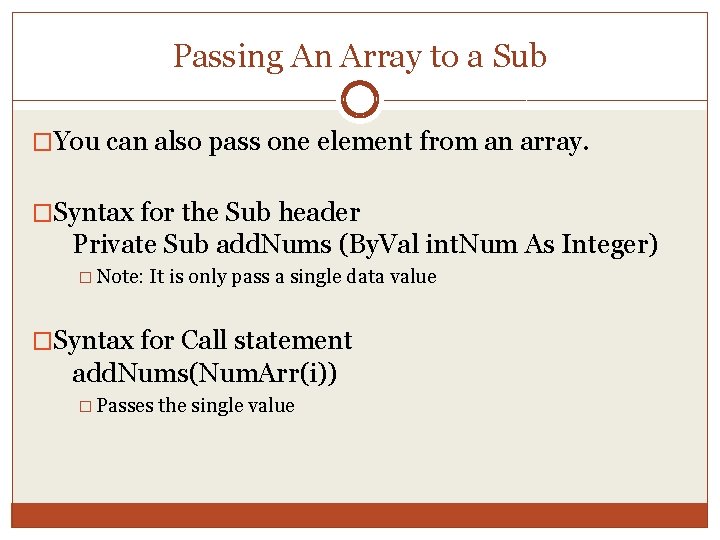
Passing An Array to a Sub �You can also pass one element from an array. �Syntax for the Sub header Private Sub add. Nums (By. Val int. Num As Integer) � Note: It is only pass a single data value �Syntax for Call statement add. Nums(Num. Arr(i)) � Passes the single value
Vocabulary �Array �Element �Index Position �Length �Re. Dim �Preserve �Dynamic Array
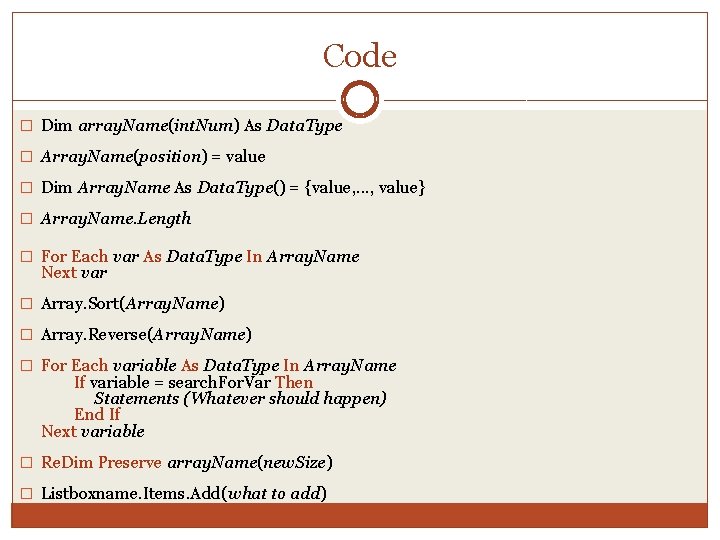
Code � Dim array. Name(int. Num) As Data. Type � Array. Name(position) = value � Dim Array. Name As Data. Type() = {value, . . . , value} � Array. Name. Length � For Each var As Data. Type In Array. Name Next var � Array. Sort(Array. Name) � Array. Reverse(Array. Name) � For Each variable As Data. Type In Array. Name If variable = search. For. Var Then Statements (Whatever should happen) End If Next variable � Re. Dim Preserve array. Name(new. Size) � Listboxname. Items. Add(what to add)
Wrap It Up �In this presentation you learned about single- dimension arrays. �Arrays are powerful tools that can be used to simplify programs. �More sample programs are provided in the unpacked content.
- Slides: 31