
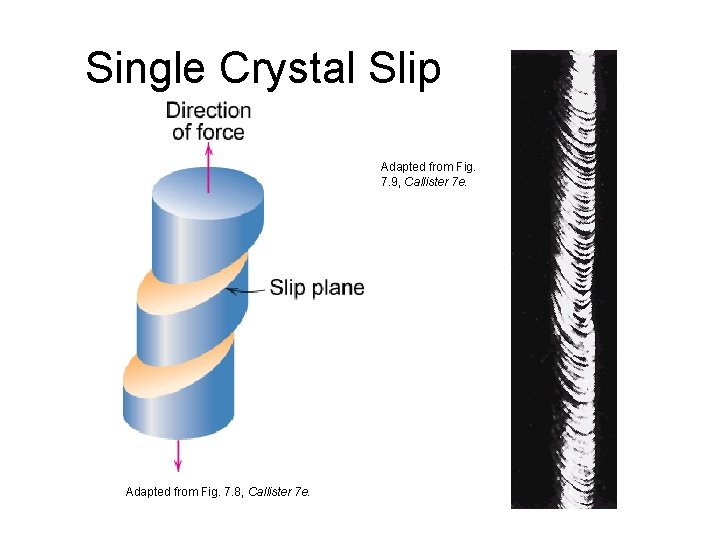
Single Crystal Slip Adapted from Fig 7 9



- Slides: 15
Single Crystal Slip Adapted from Fig. 7. 9, Callister 7 e. Adapted from Fig. 7. 8, Callister 7 e.
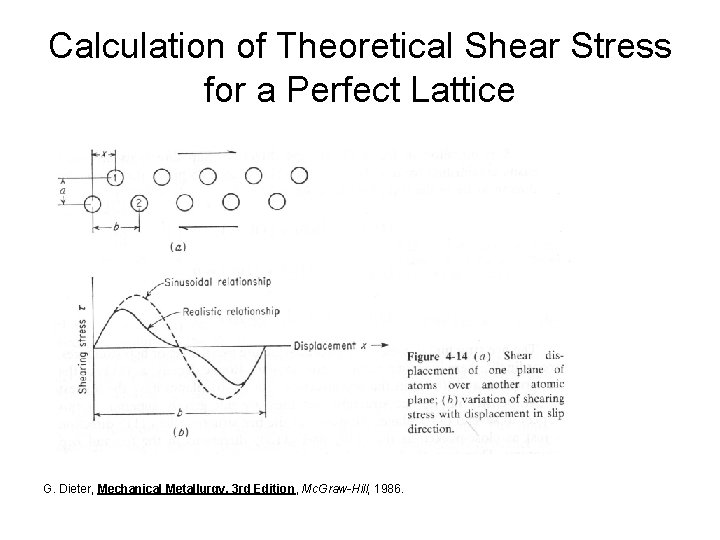
Calculation of Theoretical Shear Stress for a Perfect Lattice G. Dieter, Mechanical Metallurgy, 3 rd Edition, Mc. Graw-Hill, 1986.
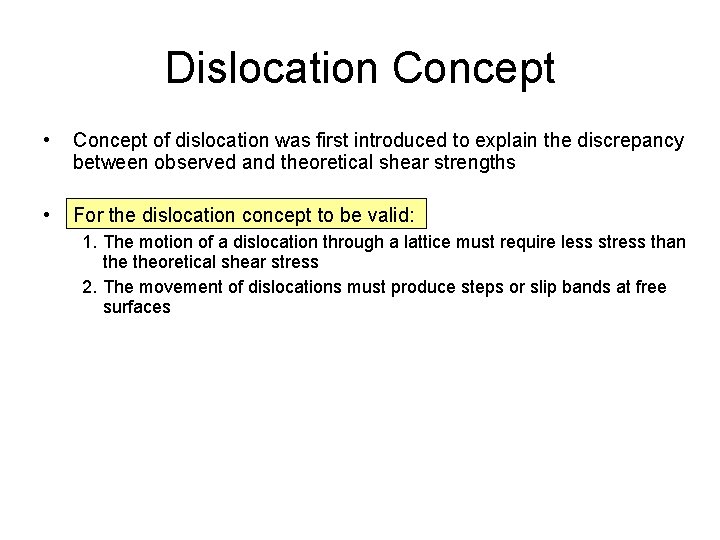
Dislocation Concept • Concept of dislocation was first introduced to explain the discrepancy between observed and theoretical shear strengths • For the dislocation concept to be valid: 1. The motion of a dislocation through a lattice must require less stress than theoretical shear stress 2. The movement of dislocations must produce steps or slip bands at free surfaces
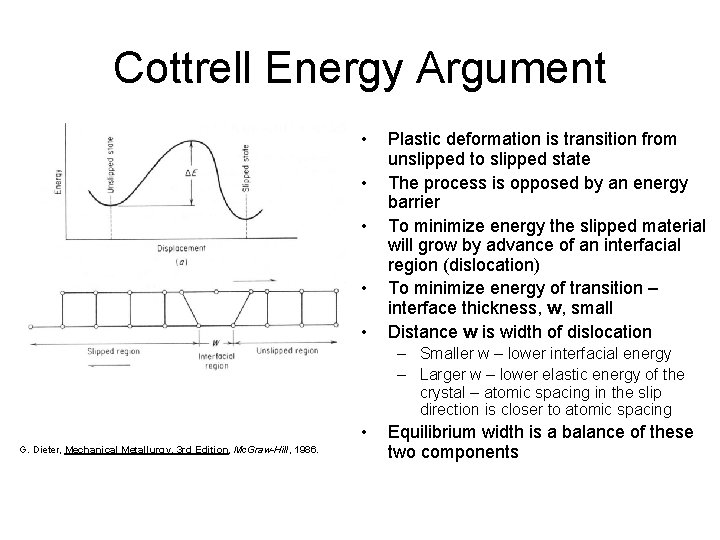
Cottrell Energy Argument • • • Plastic deformation is transition from unslipped to slipped state The process is opposed by an energy barrier To minimize energy the slipped material will grow by advance of an interfacial region (dislocation) To minimize energy of transition – interface thickness, w, small Distance w is width of dislocation – Smaller w – lower interfacial energy – Larger w – lower elastic energy of the crystal – atomic spacing in the slip direction is closer to atomic spacing • G. Dieter, Mechanical Metallurgy, 3 rd Edition, Mc. Graw-Hill, 1986. Equilibrium width is a balance of these two components
Peierls-Nabarro Force • Dislocation width determines the force required to move a dislocation through a crystal lattice • Peierls stress is the shear stress required to move a dislocation through a crystal lattice a is distance between slip planes b is the distance between atoms in the slip direction • Note: wide dislocations require lower stress to move – Makes sense: Wide – the highly distorted region at core is not localized on any particular atom • In ductile metals the dislocation width is on the order of 10 atomic spacings In ceramics with directional covalent bonds – high interfacial energy, dislocations are narrow – relatively immobile Combined with restrictions on slip systems imposed by electrostatic forces – low degree of plasticity
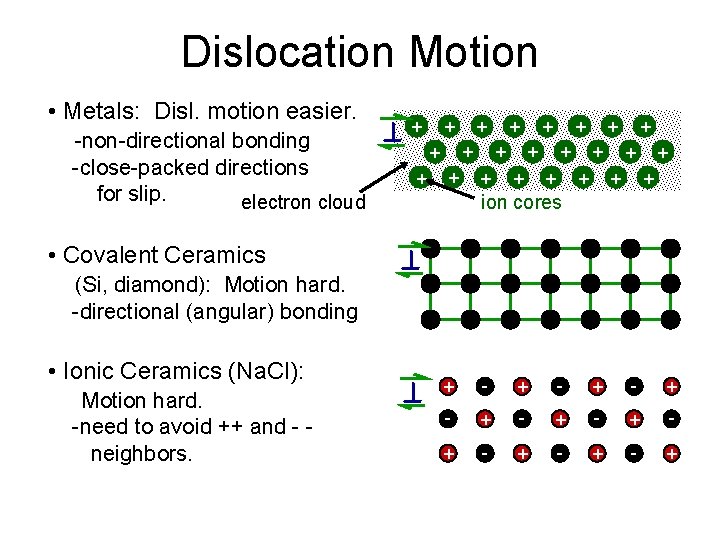
Dislocation Motion • Metals: Disl. motion easier. -non-directional bonding -close-packed directions for slip. electron cloud + + + + + + ion cores • Covalent Ceramics (Si, diamond): Motion hard. -directional (angular) bonding • Ionic Ceramics (Na. Cl): Motion hard. -need to avoid ++ and - neighbors. + - + - + - +
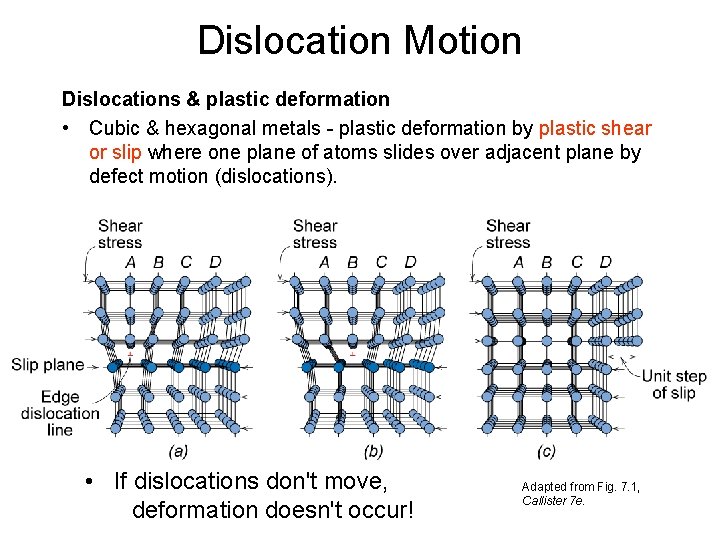
Dislocation Motion Dislocations & plastic deformation • Cubic & hexagonal metals - plastic deformation by plastic shear or slip where one plane of atoms slides over adjacent plane by defect motion (dislocations). • If dislocations don't move, deformation doesn't occur! Adapted from Fig. 7. 1, Callister 7 e.
Dislocation Motion • Dislocation moves along slip plane in slip direction perpendicular to dislocation line • Slip direction same direction as Burgers vector Edge dislocation Adapted from Fig. 7. 2, Callister 7 e. Screw dislocation
Definition of a Slip System – Slip plane - plane allowing easiest slippage: • Minimize atomic distortion (energy) associated with dislocation motion • Wide interplanar spacings - highest planar atomic densities (Close Packed) – Slip direction - direction of movement • Highest linear atomic densities on slip plane
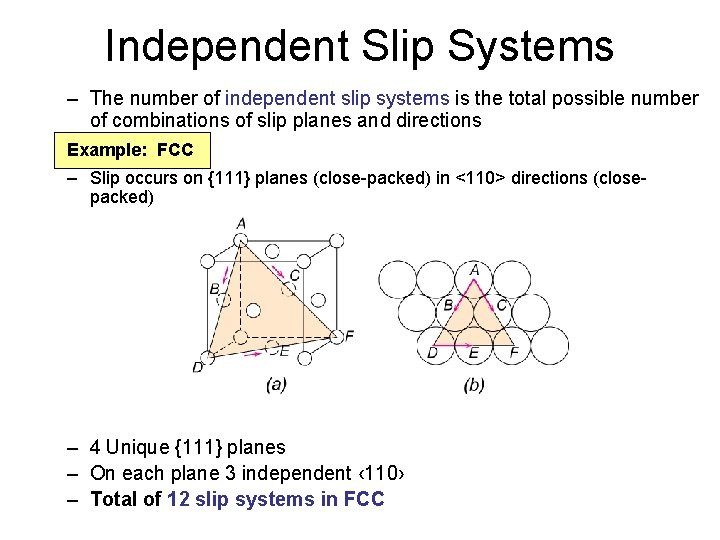
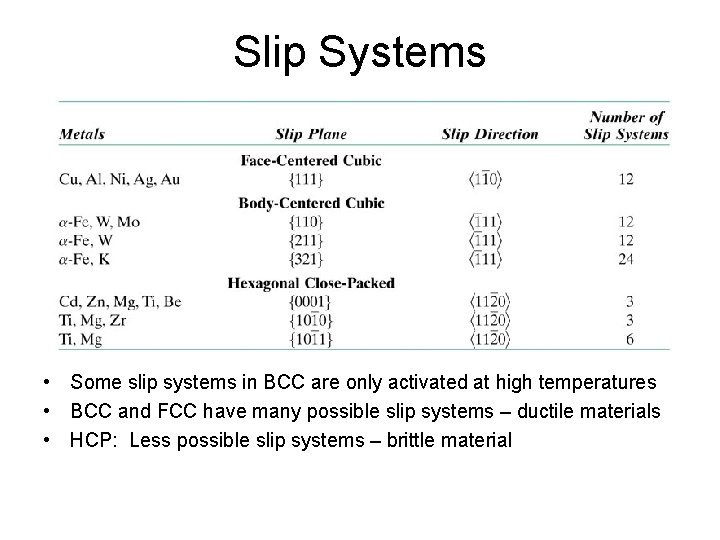
Independent Slip Systems – The number of independent slip systems is the total possible number of combinations of slip planes and directions Example: FCC – Slip occurs on {111} planes (close-packed) in <110> directions (closepacked) – 4 Unique {111} planes – On each plane 3 independent ‹ 110› – Total of 12 slip systems in FCC
Slip Systems • Some slip systems in BCC are only activated at high temperatures • BCC and FCC have many possible slip systems – ductile materials • HCP: Less possible slip systems – brittle material
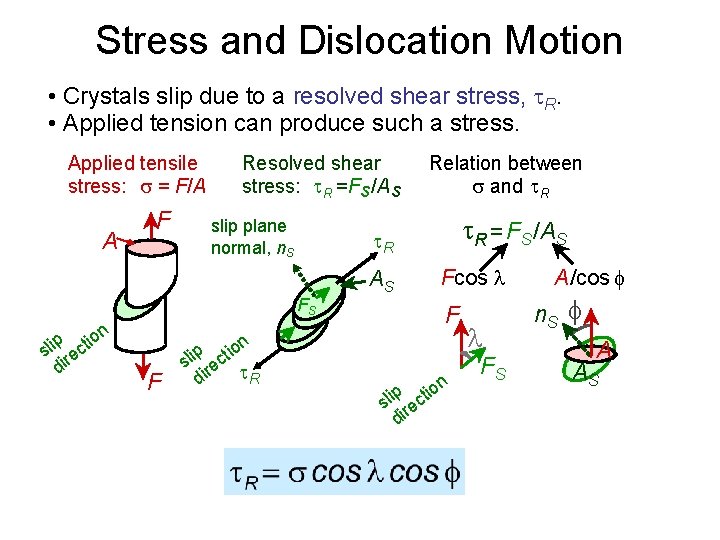
Stress and Dislocation Motion • Crystals slip due to a resolved shear stress, R. • Applied tension can produce such a stress. Applied tensile stress: = F/A A F Resolved shear stress: R =Fs /A s slip plane normal, ns n F n p ctio i l s re R di R = FS /AS R FS p io sli rect di Relation between and R AS Fcos F p sli rec di n tio FS A/cos n. S A AS
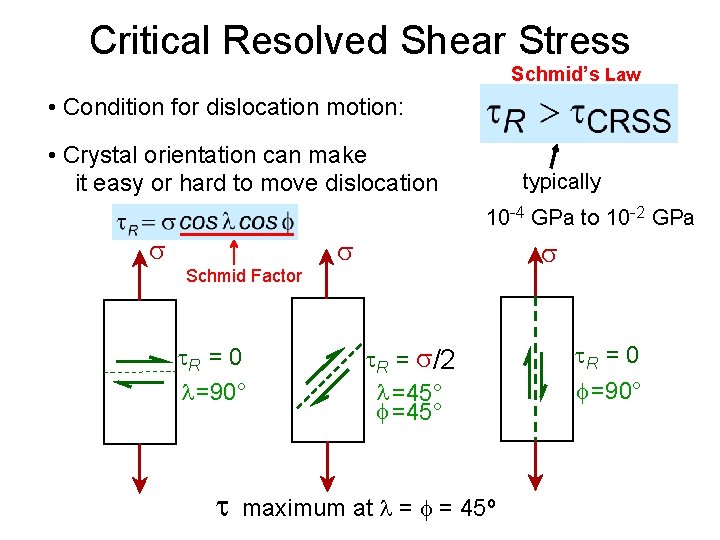
Critical Resolved Shear Stress Schmid’s Law • Condition for dislocation motion: • Crystal orientation can make it easy or hard to move dislocation typically 10 -4 GPa to 10 -2 GPa Schmid Factor R = 0 =90° R = /2 =45° maximum at = = 45º R = 0 =90°
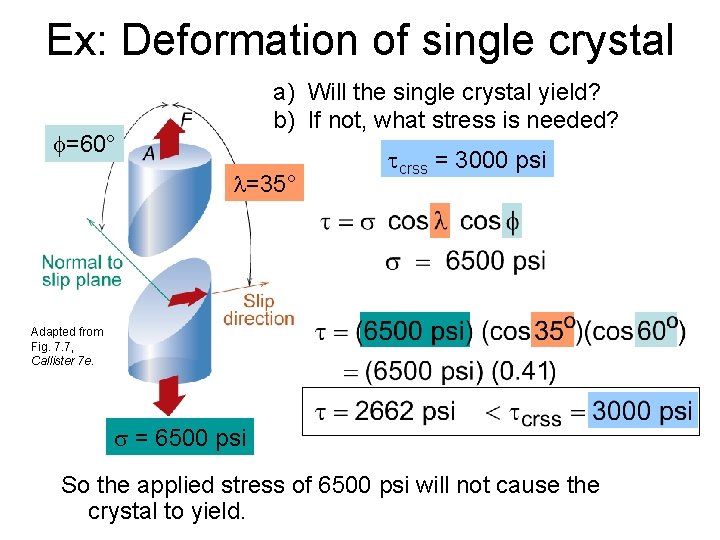
Ex: Deformation of single crystal a) Will the single crystal yield? b) If not, what stress is needed? =60° =35° crss = 3000 psi Adapted from Fig. 7. 7, Callister 7 e. = 6500 psi So the applied stress of 6500 psi will not cause the crystal to yield.
Ex: Deformation of single crystal What stress is necessary (i. e. , what is the yield stress, y)? So for deformation to occur the applied stress must be greater than or equal to the yield stress