
Single crystal diamond detectors Gianluca Verona Rinati Dipartimento


- Slides: 21
Single crystal diamond detectors Gianluca Verona Rinati Dipartimento di Ingegneria Industriale Università di Roma “Tor Vergata” gianluca. verona. rinati@uniroma 2. it
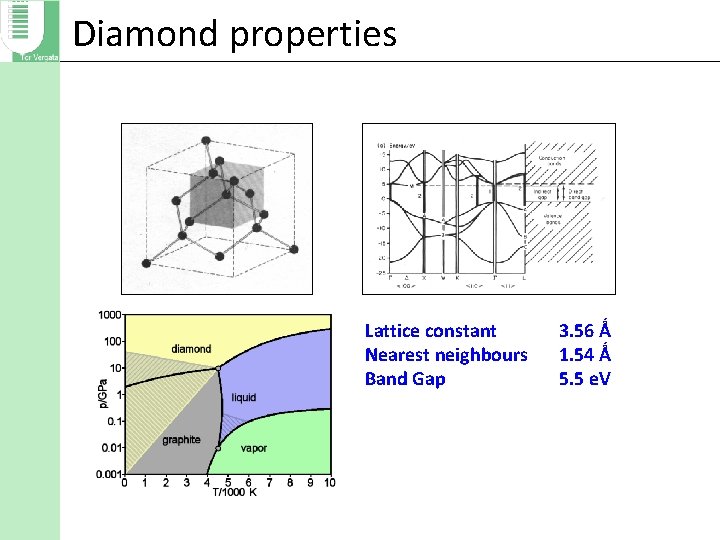
Diamond properties Lattice constant Nearest neighbours Band Gap 3. 56 Ǻ 1. 54 Ǻ 5. 5 e. V
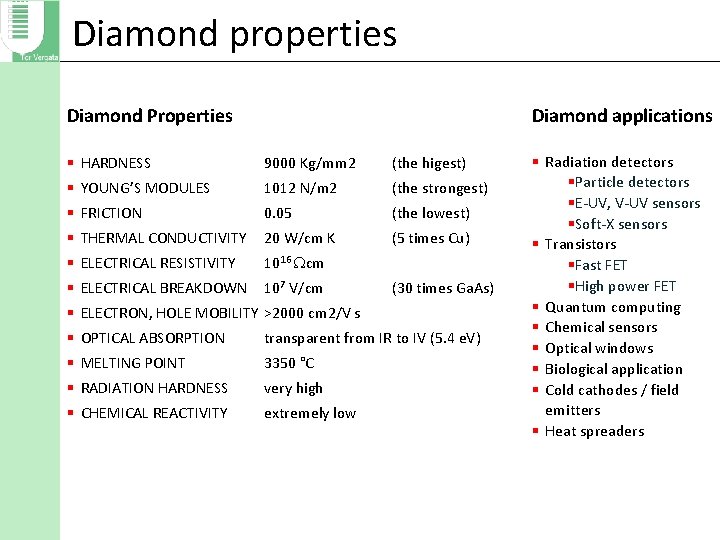
Diamond properties Diamond Properties Diamond applications § HARDNESS 9000 Kg/mm 2 (the higest) § YOUNG’S MODULES 1012 N/m 2 (the strongest) § FRICTION 0. 05 (the lowest) § THERMAL CONDUCTIVITY 20 W/cm K (5 times Cu) § ELECTRICAL RESISTIVITY 1016 cm § ELECTRICAL BREAKDOWN 107 V/cm (30 times Ga. As) § ELECTRON, HOLE MOBILITY >2000 cm 2/V s § OPTICAL ABSORPTION transparent from IR to IV (5. 4 e. V) § MELTING POINT 3350 °C § RADIATION HARDNESS very high § CHEMICAL REACTIVITY extremely low § Radiation detectors §Particle detectors §E-UV, V-UV sensors §Soft-X sensors § Transistors §Fast FET §High power FET § Quantum computing § Chemical sensors § Optical windows § Biological application § Cold cathodes / field emitters § Heat spreaders
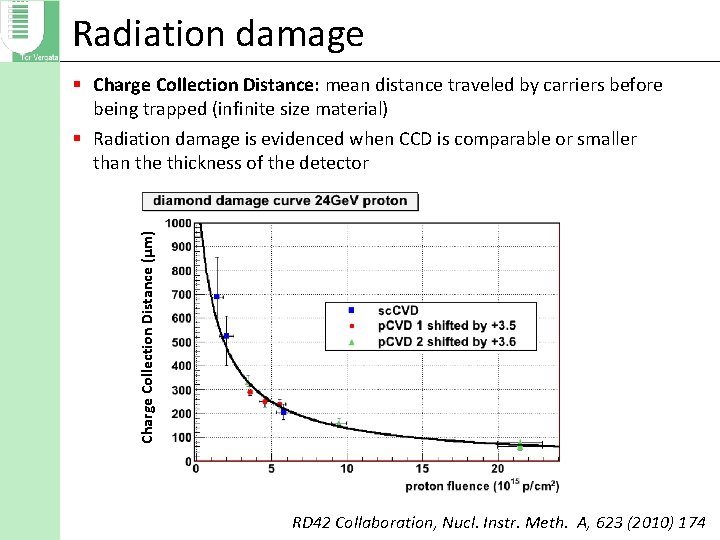
Radiation damage Charge Collection Distance (µm) § Charge Collection Distance: mean distance traveled by carriers before being trapped (infinite size material) § Radiation damage is evidenced when CCD is comparable or smaller than the thickness of the detector RD 42 Collaboration, Nucl. Instr. Meth. A, 623 (2010) 174
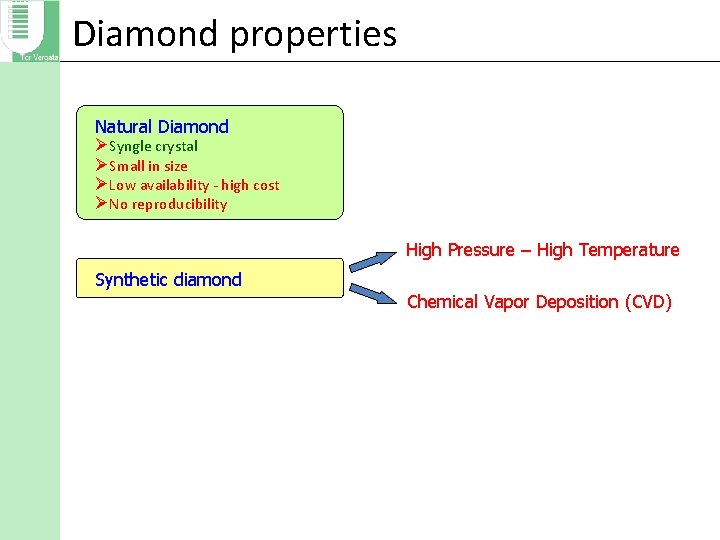
Diamond properties Natural Diamond ØSyngle crystal ØSmall in size ØLow availability - high cost ØNo reproducibility High Pressure – High Temperature Synthetic diamond Chemical Vapor Deposition (CVD)
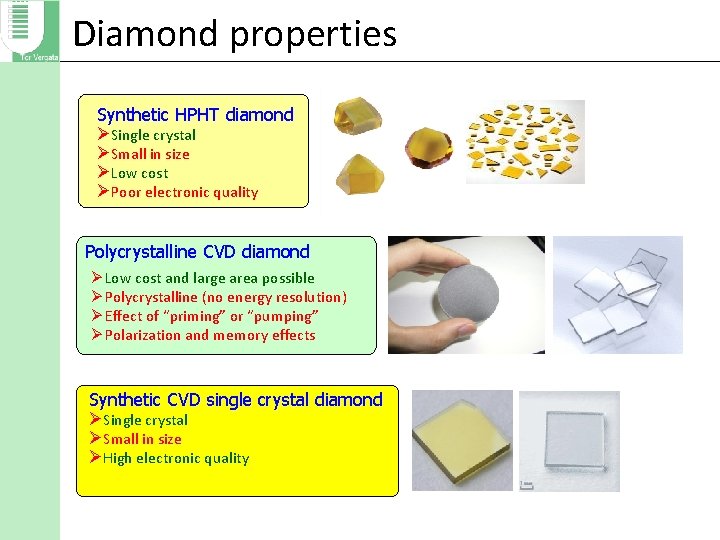
Diamond properties Synthetic HPHT diamond ØSingle crystal ØSmall in size ØLow cost ØPoor electronic quality Polycrystalline CVD diamond Ø Low cost and large area possible Ø Polycrystalline (no energy resolution) Ø Effect of “priming” or “pumping” Ø Polarization and memory effects Synthetic CVD single crystal diamond ØSingle crystal ØSmall in size ØHigh electronic quality
CVD diamond deposition Microwave Plasma CVD Al contact Output Ag contact CVD slightly B doped CVD B+ doped HPHT substrate Oscilloscope Ionizing particle Typical growth parameters Plasma composition 99% H 2 - 1% CH 4, Temperature 650 – 800 °C Microwave power 600 - 1300 W Pressure 100 - 150 mbar Gas flow rate 100 sccm Electrical contacts h e Shaping Amplifier Charge Sensitive Amplifier Diamond Bias Multichannel Analyzer
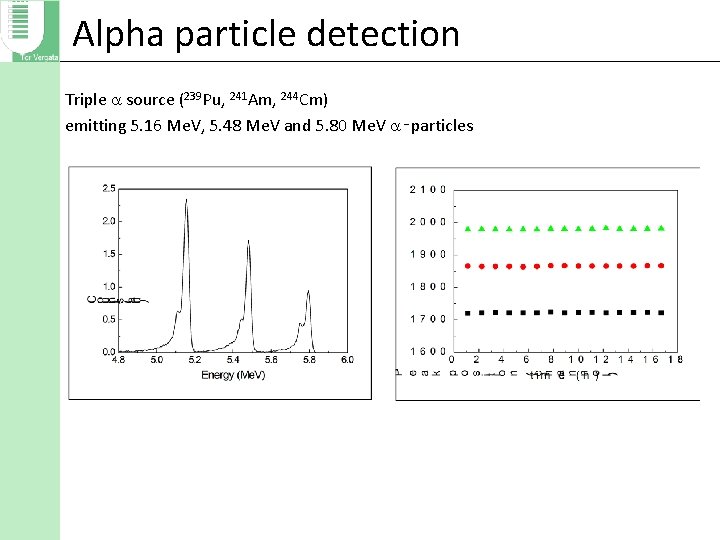
Alpha particle detection Triple source (239 Pu, 241 Am, 244 Cm) emitting 5. 16 Me. V, 5. 48 Me. V and 5. 80 Me. V ‑particles
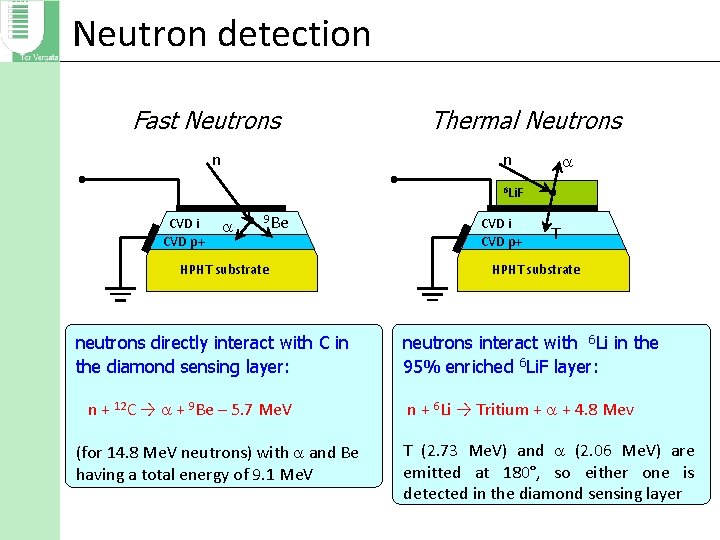
Neutron detection Fast Neutrons n Thermal Neutrons n 6 Li. F CVD i CVD p+ 9 Be HPHT substrate CVD i CVD p+ T HPHT substrate neutrons directly interact with C in the diamond sensing layer: neutrons interact with 6 Li in the 95% enriched 6 Li. F layer: n + 12 C → + 9 Be – 5. 7 Me. V n + 6 Li → Tritium + + 4. 8 Mev (for 14. 8 Me. V neutrons) with and Be having a total energy of 9. 1 Me. V T (2. 73 Me. V) and (2. 06 Me. V) are emitted at 180°, so either one is detected in the diamond sensing layer
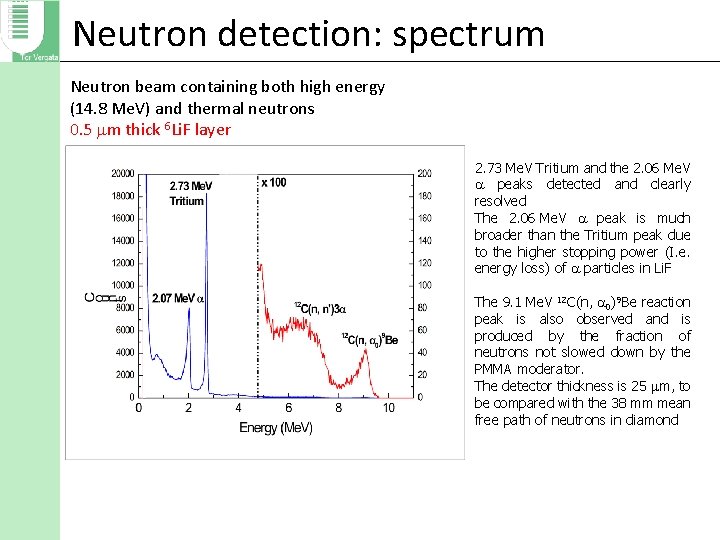
Neutron detection: spectrum Neutron beam containing both high energy (14. 8 Me. V) and thermal neutrons 0. 5 m thick 6 Li. F layer 2. 73 Me. V Tritium and the 2. 06 Me. V peaks detected and clearly resolved The 2. 06 Me. V peak is much broader than the Tritium peak due to the higher stopping power (I. e. energy loss) of particles in Li. F The 9. 1 Me. V 12 C(n, 0)9 Be reaction peak is also observed and is produced by the fraction of neutrons not slowed down by the PMMA moderator. The detector thickness is 25 m, to be compared with the 38 mm mean free path of neutrons in diamond
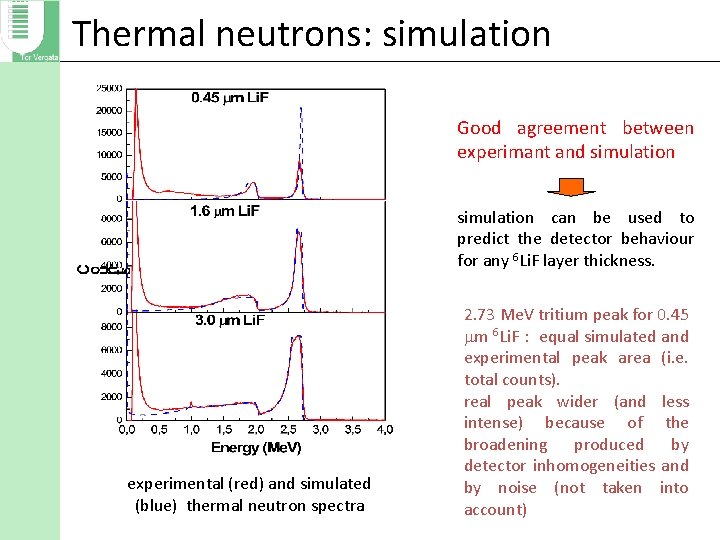
Thermal neutrons: simulation Good agreement between experimant and simulation can be used to predict the detector behaviour for any 6 Li. F layer thickness. experimental (red) and simulated (blue) thermal neutron spectra 2. 73 Me. V tritium peak for 0. 45 m 6 Li. F : equal simulated and experimental peak area (i. e. total counts). real peak wider (and less intense) because of the broadening produced by detector inhomogeneities and by noise (not taken into account)
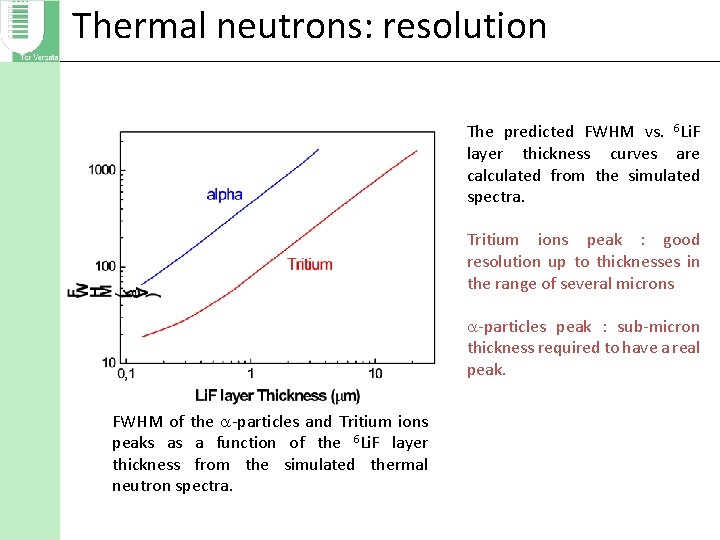
Thermal neutrons: resolution The predicted FWHM vs. 6 Li. F layer thickness curves are calculated from the simulated spectra. Tritium ions peak : good resolution up to thicknesses in the range of several microns -particles peak : sub-micron thickness required to have a real peak. FWHM of the -particles and Tritium ions peaks as a function of the 6 Li. F layer thickness from the simulated thermal neutron spectra.
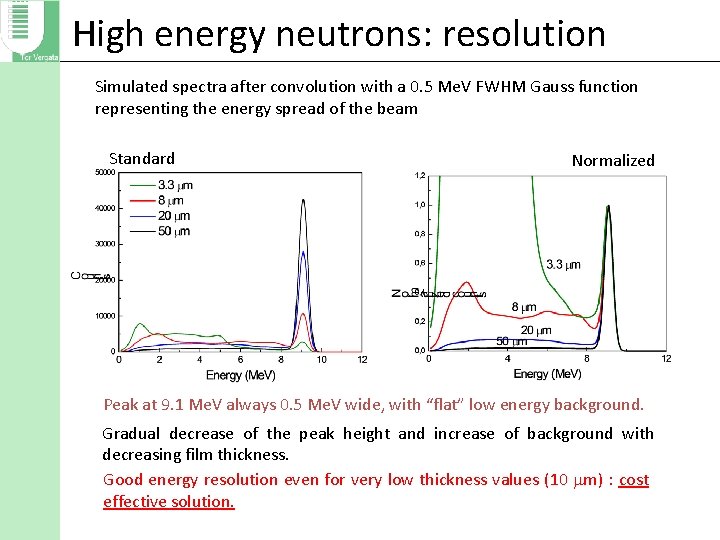
High energy neutrons: resolution Simulated spectra after convolution with a 0. 5 Me. V FWHM Gauss function representing the energy spread of the beam Standard Normalized Peak at 9. 1 Me. V always 0. 5 Me. V wide, with “flat” low energy background. Gradual decrease of the peak height and increase of background with decreasing film thickness. Good energy resolution even for very low thickness values (10 m) : cost effective solution.
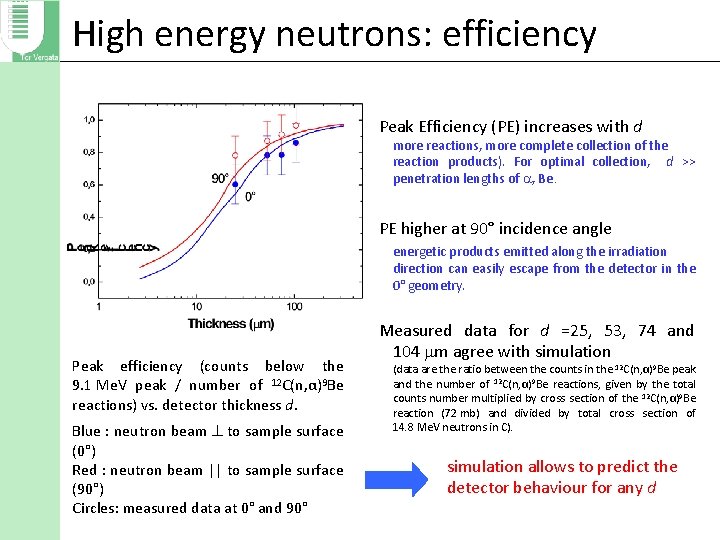
High energy neutrons: efficiency Peak Efficiency (PE) increases with d more reactions, more complete collection of the reaction products). For optimal collection, d >> penetration lengths of , Be. PE higher at 90° incidence angle energetic products emitted along the irradiation direction can easily escape from the detector in the 0° geometry. Peak efficiency (counts below the 9. 1 Me. V peak / number of 12 C(n, α)9 Be reactions) vs. detector thickness d. Blue : neutron beam to sample surface (0°) Red : neutron beam || to sample surface (90°) Circles: measured data at 0° and 90° Measured data for d =25, 53, 74 and 104 m agree with simulation (data are the ratio between the counts in the 12 C(n, α)9 Be peak and the number of 12 C(n, α)9 Be reactions, given by the total counts number multiplied by cross section of the 12 C(n, α)9 Be reaction (72 mb) and divided by total cross section of 14. 8 Me. V neutrons in C). simulation allows to predict the detector behaviour for any d
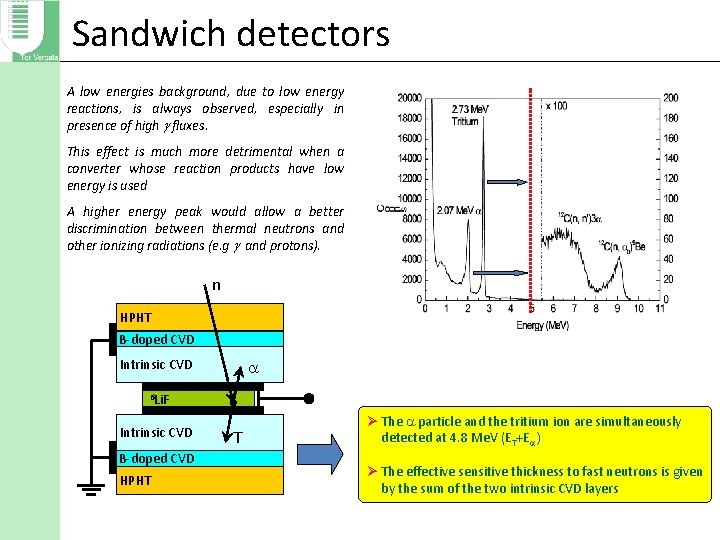
Sandwich detectors A low energies background, due to low energy reactions, is always observed, especially in presence of high g fluxes. This effect is much more detrimental when a converter whose reaction products have low energy is used A higher energy peak would allow a better discrimination between thermal neutrons and other ionizing radiations (e. g g and protons). n HPHT B-doped CVD Intrinsic CVD 6 Li. F Intrinsic CVD B-doped CVD HPHT T Ø The particle and the tritium ion are simultaneously detected at 4. 8 Me. V (ET+E ) Ø The effective sensitive thickness to fast neutrons is given by the sum of the two intrinsic CVD layers
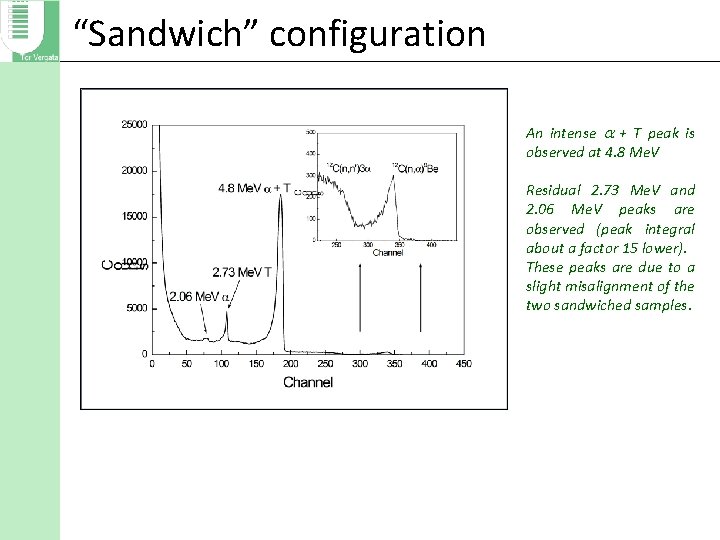
“Sandwich” configuration An intense a + T peak is observed at 4. 8 Me. V Residual 2. 73 Me. V and 2. 06 Me. V peaks are observed (peak integral about a factor 15 lower). These peaks are due to a slight misalignment of the two sandwiched samples.
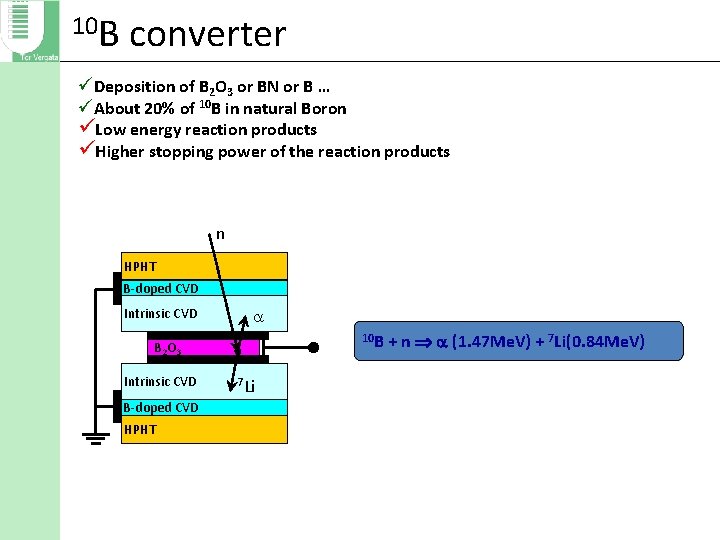
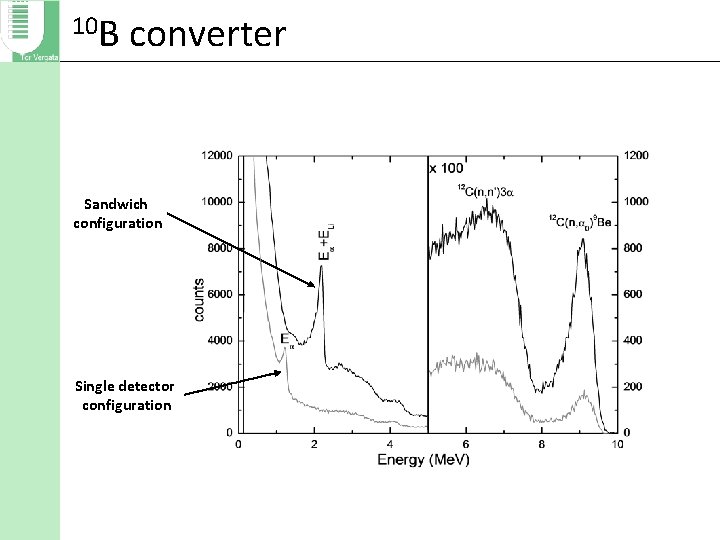
10 B converter üDeposition of B 2 O 3 or BN or B … üAbout 20% of 10 B in natural Boron üLow energy reaction products üHigher stopping power of the reaction products n HPHT B-doped CVD Intrinsic CVD 10 B B 2 O 3 Intrinsic CVD B-doped CVD HPHT 7 Li + n a (1. 47 Me. V) + 7 Li(0. 84 Me. V)
10 B converter Sandwich configuration Single detector configuration
Conclusion üDiamond is a very intersting material for neutron detection especially in high neutron flux condition, when high radiation hardness is needed. üNumerical simulations allow accurate prediction of the behavior of the device under neutron irradiation. Particular care has to be devoted to the detector design in order to optimize its performance for the specific application. ü“Sandwich” device allow to increase the discrimination ratio between neutron spectrum and the background. Incoincidence measurements are possible with such devices, further improving the background separation.
Collaborations Università di Roma “Tor Vergata” Dip. Ing. Industriale C. Di Venanzio M. Marinelli E. Milani F. Pompili G. Prestopino A. Tonnetti C. Verona G. Verona Rinati Enea Frascati M. Angelone A. Pietropaolo M. Pillon INFN Genova M. Osipenko G. Ricco M. Ripani
Thank you!