
Single Component Systems First Order Transition Gibbs Free
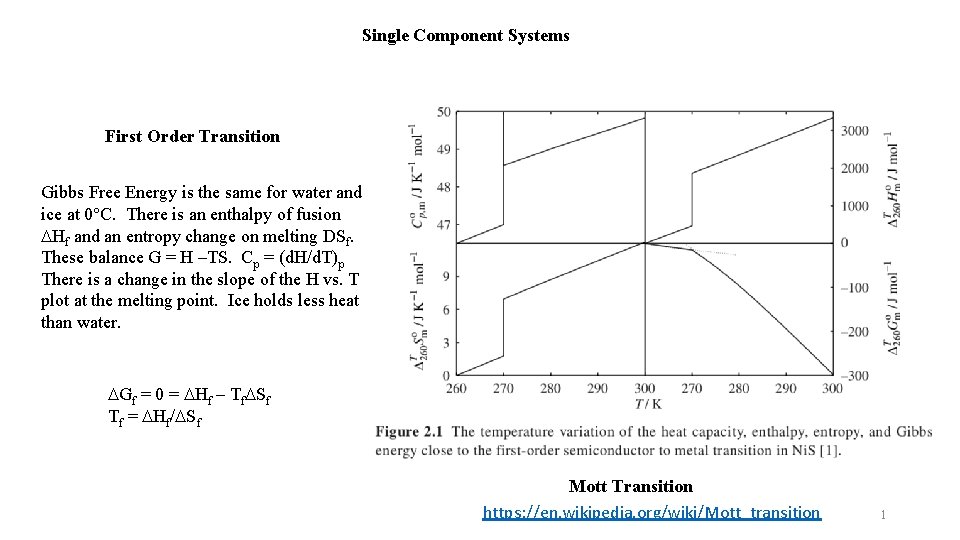
Single Component Systems First Order Transition Gibbs Free Energy is the same for water and ice at 0°C. There is an enthalpy of fusion DHf and an entropy change on melting DSf. These balance G = H –TS. Cp = (d. H/d. T)p There is a change in the slope of the H vs. T plot at the melting point. Ice holds less heat than water. DGf = 0 = DHf – Tf. DSf Tf = DHf/DSf Mott Transition https: //en. wikipedia. org/wiki/Mott_transition 1
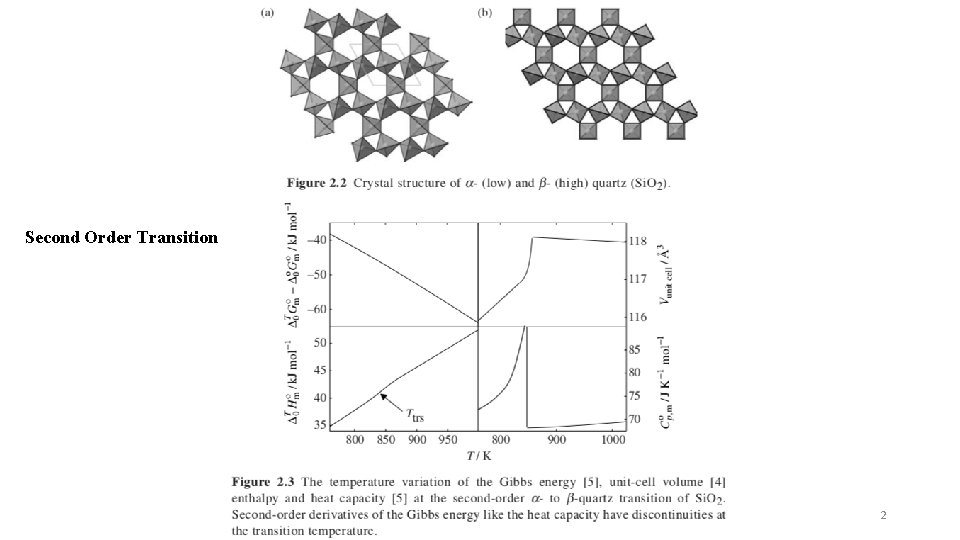
Second Order Transition 2
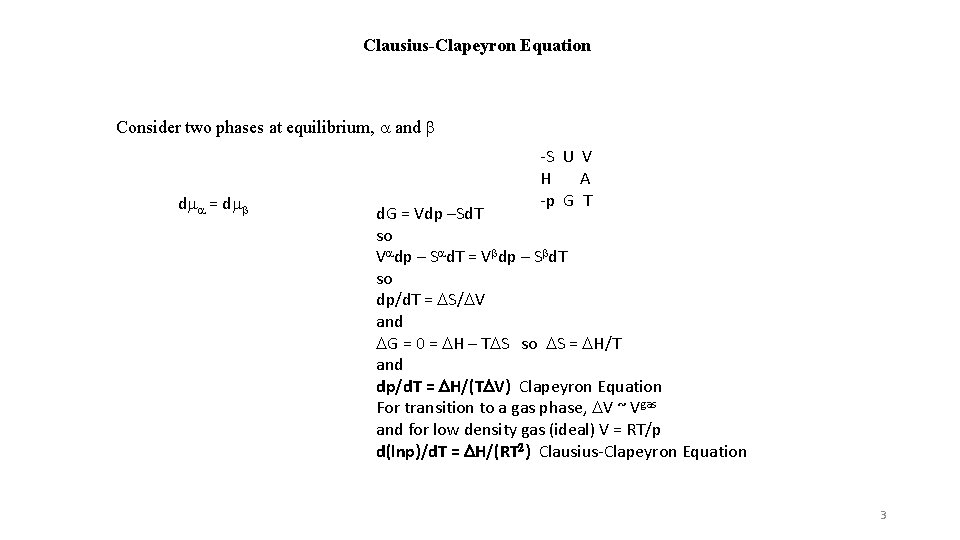
Clausius-Clapeyron Equation Consider two phases at equilibrium, a and b dma = dmb -S U V H A -p G T d. G = Vdp –Sd. T so Vadp – Sad. T = Vbdp – Sbd. T so dp/d. T = DS/DV and DG = 0 = DH – TDS so DS = DH/T and dp/d. T = DH/(TDV) Clapeyron Equation For transition to a gas phase, DV ~ Vgas and for low density gas (ideal) V = RT/p d(lnp)/d. T = DH/(RT 2) Clausius-Clapeyron Equation 3
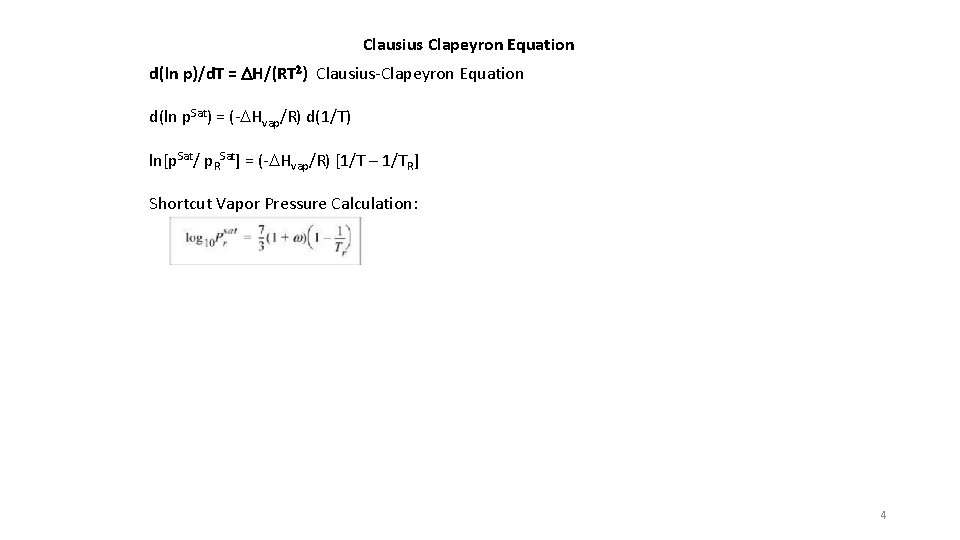
Clausius Clapeyron Equation d(ln p)/d. T = DH/(RT 2) Clausius-Clapeyron Equation d(ln p. Sat) = (-DHvap/R) d(1/T) ln[p. Sat/ p. RSat] = (-DHvap/R) [1/T – 1/TR] Shortcut Vapor Pressure Calculation: 4
![Clausius Clapeyron Equation d(ln p. Sat) = (-DHvap/R) d(1/T) ln[p. Sat/ p. RSat] =](http://slidetodoc.com/presentation_image_h2/f6b381ed5ce3e135cdaed09725960ddd/image-5.jpg "Clausius Clapeyron Equation d(ln p. Sat) = (-DHvap/R) d(1/T) ln[p. Sat/ p. RSat] =")
Clausius Clapeyron Equation d(ln p. Sat) = (-DHvap/R) d(1/T) ln[p. Sat/ p. RSat] = (-DHvap/R) [1/T – 1/TR] This is a kind of Arrhenius Plot 5
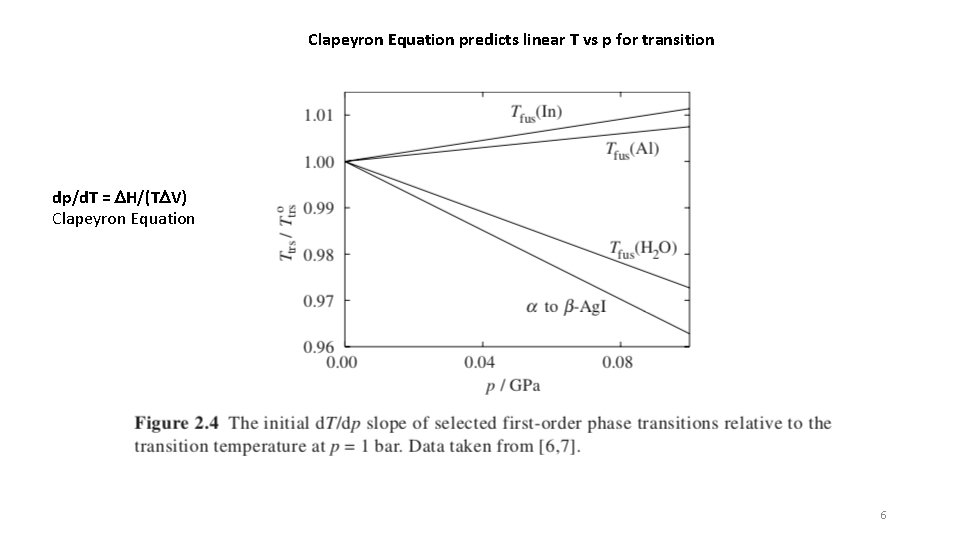
Clapeyron Equation predicts linear T vs p for transition dp/d. T = DH/(TDV) Clapeyron Equation 6
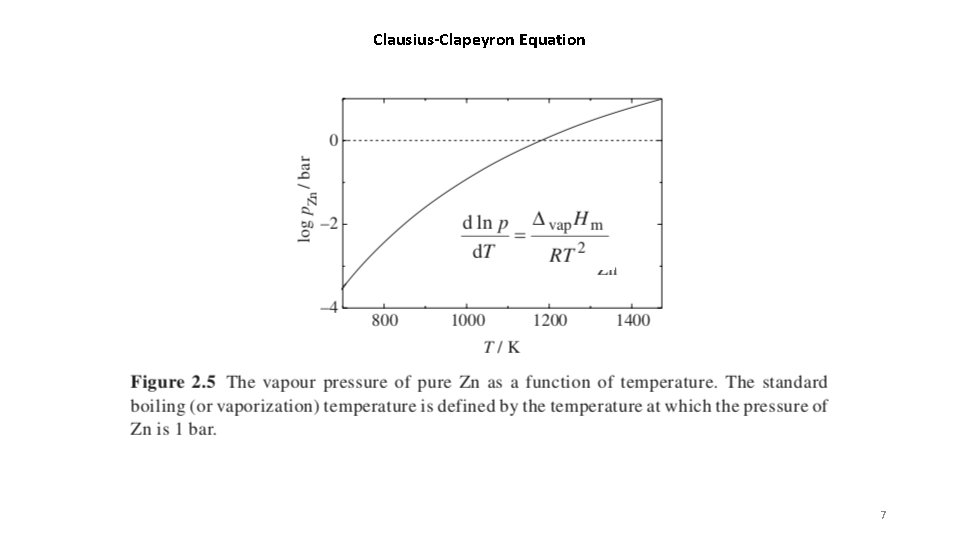
Clausius-Clapeyron Equation 7
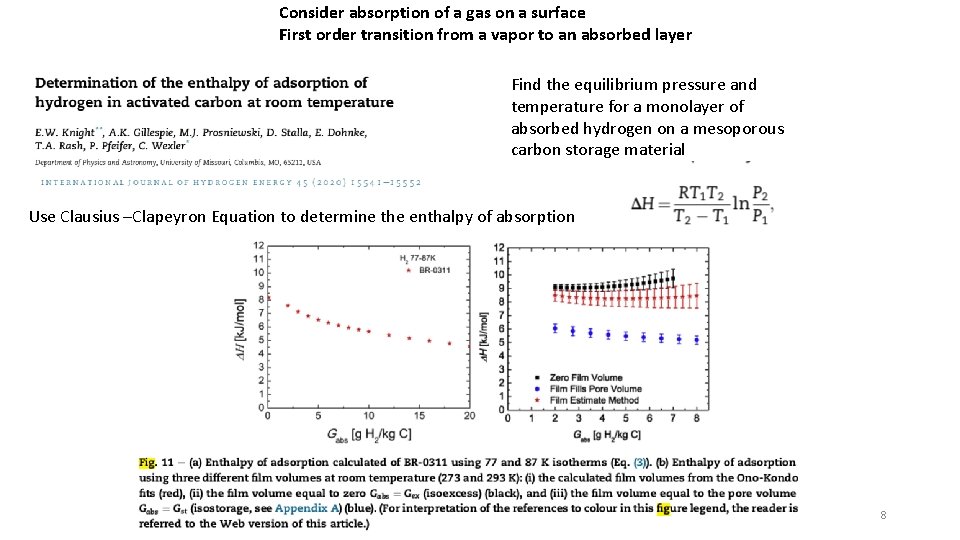
Consider absorption of a gas on a surface First order transition from a vapor to an absorbed layer Find the equilibrium pressure and temperature for a monolayer of absorbed hydrogen on a mesoporous carbon storage material Use Clausius –Clapeyron Equation to determine the enthalpy of absorption 8
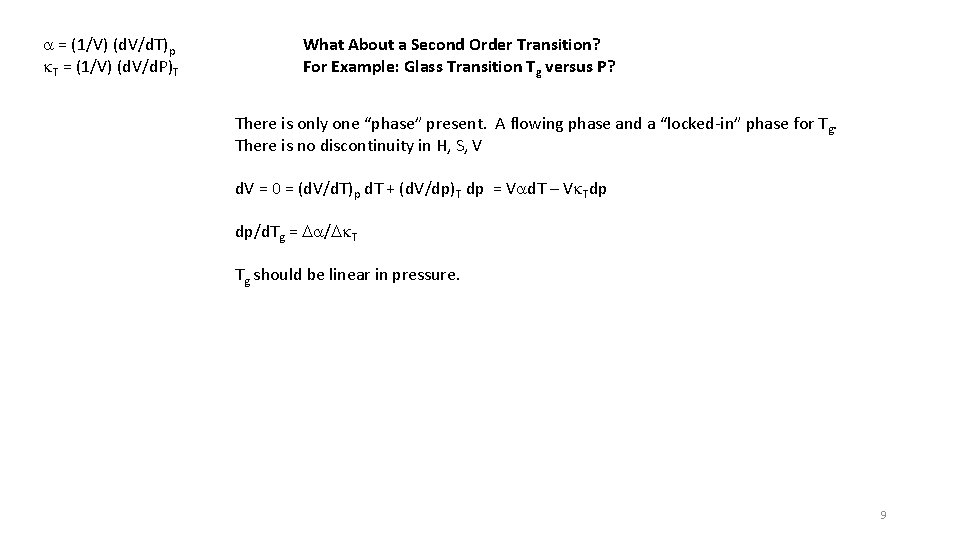
a = (1/V) (d. V/d. T)p k. T = (1/V) (d. V/d. P)T What About a Second Order Transition? For Example: Glass Transition Tg versus P? There is only one “phase” present. A flowing phase and a “locked-in” phase for Tg. There is no discontinuity in H, S, V d. V = 0 = (d. V/d. T)p d. T + (d. V/dp)T dp = Vad. T – Vk. Tdp dp/d. Tg = Da/Dk. T Tg should be linear in pressure. 9
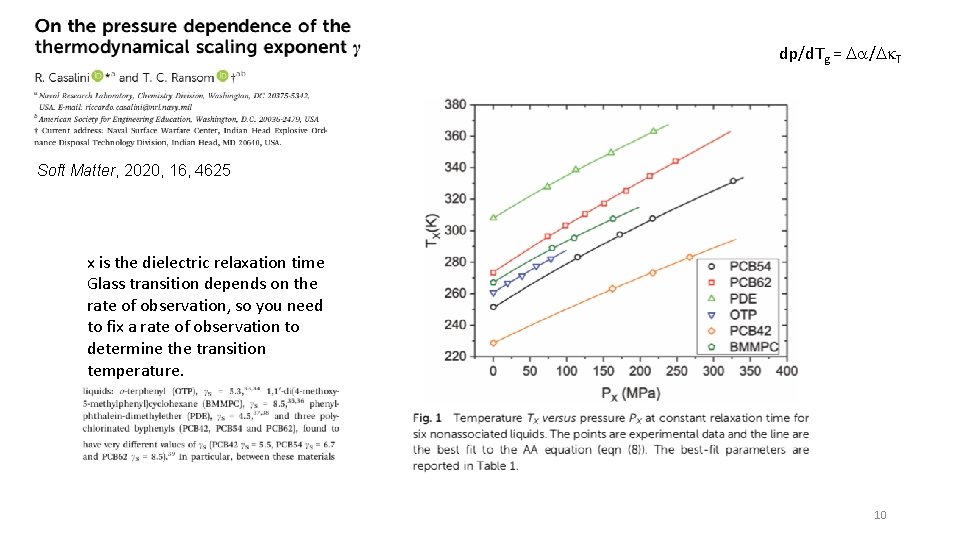
dp/d. Tg = Da/Dk. T Soft Matter, 2020, 16, 4625 x is the dielectric relaxation time Glass transition depends on the rate of observation, so you need to fix a rate of observation to determine the transition temperature. 10
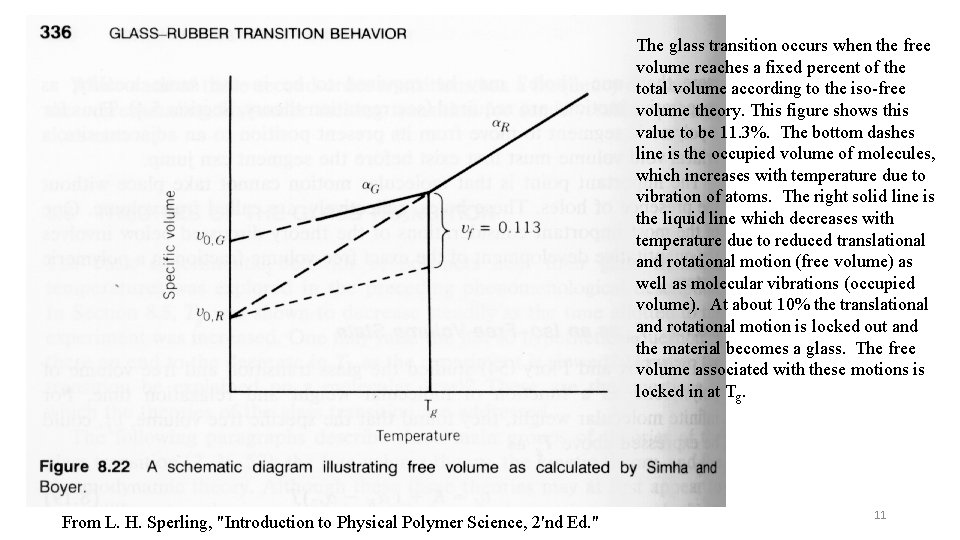
The glass transition occurs when the free volume reaches a fixed percent of the total volume according to the iso-free volume theory. This figure shows this value to be 11. 3%. The bottom dashes line is the occupied volume of molecules, which increases with temperature due to vibration of atoms. The right solid line is the liquid line which decreases with temperature due to reduced translational and rotational motion (free volume) as well as molecular vibrations (occupied volume). At about 10% the translational and rotational motion is locked out and the material becomes a glass. The free volume associated with these motions is locked in at Tg. From L. H. Sperling, "Introduction to Physical Polymer Science, 2'nd Ed. " 11
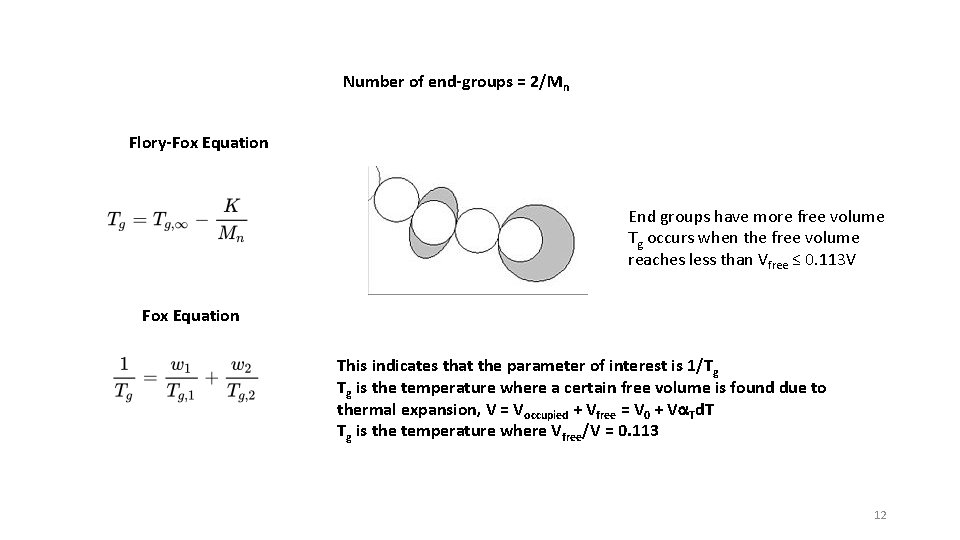
Number of end-groups = 2/Mn Flory-Fox Equation End groups have more free volume Tg occurs when the free volume reaches less than Vfree ≤ 0. 113 V Fox Equation This indicates that the parameter of interest is 1/Tg Tg is the temperature where a certain free volume is found due to thermal expansion, V = Voccupied + Vfree = V 0 + Va. Td. T Tg is the temperature where Vfree/V = 0. 113 12
Second order transition Curie and Neel Temperatures Ferro to Para Magnetic Ferri to Para Magnetic 13
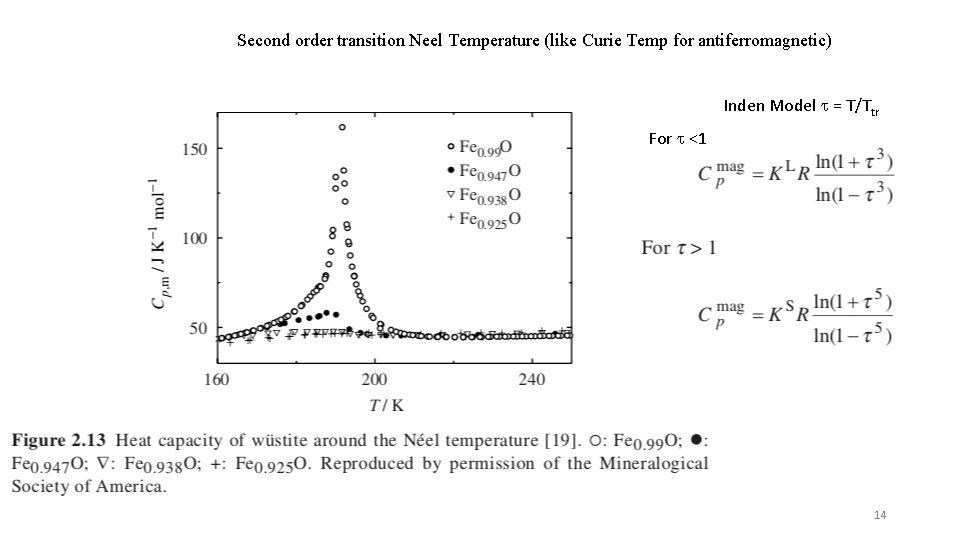
Second order transition Neel Temperature (like Curie Temp for antiferromagnetic) Inden Model t = T/Ttr For t <1 14
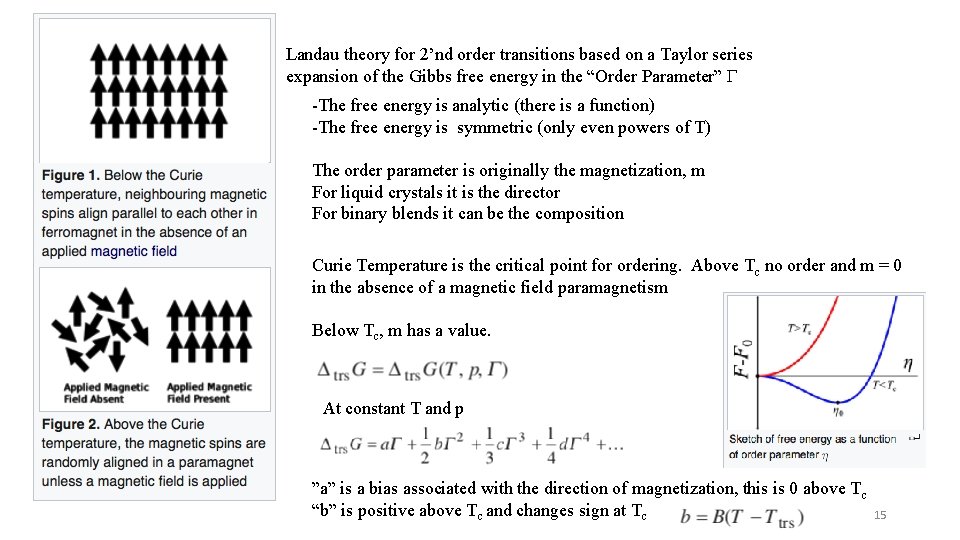
Landau theory for 2’nd order transitions based on a Taylor series expansion of the Gibbs free energy in the “Order Parameter” G -The free energy is analytic (there is a function) -The free energy is symmetric (only even powers of T) The order parameter is originally the magnetization, m For liquid crystals it is the director For binary blends it can be the composition Curie Temperature is the critical point for ordering. Above Tc no order and m = 0 in the absence of a magnetic field paramagnetism Below Tc, m has a value. At constant T and p ”a” is a bias associated with the direction of magnetization, this is 0 above T c “b” is positive above Tc and changes sign at Tc 15
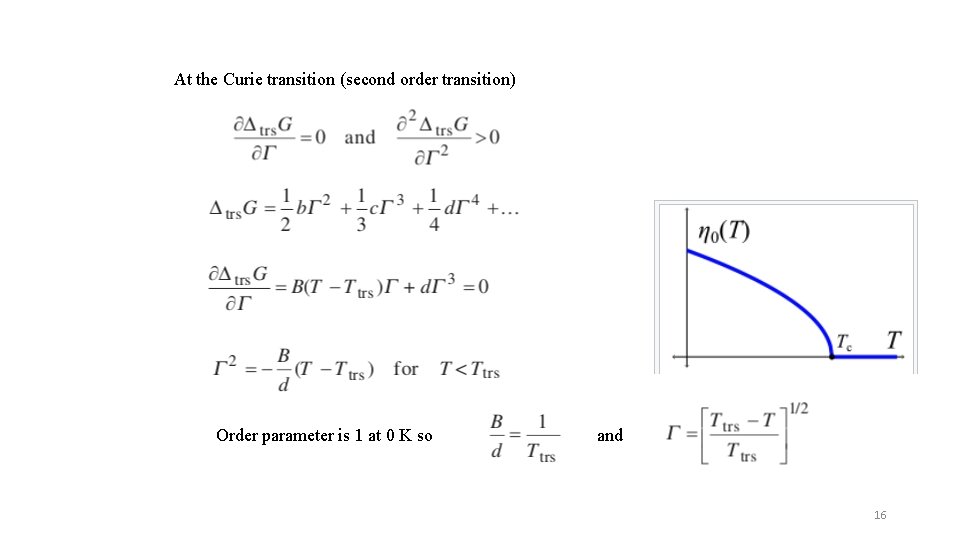
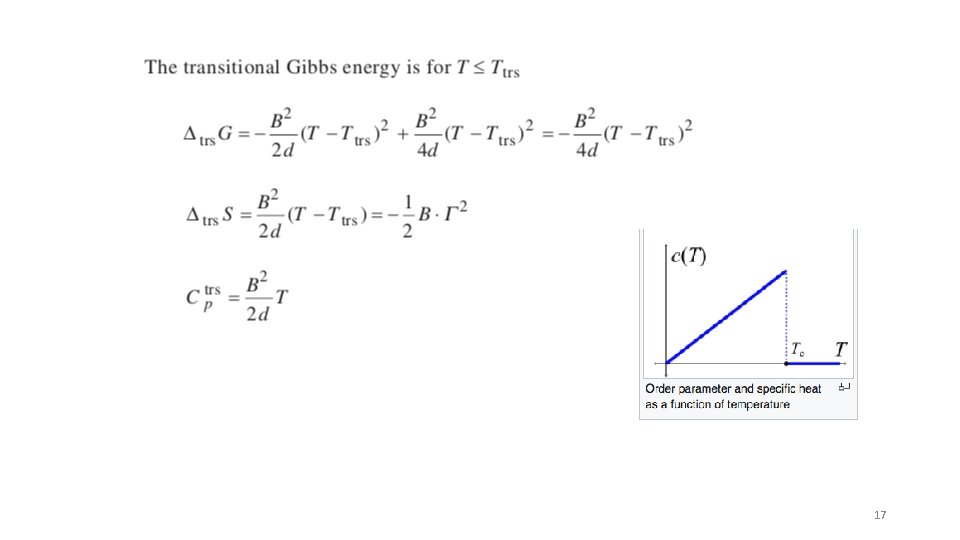
At the Curie transition (second order transition) Order parameter is 1 at 0 K so and 16
17
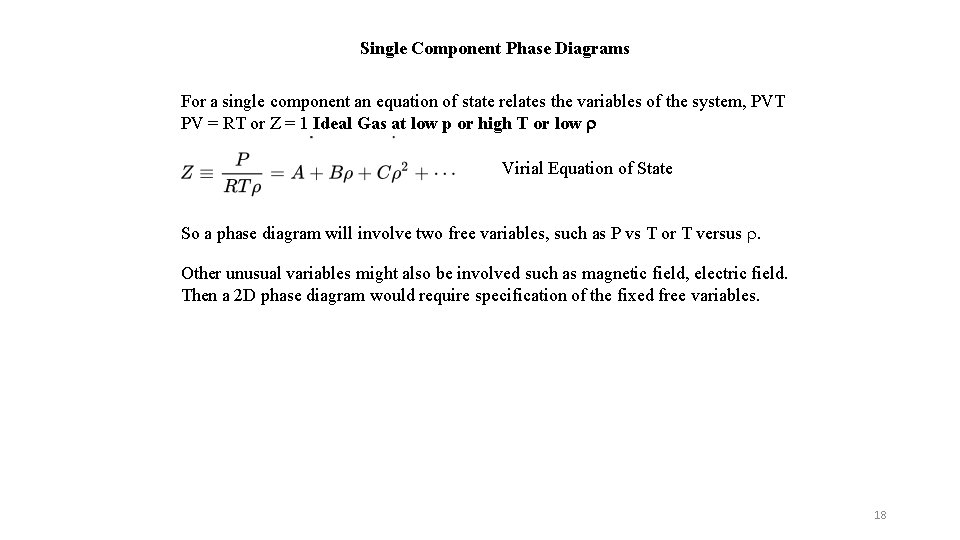
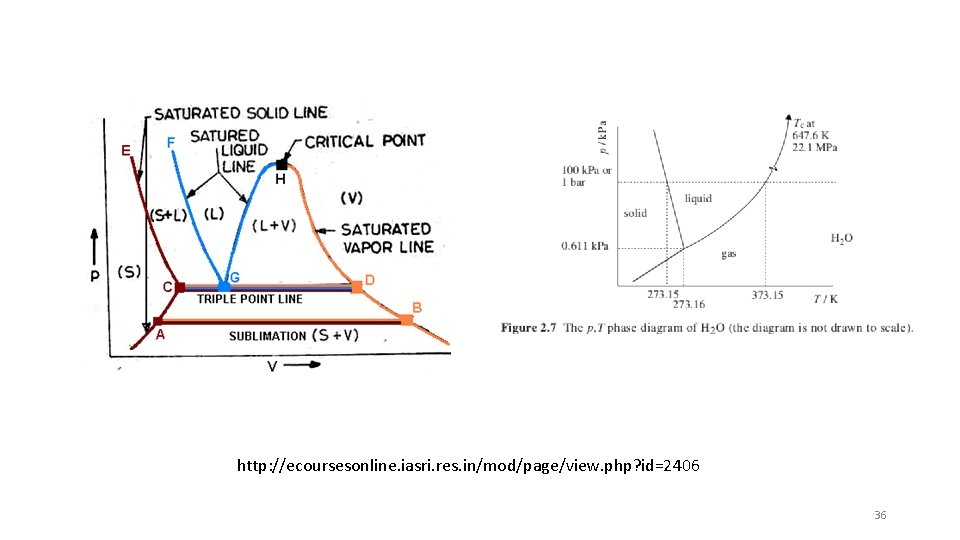
Single Component Phase Diagrams For a single component an equation of state relates the variables of the system, PVT PV = RT or Z = 1 Ideal Gas at low p or high T or low r Virial Equation of State So a phase diagram will involve two free variables, such as P vs T or T versus r. Other unusual variables might also be involved such as magnetic field, electric field. Then a 2 D phase diagram would require specification of the fixed free variables. 18

Single Component Phase Diagrams Isochoric phase diagram For a single component an equation of state relates the variables of the system, PVT 19
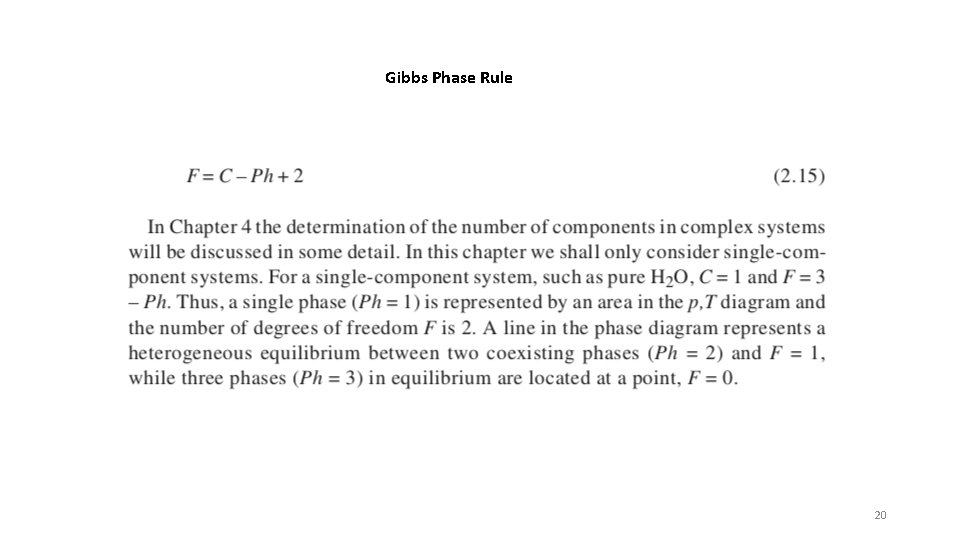
Gibbs Phase Rule 20
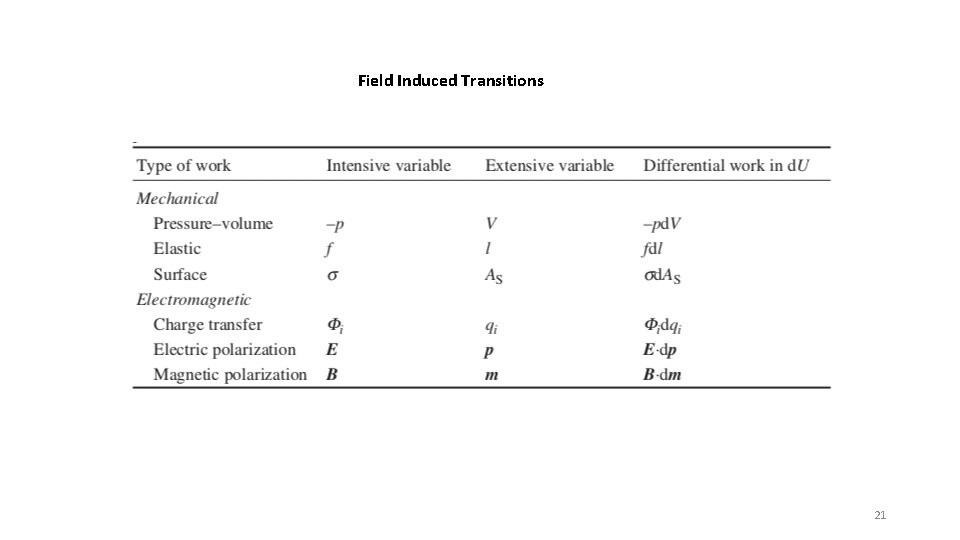
Field Induced Transitions 21
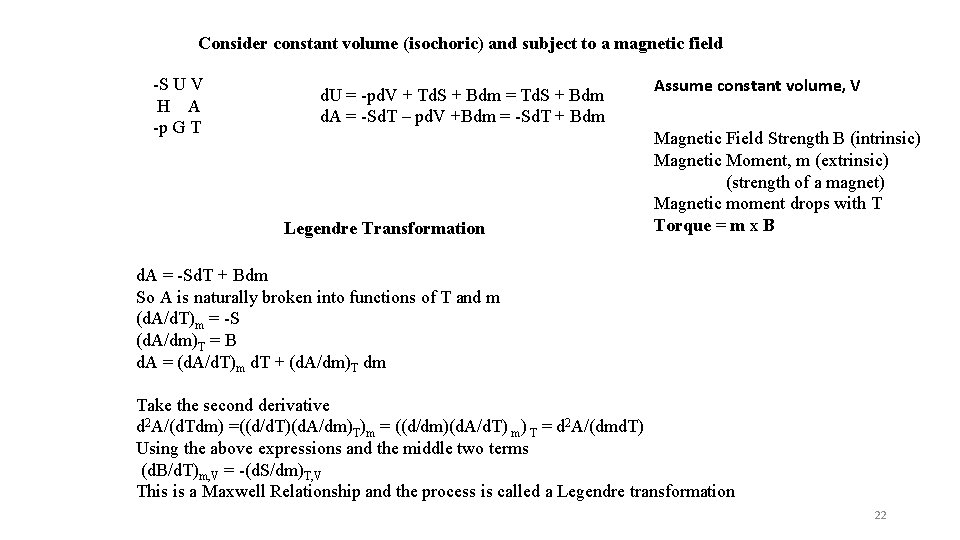
Consider constant volume (isochoric) and subject to a magnetic field -S U V H A -p G T d. U = -pd. V + Td. S + Bdm = Td. S + Bdm d. A = -Sd. T – pd. V +Bdm = -Sd. T + Bdm Legendre Transformation Assume constant volume, V Magnetic Field Strength B (intrinsic) Magnetic Moment, m (extrinsic) (strength of a magnet) Magnetic moment drops with T Torque = m x B d. A = -Sd. T + Bdm So A is naturally broken into functions of T and m (d. A/d. T)m = -S (d. A/dm)T = B d. A = (d. A/d. T)m d. T + (d. A/dm)T dm Take the second derivative d 2 A/(d. Tdm) =((d/d. T)(d. A/dm)T)m = ((d/dm)(d. A/d. T) m) T = d 2 A/(dmd. T) Using the above expressions and the middle two terms (d. B/d. T)m, V = -(d. S/dm)T, V This is a Maxwell Relationship and the process is called a Legendre transformation 22
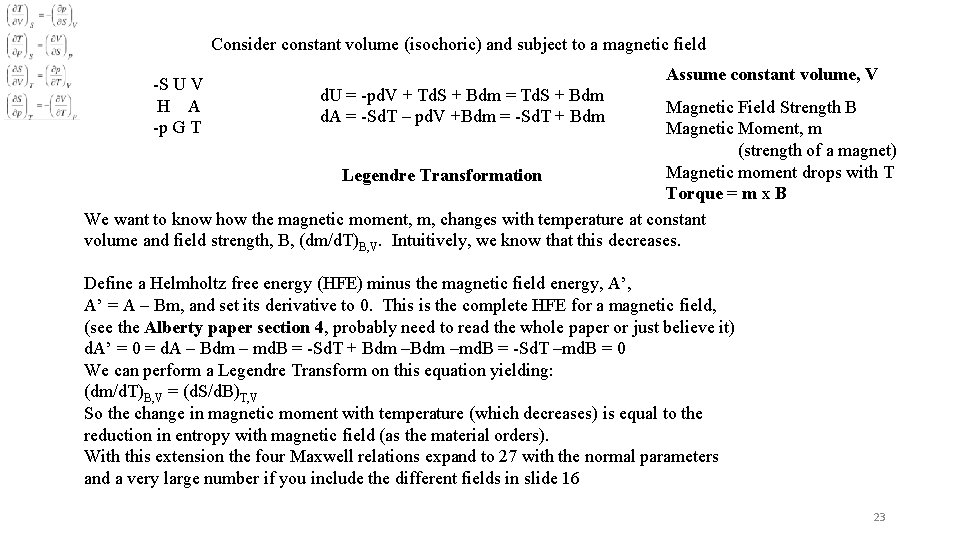
Consider constant volume (isochoric) and subject to a magnetic field -S U V H A -p G T Assume constant volume, V d. U = -pd. V + Td. S + Bdm = Td. S + Bdm d. A = -Sd. T – pd. V +Bdm = -Sd. T + Bdm Magnetic Field Strength B Magnetic Moment, m (strength of a magnet) Magnetic moment drops with T Legendre Transformation Torque = m x B We want to know how the magnetic moment, m, changes with temperature at constant volume and field strength, B, (dm/d. T)B, V. Intuitively, we know that this decreases. Define a Helmholtz free energy (HFE) minus the magnetic field energy, A’ = A – Bm, and set its derivative to 0. This is the complete HFE for a magnetic field, (see the Alberty paper section 4, probably need to read the whole paper or just believe it) d. A’ = 0 = d. A – Bdm – md. B = -Sd. T + Bdm –md. B = -Sd. T –md. B = 0 We can perform a Legendre Transform on this equation yielding: (dm/d. T)B, V = (d. S/d. B)T, V So the change in magnetic moment with temperature (which decreases) is equal to the reduction in entropy with magnetic field (as the material orders). With this extension the four Maxwell relations expand to 27 with the normal parameters and a very large number if you include the different fields in slide 16 23
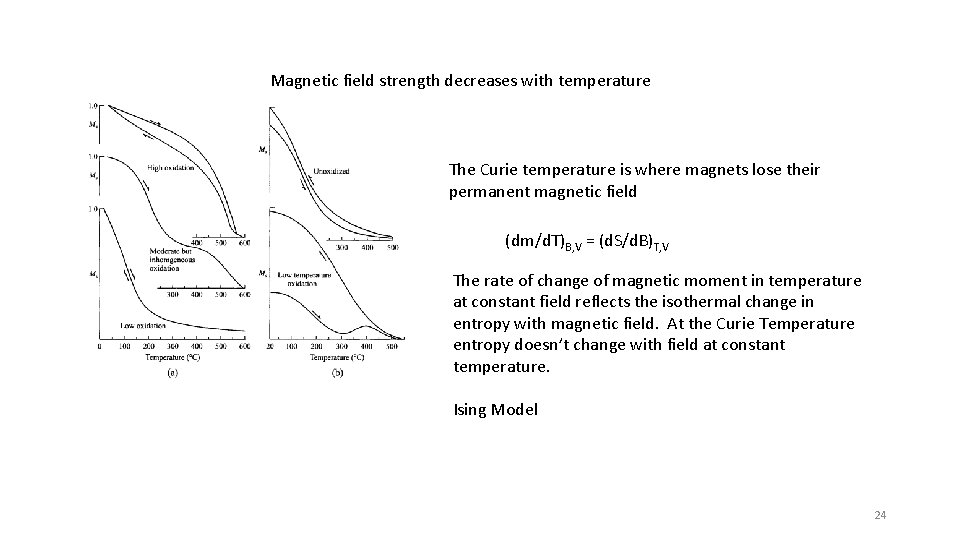
Magnetic field strength decreases with temperature The Curie temperature is where magnets lose their permanent magnetic field (dm/d. T)B, V = (d. S/d. B)T, V The rate of change of magnetic moment in temperature at constant field reflects the isothermal change in entropy with magnetic field. At the Curie Temperature entropy doesn’t change with field at constant temperature. Ising Model 24
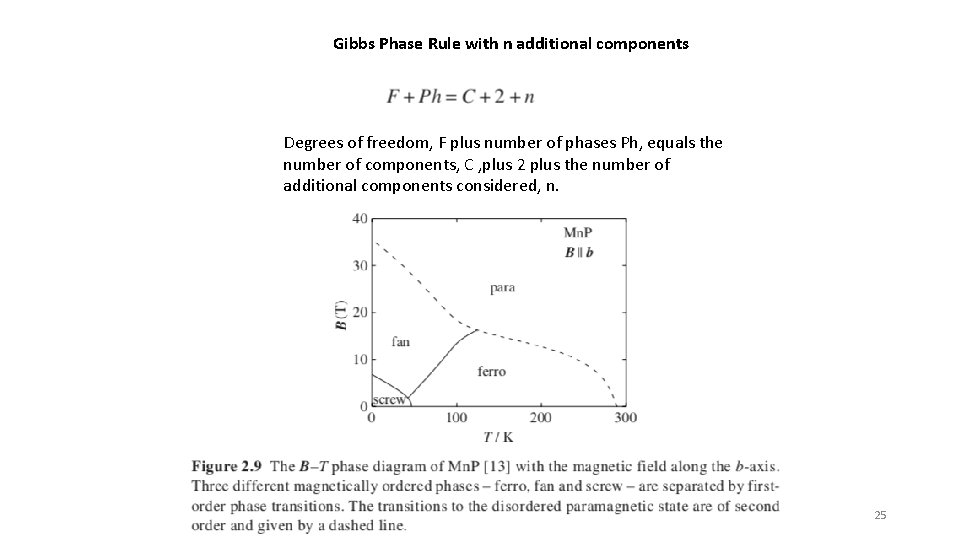
Gibbs Phase Rule with n additional components Degrees of freedom, F plus number of phases Ph, equals the number of components, C , plus 2 plus the number of additional components considered, n. 25
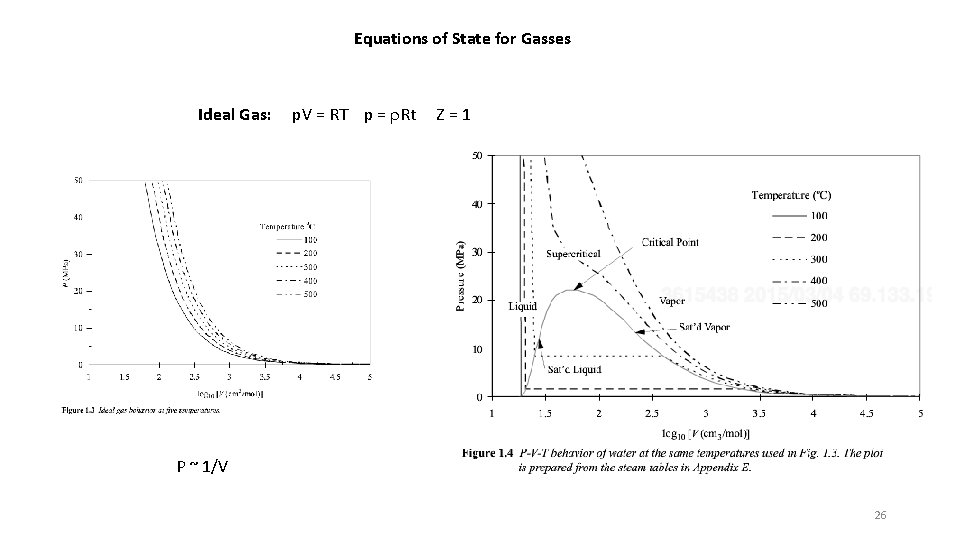
Equations of State for Gasses Ideal Gas: p. V = RT p = r. Rt Z=1 P ~ 1/V 26
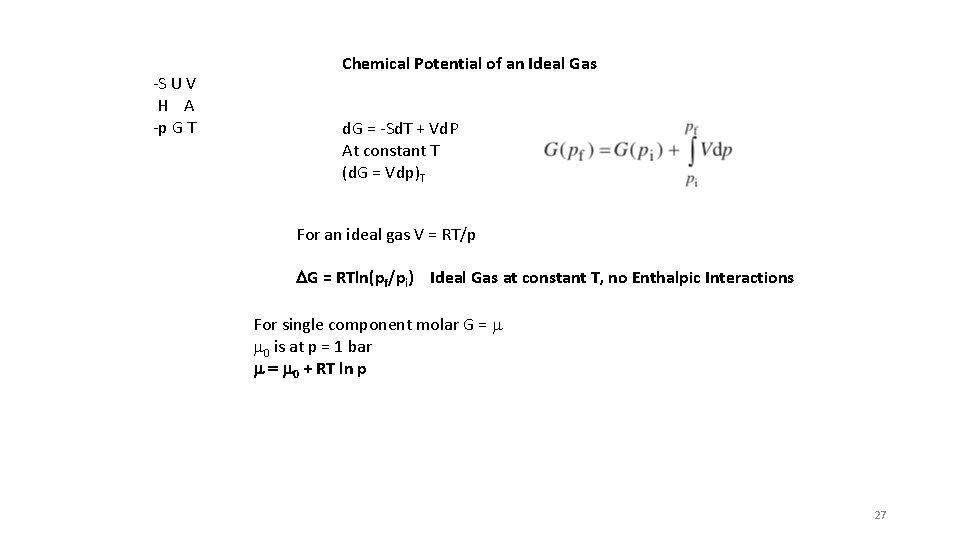
-S U V H A -p G T Chemical Potential of an Ideal Gas d. G = -Sd. T + Vd. P At constant T (d. G = Vdp)T For an ideal gas V = RT/p DG = RTln(pf/pi) Ideal Gas at constant T, no Enthalpic Interactions For single component molar G = m m 0 is at p = 1 bar m = m 0 + RT ln p 27
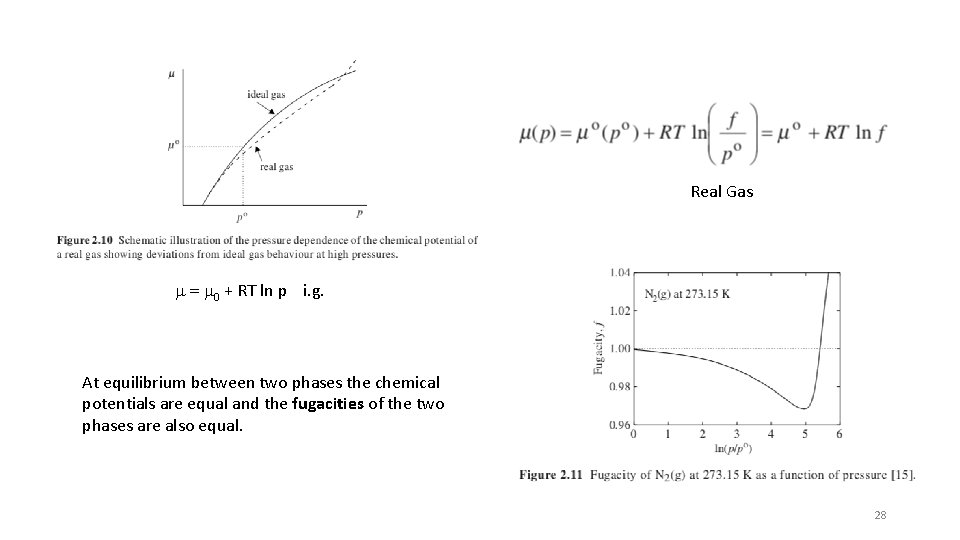
Real Gas m = m 0 + RT ln p i. g. At equilibrium between two phases the chemical potentials are equal and the fugacities of the two phases are also equal. 28
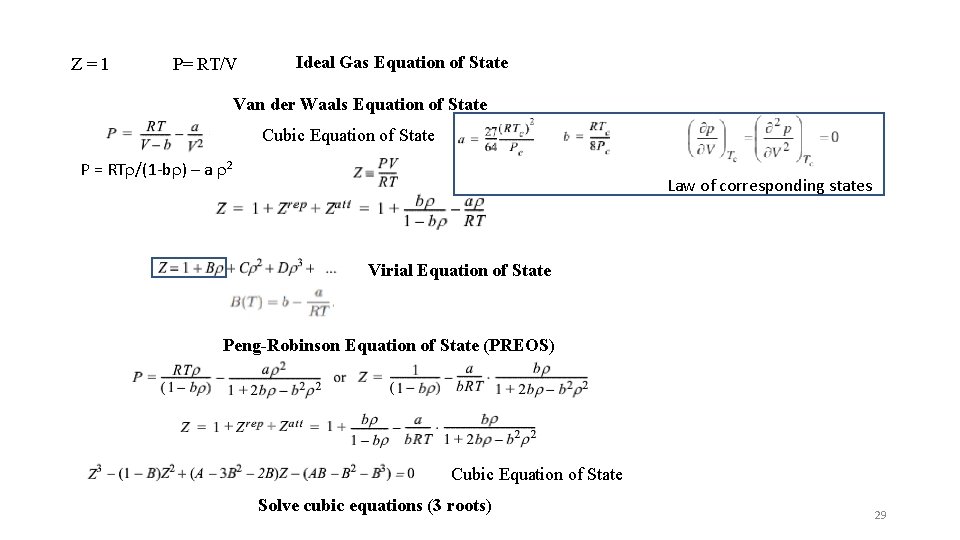
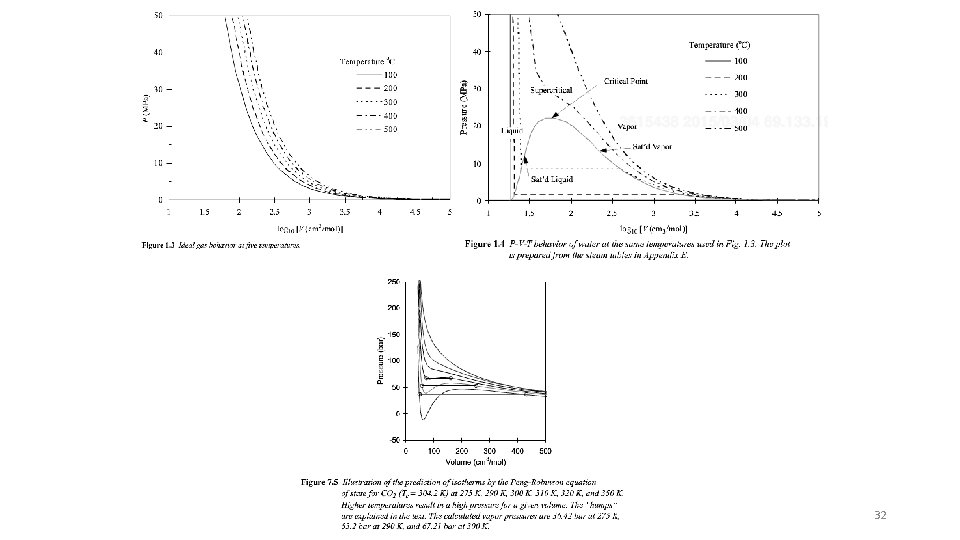
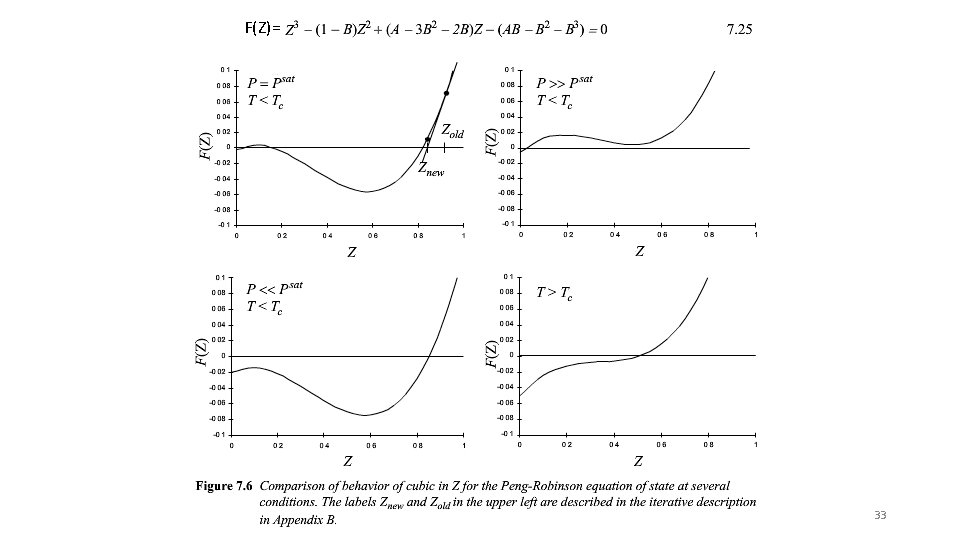
Z=1 P= RT/V Ideal Gas Equation of State Van der Waals Equation of State Cubic Equation of State P = RTr/(1 -br) – a r 2 Law of corresponding states Virial Equation of State Peng-Robinson Equation of State (PREOS) Cubic Equation of State Solve cubic equations (3 roots) 29
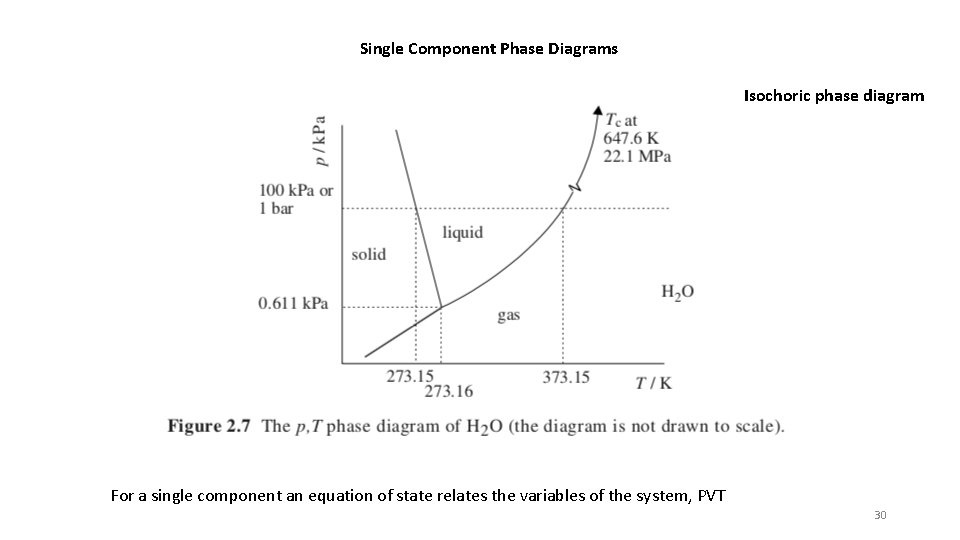
Single Component Phase Diagrams Isochoric phase diagram For a single component an equation of state relates the variables of the system, PVT 30
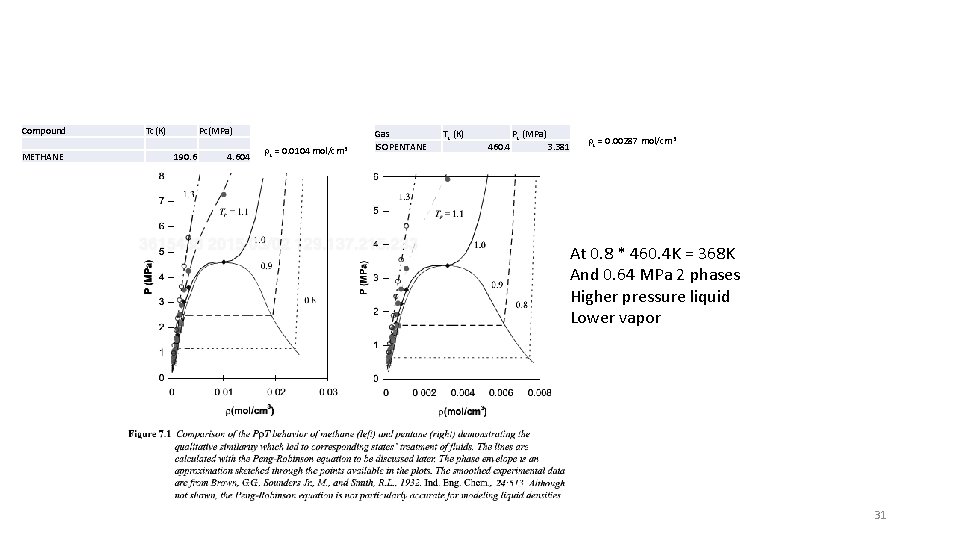
Compound METHANE Tc(K) Pc(MPa) 190. 6 4. 604 rc = 0. 0104 mol/cm 3 Gas ISOPENTANE Tc (K) 460. 4 Pc (MPa) 3. 381 rc = 0. 00287 mol/cm 3 At 0. 8 * 460. 4 K = 368 K And 0. 64 MPa 2 phases Higher pressure liquid Lower vapor 31
32
F(Z)= 33
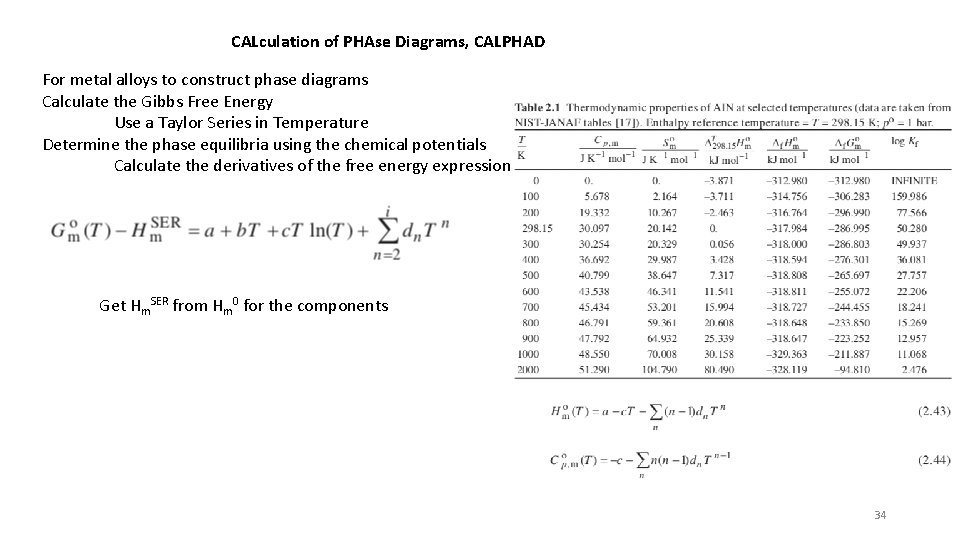
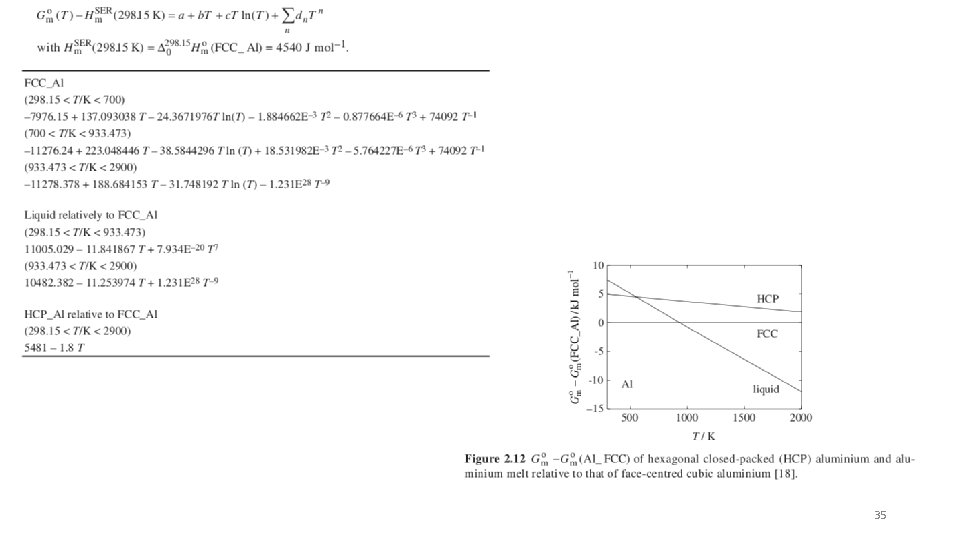
CALculation of PHAse Diagrams, CALPHAD For metal alloys to construct phase diagrams Calculate the Gibbs Free Energy Use a Taylor Series in Temperature Determine the phase equilibria using the chemical potentials Calculate the derivatives of the free energy expression Get Hm. SER from Hm 0 for the components 34
35
http: //ecoursesonline. iasri. res. in/mod/page/view. php? id=2406 36
- Slides: 36