
Single Bonded Functional Groups UNIT TWO Single Bonded

Single Bonded Functional Groups UNIT TWO
Single Bonded Functional Groups When compounds have the same functional group they exhibit similar behaviours. For simple organic compounds there is a general formula for identifying functional groups R + functional group If the functional group was a hydroxyl (OH) we could see… CH 3 OH CH 3 CH 2 OH, etc
Naming Organic Compounds with Functional Groups Organic compounds are named according to their functional groups – as the functional groups dictate how the compound generally reacts – in the suffix In the above examples, due to the -OH (hydroxyl) functional group – methanol, ethanol
Physical Properties and Forces Physical properties (boiling point, melting point, solubility) determined mostly by intermolecular forces (attraction and repulsion between particles) Hydrogen bonding (strong bond between N-H, O-H or F-H on one molecule and N, O, F on another molecule) Dipole-dipole interactions – wherein polar molecules are attracted to one another Dispersion forces – the attractive bond between all covalent molecules, strengthen as the size of a molecule increases
Using the Forces Can the molecules form H bonds (water) – If the molecule has the right bonds, they can form H bonds with H (themselves) and water If the molecule has unbonded O, N, F they could form with water If they can H bond with themselves they have higher boiling points than similar compounds that cannot (ex. Alcohol vs. alkane) Usually soluble in water (typically applies to most alcohols) Are the molecules polar? If there are polar bonds (that are not acting in opposite directions) they will be attracted to other polar bonds have a higher boiling point than non-polar molecules Polar molecules that can form Hydrogen bonds have even higher boiling points (ex. Ethanol vs. methoxymethane vs ethane)
Using the Forces cont’d … If polar molecules have a long hydrocarbon chain have a reduced polarity Ex. Octanol vs. ethanol The longer polar hydrocarbons are less soluble than smaller polar hydrocarbons Strength of the dispersion forces When a hydrocarbon part of a molecule is very large, the dispersion forces are stronger than normal With a greater number of Carbon has a higher boiling part Ex. Hexane vs ethane

Single Bonded Functional Groups alcohols, alkyl halides, ethers, and amines
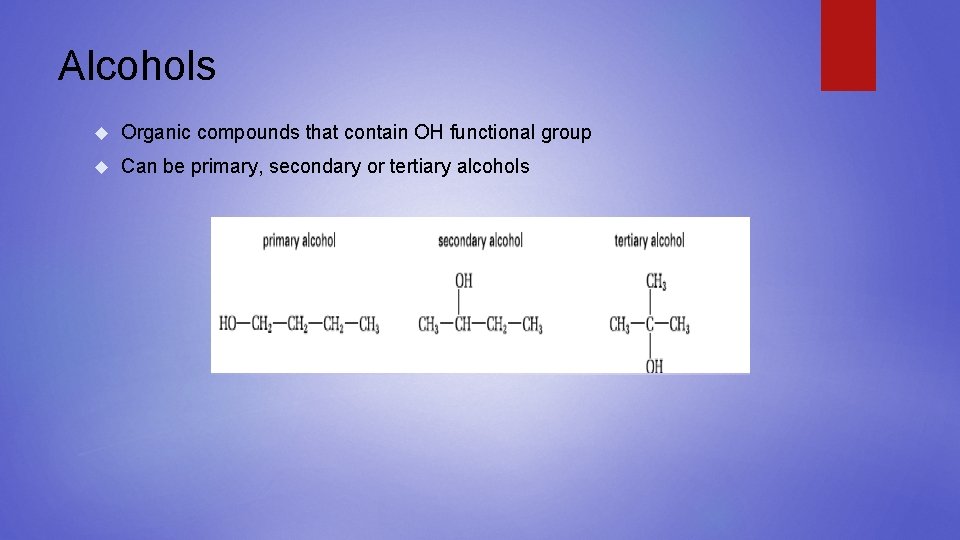
Alcohols Organic compounds that contain OH functional group Can be primary, secondary or tertiary alcohols
Naming Alcohols How to name an alcohol Locate the longest chain that contains the OH functional group – name parent alkane Replace -e ending with -ol Add position numbers before root to indicate location of OH with lowest possible number If there are multiple OH groups, keep the -e ending, and add a prefix before suffix -ol Name + number other branches, and add to the prefix Prefix + root + suffix
Physical Properties of Alcohols Polar (small alcohols more polar than large hydrocarbon-alcohols) Hydrogen bonding between molecules Extremely soluble (decreases as hydrocarbon chain increases) High melting/boiling points Most liquid at room temperature Extremely flammable Most poisonous
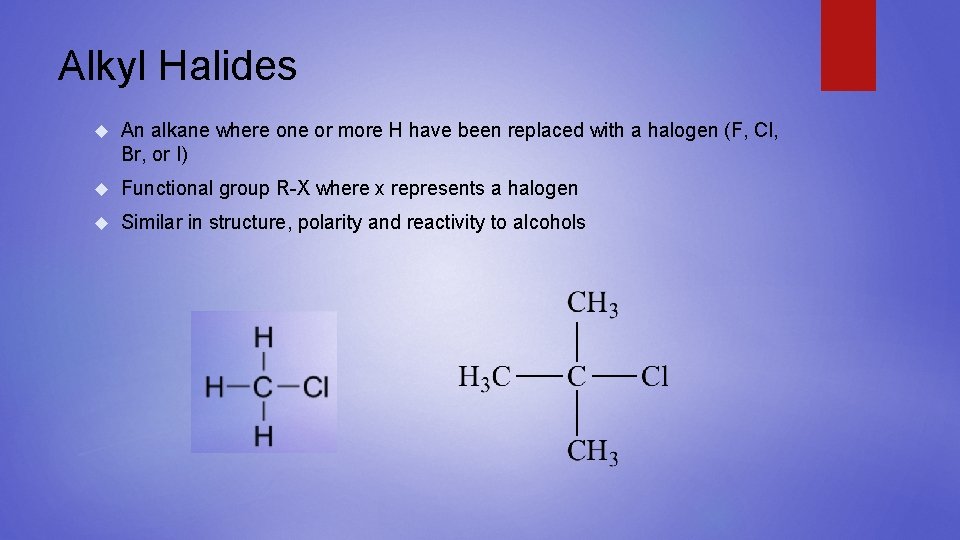
Alkyl Halides An alkane where one or more H have been replaced with a halogen (F, Cl, Br, or I) Functional group R-X where x represents a halogen Similar in structure, polarity and reactivity to alcohols
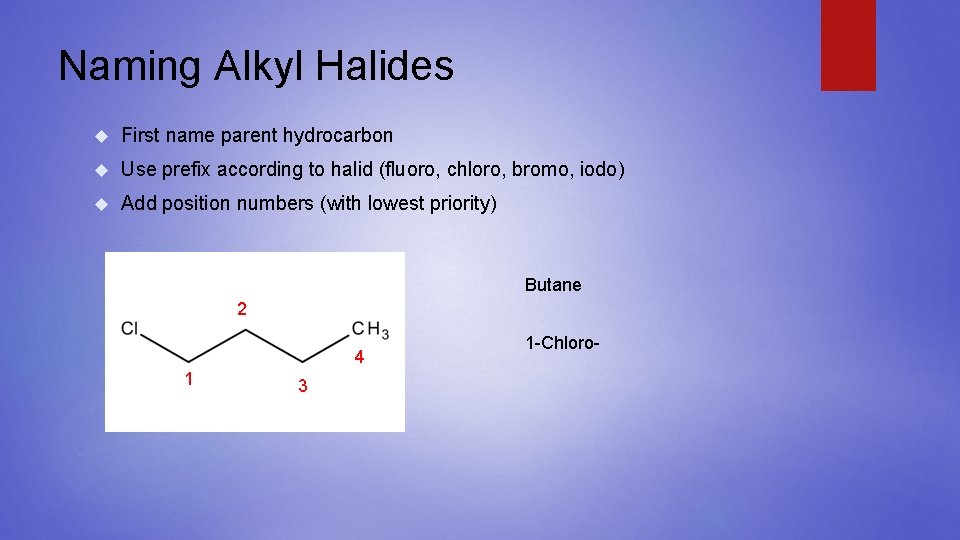
Naming Alkyl Halides First name parent hydrocarbon Use prefix according to halid (fluoro, chloro, bromo, iodo) Add position numbers (with lowest priority) Butane 2 4 1 3 1 -Chloro-
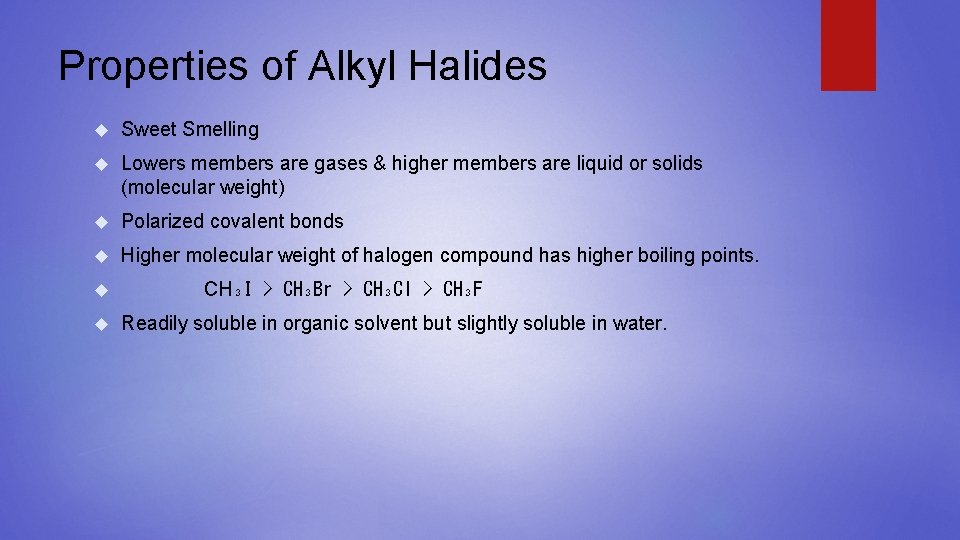
Properties of Alkyl Halides Sweet Smelling Lowers members are gases & higher members are liquid or solids (molecular weight) Polarized covalent bonds Higher molecular weight of halogen compound has higher boiling points. CH₃I > CH₃Br > CH₃Cl > CH₃F Readily soluble in organic solvent but slightly soluble in water.
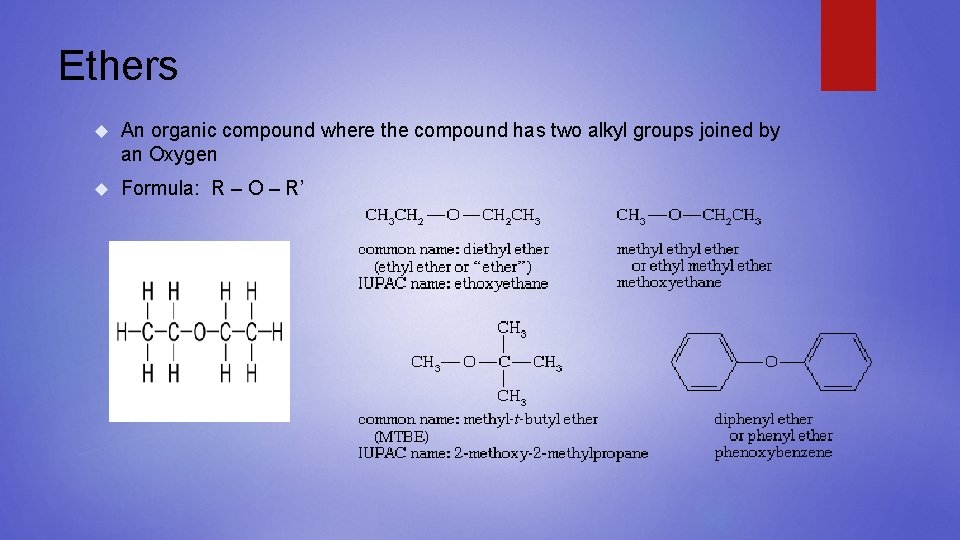
Ethers An organic compound where the compound has two alkyl groups joined by an Oxygen Formula: R – O – R’
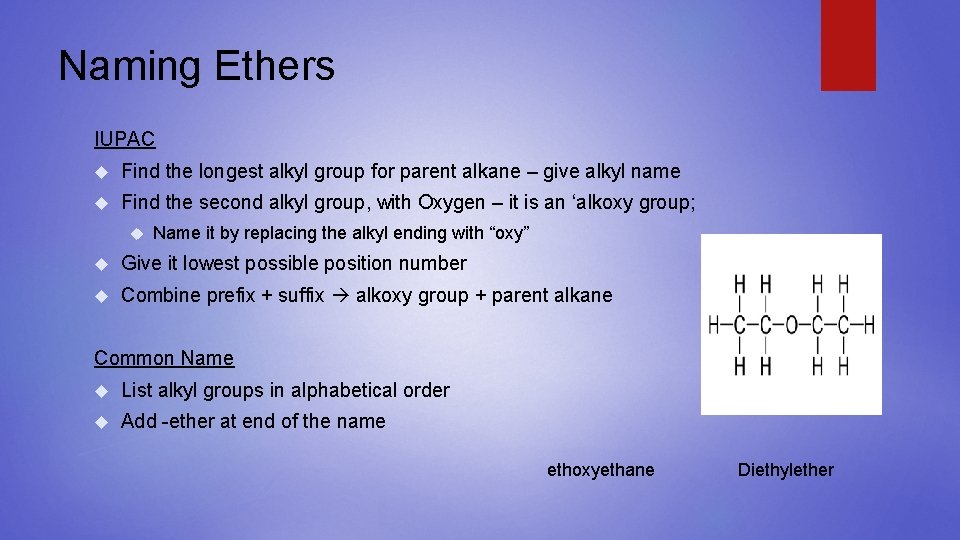
Naming Ethers IUPAC Find the longest alkyl group for parent alkane – give alkyl name Find the second alkyl group, with Oxygen – it is an ‘alkoxy group; Name it by replacing the alkyl ending with “oxy” Give it lowest possible position number Combine prefix + suffix alkoxy group + parent alkane Common Name List alkyl groups in alphabetical order Add -ether at end of the name ethoxyethane Diethylether
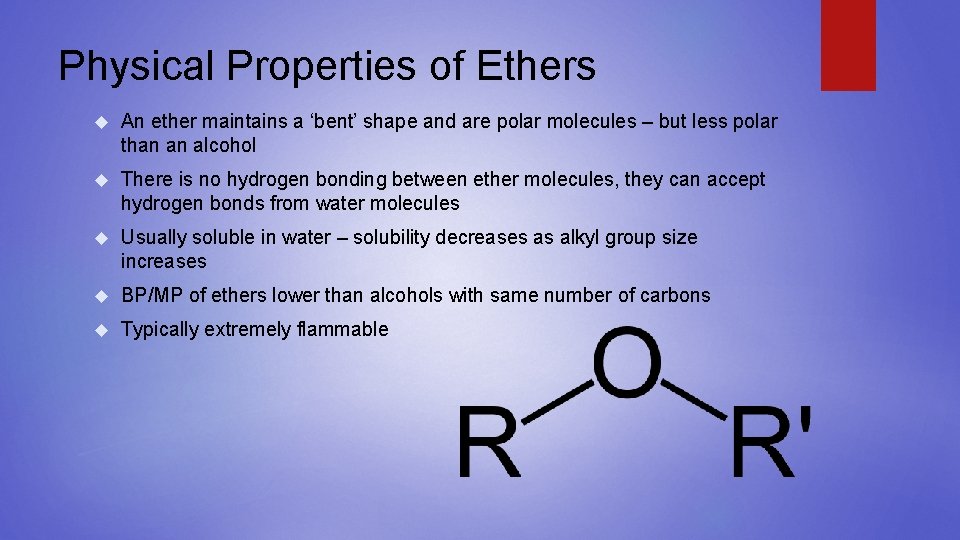
Physical Properties of Ethers An ether maintains a ‘bent’ shape and are polar molecules – but less polar than an alcohol There is no hydrogen bonding between ether molecules, they can accept hydrogen bonds from water molecules Usually soluble in water – solubility decreases as alkyl group size increases BP/MP of ethers lower than alcohols with same number of carbons Typically extremely flammable
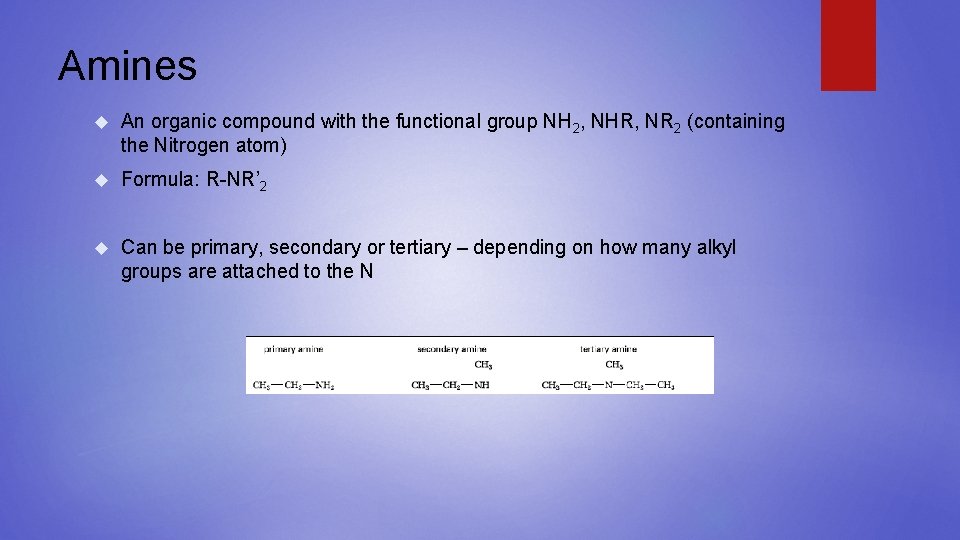
Amines An organic compound with the functional group NH 2, NHR, NR 2 (containing the Nitrogen atom) Formula: R-NR’ 2 Can be primary, secondary or tertiary – depending on how many alkyl groups are attached to the N
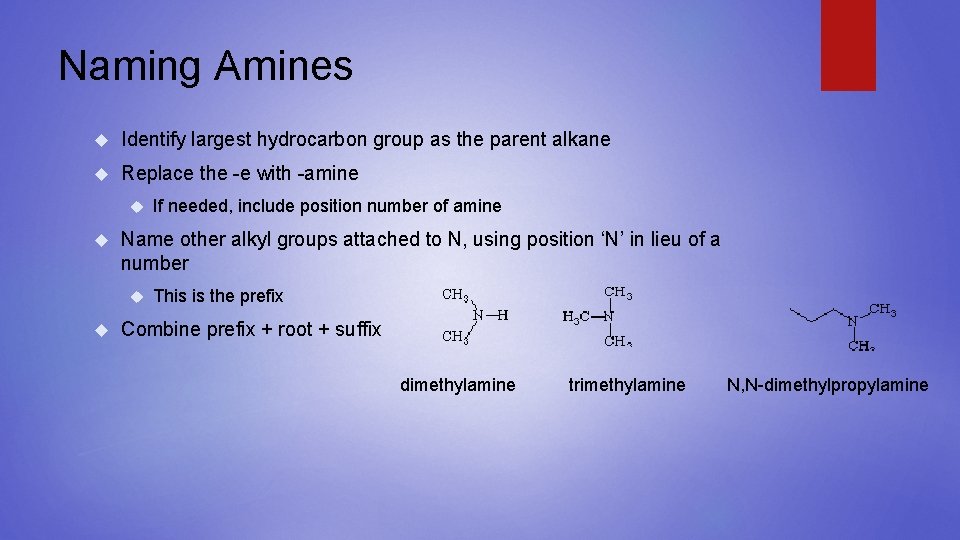
Naming Amines Identify largest hydrocarbon group as the parent alkane Replace the -e with -amine Name other alkyl groups attached to N, using position ‘N’ in lieu of a number If needed, include position number of amine This is the prefix Combine prefix + root + suffix dimethylamine trimethylamine N, N-dimethylpropylamine
Physical Properties of Amines C-N, N-H bonds are polar, amines are typical polar. Only primary and secondary amines can form H bonds If the amines has <4 Carbon atoms they are miscible with water, as the number of Carbons increases the solubility decreases MP/BP of primary + secondary amines are higher than tertiary amines (due to H bonding) Found in nature and often toxic With low molecular masses typically smell fishy / responsible for a lot of odours of decay A weak base – if added to an acid produces a salt
- Slides: 19