
Singapore Model Drawing A Problem solving graphic organizer
Singapore Model Drawing: A Problem solving graphic organizer By: Erica Martinez
Research • “A graphic organizer is an instructional too student can use to organize and structure information and concepts and to promote thinking about relationship between concepts. ” (Zollman, A. 2009) • On a study done with middle school students using a graphic organizer to solve word problems, teachers reported a dramatic improvement in students’ mathematical scores after implementing a graphic organizer to solve problems. (Zollman, A. 2009) • “Graphic organizers rely on visual/spatial reasoning skills more so than conventional teaching approaches and may be applied to the teaching of higher-level mathematics. ” (Ives, B. B. 2003) • “Graphic organizers fill a need for teaching students with strong spatial and nonverbal reasoning skills but relatively poor language skills. ” (Ives, B. B. 2003)
Research continued • Graphic organizers “can be used to facilitate instruction of complex procedures and can be used to enhance understanding of mathematics concepts. ” (Ives, B. B. 2003) • “Reading mathematics is complex because of the mixture of words, numerals, letters, symbols and graphics that require the reader to shift from one type of vocabulary to another” (Braselton, S. & Decker, B. C 1994) • “One strategy that is effective in improving content area reading comprehension is the use of graphic organizers” (Braselton, S. & Decker, B. C 1994)
Description of Participants and Setting • • Classroom: 3 rd grade bilingual Topic: Math Problem Solving Time: During Math block 9: 35 -11: 05 Gender: 10 girls and 6 boys
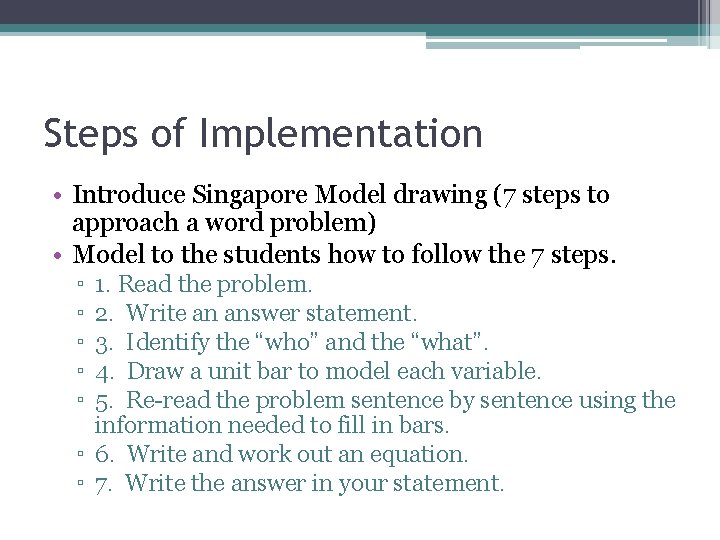
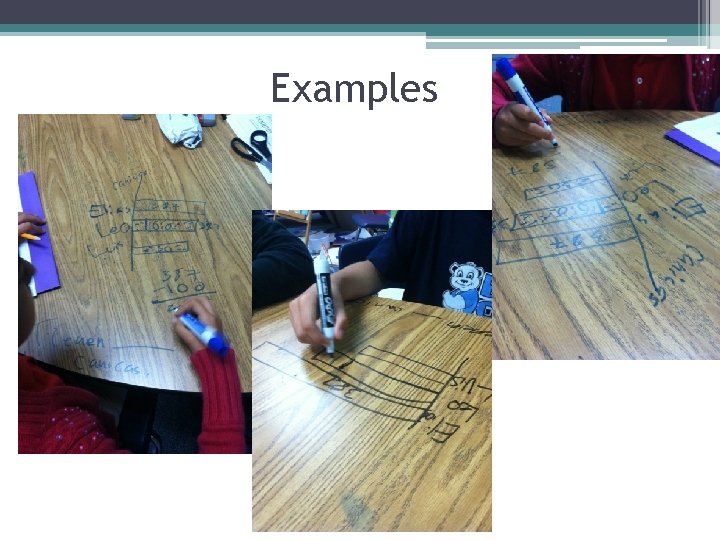
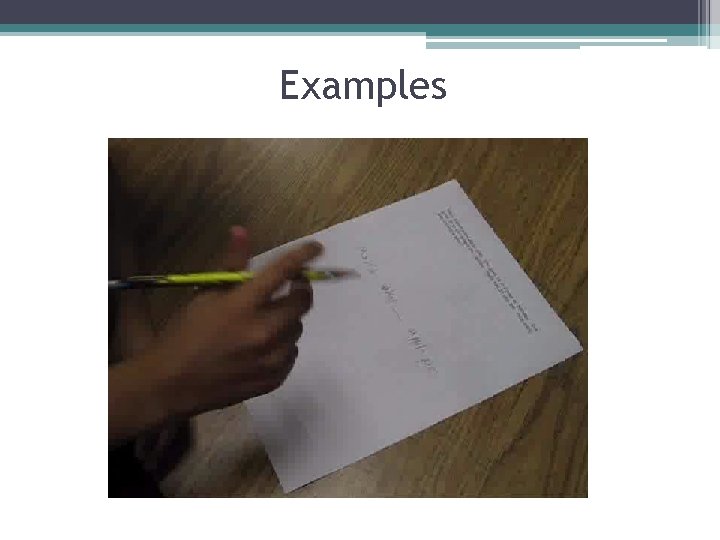
Steps of Implementation • Introduce Singapore Model drawing (7 steps to approach a word problem) • Model to the students how to follow the 7 steps. ▫ ▫ ▫ 1. Read the problem. 2. Write an answer statement. 3. Identify the “who” and the “what”. 4. Draw a unit bar to model each variable. 5. Re-read the problem sentence by sentence using the information needed to fill in bars. ▫ 6. Write and work out an equation. ▫ 7. Write the answer in your statement.
Steps of Implementation Continued • Work out various word problems: Modeled, Guided and Independent. • After going over the modeled and guided problems students go to rotations where they will practice model drawing in three rotations: 1) Seat work 2) Computer: www. thinkingblocks. com and 3) Small group with the teacher • Practice the strategy with the students everyday and allow them opportunities to practice the strategy on their own.
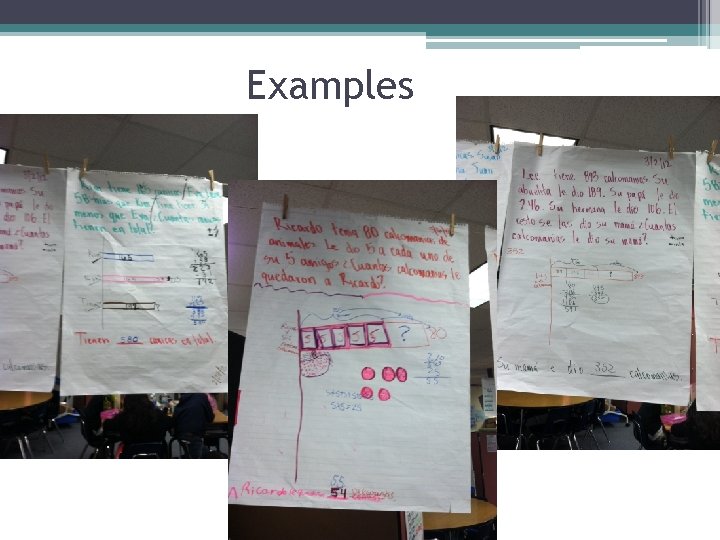
Examples
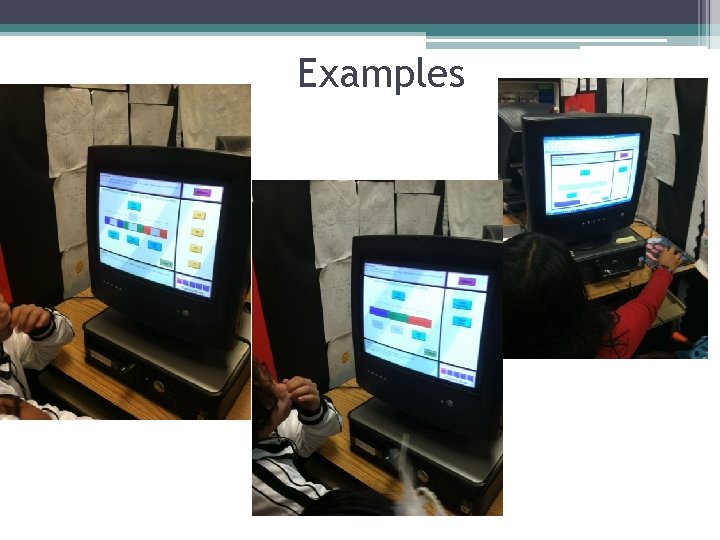
Examples
Examples
Examples
Assessment Tool • Since Model Drawing has been a school wide expectation from the beginning of the year, I gave my students 2 tests. On the first test they were instructed to solve all the problems, on the second test they were instructed to use the model drawing strategy.
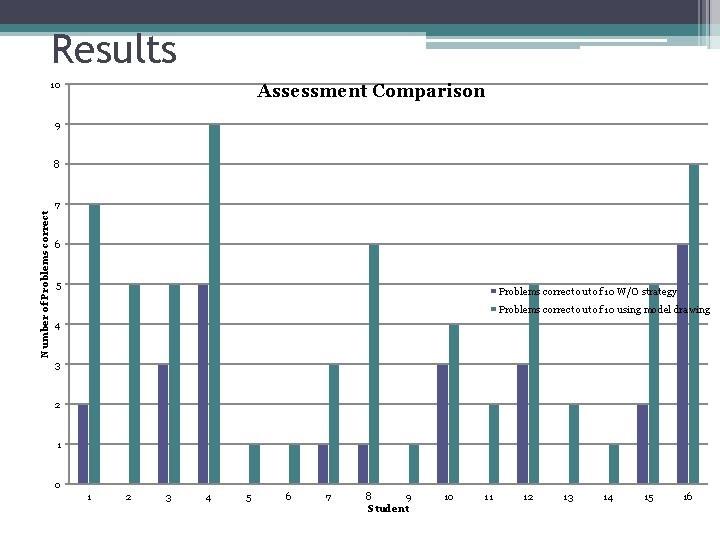
Results 10 Assessment Comparison 9 8 Number of Problems correct 7 6 5 Problems correct out of 10 W/O strategy Problems correct out of 10 using model drawing 4 3 2 1 0 1 2 3 4 5 6 7 8 9 Student 10 11 12 13 14 15 16
Student comments: How does model drawing help you? • “It helps me separate the problem and makes it easier. ” – Ida • “It helps me remember the numbers and the important information” – Elias • “Helps me solve the problem faster” – Luis • “We get the answer easier” – Laidy • “It’s a strategy to help us more” - Ashley

In the future…
References • Zollman, A. (2009). Students Use Graphic Organizers to Improve Mathematical Problem-Solving Communications. Middle School Journal, 41(2), 4 -12. • Coleman, J. (2010). Elementary Teachers' Instructional Practices Involving Graphical Representations. Journal Of Visual Literacy, 29(2), 198 -222. • What Works Clearinghouse, (. (2009). Singapore Math. What Works Clearinghouse • Ives, B. B. , & Hoy, C. C. (2003). Graphic Organizers Applied to Higher– Level Secondary Mathematics. Learning Disabilities Research & Practice (Blackwell Publishing Limited), 18(1), 36 -51. • Braselton, S. , & Decker, B. C. (1994). Using Graphic Organizers to Improve the Reading of Mathematics. Reading Teacher, 48(3), 276 -81
- Slides: 15