
Sinead Boyce MSc CNS Cognitive Behavioural Psychotherapist Mental
Sinead Boyce MSc, CNS Cognitive Behavioural Psychotherapist
“Mental health is a state of well-being in which an individual realizes his or her own abilities, can cope with the normal stresses of life, can work productively and is able to make a contribution to his or her community” (WHO, 2010).
“Emotional well-being is not the absence of emotions, but it is your ability to understand the value of your emotions and use them to move your life forward in positive directions” (Colby, 2010). “Everyday emotional well-being also involves identifying, building upon, and operating from your strengths rather than focusing on fixing problems or weaknesses. The better you are able to master your emotions, the greater your capacity to enjoy life, cope with stress, and focus on important personal priorities” (Colby, 2010).
Psychological resistance to change Resistance to change is the action taken by individuals when they perceive that change is a threat. Changing or Adapting? We change circumstances whenever possible, but adapt whenever necessary.
Resistance to change Psychological resistance to insulin (Gherman et al, 2011) Anxiety - Fear Self esteem Non Compliance Risky Behaviours
There does appear to be a link between diabetes and the incidence of depression, however, what the link is has not been fully proved as yet. In recent years, the two conditions do seem to be more common together, but it should be remembered that diabetes is not the only chronic condition where depression occurs. Psychological Resistance Anxiety, Self Esteem, Obsessive traits
The lifetime prevalence for depression is 17. 1 percent (Kelly et al 2009) These rates increase with comorbid medical illness and the acuity of illness. The prevalence of depression in adult patients with type 1 and type 2 diabetes suggest that the presence of diabetes almost doubles the risk of comorbid depression. 20% more likely to experience anxiety NICE (2009) 90% of psychological adaptive disorders treated in primary care Anderson et al 2001& Ali et al 2006 Diabetic Medicine
Wakefield et al (2007) who argue that up to 25% of people diagnosed with depression may in actual fact be experiencing normal sadness in the context of their experience e. g diagnoses of diabetes. Therefore it is not surprising that by 2020 depression will be the second leading cause of disease burden (World Health Organisation (WHO), 2010).
When people in society are exposed to advertisements, media attention and news stories regarding depressive symptoms they can confuse depression with normal sadness and monitor themselves for such symptoms and therefore reframe their own experiences of sadness as signs of mental disorder and in turn seek professional help for their experiences.
Many people will find that the diagnosis of diabetes has a profound effect on their feelings. This may cause many emotions to surface including: v anger v denial v guilt v frustration v loneliness v sadness v depression v confusion (diabetes. co. uk)
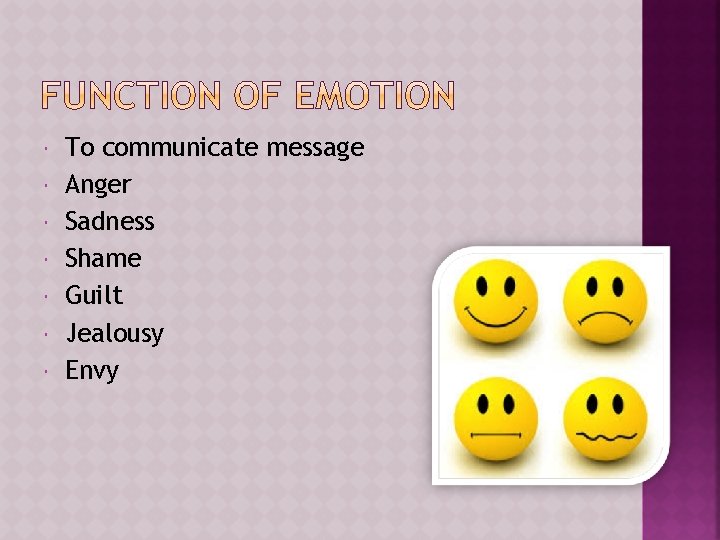
To communicate message Anger Sadness Shame Guilt Jealousy Envy
Stress results when something causes your body to behave as if it were under attack. Stress is a physical and mental reaction to perceived danger. Conditions that seem uncontrollable or require emotional and behavioural change tend to be perceived as a threat Whether threat is perceived or imagined body prepares for survival 50% perceived stressors
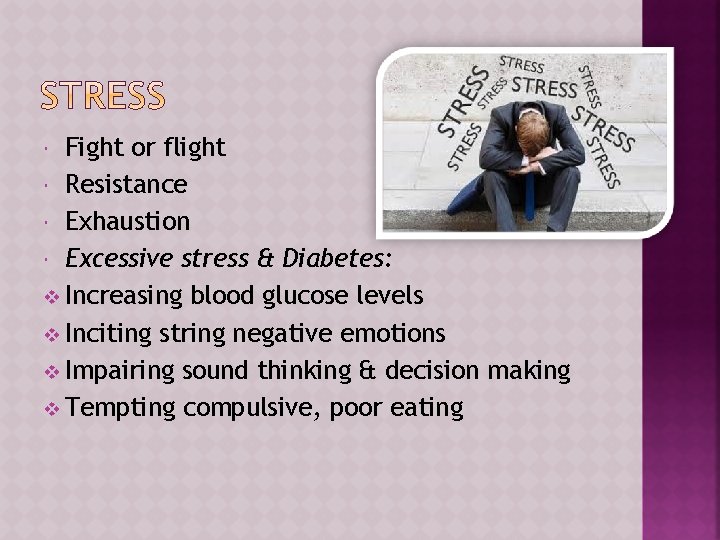
Fight or flight Resistance Exhaustion Excessive stress & Diabetes: v Increasing blood glucose levels v Inciting string negative emotions v Impairing sound thinking & decision making v Tempting compulsive, poor eating
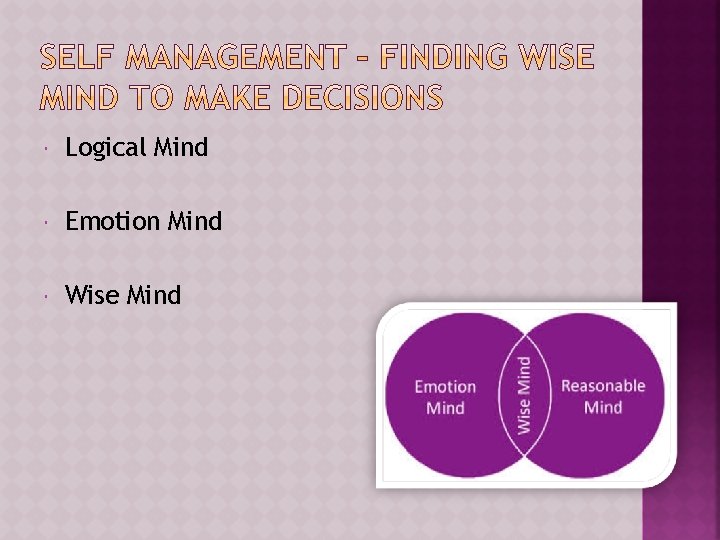
Logical Mind Emotion Mind Wise Mind
Mindful living – An antidote to stress Being aware of what is happening within yourself and in the world around you. It is being aware what you are doing and why, being aware of what is working and what is not working for you A mindful approach to coping opens the way to using a variety of tools to preventing avoidable stress & managing unavoidable stress or change
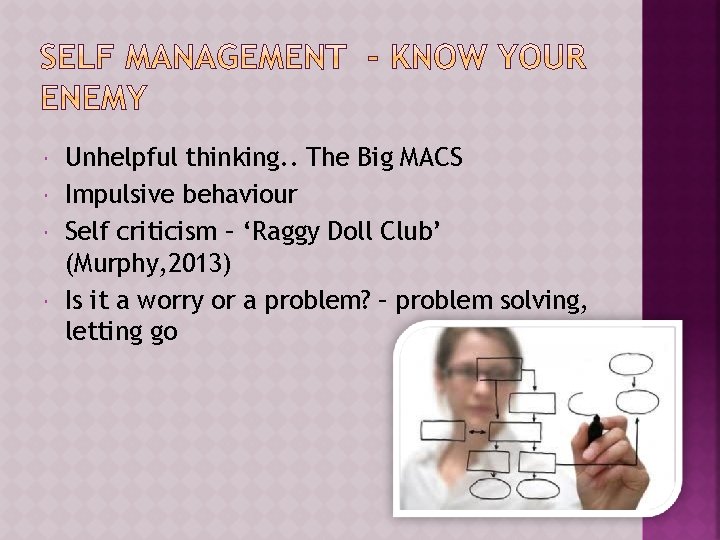
Unhelpful thinking. . The Big MACS Impulsive behaviour Self criticism – ‘Raggy Doll Club’ (Murphy, 2013) Is it a worry or a problem? – problem solving, letting go

What are the chances. . ? What is the worst thing. . . ? Am I right to think that. . . ? The 5 year rule What is it worth?

v. You don’t have the skills for acceptance; you do not know how to accept painful events and facts. v You believe that if you accept you are making light of or are approving of the facts v. You believe that if you accept a painful event nothing will be done to change or prevent future painful events. v Emotions get in the way (unbearable sadness; anger at the person or illness that caused the painful event; rage at the injustice of the world; voverwhelming shame about who you are; guilt about your own behaviour).
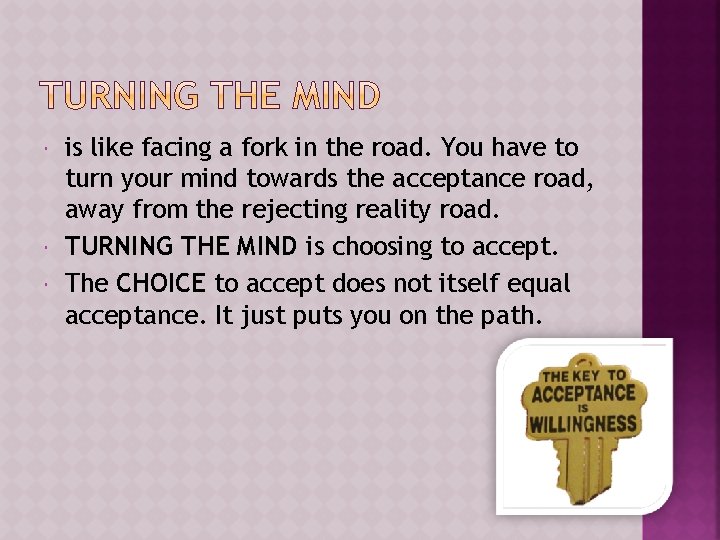
is like facing a fork in the road. You have to turn your mind towards the acceptance road, away from the rejecting reality road. TURNING THE MIND is choosing to accept. The CHOICE to accept does not itself equal acceptance. It just puts you on the path.
STEP-BY-STEP OBSERVE that you are not accepting. (Look for anger, bitterness, annoyance, avoiding emotions, saying “Why Me” “Why is this happening”, “I can’t stand this, ” “it shouldn’t be this way”) Go within yourself and MAKE AN INNER COMMITMENT to accept reality as it is. DO IT AGAIN, over and over. Keep turning your mind to acceptance each time you come to the fork in the road where can reject reality or accept it. DEVELOP A PLAN for catching yourself in the future when you drift out of acceptance.
If we consider that life is like a game of cards. It makes no difference to a skilled card player what cards they get. The object is to play whatever hand they get AS WELL AS POSSIBLE (willingness). As soon as one hand is played another hand is dealt. The last game is over and the current hand is on. For the skilled player the goal now is to be MINDFUL of the current hand play it AS WELL AS POSSIBLE, and then LET GO and then TURN THE MIND to the next hand of cards. If a player judges themselves on the last hand can’t take their mind off of it (wilfulness), then their ability to fully concentrate on the next hand is compromised and they struggle more in playing the game. Our goal on this programme is to learn to play the cards we are dealt with in life as best we can!
1. Normalise the persons emotional distress in the context of their life experiences for example diabetes (normalise is not the same as doing nothing). 2. Don’t medicalise or pathologise their emotional distress i. e. don’t see their emotional distress in terms of symptoms only, view it in terms of what the individual is attempting to communicate to you through their emotions.
3. Have a list of mental health organisations both voluntary and statutory that may be useful to the person i. e. low cost counselling, supports groups, psychoeducation, diabetes support groups, etc 4. Cognitive behaviour therapy, interpersonal therapy, supportive counselling, ACT therapy. 5. Pharmacological intervention.
Stop Be mindful Check the facts. . ask? Unhelpful thinking styles/thoughts, beliefs about diagnosis Validate the valid Accumulate positive emotion Stress management Pros and cons – choice Acceptance
Suppose you are taking a hike in the mountains. You know how mountain trails are constructed, especially if the slopes are steep. They wind back up and forth; often they have “switchbacks”, which make you literally walk back and forth, and sometimes a trail will even drop back to below a level you had reached earlier. If I asked you a number of points on such a trail to evaluate how well you are accomplishing your goal of reaching the mountaintop, I would hear a different story every time. If you were in switchback mode, you would probably tell me that things weren’t going well, that you were never going to reach the top. If you were in a stretch of open territory where you could see the mountaintop and the path leading up to it, you would probably tell me things were going very well. Now imagine that we are across the valley with binoculars, looking at people hiking on this trail. If we were asked how they were doing, we would have a positive progress report every time. We would be able to see that the overall direction of the trail, not what it looks like at a given moment, is the key to progress. We would see that following this crazy, winding trail is exactly what leads to the top. (Steven Hayes et al 2003)

Department of Health (2001) Primary Care: A New Direction, Quality and Fairness, A Health System for You, Stationery Office, Dublin. Dialectical Behaviour Therapy for Borderline personality Disorder Government of Ireland (1998) Report of the Commission on Nursing - Blueprint for the Future. Stationery Office, Dublin. Hlahane MS. , Greeff, M. and Plessis, E. (2006) Professional nurses perceptions of the skills required to render comprehensive primary health care services. Curationis 29 (4): 82 -94. Mc. Cann, T. V. and Baker, H. (2003) Models of mental health nurse-general practitioner liaison: promoting continuity of care. Journal of Advanced Nursing 41 (5): 471 -479. Linehan, M. Dialectical Behaviour Therapy for Borderline personality Disorder. (2002), Guilford. National Council for the Professional Development of Nursing and Midwifery (2001) Clinical Nurse/Midwife Specialists - Intermediate Pathway. National Council for the Professional Development of Nursing and Midwifery, Dublin.
National Council for the Professional Development of Nursing and Midwifery (2004) Clinical Nurse/Midwife Specialists - Intermediate Pathway. National Council for the Professional Development of Nursing and Midwifery, Dublin. Secker, J. , Pidd. , F and Parham, A. (1999) Mental health training needs of primary health care nurses. Journal of Clinical Nursing 8 (6): 643 -652. Southern, L. , Leahey, M. , Harper, J. S. , Mc. Gonigal, K. and Syverson, A. (2007). Integrating mental health into urgent care in a community health centre. Candian Nurse 103 (1): 29 -34.
National Council for the Professional Development of Nursing and Midwifery (2001) Clinical Nurse/Midwife Specialists Intermediate Pathway. National Council for the Professional Development of Nursing and Midwifery, Dublin. National Council for the Professional Development of Nursing and Midwifery (2004) Clinical Nurse/Midwife Specialists Intermediate Pathway. National Council for the Professional Development of Nursing and Midwifery, Dublin. Secker, J. , Pidd. , F and Parham, A. (1999) Mental health training needs of primary health care nurses. Journal of Clinical Nursing 8 (6): 643 -652. Southern, L. , Leahey, M. , Harper, J. S. , Mc. Gonigal, K. and Syverson, A. (2007). Integrating mental health into urgent care in a community health centre. Candian Nurse 103 (1): 29 -34.
Gelder, M. , Gath, D. & Mayou, R. (1993). Oxford Textbook of Psychiatry Oxford: Oxford medical Publications Muir-Cochrane, E. (2003) The person Who Experiences Anxiety In Barker, P. (ed) Psychiatric and Mental Health Nursing. The Craft of Caring. London: Arnold. Stuart, G. & Laraia, M. (1998) Principles and Practice of Psychiatric Nursing 6 th Ed. St. Louis: Mosby Wells, A. (2007) Cognitive Therapy of Anxiety Disorders NY: John Wiley & Sons.
- Slides: 30