
Simultaneous Localization and Map Building System for Prototype
Simultaneous Localization and Map Building System for Prototype Mars Rover CECS 398 Capstone Design I October 24, 2001
Project Mentors: Dr. Jeffrey Uhlmann Dr. Marjorie Skubic Project Members: Karen Casey Kenneth Estes Laura Heffernan
Overview n Problem Definition Background n Goals and Objectives n
Overview n Requirements Analysis System Components n Constraints n Requirements n Alternative Approaches n Testing Methods n Scheduling n
Background Covariance Intersection Research and Development n Naval n Decentralized data fusion problems n Dynamic map building and localization n NASA n Research Laboratory Mars Rover Onboard data fusion system n Simultaneous Localization and Map Building System (SLAM)
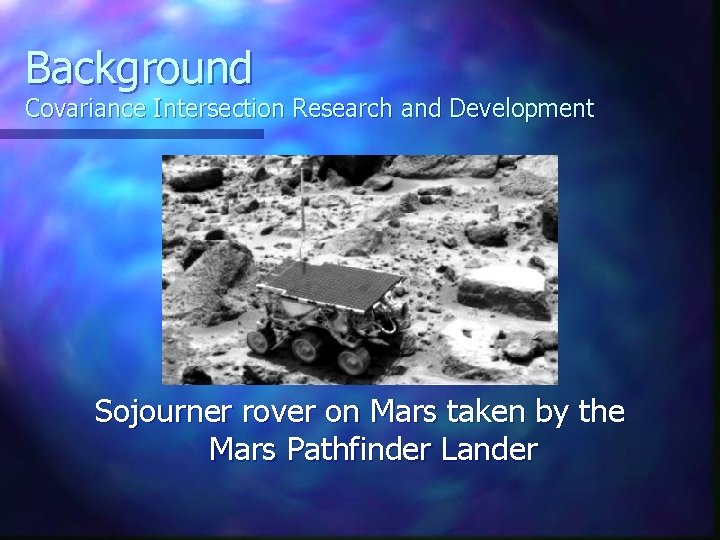
Background Covariance Intersection Research and Development Sojourner rover on Mars taken by the Mars Pathfinder Lander

Background Covariance Intersection Research and Development What is data fusion? n Demands a method of combining information from multiple sources Covariance Intersection (CI) consistently provides a conservatively fused estimate of the input.
Background Kalman Filter vs. CI Filter Kalman Filter Represents information about estimated or measured quantities in terms of a mean and a covariance matrix n Can combine estimates with a known n degree of independence
Background Kalman Filter vs. CI Filter Does not make any assumptions about the degree of independence between information it fuses n Exhibits considerably more stable behavior than Kalman filters n
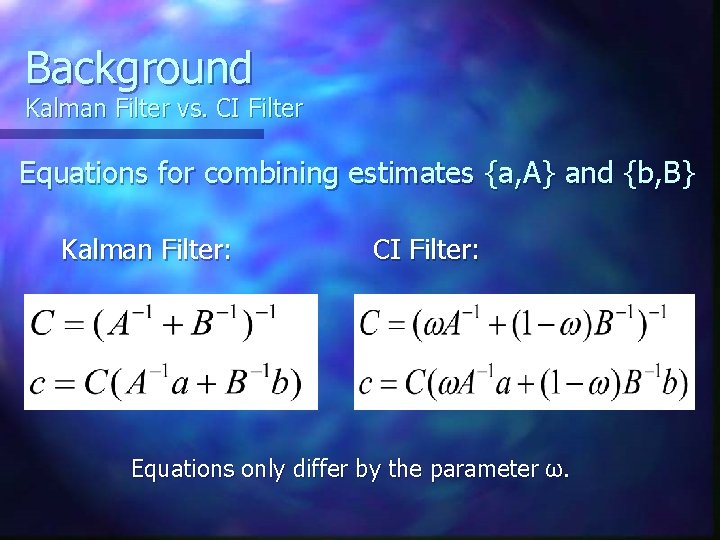
Background Kalman Filter vs. CI Filter Equations for combining estimates {a, A} and {b, B} Kalman Filter: CI Filter: Equations only differ by the parameter ω.
Background Kalman Filter vs. CI Filter Principle advantage of CI: n Permits filtering and data fusion without the need to know the degree of correlation between the estimates being fused Applications include simultaneous map building and localization for autonomous vehicles.
Goals n To prove that CI is a reliable solution to the SLAM problem n Use a test robot to identify predefined beacons n Given the information gathered, use CI to create a simultaneous and localization map
Objectives Research and obtain a robot that will be able to move in two dimensions. We will also need to be able to get speed information from the robot in order to dependably update our map. n Construct a small controlled test bed environment with identifiable beacons. n
Objectives n n n Develop software that will take the image and extract the relative beacon position we will need in order to build a map. Develop software that will control the robot's movements and navigate it around its environment so it can map the beacons in the test bed. Use Covariance Intersection to estimate the beacon locations so that the relative map can be updated.
System Components n Palm Pilot Robot n Handspring Visor Prism n Eyemodule 2 camera n CI software
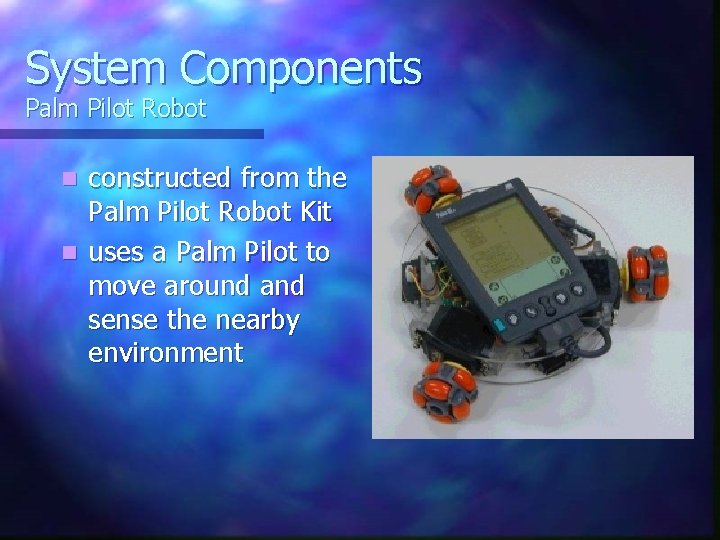
System Components Palm Pilot Robot constructed from the Palm Pilot Robot Kit n uses a Palm Pilot to move around and sense the nearby environment n
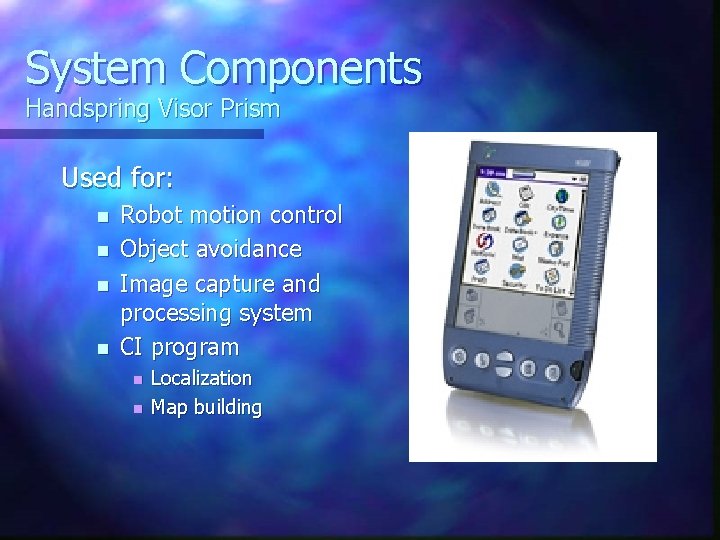
System Components Handspring Visor Prism Used for: n n Robot motion control Object avoidance Image capture and processing system CI program n n Localization Map building
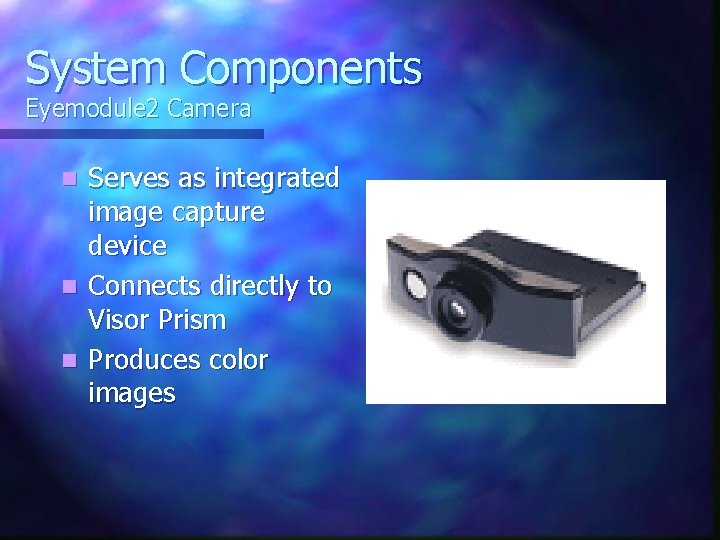
System Components Eyemodule 2 Camera Serves as integrated image capture device n Connects directly to Visor Prism n Produces color images n
System Components CI Software Modular program will include: Robot movement and motor control n Image processing n Coordinate triangulation n Covariance matrix calculations n
Constraints n Vision n system Environment Beacon size and height n Walls and floor n n Color recognition n Hardware interface connections n Maintenance
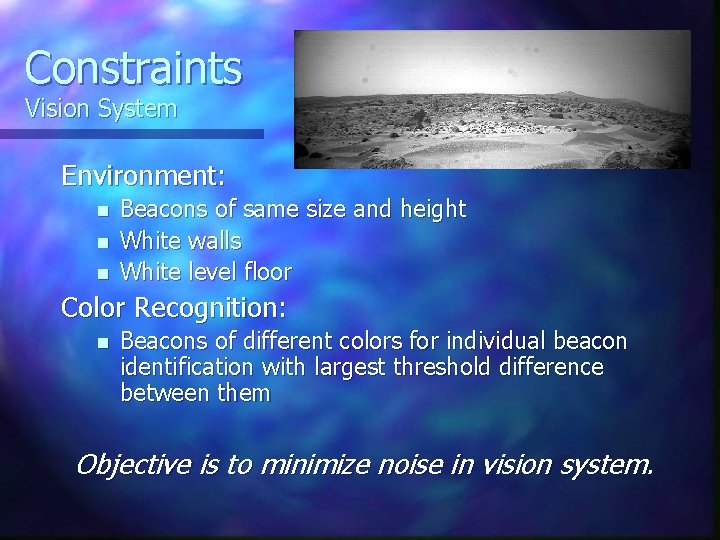
Constraints Vision System Environment: n n n Beacons of same size and height White walls White level floor Color Recognition: n Beacons of different colors for individual beacon identification with largest threshold difference between them Objective is to minimize noise in vision system.
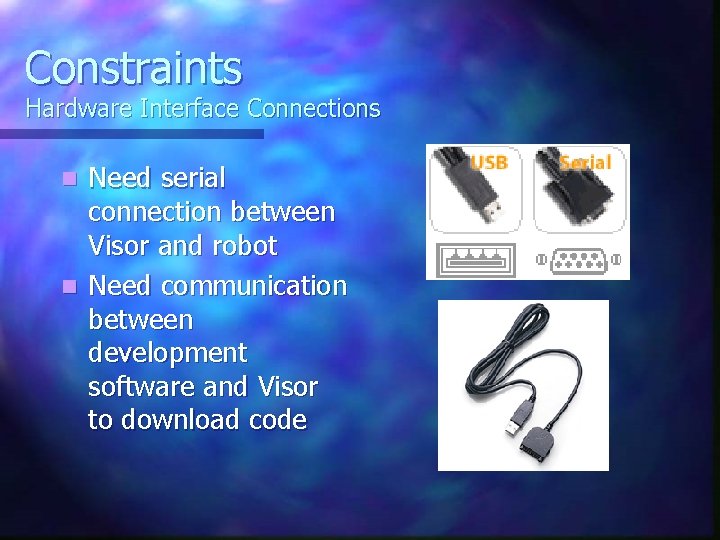
Constraints Hardware Interface Connections Need serial connection between Visor and robot n Need communication between development software and Visor to download code n
Constraints Maintenance Minimal maintenance: Connections and wiring n C program for Palm OS n OS version n Visor model n Camera model n n NASA testing and modifications
Requirements n Cost n Requirements Time: Research the hardware/software components n Implement the robot and software. n Meet with project mentors. n n Resources: n Mentors will serve as our basic reference tool for background and implementation information.
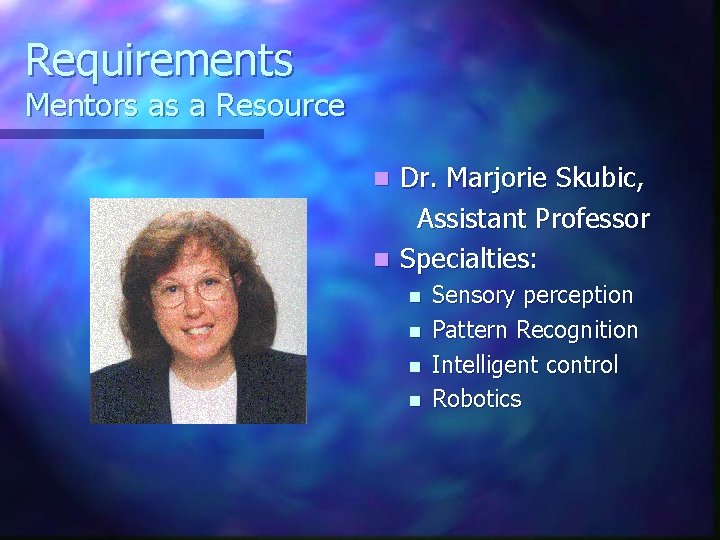
Requirements Mentors as a Resource Dr. Marjorie Skubic, Assistant Professor n Specialties: n n n Sensory perception Pattern Recognition Intelligent control Robotics
Requirements Mentors as a Resource Dr. Jeffery Uhlmann, Assistant Professor n Specialties: n n n Kalman Filtering Statistical Algorithms Autonomous Vehicles and Robotics Large Scale Simulation
Requirements n Cost Requirements n Resources: Reference books (Code. Warrior) n Visor developer support for code to access the structure that contains pixel information. n Covariance Intersection software libraries n n Facilities: n EBW Lab 222 with Artemis.
Requirements n Cost n Requirements Money: Purchase serial connection converter to handle communication needs between the robot and Visor. n Materials for the testing environment. n n Performance n Requirements No required time limit for system response.
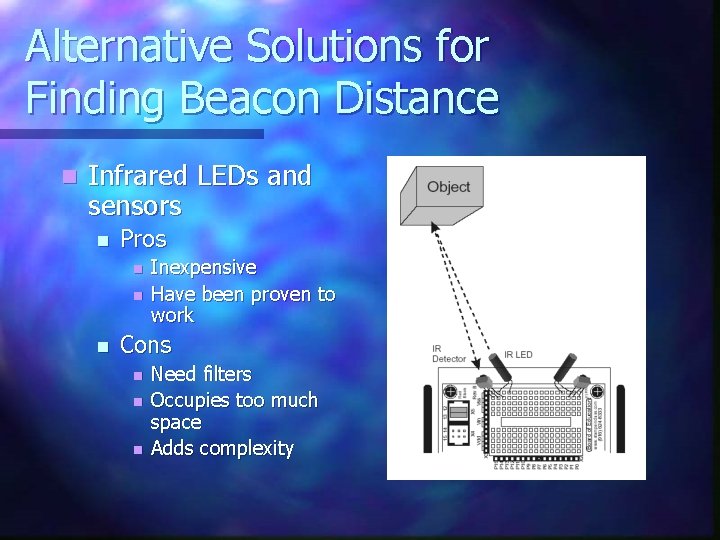
Alternative Solutions for Finding Beacon Distance n Infrared LEDs and sensors n Pros n n n Inexpensive Have been proven to work Cons n n n Need filters Occupies too much space Adds complexity
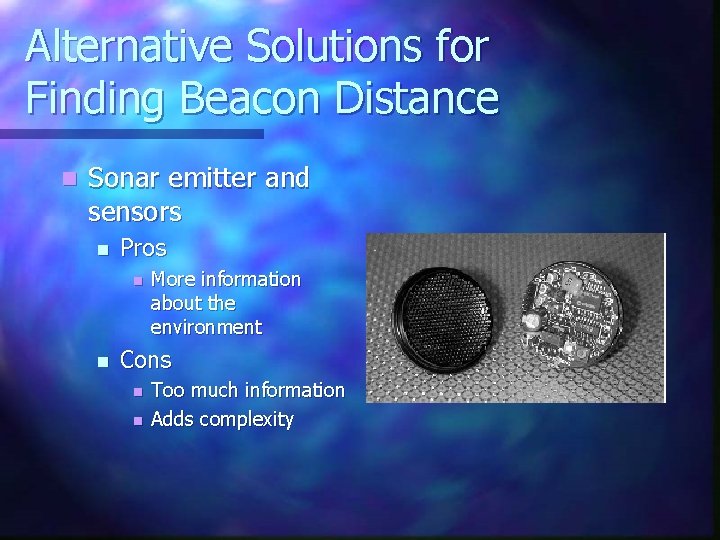
Alternative Solutions for Finding Beacon Distance n Sonar emitter and sensors n Pros n n More information about the environment Cons n n Too much information Adds complexity
Testing Navigation and Control n Test limitations of robot control n Successful if the robot is able to move about the environment and move within visual range of the beacons for identification
Testing Identification of Beacons n Test the ability of our software to distinguish between the background a beacon n Need to be able to identify the size of the beacon and the position of the center of the beacon
Testing Identification of Beacons n Use trial and error to create a hash table associating the size of the beacon to the distance to the beacon n Successful if the software can identify beacons, determine the distance to the beacons, and reduce the information to a specific XYZ coordinate for a beacon
Testing CI Solution n Hardware is being used in order to test our CI solution n Successful when the robot is able to identify beacons and move around while maintaining an acceptably accurate map
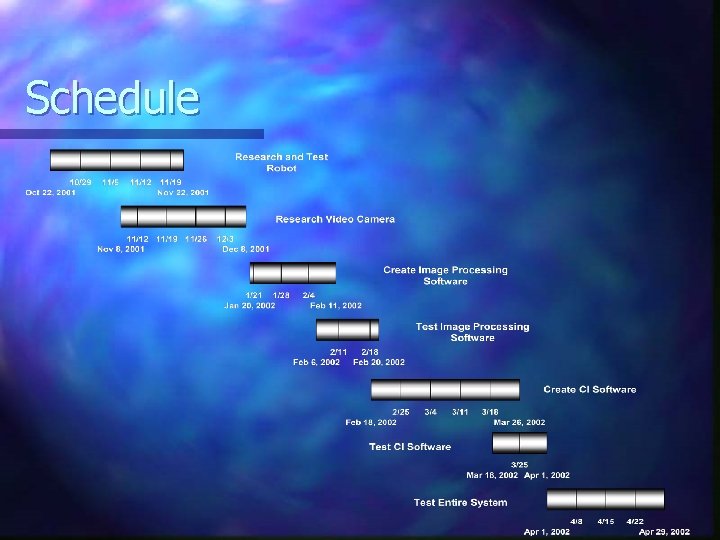
Schedule
Conclusion n Further refine scope of the project n Familiarize ourselves with the operation of the system components n Design the algorithm for image processing n Continue research into CI
- Slides: 36