
Simultaneous Liposomal Encapsulation of FOLFIRINOX Chemotherapy Regimen M
- Slides: 1
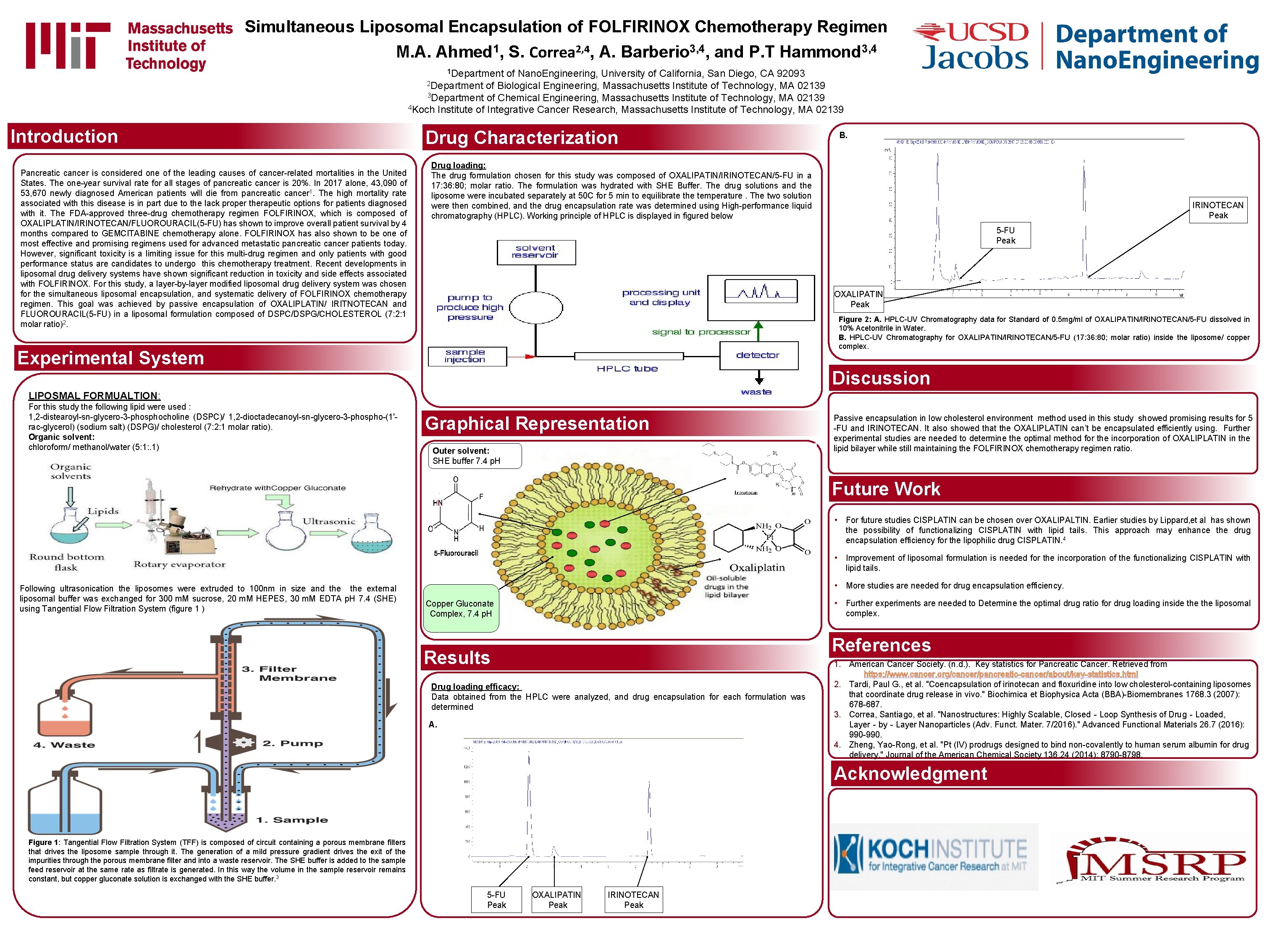
Simultaneous Liposomal Encapsulation of FOLFIRINOX Chemotherapy Regimen M. A. Ahmed 1, S. Correa 2, 4, A. Barberio 3, 4, and P. T Hammond 3, 4 1 Department of Nano. Engineering, University of California, San Diego, CA 92093 2 Department of Biological Engineering, Massachusetts Institute of Technology, MA 02139 3 Department of Chemical Engineering, Massachusetts Institute of Technology, MA 02139 4 Koch Institute of Integrative Cancer Research, Massachusetts Institute of Technology, MA 02139 Introduction Drug Characterization Pancreatic cancer is considered one of the leading causes of cancer-related mortalities in the United States. The one-year survival rate for all stages of pancreatic cancer is 20%. In 2017 alone, 43, 090 of 53, 670 newly diagnosed American patients will die from pancreatic cancer 1. The high mortality rate associated with this disease is in part due to the lack proper therapeutic options for patients diagnosed with it. The FDA-approved three-drug chemotherapy regimen FOLFIRINOX, which is composed of OXALIPLATIN/IRINOTECAN/FLUOROURACIL(5 -FU) has shown to improve overall patient survival by 4 months compared to GEMCITABINE chemotherapy alone. FOLFIRINOX has also shown to be one of most effective and promising regimens used for advanced metastatic pancreatic cancer patients today. However, significant toxicity is a limiting issue for this multi-drug regimen and only patients with good performance status are candidates to undergo this chemotherapy treatment. Recent developments in liposomal drug delivery systems have shown significant reduction in toxicity and side effects associated with FOLFIRINOX. For this study, a layer-by-layer modified liposomal drug delivery system was chosen for the simultaneous liposomal encapsulation, and systematic delivery of FOLFIRINOX chemotherapy regimen. This goal was achieved by passive encapsulation of OXALIPLATIN/ IRITNOTECAN and FLUOROURACIL(5 -FU) in a liposomal formulation composed of DSPC/DSPG/CHOLESTEROL (7: 2: 1 molar ratio)2. Drug loading: The drug formulation chosen for this study was composed of OXALIPATIN/IRINOTECAN/5 -FU in a 17: 36: 80; molar ratio. The formulation was hydrated with SHE Buffer. The drug solutions and the liposome were incubated separately at 50 C for 5 min to equilibrate the temperature. The two solution were then combined, and the drug encapsulation rate was determined using High-performance liquid chromatography (HPLC). Working principle of HPLC is displayed in figured below IRINOTECAN Peak 5 -FU Peak OXALIPATIN Peak Figure 2: A. HPLC-UV Chromatography data for Standard of 0. 5 mg/ml of OXALIPATIN/IRINOTECAN/5 -FU dissolved in 10% Acetonitrile in Water. B. HPLC-UV Chromatography for OXALIPATIN/IRINOTECAN/5 -FU (17: 36: 80; molar ratio) inside the liposome/ copper complex. Experimental System LIPOSMAL FORMUALTION: B. Discussion 4 For this study the following lipid were used : 1, 2 -distearoyl-sn-glycero-3 -phosphocholine (DSPC)/ 1, 2 -dioctadecanoyl-sn-glycero-3 -phospho-(1'rac-glycerol) (sodium salt) (DSPG)/ cholesterol (7: 2: 1 molar ratio). Organic solvent: chloroform/ methanol/water (5: 1: . 1) 1 Graphical Representation Outer solvent: SHE buffer 7. 4 p. H Passive encapsulation in low cholesterol environment method used in this study showed promising results for 5 -FU and IRINOTECAN. It also showed that the OXALIPLATIN can’t be encapsulated efficiently using. Further experimental studies are needed to determine the optimal method for the incorporation of OXALIPLATIN in the lipid bilayer while still maintaining the FOLFIRINOX chemotherapy regimen ratio. Future Work • For future studies CISPLATIN can be chosen over OXALIPALTIN. Earlier studies by Lippard, et al has shown the possibility of functionalizing CISPLATIN with lipid tails. This approach may enhance the drug encapsulation efficiency for the lipophilic drug CISPLATIN. 4 • Improvement of liposomal formulation is needed for the incorporation of the functionalizing CISPLATIN with lipid tails. Following ultrasonication the liposomes were extruded to 100 nm in size and the external liposomal buffer was exchanged for 300 m. M sucrose, 20 m. M HEPES, 30 m. M EDTA p. H 7. 4 (SHE) using Tangential Flow Filtration System (figure 1 ) • More studies are needed for drug encapsulation efficiency. • Further experiments are needed to Determine the optimal drug ratio for drug loading inside the liposomal complex. Copper Gluconate Complex, 7. 4 p. H References Results Drug loading efficacy: Data obtained from the HPLC were analyzed, and drug encapsulation for each formulation was determined A. 1. American Cancer Society. (n. d. ). Key statistics for Pancreatic Cancer. Retrieved from https: //www. cancer. org/cancer/pancreatic-cancer/about/key-statistics. html 2. Tardi, Paul G. , et al. "Coencapsulation of irinotecan and floxuridine into low cholesterol-containing liposomes that coordinate drug release in vivo. " Biochimica et Biophysica Acta (BBA)-Biomembranes 1768. 3 (2007): 678 -687. 3. Correa, Santiago, et al. "Nanostructures: Highly Scalable, Closed‐Loop Synthesis of Drug‐Loaded, Layer‐by‐Layer Nanoparticles (Adv. Funct. Mater. 7/2016). " Advanced Functional Materials 26. 7 (2016): 990 -990. 4. Zheng, Yao-Rong, et al. "Pt (IV) prodrugs designed to bind non-covalently to human serum albumin for drug delivery. " Journal of the American Chemical Society 136. 24 (2014): 8790 -8798. Acknowledgment Figure 1: Tangential Flow Filtration System (TFF) is composed of circuit containing a porous membrane filters that drives the liposome sample through it. The generation of a mild pressure gradient drives the exit of the impurities through the porous membrane filter and into a waste reservoir. The SHE buffer is added to the sample feed reservoir at the same rate as filtrate is generated. In this way the volume in the sample reservoir remains constant, but copper gluconate solution is exchanged with the SHE buffer. 3 5 -FU Peak OXALIPATIN Peak IRINOTECAN Peak