
Simulink Based Vehicle Cooling System Simulation Series Hybrid
Simulink Based Vehicle Cooling System Simulation; Series Hybrid Vehicle Cooling System Simulation 13 th ARC Annual Conference May 16, 2007 Sung. Jin Park, Dohoy Jung, and Dennis N. Assanis University of Michigan ARC
Outline • Introduction – Motivation – Objectives • Simulation and Integration • Hybrid vehicle system modeling [VESIM] • Cooling system modeling • Configuration of HEV cooling system • Summary ARC
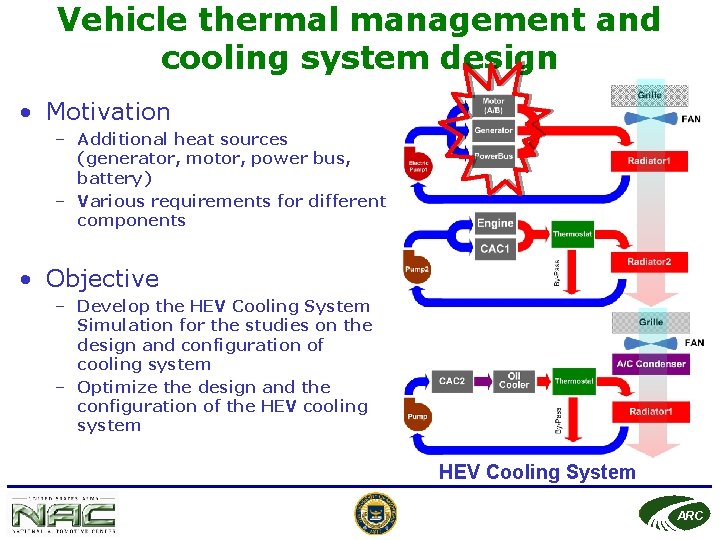
Vehicle thermal management and cooling system design • Motivation – Additional heat sources (generator, motor, power bus, battery) – Various requirements for different components • Objective – Develop the HEV Cooling System Simulation for the studies on the design and configuration of cooling system – Optimize the design and the configuration of the HEV cooling system Conventional Cooling System HEV Cooling System ARC
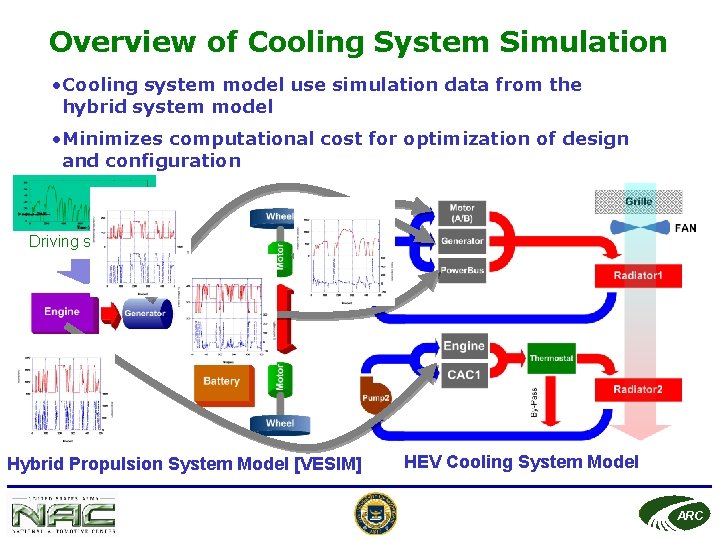
Overview of Cooling System Simulation • Cooling system model use simulation data from the hybrid system model • Minimizes computational cost for optimization of design and configuration Driving schedule Hybrid Propulsion System Model [VESIM] HEV Cooling System Model ARC
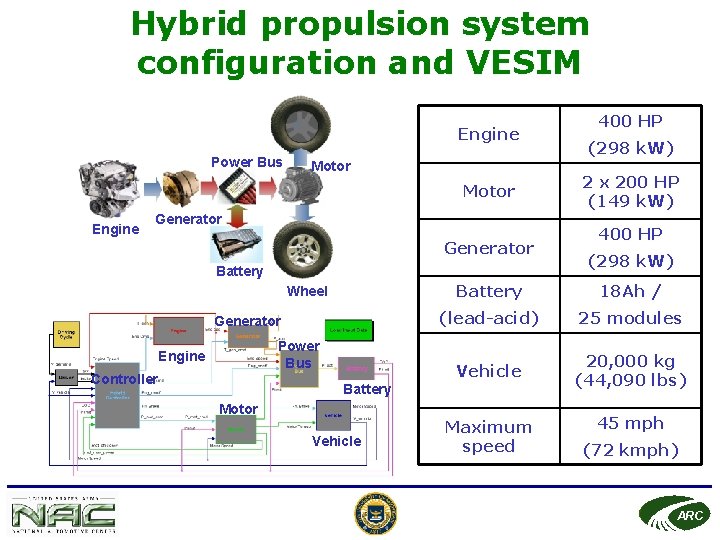
Hybrid propulsion system configuration and VESIM Engine Power Bus Motor Engine Generator Battery Wheel Generator Power Bus Engine Controller Vehicle (298 k. W) 2 x 200 HP (149 k. W) 400 HP (298 k. W) Battery 18 Ah / (lead-acid) 25 modules Vehicle 20, 000 kg (44, 090 lbs) Battery Motor 400 HP Maximum speed 45 mph (72 kmph) ARC
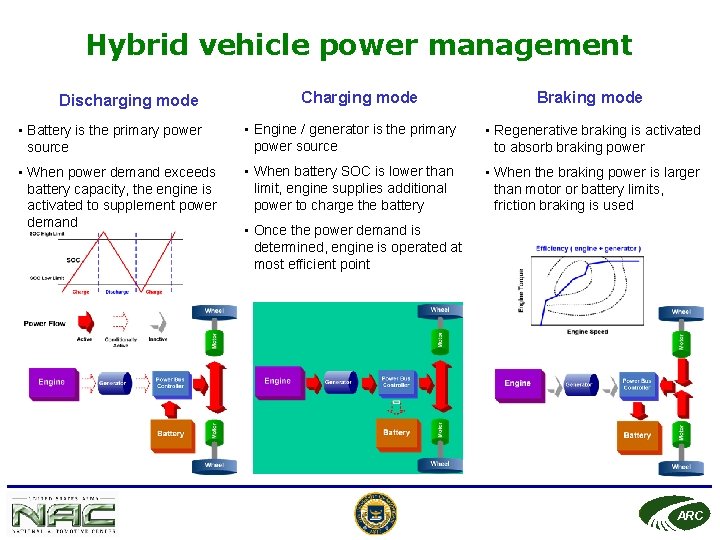
Hybrid vehicle power management Discharging mode Charging mode Braking mode • Battery is the primary power source • Engine / generator is the primary power source • Regenerative braking is activated to absorb braking power • When power demand exceeds battery capacity, the engine is activated to supplement power demand • When battery SOC is lower than limit, engine supplies additional power to charge the battery • When the braking power is larger than motor or battery limits, friction braking is used • Once the power demand is determined, engine is operated at most efficient point ARC
![Vehicle simulation model [VESIM] Vehicle driving cycle Cycle simulation results ( engine / generator](http://slidetodoc.com/presentation_image_h2/42a477daee864216f29e4e51bec6dc90/image-7.jpg "Vehicle simulation model [VESIM] Vehicle driving cycle Cycle simulation results ( engine / generator")
Vehicle simulation model [VESIM] Vehicle driving cycle Cycle simulation results ( engine / generator / motor / battery) Engine Speed Generator Speed Motor Speed Engine BMEP Generator Torque Motor Torque Battery SOC ARC
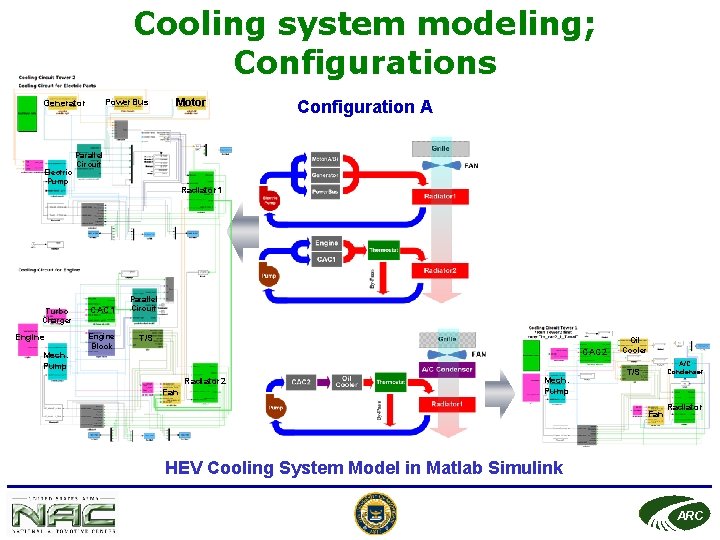
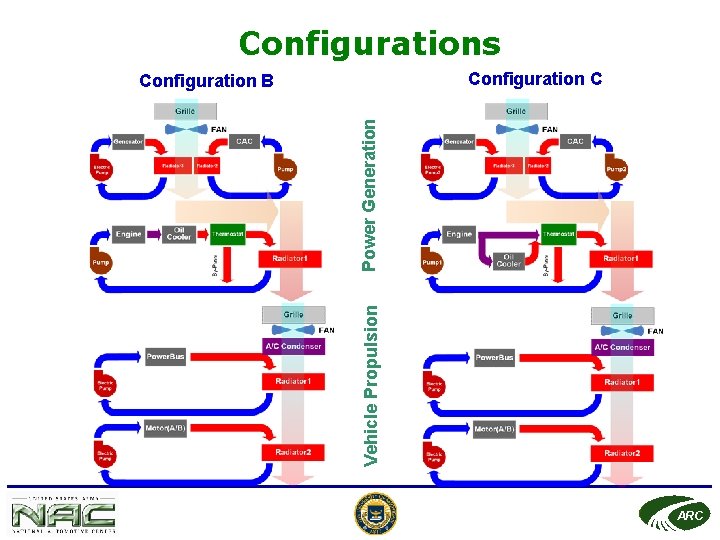
Cooling system modeling; Configurations Power. Bus Generator Electric Pump Turbo Charger Engine Mech. Pump Motor Configuration A Parallel Circuit Radiator 1 CAC 1 Engine Block Parallel Circuit T/S CAC 2 Radiator 2 Fan Mech. Pump Oil Cooler A/C Condenser T/S Fan Radiator HEV Cooling System Model in Matlab Simulink ARC
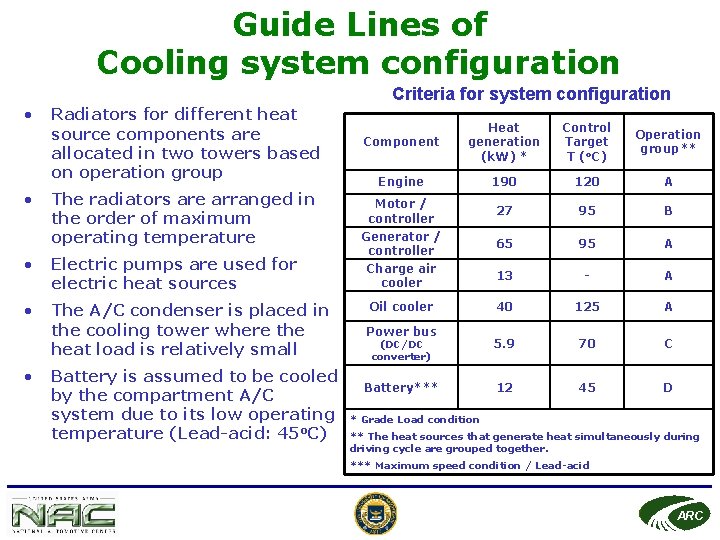
Guide Lines of Cooling system configuration Criteria for system configuration • • Radiators for different heat source components are allocated in two towers based on operation group The radiators are arranged in the order of maximum operating temperature • Electric pumps are used for electric heat sources • The A/C condenser is placed in the cooling tower where the heat load is relatively small • Battery is assumed to be cooled by the compartment A/C system due to its low operating temperature (Lead-acid: 45 o. C) Component Heat generation (k. W) * Control Target T (o. C) Operation group** Engine 190 120 A Motor / controller 27 95 B 65 95 A 13 - A 40 125 A (DC/DC converter) 5. 9 70 C Battery*** 12 45 D Generator / controller Charge air cooler Oil cooler Power bus * Grade Load condition ** The heat sources that generate heat simultaneously during driving cycle are grouped together. *** Maximum speed condition / Lead-acid ARC
Configurations Configuration C Vehicle Propulsion Power Generation Configuration B ARC
Modeling Approach Component Approach Implementation Heat Exchanger Thermal resistance concept 2 -D FDM Fortran (S-Function) Pump Performance data-based model Matlab/Simulink Cooling fan Performance data-based model Fortran (S-Function) Thermostat Modeled by a pair of valves Fortran (S-Function) Engine Map-based performance model Matlab/Simulink Engine block Lumped thermal mass model Matlab/Simulink Generator Lumped thermal mass model Matlab/Simulink Power bus Lumped thermal mass model Matlab/Simulink Motor Lumped thermal mass model Matlab/Simulink Oil cooler Heat exchanger model (NTU method) Matlab/Simulink Turbocharger Map-based performance model Matlab/Simulink Condenser Heat addition model Matlab/Simulink Charge air cooler Thermal resistance concept 2 -D FDM Fortran (S-Function) ARC
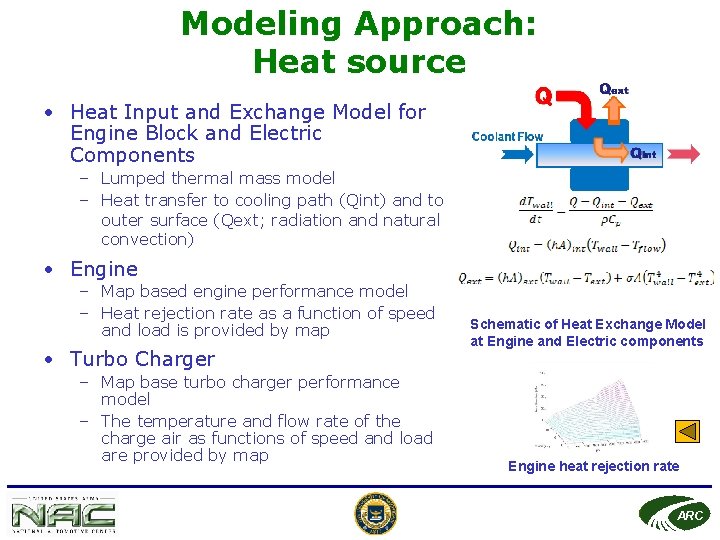
Modeling Approach: Heat source • Heat Input and Exchange Model for Engine Block and Electric Components – Lumped thermal mass model – Heat transfer to cooling path (Qint) and to outer surface (Qext; radiation and natural convection) • Engine – Map based engine performance model – Heat rejection rate as a function of speed and load is provided by map • Turbo Charger – Map base turbo charger performance model – The temperature and flow rate of the charge air as functions of speed and load are provided by map Schematic of Heat Exchange Model at Engine and Electric components Engine heat rejection rate ARC
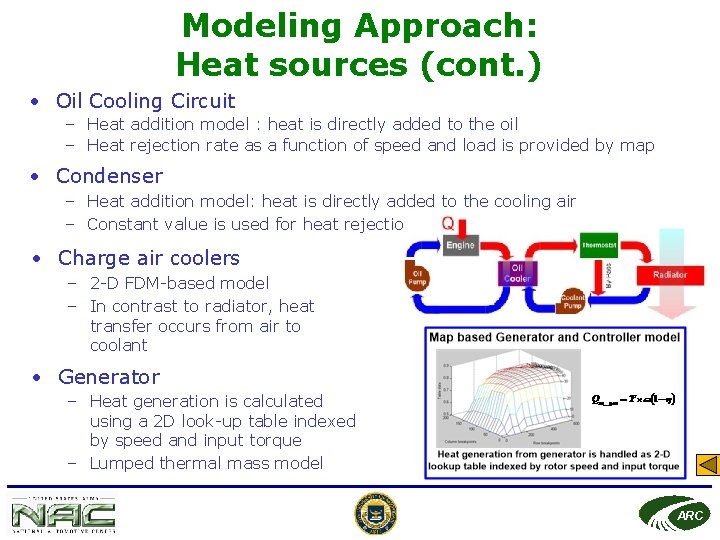
Modeling Approach: Heat sources (cont. ) • Oil Cooling Circuit – Heat addition model : heat is directly added to the oil – Heat rejection rate as a function of speed and load is provided by map • Condenser – Heat addition model: heat is directly added to the cooling air – Constant value is used for heat rejection rate • Charge air coolers – 2 -D FDM-based model – In contrast to radiator, heat transfer occurs from air to coolant • Generator – Heat generation is calculated using a 2 D look-up table indexed by speed and input torque – Lumped thermal mass model ARC
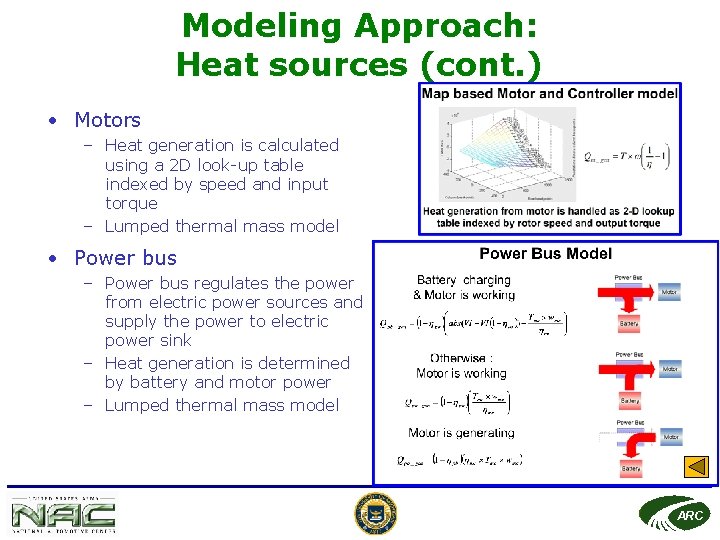
Modeling Approach: Heat sources (cont. ) • Motors – Heat generation is calculated using a 2 D look-up table indexed by speed and input torque – Lumped thermal mass model • Power bus – Power bus regulates the power from electric power sources and supply the power to electric power sink – Heat generation is determined by battery and motor power – Lumped thermal mass model ARC
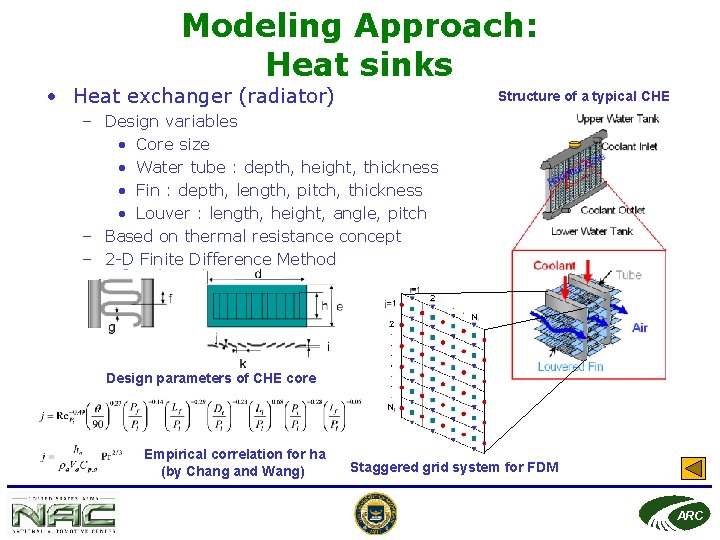
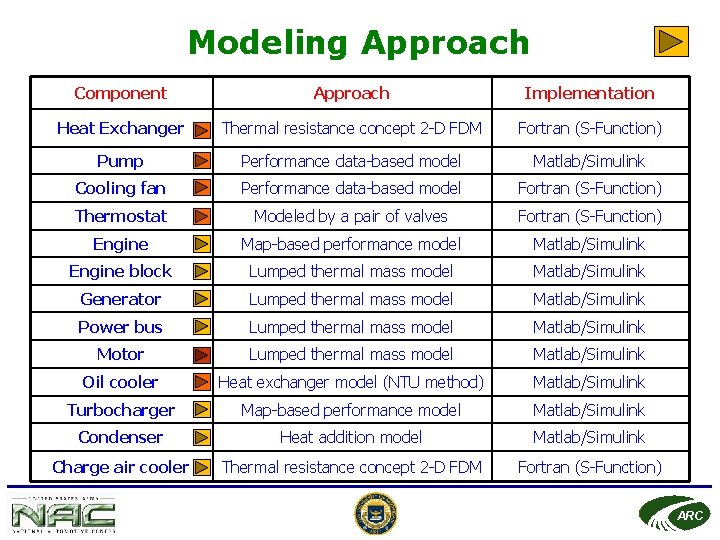
Modeling Approach: Heat sinks • Heat exchanger (radiator) Structure of a typical CHE – Design variables • Core size • Water tube : depth, height, thickness • Fin : depth, length, pitch, thickness • Louver : length, height, angle, pitch – Based on thermal resistance concept – 2 -D Finite Difference Method Design parameters of CHE core Empirical correlation for ha (by Chang and Wang) Staggered grid system for FDM ARC
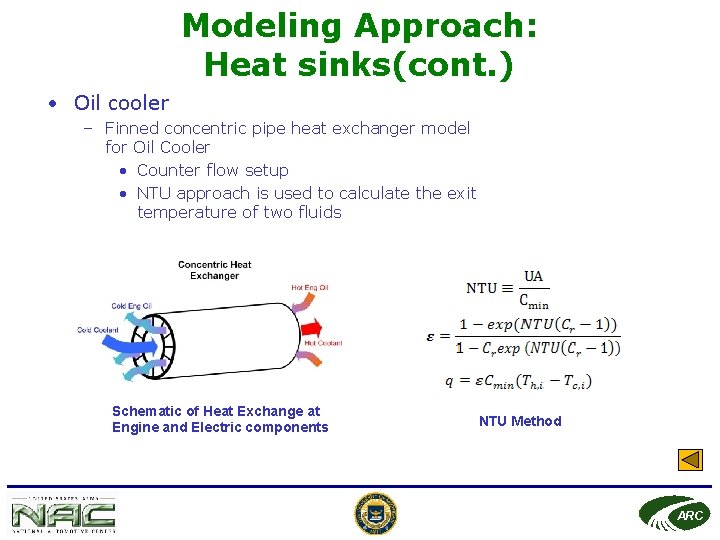
Modeling Approach: Heat sinks(cont. ) • Oil cooler – Finned concentric pipe heat exchanger model for Oil Cooler • Counter flow setup • NTU approach is used to calculate the exit temperature of two fluids Schematic of Heat Exchange at Engine and Electric components NTU Method ARC
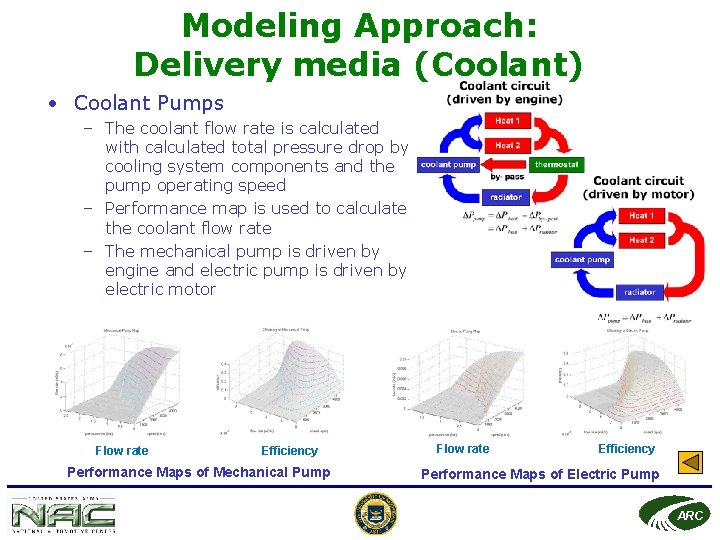
Modeling Approach: Delivery media (Coolant) • Coolant Pumps – The coolant flow rate is calculated with calculated total pressure drop by cooling system components and the pump operating speed – Performance map is used to calculate the coolant flow rate – The mechanical pump is driven by engine and electric pump is driven by electric motor Flow rate Efficiency Performance Maps of Mechanical Pump Flow rate Efficiency Performance Maps of Electric Pump ARC
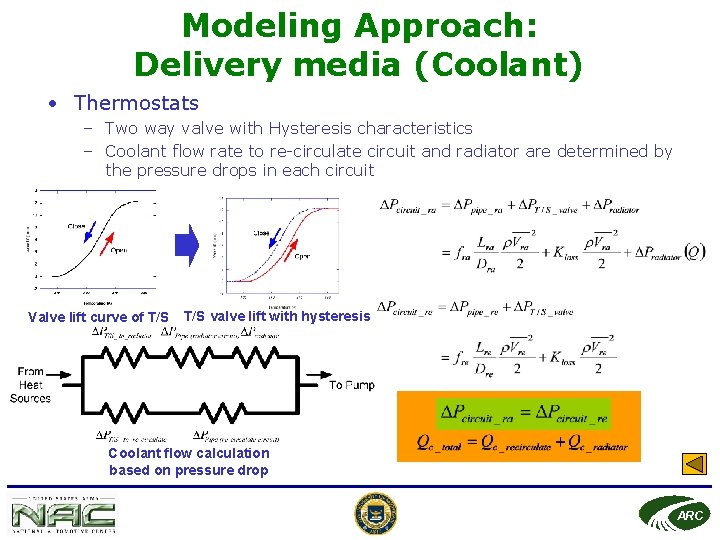
Modeling Approach: Delivery media (Coolant) • Thermostats – Two way valve with Hysteresis characteristics – Coolant flow rate to re-circulate circuit and radiator are determined by the pressure drops in each circuit Valve lift curve of T/S valve lift with hysteresis Coolant flow calculation based on pressure drop ARC
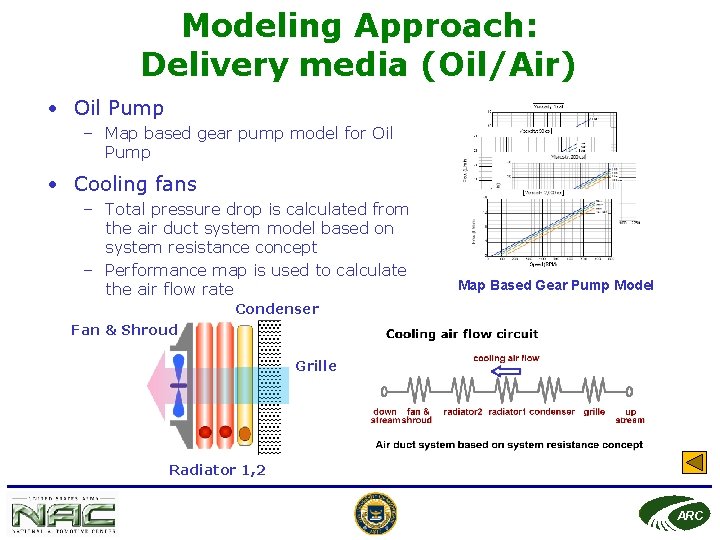
Modeling Approach: Delivery media (Oil/Air) • Oil Pump – Map based gear pump model for Oil Pump • Cooling fans – Total pressure drop is calculated from the air duct system model based on system resistance concept – Performance map is used to calculate the air flow rate Map Based Gear Pump Model Condenser Fan & Shroud Grille Radiator 1, 2 ARC
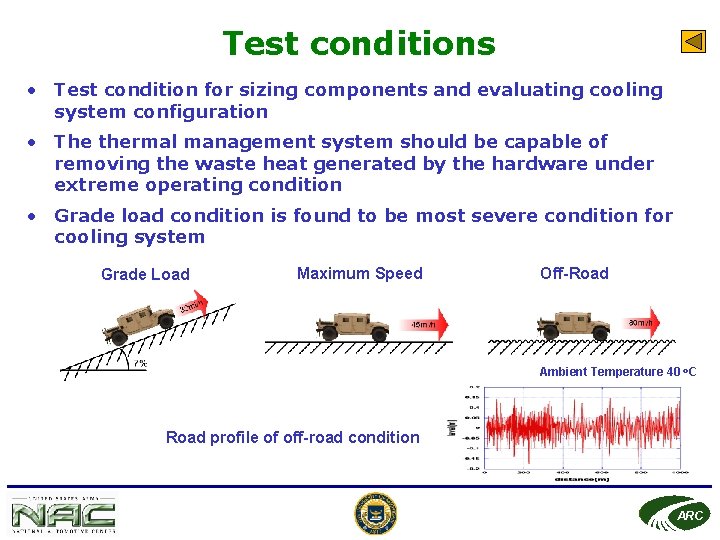
Test conditions • Test condition for sizing components and evaluating cooling system configuration • The thermal management system should be capable of removing the waste heat generated by the hardware under extreme operating condition • Grade load condition is found to be most severe condition for cooling system Grade Load Maximum Speed Off-Road Ambient Temperature 40 o. C Road profile of off-road condition ARC

Configuration test; Grade Load (30 MPH, 7 %) Engine Speed Engine BMEP Battery SOC Grade Load Max. SOC: 0. 7 Min. SOC: 0. 6 Initial SOC: 0. 6 ARC
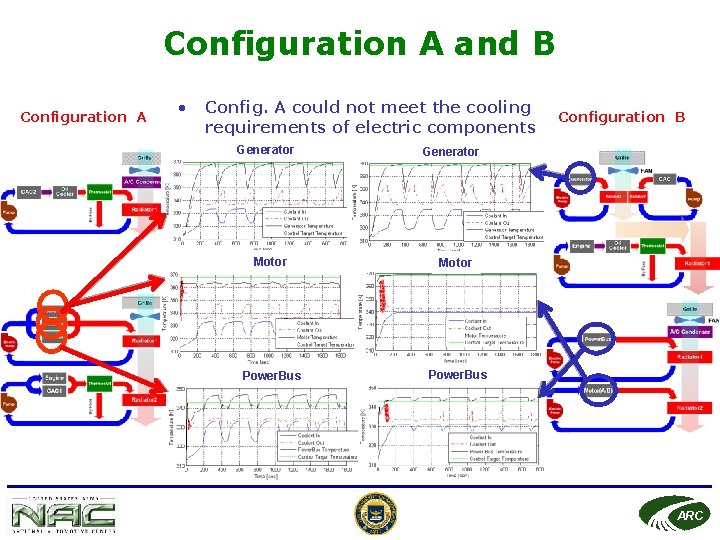
Configuration A and B Configuration A • Config. A could not meet the cooling requirements of electric components Generator Configuration B Generator Motor Power. Bus ARC
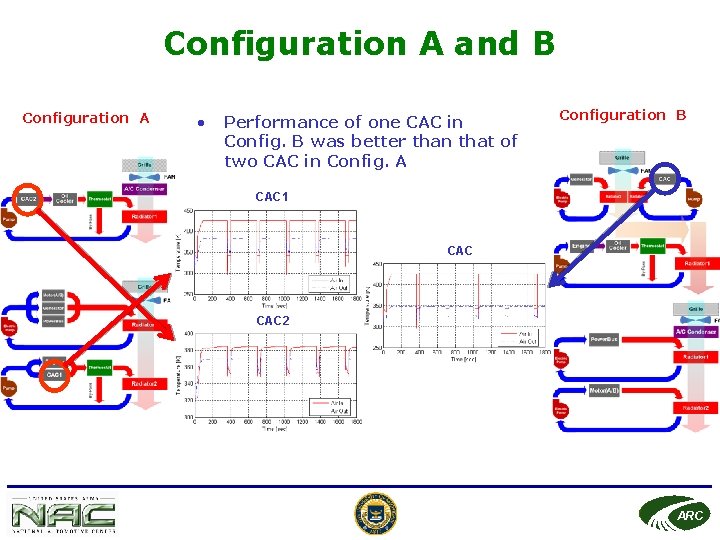
Configuration A and B Configuration A • Performance of one CAC in Config. B was better than that of two CAC in Config. A Configuration B CAC 1 CAC 2 ARC
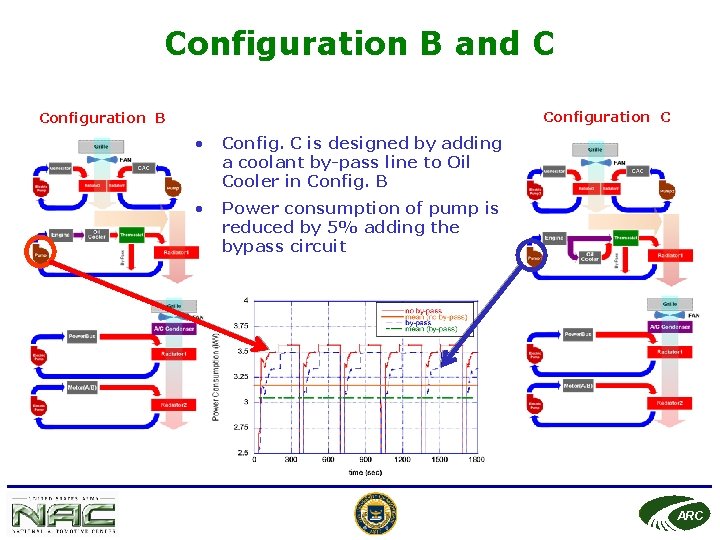
Configuration B and C Configuration B • Config. C is designed by adding a coolant by-pass line to Oil Cooler in Config. B • Power consumption of pump is reduced by 5% adding the bypass circuit ARC
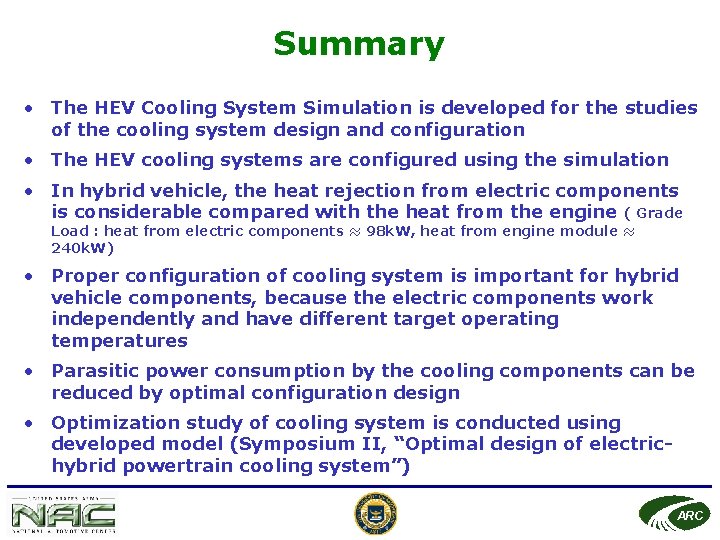
Summary • The HEV Cooling System Simulation is developed for the studies of the cooling system design and configuration • The HEV cooling systems are configured using the simulation • In hybrid vehicle, the heat rejection from electric components is considerable compared with the heat from the engine ( Grade Load : heat from electric components ≈ 98 k. W, heat from engine module ≈ 240 k. W) • Proper configuration of cooling system is important for hybrid vehicle components, because the electric components work independently and have different target operating temperatures • Parasitic power consumption by the cooling components can be reduced by optimal configuration design • Optimization study of cooling system is conducted using developed model (Symposium II, “Optimal design of electrichybrid powertrain cooling system”) ARC

Acknowledgement • General Dynamics, Land Systems (GDLS) ARC

Thank you! ARC
- Slides: 27