
Simulations We become ourselves through others Lev Vygotsky
Simulations “We become ourselves through others” Lev Vygotsky
Simulation When it is impossible to study concepts of interest in “real time”, or when the risks are considered sufficiently high to require demonstration of competence in a controlled, relatively risk-free environment, simulation that we need. Simulations approximate, replicate, or emulate the features of some task, setting or context.
Instructional Simulation It is a realistic setting in which students üare presented with a problem. ü execute a sequence of inquiries, decisions, and actions ü receive information about the ways in which the situation evolves and changes in response to their actions.
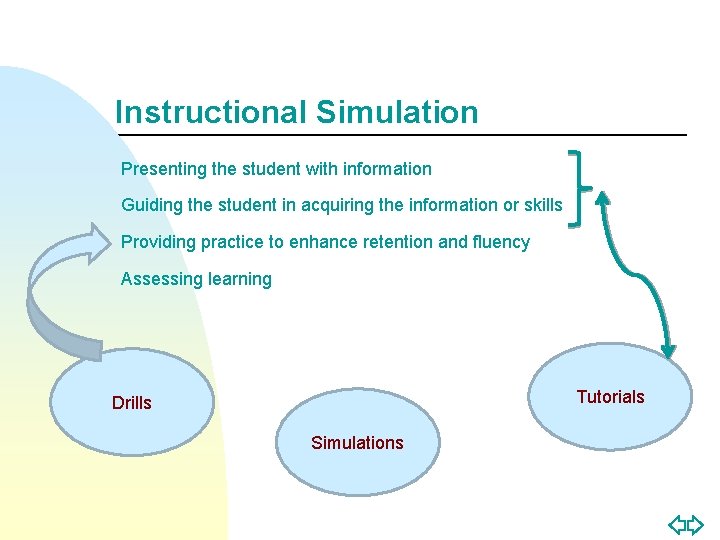
Instructional Simulation Presenting the student with information Guiding the student in acquiring the information or skills Providing practice to enhance retention and fluency Assessing learning Tutorials Drills Simulations
Instructional Simulation About simulations Physical Process How to simulations Procedural Situational
Characteristics of Effective Instructional Simulation ü provide a scenario or set of events, ü provide clear options for students participation, ü provide a range of plausible consequences for students responses to the scenarios ü provide guidance for completion of the scenarios. ü have fidelity of the images. ü increase thinking power. ü stimulate student to have a clear expectation of the anticipated consequences of the response.
Instructional Simulation: Cognitive Structure ü Make simulations perceptually appropriate for the level students have reached. ü Present only the essential system. ü Use adequate detail. ü Make simulation logical. ü Make simulation inherently meaningful.
Instructional Simulation: Cognitive and Metacognitive Strategies ü Encourage strategies other than “practice” or “rehearsal”. ü Promote examination and employment of existing knowledge. ü Support knowledge-refinement processes.
Instructional Simulation: Automaticity of Cognitive processes ü Encourage active rather than passive participation. ü Structure difficulty so as to ensure consistent success. ü Strive for relative stress free conditions.
Instructional Simulation: Affect ü Provide clear goal. ü Provide certain outcomes. ü Satisfy and sustain curiosity
Instructional Simulation ü open a window for difficult to understand problems, cases and abstract concepts by bringing them closer to the students’ mind. USE EXISTING SIMULATION TO CLARIFY AND MAKE UNDERSTANDABLE THE RULES, THEORIES ETC.
Examples
Exercise in Lab 1. Model a dynamic system on the Excel about the topic “Function” Note: Define a model for a real-world case and make connection between its parts and some other components.
- Slides: 13